Ovarian Hyperstimulation Syndrome  Presented by AHMED WALID ANWAR,M.D Lecturer of Obstetrics and Gynecology  Benha Faculty of Medicine Egypt 2008
Definition: It is a syndrome characterized   by:   variable degree of ovarian enlargement and/or ascites, pleural effusion, oliguria, hemoconcentration, thromboemolism, and electrolyte disturbances which may be life threatening.
*  It occurs  : -Commonly as an iatrogenic complication of  ovulation induction .   -Rarely may complicate normal pregnancy.   * Incidence:  - Mild OHSS ; 8  –  23%.  -  Severe OHSS : 3.5-8%  IN IVF STIMULATED CYCLES
Risk factors: (1)Patient characters :  OHSS common with:  a-  Younger cases. b-  Cases with lower body weight. c-  Anovulatory cases with menstrual disorders,  normal endogenous GnH, and estrogen . d-  Previous history of OHSS. 2) PCO:   about 50% of OHSS cases have PCO, only 6% of severe degree.
3) Ovarian stimulation drugs : a)GnRH: i-  GnRH/hMG protocol :   increase the incidence of OHSS from  0.6%  to up to  6.6% of moderate and severe grades. Tins may be due to: •  A direct effect of GnRH on the ovary. •  Prevention of premature luteinization allows many follicles to grow to a considerable size .  •  The increased pregnancy rate and rate of multiple pregnancy. •  Increased exogenous GnH. •  The "flare up" effect of GnRH on GnH. ii-  Pulsatile use of GnRH :   associated with mild OHSS.
3) Ovarian stimulation drugs : b) Human menopausal gonadotrophin:  OHSS is reported in up to 23% of cases (FSH+LH). c) Pure FSH:  OHSS is reported to be lower in these cases. d) Clomid:  mild degree occur in 13.5%. the incidence is increased when  combined  with hMG.
Risk factors: 4) Method of administration of hMG/hCG : It was suggested that fixed schedule is associated with higher rate of OHSS. 5) Luteal phase support :   risk increased with HCG and decreased with progesterone. 6) Conception cycles :   3-4 times more risk for OHSS (longer course and severer in grade)
Pathogenesis: The initial pathophysiological event   in severe cases is increased capillary permeability specially  from the enlarged ovaries leading to extravasation of fluid into the abdominal cavity causing:   1-Asctes.  2-Hemoconcentration.  3-Hypotension.  4-Decreased renal perfusion which leads to sodium  and water retentions .  N.B :  Renal failure may occur in the final stage due to sever volume depletion.
The suggested mediators for increased capillary permeability are: 1)Estrogen:   2) Prostaglandins :   3) Histamine 4) Prolactin: 5) Renin-angiotensin: 6) Cytokines: 7) Vascular endothelial growth factor (VEGF):
Pathogenesis: N.B :  It was suggested that haemodynamic  changes are due to : peripheral arteriolar dilatation leading to hypotension, tachycardia, and renal hypoperfusion. However   this hypothesis did not explain hemoconcentrstion commonly found in sever OHSS.
Benefits of mild OHSS: 1- Allow stimulation of more synchronous follicles. 2- Multiple mature oocytes can be fertilized. 3- Proper endometrial development - support implantation. 4- Low cycle cancellation
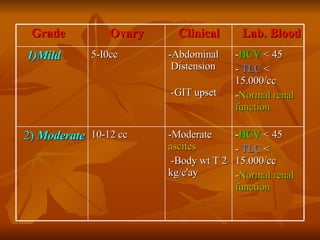
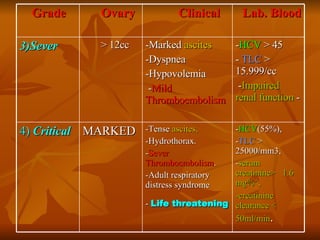
Recent classification of OHSS  ( Jenkins&Mathur,1998 )  1)Mild.   2)Moderate.   3)Severe. 4)Critical.
Lab. Blood Clinical  Ovary Grade  - HCV  < 45 -  TLC  < 15.000/cc - Normal renal function   -Abdominal  Distension  -GIT upset  5-I0cc  1)Mild  - HCV  < 45 -  TLC  < 15.000/cc - Normal renal function   -Moderate  ascites -Body wt T 2 kg/c'ay  10-12 cc  2)  Moderate
Lab. Blood Clinical  Ovary Grade  - HCV  > 45 -  TLC  > 15.999/cc - Impaired renal function  - -Marked  ascites -Dyspnea -Hypovolemia - Mild Thromboembolism   > 12cc  3)Sever   - HCV (55%),  - TLC  > 25000/mm3, - serum creatinine>  1.6 mg%^,  -creatinine clearance < 50ml/min .  -Tense  ascites,   -Hydrothorax.  - Sever Thrombocmbolism .  -Adult respiratory distress syndrome -  Life threatening   MARKED  4)  Critical
Complications of OHSS:
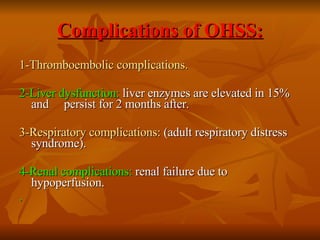
Complications of OHSS: 1-Thromboembolic complications. 2-Liver dysfunction:  liver enzymes are elevated in 15% and  persist for 2 months after.  3-Respiratory complications:  (adult respiratory distress  syndrome). 4-Renal complications:  renal failure due to hypoperfusion. .
Complications of OHSS: 5-Adnexal torsion: due  to enlargement, however laparoscopic  unwinding is successful. 6-Internal hemorrhage. 7 - Abortion rate:  Increased form 30% to 50% in OHSS stimulated cycles after matching the maternal age.
Complications of OHSS: 8-Congenital malformation:   Increased incidence   due to  abnormal steroid levels, abnormal body  homeostasis and drugs used in treating the case ,  however  there is increasing evidence reporting no association . 9- OHSS and ovarian cancer:  The relation was suggested by some authors but with no general  acceptance
Prevention of OHSS : ( Most important line of treatment ).   HOW???
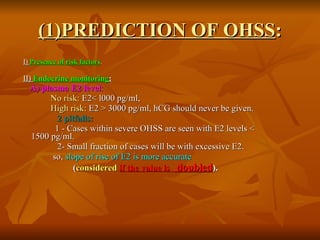
(1)PREDICTION OF OHSS : I)  Presence of risk factors . II)  Endocrine monitoring : A) plasma E2 level : No risk:  E2< l000 pg/ml, High risk:  E2 > 3000 pg/ml, hCG should never be given. 2 pitfalls: 1 - Cases within severe OHSS are seen with E2 levels <  1500 pg/ml. 2- Small fraction of cases will be with excessive E2. so,  slope of rise of E2 is more accurate   ( considered   if the value is  doubled ).
(1)PREDICTION OF OHSS : II)  Endocrine monitoring :   B) Urinary E3 glucuronyl  > 200 ug/24hrs are dangerous, Disadvantages:  1- Retrospective (take 24h). 2- Affected by body weight. 3- Difficulties and errors in urine collection.  C)   VEGF IS RECENTLY STUDIED AS A PRIDICTOR OF OHSS.
(1)PREDICTION OF OHSS : Ill)  Follicular monitoring by U/S: *It was suggested that the number of the immature follicles is more important than the number of mature follicles in predicting OHSS. *No risk when immature follicles are < 15. IV)  Color Doppler :  under trial.
(1)PREDICTION OF OHSS : Conclusions: It is concluded that combined E2 plasma level ± slope of rise + U/S folliculometry are accurate combination for : -Predicting OHSS and in, -Determining the optimum time and  safety for giving hCG.
(2) Modified Stimulation Protocols: A)  Modification of HMG administration: 1- HMG Coasting:  withhold hMG and continued GnRHa in cases with E2 levels > 6000 pg/ml till it reaches < 3000 pg/ml then 10000 IU of HCG was administered. 2- Titration of HMG or FHS dose in cases with PCOS:  after GnRh desensitization start GnH with one ampoule to be increased by 1/2 ampoule gradualy  {Small dose setup protocol in PCOS patients}.
(2) Modified Stimulation Protocols: B)  GnRh analogue: 1-  Using GnRH agonist  { Treptorelien   0.2 mg} to trigger ovulation instead of hCG:  the drug can be used to trigger endogenous LH  ( flare up effect )  to effect ovulation in cases with high risk for development of OHSS. N.B:  This method cannot be used in cycles where pituitary desensitization was performed with continuous GnRH agonist.  2-Using  GnRH agonist pump. 3- Using GnRH antagonists:  delay LH surge 6-7 days.
(2) Modified Stimulation Protocols: C)  Modification of HCG administration: 1- Withhold HCG administration:  Don't completely prevent OHSS as endogenous LH is also  involved. 2- Lower HCG doses  (2000 1U). 3-  Delaying HCG administration:  studies are deficient and of nonconstant results.  D)  Luteal phase support:  use of progesterone, no HCG.
(3) Modified techniques: 1 -  Follicular aspiration :   it was suggested that aspiration of the follicles is protective against OHSS since. However, Aboulghar et al (1992) found no protective effect of such method . 2-  Cryopreservation  of embryo   with subsequent replacement in non stimulated or natural cycle.   3-  Selective oocyte retrieva l in spontaneous conception cycles:  This is done by puncturing most  of the  ovarian follicles 35 hrs after hCG administration as in IVF programs, prevent OHSS as well as  multiple pregnancy.
4) Adjuvant: 1   - Intravenous albumin administration ;   why ?: a) Albumin can sequestrate any vasoactive substance   released  from  corpora  lutea or produced in the course of the  disease  (1/2 life of albumin =10-15 day).  b) Due to its oncotic power , it serves to maintain intravascular  volume and prevent ascites, hypovolemia and  hemoconcentration.
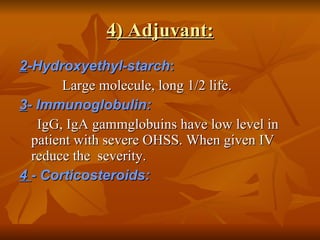
4) Adjuvant: 2 -Hydroxyethyl-starch :   Large molecule, long 1/2 life. 3 - Immunoglobulin: IgG, IgA gammglobuins have low level in patient with severe OHSS. When given IV reduce the  severity. 4  - Corticosteroids:
Management of OHSS   HOW ? ? ?
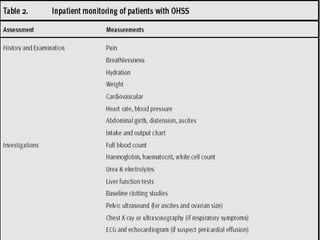
*DIAGNOSIS: a)  History taking. b) Examination:   (local, chest, abdomen, and for TE).  c) Investigations.
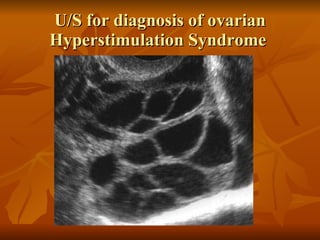
U/S for diagnosis of ovarian Hyperstimulation Syndrome
*Treatment A- Mild cases:  Spontaneous recovery within 2-3 Wk (conservative measures and follow up) B- Moderate and severe cases : 1-General treatment:   a- Hospitalization and reassurance .  b- Observations; (ICU)
 
2- Medical treatment : a-  Circulation and electrolytes:   •   Preserve the intravascular volume and renal perfusion. •   Done using colloid plasma expanders or human albumin, (effect is temporary) •   Sodium and water restriction (non effective). b- Symptomatic treatment: -Analgesia :  paracetamol and opoids.  -Antiemetics:  metoclopramid.
2- Medical treatment : c- Prevent TE{ Thromboembolism } through:   - Anticoagulant therapy:  only with: •   Clinical evidence of thromboembolic complications. •   Laboratory Evidence :hypercoagulability. -Mechanical methods .
2- Medical treatment : d-  Antihistamines:  was suggested to cause stabilization of capillary membrane.  e-  Dopamine:  in oliguric cases to improve perfusion and avoid renal failure. f-  Methotrexate:  treatment of associated ectopic pregnancy to avoid surgery.
AVOID: 1- Anti-PG :  disturb renal function. 2- Danazol:   ineffective. 3- Diuretics:   used only in pulmonary edema.  NEVER   to use  Diuretics  before  proper intravascular volume replacement  to  avoid further renal hypoperfusion
3) Aspiration of ascetic fluid or pleural effusion: * Method: - Paracentesis or transvaginal aspiration under U/S guidance.  -The amount of aspirate ranges from 200-1400 ml/session. *Advantages: •   Improvement of respiration . •   Decrease abdominal discomfort.. •   Increase venous return and COP. •   Increase urine output and createnine clearance reflecting improving renal functions .
3) Aspiration of ascetic fluid or pleural effusion: *Disadvantages: •   Temporary effect: Recollection causes discomfort needs 3-5 days. •   Loss of large amounts of proteins (25-69g/L), so protein replacement should be effected. •   Injury of the enlarged ovaries (avoided by U/S guide). •   Introduction of infection (so use strict aseptic conditions).
4)Surgical treatment: * Indications of surgery in severe OHSS: a- Signs of intraperitoneal Hemorrhage  and/or rupture of ovarian cyst. b- Adnexal torsion. c- Associated ectopic pregnancy .
4)Surgical treatment: * Types of surgery: a- Laparoscopy:  the ideal surgical method through which all procedures can be done. b- Laparotomy:  should always be avoided and if deemed necessary, measures are done to preserve (Ovary)
Thank you E.MAIL :: [email_address]

Ovarian Hyperstimulation Syndrome

  • 1.
    Ovarian Hyperstimulation Syndrome Presented by AHMED WALID ANWAR,M.D Lecturer of Obstetrics and Gynecology Benha Faculty of Medicine Egypt 2008
  • 2.
    Definition: It isa syndrome characterized by: variable degree of ovarian enlargement and/or ascites, pleural effusion, oliguria, hemoconcentration, thromboemolism, and electrolyte disturbances which may be life threatening.
  • 3.
    * Itoccurs : -Commonly as an iatrogenic complication of ovulation induction . -Rarely may complicate normal pregnancy. * Incidence: - Mild OHSS ; 8 – 23%. - Severe OHSS : 3.5-8% IN IVF STIMULATED CYCLES
  • 4.
    Risk factors: (1)Patientcharacters : OHSS common with: a- Younger cases. b- Cases with lower body weight. c- Anovulatory cases with menstrual disorders, normal endogenous GnH, and estrogen . d- Previous history of OHSS. 2) PCO: about 50% of OHSS cases have PCO, only 6% of severe degree.
  • 5.
    3) Ovarian stimulationdrugs : a)GnRH: i- GnRH/hMG protocol : increase the incidence of OHSS from 0.6% to up to 6.6% of moderate and severe grades. Tins may be due to: • A direct effect of GnRH on the ovary. • Prevention of premature luteinization allows many follicles to grow to a considerable size . • The increased pregnancy rate and rate of multiple pregnancy. • Increased exogenous GnH. • The &quot;flare up&quot; effect of GnRH on GnH. ii- Pulsatile use of GnRH : associated with mild OHSS.
  • 6.
    3) Ovarian stimulationdrugs : b) Human menopausal gonadotrophin: OHSS is reported in up to 23% of cases (FSH+LH). c) Pure FSH: OHSS is reported to be lower in these cases. d) Clomid: mild degree occur in 13.5%. the incidence is increased when combined with hMG.
  • 7.
    Risk factors: 4)Method of administration of hMG/hCG : It was suggested that fixed schedule is associated with higher rate of OHSS. 5) Luteal phase support : risk increased with HCG and decreased with progesterone. 6) Conception cycles : 3-4 times more risk for OHSS (longer course and severer in grade)
  • 8.
    Pathogenesis: The initialpathophysiological event in severe cases is increased capillary permeability specially from the enlarged ovaries leading to extravasation of fluid into the abdominal cavity causing: 1-Asctes. 2-Hemoconcentration. 3-Hypotension. 4-Decreased renal perfusion which leads to sodium and water retentions . N.B : Renal failure may occur in the final stage due to sever volume depletion.
  • 9.
    The suggested mediatorsfor increased capillary permeability are: 1)Estrogen: 2) Prostaglandins : 3) Histamine 4) Prolactin: 5) Renin-angiotensin: 6) Cytokines: 7) Vascular endothelial growth factor (VEGF):
  • 10.
    Pathogenesis: N.B : It was suggested that haemodynamic changes are due to : peripheral arteriolar dilatation leading to hypotension, tachycardia, and renal hypoperfusion. However this hypothesis did not explain hemoconcentrstion commonly found in sever OHSS.
  • 11.
    Benefits of mildOHSS: 1- Allow stimulation of more synchronous follicles. 2- Multiple mature oocytes can be fertilized. 3- Proper endometrial development - support implantation. 4- Low cycle cancellation
  • 12.
    Recent classification ofOHSS ( Jenkins&Mathur,1998 ) 1)Mild. 2)Moderate. 3)Severe. 4)Critical.
  • 13.
    Lab. Blood Clinical Ovary Grade - HCV < 45 - TLC < 15.000/cc - Normal renal function -Abdominal Distension -GIT upset 5-I0cc 1)Mild - HCV < 45 - TLC < 15.000/cc - Normal renal function -Moderate ascites -Body wt T 2 kg/c'ay 10-12 cc 2) Moderate
  • 14.
    Lab. Blood Clinical Ovary Grade - HCV > 45 - TLC > 15.999/cc - Impaired renal function - -Marked ascites -Dyspnea -Hypovolemia - Mild Thromboembolism > 12cc 3)Sever - HCV (55%), - TLC > 25000/mm3, - serum creatinine> 1.6 mg%^, -creatinine clearance < 50ml/min . -Tense ascites, -Hydrothorax. - Sever Thrombocmbolism . -Adult respiratory distress syndrome - Life threatening MARKED 4) Critical
  • 15.
  • 16.
    Complications of OHSS:1-Thromboembolic complications. 2-Liver dysfunction: liver enzymes are elevated in 15% and persist for 2 months after. 3-Respiratory complications: (adult respiratory distress syndrome). 4-Renal complications: renal failure due to hypoperfusion. .
  • 17.
    Complications of OHSS:5-Adnexal torsion: due to enlargement, however laparoscopic unwinding is successful. 6-Internal hemorrhage. 7 - Abortion rate: Increased form 30% to 50% in OHSS stimulated cycles after matching the maternal age.
  • 18.
    Complications of OHSS:8-Congenital malformation: Increased incidence due to abnormal steroid levels, abnormal body homeostasis and drugs used in treating the case , however there is increasing evidence reporting no association . 9- OHSS and ovarian cancer: The relation was suggested by some authors but with no general acceptance
  • 19.
    Prevention of OHSS: ( Most important line of treatment ). HOW???
  • 20.
    (1)PREDICTION OF OHSS: I) Presence of risk factors . II) Endocrine monitoring : A) plasma E2 level : No risk: E2< l000 pg/ml, High risk: E2 > 3000 pg/ml, hCG should never be given. 2 pitfalls: 1 - Cases within severe OHSS are seen with E2 levels < 1500 pg/ml. 2- Small fraction of cases will be with excessive E2. so, slope of rise of E2 is more accurate ( considered if the value is doubled ).
  • 21.
    (1)PREDICTION OF OHSS: II) Endocrine monitoring : B) Urinary E3 glucuronyl > 200 ug/24hrs are dangerous, Disadvantages: 1- Retrospective (take 24h). 2- Affected by body weight. 3- Difficulties and errors in urine collection. C) VEGF IS RECENTLY STUDIED AS A PRIDICTOR OF OHSS.
  • 22.
    (1)PREDICTION OF OHSS: Ill) Follicular monitoring by U/S: *It was suggested that the number of the immature follicles is more important than the number of mature follicles in predicting OHSS. *No risk when immature follicles are < 15. IV) Color Doppler : under trial.
  • 23.
    (1)PREDICTION OF OHSS: Conclusions: It is concluded that combined E2 plasma level ± slope of rise + U/S folliculometry are accurate combination for : -Predicting OHSS and in, -Determining the optimum time and safety for giving hCG.
  • 24.
    (2) Modified StimulationProtocols: A) Modification of HMG administration: 1- HMG Coasting: withhold hMG and continued GnRHa in cases with E2 levels > 6000 pg/ml till it reaches < 3000 pg/ml then 10000 IU of HCG was administered. 2- Titration of HMG or FHS dose in cases with PCOS: after GnRh desensitization start GnH with one ampoule to be increased by 1/2 ampoule gradualy {Small dose setup protocol in PCOS patients}.
  • 25.
    (2) Modified StimulationProtocols: B) GnRh analogue: 1- Using GnRH agonist { Treptorelien 0.2 mg} to trigger ovulation instead of hCG: the drug can be used to trigger endogenous LH ( flare up effect ) to effect ovulation in cases with high risk for development of OHSS. N.B: This method cannot be used in cycles where pituitary desensitization was performed with continuous GnRH agonist. 2-Using GnRH agonist pump. 3- Using GnRH antagonists: delay LH surge 6-7 days.
  • 26.
    (2) Modified StimulationProtocols: C) Modification of HCG administration: 1- Withhold HCG administration: Don't completely prevent OHSS as endogenous LH is also involved. 2- Lower HCG doses (2000 1U). 3- Delaying HCG administration: studies are deficient and of nonconstant results. D) Luteal phase support: use of progesterone, no HCG.
  • 27.
    (3) Modified techniques:1 - Follicular aspiration : it was suggested that aspiration of the follicles is protective against OHSS since. However, Aboulghar et al (1992) found no protective effect of such method . 2- Cryopreservation of embryo with subsequent replacement in non stimulated or natural cycle. 3- Selective oocyte retrieva l in spontaneous conception cycles: This is done by puncturing most of the ovarian follicles 35 hrs after hCG administration as in IVF programs, prevent OHSS as well as multiple pregnancy.
  • 28.
    4) Adjuvant: 1 - Intravenous albumin administration ; why ?: a) Albumin can sequestrate any vasoactive substance released from corpora lutea or produced in the course of the disease (1/2 life of albumin =10-15 day). b) Due to its oncotic power , it serves to maintain intravascular volume and prevent ascites, hypovolemia and hemoconcentration.
  • 29.
    4) Adjuvant: 2-Hydroxyethyl-starch : Large molecule, long 1/2 life. 3 - Immunoglobulin: IgG, IgA gammglobuins have low level in patient with severe OHSS. When given IV reduce the severity. 4 - Corticosteroids:
  • 30.
  • 31.
    *DIAGNOSIS: a) History taking. b) Examination: (local, chest, abdomen, and for TE). c) Investigations.
  • 32.
    U/S for diagnosisof ovarian Hyperstimulation Syndrome
  • 33.
    *Treatment A- Mildcases: Spontaneous recovery within 2-3 Wk (conservative measures and follow up) B- Moderate and severe cases : 1-General treatment: a- Hospitalization and reassurance . b- Observations; (ICU)
  • 34.
  • 35.
    2- Medical treatment: a- Circulation and electrolytes: • Preserve the intravascular volume and renal perfusion. • Done using colloid plasma expanders or human albumin, (effect is temporary) • Sodium and water restriction (non effective). b- Symptomatic treatment: -Analgesia : paracetamol and opoids. -Antiemetics: metoclopramid.
  • 36.
    2- Medical treatment: c- Prevent TE{ Thromboembolism } through: - Anticoagulant therapy: only with: • Clinical evidence of thromboembolic complications. • Laboratory Evidence :hypercoagulability. -Mechanical methods .
  • 37.
    2- Medical treatment: d- Antihistamines: was suggested to cause stabilization of capillary membrane. e- Dopamine: in oliguric cases to improve perfusion and avoid renal failure. f- Methotrexate: treatment of associated ectopic pregnancy to avoid surgery.
  • 38.
    AVOID: 1- Anti-PG: disturb renal function. 2- Danazol: ineffective. 3- Diuretics: used only in pulmonary edema. NEVER to use Diuretics before proper intravascular volume replacement to avoid further renal hypoperfusion
  • 39.
    3) Aspiration ofascetic fluid or pleural effusion: * Method: - Paracentesis or transvaginal aspiration under U/S guidance. -The amount of aspirate ranges from 200-1400 ml/session. *Advantages: • Improvement of respiration . • Decrease abdominal discomfort.. • Increase venous return and COP. • Increase urine output and createnine clearance reflecting improving renal functions .
  • 40.
    3) Aspiration ofascetic fluid or pleural effusion: *Disadvantages: • Temporary effect: Recollection causes discomfort needs 3-5 days. • Loss of large amounts of proteins (25-69g/L), so protein replacement should be effected. • Injury of the enlarged ovaries (avoided by U/S guide). • Introduction of infection (so use strict aseptic conditions).
  • 41.
    4)Surgical treatment: *Indications of surgery in severe OHSS: a- Signs of intraperitoneal Hemorrhage and/or rupture of ovarian cyst. b- Adnexal torsion. c- Associated ectopic pregnancy .
  • 42.
    4)Surgical treatment: *Types of surgery: a- Laparoscopy: the ideal surgical method through which all procedures can be done. b- Laparotomy: should always be avoided and if deemed necessary, measures are done to preserve (Ovary)
  • 43.
    Thank you E.MAIL:: [email_address]