BASIC NOTIONS: LANGUAGE
VARIATION AND LEVELS
SCHNEIDER
AMNA FAYYAZ
CONTENTS
• Language variation
• Levels of language (variation)
• Language change and language contact
• Categorizing World Englishes
LANGUAGE VARIATION
• Group Specific Thing
• There are equivalent ways of saying the same thing, and none of them is inherently
superior to or worse than any other. It’s just that they work for those who share the
same speech habits or internalized knowledge, and they may cause difficulty to
outsiders of a speech community. Speaking the same dialect means using the same
coding system about how to get one’s thoughts and meanings mapped onto
sounds, and that needs to be done in a systematic, regular, predictable Basic
notions fashion shared by all other speakers of the same dialect – otherwise
communication wouldn’t work
VARIETY
• The neutral term that has come to be used normally for such group specific
language forms is “a variety.
• Variety means any set of language habits that is shared by a certain group of
speakers for use in certain contexts constitutes such a variety
LANGUAGE VARIATION THROUGH SOCIOLINGUISTIC
PARAMETERS
• Linguists nowadays emphasize the fact that languages vary, and they do so
systematically, correlating with so-called “sociolinguistic parameters” like a
speaker’s regional origin, gender, age, or status, or the context of situation.
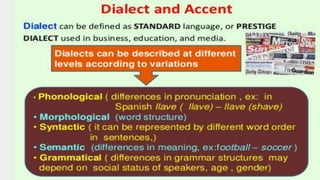
• Dialect
• “dialect,” which also denotes a language form associated with a certain group of
people but is usually associated with a given region (hence a “regional dialect”) or a
social class or group (a “social dialect”)
REGISTER AND ACCENT
Register
• “register” refers to stylistically defined language varieties associated with certain
channels (such as spoken or written) or situational contexts (e.g. letter writing,
texting, or giving a political speech).
Accent
The notion of “accent” relates to pronunciation only, but otherwise conforms largely to
the reference of “dialect”
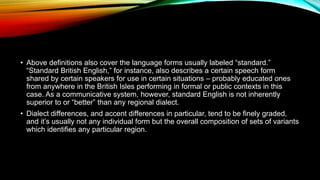
• Above definitions also cover the language forms usually labeled “standard.”
“Standard British English,” for instance, also describes a certain speech form
shared by certain speakers for use in certain situations – probably educated ones
from anywhere in the British Isles performing in formal or public contexts in this
case. As a communicative system, however, standard English is not inherently
superior to or “better” than any regional dialect.
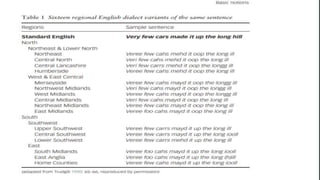
• Dialect differences, and accent differences in particular, tend to be finely graded,
and it’s usually not any individual form but the overall composition of sets of variants
which identifies any particular region.
LEVELS OF LANGUAGE
VARIATION
• Language changes after every ten miles. Language varies at three Levels
• Pronunciation
• Grammar
• Vocabulary
PHONETIC LEVEL
• Speaking first and foremost means producing sounds with one’s articulatory organs
in the oral cavity. Hence, phonetics describes how the air stream coming from the
lungs is modulated and given its meaningful shape by the lips, the teeth, the tongue,
the nose, etc. Some of these movements are minute, and produce the finely graded
sound distinctions which we associate with “an accent” – but these differences can
be described and systematized.
PHONOLOGY
• Abstracting from such minimal distinctions, all languages use a limited set of sounds
which can be identified and which they use systematically in building their words,
the “phonemes,” the units of phonology, the second way of looking at pronunciation
differences. Phonetics deals with all possible human sounds and their articulation,
including minimal distinctions; phonology investigates language-specific sound
systems.
LEXICAL VARIATION
• Lexical variation, word choice, and usage, needs little discussion, I suppose –
everybody knows that people from different dialectal regions or countries have
words of their own.
SYNTACTIC AND GRAMMAR
VARIATION
• On the level of syntax (or “grammar”), the way we combine words to form
constructions and sentences, though it is there as well. Which words or constituents
in a language or variety may or may not follow each other, and with which effect, is
a much more complicated matter than we may think, and the rules as to how to do
what with which words vary more or less subtly
LEVELS OF LANGUAGE
VARIATION
LEVELS OF LANGUAGE
VARIATION
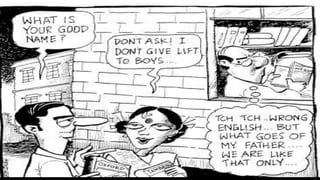
• . There are always many different ways of saying the same thing, and the choice of
any individual form of expression depends upon a speaker’s background, the
context of situation. This is “language variation,”.

Basic notions; language variation and levels

  • 1.
    BASIC NOTIONS: LANGUAGE VARIATIONAND LEVELS SCHNEIDER AMNA FAYYAZ
  • 2.
    CONTENTS • Language variation •Levels of language (variation) • Language change and language contact • Categorizing World Englishes
  • 4.
    LANGUAGE VARIATION • GroupSpecific Thing • There are equivalent ways of saying the same thing, and none of them is inherently superior to or worse than any other. It’s just that they work for those who share the same speech habits or internalized knowledge, and they may cause difficulty to outsiders of a speech community. Speaking the same dialect means using the same coding system about how to get one’s thoughts and meanings mapped onto sounds, and that needs to be done in a systematic, regular, predictable Basic notions fashion shared by all other speakers of the same dialect – otherwise communication wouldn’t work
  • 5.
    VARIETY • The neutralterm that has come to be used normally for such group specific language forms is “a variety. • Variety means any set of language habits that is shared by a certain group of speakers for use in certain contexts constitutes such a variety
  • 6.
    LANGUAGE VARIATION THROUGHSOCIOLINGUISTIC PARAMETERS • Linguists nowadays emphasize the fact that languages vary, and they do so systematically, correlating with so-called “sociolinguistic parameters” like a speaker’s regional origin, gender, age, or status, or the context of situation. • Dialect • “dialect,” which also denotes a language form associated with a certain group of people but is usually associated with a given region (hence a “regional dialect”) or a social class or group (a “social dialect”)
  • 8.
    REGISTER AND ACCENT Register •“register” refers to stylistically defined language varieties associated with certain channels (such as spoken or written) or situational contexts (e.g. letter writing, texting, or giving a political speech). Accent The notion of “accent” relates to pronunciation only, but otherwise conforms largely to the reference of “dialect”
  • 9.
    • Above definitionsalso cover the language forms usually labeled “standard.” “Standard British English,” for instance, also describes a certain speech form shared by certain speakers for use in certain situations – probably educated ones from anywhere in the British Isles performing in formal or public contexts in this case. As a communicative system, however, standard English is not inherently superior to or “better” than any regional dialect. • Dialect differences, and accent differences in particular, tend to be finely graded, and it’s usually not any individual form but the overall composition of sets of variants which identifies any particular region.
  • 11.
    LEVELS OF LANGUAGE VARIATION •Language changes after every ten miles. Language varies at three Levels • Pronunciation • Grammar • Vocabulary
  • 12.
    PHONETIC LEVEL • Speakingfirst and foremost means producing sounds with one’s articulatory organs in the oral cavity. Hence, phonetics describes how the air stream coming from the lungs is modulated and given its meaningful shape by the lips, the teeth, the tongue, the nose, etc. Some of these movements are minute, and produce the finely graded sound distinctions which we associate with “an accent” – but these differences can be described and systematized.
  • 13.
    PHONOLOGY • Abstracting fromsuch minimal distinctions, all languages use a limited set of sounds which can be identified and which they use systematically in building their words, the “phonemes,” the units of phonology, the second way of looking at pronunciation differences. Phonetics deals with all possible human sounds and their articulation, including minimal distinctions; phonology investigates language-specific sound systems.
  • 14.
    LEXICAL VARIATION • Lexicalvariation, word choice, and usage, needs little discussion, I suppose – everybody knows that people from different dialectal regions or countries have words of their own.
  • 15.
    SYNTACTIC AND GRAMMAR VARIATION •On the level of syntax (or “grammar”), the way we combine words to form constructions and sentences, though it is there as well. Which words or constituents in a language or variety may or may not follow each other, and with which effect, is a much more complicated matter than we may think, and the rules as to how to do what with which words vary more or less subtly
  • 16.
  • 17.
    LEVELS OF LANGUAGE VARIATION •. There are always many different ways of saying the same thing, and the choice of any individual form of expression depends upon a speaker’s background, the context of situation. This is “language variation,”.