SOCIOLINGUISTIC
(Introduction to Linguistics)
(Level-3)
THE TERM OF SOCIOLINGUISTIC
A term sociolinguistics is a derivational word. Two
words that form it are sociology and linguistics.
 Sociology refers to a science of society; and
 linguistics refers to a science of human language.
DEFINITION OF SOCIOLINGUISTIC
Sociolinguistics is the study of the relationship between language and
society.
 It explains how people speak differently in different social contexts.
 It discusses the social functions of language and the ways it is used
to convey social meaning.
 It provides a lot of information about the language functions, as well
as social relationships in a community, and the way people signal
aspects of their social identity through their language.
Other Definitions of Sociolinguistics
 The study that is concerned with investigating the relationship between language and
society with the goal of a better understanding of the structure of language and of how
languages function in communication ( Wardhaugh, 1986 : 12)
 The study of the characteristics of language varieties, the characteristics of their
functions, and the characteristics of their speakers as these three constantly interact,
change and change one another within a speech community (Fishman 1972:4)
 The part of linguistics which is concerned with language as a social and cultural
phenomenon. It investigates the field of language and society & has close connections
with the social sciences, especially social psychology, anthropology, human geography
and sociology (Trudgill 1974: 32)
STANDARD AND NON-STANDARD LANGUAGE
Standard language is a variety of language that is used by governments (or official
language), in the media, in schools and for international communication. There are
different standard varieties of English in the world, such as North American English,
Australian English and Indian English.
In contrast, there are non-standard forms of language that are used, for example, in
different regional dialects and these non-standard varieties are different from each other.
LANGUAGE VARIATION
Definition:
 The term linguistic variation (or simply variation) refers to regional, social, or contextual
differences in the ways that a particular language is used.
 Variation between languages, dialects, and speakers is known as interspeaker variation.
Variation within the language of a single speaker is called intraspeaker variation.
 In this chapter:
1- LANGUAGE VARIATION: FOCUS ON USERS
2- LANGUAGE VARIATION: FOCUS ON USE
LANGUAGE VARIATION: FOCUS ON USERS
1- Idiolect
 Idiolect is the language variation that is individual in nature. It has his own language
variation or his own idiolect.
 Idiolect variation is concerning with the colors of voice, choice of words, language
style, sentence order, etc.
 The colors of voice is the most dominant aspect in language variation, because
we can recognize someone just by listening to voice without seeing the person.
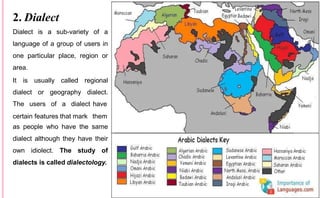
2. Dialect
Dialect is a sub-variety of a
language of a group of users in
one particular place, region or
area.
It is usually called regional
dialect or geography dialect.
The users of a dialect have
certain features that mark them
as people who have the same
dialect although they have their
own idiolect. The study of
dialects is called dialectology.
3. Sociolect (Social dialect)
 Social dialects are the language that reflects the groupings of people that is based
on similar social and economic factors.
 A person’s dialect reflects his social background. It also based on age, social
strata etc.
4. Temporal dialect
 It means the language variation that is used by a certain social group in particular
time.
 For example, in the development of English. English had began from the Old
English in the year of 600 to 1100, the Middle English in the year of 1100 to 1450,
the Early Modern English in the year of 1450 to 1700 until the Modern English in
the year of 1700 up to now.
LANGUAGE VARIATION: FOCUS ON USES
1. Style:
According to Janet Holmes, 2001 the definitions of style are:
a. Style is language variation which reflects changes in
situational factors, such as addressee, setting, task or topic.
b. Style is often analyzed along scale of formality.
c. The level of formality is influenced by some factors like the
various differences among the participants, topic, emotional,
involvement, etc.
2. Register
Holmes (2001:246) states that it refers to the language of groups of people with
common interests or jobs, or specific situations.
The different registers can be seen in the language used by legalist, auctioneers, race-
callers, sports commentator, airline pilots, criminals, financiers, politicians, disc jockeys,
in the courtroom and the classroom, journalist.
Language of journalism (journalistic) has specific characteristics, it is simple,
communicative and brief. The language is simple because it has to be understood
easily, communicative because it has to deliver news appropriately, and brief because of
the limited space (in printed media) and limited time (in electronic media).
OTHER LANGUAGE VARIATION
 Accent
Accent is the way of pronunciation particular to a speaker of
group. All languages are spoken with several different
accents. There is nothing unusual about English, and not
everyone who comes from the same place speaks in the
same. In any place there is a variety of accent. For example:
Britis (United Kingdom) and American (United States)
 Bilingualism and multilingualism
The use of language in a situation of bilingualism and/or
multilingualism often involves the problems of who speaks,
what language, to whom and when.
Bilingualism is an individual’s ability to use two language
variety. Individual bilingualism use of more that one
languages or competence in more that one languages.
While multilingualism is an individual’s ability to use many
languages.
 Lingua Franca
Lingua franca is language of wider community, is used as a means
of communication among the speakers of other languages. It is
called bridge language, or vehicular language in certain place with
many different speaker and language.
For example: English as international language in the world.
 Pidgin and Creole
Pidgin is basically contact language. They envolve between
in different culture who speak different languages and need
some way of communicating with each other to carry out trade
or work. The vocabularies are mix structure as the
consequence of mixing two culture.
Example: Traders communicate with the tourist
Creole is pidgin which has run long time so that the structure
and the vovabularies become better and better. It also used by
new generation.
 Code Switching and Code Mixing
Code- Switching is switching the situation from one code to another.
If a speaker firstly uses code A (for example Arabic Language) then
she/he changes the code to code B (English Language).
Code Mixing is used when the speaker mix two language or use both
language together to in single utterance.

Sociolinguistic Introduction

  • 1.
  • 2.
    THE TERM OFSOCIOLINGUISTIC A term sociolinguistics is a derivational word. Two words that form it are sociology and linguistics.  Sociology refers to a science of society; and  linguistics refers to a science of human language.
  • 3.
    DEFINITION OF SOCIOLINGUISTIC Sociolinguisticsis the study of the relationship between language and society.  It explains how people speak differently in different social contexts.  It discusses the social functions of language and the ways it is used to convey social meaning.  It provides a lot of information about the language functions, as well as social relationships in a community, and the way people signal aspects of their social identity through their language.
  • 4.
    Other Definitions ofSociolinguistics  The study that is concerned with investigating the relationship between language and society with the goal of a better understanding of the structure of language and of how languages function in communication ( Wardhaugh, 1986 : 12)  The study of the characteristics of language varieties, the characteristics of their functions, and the characteristics of their speakers as these three constantly interact, change and change one another within a speech community (Fishman 1972:4)  The part of linguistics which is concerned with language as a social and cultural phenomenon. It investigates the field of language and society & has close connections with the social sciences, especially social psychology, anthropology, human geography and sociology (Trudgill 1974: 32)
  • 5.
    STANDARD AND NON-STANDARDLANGUAGE Standard language is a variety of language that is used by governments (or official language), in the media, in schools and for international communication. There are different standard varieties of English in the world, such as North American English, Australian English and Indian English. In contrast, there are non-standard forms of language that are used, for example, in different regional dialects and these non-standard varieties are different from each other.
  • 6.
    LANGUAGE VARIATION Definition:  Theterm linguistic variation (or simply variation) refers to regional, social, or contextual differences in the ways that a particular language is used.  Variation between languages, dialects, and speakers is known as interspeaker variation. Variation within the language of a single speaker is called intraspeaker variation.  In this chapter: 1- LANGUAGE VARIATION: FOCUS ON USERS 2- LANGUAGE VARIATION: FOCUS ON USE
  • 7.
    LANGUAGE VARIATION: FOCUSON USERS 1- Idiolect  Idiolect is the language variation that is individual in nature. It has his own language variation or his own idiolect.  Idiolect variation is concerning with the colors of voice, choice of words, language style, sentence order, etc.  The colors of voice is the most dominant aspect in language variation, because we can recognize someone just by listening to voice without seeing the person.
  • 8.
    2. Dialect Dialect isa sub-variety of a language of a group of users in one particular place, region or area. It is usually called regional dialect or geography dialect. The users of a dialect have certain features that mark them as people who have the same dialect although they have their own idiolect. The study of dialects is called dialectology.
  • 9.
    3. Sociolect (Socialdialect)  Social dialects are the language that reflects the groupings of people that is based on similar social and economic factors.  A person’s dialect reflects his social background. It also based on age, social strata etc. 4. Temporal dialect  It means the language variation that is used by a certain social group in particular time.  For example, in the development of English. English had began from the Old English in the year of 600 to 1100, the Middle English in the year of 1100 to 1450, the Early Modern English in the year of 1450 to 1700 until the Modern English in the year of 1700 up to now.
  • 10.
    LANGUAGE VARIATION: FOCUSON USES 1. Style: According to Janet Holmes, 2001 the definitions of style are: a. Style is language variation which reflects changes in situational factors, such as addressee, setting, task or topic. b. Style is often analyzed along scale of formality. c. The level of formality is influenced by some factors like the various differences among the participants, topic, emotional, involvement, etc.
  • 11.
    2. Register Holmes (2001:246)states that it refers to the language of groups of people with common interests or jobs, or specific situations. The different registers can be seen in the language used by legalist, auctioneers, race- callers, sports commentator, airline pilots, criminals, financiers, politicians, disc jockeys, in the courtroom and the classroom, journalist. Language of journalism (journalistic) has specific characteristics, it is simple, communicative and brief. The language is simple because it has to be understood easily, communicative because it has to deliver news appropriately, and brief because of the limited space (in printed media) and limited time (in electronic media).
  • 12.
    OTHER LANGUAGE VARIATION Accent Accent is the way of pronunciation particular to a speaker of group. All languages are spoken with several different accents. There is nothing unusual about English, and not everyone who comes from the same place speaks in the same. In any place there is a variety of accent. For example: Britis (United Kingdom) and American (United States)
  • 13.
     Bilingualism andmultilingualism The use of language in a situation of bilingualism and/or multilingualism often involves the problems of who speaks, what language, to whom and when. Bilingualism is an individual’s ability to use two language variety. Individual bilingualism use of more that one languages or competence in more that one languages. While multilingualism is an individual’s ability to use many languages.
  • 14.
     Lingua Franca Linguafranca is language of wider community, is used as a means of communication among the speakers of other languages. It is called bridge language, or vehicular language in certain place with many different speaker and language. For example: English as international language in the world.
  • 15.
     Pidgin andCreole Pidgin is basically contact language. They envolve between in different culture who speak different languages and need some way of communicating with each other to carry out trade or work. The vocabularies are mix structure as the consequence of mixing two culture. Example: Traders communicate with the tourist Creole is pidgin which has run long time so that the structure and the vovabularies become better and better. It also used by new generation.
  • 16.
     Code Switchingand Code Mixing Code- Switching is switching the situation from one code to another. If a speaker firstly uses code A (for example Arabic Language) then she/he changes the code to code B (English Language). Code Mixing is used when the speaker mix two language or use both language together to in single utterance.