Direct Method
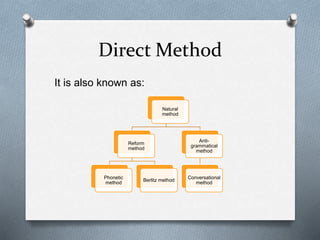
It is also known as:
Natural
method
Reform
method
Phonetic
method
Berlitz method
Anti-
grammatical
method
Conversational
method
Background of Direct method
O The principle advocates were Pendergast and
Sauveur, who proposed what they called ‘Natural
method’, that suggested radical change from
‘Grammar translation method.’ This ‘Natural
method’ is now called ‘Direct method.’
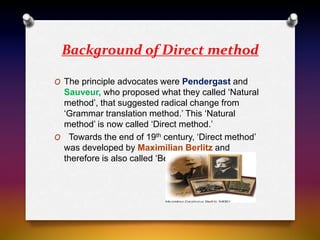
O Towards the end of 19th century, ‘Direct method’
was developed by Maximilian Berlitz and
therefore is also called ‘Berlitz method.’
Background of Direct method
O One source might be Passy’s 1899
publication “De La methode directe danc
l’enseigment des langues vivantes.”
O Those who pioneered direct method were
from ‘Reform School’ and were
‘Phoneticians’ the same people who
founded the ‘Phonetic Teachers’
Association in 1886 and the ‘International
Phonetic Association’ in 1897.
O Direct method places stress on oral ability
and teaching the language ‘directly’ rather
than ‘about it.’
O According to this method:
“Meaning should be connected directly
with the target language without
translation into the native language.”
Meaning
Target
language
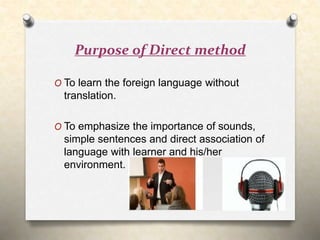
Purpose of Direct method
O To learn the foreign language without
translation.
O To emphasize the importance of sounds,
simple sentences and direct association of
language with learner and his/her
environment.
(1)Use everyday vocabulary and
structure.
(2)Teach grammar inducvtively and by
situation.
(3)Teach orally grammar and vocabulary.
(4)Teach concrete meanings through
pictures, objects etc and abstract
meanings through association of ideas.
(5)Emphasize correct pronunciation.
(1)Never translate: demonstrate.
(2)Never make a speech: ask questions.
(3)Never speak with single words: use
sentences.
(4)Never use the book: use your lesson
plan.
(5)Never jump around: follow your plan.
(6)Never speak too much: make student
speak much.
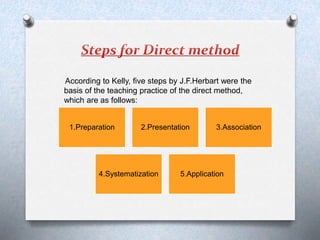
According to Kelly, five steps by J.F.Herbart were the
basis of the teaching practice of the direct method,
which are as follows:
1.Preparation 2.Presentation 3.Association
4.Systematization 5.Application
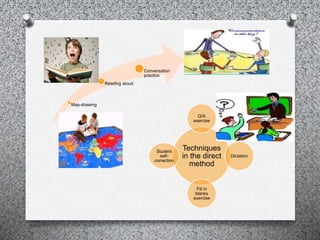
Techniques
in the direct
method
Q/A
exercise
Dictation
Fill in
blanks
exercise
Student
self-
correction
Map-drawing
Reading aloud
Conversation
practice
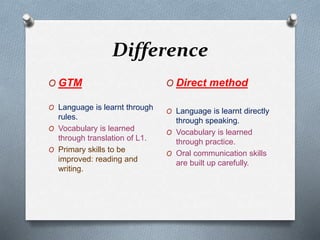
Difference
O GTM
O Language is learnt through
rules.
O Vocabulary is learned
through translation of L1.
O Primary skills to be
improved: reading and
writing.
O Direct method
O Language is learnt directly
through speaking.
O Vocabulary is learned
through practice.
O Oral communication skills
are built up carefully.
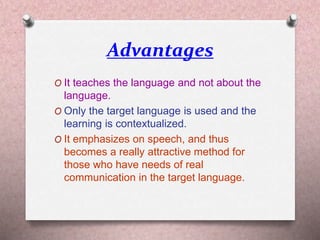
Advantages
O It teaches the language and not about the
language.
O Only the target language is used and the
learning is contextualized.
O It emphasizes on speech, and thus
becomes a really attractive method for
those who have needs of real
communication in the target language.
Drawbacks of ‘Direct method’
O It required teachers who were native
speakers or who had native like fluency in
the foreign language.
O It was largely dependent on teacher skills,
rather than on a textbook.
O This method demanded more time.
O it was hard for public schools to integrate
it.
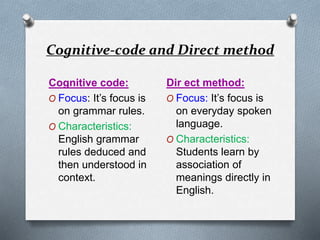
Cognitive-code and Direct method
Cognitive code:
O Focus: It’s focus is
on grammar rules.
O Characteristics:
English grammar
rules deduced and
then understood in
context.
Dir ect method:
O Focus: It’s focus is
on everyday spoken
language.
O Characteristics:
Students learn by
association of
meanings directly in
English.
Direct method in applied linguistics

Direct method in applied linguistics

  • 2.
    Direct Method It isalso known as: Natural method Reform method Phonetic method Berlitz method Anti- grammatical method Conversational method
  • 3.
    Background of Directmethod O The principle advocates were Pendergast and Sauveur, who proposed what they called ‘Natural method’, that suggested radical change from ‘Grammar translation method.’ This ‘Natural method’ is now called ‘Direct method.’ O Towards the end of 19th century, ‘Direct method’ was developed by Maximilian Berlitz and therefore is also called ‘Berlitz method.’
  • 4.
    Background of Directmethod O One source might be Passy’s 1899 publication “De La methode directe danc l’enseigment des langues vivantes.” O Those who pioneered direct method were from ‘Reform School’ and were ‘Phoneticians’ the same people who founded the ‘Phonetic Teachers’ Association in 1886 and the ‘International Phonetic Association’ in 1897.
  • 5.
    O Direct methodplaces stress on oral ability and teaching the language ‘directly’ rather than ‘about it.’ O According to this method: “Meaning should be connected directly with the target language without translation into the native language.” Meaning Target language
  • 6.
    Purpose of Directmethod O To learn the foreign language without translation. O To emphasize the importance of sounds, simple sentences and direct association of language with learner and his/her environment.
  • 7.
    (1)Use everyday vocabularyand structure. (2)Teach grammar inducvtively and by situation. (3)Teach orally grammar and vocabulary. (4)Teach concrete meanings through pictures, objects etc and abstract meanings through association of ideas. (5)Emphasize correct pronunciation.
  • 8.
    (1)Never translate: demonstrate. (2)Nevermake a speech: ask questions. (3)Never speak with single words: use sentences. (4)Never use the book: use your lesson plan. (5)Never jump around: follow your plan. (6)Never speak too much: make student speak much.
  • 9.
    According to Kelly,five steps by J.F.Herbart were the basis of the teaching practice of the direct method, which are as follows: 1.Preparation 2.Presentation 3.Association 4.Systematization 5.Application
  • 10.
    Techniques in the direct method Q/A exercise Dictation Fillin blanks exercise Student self- correction Map-drawing Reading aloud Conversation practice
  • 11.
    Difference O GTM O Languageis learnt through rules. O Vocabulary is learned through translation of L1. O Primary skills to be improved: reading and writing. O Direct method O Language is learnt directly through speaking. O Vocabulary is learned through practice. O Oral communication skills are built up carefully.
  • 12.
    Advantages O It teachesthe language and not about the language. O Only the target language is used and the learning is contextualized. O It emphasizes on speech, and thus becomes a really attractive method for those who have needs of real communication in the target language.
  • 13.
    Drawbacks of ‘Directmethod’ O It required teachers who were native speakers or who had native like fluency in the foreign language. O It was largely dependent on teacher skills, rather than on a textbook. O This method demanded more time. O it was hard for public schools to integrate it.
  • 14.
    Cognitive-code and Directmethod Cognitive code: O Focus: It’s focus is on grammar rules. O Characteristics: English grammar rules deduced and then understood in context. Dir ect method: O Focus: It’s focus is on everyday spoken language. O Characteristics: Students learn by association of meanings directly in English.