The Study of Language
Chapter 18
Regional variation in
language
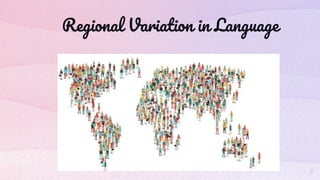
Regional Variation in Language
2
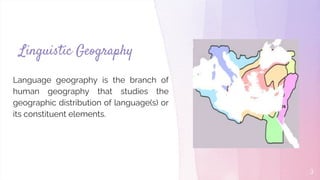
Linguistic Geography
Language geography is the branch of
human geography that studies the
geographic distribution of language(s) or
its constituent elements.
3
The Standard Language
This is actually an
idealized variety,
because it has no
specific region. It is the
variety associated with
administrative,
commercial and
educational centers,
regardless of region.
“ It is clearly associated with education and
broadcasting in public contexts and is
more easily described in terms of the
written language than the spoken
language”
5
Dialect
This term is used to describe features of
grammar and vocabulary as well as
aspects of pronunciation.
6
Accent
It is a myth that some speakers have
accents while others do not. We might feel
that some speakers have very distinct or
easily recognized types of accents, but
every language-user speaks with an accent
7
Dialectology
To distinguish between two
different dialects of the same
language (whose speakers
can usually understand each
other.
8
9
Isoglosses
An isogloss is a geographical boundary line marking the area in which a
distinctive linguistic feature commonly occurs.
This linguistic feature may be phonological (e.g., the pronunciation of a
vowel), lexical (the use of a word), or some other aspect of language.
Major divisions between dialects are marked by bundles of isoglosses.
Speakers who move back and forth across this
border area, using different varieties with some ease,
may be described as BIDIALECTAL, for example:
speaking two dialects.
Most of us grow up with some form of bidialectalism,
speaking one dialect in the street among family and
friends, and having to learn another dialect in school
Dialect Continuum
10
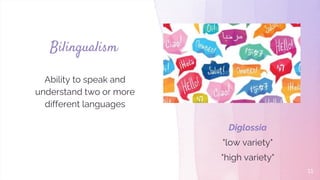
Bilingualism
Ability to speak and
understand two or more
different languages
11
Diglossia
"low variety"
"high variety"
Language planning
12
selection
codification
elaboration
implementatio
n
acceptance
Pidgins
13
Variety of language
developed among groups of
people that do not have a
language in common
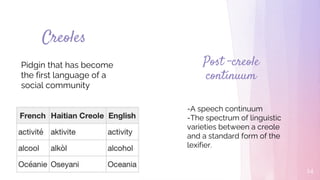
Creoles
14
Pidgin that has become
the first language of a
social community
Post -creole
continuum
-A speech continuum
-The spectrum of linguistic
varieties between a creole
and a standard form of the
lexifier.

Chapter 18

  • 1.
    The Study ofLanguage Chapter 18 Regional variation in language
  • 2.
  • 3.
    Linguistic Geography Language geographyis the branch of human geography that studies the geographic distribution of language(s) or its constituent elements. 3
  • 4.
    The Standard Language Thisis actually an idealized variety, because it has no specific region. It is the variety associated with administrative, commercial and educational centers, regardless of region.
  • 5.
    “ It isclearly associated with education and broadcasting in public contexts and is more easily described in terms of the written language than the spoken language” 5
  • 6.
    Dialect This term isused to describe features of grammar and vocabulary as well as aspects of pronunciation. 6
  • 7.
    Accent It is amyth that some speakers have accents while others do not. We might feel that some speakers have very distinct or easily recognized types of accents, but every language-user speaks with an accent 7
  • 8.
    Dialectology To distinguish betweentwo different dialects of the same language (whose speakers can usually understand each other. 8
  • 9.
    9 Isoglosses An isogloss isa geographical boundary line marking the area in which a distinctive linguistic feature commonly occurs. This linguistic feature may be phonological (e.g., the pronunciation of a vowel), lexical (the use of a word), or some other aspect of language. Major divisions between dialects are marked by bundles of isoglosses.
  • 10.
    Speakers who moveback and forth across this border area, using different varieties with some ease, may be described as BIDIALECTAL, for example: speaking two dialects. Most of us grow up with some form of bidialectalism, speaking one dialect in the street among family and friends, and having to learn another dialect in school Dialect Continuum 10
  • 11.
    Bilingualism Ability to speakand understand two or more different languages 11 Diglossia "low variety" "high variety"
  • 12.
  • 13.
    Pidgins 13 Variety of language developedamong groups of people that do not have a language in common
  • 14.
    Creoles 14 Pidgin that hasbecome the first language of a social community Post -creole continuum -A speech continuum -The spectrum of linguistic varieties between a creole and a standard form of the lexifier.