Saurab Sharma, MPT
Lecturer, KUSMS
TENS (Transcutaneous Electrical
Nerve Stimulation)
MSK II
Physiotherapy II
Electrotherapy
Lecture 1
Objectives of session
ļ‚— At the end of the class, students will be
able to:
ļ‚— Understand the theory of TENS
ļ‚— Explain the techniques of TENS
application
ļ‚— Identify the uses of TENS
ļ‚— Identify Precautions and2
Contents
ļ‚— Introduction
ļ‚— Features of TENS
ļ‚— Applications of TENS
ļ‚— Uses of TENS – common and uncommon
ļ‚— Electrode Placement
ļ‚— Precautions and contraindications
3
Introduction
ļ‚— Transcutaneous Electrical Nerve
Stimulation
ļ‚— Delivers electricity across the intact surface
of the skin to activate underlying nerves
ļ‚— Simple, non-invasive analgesia causing
modality
ļ‚— For pain- acute, chronic non-malignant
ļ‚— For palliative care of malignant conditions4
Keys principles
Outcome of treatment is based on the:
ļ‚— Knowledge of intent of TENS
application
ļ‚— Location of electrode placement
ļ‚— Selection of appropriate current types
ļ‚— Dosage
5
Principles of Nerve Fibre
Activation
ļ‚— Initially- stimulation of non-nociceptive
nerve fibres like A-alpha, A beta fibres
which have low threshold of stimulation
causing tingling
ļ‚— Followed by activation of A-delta and C-
fibres causing pain
6
Principles of Nerve Fibre
Activation
ļ‚— Low intensity current with pulse duration
50-500 micro seconds stimulates larger
diameter fibres (A beta) without
activation of smaller diameter fibres (A
delta and C)
ļ‚— Pulse duration more than 500 micro
seconds activates small diameter fibres7
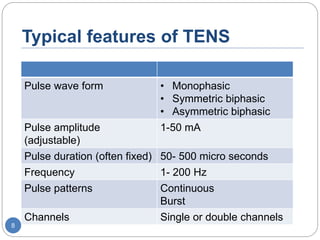
Typical features of TENS
Pulse wave form • Monophasic
• Symmetric biphasic
• Asymmetric biphasic
Pulse amplitude
(adjustable)
1-50 mA
Pulse duration (often fixed) 50- 500 micro seconds
Frequency 1- 200 Hz
Pulse patterns Continuous
Burst
Channels Single or double channels
8
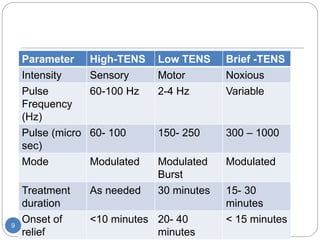
Parameter High-TENS Low TENS Brief -TENS
Intensity Sensory Motor Noxious
Pulse
Frequency
(Hz)
60-100 Hz 2-4 Hz Variable
Pulse (micro
sec)
60- 100 150- 250 300 – 1000
Mode Modulated Modulated
Burst
Modulated
Treatment
duration
As needed 30 minutes 15- 30
minutes
Onset of
relief
<10 minutes 20- 40
minutes
< 15 minutes9
Techniques of TENS application:
1. Conventional or High Frequency
TENS
2. Acupuncture or Low Frequency TENS
3. Brief Intense TENS
4. Burst Mode TENS
5. Modulated TENS
10
Techniques of TENS application:
1. Conventional or High Frequency
TENS
2. Acupuncture or Low Frequency TENS
3. Brief Intense TENS
4. Burst Mode TENS
5. Modulated TENS
11
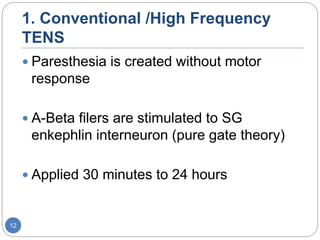
1. Conventional /High Frequency
TENS
ļ‚— Paresthesia is created without motor
response
ļ‚— A-Beta filers are stimulated to SG
enkephlin interneuron (pure gate theory)
ļ‚— Applied 30 minutes to 24 hours
12
1. Conventional /High Frequency
TENS
ļ‚— Creates the fastest relief
ļ‚— Relief is short lived (45 sec 1/2 life)
ļ‚— May stop the pain-spasms cycle
13
Application of High TENS
ļ‚— Pulse rate: high 75-100 Hz (generally
80), constant
ļ‚— Pulse width: narrow, less than 300 mSec
generally 60 microSec
ļ‚— Intensity: comfortable to tolerable
14
Techniques of TENS application:
1. Conventional or High Frequency
TENS
2. Acupuncture or Low Frequency TENS
3. Brief Intense TENS
4. Burst Mode TENS
5. Modulated TENS
15
2. Low frequency/ Acupuncture like
TENS
ļ‚— Activation of descending pain
suppression pathway activating
endorphins
ļ‚— Longer lasting pain relief but slower to
start
ļ‚— Application
ļ‚—Frequency usually- 1-5 Hz (below
10 Hz)
ļ‚—Pulse width: 200-300 micro16
Techniques of TENS application:
1. Conventional or High Frequency
TENS
2. Acupuncture or Low Frequency TENS
3. Brief Intense TENS
4. Burst Mode TENS
5. Modulated TENS
17
3. Brief, Intense TENS:
hyper-stimulation analgesia
ļ‚—Similar to high frequency TENS
ļ‚—Highest rate (100 Hz)
ļ‚—pulse width: 200 micro sec
ļ‚—Intensity to a very strong but tolerable
level
18
3. Brief, Intense TENS:
hyper-stimulation analgesia
ļ‚—Treatment time is only 15 minutes, if
no relief then treat again after 2-3
minutes
ļ‚—Mono or biphasic current give a ā€œbee
stingā€ sensation
ļ‚—Utilize motor, trigger or acupuncture
points.
19
Techniques of TENS application:
1. Conventional or High Frequency
TENS
2. Acupuncture or Low Frequency TENS
3. Brief Intense TENS
4. Burst Mode TENS
5. Modulated TENS
20
4. Burst TENS
ļ‚— Carrier frequency is at a certain rate with a
built in duty cycle
ļ‚— Similar to low frequency TENS
ļ‚— Carrier frequency of 70-100 Hz packaged
in bursts of about 7 bursts per second
21
4. Burst TENS
ļ‚— Pulses within burst can vary
ļ‚— Burst frequency is 1-5 bursts per second
ļ‚— Strong contraction at lower frequencies
ļ‚— Combines efficacy of low TENS with the
comfort of conventional TENS
22
4. Burst TENS- Application
ļ‚— Pulse width: high 100-200 micro
seconds
ļ‚— Pulse rate: 70-100 pps modulated to 1-5
burst/sec
ļ‚— Intensity: strong but comfortable
ļ‚— treatment length: 20-60 minutes
23
Techniques of TENS application:
1. Conventional or High Frequency
TENS
2. Acupuncture or Low Frequency TENS
3. Brief Intense TENS
4. Burst Mode TENS
5. Modulated TENS
25
5. Modulated Stimulation:
ļ‚— Keeps tissues reactive so no
accommodation occurs
ļ‚— Simultaneous modulation of amplitude
and pulse width; Frequency can also be
modulated
ļ‚— As amplitude is decreased, pulse width
is automatically increased to deliver
more consistent energy per pulse26
Contents
ļ‚— Introduction
ļ‚— Features of TENS
ļ‚— Applications of TENS
ļ‚— Uses of TENS – common and
uncommon
ļ‚— Electrode Placement
ļ‚— Precautions and contraindications
27
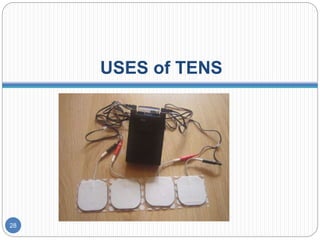
USES of TENS
28
Biophysical Effects
ļ‚— Primary use is to control pain through
Gate Control Theory
ļ‚— May produce muscle contractions
ļ‚— Various methods
ļ‚—High TENS (Activate A-delta fibers)
ļ‚—Low TENS (release of -endorphins)
ļ‚—Brief-Intense TENS (noxious
stimulation to active C fibers)
29
Common conditions where TENS is
used
Relief of Acute Pain:
ļ‚— Post operative pain
ļ‚— Labour pain
ļ‚— Dysmenorrhoea
ļ‚— Angina Pectoris
ļ‚— Orofascial pain, dental procedures
ļ‚— Physical trauma- fracture ribs, minor
medical procedures
30
Common conditions where TENS is
used
Relief of Chronic Pain:
ļ‚— Low back pain
ļ‚— Arthritic pain: RA, OA
ļ‚— Myofascial pain
ļ‚— Neuropathic pain- trigeminal neuralgia,
phantom pain, post-herpes pain
ļ‚— Cancer pain
ļ‚— CRPS (Complex Regional Pain
syndrome)
31
Other conditions where TENS is
used
Non-analgesic effects:
ļ‚— Reducing symptoms of Alzheimer’s
dementia
ļ‚— Neuromuscular stimulating effects
ļ‚— Faecal and urinary incontinence
ļ‚— Antiemetic effects:
ļ‚— Morning sickness, motion sickness, post
chemotherapy, nausea due to other drugs
ļ‚— Improving blood flow
ļ‚— Wound healing/ Fracture healing
ļ‚— Raynaud’s disease
32
Electrode placement
33
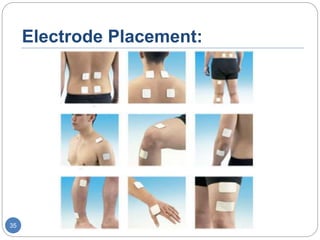
Electrode Placement:
ļ‚— Directly over painful sites: trigger points
ļ‚— Dermatomes, Myotomes
ļ‚— Accupunture points
ļ‚— Spinal nerve roots
ļ‚— May be crossed or uncrossed
ļ‚— Horizontal or vertical
34
Electrode Placement:
35
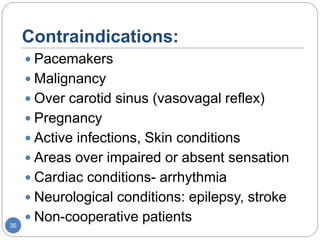
Contraindications:
ļ‚— Pacemakers
ļ‚— Malignancy
ļ‚— Over carotid sinus (vasovagal reflex)
ļ‚— Pregnancy
ļ‚— Active infections, Skin conditions
ļ‚— Areas over impaired or absent sensation
ļ‚— Cardiac conditions- arrhythmia
ļ‚— Neurological conditions: epilepsy, stroke
ļ‚— Non-cooperative patients36
Precautions/ side effects:
ļ‚— Dysaethesia
ļ‚— Contact dermatitis
ļ‚— Autonomic reactions- nausea, dizziness,
fainting
37
Summary
ļ‚— Uses of TENS
ļ‚— Application/ Types of TENS
ļ‚— Precautions/ Contraindications
38
References
ļ‚— Tim Watson. Electrotherapy: Evidence Based
Practice. 2008. Churchill Livingstone. 12th
edition.
ļ‚— Joseph Kahn. Principles and Practice of
Electrotherapy. 2000. Churchill Livingstone.
4th Edition.
ļ‚— John Low, Ann Reed. Electrotherapy
Explained. Principles and Practice.
Butterworth Heinemann. 3rd Edition.
ļ‚— Forster and Palastanga. Clayton’s
Electrotherapy Theory and Practice. Aitbs
Publishers. 9th edition
39

Transcutaneous electrical nerve stimulation (TENS)

  • 1.
    Saurab Sharma, MPT Lecturer,KUSMS TENS (Transcutaneous Electrical Nerve Stimulation) MSK II Physiotherapy II Electrotherapy Lecture 1
  • 2.
    Objectives of session ļ‚—At the end of the class, students will be able to: ļ‚— Understand the theory of TENS ļ‚— Explain the techniques of TENS application ļ‚— Identify the uses of TENS ļ‚— Identify Precautions and2
  • 3.
    Contents ļ‚— Introduction ļ‚— Featuresof TENS ļ‚— Applications of TENS ļ‚— Uses of TENS – common and uncommon ļ‚— Electrode Placement ļ‚— Precautions and contraindications 3
  • 4.
    Introduction ļ‚— Transcutaneous ElectricalNerve Stimulation ļ‚— Delivers electricity across the intact surface of the skin to activate underlying nerves ļ‚— Simple, non-invasive analgesia causing modality ļ‚— For pain- acute, chronic non-malignant ļ‚— For palliative care of malignant conditions4
  • 5.
    Keys principles Outcome oftreatment is based on the: ļ‚— Knowledge of intent of TENS application ļ‚— Location of electrode placement ļ‚— Selection of appropriate current types ļ‚— Dosage 5
  • 6.
    Principles of NerveFibre Activation ļ‚— Initially- stimulation of non-nociceptive nerve fibres like A-alpha, A beta fibres which have low threshold of stimulation causing tingling ļ‚— Followed by activation of A-delta and C- fibres causing pain 6
  • 7.
    Principles of NerveFibre Activation ļ‚— Low intensity current with pulse duration 50-500 micro seconds stimulates larger diameter fibres (A beta) without activation of smaller diameter fibres (A delta and C) ļ‚— Pulse duration more than 500 micro seconds activates small diameter fibres7
  • 8.
    Typical features ofTENS Pulse wave form • Monophasic • Symmetric biphasic • Asymmetric biphasic Pulse amplitude (adjustable) 1-50 mA Pulse duration (often fixed) 50- 500 micro seconds Frequency 1- 200 Hz Pulse patterns Continuous Burst Channels Single or double channels 8
  • 9.
    Parameter High-TENS LowTENS Brief -TENS Intensity Sensory Motor Noxious Pulse Frequency (Hz) 60-100 Hz 2-4 Hz Variable Pulse (micro sec) 60- 100 150- 250 300 – 1000 Mode Modulated Modulated Burst Modulated Treatment duration As needed 30 minutes 15- 30 minutes Onset of relief <10 minutes 20- 40 minutes < 15 minutes9
  • 10.
    Techniques of TENSapplication: 1. Conventional or High Frequency TENS 2. Acupuncture or Low Frequency TENS 3. Brief Intense TENS 4. Burst Mode TENS 5. Modulated TENS 10
  • 11.
    Techniques of TENSapplication: 1. Conventional or High Frequency TENS 2. Acupuncture or Low Frequency TENS 3. Brief Intense TENS 4. Burst Mode TENS 5. Modulated TENS 11
  • 12.
    1. Conventional /HighFrequency TENS ļ‚— Paresthesia is created without motor response ļ‚— A-Beta filers are stimulated to SG enkephlin interneuron (pure gate theory) ļ‚— Applied 30 minutes to 24 hours 12
  • 13.
    1. Conventional /HighFrequency TENS ļ‚— Creates the fastest relief ļ‚— Relief is short lived (45 sec 1/2 life) ļ‚— May stop the pain-spasms cycle 13
  • 14.
    Application of HighTENS ļ‚— Pulse rate: high 75-100 Hz (generally 80), constant ļ‚— Pulse width: narrow, less than 300 mSec generally 60 microSec ļ‚— Intensity: comfortable to tolerable 14
  • 15.
    Techniques of TENSapplication: 1. Conventional or High Frequency TENS 2. Acupuncture or Low Frequency TENS 3. Brief Intense TENS 4. Burst Mode TENS 5. Modulated TENS 15
  • 16.
    2. Low frequency/Acupuncture like TENS ļ‚— Activation of descending pain suppression pathway activating endorphins ļ‚— Longer lasting pain relief but slower to start ļ‚— Application ļ‚—Frequency usually- 1-5 Hz (below 10 Hz) ļ‚—Pulse width: 200-300 micro16
  • 17.
    Techniques of TENSapplication: 1. Conventional or High Frequency TENS 2. Acupuncture or Low Frequency TENS 3. Brief Intense TENS 4. Burst Mode TENS 5. Modulated TENS 17
  • 18.
    3. Brief, IntenseTENS: hyper-stimulation analgesia ļ‚—Similar to high frequency TENS ļ‚—Highest rate (100 Hz) ļ‚—pulse width: 200 micro sec ļ‚—Intensity to a very strong but tolerable level 18
  • 19.
    3. Brief, IntenseTENS: hyper-stimulation analgesia ļ‚—Treatment time is only 15 minutes, if no relief then treat again after 2-3 minutes ļ‚—Mono or biphasic current give a ā€œbee stingā€ sensation ļ‚—Utilize motor, trigger or acupuncture points. 19
  • 20.
    Techniques of TENSapplication: 1. Conventional or High Frequency TENS 2. Acupuncture or Low Frequency TENS 3. Brief Intense TENS 4. Burst Mode TENS 5. Modulated TENS 20
  • 21.
    4. Burst TENS ļ‚—Carrier frequency is at a certain rate with a built in duty cycle ļ‚— Similar to low frequency TENS ļ‚— Carrier frequency of 70-100 Hz packaged in bursts of about 7 bursts per second 21
  • 22.
    4. Burst TENS ļ‚—Pulses within burst can vary ļ‚— Burst frequency is 1-5 bursts per second ļ‚— Strong contraction at lower frequencies ļ‚— Combines efficacy of low TENS with the comfort of conventional TENS 22
  • 23.
    4. Burst TENS-Application ļ‚— Pulse width: high 100-200 micro seconds ļ‚— Pulse rate: 70-100 pps modulated to 1-5 burst/sec ļ‚— Intensity: strong but comfortable ļ‚— treatment length: 20-60 minutes 23
  • 24.
    Techniques of TENSapplication: 1. Conventional or High Frequency TENS 2. Acupuncture or Low Frequency TENS 3. Brief Intense TENS 4. Burst Mode TENS 5. Modulated TENS 25
  • 25.
    5. Modulated Stimulation: ļ‚—Keeps tissues reactive so no accommodation occurs ļ‚— Simultaneous modulation of amplitude and pulse width; Frequency can also be modulated ļ‚— As amplitude is decreased, pulse width is automatically increased to deliver more consistent energy per pulse26
  • 26.
    Contents ļ‚— Introduction ļ‚— Featuresof TENS ļ‚— Applications of TENS ļ‚— Uses of TENS – common and uncommon ļ‚— Electrode Placement ļ‚— Precautions and contraindications 27
  • 27.
  • 28.
    Biophysical Effects ļ‚— Primaryuse is to control pain through Gate Control Theory ļ‚— May produce muscle contractions ļ‚— Various methods ļ‚—High TENS (Activate A-delta fibers) ļ‚—Low TENS (release of -endorphins) ļ‚—Brief-Intense TENS (noxious stimulation to active C fibers) 29
  • 29.
    Common conditions whereTENS is used Relief of Acute Pain: ļ‚— Post operative pain ļ‚— Labour pain ļ‚— Dysmenorrhoea ļ‚— Angina Pectoris ļ‚— Orofascial pain, dental procedures ļ‚— Physical trauma- fracture ribs, minor medical procedures 30
  • 30.
    Common conditions whereTENS is used Relief of Chronic Pain: ļ‚— Low back pain ļ‚— Arthritic pain: RA, OA ļ‚— Myofascial pain ļ‚— Neuropathic pain- trigeminal neuralgia, phantom pain, post-herpes pain ļ‚— Cancer pain ļ‚— CRPS (Complex Regional Pain syndrome) 31
  • 31.
    Other conditions whereTENS is used Non-analgesic effects: ļ‚— Reducing symptoms of Alzheimer’s dementia ļ‚— Neuromuscular stimulating effects ļ‚— Faecal and urinary incontinence ļ‚— Antiemetic effects: ļ‚— Morning sickness, motion sickness, post chemotherapy, nausea due to other drugs ļ‚— Improving blood flow ļ‚— Wound healing/ Fracture healing ļ‚— Raynaud’s disease 32
  • 32.
  • 33.
    Electrode Placement: ļ‚— Directlyover painful sites: trigger points ļ‚— Dermatomes, Myotomes ļ‚— Accupunture points ļ‚— Spinal nerve roots ļ‚— May be crossed or uncrossed ļ‚— Horizontal or vertical 34
  • 34.
  • 35.
    Contraindications: ļ‚— Pacemakers ļ‚— Malignancy ļ‚—Over carotid sinus (vasovagal reflex) ļ‚— Pregnancy ļ‚— Active infections, Skin conditions ļ‚— Areas over impaired or absent sensation ļ‚— Cardiac conditions- arrhythmia ļ‚— Neurological conditions: epilepsy, stroke ļ‚— Non-cooperative patients36
  • 36.
    Precautions/ side effects: ļ‚—Dysaethesia ļ‚— Contact dermatitis ļ‚— Autonomic reactions- nausea, dizziness, fainting 37
  • 37.
    Summary ļ‚— Uses ofTENS ļ‚— Application/ Types of TENS ļ‚— Precautions/ Contraindications 38
  • 38.
    References ļ‚— Tim Watson.Electrotherapy: Evidence Based Practice. 2008. Churchill Livingstone. 12th edition. ļ‚— Joseph Kahn. Principles and Practice of Electrotherapy. 2000. Churchill Livingstone. 4th Edition. ļ‚— John Low, Ann Reed. Electrotherapy Explained. Principles and Practice. Butterworth Heinemann. 3rd Edition. ļ‚— Forster and Palastanga. Clayton’s Electrotherapy Theory and Practice. Aitbs Publishers. 9th edition 39