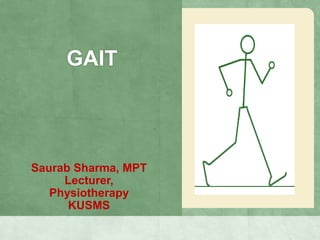
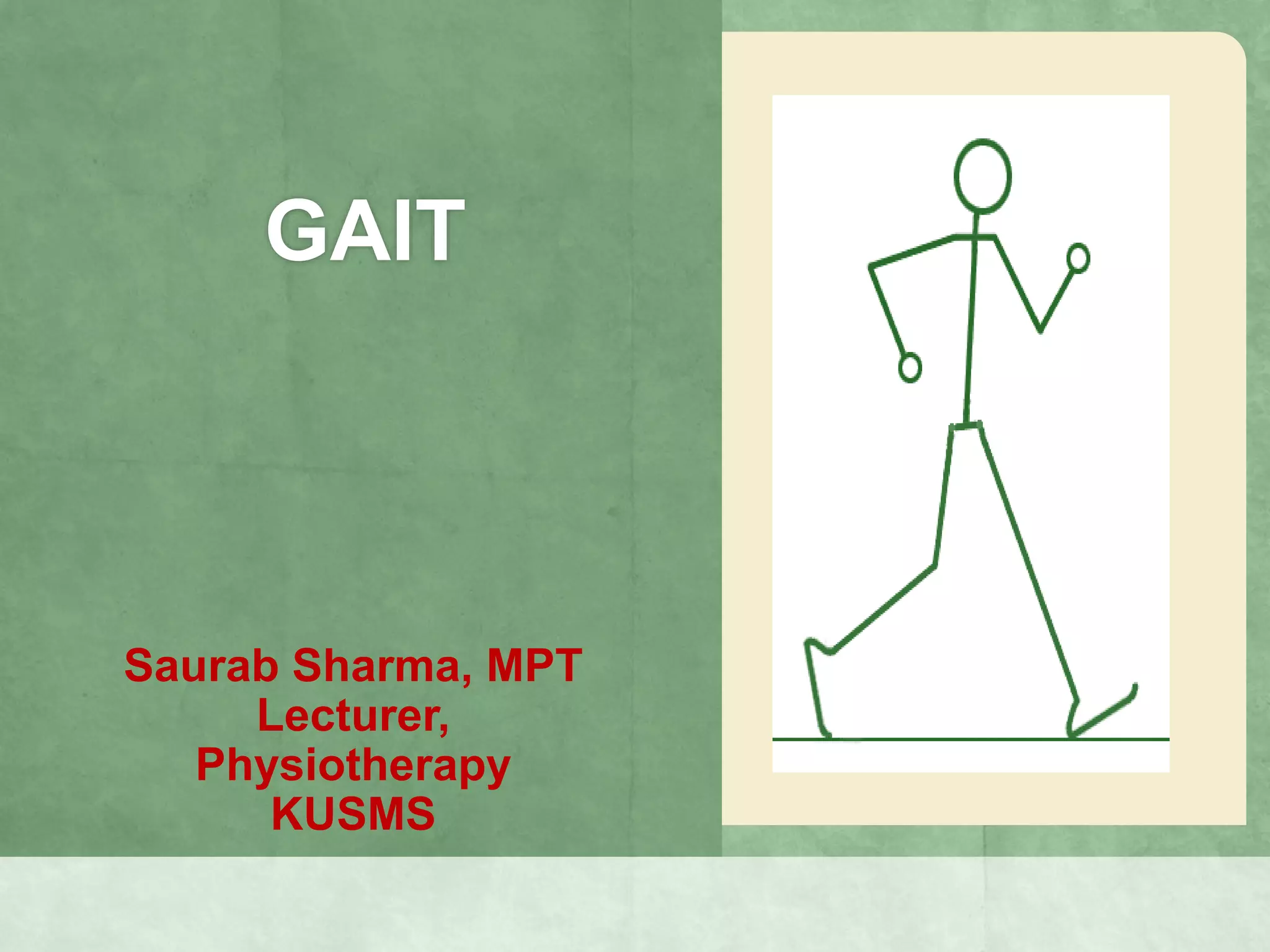
GAIT
Saurab Sharma, MPT
Lecturer,
Physiotherapy
KUSMS
Contents:
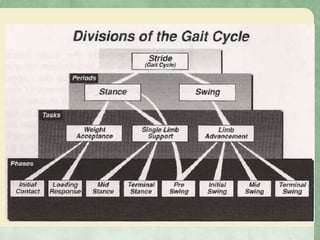
• Divisions of gait cycle
• Temporal and spatial
variables
• Determinants of gait
• Phases of gait cycle
Human Locomotion/
Gait
• Translatory progression of the body as a
whole
• Produced by coordinated, rotatory
movements of body segments
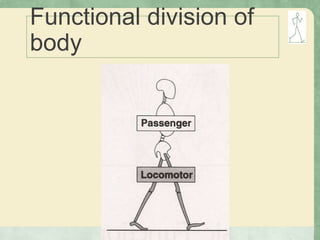
Functional division of
body
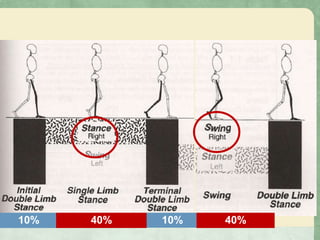
10% 40% 10% 40%
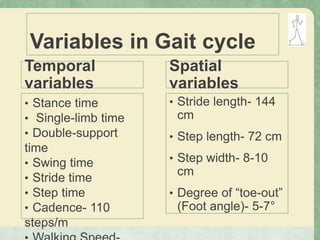
Variables in Gait cycle
Temporal
variables
• Stance time
• Single-limb time
• Double-support
time
• Swing time
• Stride time
• Step time
• Cadence- 110
steps/m
Spatial
variables
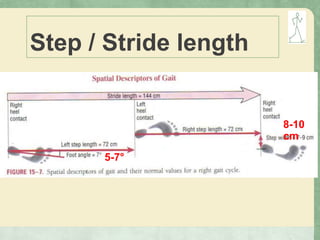
• Stride length- 144
cm
• Step length- 72 cm
• Step width- 8-10
cm
• Degree of “toe-out”
(Foot angle)- 5-7°
Step / Stride length
5-7°
8-10
cm
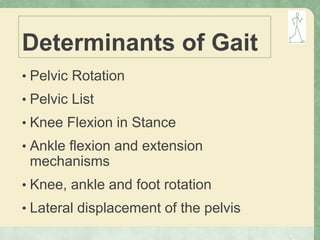
Determinants of Gait
• Pelvic Rotation
• Pelvic List
• Knee Flexion in Stance
• Ankle flexion and extension
mechanisms
• Knee, ankle and foot rotation
• Lateral displacement of the pelvis
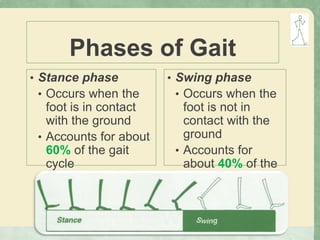
Phases of Gait
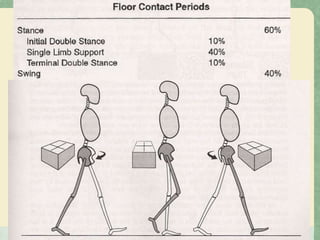
• Stance phase
• Occurs when the
foot is in contact
with the ground
• Accounts for about
60% of the gait
cycle
• Swing phase
• Occurs when the
foot is not in
contact with the
ground
• Accounts for
about 40% of the
gait cycle
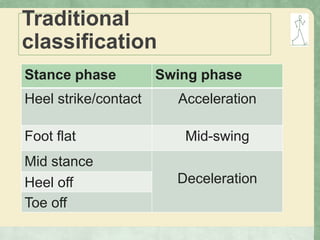
Traditional
classification
Stance phase Swing phase
Heel strike/contact Acceleration
Foot flat Mid-swing
Mid stance
DecelerationHeel off
Toe off
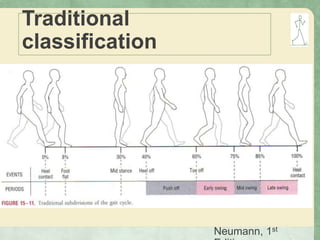
Traditional
classification
Neumann, 1st
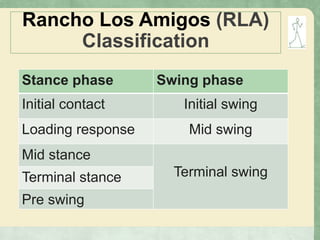
Rancho Los Amigos (RLA)
Classification
Stance phase Swing phase
Initial contact Initial swing
Loading response Mid swing
Mid stance
Terminal swingTerminal stance
Pre swing
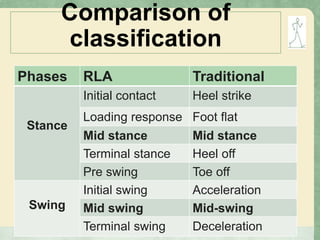
Comparison of
classification
Phases RLA Traditional
Stance
Initial contact Heel strike
Loading response Foot flat
Mid stance Mid stance
Terminal stance Heel off
Pre swing Toe off
Swing
Initial swing Acceleration
Mid swing Mid-swing
Terminal swing Deceleration
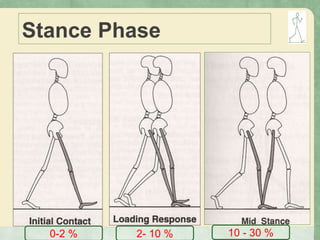
Stance Phase
0-2 % 2- 10 % 10 - 30 %
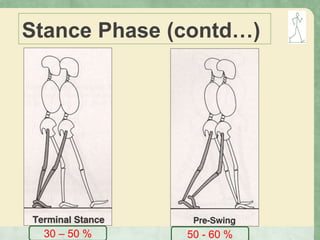
Stance Phase (contd…)
30 – 50 % 50 - 60 %
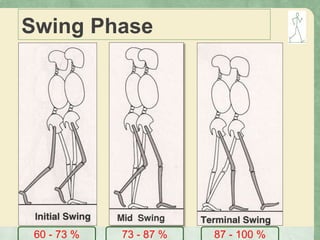
Swing Phase
60 - 73 % 73 - 87 % 87 - 100 %
• Divisions of gait cycle
• Temporal and spatial variables
• Determinants of gait
• Phases of gait cycle
Summary
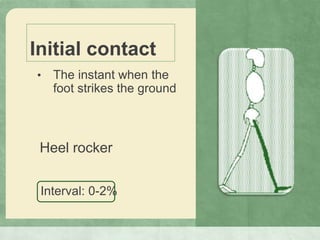
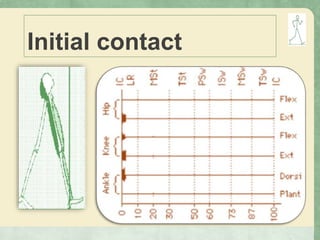
Initial contact
• The instant when the
foot strikes the ground
Interval: 0-2%
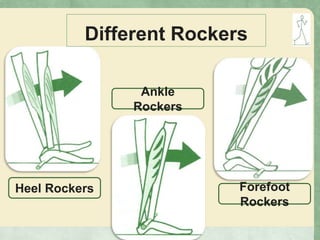
Heel rocker
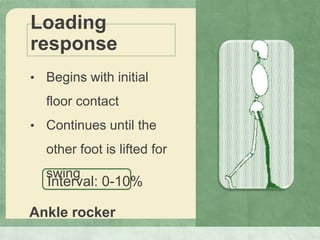
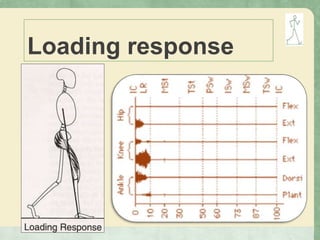
Loading
response
• Begins with initial
floor contact
• Continues until the
other foot is lifted for
swing
Interval: 0-10%
Ankle rocker
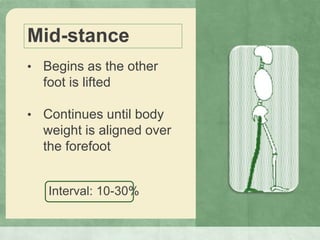
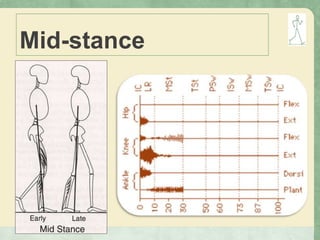
Mid-stance
• Begins as the other
foot is lifted
• Continues until body
weight is aligned over
the forefoot
Interval: 10-30%
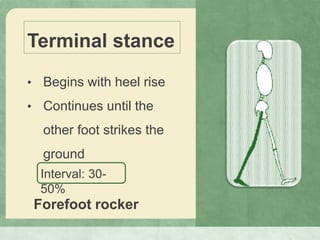
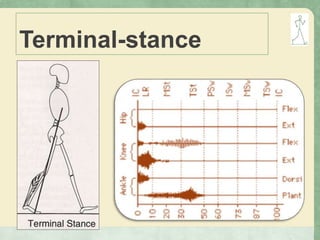
Terminal stance
• Begins with heel rise
• Continues until the
other foot strikes the
ground
Interval: 30-
50%
Forefoot rocker
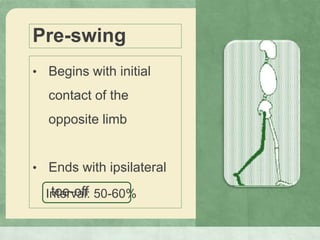
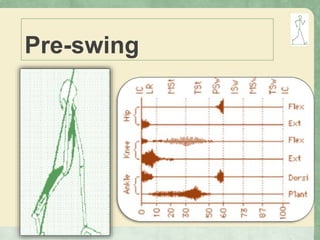
Pre-swing
• Begins with initial
contact of the
opposite limb
• Ends with ipsilateral
toe-offInterval: 50-60%
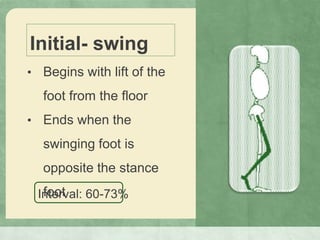
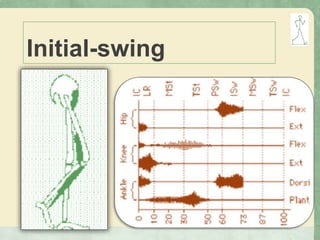
Initial- swing
• Begins with lift of the
foot from the floor
• Ends when the
swinging foot is
opposite the stance
footInterval: 60-73%
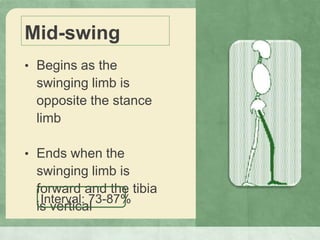
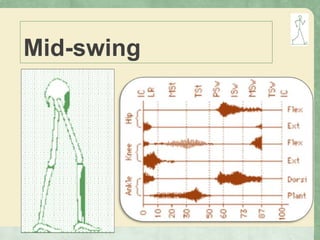
Mid-swing
• Begins as the
swinging limb is
opposite the stance
limb
• Ends when the
swinging limb is
forward and the tibia
is vertical
Interval: 73-87%
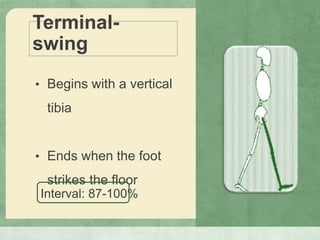
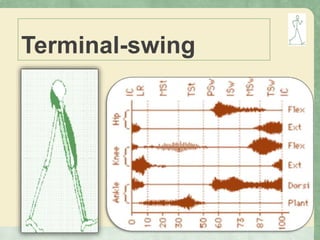
Terminal-
swing
• Begins with a vertical
tibia
• Ends when the foot
strikes the floor
Interval: 87-100%
Different Rockers
Heel Rockers Forefoot
Rockers
Ankle
Rockers
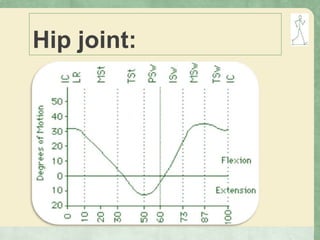
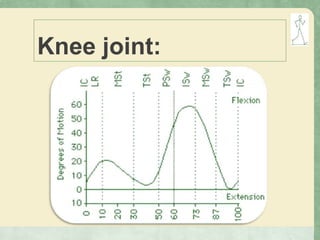
Joint motions -
Phases of Gait
Hip joint:
Knee joint:
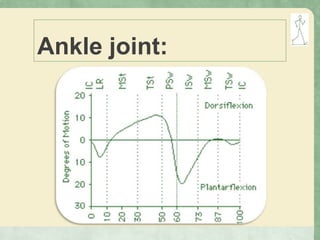
Ankle joint:
Muscle actions -
phases of gait
Initial contact
Loading response
Mid-stance
Terminal-stance
Pre-swing
Initial-swing
Mid-swing
Terminal-swing
References
• Gait analysis: normal and pathological
function. Jacquelin Perry.
• Joint structure and function. 4th edition. Cynthia
Norkin.
Gait, Phases of Gait, Kinamatics and kinetics of gait

Gait, Phases of Gait, Kinamatics and kinetics of gait

Editor's Notes

  • #8 Speed combines both spatial and temporal parameters= step length X step time
  • #13 Heel contact- heel comes in contact with the ground Foot flat- entire plantar surface in contact with the ground Mid stance- point at which body’s weight passes directly over the supporting lower extremity; foot in swing phase is next to stance leg
  • #14 The traditional terminology developed as interest in gait rehabilitation mounted after WWII in the effort to improve lower extremity prosthetics. It describes gait in terms of discreet, momentary events, such as heelstrike, heel rise, and toe-off
  • #15 The Rancho Los Amigos (RLA) terminology became increasingly popular in the late 1980’s and early 1990’s and is currently assuming a position as the preferred standard among clinicians. It describes gait more in terms of processes or segments of time, such as loading response, terminal stance, and pre-swing, and because it is semantically more generic and better encompasses the common features of normal and pathological gait
  • #16 The Rancho Los Amigos (RLA) terminology became increasingly popular in the late 1980’s and early 1990’s and is currently assuming a position as the preferred standard among clinicians. It describes gait more in terms of processes or segments of time, such as loading response, terminal stance, and pre-swing, and because it is semantically more generic and better encompasses the common features of normal and pathological gait
  • #21 Objective: The limb is positioned to start stance with a heel rocker.
  • #22 Ob: Shock absorption Weight-bearing stability Preservation of progression
  • #23 Ob: progression over the stationary foot; Limb and trunk stability
  • #24 Ob: Progression of the body beyond the supporting foot
  • #25 Ob: Position the limb for swing
  • #26 Ob: Foot c1earance of the floor Advancement of the limb from its trailing position
  • #27 Objectives: Limb advancement Foot clearance from the floor
  • #28 Objectives: Complete limb advancement Prepare the limb for stance
  • #29 HEEL ROCKER. Lasts from initial contact to the time of foot flat. Its function is to translate the vertical component of the ground reaction force into forward progression of the tibia through the link provided by the eccentric action of tibialis anterior. ANKLE ROCKER. Lasts from the time of foot flat to heel rise. Its function is to control the rate of forward progression of the body as the tibia rotates at the ankle joint over the fixed foot under the eccentric control of the triceps surae. FOREFOOT ROCKER. Lasts from heel rise until the end of stance. It functions to extend the period of ground contact via the gastrocnemius to exploit the GRF vector’s helpful influence on swing initiation.