Saurab Sharma, MPT
Lecturer, KUSMS
TENS (Transcutaneous Electrical
Nerve Stimulation)
MSK II
Physiotherapy II
Electrotherapy
Lecture 1
Objectives of session
 At the end of the class, students will be
able to:
 Understand the theory of TENS
 Explain the techniques of TENS
application
 Identify the uses of TENS
 Identify Precautions and2
Contents
 Introduction
 Features of TENS
 Applications of TENS
 Uses of TENS – common and uncommon
 Electrode Placement
 Precautions and contraindications
3
Introduction
 Transcutaneous Electrical Nerve
Stimulation
 Delivers electricity across the intact surface
of the skin to activate underlying nerves
 Simple, non-invasive analgesia causing
modality
 For pain- acute, chronic non-malignant
 For palliative care of malignant conditions4
Keys principles
Outcome of treatment is based on the:
 Knowledge of intent of TENS
application
 Location of electrode placement
 Selection of appropriate current types
 Dosage
5
Principles of Nerve Fibre
Activation
 Initially- stimulation of non-nociceptive
nerve fibres like A-alpha, A beta fibres
which have low threshold of stimulation
causing tingling
 Followed by activation of A-delta and C-
fibres causing pain
6
Principles of Nerve Fibre
Activation
 Low intensity current with pulse duration
50-500 micro seconds stimulates larger
diameter fibres (A beta) without
activation of smaller diameter fibres (A
delta and C)
 Pulse duration more than 500 micro
seconds activates small diameter fibres7
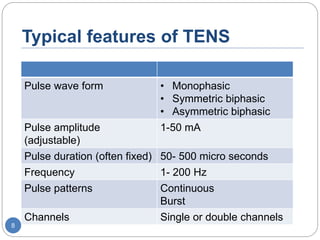
Typical features of TENS
Pulse wave form • Monophasic
• Symmetric biphasic
• Asymmetric biphasic
Pulse amplitude
(adjustable)
1-50 mA
Pulse duration (often fixed) 50- 500 micro seconds
Frequency 1- 200 Hz
Pulse patterns Continuous
Burst
Channels Single or double channels
8
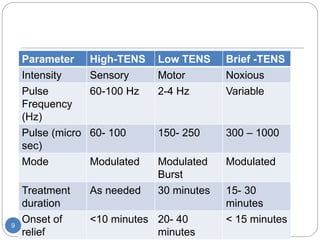
Parameter High-TENS Low TENS Brief -TENS
Intensity Sensory Motor Noxious
Pulse
Frequency
(Hz)
60-100 Hz 2-4 Hz Variable
Pulse (micro
sec)
60- 100 150- 250 300 – 1000
Mode Modulated Modulated
Burst
Modulated
Treatment
duration
As needed 30 minutes 15- 30
minutes
Onset of
relief
<10 minutes 20- 40
minutes
< 15 minutes9
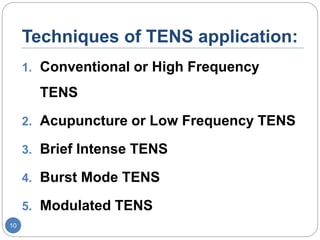
Techniques of TENS application:
1. Conventional or High Frequency
TENS
2. Acupuncture or Low Frequency TENS
3. Brief Intense TENS
4. Burst Mode TENS
5. Modulated TENS
10
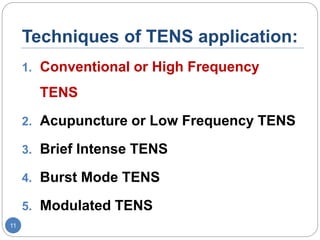
Techniques of TENS application:
1. Conventional or High Frequency
TENS
2. Acupuncture or Low Frequency TENS
3. Brief Intense TENS
4. Burst Mode TENS
5. Modulated TENS
11
1. Conventional /High Frequency
TENS
 Paresthesia is created without motor
response
 A-Beta filers are stimulated to SG
enkephlin interneuron (pure gate theory)
 Applied 30 minutes to 24 hours
12
1. Conventional /High Frequency
TENS
 Creates the fastest relief
 Relief is short lived (45 sec 1/2 life)
 May stop the pain-spasms cycle
13
Application of High TENS
 Pulse rate: high 75-100 Hz (generally
80), constant
 Pulse width: narrow, less than 300 mSec
generally 60 microSec
 Intensity: comfortable to tolerable
14
Techniques of TENS application:
1. Conventional or High Frequency
TENS
2. Acupuncture or Low Frequency TENS
3. Brief Intense TENS
4. Burst Mode TENS
5. Modulated TENS
15
2. Low frequency/ Acupuncture like
TENS
 Activation of descending pain
suppression pathway activating
endorphins
 Longer lasting pain relief but slower to
start
 Application
Frequency usually- 1-5 Hz (below
10 Hz)
Pulse width: 200-300 micro16
Techniques of TENS application:
1. Conventional or High Frequency
TENS
2. Acupuncture or Low Frequency TENS
3. Brief Intense TENS
4. Burst Mode TENS
5. Modulated TENS
17
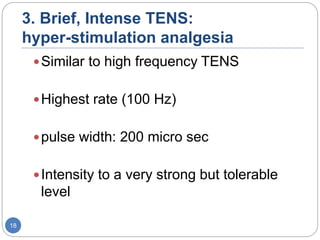
3. Brief, Intense TENS:
hyper-stimulation analgesia
Similar to high frequency TENS
Highest rate (100 Hz)
pulse width: 200 micro sec
Intensity to a very strong but tolerable
level
18
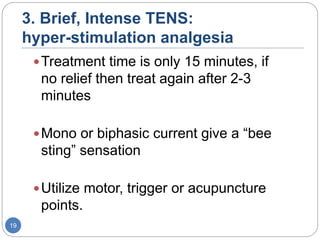
3. Brief, Intense TENS:
hyper-stimulation analgesia
Treatment time is only 15 minutes, if
no relief then treat again after 2-3
minutes
Mono or biphasic current give a “bee
sting” sensation
Utilize motor, trigger or acupuncture
points.
19
Techniques of TENS application:
1. Conventional or High Frequency
TENS
2. Acupuncture or Low Frequency TENS
3. Brief Intense TENS
4. Burst Mode TENS
5. Modulated TENS
20
4. Burst TENS
 Carrier frequency is at a certain rate with a
built in duty cycle
 Similar to low frequency TENS
 Carrier frequency of 70-100 Hz packaged
in bursts of about 7 bursts per second
21
4. Burst TENS
 Pulses within burst can vary
 Burst frequency is 1-5 bursts per second
 Strong contraction at lower frequencies
 Combines efficacy of low TENS with the
comfort of conventional TENS
22
4. Burst TENS- Application
 Pulse width: high 100-200 micro
seconds
 Pulse rate: 70-100 pps modulated to 1-5
burst/sec
 Intensity: strong but comfortable
 treatment length: 20-60 minutes
23
Techniques of TENS application:
1. Conventional or High Frequency
TENS
2. Acupuncture or Low Frequency TENS
3. Brief Intense TENS
4. Burst Mode TENS
5. Modulated TENS
25
5. Modulated Stimulation:
 Keeps tissues reactive so no
accommodation occurs
 Simultaneous modulation of amplitude
and pulse width; Frequency can also be
modulated
 As amplitude is decreased, pulse width
is automatically increased to deliver
more consistent energy per pulse26
Contents
 Introduction
 Features of TENS
 Applications of TENS
 Uses of TENS – common and
uncommon
 Electrode Placement
 Precautions and contraindications
27
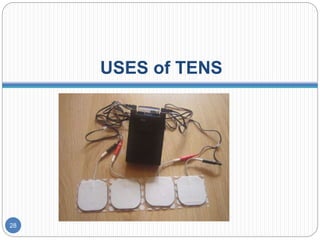
USES of TENS
28
Biophysical Effects
 Primary use is to control pain through
Gate Control Theory
 May produce muscle contractions
 Various methods
High TENS (Activate A-delta fibers)
Low TENS (release of -endorphins)
Brief-Intense TENS (noxious
stimulation to active C fibers)
29
Common conditions where TENS is
used
Relief of Acute Pain:
 Post operative pain
 Labour pain
 Dysmenorrhoea
 Angina Pectoris
 Orofascial pain, dental procedures
 Physical trauma- fracture ribs, minor
medical procedures
30
Common conditions where TENS is
used
Relief of Chronic Pain:
 Low back pain
 Arthritic pain: RA, OA
 Myofascial pain
 Neuropathic pain- trigeminal neuralgia,
phantom pain, post-herpes pain
 Cancer pain
 CRPS (Complex Regional Pain
syndrome)
31
Other conditions where TENS is
used
Non-analgesic effects:
 Reducing symptoms of Alzheimer’s
dementia
 Neuromuscular stimulating effects
 Faecal and urinary incontinence
 Antiemetic effects:
 Morning sickness, motion sickness, post
chemotherapy, nausea due to other drugs
 Improving blood flow
 Wound healing/ Fracture healing
 Raynaud’s disease
32
Electrode placement
33
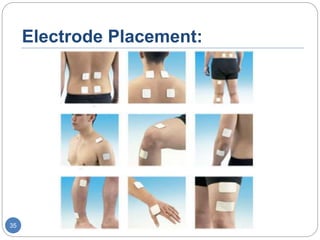
Electrode Placement:
 Directly over painful sites: trigger points
 Dermatomes, Myotomes
 Accupunture points
 Spinal nerve roots
 May be crossed or uncrossed
 Horizontal or vertical
34
Electrode Placement:
35
Contraindications:
 Pacemakers
 Malignancy
 Over carotid sinus (vasovagal reflex)
 Pregnancy
 Active infections, Skin conditions
 Areas over impaired or absent sensation
 Cardiac conditions- arrhythmia
 Neurological conditions: epilepsy, stroke
 Non-cooperative patients36
Precautions/ side effects:
 Dysaethesia
 Contact dermatitis
 Autonomic reactions- nausea, dizziness,
fainting
37
Summary
 Uses of TENS
 Application/ Types of TENS
 Precautions/ Contraindications
38
References
 Tim Watson. Electrotherapy: Evidence Based
Practice. 2008. Churchill Livingstone. 12th
edition.
 Joseph Kahn. Principles and Practice of
Electrotherapy. 2000. Churchill Livingstone.
4th Edition.
 John Low, Ann Reed. Electrotherapy
Explained. Principles and Practice.
Butterworth Heinemann. 3rd Edition.
 Forster and Palastanga. Clayton’s
Electrotherapy Theory and Practice. Aitbs
Publishers. 9th edition
39

Transcutaneous electrical nerve stimulation (TENS)

  • 1.
    Saurab Sharma, MPT Lecturer,KUSMS TENS (Transcutaneous Electrical Nerve Stimulation) MSK II Physiotherapy II Electrotherapy Lecture 1
  • 2.
    Objectives of session At the end of the class, students will be able to:  Understand the theory of TENS  Explain the techniques of TENS application  Identify the uses of TENS  Identify Precautions and2
  • 3.
    Contents  Introduction  Featuresof TENS  Applications of TENS  Uses of TENS – common and uncommon  Electrode Placement  Precautions and contraindications 3
  • 4.
    Introduction  Transcutaneous ElectricalNerve Stimulation  Delivers electricity across the intact surface of the skin to activate underlying nerves  Simple, non-invasive analgesia causing modality  For pain- acute, chronic non-malignant  For palliative care of malignant conditions4
  • 5.
    Keys principles Outcome oftreatment is based on the:  Knowledge of intent of TENS application  Location of electrode placement  Selection of appropriate current types  Dosage 5
  • 6.
    Principles of NerveFibre Activation  Initially- stimulation of non-nociceptive nerve fibres like A-alpha, A beta fibres which have low threshold of stimulation causing tingling  Followed by activation of A-delta and C- fibres causing pain 6
  • 7.
    Principles of NerveFibre Activation  Low intensity current with pulse duration 50-500 micro seconds stimulates larger diameter fibres (A beta) without activation of smaller diameter fibres (A delta and C)  Pulse duration more than 500 micro seconds activates small diameter fibres7
  • 8.
    Typical features ofTENS Pulse wave form • Monophasic • Symmetric biphasic • Asymmetric biphasic Pulse amplitude (adjustable) 1-50 mA Pulse duration (often fixed) 50- 500 micro seconds Frequency 1- 200 Hz Pulse patterns Continuous Burst Channels Single or double channels 8
  • 9.
    Parameter High-TENS LowTENS Brief -TENS Intensity Sensory Motor Noxious Pulse Frequency (Hz) 60-100 Hz 2-4 Hz Variable Pulse (micro sec) 60- 100 150- 250 300 – 1000 Mode Modulated Modulated Burst Modulated Treatment duration As needed 30 minutes 15- 30 minutes Onset of relief <10 minutes 20- 40 minutes < 15 minutes9
  • 10.
    Techniques of TENSapplication: 1. Conventional or High Frequency TENS 2. Acupuncture or Low Frequency TENS 3. Brief Intense TENS 4. Burst Mode TENS 5. Modulated TENS 10
  • 11.
    Techniques of TENSapplication: 1. Conventional or High Frequency TENS 2. Acupuncture or Low Frequency TENS 3. Brief Intense TENS 4. Burst Mode TENS 5. Modulated TENS 11
  • 12.
    1. Conventional /HighFrequency TENS  Paresthesia is created without motor response  A-Beta filers are stimulated to SG enkephlin interneuron (pure gate theory)  Applied 30 minutes to 24 hours 12
  • 13.
    1. Conventional /HighFrequency TENS  Creates the fastest relief  Relief is short lived (45 sec 1/2 life)  May stop the pain-spasms cycle 13
  • 14.
    Application of HighTENS  Pulse rate: high 75-100 Hz (generally 80), constant  Pulse width: narrow, less than 300 mSec generally 60 microSec  Intensity: comfortable to tolerable 14
  • 15.
    Techniques of TENSapplication: 1. Conventional or High Frequency TENS 2. Acupuncture or Low Frequency TENS 3. Brief Intense TENS 4. Burst Mode TENS 5. Modulated TENS 15
  • 16.
    2. Low frequency/Acupuncture like TENS  Activation of descending pain suppression pathway activating endorphins  Longer lasting pain relief but slower to start  Application Frequency usually- 1-5 Hz (below 10 Hz) Pulse width: 200-300 micro16
  • 17.
    Techniques of TENSapplication: 1. Conventional or High Frequency TENS 2. Acupuncture or Low Frequency TENS 3. Brief Intense TENS 4. Burst Mode TENS 5. Modulated TENS 17
  • 18.
    3. Brief, IntenseTENS: hyper-stimulation analgesia Similar to high frequency TENS Highest rate (100 Hz) pulse width: 200 micro sec Intensity to a very strong but tolerable level 18
  • 19.
    3. Brief, IntenseTENS: hyper-stimulation analgesia Treatment time is only 15 minutes, if no relief then treat again after 2-3 minutes Mono or biphasic current give a “bee sting” sensation Utilize motor, trigger or acupuncture points. 19
  • 20.
    Techniques of TENSapplication: 1. Conventional or High Frequency TENS 2. Acupuncture or Low Frequency TENS 3. Brief Intense TENS 4. Burst Mode TENS 5. Modulated TENS 20
  • 21.
    4. Burst TENS Carrier frequency is at a certain rate with a built in duty cycle  Similar to low frequency TENS  Carrier frequency of 70-100 Hz packaged in bursts of about 7 bursts per second 21
  • 22.
    4. Burst TENS Pulses within burst can vary  Burst frequency is 1-5 bursts per second  Strong contraction at lower frequencies  Combines efficacy of low TENS with the comfort of conventional TENS 22
  • 23.
    4. Burst TENS-Application  Pulse width: high 100-200 micro seconds  Pulse rate: 70-100 pps modulated to 1-5 burst/sec  Intensity: strong but comfortable  treatment length: 20-60 minutes 23
  • 24.
    Techniques of TENSapplication: 1. Conventional or High Frequency TENS 2. Acupuncture or Low Frequency TENS 3. Brief Intense TENS 4. Burst Mode TENS 5. Modulated TENS 25
  • 25.
    5. Modulated Stimulation: Keeps tissues reactive so no accommodation occurs  Simultaneous modulation of amplitude and pulse width; Frequency can also be modulated  As amplitude is decreased, pulse width is automatically increased to deliver more consistent energy per pulse26
  • 26.
    Contents  Introduction  Featuresof TENS  Applications of TENS  Uses of TENS – common and uncommon  Electrode Placement  Precautions and contraindications 27
  • 27.
  • 28.
    Biophysical Effects  Primaryuse is to control pain through Gate Control Theory  May produce muscle contractions  Various methods High TENS (Activate A-delta fibers) Low TENS (release of -endorphins) Brief-Intense TENS (noxious stimulation to active C fibers) 29
  • 29.
    Common conditions whereTENS is used Relief of Acute Pain:  Post operative pain  Labour pain  Dysmenorrhoea  Angina Pectoris  Orofascial pain, dental procedures  Physical trauma- fracture ribs, minor medical procedures 30
  • 30.
    Common conditions whereTENS is used Relief of Chronic Pain:  Low back pain  Arthritic pain: RA, OA  Myofascial pain  Neuropathic pain- trigeminal neuralgia, phantom pain, post-herpes pain  Cancer pain  CRPS (Complex Regional Pain syndrome) 31
  • 31.
    Other conditions whereTENS is used Non-analgesic effects:  Reducing symptoms of Alzheimer’s dementia  Neuromuscular stimulating effects  Faecal and urinary incontinence  Antiemetic effects:  Morning sickness, motion sickness, post chemotherapy, nausea due to other drugs  Improving blood flow  Wound healing/ Fracture healing  Raynaud’s disease 32
  • 32.
  • 33.
    Electrode Placement:  Directlyover painful sites: trigger points  Dermatomes, Myotomes  Accupunture points  Spinal nerve roots  May be crossed or uncrossed  Horizontal or vertical 34
  • 34.
  • 35.
    Contraindications:  Pacemakers  Malignancy Over carotid sinus (vasovagal reflex)  Pregnancy  Active infections, Skin conditions  Areas over impaired or absent sensation  Cardiac conditions- arrhythmia  Neurological conditions: epilepsy, stroke  Non-cooperative patients36
  • 36.
    Precautions/ side effects: Dysaethesia  Contact dermatitis  Autonomic reactions- nausea, dizziness, fainting 37
  • 37.
    Summary  Uses ofTENS  Application/ Types of TENS  Precautions/ Contraindications 38
  • 38.
    References  Tim Watson.Electrotherapy: Evidence Based Practice. 2008. Churchill Livingstone. 12th edition.  Joseph Kahn. Principles and Practice of Electrotherapy. 2000. Churchill Livingstone. 4th Edition.  John Low, Ann Reed. Electrotherapy Explained. Principles and Practice. Butterworth Heinemann. 3rd Edition.  Forster and Palastanga. Clayton’s Electrotherapy Theory and Practice. Aitbs Publishers. 9th edition 39