LASER
KEERTHI PRIYA MPT NEURO,
ASSISTANT PROFESSOR
CONTENTS
INTRODUCTION
PRODUCTION
TYPES
TECHNIQUE OF APPLICATION
PHYSIOLOGICAL EFFECTS
THERAPEUTIC EFFECTS
INDICATIONS
PRECAUTIONS
LASER: LIGHT AMPLIFICATED STIMULATED EMISSION OF
RADIATION.
DEFINITION: A device that concentrates high energies into a narrow beam of
coherent & monochromatic light.
USES :
Light Shows
Surgeries
Super Market
Physiotherapy Department
PROPERTIES OF LASER:
1. Monochromaticity
2. Coherence
3. Collimation
INTRODUCTION
PROPERTIES OF LASER
INTRODUCTION
MONOCHROMATICITY:
CHROMA=COLOUR
Emitted rays have single colour
of same wavelength & frequency
PROPERTIES OF LASER
INTRODUCTION
COHERENCE
Maintain same phase of crest & troughs.
1. Spatial : waves travel in same direction
2. Temporal : Electric & magnetic field
occurs in same time
PROPERTIES OF LASER
INTRODUCTION
COLLIMATION
Decreased or no divergence of
the waves as they travel parallel
to each other.
PRODUCTION
PRINCIPLE: Production of laser is based on quantum theory
QUANTUM THEORY
Heating of an atom
Molecular collision
takes place
Electrons move
from outer to inner
shells.
Electrons are
unstable &
spontaneously
energy is released
as photon.
Metastable
electrons photons
collide and gives
an identical photon
.
Stimulated
emission
COMPONENTS FOR PRODUCTION
OF LASER
PRODUCTION
LASING MEDIUM
Materials which absorbs external
energy and gives off the energy
as photons
ENERGY SOURCE
Flash gun is used to excite
electrons in lasing medium.
RESONATING CHAMBER
Lasing medium surrounded by 2
reflecting surfaces at either ends.
One end with complete reflection &
other with partial reflection
BASED ON TYPE OF LASING
MEDIUM
1. RUBY LASER
2. HE NE LASER
3. DIODE LASER
BASED ON INTENSITY OF
ENERGY
CLASSIFICATION
1. HIGH POWER LASER
2. LOW POWER LASER
BASED ON LASING MEDIUM
CLASSIFICATION
RUBY LASER : CRYSTAL LASER
Synthetic ruby rod made of Aluminium oxide is the
lasing medium. Xenon flash tube is coiled around the rod
is the flash gun.
Pulse mode
Wavelength= 694.3nm
BASED ON LASING MEDIUM
CLASSIFICATION
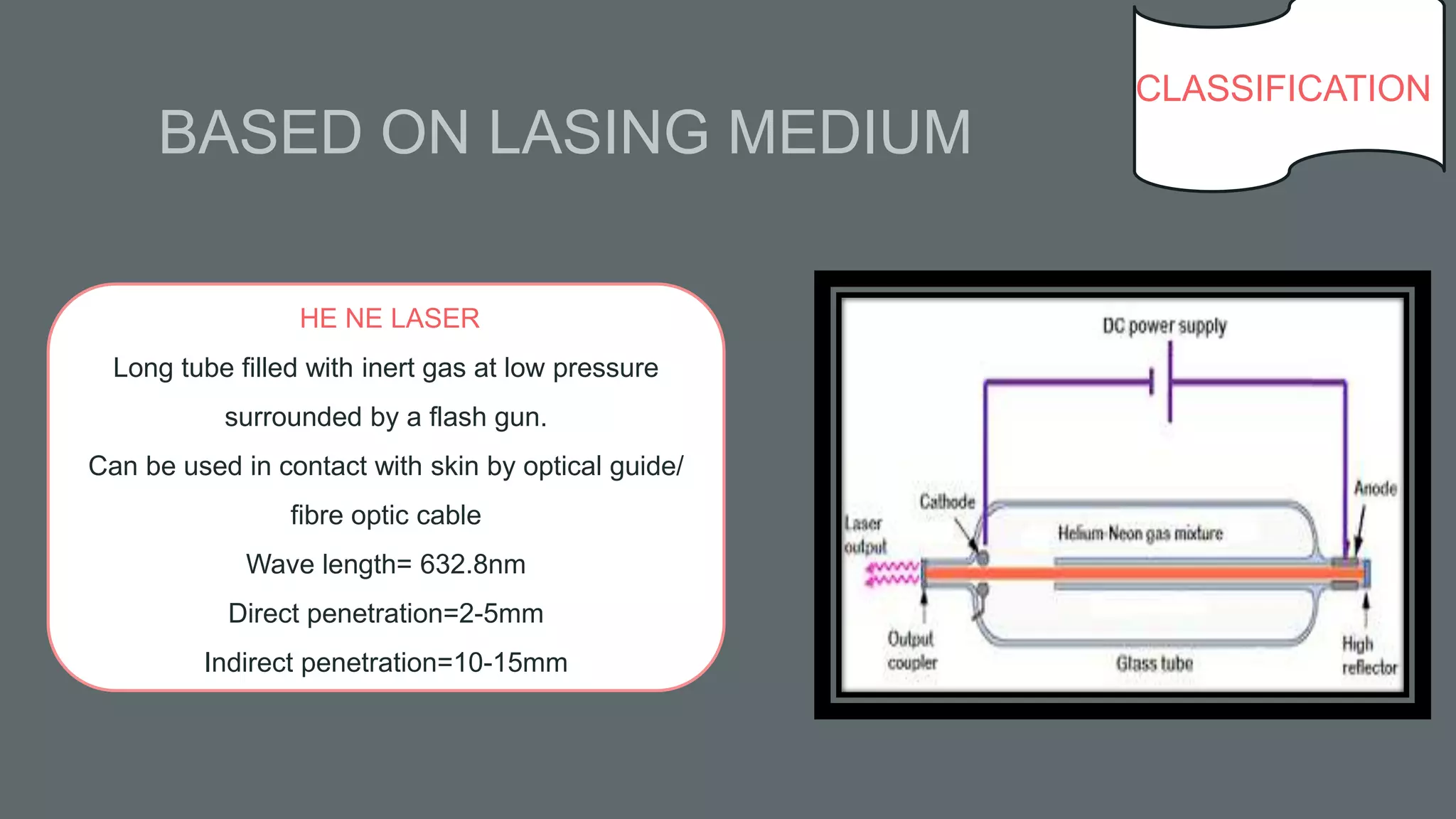
HE NE LASER
Long tube filled with inert gas at low pressure
surrounded by a flash gun.
Can be used in contact with skin by optical guide/
fibre optic cable
Wave length= 632.8nm
Direct penetration=2-5mm
Indirect penetration=10-15mm
BASED ON LASING MEDIUM
CLASSIFICATION
DIODE LASER: SEMICONDUCTOR
LASER
Light emitting diode made of gallium
aluminium arsenide.
Wave length= 904nm
Direct penetration=1-2cm
Indirect penetration=5cm
BASED ON INTENSITY OF ENERGY CLASSIFICATION
HIGH POWER LASER
• Also called as HOT LASER
• Therapeutic response is achieved
due to heat.
Used in
• surgeries
• Dermatology
• Ophthalmology
• Oncology & vascular
LOW POWER LASER
Also called as THERAPEUTIC
LASER
Used in
• Wound healing
• Pain
• Inflammation
FDA CLASSIFICATION OF LASER CLASSIFICATION
CLASS I EXCEMPT
Non hazardous
Power<1mw
GaAs: 820-910nm
CLASS III MODERATE RISK
Hazardous
Eye damage
No skin damage
CLASS II LOW POWER
Hazardous
Power=1mw
HeNe
CLASS IV HIGH POWER
Combustion effect
Damages retina and skin
EFFECTS OF LASER
REFLECTION
LASER light is reflected based
on wave length & nature of
tissue & incidence angle
ABSORPTION
Absorbed by cytochromes &
macrophages.
SCATTERING &
PENETRATION
Scattering is due to divergence,
reflection & refraction.
Penetration by
Red light is 1-2mm.
Infrared rays is 2-4mm
PHYSIOLOGICAL
EFFECTS
 Altered cell proliferation & cell motility
 Alteration of cell membrane potentials
& AP
 Altered prostaglandin production &
endogenous opoid production
PHYSIOLOGICAL
EFFECTS
 Activation of phagocytes
 Activation & proliferation of fibroblasts
 Stimulation of immune responses,
macrophages & mast cell
degranulation
 Stimulation of angiogenesis
THERAPEUTIC
EFFECTS
 Wound Healing
 Pain relief
 Immunological response
 Inflammation
WOUND
HEALING
Activation of
chromophores
Stimulation of
fibroblast
Increased
production of
connective
tissue
Increased
intra cellular
substances
Increased
mitochondria
PAIN RELIEF
 Decreased sensory nerve conduction
 Increased healing
 Anti-inflammatory effect
 Increased neuro-humoral response
IMMUNOLOGICAL
RESPONSE
LEUCOCYTE
ACTIVATION
INCREASED
PHAGOCYTIC
EFFECT
BACTERIAL
DESTRUCTION
INFLAMMATION
Inhibits
prostaglandin
production
Decreased
prostaglandin
Blood vessel
are normal
Decreased
flow of
plasma over
interstial
space
INDICATIONS
 Facilitate wound healing
 Pain reduction
 Increasing the tensile strength
of a scar
 Decreasing scar tissue
 Decreasing inflammation
 Bone healing and fracture
consolidation
CONTRAINDICATIONS
Directly Over Eyes
Pregnancy
Cancerous Growths
TECHNIQUE OF APPLICATION
PREPERATION OF
PATIENT
Explain procedure
Effects
Dangers
PREPERATION OF
APPARATUS
Selection of appropriate
apparatus
PREPERATION OF
TREATMENT AREA
clean the area with
alcohol.
Comfortable position
TECHNIQUE OF APPLICATION
APPLICATION
• Focus the laser over treatment area
• Adjust the parameters
• Turn on
• Choose the lasing medium
• Wear protective gogles
TERMINATION
• Check the area after
treatment .
• Note down if patient
complains anything
DOSAGE
WAVE LENGTH
Superficial =Red Visible
Musculoskeletal= Infra
Red Spectrum
ENERGY DENSITY
POWER OUTPUT AND
AREA
POWEROUTPUT=
E.D=1-10J/cm
OPENWOUND=4J/CM
OUTPUT
PULSE
CONTINOUS
LASING TECHNIQUE
GRID
SCAN
REFERENCES
 ELECTROTHERAPY EXPLAINED BY LOW & REED
 CLAYTONS ELECTROTHERAPY
 THERAPEUTIC FOR SPORTS MEDICINE AND ATHLETIC TRAINING MODALITIES BY W
I L L I A M E . P R E N T I C E
LASER
LASER

LASER

  • 1.
    LASER KEERTHI PRIYA MPTNEURO, ASSISTANT PROFESSOR
  • 2.
    CONTENTS INTRODUCTION PRODUCTION TYPES TECHNIQUE OF APPLICATION PHYSIOLOGICALEFFECTS THERAPEUTIC EFFECTS INDICATIONS PRECAUTIONS
  • 3.
    LASER: LIGHT AMPLIFICATEDSTIMULATED EMISSION OF RADIATION. DEFINITION: A device that concentrates high energies into a narrow beam of coherent & monochromatic light. USES : Light Shows Surgeries Super Market Physiotherapy Department PROPERTIES OF LASER: 1. Monochromaticity 2. Coherence 3. Collimation INTRODUCTION
  • 4.
    PROPERTIES OF LASER INTRODUCTION MONOCHROMATICITY: CHROMA=COLOUR Emittedrays have single colour of same wavelength & frequency
  • 5.
    PROPERTIES OF LASER INTRODUCTION COHERENCE Maintainsame phase of crest & troughs. 1. Spatial : waves travel in same direction 2. Temporal : Electric & magnetic field occurs in same time
  • 6.
    PROPERTIES OF LASER INTRODUCTION COLLIMATION Decreasedor no divergence of the waves as they travel parallel to each other.
  • 7.
    PRODUCTION PRINCIPLE: Production oflaser is based on quantum theory QUANTUM THEORY Heating of an atom Molecular collision takes place Electrons move from outer to inner shells. Electrons are unstable & spontaneously energy is released as photon. Metastable electrons photons collide and gives an identical photon . Stimulated emission
  • 9.
    COMPONENTS FOR PRODUCTION OFLASER PRODUCTION LASING MEDIUM Materials which absorbs external energy and gives off the energy as photons ENERGY SOURCE Flash gun is used to excite electrons in lasing medium. RESONATING CHAMBER Lasing medium surrounded by 2 reflecting surfaces at either ends. One end with complete reflection & other with partial reflection
  • 10.
    BASED ON TYPEOF LASING MEDIUM 1. RUBY LASER 2. HE NE LASER 3. DIODE LASER BASED ON INTENSITY OF ENERGY CLASSIFICATION 1. HIGH POWER LASER 2. LOW POWER LASER
  • 11.
    BASED ON LASINGMEDIUM CLASSIFICATION RUBY LASER : CRYSTAL LASER Synthetic ruby rod made of Aluminium oxide is the lasing medium. Xenon flash tube is coiled around the rod is the flash gun. Pulse mode Wavelength= 694.3nm
  • 12.
    BASED ON LASINGMEDIUM CLASSIFICATION HE NE LASER Long tube filled with inert gas at low pressure surrounded by a flash gun. Can be used in contact with skin by optical guide/ fibre optic cable Wave length= 632.8nm Direct penetration=2-5mm Indirect penetration=10-15mm
  • 13.
    BASED ON LASINGMEDIUM CLASSIFICATION DIODE LASER: SEMICONDUCTOR LASER Light emitting diode made of gallium aluminium arsenide. Wave length= 904nm Direct penetration=1-2cm Indirect penetration=5cm
  • 14.
    BASED ON INTENSITYOF ENERGY CLASSIFICATION HIGH POWER LASER • Also called as HOT LASER • Therapeutic response is achieved due to heat. Used in • surgeries • Dermatology • Ophthalmology • Oncology & vascular LOW POWER LASER Also called as THERAPEUTIC LASER Used in • Wound healing • Pain • Inflammation
  • 15.
    FDA CLASSIFICATION OFLASER CLASSIFICATION CLASS I EXCEMPT Non hazardous Power<1mw GaAs: 820-910nm CLASS III MODERATE RISK Hazardous Eye damage No skin damage CLASS II LOW POWER Hazardous Power=1mw HeNe CLASS IV HIGH POWER Combustion effect Damages retina and skin
  • 16.
    EFFECTS OF LASER REFLECTION LASERlight is reflected based on wave length & nature of tissue & incidence angle ABSORPTION Absorbed by cytochromes & macrophages. SCATTERING & PENETRATION Scattering is due to divergence, reflection & refraction. Penetration by Red light is 1-2mm. Infrared rays is 2-4mm
  • 17.
    PHYSIOLOGICAL EFFECTS  Altered cellproliferation & cell motility  Alteration of cell membrane potentials & AP  Altered prostaglandin production & endogenous opoid production
  • 18.
    PHYSIOLOGICAL EFFECTS  Activation ofphagocytes  Activation & proliferation of fibroblasts  Stimulation of immune responses, macrophages & mast cell degranulation  Stimulation of angiogenesis
  • 19.
    THERAPEUTIC EFFECTS  Wound Healing Pain relief  Immunological response  Inflammation
  • 20.
    WOUND HEALING Activation of chromophores Stimulation of fibroblast Increased productionof connective tissue Increased intra cellular substances Increased mitochondria
  • 21.
    PAIN RELIEF  Decreasedsensory nerve conduction  Increased healing  Anti-inflammatory effect  Increased neuro-humoral response
  • 22.
  • 23.
  • 24.
    INDICATIONS  Facilitate woundhealing  Pain reduction  Increasing the tensile strength of a scar  Decreasing scar tissue  Decreasing inflammation  Bone healing and fracture consolidation CONTRAINDICATIONS Directly Over Eyes Pregnancy Cancerous Growths
  • 25.
    TECHNIQUE OF APPLICATION PREPERATIONOF PATIENT Explain procedure Effects Dangers PREPERATION OF APPARATUS Selection of appropriate apparatus PREPERATION OF TREATMENT AREA clean the area with alcohol. Comfortable position
  • 26.
    TECHNIQUE OF APPLICATION APPLICATION •Focus the laser over treatment area • Adjust the parameters • Turn on • Choose the lasing medium • Wear protective gogles TERMINATION • Check the area after treatment . • Note down if patient complains anything
  • 27.
    DOSAGE WAVE LENGTH Superficial =RedVisible Musculoskeletal= Infra Red Spectrum ENERGY DENSITY POWER OUTPUT AND AREA POWEROUTPUT= E.D=1-10J/cm OPENWOUND=4J/CM OUTPUT PULSE CONTINOUS LASING TECHNIQUE GRID SCAN
  • 29.
    REFERENCES  ELECTROTHERAPY EXPLAINEDBY LOW & REED  CLAYTONS ELECTROTHERAPY  THERAPEUTIC FOR SPORTS MEDICINE AND ATHLETIC TRAINING MODALITIES BY W I L L I A M E . P R E N T I C E