CRYOTHERAPY
Dr. Arjun Patel,
MPT-Musculoskeletal and sports science
CRYOTHERAPY
 The application of cold for various
therapuetic purpose is called cryotherapy.
 Cryotherapy refers to the use of local or
general body cooling for therapuetic
purposes.
 Cryotherapy is commonly used in the
treatment of acute trauma and subacute
injury.
2
FACTORS AFFECTING THE HEAT LOSS
 The magnitude of the cooling agent
depends upon the,
 Area of body tissue exposed
 Temperature of cooling agent
 Duration of exposure
3
FACTORS AFFECTING THE HEAT LOSS
 Thus, the temperature drop in the tissues will
depends upon :
(1) The temperature difference between the
coolant and the tissue :
 The coolder the application the greater heat
loss from the tissue.
(2)Length of time :
 The amount of energy loss is fully depends
upon the length of exposure.
4
FACTORS AFFECTING THE HEAT LOSS
(3)The thermal conductivity of the tissues :
o Water-filled area such as muscle have a
high thermal conductivity as compared
to fat.
o Thus, the cooling of deeper tissue
depend on the nature of overlying
tissue.
(4)Size of area :
o The smaller the area more will be
cooling. 5
METHODS OF APPLICATION
 The various techniques that are used for
administering cold are :
 Ice massage
 Ice towel
 Immersion in cold / Cold whirlpool
 Ice packs
 Evaporative cooling / Vapocolant sprays
 Excitatory Cold
 Controlled cold compression unit
6
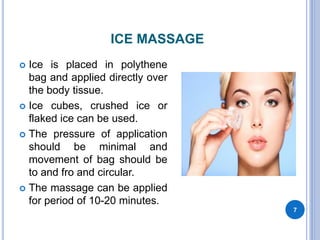
ICE MASSAGE
 Ice is placed in polythene
bag and applied directly over
the body tissue.
 Ice cubes, crushed ice or
flaked ice can be used.
 The pressure of application
should be minimal and
movement of bag should be
to and fro and circular.
 The massage can be applied
for period of 10-20 minutes.
7
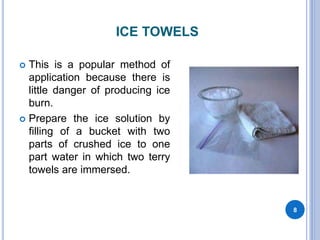
ICE TOWELS
 This is a popular method of
application because there is
little danger of producing ice
burn.
 Prepare the ice solution by
filling of a bucket with two
parts of crushed ice to one
part water in which two terry
towels are immersed.
8
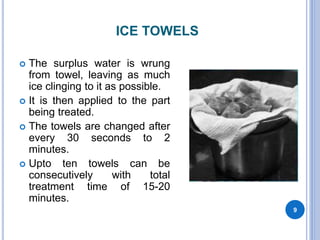
ICE TOWELS
 The surplus water is wrung
from towel, leaving as much
ice clinging to it as possible.
 It is then applied to the part
being treated.
 The towels are changed after
every 30 seconds to 2
minutes.
 Upto ten towels can be
consecutively with total
treatment time of 15-20
minutes.
9
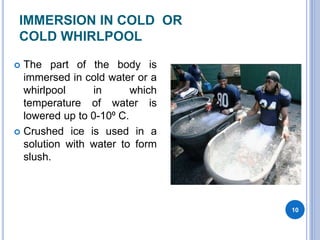
IMMERSION IN COLD OR
COLD WHIRLPOOL
 The part of the body is
immersed in cold water or a
whirlpool in which
temperature of water is
lowered up to 0-10⁰ C.
 Crushed ice is used in a
solution with water to form
slush.
10
 The total duration of the treatment is 10
minutes in which the patient can immerse in
either for a single 10 minute session or for a
series of shorter immersion.
 Treatment time should not exceed more
than 15 minutes.
 Extremities of the body can be effectively
treated with immersion in cold.
 It is indicated when exercising the injured
part during that cold application is desired.
11
COLD PACKS
 Application of ice packs is
the most common form of
cryotherapy.
 These cold packs contain
special material which
retains the cold like silicate
gel.
 These are available in
various sizes and shapes.
12
 Different body parts are treated with
different sizes and shapes of cold packs.
 These packs are stored in a special
refrigeration or freezer for atleast 20
minutes to 1 hour before use.
 The main advantage of these cold packs
are that they are reusable.
 15-20 minutes are adequate for most
therapuetic purpose.
 It should be repeated approximately every 2
hours as needed.
13
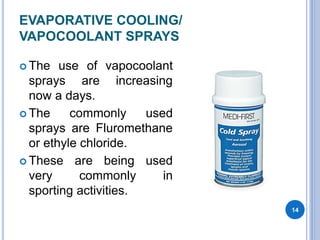
EVAPORATIVE COOLING/
VAPOCOOLANT SPRAYS
 The use of vapocoolant
sprays are increasing
now a days.
 The commonly used
sprays are Fluromethane
or ethyle chloride.
 These are being used
very commonly in
sporting activities.
14
 The jet of spray is
usually applied from a
distance of about 1 feet
or 12 inches.
 Gentle strech is applied
to the tissues after
application of
vapocoolant sprays.
15
EXCITATORY COLD
 The marked sensory stimulus of ice on the skin can
be used to facilitate contraction of inhibited muscle.
 The ice is stroked quickely three times over
dermatome and skin is then dried.
 The increased excitation may supplement the
patient’s willing effort to make the muscle contract.
 This technique of ‘quick ice’ is often useful stimulus
in aiding voluntary contraction of muscle.
16
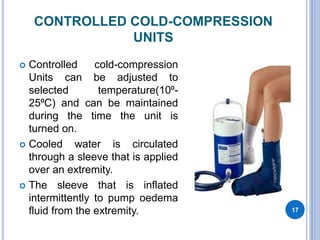
CONTROLLED COLD-COMPRESSION
UNITS
 Controlled cold-compression
Units can be adjusted to
selected temperature(10⁰-
25⁰C) and can be maintained
during the time the unit is
turned on.
 Cooled water is circulated
through a sleeve that is applied
over an extremity.
 The sleeve that is inflated
intermittently to pump oedema
fluid from the extremity. 17
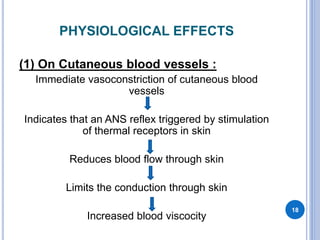
PHYSIOLOGICAL EFFECTS
(1) On Cutaneous blood vessels :
Immediate vasoconstriction of cutaneous blood
vessels
Indicates that an ANS reflex triggered by stimulation
of thermal receptors in skin
Reduces blood flow through skin
Limits the conduction through skin
Increased blood viscocity
18
 After some minutes the vasoconstriction may
give way to a marked vasodilation which is
replaced by another episode of
vasoconstriction.
 This alteration of constriction and dilation is
called the ‘LEWIS HUNTING REACTION’.
(Lewis,1930)
 The response varies from person to person
and does not always show the clear cut
cycling effect.
19
(2) On deeper tissue blood flow :
Effects are less if thickness of overlying
adipose tissue is greater
Deeper tissue cool and rewarm more slowly
than superficial ones
20
(3) On peripheral nervous system :
Rate of conduction of nerve fiber is reduced by cold
A-fibers are affected first followed by B and C fibers
Stimulates the cold receptors
Impulses passes into the spinal cord via posterior root
Stimulates the substantia gelatinosa
Inhibits the functions of T-cells 21
Than, impulses goes to cerebral cortex through lateral
spinothalamic tract
Release endorphine
Relieves the pain
22
THERAPUETIC EFFECTS
(1) Pain Relief :
 By pain gate mechanism
 Increased circulation by cold
 Removes the chemical substances which are
stimulating nocieptors
 Thus, pain is reduced
23
(2) Recent Injury :
 In acute condition, Ice is the best because it will be
calm down the metabolic rate of tissue.
 It will limits the bleeding by vasoconstriction and
increased blood viscocity.
24
(3) Post surgery :
 Limits pain by reducing the rate and extent of
oedema formation
 Reduce local metabolic rate and secondary cell
ischemia and cell necrosis
 Hence, mainly application of cold reduces oedema
formation.
25
(4) Spasticity :
 Short, Brisk application of cold used to increased
muscle tone which will increased spasticity.
 But, The prolonged use of cold can inhibit and
reduce the muscle tone to greater extent. By that it
reduces the spasticity.
26
INDICTAIONS
 Pain Relief
 Muscle Spasm
 Acute muscle strain
 Ligament sprain
 Acute contusion
 Tendinitis
 Delayed onset muscle soreness
 Sports injury
27
CONTRAINDICATIONS
 Cardiac condition
 Peripheral nerve injury
 Peripheral vascular disease/ Vasospastic
disease
 Psychological patient
 Cold sensitive
28
REFERENCES
 Textbook of electrotherapy : Jagmohan
Singh
 Helpline Electrotherapy for Physiotherapist :
Virendra Kr. Khokhar
 Electrotherapy explained principles and
practice, 4th edition : Robertson, ward, Low
and Reed
29
THANK YOU…
30

Cryotherapy

  • 1.
  • 2.
    CRYOTHERAPY  The applicationof cold for various therapuetic purpose is called cryotherapy.  Cryotherapy refers to the use of local or general body cooling for therapuetic purposes.  Cryotherapy is commonly used in the treatment of acute trauma and subacute injury. 2
  • 3.
    FACTORS AFFECTING THEHEAT LOSS  The magnitude of the cooling agent depends upon the,  Area of body tissue exposed  Temperature of cooling agent  Duration of exposure 3
  • 4.
    FACTORS AFFECTING THEHEAT LOSS  Thus, the temperature drop in the tissues will depends upon : (1) The temperature difference between the coolant and the tissue :  The coolder the application the greater heat loss from the tissue. (2)Length of time :  The amount of energy loss is fully depends upon the length of exposure. 4
  • 5.
    FACTORS AFFECTING THEHEAT LOSS (3)The thermal conductivity of the tissues : o Water-filled area such as muscle have a high thermal conductivity as compared to fat. o Thus, the cooling of deeper tissue depend on the nature of overlying tissue. (4)Size of area : o The smaller the area more will be cooling. 5
  • 6.
    METHODS OF APPLICATION The various techniques that are used for administering cold are :  Ice massage  Ice towel  Immersion in cold / Cold whirlpool  Ice packs  Evaporative cooling / Vapocolant sprays  Excitatory Cold  Controlled cold compression unit 6
  • 7.
    ICE MASSAGE  Iceis placed in polythene bag and applied directly over the body tissue.  Ice cubes, crushed ice or flaked ice can be used.  The pressure of application should be minimal and movement of bag should be to and fro and circular.  The massage can be applied for period of 10-20 minutes. 7
  • 8.
    ICE TOWELS  Thisis a popular method of application because there is little danger of producing ice burn.  Prepare the ice solution by filling of a bucket with two parts of crushed ice to one part water in which two terry towels are immersed. 8
  • 9.
    ICE TOWELS  Thesurplus water is wrung from towel, leaving as much ice clinging to it as possible.  It is then applied to the part being treated.  The towels are changed after every 30 seconds to 2 minutes.  Upto ten towels can be consecutively with total treatment time of 15-20 minutes. 9
  • 10.
    IMMERSION IN COLDOR COLD WHIRLPOOL  The part of the body is immersed in cold water or a whirlpool in which temperature of water is lowered up to 0-10⁰ C.  Crushed ice is used in a solution with water to form slush. 10
  • 11.
     The totalduration of the treatment is 10 minutes in which the patient can immerse in either for a single 10 minute session or for a series of shorter immersion.  Treatment time should not exceed more than 15 minutes.  Extremities of the body can be effectively treated with immersion in cold.  It is indicated when exercising the injured part during that cold application is desired. 11
  • 12.
    COLD PACKS  Applicationof ice packs is the most common form of cryotherapy.  These cold packs contain special material which retains the cold like silicate gel.  These are available in various sizes and shapes. 12
  • 13.
     Different bodyparts are treated with different sizes and shapes of cold packs.  These packs are stored in a special refrigeration or freezer for atleast 20 minutes to 1 hour before use.  The main advantage of these cold packs are that they are reusable.  15-20 minutes are adequate for most therapuetic purpose.  It should be repeated approximately every 2 hours as needed. 13
  • 14.
    EVAPORATIVE COOLING/ VAPOCOOLANT SPRAYS The use of vapocoolant sprays are increasing now a days.  The commonly used sprays are Fluromethane or ethyle chloride.  These are being used very commonly in sporting activities. 14
  • 15.
     The jetof spray is usually applied from a distance of about 1 feet or 12 inches.  Gentle strech is applied to the tissues after application of vapocoolant sprays. 15
  • 16.
    EXCITATORY COLD  Themarked sensory stimulus of ice on the skin can be used to facilitate contraction of inhibited muscle.  The ice is stroked quickely three times over dermatome and skin is then dried.  The increased excitation may supplement the patient’s willing effort to make the muscle contract.  This technique of ‘quick ice’ is often useful stimulus in aiding voluntary contraction of muscle. 16
  • 17.
    CONTROLLED COLD-COMPRESSION UNITS  Controlledcold-compression Units can be adjusted to selected temperature(10⁰- 25⁰C) and can be maintained during the time the unit is turned on.  Cooled water is circulated through a sleeve that is applied over an extremity.  The sleeve that is inflated intermittently to pump oedema fluid from the extremity. 17
  • 18.
    PHYSIOLOGICAL EFFECTS (1) OnCutaneous blood vessels : Immediate vasoconstriction of cutaneous blood vessels Indicates that an ANS reflex triggered by stimulation of thermal receptors in skin Reduces blood flow through skin Limits the conduction through skin Increased blood viscocity 18
  • 19.
     After someminutes the vasoconstriction may give way to a marked vasodilation which is replaced by another episode of vasoconstriction.  This alteration of constriction and dilation is called the ‘LEWIS HUNTING REACTION’. (Lewis,1930)  The response varies from person to person and does not always show the clear cut cycling effect. 19
  • 20.
    (2) On deepertissue blood flow : Effects are less if thickness of overlying adipose tissue is greater Deeper tissue cool and rewarm more slowly than superficial ones 20
  • 21.
    (3) On peripheralnervous system : Rate of conduction of nerve fiber is reduced by cold A-fibers are affected first followed by B and C fibers Stimulates the cold receptors Impulses passes into the spinal cord via posterior root Stimulates the substantia gelatinosa Inhibits the functions of T-cells 21
  • 22.
    Than, impulses goesto cerebral cortex through lateral spinothalamic tract Release endorphine Relieves the pain 22
  • 23.
    THERAPUETIC EFFECTS (1) PainRelief :  By pain gate mechanism  Increased circulation by cold  Removes the chemical substances which are stimulating nocieptors  Thus, pain is reduced 23
  • 24.
    (2) Recent Injury:  In acute condition, Ice is the best because it will be calm down the metabolic rate of tissue.  It will limits the bleeding by vasoconstriction and increased blood viscocity. 24
  • 25.
    (3) Post surgery:  Limits pain by reducing the rate and extent of oedema formation  Reduce local metabolic rate and secondary cell ischemia and cell necrosis  Hence, mainly application of cold reduces oedema formation. 25
  • 26.
    (4) Spasticity : Short, Brisk application of cold used to increased muscle tone which will increased spasticity.  But, The prolonged use of cold can inhibit and reduce the muscle tone to greater extent. By that it reduces the spasticity. 26
  • 27.
    INDICTAIONS  Pain Relief Muscle Spasm  Acute muscle strain  Ligament sprain  Acute contusion  Tendinitis  Delayed onset muscle soreness  Sports injury 27
  • 28.
    CONTRAINDICATIONS  Cardiac condition Peripheral nerve injury  Peripheral vascular disease/ Vasospastic disease  Psychological patient  Cold sensitive 28
  • 29.
    REFERENCES  Textbook ofelectrotherapy : Jagmohan Singh  Helpline Electrotherapy for Physiotherapist : Virendra Kr. Khokhar  Electrotherapy explained principles and practice, 4th edition : Robertson, ward, Low and Reed 29
  • 30.