Third Year
McKenzie’s Approach
(Directional preference)
(Mechanical Diagnosis Therapy)
Saurab Sharma, MPT
Lecturer, KUSMS
1
Objectives
• At the end of the class, students will be able to:
• Understand the basic concept of McKenzie
• Explain types of syndromes
• Explain repeated movement testing
• Explain progression of mechanical forces
• Explain traffic light guide
2
Introduction
The McKenzie method of spinal therapy is
“progression of mechanical forces
applied by or to the patient
so that a minimal amount is utilized to effect a
therapeutic change in the presenting
mechanical syndrome.”
3
The Three Syndromes
1. Postural syndrome
2. Dysfunction syndrome
3. Derangement syndrome
4
1. Postural syndrome
• Pain appears after prolonged static loading,
which in turn causes over stretching and
mechanical deformation of normal spinal tissue.
• The pain eases on removal of loading.
5
1. Postural syndrome
Clinical features:
• Usually less than 30 years old
• Sedentary occupation
• Under exercised
• Onset: insidious and gradually worsening
• Pain free when active or moving
• Always intermittent
6
2. Dysfunction syndrome
• Dysfunction pain appears immediately when
shortened spinal tissues are stretched
• The pain eases and then stops on removal of end
range stress.
• Mechanism of pain:
Due to Absence of adequate movement while
tightness of soft tissues is occurring.
7
2. Dysfunction syndrome:
Clinical features
• Usually more than 30 years of age
• Poor posture
• Under exercised
• Progressive loss of movement
• Pain felt at end range NOT during movement
• Early morning stiffness and eases as day
progresses
8
3. Derangement syndrome
• This pain is felt immediately or eventually when
there is an anatomical disruption or
displacement of the intervertebral segment
• Mechanism of pain:
When asymmetrical or unequal loading of spine
occurs, disc protrudes causing pain
9
Derangement syndrome
Clinical features:
• 20- 55 years (lumbar region)
• 12- 55 years (cervical region)
• There is usually a sudden onset of pain
disabling type (within few hours)
10
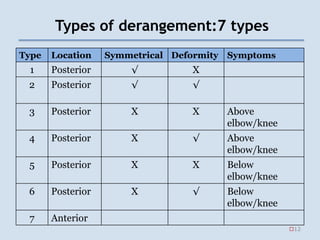
Types of derangement:7 types
Type Location Symmetrical Deformity Symptoms
1 Posterior √ X
2 Posterior √ √
3 Posterior X X Above
elbow/knee
4 Posterior X √ Above
elbow/knee
5 Posterior X X Below
elbow/knee
6 Posterior X √ Below
elbow/knee
7 Anterior
12
Assessment
• History-mechanical/non-mechanical pain,
ergonomic
• Posture
• Neurological examination
• Examination of movement
• Dynamic mechanical evaluation
• Static mechanical evaluation
• Palpation
14
McKenzie method of spinal examination
Repeated movement testing:
• 8 - 15 movements
• Diagnostic, prognostic, therapeutic and
prophylactic value.
15
16
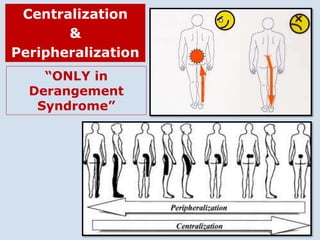
“ONLY in
Derangement
Syndrome”
Centralization
&
Peripheralization
Aims of repeated movement testing:
1. Identify the syndromes responsible for the
patient symptoms
2. Identify any contraindications
3. Predict treatment outcome
4. Identify the correct direction of movement to be
used for treatment
5. Determine the stability of healing following
trauma and derangement
6. Provide guidelines for safe exercising (home
programme)
17
Management of Spinal Disorders
using
McKenzie Technique
20
Management of The Syndromes
Postural Syndrome:
• Removal of all postural stress
• Postural correction and re-education
• Making the patient feel the pain/no pain pattern
for realizing the value of correct posture
21
Management of The Syndromes
Dysfunction Syndrome:
• Remodeling of pathologically shortened
structures by stretching maneuvers
• Postural correction
22
Management of The Syndromes
Derangement Syndrome:
• Using RMT find the correct direction of
movement for therapy and reduce the
derangement
• Maintenance of reduction:
– for posterior derangements: static and
dynamic flexion must be avoided
– for anterior derangement: extension must
be avoided
23
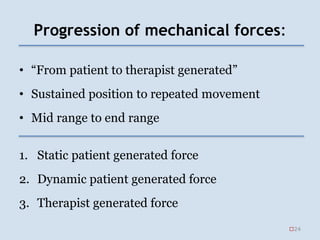
Progression of mechanical forces:
• “From patient to therapist generated”
• Sustained position to repeated movement
• Mid range to end range
1. Static patient generated force
2. Dynamic patient generated force
3. Therapist generated force
24
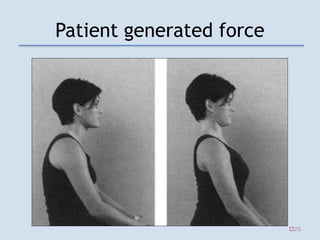
Patient generated force
25
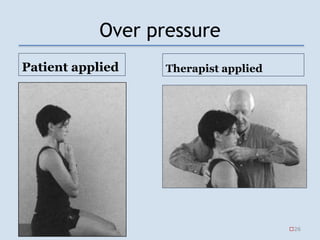
Over pressure
Patient applied Therapist applied
26
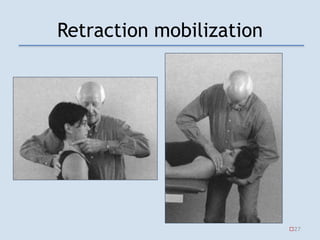
Retraction mobilization
27
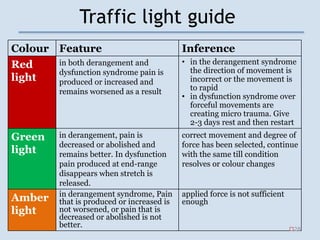
Traffic light guide
Colour Feature Inference
Red
light
in both derangement and
dysfunction syndrome pain is
produced or increased and
remains worsened as a result
• in the derangement syndrome
the direction of movement is
incorrect or the movement is
to rapid
• in dysfunction syndrome over
forceful movements are
creating micro trauma. Give
2-3 days rest and then restart
Green
light
in derangement, pain is
decreased or abolished and
remains better. In dysfunction
pain produced at end-range
disappears when stretch is
released.
correct movement and degree of
force has been selected, continue
with the same till condition
resolves or colour changes
Amber
light
in derangement syndrome, Pain
that is produced or increased is
not worsened, or pain that is
decreased or abolished is not
better.
applied force is not sufficient
enough
28
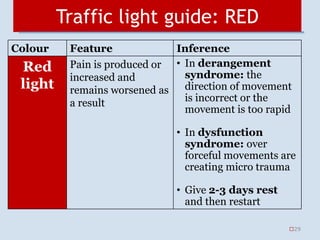
Traffic light guide: RED
Colour Feature Inference
Red
light
Pain is produced or
increased and
remains worsened as
a result
• In derangement
syndrome: the
direction of movement
is incorrect or the
movement is too rapid
• In dysfunction
syndrome: over
forceful movements are
creating micro trauma
• Give 2-3 days rest
and then restart
29
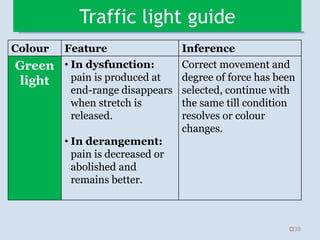
Traffic light guide
Colour Feature Inference
Green
light
• In dysfunction:
pain is produced at
end-range disappears
when stretch is
released.
• In derangement:
pain is decreased or
abolished and
remains better.
Correct movement and
degree of force has been
selected, continue with
the same till condition
resolves or colour
changes.
30
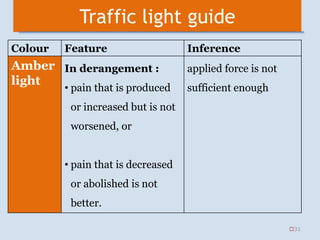
Traffic light guide
Colour Feature Inference
Amber
light
In derangement :
• pain that is produced
or increased but is not
worsened, or
• pain that is decreased
or abolished is not
better.
applied force is not
sufficient enough
31
Summary
• Types of dysfunction
• Aims of repeated movement testing
• Management guidelines
• Progression of mechanical forces
32
References
• Mechanical diagnosis and treatment of Lumbar
Spine, McKenzie R, Volume 1
• Mechanical diagnosis and treatment of cervical
and thoracic spine, McKenzie, Vol 1
33

Mckenzie approach, Mechanical Diagnosis Therapy, Directional preference

  • 1.
    Third Year McKenzie’s Approach (Directionalpreference) (Mechanical Diagnosis Therapy) Saurab Sharma, MPT Lecturer, KUSMS 1
  • 2.
    Objectives • At theend of the class, students will be able to: • Understand the basic concept of McKenzie • Explain types of syndromes • Explain repeated movement testing • Explain progression of mechanical forces • Explain traffic light guide 2
  • 3.
    Introduction The McKenzie methodof spinal therapy is “progression of mechanical forces applied by or to the patient so that a minimal amount is utilized to effect a therapeutic change in the presenting mechanical syndrome.” 3
  • 4.
    The Three Syndromes 1.Postural syndrome 2. Dysfunction syndrome 3. Derangement syndrome 4
  • 5.
    1. Postural syndrome •Pain appears after prolonged static loading, which in turn causes over stretching and mechanical deformation of normal spinal tissue. • The pain eases on removal of loading. 5
  • 6.
    1. Postural syndrome Clinicalfeatures: • Usually less than 30 years old • Sedentary occupation • Under exercised • Onset: insidious and gradually worsening • Pain free when active or moving • Always intermittent 6
  • 7.
    2. Dysfunction syndrome •Dysfunction pain appears immediately when shortened spinal tissues are stretched • The pain eases and then stops on removal of end range stress. • Mechanism of pain: Due to Absence of adequate movement while tightness of soft tissues is occurring. 7
  • 8.
    2. Dysfunction syndrome: Clinicalfeatures • Usually more than 30 years of age • Poor posture • Under exercised • Progressive loss of movement • Pain felt at end range NOT during movement • Early morning stiffness and eases as day progresses 8
  • 9.
    3. Derangement syndrome •This pain is felt immediately or eventually when there is an anatomical disruption or displacement of the intervertebral segment • Mechanism of pain: When asymmetrical or unequal loading of spine occurs, disc protrudes causing pain 9
  • 10.
    Derangement syndrome Clinical features: •20- 55 years (lumbar region) • 12- 55 years (cervical region) • There is usually a sudden onset of pain disabling type (within few hours) 10
  • 11.
    Types of derangement:7types Type Location Symmetrical Deformity Symptoms 1 Posterior √ X 2 Posterior √ √ 3 Posterior X X Above elbow/knee 4 Posterior X √ Above elbow/knee 5 Posterior X X Below elbow/knee 6 Posterior X √ Below elbow/knee 7 Anterior 12
  • 12.
    Assessment • History-mechanical/non-mechanical pain, ergonomic •Posture • Neurological examination • Examination of movement • Dynamic mechanical evaluation • Static mechanical evaluation • Palpation 14
  • 13.
    McKenzie method ofspinal examination Repeated movement testing: • 8 - 15 movements • Diagnostic, prognostic, therapeutic and prophylactic value. 15
  • 14.
  • 15.
    Aims of repeatedmovement testing: 1. Identify the syndromes responsible for the patient symptoms 2. Identify any contraindications 3. Predict treatment outcome 4. Identify the correct direction of movement to be used for treatment 5. Determine the stability of healing following trauma and derangement 6. Provide guidelines for safe exercising (home programme) 17
  • 16.
    Management of SpinalDisorders using McKenzie Technique 20
  • 17.
    Management of TheSyndromes Postural Syndrome: • Removal of all postural stress • Postural correction and re-education • Making the patient feel the pain/no pain pattern for realizing the value of correct posture 21
  • 18.
    Management of TheSyndromes Dysfunction Syndrome: • Remodeling of pathologically shortened structures by stretching maneuvers • Postural correction 22
  • 19.
    Management of TheSyndromes Derangement Syndrome: • Using RMT find the correct direction of movement for therapy and reduce the derangement • Maintenance of reduction: – for posterior derangements: static and dynamic flexion must be avoided – for anterior derangement: extension must be avoided 23
  • 20.
    Progression of mechanicalforces: • “From patient to therapist generated” • Sustained position to repeated movement • Mid range to end range 1. Static patient generated force 2. Dynamic patient generated force 3. Therapist generated force 24
  • 21.
  • 22.
    Over pressure Patient appliedTherapist applied 26
  • 23.
  • 24.
    Traffic light guide ColourFeature Inference Red light in both derangement and dysfunction syndrome pain is produced or increased and remains worsened as a result • in the derangement syndrome the direction of movement is incorrect or the movement is to rapid • in dysfunction syndrome over forceful movements are creating micro trauma. Give 2-3 days rest and then restart Green light in derangement, pain is decreased or abolished and remains better. In dysfunction pain produced at end-range disappears when stretch is released. correct movement and degree of force has been selected, continue with the same till condition resolves or colour changes Amber light in derangement syndrome, Pain that is produced or increased is not worsened, or pain that is decreased or abolished is not better. applied force is not sufficient enough 28
  • 25.
    Traffic light guide:RED Colour Feature Inference Red light Pain is produced or increased and remains worsened as a result • In derangement syndrome: the direction of movement is incorrect or the movement is too rapid • In dysfunction syndrome: over forceful movements are creating micro trauma • Give 2-3 days rest and then restart 29
  • 26.
    Traffic light guide ColourFeature Inference Green light • In dysfunction: pain is produced at end-range disappears when stretch is released. • In derangement: pain is decreased or abolished and remains better. Correct movement and degree of force has been selected, continue with the same till condition resolves or colour changes. 30
  • 27.
    Traffic light guide ColourFeature Inference Amber light In derangement : • pain that is produced or increased but is not worsened, or • pain that is decreased or abolished is not better. applied force is not sufficient enough 31
  • 28.
    Summary • Types ofdysfunction • Aims of repeated movement testing • Management guidelines • Progression of mechanical forces 32
  • 29.
    References • Mechanical diagnosisand treatment of Lumbar Spine, McKenzie R, Volume 1 • Mechanical diagnosis and treatment of cervical and thoracic spine, McKenzie, Vol 1 33

Editor's Notes

  • #6 Pain arises because the spinal soft tissues are getting mechanically deformed due to sustained end range postures and positions.
  • #13 First two are symmetrical, rest assymetrical Odd numbers are without deformity, even numbers are with deformity 3 and 4- above elbow and knee 5 and 6- below elbow and knee
  • #21 How do you think management is done?
  • #29 To decide appropriate mechanical force to be used
  • #30 To decide appropriate mechanical force to be used
  • #31 To decide appropriate mechanical force to be used
  • #32 To decide appropriate mechanical force to be used