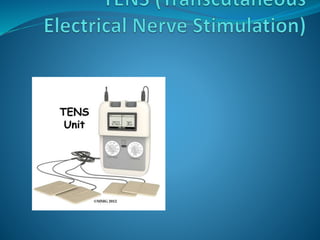
Transcutaneous Electrical Nerve
Stimulation (TENS) TENS is a stimulating device which delivers electrical
current across the intact surface of the skin via surface
electrodes.
 It is a simple, non-invasive, analgesic (acting to relieve
pain) technique. This current is usually generated by
a small battery-operated machines.
 In battery, circuits modify the output in such a way
that it will have a stimulatory effect. TENS is a therapy
that uses low-voltage electrical current for pain relief.
Parameters of TENS:
1)Waveform:
Biphasic waveform (having both the negative and positive phases)
These waveforms can be square, rectangular, sine wave, and triangular spikes.
For hypersensitive patients and the pain associated with nerve injury, used rectangular waves.
The triangular (spike-shaped waves) are recommended for intense or hyper-irritating
stimulation, as done in acute pain or for the resistant tissue.
2)Frequency:
The frequency of TENS can be high (80-120Hz), which is selected for the acute
conditions causing immediate pain relief.
The frequency can be low (1-20Hz), which is used for chronic pain.
3)Pulsed width:
It is the length of time, the current is acting on the patient in each pulse.
The pulse width varies from 50-400 μs.
For normal neuromuscular system, the pulse width selected is from 50-400 μs
Patients with neurologic damage, higher widths of 200-300 μs are suggested.
4)Amplitude:
Most TENS units have an amplitude control ranging from 1mAto100mA
For the immediate relief of pain, referred to the high amplitude and narrow width
combination.
Types of TENS(Modes):
1)Conventional (high TENS)
This mode is used to activate selectively large-diameter Aβ
fibers without concurrently activating small diameter Aδ and C
(pain-related) fibers. Conventional (high-frequency low
intensity) TENS is the most commonly used mode of TENS.
It is effective in modulating acute pain via inhibition of pain fibers
by large diameter fiber activation(gate mechanism). the
stimulation parameters are as follows-
A low intensity: 12-30 mA producing comfortable tingling
sensation and paresthesia, but no muscle contraction.
A high frequency typically above 100 Hz (80-120Hz)
A pulse duration which is usually short (50-80μs)
Duration of treatment: 20-60 minute
As the Aβ fibers are stimulated, this TENS mode achieves analgesia
primarily by spinal segmental mechanisms,i.e. gating effect.
Acupuncture like (low TENS):
It is a common misconception that this mode derives its name from
application over acupuncture points. Acupuncture like(low-frequency
high intensity) TENS primarily stimulates the Aδ and C nociceptive
fibers. the stimulation parameters are:
low frequency usually 2-5Hz
A high intensity: 30mA or more, (enough to produce visible muscle
contraction)
Long pulse duration (150-300μs)
Duration of treatment: 30-40 minutes
The electrode should be positioned to produce visible muscle
contractions. examples- over a myotome related to the painful area, the
intensity should be increased until the patient experience the same
desired muscle contractions.
This mode of TENS is operating primarily through the descending pain
suppression system. Thus there is a relatively longer onset to analgesia,
which lasts more than the conventional TENS.
3) Brief intense TENS:
This mode is used to provide rapid onset, but short term pain relief. It used during
painful procedures done by the clinicians, such as wound debridement, joint
mobilization, etc. the parameters include:
Amplitude: to patient’s tolerance
Pulse rate: 125-250Hz
Pulse duration: 200-250μs
Duration of treatment: 15 minutes
Duration of pain relief: temporary
4) Burst mode(pulse trains) TENS:
This mode of TENS was developed by Eriksson and Sjölund in 1976. The burst
mode provides a packaging of several stimuli in a group ranging from 1-10. It is
presented in a burst of energy. The patient sensed it as a single stimulus. Pain
relief is through the stimulation of endogenous opiates. some patients prefer
this mode because the pulse trains produce a more comfortable muscle
contraction. The parameters include:
Amplitude: comfortable intermittent paresthesia
Frequency:50-100Hz, delivered in packets or bursts of 1-4 Hz
Pulse duration: 50-200 Hz
Duration of treatment: 20-30 minutes
Duration of pain relief: long-lasting
Indications:
 Relief of Acute Pain
 Postoperative pain
 Labour pain
 Musculoskeletal pain
 Bone fracture
 Dental procedures
 Relief of Chronic Pain
 Low back
 Arthritis
 Peripheral nerve injuries
 Angina pectoris
 Facial pain
 Metastatic bone pain
Contraindications:
 Undiagnosed pain (unless recommended by a medical
practitioner)
 Pacemakers (unless recommended by a cardiologist)
 Heart disease (unless recommended by a cardiologist)
 Epilepsy (unless recommended by a medical practitioner)
 Pregnancy: first trimester , over the uterus
 Do not apply TENS: over the carotid sinus, on broken skin,
on dysaesthetic skin, internally (mouth)
TENS and Electrodes:
A variety of TENS models are currently available ranging from single or dual-
channel to multi-channel units.
There is a broad range of types and sizes of electrodes used with TENS. Electrode
can be a carbon rubber electrode. which is made to be covered with a
conductive gel. Probably the most popular choice of electrode is a self-adhesive
type, which comes in a variety of shapes and sizes and can be mold over
irregularly shaped areas of the body.
Electrode Placement for TENS:
One of the primary factors responsible for a poor response to TENS treatment is
that of ineffective electrode placement. Essentially, there are four broad
categories of anatomical sites to which the TENS electrodes can be applied-
Painful area
Peripheral nerve
Spinal nerve root
Other specific points (acupuncture, trigger, motor points)
Interferential Therapy(IFT)
What is Interferential therapy?
 Interferential therapy (IFT) is widely used in
physiotherapy. It is developed by Dr. Hans Nemec of
Vienna, Austria in the early 1950s. It is very helpful in
relieving pain due to muscle spasm and various other kinds
of pain.
 Interferential therapy is a form of electrical treatment in
which we used interferential current.
 As the name suggests, there has to be two current that
interferes with each other resulting in the production of
interferential current.
 When two medium frequency current interferes, they
produce a beat frequency. This beat frequency is termed as
Interferential current. The treatment process through this
current is called as Interferential Therapy.
 The basic principle of interferential therapy (IFT) is to use the
important physiological effects of low-frequency electrical
stimulation of nerve without the associated painful and some
what unpleasant side effects.
 To produce low-frequency effects at sufficient intensity and
sufficient depth, the patient can experience much discomfort in
the superficial tissue(i.e. in the skin).
 This is due to the impedance of the skin.
 Interferential therapy utilizes two of these medium frequency
currents, passed through the tissues simultaneously, where they
interfere with each other.
 This interaction gives rise to an interference current ( or beat
frequency).
 Beat frequency controlled through input frequency.
 for example- one current was at 4100Hz and it’s associate current
at 4000Hz, the resultant beat frequency, would be at 100Hz.
Principle of IFT:
Electrode:
 Mainly two types of electrode used in IFT –
 Suction electrode
 Flat carbon rubber electrode
 The suction electrode has the advantage of allowing the
application to large flat areas or patients who are relatively
immobile.
 Flat carbon rubber electrodes may be easier to apply to the
peripheral limbs, when they may be held in position by bandages
or velcro straps.
Current intensity:
 Always turn the intensity dial to zero before beginning the
treatment.
 The intensity should be slowly turned up until the patient
signals that the required sensation has been reached.
 To neutralize adaptation, adjust intensity periodically.
Treatment duration:
 Treatment time has been reported by most clinicians to be
between 10- 15 minutes.
 Physiological Effects of IFT:
 This depend upon:
 Magnitude of current.
 Type of mode used i.e.rhythmic or constant.
 The frequency range used.
 Accuracy of electrode positioning.
 Main physiological effect are-
 Pain relief
 Muscle stimulation
 Increased local blood flow
 Reduction of edema
 Effect of autonomic nervous system
 Indication:
 Pain- both cases of pain and referred pain.
 Muscle spasm
 Edema
 Hematoma
 Chronic ligament lesion
 Trigger point
 Contraindication:
 Arterial disease
 Hemorrhage
 Skin infection
 Pregnant uterus
 Malignancy
 Pacemakers
 Deep vein thrombosis
 Large open wounds
 Advanced cardiac disease
 Hypertension
 Infection
Paraffin wax bath
 Paraffin wax has been used for many years, it is an
effective medium for heat transfer to the skin and
joint. It is a form of deep heat therapy.
 A paraffin treatment uses warm oil-based (mineral
oil) wax to provide pain relief to hand, feet, and sore
joints and muscles. Liquefied paraffin wax is very
efficient at absorbing and retaining heat.
 The warm paraffin wax applied to the skin makes the
blood vessels expand and therefore helps the
circulation, bringing healing nutrients to the surface
and flushing toxins out of the skin.
 Paraffin Wax Bath Unit:
 Paraffin wax bath therapy is an application of the molten
paraffin wax on the body part. The temperature of the
paraffin wax is maintaining at 42-52°c, whereas its melting
point is 51-55°c.
 If the molten wax at 51-55°c is poured on the body part, it’s
may cause burn over the body tissue, which is why some
impurity is added to lower down its melting point such as
liquid paraffin, mineral oil or petroleum jelly.
 The combination of the paraffin and the mineral oil has
low specific heat which enhances the patient’s ability to
tolerate heat from the paraffin better than from the water
of the same temperature.
 The composition of the solid wax: liquid paraffin:
petroleum jelly is 2:1:1 or Paraffin wax: or mineral oil is 7:1
or 6:1 ratio.
 The mode of the transmission of heat from paraffin to the
patient skin is through conduction.
 Preparation of Patient or Method:
 The nature of wax treatment is explained.
 The area to be treated is inspected for contraindication.
 Look for any wound, skin infection, rashes, etc. on the part
to be treated.
 Cleaned the skin using tissue paper or cotton.
 The jewelry from the part should be removed.
 Tell the patient in brief about the temperature of the wax
and
 Drip down a few drops of molten wax on the dorsal surface
of your hand to check the temperature.
 Psychologically prepare patient and minimized fear of heat
 After the above step the patient is always found to
cooperate and fear of molten wax and heat is removing
from the mind.
Methods
 The part to be treated must be cleaned by soap and
moisture to be soaked by a towel.
 The position of the patient should be such that the
part to be treated comes closer to the wax bath
container.
 Before application one must ensure that there should
be no moisture on the body tissues otherwise burn
could occur.
 The warm wax is placed on the body tissues by various
techniques and the treatment is given for about 10-20
min
 Techniques of Application:
 Various techniques used for the application of paraffin
wax are as follows:
 1)Direct pouring method:
 The molten Wax is directly poured by a mug or utensil
on the part to be treated and then wrapped around by
a towel.
 The wax is allowed to solidify for about 10-20 minutes.
Several (4-6) layers can be made over the body tissues.
 This method applies to areas like the knee, elbow.
 2)Brushing method:
 It is a less commonly used method of paraffin wax
application. In this method, 8-10 coats of wax are applied to
the area with a paintbrush using even and rapid strokes.
 This method is commonly used for areas like the hip, knee,
elbow, shoulder, etc
 The area is then wrapped with a towel for 10-20 minutes
and after this time, paraffin wax is removed
 3)Immersion method:
 This method of application provides somewhat vigorous
 The body part to be treated dipped 3-4 time to form a
thin coat and then left immersed in paraffin wax for 20-
30minutes
 A thin glove of solid paraffin wax formed slows the heat
 The patient is in a comfortable position during the
treatment.
 With the immersion method, the temperature elevation
of body tissue is 2°c higher than the dipping method.
 4)Dipping method:
 It provides mild heating. The patient should wash and dry
the part to be treated. Dipping is repeated until a thick coat
is formed. In other words, at least 8-12 times until thick
glow on a part.
 Once thick glow of wax is formed the treated area should
be wrapped 1st in a plastic and then wrapped with a towel.
 If edema is concerned then the area may be elevated.
 The effective duration of this treatment is 10-15 minutes.
 5)Toweling or bandaging method
 A towel or a roll of bandage is immersed in molten paraffin
wax and then wrapped around the body part.
 Several layers can be made over the body part.
 This method is preferably used for treating proximal parts
of the body.
 Physiological Response:
 1) Heat production:
 There is a marked increase in skin temperature in the 1st two minutes, up
to 12-13°c.
 This drop, while in the wax wrapping to an increase of about 8°c at the
end of 30 minutes.
 In the subcutaneous fascia, there is an increase of 5°c at the end of the
treatment.
 In the superficial muscles, then in only about 2-3°c rise in temperature at
the end of the treatment
 2) Circulating effect:
 Stimulation of superficial capillaries and arterioles causes local
hyperemia and reflex vasodilatation.
 Hyperemia is due to the response of the skin to its function of heat
regulation.
 Skin and subcutaneous tissue temperature drop after15-20 minute,
reducing the vasodilatation
 Exercise after the wax is essential to increase the muscle circulation and
sedative effect of heat to obtain more range of movement and muscle
strength.
 3) Analgesic effect:
 The most important effect of wax its marked sedative
effect on the tissue.
 It is this effect that is used before the exercise, in the
treatment of superficially placed joints.
 4) Stretching effect:
 Wax leaves the skin moist, soft, and pliable.
 This is useful for stretching scar and adhesion before
applying mobilization techniques.
 Indications and Uses of Paraffin Wax Bath:
 Arthritic condition (like rheumatoid arthritis and
other poly or oligo arthritic conditions.)
 Pain (sprain, strain affecting the small distal joint)
 Stiff joints (following trauma or disease)
 Chronic inflammation
 Contraindication:
 Open wound
 Skin infection
 Defective skin sensation
 Ischemic conditions
 Skin allergy

Tens

  • 2.
    Transcutaneous Electrical Nerve Stimulation(TENS) TENS is a stimulating device which delivers electrical current across the intact surface of the skin via surface electrodes.  It is a simple, non-invasive, analgesic (acting to relieve pain) technique. This current is usually generated by a small battery-operated machines.  In battery, circuits modify the output in such a way that it will have a stimulatory effect. TENS is a therapy that uses low-voltage electrical current for pain relief.
  • 3.
    Parameters of TENS: 1)Waveform: Biphasicwaveform (having both the negative and positive phases) These waveforms can be square, rectangular, sine wave, and triangular spikes. For hypersensitive patients and the pain associated with nerve injury, used rectangular waves. The triangular (spike-shaped waves) are recommended for intense or hyper-irritating stimulation, as done in acute pain or for the resistant tissue. 2)Frequency: The frequency of TENS can be high (80-120Hz), which is selected for the acute conditions causing immediate pain relief. The frequency can be low (1-20Hz), which is used for chronic pain. 3)Pulsed width: It is the length of time, the current is acting on the patient in each pulse. The pulse width varies from 50-400 μs. For normal neuromuscular system, the pulse width selected is from 50-400 μs Patients with neurologic damage, higher widths of 200-300 μs are suggested. 4)Amplitude: Most TENS units have an amplitude control ranging from 1mAto100mA For the immediate relief of pain, referred to the high amplitude and narrow width combination.
  • 4.
    Types of TENS(Modes): 1)Conventional(high TENS) This mode is used to activate selectively large-diameter Aβ fibers without concurrently activating small diameter Aδ and C (pain-related) fibers. Conventional (high-frequency low intensity) TENS is the most commonly used mode of TENS. It is effective in modulating acute pain via inhibition of pain fibers by large diameter fiber activation(gate mechanism). the stimulation parameters are as follows- A low intensity: 12-30 mA producing comfortable tingling sensation and paresthesia, but no muscle contraction. A high frequency typically above 100 Hz (80-120Hz) A pulse duration which is usually short (50-80μs) Duration of treatment: 20-60 minute As the Aβ fibers are stimulated, this TENS mode achieves analgesia primarily by spinal segmental mechanisms,i.e. gating effect.
  • 5.
    Acupuncture like (lowTENS): It is a common misconception that this mode derives its name from application over acupuncture points. Acupuncture like(low-frequency high intensity) TENS primarily stimulates the Aδ and C nociceptive fibers. the stimulation parameters are: low frequency usually 2-5Hz A high intensity: 30mA or more, (enough to produce visible muscle contraction) Long pulse duration (150-300μs) Duration of treatment: 30-40 minutes The electrode should be positioned to produce visible muscle contractions. examples- over a myotome related to the painful area, the intensity should be increased until the patient experience the same desired muscle contractions. This mode of TENS is operating primarily through the descending pain suppression system. Thus there is a relatively longer onset to analgesia, which lasts more than the conventional TENS.
  • 6.
    3) Brief intenseTENS: This mode is used to provide rapid onset, but short term pain relief. It used during painful procedures done by the clinicians, such as wound debridement, joint mobilization, etc. the parameters include: Amplitude: to patient’s tolerance Pulse rate: 125-250Hz Pulse duration: 200-250μs Duration of treatment: 15 minutes Duration of pain relief: temporary 4) Burst mode(pulse trains) TENS: This mode of TENS was developed by Eriksson and Sjölund in 1976. The burst mode provides a packaging of several stimuli in a group ranging from 1-10. It is presented in a burst of energy. The patient sensed it as a single stimulus. Pain relief is through the stimulation of endogenous opiates. some patients prefer this mode because the pulse trains produce a more comfortable muscle contraction. The parameters include: Amplitude: comfortable intermittent paresthesia Frequency:50-100Hz, delivered in packets or bursts of 1-4 Hz Pulse duration: 50-200 Hz Duration of treatment: 20-30 minutes Duration of pain relief: long-lasting
  • 7.
    Indications:  Relief ofAcute Pain  Postoperative pain  Labour pain  Musculoskeletal pain  Bone fracture  Dental procedures  Relief of Chronic Pain  Low back  Arthritis  Peripheral nerve injuries  Angina pectoris  Facial pain  Metastatic bone pain
  • 8.
    Contraindications:  Undiagnosed pain(unless recommended by a medical practitioner)  Pacemakers (unless recommended by a cardiologist)  Heart disease (unless recommended by a cardiologist)  Epilepsy (unless recommended by a medical practitioner)  Pregnancy: first trimester , over the uterus  Do not apply TENS: over the carotid sinus, on broken skin, on dysaesthetic skin, internally (mouth)
  • 9.
    TENS and Electrodes: Avariety of TENS models are currently available ranging from single or dual- channel to multi-channel units. There is a broad range of types and sizes of electrodes used with TENS. Electrode can be a carbon rubber electrode. which is made to be covered with a conductive gel. Probably the most popular choice of electrode is a self-adhesive type, which comes in a variety of shapes and sizes and can be mold over irregularly shaped areas of the body. Electrode Placement for TENS: One of the primary factors responsible for a poor response to TENS treatment is that of ineffective electrode placement. Essentially, there are four broad categories of anatomical sites to which the TENS electrodes can be applied- Painful area Peripheral nerve Spinal nerve root Other specific points (acupuncture, trigger, motor points)
  • 10.
  • 11.
    What is Interferentialtherapy?  Interferential therapy (IFT) is widely used in physiotherapy. It is developed by Dr. Hans Nemec of Vienna, Austria in the early 1950s. It is very helpful in relieving pain due to muscle spasm and various other kinds of pain.  Interferential therapy is a form of electrical treatment in which we used interferential current.  As the name suggests, there has to be two current that interferes with each other resulting in the production of interferential current.  When two medium frequency current interferes, they produce a beat frequency. This beat frequency is termed as Interferential current. The treatment process through this current is called as Interferential Therapy.
  • 12.
     The basicprinciple of interferential therapy (IFT) is to use the important physiological effects of low-frequency electrical stimulation of nerve without the associated painful and some what unpleasant side effects.  To produce low-frequency effects at sufficient intensity and sufficient depth, the patient can experience much discomfort in the superficial tissue(i.e. in the skin).  This is due to the impedance of the skin.  Interferential therapy utilizes two of these medium frequency currents, passed through the tissues simultaneously, where they interfere with each other.  This interaction gives rise to an interference current ( or beat frequency).  Beat frequency controlled through input frequency.  for example- one current was at 4100Hz and it’s associate current at 4000Hz, the resultant beat frequency, would be at 100Hz. Principle of IFT:
  • 13.
    Electrode:  Mainly twotypes of electrode used in IFT –  Suction electrode  Flat carbon rubber electrode  The suction electrode has the advantage of allowing the application to large flat areas or patients who are relatively immobile.  Flat carbon rubber electrodes may be easier to apply to the peripheral limbs, when they may be held in position by bandages or velcro straps. Current intensity:  Always turn the intensity dial to zero before beginning the treatment.  The intensity should be slowly turned up until the patient signals that the required sensation has been reached.  To neutralize adaptation, adjust intensity periodically. Treatment duration:  Treatment time has been reported by most clinicians to be between 10- 15 minutes.
  • 14.
     Physiological Effectsof IFT:  This depend upon:  Magnitude of current.  Type of mode used i.e.rhythmic or constant.  The frequency range used.  Accuracy of electrode positioning.  Main physiological effect are-  Pain relief  Muscle stimulation  Increased local blood flow  Reduction of edema  Effect of autonomic nervous system
  • 15.
     Indication:  Pain-both cases of pain and referred pain.  Muscle spasm  Edema  Hematoma  Chronic ligament lesion  Trigger point  Contraindication:  Arterial disease  Hemorrhage  Skin infection  Pregnant uterus  Malignancy  Pacemakers  Deep vein thrombosis  Large open wounds  Advanced cardiac disease  Hypertension  Infection
  • 16.
  • 17.
     Paraffin waxhas been used for many years, it is an effective medium for heat transfer to the skin and joint. It is a form of deep heat therapy.  A paraffin treatment uses warm oil-based (mineral oil) wax to provide pain relief to hand, feet, and sore joints and muscles. Liquefied paraffin wax is very efficient at absorbing and retaining heat.  The warm paraffin wax applied to the skin makes the blood vessels expand and therefore helps the circulation, bringing healing nutrients to the surface and flushing toxins out of the skin.
  • 18.
     Paraffin WaxBath Unit:  Paraffin wax bath therapy is an application of the molten paraffin wax on the body part. The temperature of the paraffin wax is maintaining at 42-52°c, whereas its melting point is 51-55°c.  If the molten wax at 51-55°c is poured on the body part, it’s may cause burn over the body tissue, which is why some impurity is added to lower down its melting point such as liquid paraffin, mineral oil or petroleum jelly.  The combination of the paraffin and the mineral oil has low specific heat which enhances the patient’s ability to tolerate heat from the paraffin better than from the water of the same temperature.  The composition of the solid wax: liquid paraffin: petroleum jelly is 2:1:1 or Paraffin wax: or mineral oil is 7:1 or 6:1 ratio.  The mode of the transmission of heat from paraffin to the patient skin is through conduction.
  • 19.
     Preparation ofPatient or Method:  The nature of wax treatment is explained.  The area to be treated is inspected for contraindication.  Look for any wound, skin infection, rashes, etc. on the part to be treated.  Cleaned the skin using tissue paper or cotton.  The jewelry from the part should be removed.  Tell the patient in brief about the temperature of the wax and  Drip down a few drops of molten wax on the dorsal surface of your hand to check the temperature.  Psychologically prepare patient and minimized fear of heat  After the above step the patient is always found to cooperate and fear of molten wax and heat is removing from the mind.
  • 20.
    Methods  The partto be treated must be cleaned by soap and moisture to be soaked by a towel.  The position of the patient should be such that the part to be treated comes closer to the wax bath container.  Before application one must ensure that there should be no moisture on the body tissues otherwise burn could occur.  The warm wax is placed on the body tissues by various techniques and the treatment is given for about 10-20 min
  • 21.
     Techniques ofApplication:  Various techniques used for the application of paraffin wax are as follows:  1)Direct pouring method:  The molten Wax is directly poured by a mug or utensil on the part to be treated and then wrapped around by a towel.  The wax is allowed to solidify for about 10-20 minutes. Several (4-6) layers can be made over the body tissues.  This method applies to areas like the knee, elbow.
  • 22.
     2)Brushing method: It is a less commonly used method of paraffin wax application. In this method, 8-10 coats of wax are applied to the area with a paintbrush using even and rapid strokes.  This method is commonly used for areas like the hip, knee, elbow, shoulder, etc  The area is then wrapped with a towel for 10-20 minutes and after this time, paraffin wax is removed
  • 23.
     3)Immersion method: This method of application provides somewhat vigorous  The body part to be treated dipped 3-4 time to form a thin coat and then left immersed in paraffin wax for 20- 30minutes  A thin glove of solid paraffin wax formed slows the heat  The patient is in a comfortable position during the treatment.  With the immersion method, the temperature elevation of body tissue is 2°c higher than the dipping method.
  • 24.
     4)Dipping method: It provides mild heating. The patient should wash and dry the part to be treated. Dipping is repeated until a thick coat is formed. In other words, at least 8-12 times until thick glow on a part.  Once thick glow of wax is formed the treated area should be wrapped 1st in a plastic and then wrapped with a towel.  If edema is concerned then the area may be elevated.  The effective duration of this treatment is 10-15 minutes.  5)Toweling or bandaging method  A towel or a roll of bandage is immersed in molten paraffin wax and then wrapped around the body part.  Several layers can be made over the body part.  This method is preferably used for treating proximal parts of the body.
  • 25.
     Physiological Response: 1) Heat production:  There is a marked increase in skin temperature in the 1st two minutes, up to 12-13°c.  This drop, while in the wax wrapping to an increase of about 8°c at the end of 30 minutes.  In the subcutaneous fascia, there is an increase of 5°c at the end of the treatment.  In the superficial muscles, then in only about 2-3°c rise in temperature at the end of the treatment  2) Circulating effect:  Stimulation of superficial capillaries and arterioles causes local hyperemia and reflex vasodilatation.  Hyperemia is due to the response of the skin to its function of heat regulation.  Skin and subcutaneous tissue temperature drop after15-20 minute, reducing the vasodilatation  Exercise after the wax is essential to increase the muscle circulation and sedative effect of heat to obtain more range of movement and muscle strength.
  • 26.
     3) Analgesiceffect:  The most important effect of wax its marked sedative effect on the tissue.  It is this effect that is used before the exercise, in the treatment of superficially placed joints.  4) Stretching effect:  Wax leaves the skin moist, soft, and pliable.  This is useful for stretching scar and adhesion before applying mobilization techniques.
  • 27.
     Indications andUses of Paraffin Wax Bath:  Arthritic condition (like rheumatoid arthritis and other poly or oligo arthritic conditions.)  Pain (sprain, strain affecting the small distal joint)  Stiff joints (following trauma or disease)  Chronic inflammation  Contraindication:  Open wound  Skin infection  Defective skin sensation  Ischemic conditions  Skin allergy