Subject: Electrotherapy and
Hydrotherapy
Topic: LASER
Presented by :Afsana Mimi
Abu Zaher Rahat
Boisakhi Banik
Rina Parvin
Presentation on "LASER"
 Introduction of laser
 Properties
 Types
 Wavelenth
 Component of laser production
 How laser produce
 Physiological effects
 Therapeutic effects
 Use and effecs of cold laser
 Indication and Contraindication
 Principles of application
 Dosage parameters
 Danger.
 1.Monochromaticity: This means that the laser light has
a single colour , mono means single chromaticity
means coloration. This is because the lasers are of a
single wavelength and thus the definite frequency .
 2. Coherence : Laser radition are not of the same
wavelength but also has same phase. Coherence means
similar or synchronous behavior of laser beam.

 3.Collimation: Laser beams remain collimated that
means they remain in parallel. They do not diverge
much and the energy can be propagated over a larger
distance ( Jagmohan , 2012).
 Most commonly used laser are :
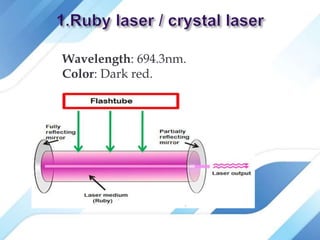
 1.Ruby laser / Crystal laser
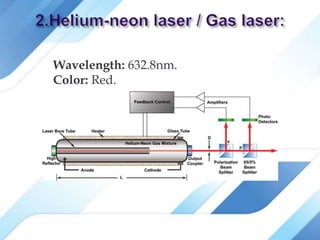
 2.Helium-neon laser / Gas laser
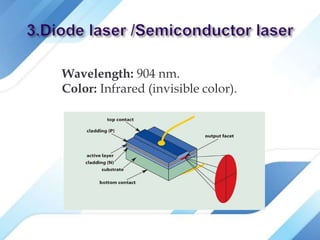
 3.Diode laser /Semiconductor laser
Wavelength: 694.3nm.
Color: Dark red.
Wavelength: 632.8nm.
Color: Red.
Wavelength: 904 nm.
Color: Infrared (invisible color).
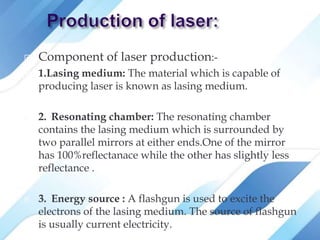
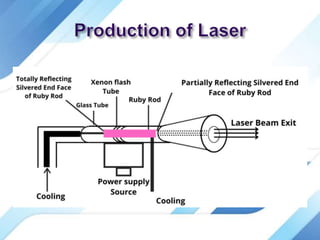
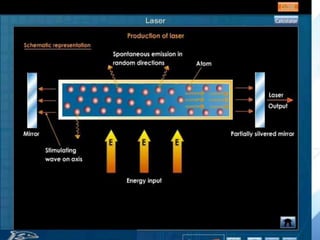
 Component of laser production:-
 1.Lasing medium: The material which is capable of
producing laser is known as lasing medium.
 2. Resonating chamber: The resonating chamber
contains the lasing medium which is surrounded by
two parallel mirrors at either ends.One of the mirror
has 100%reflectanace while the other has slightly less
reflectance .
 3. Energy source : A flashgun is used to excite the
electrons of the lasing medium. The source of flashgun
is usually current electricity.
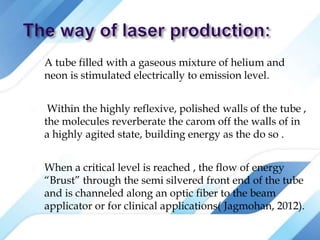
 A tube filled with a gaseous mixture of helium and
neon is stimulated electrically to emission level.
 Within the highly reflexive, polished walls of the tube ,
the molecules reverberate the carom off the walls of in
a highly agited state, building energy as the do so .
 When a critical level is reached , the flow of energy
“Brust” through the semi silvered front end of the tube
and is channeled along an optic fiber to the beam
applicator or for clinical applications( Jagmohan, 2012).
 1.Wound healing
 2.Analgesic effects
 3. Musculoskeletal condition
 4.Bactericidal effects
 5.Inflammatory condition
 6.Bone and articular cartilage ( Jagmohan,
2012).
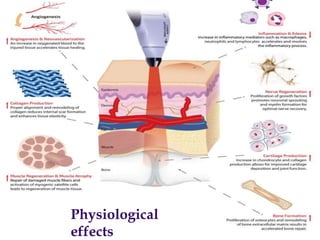
Physiological
effects
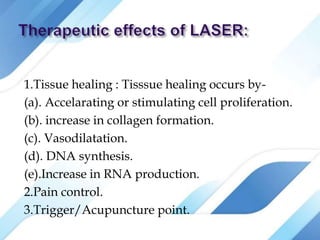
1.Tissue healing : Tisssue healing occurs by-
(a). Accelarating or stimulating cell proliferation.
(b). increase in collagen formation.
(c). Vasodilatation.
(d). DNA synthesis.
(e).Increase in RNA production.
2.Pain control.
3.Trigger/Acupuncture point.
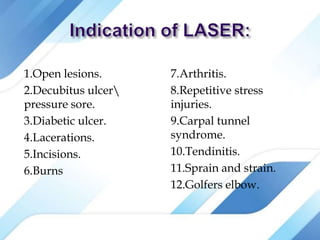
1.Open lesions.
2.Decubitus ulcer
pressure sore.
3.Diabetic ulcer.
4.Lacerations.
5.Incisions.
6.Burns
7.Arthritis.
8.Repetitive stress
injuries.
9.Carpal tunnel
syndrome.
10.Tendinitis.
11.Sprain and strain.
12.Golfers elbow.
1.Eye.
2.Neoplastic tissue.
3.Pregnant uterus.
4.Haemorrhage.
5.Thyroid gland.
 Arthritis pain.
 Back pain.
 Carpal tunnel syndrome.
 Fibromyalgia pain.
 Knee pain.
 Neck pain
 Tendonitis(Alexandra Schnee,2009)
For musculoskeletal disorders the efficacy seems
to be better than for a placebo treatment .For
rheumatoid arthritis,post traumatic joint disorder
and myofascial pain, laser therapy seemed to
have a substantial therapeutic effect.
In a study of use of laser laser therapy in clinical
practice,found that over 50% of respondents felt
that soft tissue injuries and wound healing
including burns responded particularly well to
treatment (John 2000).
 Preparation of the patient : Explain the
patient about nature of the treatment and aware
to wear goggles or spectacles.
 Preparation of the apparatus: The surface of
the skin to be treated is cleaned with an alcohol
wipe in oder to remove any material on the
surface that might absorb or scatter the radiation
. The part is supported in such a way that any
pressure of the laser applicator does not cause
movement or discomfort.
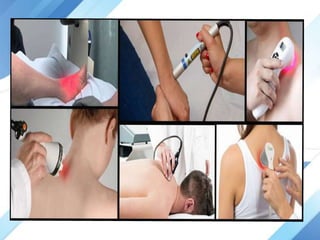
 Application: A key usually activate the
machine and ensures that unauthorized people
do not switch the laser on .The laser applicator is
applied to the surface before switching on .It is
important to maintain the laser applicator in
contact with the tissues so that the beam is
applied at right angle in oeder to achieve
maximum penetration.
 If , contact is not desired , for example because of
an infected wound , the applicator may be held
just off the surface or covered with transparent
non reflective film.
 In all other circumstances firm contact should be
maintained throughout treatment but should
not provoke pain where tenderness is present .
The position is maintained for the necessary time
.
 Termination: The device is switch off before
removing the applicator from skin contact. The
details of dosage and any patient response ,such
as immediate increase or decrease pain are noted
and recorded,plus the parameters of dosage
(Jhon, 2000).
Wavelength:It depends on the lasing medium
used-
(a). Visible red laser : Used for superficial
conditions like wound and ulcers.
(b). Infrared laser :Used for deep condition such
as muscles and bone.
(c) Cluster probe laser: It having several diodes
and are used for larger area of soft tissues.
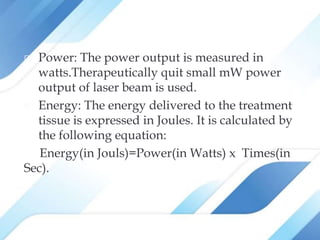
 Power: The power output is measured in
watts.Therapeutically quit small mW power
output of laser beam is used.
 Energy: The energy delivered to the treatment
tissue is expressed in Joules. It is calculated by
the following equation:
Energy(in Jouls)=Power(in Watts) x Times(in
Sec).
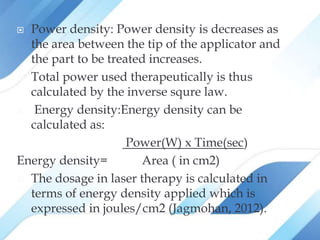
 Power density: Power density is decreases as
the area between the tip of the applicator and
the part to be treated increases.
 Total power used therapeutically is thus
calculated by the inverse squre law.
 Energy density:Energy density can be
calculated as:
Power(W) x Time(sec)
Energy density= Area ( in cm2)
 The dosage in laser therapy is calculated in
terms of energy density applied which is
expressed in joules/cm2 (Jagmohan, 2012).
 1.The main danger involvg LASER therapy is a
risk of eye damage if the beam is directly
applied into the eye.
 2.It is also dangerous that the LASER beam can
be almost totally reflected from any shiny
surface(Jhon,2000).
 1.John Low & Ann Reed (2000).Electrotherapy
Explained Principles and Practice, Third
edition. A devision of Reed Educational and
Professional Publishing Ltd.
 2.Jagmohan Singh (2012).Textbook of
Electrotherapy, Second edition. Jaypee Brothers
Medical Publisher LTD.
 3. Alexandra Schnee( 2009).Web page –Spine
Health.
Thank
You….

LASER - Presentation on Laser in Electrotherapy

  • 1.
    Subject: Electrotherapy and Hydrotherapy Topic:LASER Presented by :Afsana Mimi Abu Zaher Rahat Boisakhi Banik Rina Parvin Presentation on "LASER"
  • 2.
     Introduction oflaser  Properties  Types  Wavelenth  Component of laser production  How laser produce  Physiological effects  Therapeutic effects  Use and effecs of cold laser  Indication and Contraindication  Principles of application  Dosage parameters  Danger.
  • 5.
     1.Monochromaticity: Thismeans that the laser light has a single colour , mono means single chromaticity means coloration. This is because the lasers are of a single wavelength and thus the definite frequency .  2. Coherence : Laser radition are not of the same wavelength but also has same phase. Coherence means similar or synchronous behavior of laser beam.   3.Collimation: Laser beams remain collimated that means they remain in parallel. They do not diverge much and the energy can be propagated over a larger distance ( Jagmohan , 2012).
  • 6.
     Most commonlyused laser are :  1.Ruby laser / Crystal laser  2.Helium-neon laser / Gas laser  3.Diode laser /Semiconductor laser
  • 7.
  • 8.
  • 9.
    Wavelength: 904 nm. Color:Infrared (invisible color).
  • 10.
     Component oflaser production:-  1.Lasing medium: The material which is capable of producing laser is known as lasing medium.  2. Resonating chamber: The resonating chamber contains the lasing medium which is surrounded by two parallel mirrors at either ends.One of the mirror has 100%reflectanace while the other has slightly less reflectance .  3. Energy source : A flashgun is used to excite the electrons of the lasing medium. The source of flashgun is usually current electricity.
  • 12.
     A tubefilled with a gaseous mixture of helium and neon is stimulated electrically to emission level.  Within the highly reflexive, polished walls of the tube , the molecules reverberate the carom off the walls of in a highly agited state, building energy as the do so .  When a critical level is reached , the flow of energy “Brust” through the semi silvered front end of the tube and is channeled along an optic fiber to the beam applicator or for clinical applications( Jagmohan, 2012).
  • 14.
     1.Wound healing 2.Analgesic effects  3. Musculoskeletal condition  4.Bactericidal effects  5.Inflammatory condition  6.Bone and articular cartilage ( Jagmohan, 2012).
  • 15.
  • 16.
    1.Tissue healing :Tisssue healing occurs by- (a). Accelarating or stimulating cell proliferation. (b). increase in collagen formation. (c). Vasodilatation. (d). DNA synthesis. (e).Increase in RNA production. 2.Pain control. 3.Trigger/Acupuncture point.
  • 18.
    1.Open lesions. 2.Decubitus ulcer pressuresore. 3.Diabetic ulcer. 4.Lacerations. 5.Incisions. 6.Burns 7.Arthritis. 8.Repetitive stress injuries. 9.Carpal tunnel syndrome. 10.Tendinitis. 11.Sprain and strain. 12.Golfers elbow.
  • 19.
  • 20.
     Arthritis pain. Back pain.  Carpal tunnel syndrome.  Fibromyalgia pain.  Knee pain.  Neck pain  Tendonitis(Alexandra Schnee,2009)
  • 21.
    For musculoskeletal disordersthe efficacy seems to be better than for a placebo treatment .For rheumatoid arthritis,post traumatic joint disorder and myofascial pain, laser therapy seemed to have a substantial therapeutic effect. In a study of use of laser laser therapy in clinical practice,found that over 50% of respondents felt that soft tissue injuries and wound healing including burns responded particularly well to treatment (John 2000).
  • 22.
     Preparation ofthe patient : Explain the patient about nature of the treatment and aware to wear goggles or spectacles.  Preparation of the apparatus: The surface of the skin to be treated is cleaned with an alcohol wipe in oder to remove any material on the surface that might absorb or scatter the radiation . The part is supported in such a way that any pressure of the laser applicator does not cause movement or discomfort.
  • 23.
     Application: Akey usually activate the machine and ensures that unauthorized people do not switch the laser on .The laser applicator is applied to the surface before switching on .It is important to maintain the laser applicator in contact with the tissues so that the beam is applied at right angle in oeder to achieve maximum penetration.  If , contact is not desired , for example because of an infected wound , the applicator may be held just off the surface or covered with transparent non reflective film.
  • 25.
     In allother circumstances firm contact should be maintained throughout treatment but should not provoke pain where tenderness is present . The position is maintained for the necessary time .  Termination: The device is switch off before removing the applicator from skin contact. The details of dosage and any patient response ,such as immediate increase or decrease pain are noted and recorded,plus the parameters of dosage (Jhon, 2000).
  • 26.
    Wavelength:It depends onthe lasing medium used- (a). Visible red laser : Used for superficial conditions like wound and ulcers. (b). Infrared laser :Used for deep condition such as muscles and bone. (c) Cluster probe laser: It having several diodes and are used for larger area of soft tissues.
  • 27.
     Power: Thepower output is measured in watts.Therapeutically quit small mW power output of laser beam is used.  Energy: The energy delivered to the treatment tissue is expressed in Joules. It is calculated by the following equation: Energy(in Jouls)=Power(in Watts) x Times(in Sec).
  • 28.
     Power density:Power density is decreases as the area between the tip of the applicator and the part to be treated increases.  Total power used therapeutically is thus calculated by the inverse squre law.  Energy density:Energy density can be calculated as: Power(W) x Time(sec) Energy density= Area ( in cm2)  The dosage in laser therapy is calculated in terms of energy density applied which is expressed in joules/cm2 (Jagmohan, 2012).
  • 29.
     1.The maindanger involvg LASER therapy is a risk of eye damage if the beam is directly applied into the eye.  2.It is also dangerous that the LASER beam can be almost totally reflected from any shiny surface(Jhon,2000).
  • 30.
     1.John Low& Ann Reed (2000).Electrotherapy Explained Principles and Practice, Third edition. A devision of Reed Educational and Professional Publishing Ltd.  2.Jagmohan Singh (2012).Textbook of Electrotherapy, Second edition. Jaypee Brothers Medical Publisher LTD.  3. Alexandra Schnee( 2009).Web page –Spine Health.
  • 31.