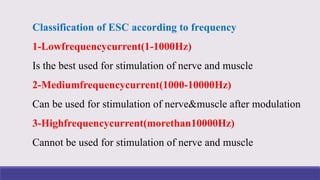
Classification of ESCaccording to frequency
1-Lowfrequencycurrent(1-1000Hz)
Is the best used for stimulation of nerve and muscle
2-Mediumfrequencycurrent(1000-10000Hz)
Can be used for stimulation of nerve&muscle after modulation
3-Highfrequencycurrent(morethan10000Hz)
Cannot be used for stimulation of nerve and muscle
Transcutaneous electrical nervestimulation
(TENS)(asymmetric biphasic current)
is a modality that uses surface electrodes to deliver a
pulsed electrical current through the skin to stimulate
nerves for the purpose of controlling and relieving pain.
The word ―transcutaneous‖ means through the skin and
―nerve stimulation‖ refers to the current having enough
intensity to depolarize sensory nerves.
6.
THE PHYSIOLOGICAL EFFECTOF TENS
The physiological effect of TENS is selective depolarization of
afferent nerves. Electrodes are placed on the skin, usually at
the site of the pain.
By adjusting different parameters on a TENS unit, the clinician
can change the patient‘s perception of acute and chronic pain.
7.
TENS MODES
There arethree major modes of TENS, each applied by
modulating the intensity and beat frequency (adjustable
pulses per second [pps]):
8.
• Sensory TENS(Conventional or High
Frequency TENS):
Used to treat acute pain by stimulating large-diameter
sensory nerves (Aβ).
The beat frequency is high (80–200 pps), pulse width
50-200 microsecond, and the intensity is adjusted to
the point where the patient reports a buzzing or
tingling (comfortable non painful parenthesia).
This is conventional or traditional TENS.
9.
• Motor TENS(Acupuncture or Low Frequency
TEN):
Used to treat chronic pain by stimulating small-diameter
afferent nerves (Aб).
The beat frequency is low (1–5 pps), pulse width 100-400
microsecond and the intensity is higher than sensory TENS
(to the patient‘s tolerance).
The patient reports some burning, needling sensation, and a
slight muscle twitch.
10.
Brief-intense TENS:
Usedto treat chronic pain prior to rehabilitation by stimulating
C fibers.
The beat frequency high
The intensity is also higher than sensory TENS (to the patient‘s
tolerance).
The patient reports some burning, needling sensation, and
twitch and tetanic muscle contractions.
Primary use isto control pain
1. The gate control system
• The gate control system is typically activated by sensory
TENS mode,
• Pain relief by means of the pain gate mechanism
involves activation (excitation) of the A beta (Aβ) sensory
fibers, and by doing so, reduces the transmission of the
noxious stimulus from the 'c' fibers, through the spinal cord
and hence on to the higher centers. The Aβ fibers appear to
appreciate being stimulated at a relatively high rate (in the
order of 80 - 130 Hz or pps).
13.
2. The opiatesystem.
• The opiate system is activated by motor TENS and
brief-intense TENS modes.
• An alternative approach is to stimulate the A delta (Aб)
fibres which respond preferentially to a much lower rate of
stimulation (in the order of 2 - 5 Hz, though some authors
consider a wider range of 2 - 10Hz), which will activate the
opioid mechanisms,and provide pain relief by causing the
release of an endogenous opiate (encephalin) in the spinal
cord which will reduce the activation of the noxious sensory
pathways.
14.
3.A third possibilityis to stimulate both nerve types at
the same time by employing burst mode stimulation.
• In this instance, the higher frequency stimulation output
(typically at about 100Hz) is interrupted (or burst) at the rate of
about 2 - 3 bursts per second. When the machine is 'on', it will
deliver pulses at the 100Hz rate, thereby activating the Aβ fibers
and the pain gate mechanism, but by virtue of the rate of the
burst, each burst will produce excitation in the Aб fibers,
therefore stimulating the opioid mechanisms. For some patients
this is by far the most effective approach to pain relief, though
as a sensation.
15.
• Numerous patientsfind it less acceptable than
some other forms of TENS as there is more of a
'grabbing', 'clawing' type sensation and usually more
by way of muscle twitching than with the high or low
frequency modes
16.
Making tens therapymore effective
To be successful in using TENS, consider the following:
• Do not treat all your patients the same (e.g., don‘t use
blanket protocol for everyone). Patients are not alike;
therefore, parameters, electrode placements, and treatment
protocols need to be modified to meet the needs of
individual patients.
17.
• Be flexible.Scientists are unclear regarding which
TENS mode is more effective under which conditions. It
might be best to start with sensory TENS because it is
easily tolerated by the patient. If the patient doesn‘t
respond, progress to either motor TENS or brief-intense
TENS.
• TENS by itself is not a cure for pain, but it can
relieve pain long enough to help a patient complete an
exercise session or get a good night‘s sleep.
![TENS MODES
There are three major modes of TENS, each applied by
modulating the intensity and beat frequency (adjustable
pulses per second [pps]):](https://image.slidesharecdn.com/transcutaneouselectricalnervestimulationtens-250224140327-44ca9f36/85/Transcutaneous-Electrical-Nerve-Stimulation-TENS-pptx-7-320.jpg)