• It is the modern, non-invasive, drug free pain
management modality
• Designed to provide afferent stimulation,
• Used for relief of acute or chronic pain.
• It is a method of applying electrical current to
stimulate the nerves across the skin, mainly
to modulate pain.
• Application of pulsed wave current via
surface electrodes on the patient skin.
• Abbreviated as TNS or TENS.
By increasing local area circulation.
Physiological block.
Pain gait theory.
Activation of Descending pain
suppression system.
• Tissue injury releases chemicals at the site that
stimulates nociceptive nerve endings.
• Through peripheral nerve pain reaches spinal
cord & then from brain stem to the cortex where
pain is appreciated.
• Pain decreases if we remove chemicals from local
area by increasing local circulation.
• Nociceptive stimulus is carried to the cord
along:-
• C fibers (slow conducting 15 pulses per
second, non myelinated fibers)
• A delta fibers (faster 40 pulses per second,
myelinated fibers)
• If a higher frequency of stimulation is applied,
a physiological block to conduction might
occur.
Modalities
• TENS
• Interferential therapy.
• Postulated by Melzack & wall in 1965.
• Afferent information must pass through synapses in
the substantia gelatinosa and nucleus proprius of
the posterior horn of spinal cord, here the pain gate
works.
• If input is predominantly small diameter
nociceptive in nature then gait is open to pain.
• If large diameter afferent information (through
thermo & mechanoreceptor) is superimposed, then
gait is closed to the nociceptive stimulus.
• TENS, IF, heat, ice, massage, vibration, joint
mobilization.
• If nociceptive stimulus is passed through gait, it travels
through lateral spinothalmic tract up to the brainstem,
thalamus and finally to the cortex where pain is
perceived.
• As it passes the mid brain, it interacts with PAG
(periaqueductal gray) & raphe nucleus.
• Their descending neurons release endogenous opiates
(endorphin & enkephalin) which inhibit the
transmission of nociceptive stimulus at spinal cord.
• Low TENS, brief icing, transverse friction, manipulation.
• Alteration of the sensitivity of peripheral
receptors of free nerve ending which conduct
and transmit the nociceptive stimulation
• Increased blood circulation may be caused
by muscle contraction and relaxation (burst or
rhythmic stimulation)
• .
•Externally applied electrical potential
from TENS must produce evolved
potentials in underlying peripheral
sensory nerve or receptor in the skin.
•Stimulus must be adequate to cause
depolarization of the nerve cell
membrane.
•High-rate TENS
•Low-rate TENS
•Brief intense TENS
•Burst mode TENS
•Point stimulation TENS
• Most common mode of TENS used in acute
or chronic pain syndrome.
• It is based on sensory level stimulation
• Activates gait control mechanism by
Stimulation of large diameter afferent fibers.
Pre-synaptic inhibition of pain carrying fibers
at substantia gelatinosa of the pain gate, by
large diameter fibers.
• Effect is rapid but transient
• i.e. no pain is felt as long as the current is on.
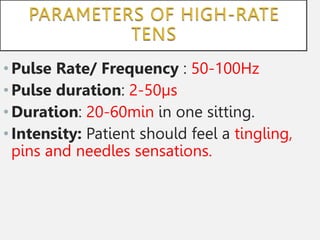
•Pulse Rate/ Frequency : 50-100Hz
•Pulse duration: 2-50µs
•Duration: 20-60min in one sitting.
•Intensity: Patient should feel a tingling,
pins and needles sensations.
• This is acupuncture like strong low frequency
stimulus, used in relief of chronic pain.
• It is based on motor-level stimulation
• Modulation of pain is through activation of
Descending pain suppression system.
• Effect is relatively slow but lasts longer i.e.
more than hours after the treatment.
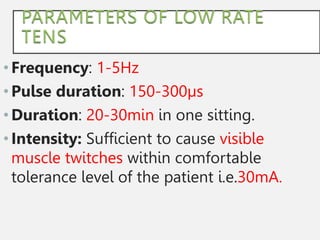
•Frequency: 1-5Hz
•Pulse duration: 150-300µs
•Duration: 20-30min in one sitting.
•Intensity: Sufficient to cause visible
muscle twitches within comfortable
tolerance level of the patient i.e.30mA.
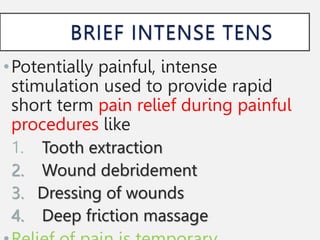
•Potentially painful, intense
stimulation used to provide rapid
short term pain relief during painful
procedures like
1. Tooth extraction
2. Wound debridement
3. Dressing of wounds
4. Deep friction massage
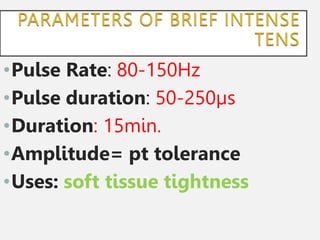
•Pulse Rate: 80-150Hz
•Pulse duration: 50-250µs
•Duration: 15min.
•Amplitude= pt tolerance
•Uses: soft tissue tightness
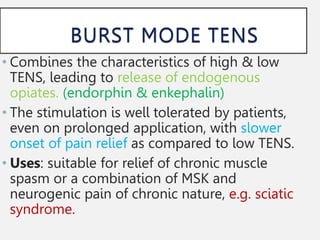
• Combines the characteristics of high & low
TENS, leading to release of endogenous
opiates. (endorphin & enkephalin)
• The stimulation is well tolerated by patients,
even on prolonged application, with slower
onset of pain relief as compared to low TENS.
• Uses: suitable for relief of chronic muscle
spasm or a combination of MSK and
neurogenic pain of chronic nature, e.g. sciatic
syndrome.
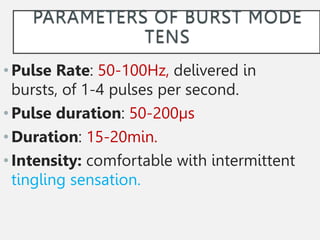
•Pulse Rate: 50-100Hz, delivered in
bursts, of 1-4 pulses per second.
•Pulse duration: 50-200µs
•Duration: 15-20min.
•Intensity: comfortable with intermittent
tingling sensation.
•It uses a small probe to located and
noxiously stimulate trigger points
•Multiple sites can be stimulated in one
treatment
•It relieve pain by Endorphin
mediated mechanism
•Pulse Rate: 1-5pps
•Pulse duration: 150-300µs
•Amplitude: Strong- to patient
tolerance
•Electrode Placement: Over the pain
site; can be placed over the nearest
trigger points.
•An optimal stimulation or site
should be:
Strong enough to stimulate the
CNS.
Suitable for proper placement of
electrodes, free of bony or hairy
area.
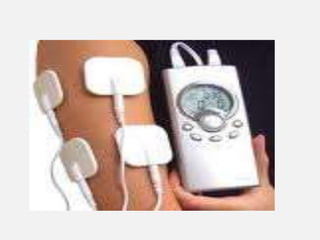
• Large main units.
• Pocket size.
• Conductive rubber electrodes covered by
conductive gel to gain good skin contact.
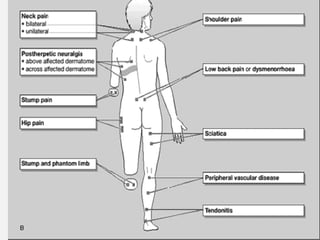
• Electrode positioning is an area of debate.
electrodes can be placed over:
Area of greatest intensity of pain.
Appropriate dermatome or spinal segment or
peripheral nerve.
•Gradual and continuous change in
one or more than one parameters of
TENS current to prevent
accommodation
•Changes in frequency or pulse width
or amplitude
•Frequency, Pulse width modulation,
Amplitude, Burst Modulation
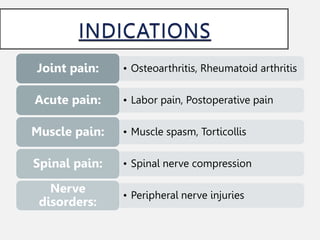
• Osteoarthritis, Rheumatoid arthritis
Joint pain:
• Labor pain, Postoperative pain
Acute pain:
• Muscle spasm, Torticollis
Muscle pain:
• Spinal nerve compression
Spinal pain:
• Peripheral nerve injuries
Nerve
disorders:
Cardiac pacemakers
Over chest wall of cardiac patient.
Over eyes, larynx, pharynx, over mucosal
membrane.
Over head and neck of a patient with the
recent history of stroke or epilepsy.
TENS Trans cutaneous electrical nerves stimulation

TENS Trans cutaneous electrical nerves stimulation

  • 2.
    • It isthe modern, non-invasive, drug free pain management modality • Designed to provide afferent stimulation, • Used for relief of acute or chronic pain. • It is a method of applying electrical current to stimulate the nerves across the skin, mainly to modulate pain. • Application of pulsed wave current via surface electrodes on the patient skin. • Abbreviated as TNS or TENS.
  • 4.
    By increasing localarea circulation. Physiological block. Pain gait theory. Activation of Descending pain suppression system.
  • 5.
    • Tissue injuryreleases chemicals at the site that stimulates nociceptive nerve endings. • Through peripheral nerve pain reaches spinal cord & then from brain stem to the cortex where pain is appreciated. • Pain decreases if we remove chemicals from local area by increasing local circulation.
  • 6.
    • Nociceptive stimulusis carried to the cord along:- • C fibers (slow conducting 15 pulses per second, non myelinated fibers) • A delta fibers (faster 40 pulses per second, myelinated fibers) • If a higher frequency of stimulation is applied, a physiological block to conduction might occur. Modalities • TENS • Interferential therapy.
  • 7.
    • Postulated byMelzack & wall in 1965. • Afferent information must pass through synapses in the substantia gelatinosa and nucleus proprius of the posterior horn of spinal cord, here the pain gate works. • If input is predominantly small diameter nociceptive in nature then gait is open to pain. • If large diameter afferent information (through thermo & mechanoreceptor) is superimposed, then gait is closed to the nociceptive stimulus. • TENS, IF, heat, ice, massage, vibration, joint mobilization.
  • 8.
    • If nociceptivestimulus is passed through gait, it travels through lateral spinothalmic tract up to the brainstem, thalamus and finally to the cortex where pain is perceived. • As it passes the mid brain, it interacts with PAG (periaqueductal gray) & raphe nucleus. • Their descending neurons release endogenous opiates (endorphin & enkephalin) which inhibit the transmission of nociceptive stimulus at spinal cord. • Low TENS, brief icing, transverse friction, manipulation.
  • 9.
    • Alteration ofthe sensitivity of peripheral receptors of free nerve ending which conduct and transmit the nociceptive stimulation • Increased blood circulation may be caused by muscle contraction and relaxation (burst or rhythmic stimulation) • .
  • 10.
    •Externally applied electricalpotential from TENS must produce evolved potentials in underlying peripheral sensory nerve or receptor in the skin. •Stimulus must be adequate to cause depolarization of the nerve cell membrane.
  • 11.
    •High-rate TENS •Low-rate TENS •Briefintense TENS •Burst mode TENS •Point stimulation TENS
  • 12.
    • Most commonmode of TENS used in acute or chronic pain syndrome. • It is based on sensory level stimulation • Activates gait control mechanism by Stimulation of large diameter afferent fibers. Pre-synaptic inhibition of pain carrying fibers at substantia gelatinosa of the pain gate, by large diameter fibers. • Effect is rapid but transient • i.e. no pain is felt as long as the current is on.
  • 13.
    •Pulse Rate/ Frequency: 50-100Hz •Pulse duration: 2-50µs •Duration: 20-60min in one sitting. •Intensity: Patient should feel a tingling, pins and needles sensations.
  • 14.
    • This isacupuncture like strong low frequency stimulus, used in relief of chronic pain. • It is based on motor-level stimulation • Modulation of pain is through activation of Descending pain suppression system. • Effect is relatively slow but lasts longer i.e. more than hours after the treatment.
  • 15.
    •Frequency: 1-5Hz •Pulse duration:150-300µs •Duration: 20-30min in one sitting. •Intensity: Sufficient to cause visible muscle twitches within comfortable tolerance level of the patient i.e.30mA.
  • 16.
    •Potentially painful, intense stimulationused to provide rapid short term pain relief during painful procedures like 1. Tooth extraction 2. Wound debridement 3. Dressing of wounds 4. Deep friction massage
  • 17.
    •Pulse Rate: 80-150Hz •Pulseduration: 50-250µs •Duration: 15min. •Amplitude= pt tolerance •Uses: soft tissue tightness
  • 18.
    • Combines thecharacteristics of high & low TENS, leading to release of endogenous opiates. (endorphin & enkephalin) • The stimulation is well tolerated by patients, even on prolonged application, with slower onset of pain relief as compared to low TENS. • Uses: suitable for relief of chronic muscle spasm or a combination of MSK and neurogenic pain of chronic nature, e.g. sciatic syndrome.
  • 19.
    •Pulse Rate: 50-100Hz,delivered in bursts, of 1-4 pulses per second. •Pulse duration: 50-200µs •Duration: 15-20min. •Intensity: comfortable with intermittent tingling sensation.
  • 20.
    •It uses asmall probe to located and noxiously stimulate trigger points •Multiple sites can be stimulated in one treatment •It relieve pain by Endorphin mediated mechanism
  • 21.
    •Pulse Rate: 1-5pps •Pulseduration: 150-300µs •Amplitude: Strong- to patient tolerance •Electrode Placement: Over the pain site; can be placed over the nearest trigger points.
  • 22.
    •An optimal stimulationor site should be: Strong enough to stimulate the CNS. Suitable for proper placement of electrodes, free of bony or hairy area.
  • 24.
    • Large mainunits. • Pocket size. • Conductive rubber electrodes covered by conductive gel to gain good skin contact. • Electrode positioning is an area of debate. electrodes can be placed over: Area of greatest intensity of pain. Appropriate dermatome or spinal segment or peripheral nerve.
  • 25.
    •Gradual and continuouschange in one or more than one parameters of TENS current to prevent accommodation •Changes in frequency or pulse width or amplitude •Frequency, Pulse width modulation, Amplitude, Burst Modulation
  • 26.
    • Osteoarthritis, Rheumatoidarthritis Joint pain: • Labor pain, Postoperative pain Acute pain: • Muscle spasm, Torticollis Muscle pain: • Spinal nerve compression Spinal pain: • Peripheral nerve injuries Nerve disorders:
  • 27.
    Cardiac pacemakers Over chestwall of cardiac patient. Over eyes, larynx, pharynx, over mucosal membrane. Over head and neck of a patient with the recent history of stroke or epilepsy.

Editor's Notes

  • #8 Nucleus prpsrious.. Layer of spinal cord
  • #9 Periaquadectal gray