Electric
Shock
13386
WWhathat IIss AAnn EElectriclectric SShockhock
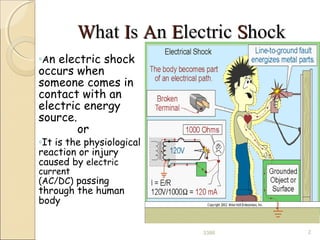
◦An electric shock
occurs when
someone comes in
contact with an
electric energy
source.
or
◦It is the physiological
reaction or injury
caused by electric
current
(AC/DC) passing
through the human
body
23386
HHowow CCan youan you GGetet AAnn EElectriclectric SShockhock
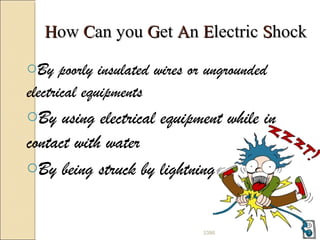
oBy poorly insulated wires or ungrounded
electrical equipments
oBy using electrical equipment while in
contact with water
oBy being struck by lightning
33386
WWhathat HHappensappens WWhenhen YYouou GGetet AAnn
EElectriclectric SShockhock
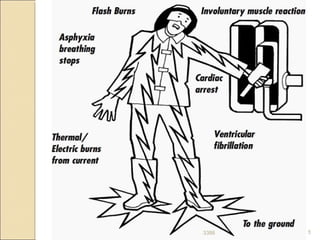
An electric shock can have no
injury at all
Burns (which are the most
common)
Cardiac arrest due to the
electrical effect on the heart
Muscle, nerve, and tissue
destruction from a current
passing through the body
Death (electrocution)
43386
53386
Factors determining the severity ofFactors determining the severity of
electric shockelectric shock
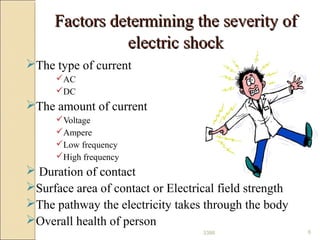
The type of current
AC
DC
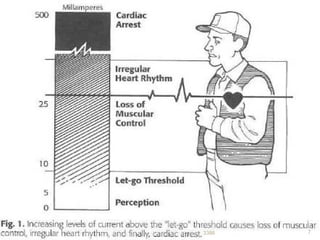
The amount of current
Voltage
Ampere
Low frequency
High frequency
 Duration of contact
Surface area of contact or Electrical field strength
The pathway the electricity takes through the body
Overall health of person
63386
73386
SymptomsSymptoms
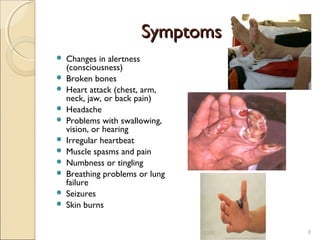
 Changes in alertness
(consciousness)
 Broken bones
 Heart attack (chest, arm,
neck, jaw, or back pain)
 Headache
 Problems with swallowing,
vision, or hearing
 Irregular heartbeat
 Muscle spasms and pain
 Numbness or tingling
 Breathing problems or lung
failure
 Seizures
 Skin burns
83386
DiagnosisDiagnosis
◦Electrocardiogram
◦complete blood count
◦Urine test for muscle enzymes
◦X-Ray
◦CT scan
93386
What to do at THE time of electricWhat to do at THE time of electric
shockshock
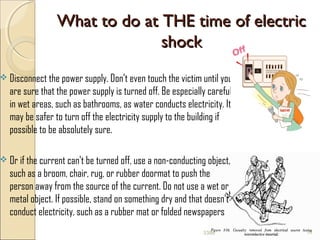
 Disconnect the power supply. Don’t even touch the victim until you
are sure that the power supply is turned off. Be especially careful
in wet areas, such as bathrooms, as water conducts electricity. It
may be safer to turn off the electricity supply to the building if
possible to be absolutely sure.
 Or if the current can't be turned off, use a non-conducting object,
such as a broom, chair, rug, or rubber doormat to push the
person away from the source of the current. Do not use a wet or
metal object. If possible, stand on something dry and that doesn't
conduct electricity, such as a rubber mat or folded newspapers
103386
What to NOT do at the time ofWhat to NOT do at the time of
electric shockelectric shock
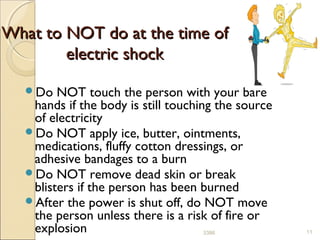
Do NOT touch the person with your bare
hands if the body is still touching the source
of electricity
Do NOT apply ice, butter, ointments,
medications, fluffy cotton dressings, or
adhesive bandages to a burn
Do NOT remove dead skin or break
blisters if the person has been burned
After the power is shut off, do NOT move
the person unless there is a risk of fire or
explosion 113386
First AidFirst Aid
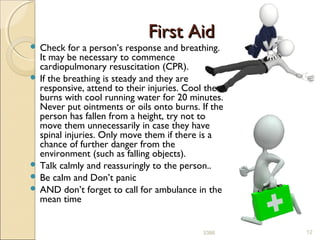
 Check for a person’s response and breathing.
It may be necessary to commence
cardiopulmonary resuscitation (CPR).
 If the breathing is steady and they are
responsive, attend to their injuries. Cool the
burns with cool running water for 20 minutes.
Never put ointments or oils onto burns. If the
person has fallen from a height, try not to
move them unnecessarily in case they have
spinal injuries. Only move them if there is a
chance of further danger from the
environment (such as falling objects).
 Talk calmly and reassuringly to the person..
 Be calm and Don’t panic
 AND don’t forget to call for ambulance in the
mean time
123386
TreatmentTreatment
Examine patients completely, including for
traumatic injuries
Resuscitation
Analgesia
Wound care
cardiac monitoring for 6 to 12 h for the patient
with following
Arrhythmias
Chest pain
Any suggestion of cardiac damage
Pregnancy
Known heart disorders
133386
In addition to burn injuries,AC can freeze
the patient's hand to the current source,
while DC can throw the patient, causing
injury.
Although skin burn severity does not predict
the degree of internal damage, internal
damage is more severe if the skin has low
resistance.
Refer patients with significant electrical
burns to a specialized burn unit and, if
significant internal damage is suspected,
begin fluid resuscitation.
143386

Electric shock

  • 1.
  • 2.
    WWhathat IIss AAnnEElectriclectric SShockhock ◦An electric shock occurs when someone comes in contact with an electric energy source. or ◦It is the physiological reaction or injury caused by electric current (AC/DC) passing through the human body 23386
  • 3.
    HHowow CCan youanyou GGetet AAnn EElectriclectric SShockhock oBy poorly insulated wires or ungrounded electrical equipments oBy using electrical equipment while in contact with water oBy being struck by lightning 33386
  • 4.
    WWhathat HHappensappens WWhenhenYYouou GGetet AAnn EElectriclectric SShockhock An electric shock can have no injury at all Burns (which are the most common) Cardiac arrest due to the electrical effect on the heart Muscle, nerve, and tissue destruction from a current passing through the body Death (electrocution) 43386
  • 5.
  • 6.
    Factors determining theseverity ofFactors determining the severity of electric shockelectric shock The type of current AC DC The amount of current Voltage Ampere Low frequency High frequency  Duration of contact Surface area of contact or Electrical field strength The pathway the electricity takes through the body Overall health of person 63386
  • 7.
  • 8.
    SymptomsSymptoms  Changes inalertness (consciousness)  Broken bones  Heart attack (chest, arm, neck, jaw, or back pain)  Headache  Problems with swallowing, vision, or hearing  Irregular heartbeat  Muscle spasms and pain  Numbness or tingling  Breathing problems or lung failure  Seizures  Skin burns 83386
  • 9.
    DiagnosisDiagnosis ◦Electrocardiogram ◦complete blood count ◦Urinetest for muscle enzymes ◦X-Ray ◦CT scan 93386
  • 10.
    What to doat THE time of electricWhat to do at THE time of electric shockshock  Disconnect the power supply. Don’t even touch the victim until you are sure that the power supply is turned off. Be especially careful in wet areas, such as bathrooms, as water conducts electricity. It may be safer to turn off the electricity supply to the building if possible to be absolutely sure.  Or if the current can't be turned off, use a non-conducting object, such as a broom, chair, rug, or rubber doormat to push the person away from the source of the current. Do not use a wet or metal object. If possible, stand on something dry and that doesn't conduct electricity, such as a rubber mat or folded newspapers 103386
  • 11.
    What to NOTdo at the time ofWhat to NOT do at the time of electric shockelectric shock Do NOT touch the person with your bare hands if the body is still touching the source of electricity Do NOT apply ice, butter, ointments, medications, fluffy cotton dressings, or adhesive bandages to a burn Do NOT remove dead skin or break blisters if the person has been burned After the power is shut off, do NOT move the person unless there is a risk of fire or explosion 113386
  • 12.
    First AidFirst Aid Check for a person’s response and breathing. It may be necessary to commence cardiopulmonary resuscitation (CPR).  If the breathing is steady and they are responsive, attend to their injuries. Cool the burns with cool running water for 20 minutes. Never put ointments or oils onto burns. If the person has fallen from a height, try not to move them unnecessarily in case they have spinal injuries. Only move them if there is a chance of further danger from the environment (such as falling objects).  Talk calmly and reassuringly to the person..  Be calm and Don’t panic  AND don’t forget to call for ambulance in the mean time 123386
  • 13.
    TreatmentTreatment Examine patients completely,including for traumatic injuries Resuscitation Analgesia Wound care cardiac monitoring for 6 to 12 h for the patient with following Arrhythmias Chest pain Any suggestion of cardiac damage Pregnancy Known heart disorders 133386
  • 14.
    In addition toburn injuries,AC can freeze the patient's hand to the current source, while DC can throw the patient, causing injury. Although skin burn severity does not predict the degree of internal damage, internal damage is more severe if the skin has low resistance. Refer patients with significant electrical burns to a specialized burn unit and, if significant internal damage is suspected, begin fluid resuscitation. 143386

Editor's Notes