Sreeraj S R
Sreeraj S R
Hot Packs are a way of transferring heat to
the patient by conduction.
Commercial hot packs is one of the most
common ways to deliver superficial moist
heat.
The heating unit is called a HYDROCOLLATOR
UNIT
Sreeraj S R
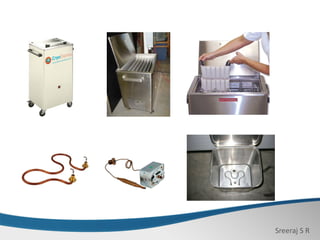
The hydro-collator unit is a stainless steel tank in which silica
gel packs or BENTONITE crystal packs are heated.
The capacities of the machines vary, and all units have
insulated bases, the larger machines being insulated with
fiberglass.
The units contain a wire rack which acts as divider for the
packs and prevents contact of packs with the bottom of the
tank.
Sreeraj S R
These packs are stored in thermostatically
controlled and maintains water in the unit at a
temperature between 70°C and 80°C.
It can be left on continuously as long as there is
enough water in the tank.
A hydrocollator pack is good in any situation that
requires penetrating heat.
Sreeraj S R
Sreeraj S R
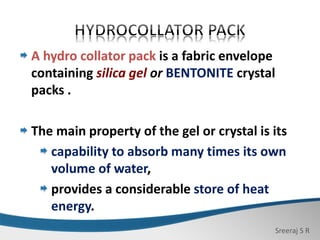
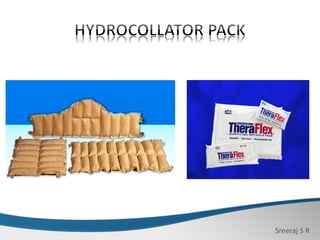
A hydro collator pack is a fabric envelope
containing silica gel or BENTONITE crystal
packs .
The main property of the gel or crystal is its
capability to absorb many times its own
volume of water,
provides a considerable store of heat
energy.
Sreeraj S R
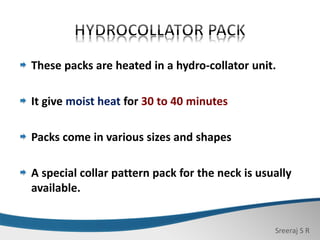
These packs are heated in a hydro-collator unit.
It give moist heat for 30 to 40 minutes
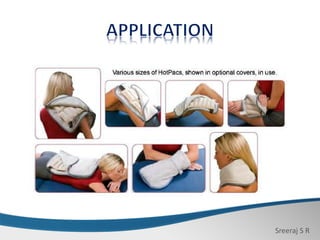
Packs come in various sizes and shapes
A special collar pattern pack for the neck is usually
available.
Sreeraj S R
Sreeraj S R
The packs are wrapped in:
 Turkish towels – 6- 8 layers of toweling
 Special / commercial terry cloth blankets
 Large packs may be wrapped in bath
blankets .
 The packs last about six months.
 When they begin to wear out the filler
leaks out and makes the water cloudy;
they should then be replaced.
Sreeraj S R
The pack is applied to the body after being
wrapped adequately in toweling or blankets.
This provides THERMAL INSULATION
The pack is at above 75˚C &
The skin temperature does not rise above
42˚C or so.
Sreeraj S R
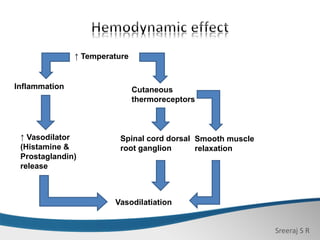
Hemodynamic effect
Neuromuscular effect
Metabolic effect
Tissue extensibility
Sreeraj S R
↑ Temperature
Inflammation
↑ Vasodilator
(Histamine &
Prostaglandin)
release
Vasodilatiation
Cutaneous
thermoreceptors
Spinal cord dorsal
root ganglion
Smooth muscle
relaxation
Sreeraj S R
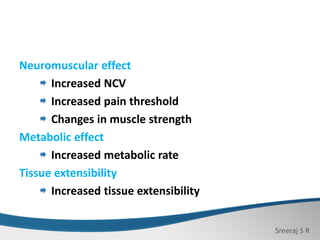
Neuromuscular effect
Increased NCV
Increased pain threshold
Changes in muscle strength
Metabolic effect
Increased metabolic rate
Tissue extensibility
Increased tissue extensibility
Sreeraj S R
1.Pain
2.Muscle spasm
3.Inflammation.
4.Edema.
5.Adhesions.
Sreeraj S R
1. Impaired Skin Sensation
2. Circulatory dysfunction
3. Analgesic drugs
4. Infections and open wounds
5. Cancer and Tuberculosis
6. Gross Oedema
7. Lack of Comprehension
8. Deep X-Ray Therapy
9. Liniment
Sreeraj S R
1. A hydro-collator pack is easy to apply
2. The packs are of various sizes which fit most clinical
needs.
3. Moist heat has a more sedative effect than dry heat.
4. low cost, minimal maintenance, long life
5. Maximal temperatures are more uniform than in
electrically-heated pads.
6. The patient does not need much handling.
7. The pads can be laid out ready for the patient to place
on the affected part.
Sreeraj S R
1. A hydro-collator pack is not easily applied
around shoulders and hips.
2. It is somewhat heavy and should not be
used on extremely sensitive patients, since
it can create discomfort.
3. Sometimes moist packs have a tendency to
cause a skin rash.
Sreeraj S R
BURNS may occur due to;
Insufficient toweling
The temperature of the pack could be too
high
Impaired circulation
DEHYDRATION – Excessive sweating may
produce dehydration
Sreeraj S R
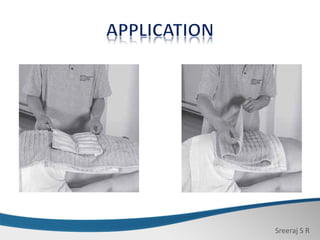
Remove the pack from the unit & place it on
the towel.
Fold another towel into 4 – 6 layers & place it
over the pack.
Wrap the whole pack up with the bottom
towel.
The temperature of the wrapped pack should
not exceed the 44˚C
Sreeraj S R
Monitor the initial response from the patient to
treatment during the first 5 to 10 min
ask the patient for feedback & by visually inspecting
the skin.
If necessary, adjust the layers of toweling.
During the treatment maintain the position of hot
pack
ensure that it does not exacerbate pain,
produce discomfort or occlude circulation.
Sreeraj S R
Sreeraj S R
Sreeraj S R
The water level should be kept up to 3/4th full
of water or slightly over the top of the packs
at all times
The unit should be cleaned periodically
Sreeraj S R

Hydrocollator pack

  • 1.
  • 2.
    Sreeraj S R HotPacks are a way of transferring heat to the patient by conduction. Commercial hot packs is one of the most common ways to deliver superficial moist heat. The heating unit is called a HYDROCOLLATOR UNIT
  • 3.
    Sreeraj S R Thehydro-collator unit is a stainless steel tank in which silica gel packs or BENTONITE crystal packs are heated. The capacities of the machines vary, and all units have insulated bases, the larger machines being insulated with fiberglass. The units contain a wire rack which acts as divider for the packs and prevents contact of packs with the bottom of the tank.
  • 4.
    Sreeraj S R Thesepacks are stored in thermostatically controlled and maintains water in the unit at a temperature between 70°C and 80°C. It can be left on continuously as long as there is enough water in the tank. A hydrocollator pack is good in any situation that requires penetrating heat.
  • 5.
  • 6.
    Sreeraj S R Ahydro collator pack is a fabric envelope containing silica gel or BENTONITE crystal packs . The main property of the gel or crystal is its capability to absorb many times its own volume of water, provides a considerable store of heat energy.
  • 7.
    Sreeraj S R Thesepacks are heated in a hydro-collator unit. It give moist heat for 30 to 40 minutes Packs come in various sizes and shapes A special collar pattern pack for the neck is usually available.
  • 8.
  • 9.
    Sreeraj S R Thepacks are wrapped in:  Turkish towels – 6- 8 layers of toweling  Special / commercial terry cloth blankets  Large packs may be wrapped in bath blankets .  The packs last about six months.  When they begin to wear out the filler leaks out and makes the water cloudy; they should then be replaced.
  • 10.
    Sreeraj S R Thepack is applied to the body after being wrapped adequately in toweling or blankets. This provides THERMAL INSULATION The pack is at above 75˚C & The skin temperature does not rise above 42˚C or so.
  • 11.
    Sreeraj S R Hemodynamiceffect Neuromuscular effect Metabolic effect Tissue extensibility
  • 12.
    Sreeraj S R ↑Temperature Inflammation ↑ Vasodilator (Histamine & Prostaglandin) release Vasodilatiation Cutaneous thermoreceptors Spinal cord dorsal root ganglion Smooth muscle relaxation
  • 13.
    Sreeraj S R Neuromusculareffect Increased NCV Increased pain threshold Changes in muscle strength Metabolic effect Increased metabolic rate Tissue extensibility Increased tissue extensibility
  • 14.
    Sreeraj S R 1.Pain 2.Musclespasm 3.Inflammation. 4.Edema. 5.Adhesions.
  • 15.
    Sreeraj S R 1.Impaired Skin Sensation 2. Circulatory dysfunction 3. Analgesic drugs 4. Infections and open wounds 5. Cancer and Tuberculosis 6. Gross Oedema 7. Lack of Comprehension 8. Deep X-Ray Therapy 9. Liniment
  • 16.
    Sreeraj S R 1.A hydro-collator pack is easy to apply 2. The packs are of various sizes which fit most clinical needs. 3. Moist heat has a more sedative effect than dry heat. 4. low cost, minimal maintenance, long life 5. Maximal temperatures are more uniform than in electrically-heated pads. 6. The patient does not need much handling. 7. The pads can be laid out ready for the patient to place on the affected part.
  • 17.
    Sreeraj S R 1.A hydro-collator pack is not easily applied around shoulders and hips. 2. It is somewhat heavy and should not be used on extremely sensitive patients, since it can create discomfort. 3. Sometimes moist packs have a tendency to cause a skin rash.
  • 18.
    Sreeraj S R BURNSmay occur due to; Insufficient toweling The temperature of the pack could be too high Impaired circulation DEHYDRATION – Excessive sweating may produce dehydration
  • 19.
    Sreeraj S R Removethe pack from the unit & place it on the towel. Fold another towel into 4 – 6 layers & place it over the pack. Wrap the whole pack up with the bottom towel. The temperature of the wrapped pack should not exceed the 44˚C
  • 20.
    Sreeraj S R Monitorthe initial response from the patient to treatment during the first 5 to 10 min ask the patient for feedback & by visually inspecting the skin. If necessary, adjust the layers of toweling. During the treatment maintain the position of hot pack ensure that it does not exacerbate pain, produce discomfort or occlude circulation.
  • 21.
  • 22.
  • 23.
    Sreeraj S R Thewater level should be kept up to 3/4th full of water or slightly over the top of the packs at all times The unit should be cleaned periodically
  • 24.