Transcutaneous Electrical Nerve
Stimulation Lecture
Presented by Andrea Eugrafia
TOPIC OUTLINE
● Introduction
● TENS Mechanism of action
● Types of TENS machine
● Types of TENS Techniques
● Machine parameters
● Electrode placement
● Contraindication and Precautions
What is TENS?
TENS is a method of electrical stimulation which primarily aims to
provide a degree of symptomatic pain relief by exciting sensory nerves
and thereby stimulating either the pain gate mechanism or the opioid
system
Research literature supports that it is better used in home-
based patient delivery therapy than in the clinic.
What is TENS?
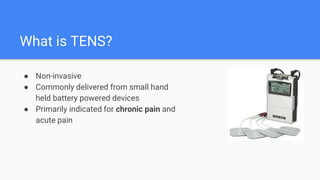
● Non-invasive
● Commonly delivered from small hand
held battery powered devices
● Primarily indicated for chronic pain and
acute pain
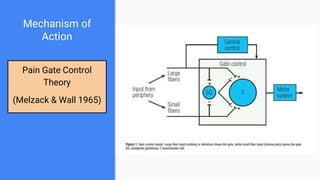
Mechanism of
Action
Pain Gate Control
Theory
(Melzack & Wall 1965)
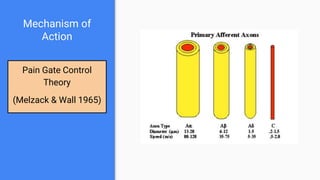
Mechanism of
Action
Pain Gate Control
Theory
(Melzack & Wall 1965)
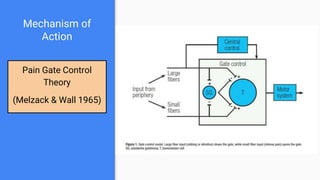
Mechanism of
Action
Pain Gate Control
Theory
(Melzack & Wall 1965)
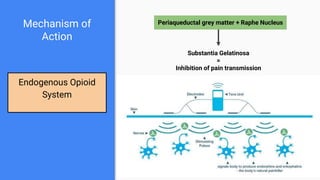
Mechanism of
Action
Endogenous Opioid
System
Periaqueductal grey matter + Raphe Nucleus
Substantia Gelatinosa
=
Inhibition of pain transmission
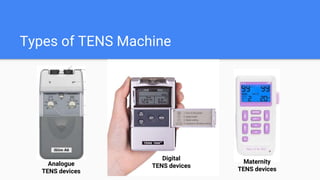
Types of TENS Machine
Analogue
TENS devices
Digital
TENS devices
Maternity
TENS devices
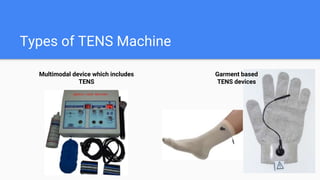
Types of TENS Machine
Multimodal device which includes
TENS
Garment based
TENS devices
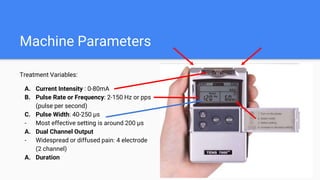
Machine Parameters
Treatment Variables:
A. Current Intensity : 0-80mA
B. Pulse Rate or Frequency: 2-150 Hz or pps
(pulse per second)
C. Pulse Width: 40-250 μs
- Most effective setting is around 200 μs
A. Dual Channel Output
- Widespread or diffused pain: 4 electrode
(2 channel)
A. Duration
Types of TENS Techniques
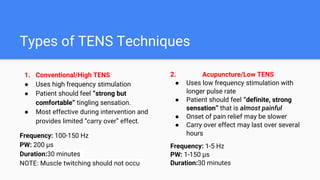
1. Conventional/High TENS
● Uses high frequency stimulation
● Patient should feel “strong but
comfortable” tingling sensation.
● Most effective during intervention and
provides limited “carry over” effect.
Frequency: 100-150 Hz
PW: 200 μs
Duration:30 minutes
NOTE: Muscle twitching should not occu
2. Acupuncture/Low TENS
● Uses low frequency stimulation with
longer pulse rate
● Patient should feel “definite, strong
sensation” that is almost painful
● Onset of pain relief may be slower
● Carry over effect may last over several
hours
Frequency: 1-5 Hz
PW: 1-150 μs
Duration:30 minutes
Types of TENS Techniques
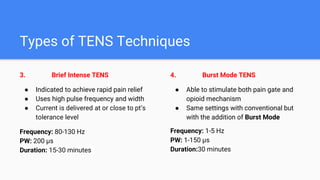
3. Brief Intense TENS
● Indicated to achieve rapid pain relief
● Uses high pulse frequency and width
● Current is delivered at or close to pt’s
tolerance level
Frequency: 80-130 Hz
PW: 200 μs
Duration: 15-30 minutes
4. Burst Mode TENS
● Able to stimulate both pain gate and
opioid mechanism
● Same settings with conventional but
with the addition of Burst Mode
Frequency: 1-5 Hz
PW: 1-150 μs
Duration:30 minutes
Types of TENS Techniques
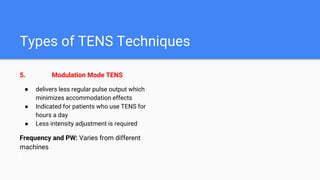
5. Modulation Mode TENS
● delivers less regular pulse output which
minimizes accommodation effects
● Indicated for patients who use TENS for
hours a day
● Less intensity adjustment is required
Frequency and PW: Varies from different
machines
Electrode Placement
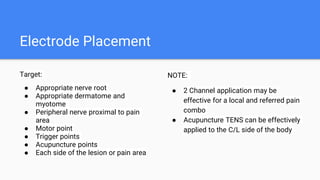
Target:
● Appropriate nerve root
● Appropriate dermatome and
myotome
● Peripheral nerve proximal to pain
area
● Motor point
● Trigger points
● Acupuncture points
● Each side of the lesion or pain area
NOTE:
● 2 Channel application may be
effective for a local and referred pain
combo
● Acupuncture TENS can be effectively
applied to the C/L side of the body
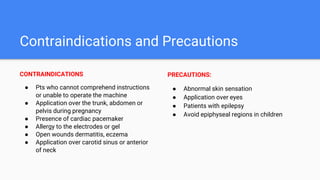
Contraindications and Precautions
CONTRAINDICATIONS
● Pts who cannot comprehend instructions
or unable to operate the machine
● Application over the trunk, abdomen or
pelvis during pregnancy
● Presence of cardiac pacemaker
● Allergy to the electrodes or gel
● Open wounds dermatitis, eczema
● Application over carotid sinus or anterior
of neck
PRECAUTIONS:
● Abnormal skin sensation
● Application over eyes
● Patients with epilepsy
● Avoid epiphyseal regions in children
THANK YOU!
References:
● Forster, A., Palastanga, N., & Clayton, E. B.
(2005). Clayton's electrotherapy: Theory &
practice. New Delhi: CBS.
● Sluka, K. A., & Walsh, D. (2003).
Transcutaneous electrical nerve
stimulation: Basic science mechanisms
and clinical effectiveness. The Journal of
Pain, 4(3), 109–121.
doi:10.1054/jpai.2003.434
● Gibson, W., Wand, B. M., & O’Connell, N. E.
(2017). Transcutaneous electrical nerve
stimulation (TENS) for neuropathic pain in
adults. Cochrane Database of Systematic
● Watson, T. (2016). Transcutaneous
electrical nerve Stimulation (TENS).
Retrieved March 03, 2021, from
http://www.electrotherapy.org/modality/tr
anscutaneous-electrical-nerve-stimulation-
tens

Eugrafia-Transcutaneous Electrical Nerve Stimulation Lecture (Edited).pptx

  • 1.
    Transcutaneous Electrical Nerve StimulationLecture Presented by Andrea Eugrafia
  • 2.
    TOPIC OUTLINE ● Introduction ●TENS Mechanism of action ● Types of TENS machine ● Types of TENS Techniques ● Machine parameters ● Electrode placement ● Contraindication and Precautions
  • 3.
    What is TENS? TENSis a method of electrical stimulation which primarily aims to provide a degree of symptomatic pain relief by exciting sensory nerves and thereby stimulating either the pain gate mechanism or the opioid system Research literature supports that it is better used in home- based patient delivery therapy than in the clinic.
  • 4.
    What is TENS? ●Non-invasive ● Commonly delivered from small hand held battery powered devices ● Primarily indicated for chronic pain and acute pain
  • 5.
    Mechanism of Action Pain GateControl Theory (Melzack & Wall 1965)
  • 6.
    Mechanism of Action Pain GateControl Theory (Melzack & Wall 1965)
  • 7.
    Mechanism of Action Pain GateControl Theory (Melzack & Wall 1965)
  • 8.
    Mechanism of Action Endogenous Opioid System Periaqueductalgrey matter + Raphe Nucleus Substantia Gelatinosa = Inhibition of pain transmission
  • 9.
    Types of TENSMachine Analogue TENS devices Digital TENS devices Maternity TENS devices
  • 10.
    Types of TENSMachine Multimodal device which includes TENS Garment based TENS devices
  • 11.
    Machine Parameters Treatment Variables: A.Current Intensity : 0-80mA B. Pulse Rate or Frequency: 2-150 Hz or pps (pulse per second) C. Pulse Width: 40-250 μs - Most effective setting is around 200 μs A. Dual Channel Output - Widespread or diffused pain: 4 electrode (2 channel) A. Duration
  • 12.
    Types of TENSTechniques 1. Conventional/High TENS ● Uses high frequency stimulation ● Patient should feel “strong but comfortable” tingling sensation. ● Most effective during intervention and provides limited “carry over” effect. Frequency: 100-150 Hz PW: 200 μs Duration:30 minutes NOTE: Muscle twitching should not occu 2. Acupuncture/Low TENS ● Uses low frequency stimulation with longer pulse rate ● Patient should feel “definite, strong sensation” that is almost painful ● Onset of pain relief may be slower ● Carry over effect may last over several hours Frequency: 1-5 Hz PW: 1-150 μs Duration:30 minutes
  • 13.
    Types of TENSTechniques 3. Brief Intense TENS ● Indicated to achieve rapid pain relief ● Uses high pulse frequency and width ● Current is delivered at or close to pt’s tolerance level Frequency: 80-130 Hz PW: 200 μs Duration: 15-30 minutes 4. Burst Mode TENS ● Able to stimulate both pain gate and opioid mechanism ● Same settings with conventional but with the addition of Burst Mode Frequency: 1-5 Hz PW: 1-150 μs Duration:30 minutes
  • 14.
    Types of TENSTechniques 5. Modulation Mode TENS ● delivers less regular pulse output which minimizes accommodation effects ● Indicated for patients who use TENS for hours a day ● Less intensity adjustment is required Frequency and PW: Varies from different machines
  • 15.
    Electrode Placement Target: ● Appropriatenerve root ● Appropriate dermatome and myotome ● Peripheral nerve proximal to pain area ● Motor point ● Trigger points ● Acupuncture points ● Each side of the lesion or pain area NOTE: ● 2 Channel application may be effective for a local and referred pain combo ● Acupuncture TENS can be effectively applied to the C/L side of the body
  • 16.
    Contraindications and Precautions CONTRAINDICATIONS ●Pts who cannot comprehend instructions or unable to operate the machine ● Application over the trunk, abdomen or pelvis during pregnancy ● Presence of cardiac pacemaker ● Allergy to the electrodes or gel ● Open wounds dermatitis, eczema ● Application over carotid sinus or anterior of neck PRECAUTIONS: ● Abnormal skin sensation ● Application over eyes ● Patients with epilepsy ● Avoid epiphyseal regions in children
  • 17.
    THANK YOU! References: ● Forster,A., Palastanga, N., & Clayton, E. B. (2005). Clayton's electrotherapy: Theory & practice. New Delhi: CBS. ● Sluka, K. A., & Walsh, D. (2003). Transcutaneous electrical nerve stimulation: Basic science mechanisms and clinical effectiveness. The Journal of Pain, 4(3), 109–121. doi:10.1054/jpai.2003.434 ● Gibson, W., Wand, B. M., & O’Connell, N. E. (2017). Transcutaneous electrical nerve stimulation (TENS) for neuropathic pain in adults. Cochrane Database of Systematic ● Watson, T. (2016). Transcutaneous electrical nerve Stimulation (TENS). Retrieved March 03, 2021, from http://www.electrotherapy.org/modality/tr anscutaneous-electrical-nerve-stimulation- tens