CARDIOPULMONARY
RESUSCITATION
SANIL VARGHESE
HISTORICAL REVIEW
• In the 19th century, Doctor H. R. Silvester
described a method “The Silvester Method”.
• Holger Neilson technique was in the United States
in 1911.
• In the 20th century at Johns Hopkins University
where the technique of CPR was originally
developed. The first effort at testing the
technique was performed on a dog by Redding,
Safar and JW Perason. Soon afterward, the
technique was used to save the life of a child.
• Peter Safar wrote the book ABC of resuscitation in
1957.
CPR For Health Care Providers
• Adult
• Child
• Infant
Terminology
• BLS / BCLS
• ALS / ACLS

• Arrest, Cardiac
Arrest, Code, Code
Blue

• Respiratory Arrest

• Ventilations
Diagnosis of cardiac arrest
Blood pressure measurement

Taking the pulse on peripheral arteries

Auscultation of cardiac tones

Loss of time !!!

Symptoms of cardiac arrest

absence of pulse on carotid arteries – a
pathognomonic symptom
3

3 respiration arrest – may be in 30 seconds after
cardiac arrest
3 enlargement of pupils – may be in 90 seconds after
5
cardiac arrest
AMERICAN HEART ASSOCIATION:

2010 GUIDELINES
Health Care Provider*
 “PUSH HARD AND PUSH FAST”
 At least 100 COMPRESSIONS / MINUTE*
 Allow the chest to recoil -- equal compression and relaxation times

 <10 seconds for pulse checks or rescue breaths
 Compression Depth*
 Adults 2”

 Child/Infant 1/3 depth of chest

 Avoid excessive ventilations

1.5" infant

2" child
AMERICAN HEART ASSOCIATION:

2010 GUIDELINES
 A-B-C changed to C-A-B*
 Critical element is chest compressions
 Delay in A-B

 Avoidance of A & B

 Early defib
 If alone--call and retrieve AED
 Exception asphyxial arrest
AMERICAN HEART ASSOCIATION:
2010 GUIDELINES
• Cricoid pressure not recommended
• Advanced airway = 1 every 6-8 seconds
• Adult: 1 every 5-6 Peds: 1 every 3

• With advanced airway- no pause
AMERICAN HEART ASSOCIATION:

2010 GUIDELINES
AHA ECC Adult Chain of Survival - New
AMERICAN HEART ASSOCIATION:2010 GUIDELINES

Simplified Universal
BLS algorithm
AMERICAN HEART ASSOCIATION:

2010 GUIDELINES
Electrical Therapies
• Shock first vs CPR first
• No precordial thump
• AED in hospital (goal to shock =< 3 mins)
• Use in infants (with or without attenuator)
AMERICAN HEART ASSOCIATION:

2010 GUIDELINES
ACLS
•
•
•
•
•
•
•

Simplified algorithm
Optimized CPR quality with monitoring
Waveform capnography (>12 mmHg)
Atropine deleted (PEA/Asystole)
Chronotropic drugs for brady, then pacing
Adenosine safe for monomorphic wide tachs
Post-cardiac arrest
AMERICAN HEART ASSOCIATION
CAPNOGRAPHY
AMERICAN HEART ASSOCIATION:

2010 GUIDELINES
Post-Cardiac Arrest – ROSC
• Therapeutic Hypothermia
– Remain comatose
– 32-34 degree C (all ages) (89.6-93.2 F)
– 12-24 hours

• PCI
• O2 sat ≥94% & PETCO 35-40
AMERICAN HEART ASSOCIATION:

2010 GUIDELINES
Special Resuscitation Situations
• Asthma

• Hypothermia

• Anaphylaxis

• Avalanche

• Pregnancy

• Drowning

• Morbid obesity
• PE

• Electrolyte imbalance
• Toxins

• Electric shock/lightening
• PCI
• Cardiac tamponade

• Cardiac surgery
AMERICAN HEART ASSOCIATION:

2010 GUIDELINES
Acute Coronary Syndromes
• Out of hospital 12-lead
• Triage to PCI
• Oxygen – > 94 % is the goal (capno)
• Morphine – use with caution in UA/non-STEMI
AMERICAN HEART ASSOCIATION:

2010 GUIDELINES
Stroke
• Stroke-prepared hospitals
• Triage to stroke centers
• TPA up to 4.5 hours
C. Circulation
Restore the circulation, that is
start external cardiac massage

18
Hand Position
• At the nipple line
• Off the zyphoid process
2 fingers = infant
1 hand = child
2 hands = adult
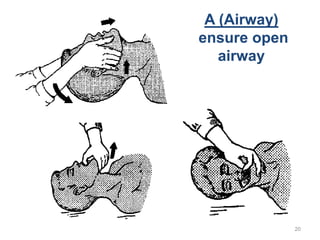
A (Airway)
ensure open
airway

20
Open the airway using a head
tilt lifting of chin. Do not tilt the
head too far back

Check the pulse on
carotid artery using
fingers of the other hand
21
B (Breathing)
Tilt the head back
and listen for. If
not breathing
normally, pinch
nose and cover
the mouth with
yours and blow
until you see the
chest rise.
22
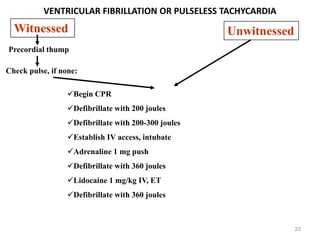
VENTRICULAR FIBRILLATION OR PULSELESS TACHYCARDIA

Witnessed

Unwitnessed

Precordial thump
Check pulse, if none:
Begin CPR
Defibrillate with 200 joules
Defibrillate with 200-300 joules
Establish IV access, intubate
Adrenaline 1 mg push
Defibrillate with 360 joules
Lidocaine 1 mg/kg IV, ET
Defibrillate with 360 joules

23
Operations in case of asystole
Asystole
Start CPR
• IV line
• Adrenaline:IV 1 mg, each 3-5 min.
-or
- intratracheal 2 - 2.5 mg
- in the absence of effect increase
the dose
-Atropine 1 mg push (repeated once
in 5 min)
•

•Na Bicarbonate 1 Eq/kg IV
•Consider pacing

24
Drugs used in CPR
• Atropine – can be injected bolus, max 3 mg to
block vagal tone, which plays significant role in
some cases of cardiac arrest
• Adrenaline – large doses have been
withdrawn from the algorithm. The
recommended dose is 1 mg in each 3-5 min.
• Vasopresine – in some cases 40 U can
replace adrenaline
• Amiodarone - should be included in algorithm
• Lidocaine – should be used only in ventricular
fibrillation
25
Public Access Defibrillation -PAD
•
•
•
•
•

Casinos
Airports
City buildings
Senior centers
Gated communities
Complications of Compressions
•
•
•
•

fractured ribs
fractured sternum
lacerated lungs
lacerated liver, blood vessels, etc,.
2010 AHA GUIDELINES
Recommendations
Component
Recognition

Adults

Children

Infants

Unresponsive (for all ages)
No breathing or
no normal
breathing (ie, only
gasping)

No breathing or only gasping

No pulse palpated within 10 seconds for all ages (HCP only)
CPR sequence
Compression rate
Compression
depth

C-A-B
At least 100/min
At least 2 inches (5 At least 2 inches (5
cm)
cm)

About 1. inches (4
cm)
Component

Adults

Recommendations
Children
Infants

Chest wall recoil

Allow complete recoil between compressions
HCPs rotate compressors every 2 minutes

Compression
interruptions

Minimize interruptions in chest compressions
Attempt to limit interrruptions to <10 seconds

Airway
Compression-toventilation
ratio (until advanced
airway placed)
Ventilations: when
rescuer
untrained or trained and
not proficient

Head tilt–chin lift (HCP suspected trauma: jaw thrust)
30:2
1 or 2
rescuers

30:2
Single rescuer
15:2
2 HCP rescuers
Compressions only
Ventilations with
advanced
airway (HCP)

Defibrillation

1 breath every 6-8 seconds (8-10
breaths/min)
Asynchronous with chest compressions
About 1 second per breath
Visible chest rise

Attach and use AED as soon as available.
Minimize interruptions in chest
compressions before and after shock;
resume CPR beginning with compressions
immediately after each shock.
Thank you

Cpr 2010

  • 1.
  • 2.
    HISTORICAL REVIEW • Inthe 19th century, Doctor H. R. Silvester described a method “The Silvester Method”. • Holger Neilson technique was in the United States in 1911. • In the 20th century at Johns Hopkins University where the technique of CPR was originally developed. The first effort at testing the technique was performed on a dog by Redding, Safar and JW Perason. Soon afterward, the technique was used to save the life of a child. • Peter Safar wrote the book ABC of resuscitation in 1957.
  • 3.
    CPR For HealthCare Providers • Adult • Child • Infant
  • 4.
    Terminology • BLS /BCLS • ALS / ACLS • Arrest, Cardiac Arrest, Code, Code Blue • Respiratory Arrest • Ventilations
  • 5.
    Diagnosis of cardiacarrest Blood pressure measurement  Taking the pulse on peripheral arteries  Auscultation of cardiac tones Loss of time !!! Symptoms of cardiac arrest absence of pulse on carotid arteries – a pathognomonic symptom 3 3 respiration arrest – may be in 30 seconds after cardiac arrest 3 enlargement of pupils – may be in 90 seconds after 5 cardiac arrest
  • 6.
    AMERICAN HEART ASSOCIATION: 2010GUIDELINES Health Care Provider*  “PUSH HARD AND PUSH FAST”  At least 100 COMPRESSIONS / MINUTE*  Allow the chest to recoil -- equal compression and relaxation times  <10 seconds for pulse checks or rescue breaths  Compression Depth*  Adults 2”  Child/Infant 1/3 depth of chest  Avoid excessive ventilations 1.5" infant 2" child
  • 7.
    AMERICAN HEART ASSOCIATION: 2010GUIDELINES  A-B-C changed to C-A-B*  Critical element is chest compressions  Delay in A-B  Avoidance of A & B  Early defib  If alone--call and retrieve AED  Exception asphyxial arrest
  • 8.
    AMERICAN HEART ASSOCIATION: 2010GUIDELINES • Cricoid pressure not recommended • Advanced airway = 1 every 6-8 seconds • Adult: 1 every 5-6 Peds: 1 every 3 • With advanced airway- no pause
  • 9.
    AMERICAN HEART ASSOCIATION: 2010GUIDELINES AHA ECC Adult Chain of Survival - New
  • 10.
    AMERICAN HEART ASSOCIATION:2010GUIDELINES Simplified Universal BLS algorithm
  • 11.
    AMERICAN HEART ASSOCIATION: 2010GUIDELINES Electrical Therapies • Shock first vs CPR first • No precordial thump • AED in hospital (goal to shock =< 3 mins) • Use in infants (with or without attenuator)
  • 12.
    AMERICAN HEART ASSOCIATION: 2010GUIDELINES ACLS • • • • • • • Simplified algorithm Optimized CPR quality with monitoring Waveform capnography (>12 mmHg) Atropine deleted (PEA/Asystole) Chronotropic drugs for brady, then pacing Adenosine safe for monomorphic wide tachs Post-cardiac arrest
  • 13.
  • 14.
    AMERICAN HEART ASSOCIATION: 2010GUIDELINES Post-Cardiac Arrest – ROSC • Therapeutic Hypothermia – Remain comatose – 32-34 degree C (all ages) (89.6-93.2 F) – 12-24 hours • PCI • O2 sat ≥94% & PETCO 35-40
  • 15.
    AMERICAN HEART ASSOCIATION: 2010GUIDELINES Special Resuscitation Situations • Asthma • Hypothermia • Anaphylaxis • Avalanche • Pregnancy • Drowning • Morbid obesity • PE • Electrolyte imbalance • Toxins • Electric shock/lightening • PCI • Cardiac tamponade • Cardiac surgery
  • 16.
    AMERICAN HEART ASSOCIATION: 2010GUIDELINES Acute Coronary Syndromes • Out of hospital 12-lead • Triage to PCI • Oxygen – > 94 % is the goal (capno) • Morphine – use with caution in UA/non-STEMI
  • 17.
    AMERICAN HEART ASSOCIATION: 2010GUIDELINES Stroke • Stroke-prepared hospitals • Triage to stroke centers • TPA up to 4.5 hours
  • 18.
    C. Circulation Restore thecirculation, that is start external cardiac massage 18
  • 19.
    Hand Position • Atthe nipple line • Off the zyphoid process 2 fingers = infant 1 hand = child 2 hands = adult
  • 20.
  • 21.
    Open the airwayusing a head tilt lifting of chin. Do not tilt the head too far back Check the pulse on carotid artery using fingers of the other hand 21
  • 22.
    B (Breathing) Tilt thehead back and listen for. If not breathing normally, pinch nose and cover the mouth with yours and blow until you see the chest rise. 22
  • 23.
    VENTRICULAR FIBRILLATION ORPULSELESS TACHYCARDIA Witnessed Unwitnessed Precordial thump Check pulse, if none: Begin CPR Defibrillate with 200 joules Defibrillate with 200-300 joules Establish IV access, intubate Adrenaline 1 mg push Defibrillate with 360 joules Lidocaine 1 mg/kg IV, ET Defibrillate with 360 joules 23
  • 24.
    Operations in caseof asystole Asystole Start CPR • IV line • Adrenaline:IV 1 mg, each 3-5 min. -or - intratracheal 2 - 2.5 mg - in the absence of effect increase the dose -Atropine 1 mg push (repeated once in 5 min) • •Na Bicarbonate 1 Eq/kg IV •Consider pacing 24
  • 25.
    Drugs used inCPR • Atropine – can be injected bolus, max 3 mg to block vagal tone, which plays significant role in some cases of cardiac arrest • Adrenaline – large doses have been withdrawn from the algorithm. The recommended dose is 1 mg in each 3-5 min. • Vasopresine – in some cases 40 U can replace adrenaline • Amiodarone - should be included in algorithm • Lidocaine – should be used only in ventricular fibrillation 25
  • 26.
    Public Access Defibrillation-PAD • • • • • Casinos Airports City buildings Senior centers Gated communities
  • 28.
    Complications of Compressions • • • • fracturedribs fractured sternum lacerated lungs lacerated liver, blood vessels, etc,.
  • 29.
    2010 AHA GUIDELINES Recommendations Component Recognition Adults Children Infants Unresponsive(for all ages) No breathing or no normal breathing (ie, only gasping) No breathing or only gasping No pulse palpated within 10 seconds for all ages (HCP only) CPR sequence Compression rate Compression depth C-A-B At least 100/min At least 2 inches (5 At least 2 inches (5 cm) cm) About 1. inches (4 cm)
  • 30.
    Component Adults Recommendations Children Infants Chest wall recoil Allowcomplete recoil between compressions HCPs rotate compressors every 2 minutes Compression interruptions Minimize interruptions in chest compressions Attempt to limit interrruptions to <10 seconds Airway Compression-toventilation ratio (until advanced airway placed) Ventilations: when rescuer untrained or trained and not proficient Head tilt–chin lift (HCP suspected trauma: jaw thrust) 30:2 1 or 2 rescuers 30:2 Single rescuer 15:2 2 HCP rescuers Compressions only
  • 31.
    Ventilations with advanced airway (HCP) Defibrillation 1breath every 6-8 seconds (8-10 breaths/min) Asynchronous with chest compressions About 1 second per breath Visible chest rise Attach and use AED as soon as available. Minimize interruptions in chest compressions before and after shock; resume CPR beginning with compressions immediately after each shock.
  • 32.