TRANSPORT OF
CRITICALLY ILL PATIENTS
RACHEL JEEVAKIRUBAI
BSC CRITICAL CARE TECHNOLOGY
INTRODUCTION
• The safest place for the critically ill
patient is stationary in the ICU connected
to a ventilator with all infusion pumps
running smoothly, intensive monitoring
installed and with a nurse present to
care for the patient.
• There may be situations when the
patient has to leave these secure
surroundings to be transported to the
radiology dept., OT or to some other
hospital.
This transport may create an increased risk for mishaps
and adverse events by,
 Disconnecting such critically ill individuals from
the equipment in the ICU to some kind of transport
gear.
 Shifting them to another stretcher.
 Reducing the personal and equipment around.
At some point in every therapist’s career, we will be
involved in the medical transport of a sick or injured
patient.
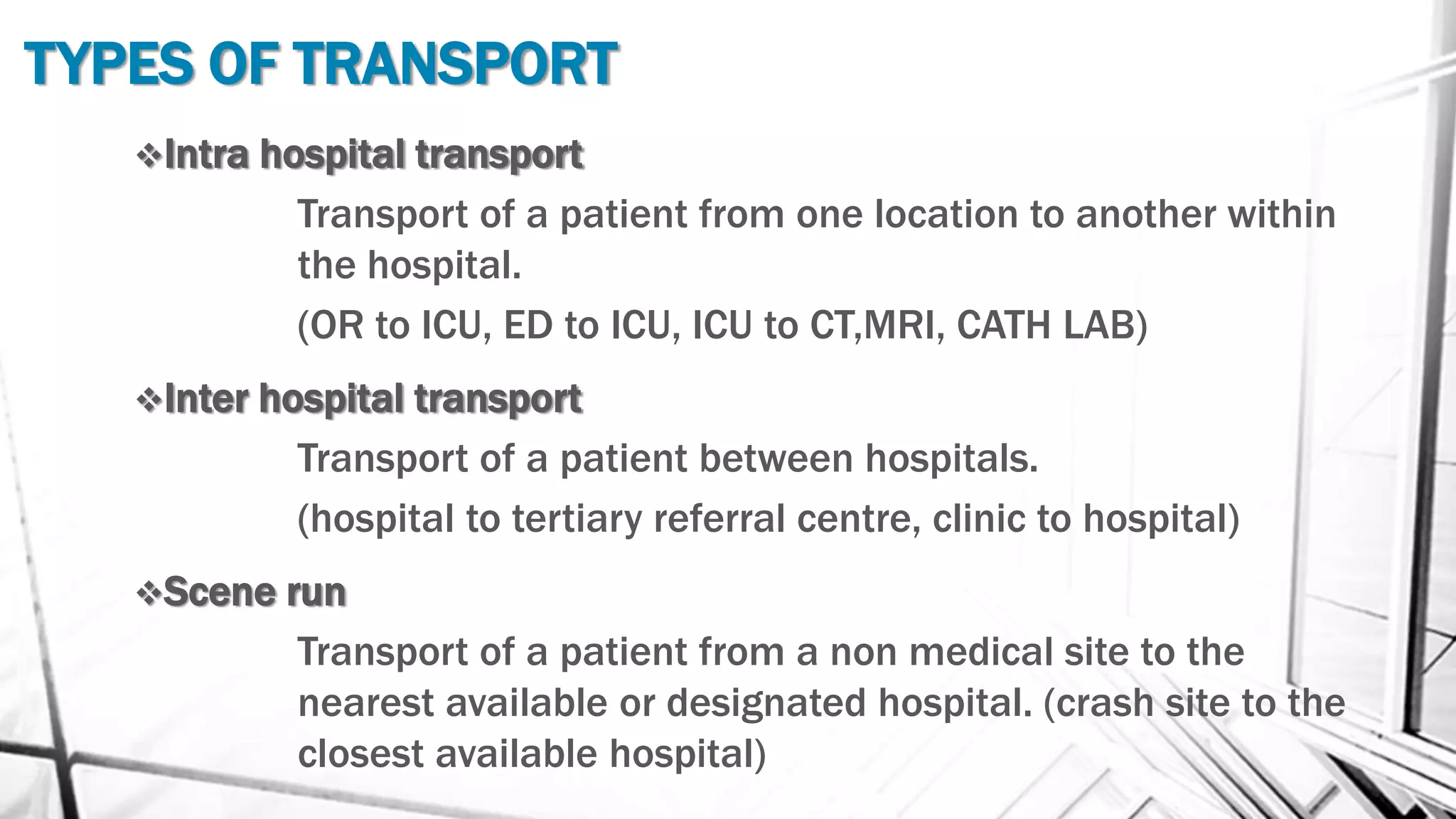
TYPES OF TRANSPORT
Intra hospital transport
Transport of a patient from one location to another within
the hospital.
(OR to ICU, ED to ICU, ICU to CT,MRI, CATH LAB)
Inter hospital transport
Transport of a patient between hospitals.
(hospital to tertiary referral centre, clinic to hospital)
Scene run
Transport of a patient from a non medical site to the
nearest available or designated hospital. (crash site to the
closest available hospital)
Critically ill patients are at increased risk of
morbidity and mortality during transport.
Risk can be minimized and outcomes can be
improved with
 Careful planning
 Appropriately qualified personnel
 Selection and availability of
appropriate equipment.
Because the transport of critically ill patients
to procedures or tests outside ICU is
potentially hazardous, the transport process
must be organised and efficient.
REMEMBER ACRONYM
Assessment
Control
Communication
Evaluation
Prepare and package
Transport
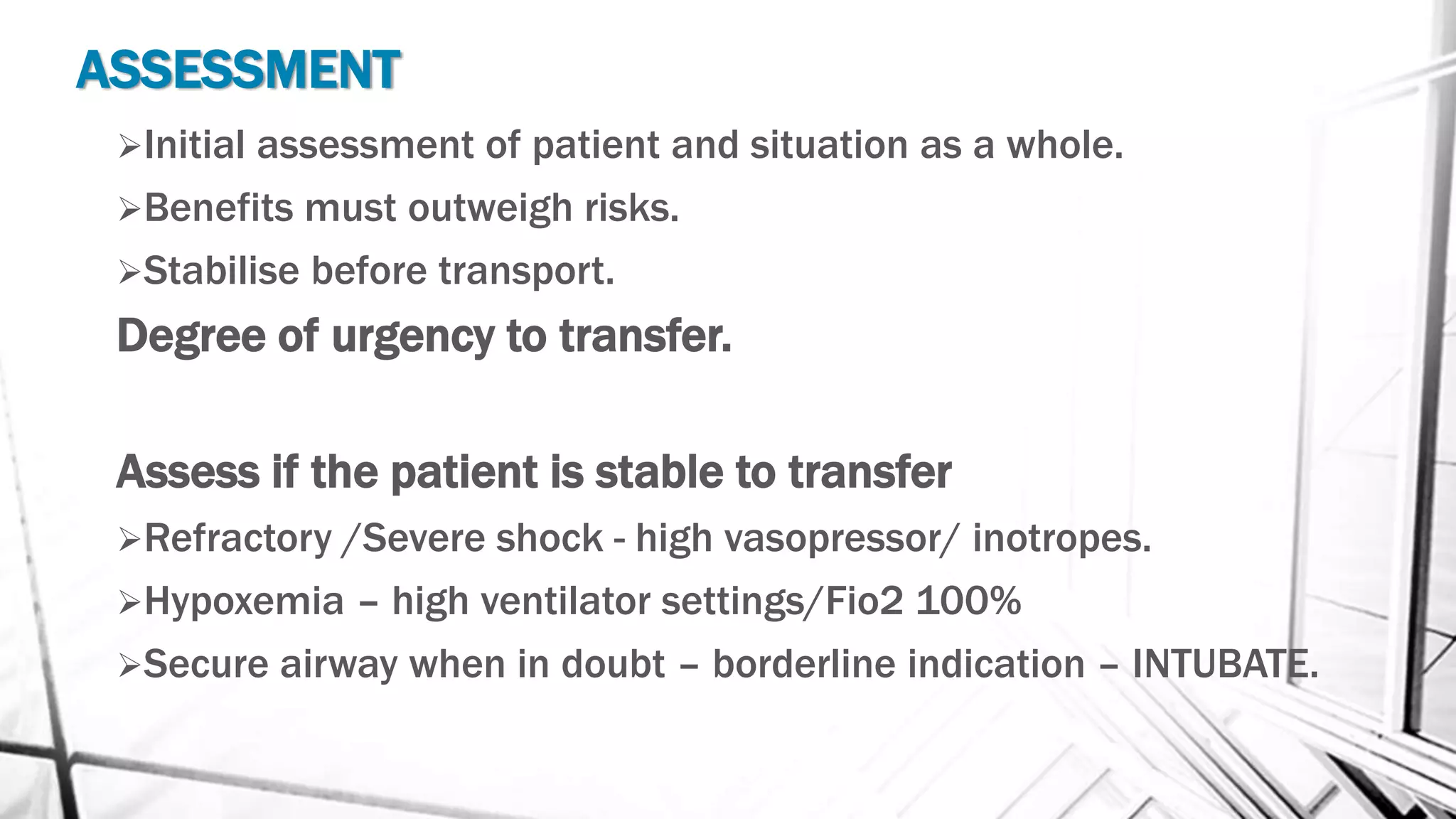
ASSESSMENT
Initial assessment of patient and situation as a whole.
Benefits must outweigh risks.
Stabilise before transport.
Degree of urgency to transfer.
Assess if the patient is stable to transfer
Refractory /Severe shock - high vasopressor/ inotropes.
Hypoxemia – high ventilator settings/Fio2 100%
Secure airway when in doubt – borderline indication – INTUBATE.
Control, Communicate, Evaluate
 Communication within team and receiving
end.
 Continuous assessment of effectiveness of
resuscitation and stabilisation process
PREPARE AND PACKAGE
Preparation of patient, equipment, supplies,
accompanying medical personnel
RESPIRATORY & CVS SUPPORT
EQUIPMENTS
Oral and nasal airways
Facemask and bains circuit or AMBU bag
O2 Mask with tubing/ reservoir mask.
Suction equipments
ET tubes, stylet
Laryngoscope and blade
Boogie, LMA
IV cannula, syringes and needles
Monitor with pulse oximetry, BP, ECG waves
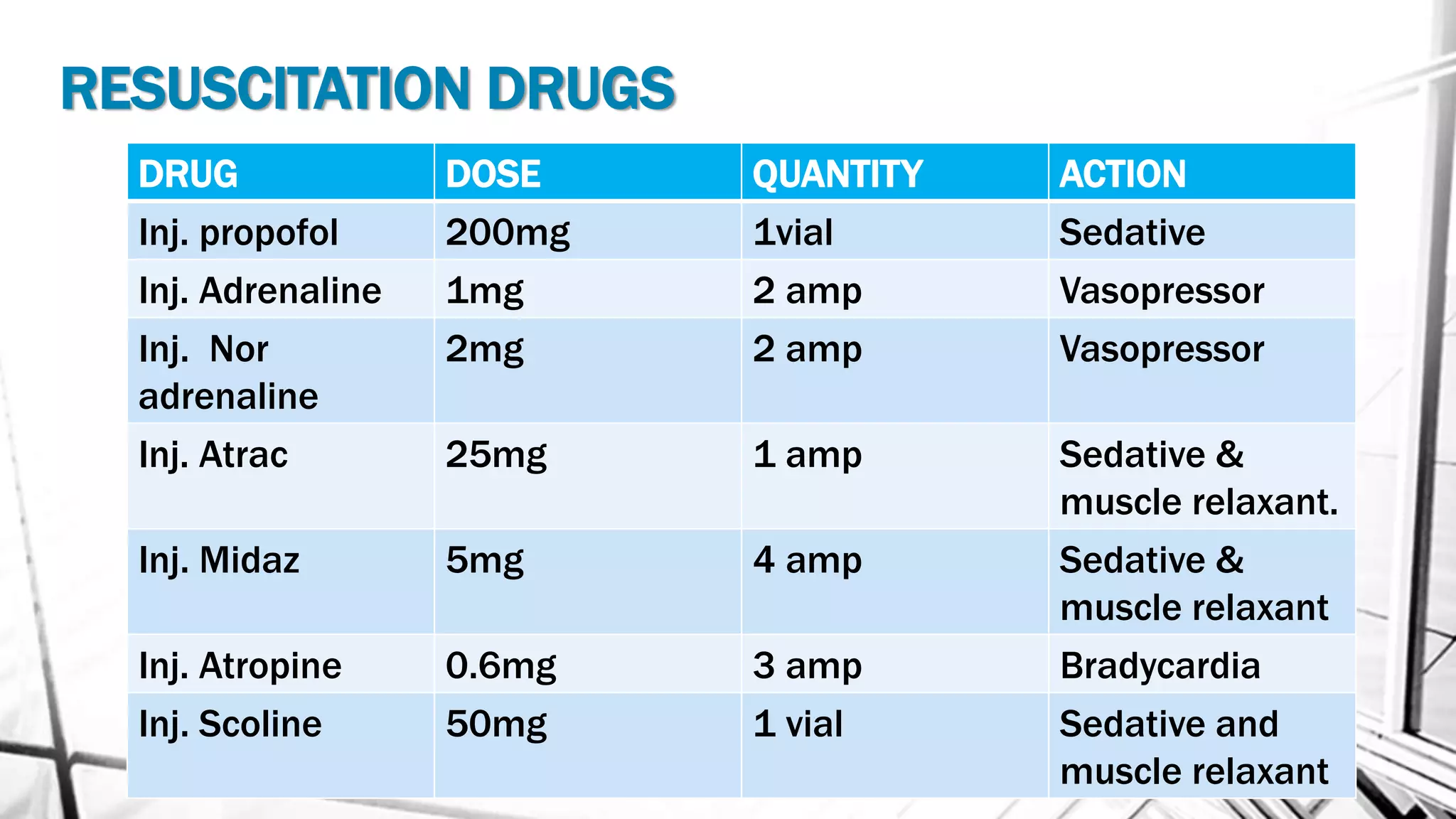
RESUSCITATION DRUGS
DRUG DOSE QUANTITY ACTION
Inj. propofol 200mg 1vial Sedative
Inj. Adrenaline 1mg 2 amp Vasopressor
Inj. Nor
adrenaline
2mg 2 amp Vasopressor
Inj. Atrac 25mg 1 amp Sedative &
muscle relaxant.
Inj. Midaz 5mg 4 amp Sedative &
muscle relaxant
Inj. Atropine 0.6mg 3 amp Bradycardia
Inj. Scoline 50mg 1 vial Sedative and
muscle relaxant
CHECK AMBU BAG:
Inlet valve
Patient valve – pressure relief valve
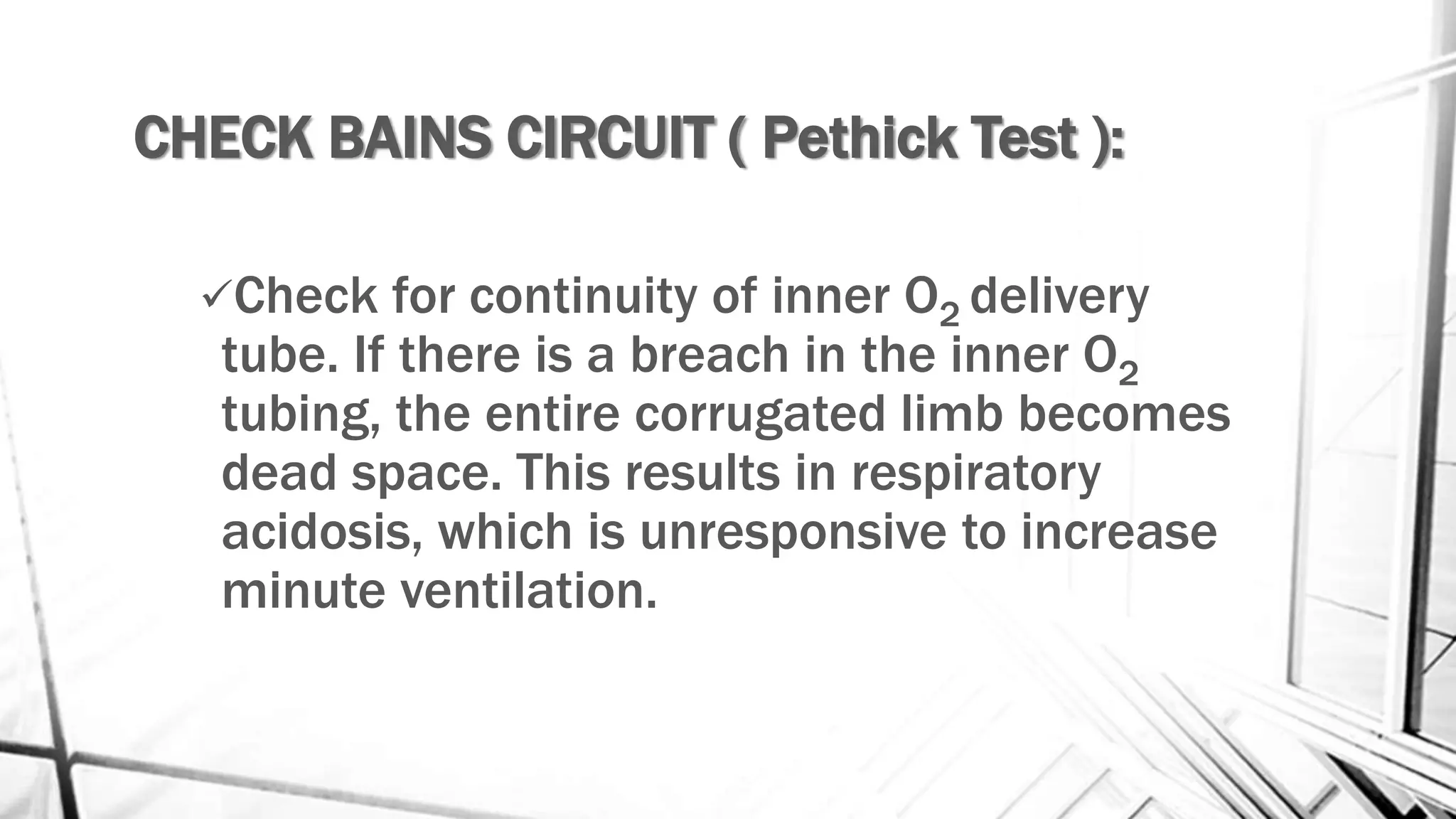
CHECK BAINS CIRCUIT ( Pethick Test ):
Check for continuity of inner O2 delivery
tube. If there is a breach in the inner O2
tubing, the entire corrugated limb becomes
dead space. This results in respiratory
acidosis, which is unresponsive to increase
minute ventilation.
CALCULATE THE AMOUNT OF O2 NEEDED
TO LAST FOR THE JOURNEY
FORMULA - TO FIND THE AMOUNT OF O2 LEFT IN THE CYLINDER
CAPACITY (L) (full vol.) = REMAINING CONTENTS (L) (vol left)
SERVICE PRESSURE (PSI) (full pres.) GAUGE PRESSURE (IN PSI ) (present pres.)
FORMULA – TIME PERIOD FOR WHICH THE CYLINDER WILL LAST
CONVERSION FACTOR X GAUGE PRESSURE = DURATION OF FLOW (MIN)
FLOW (L/MIN)
SIZE CAPACITY (L) PRESSURE (psi)
B 200 1900
D 400 1900
E 660 1900
F 1360 1900
G 3400 1900
OXYGEN CYLINDER - types
TRANSPORT
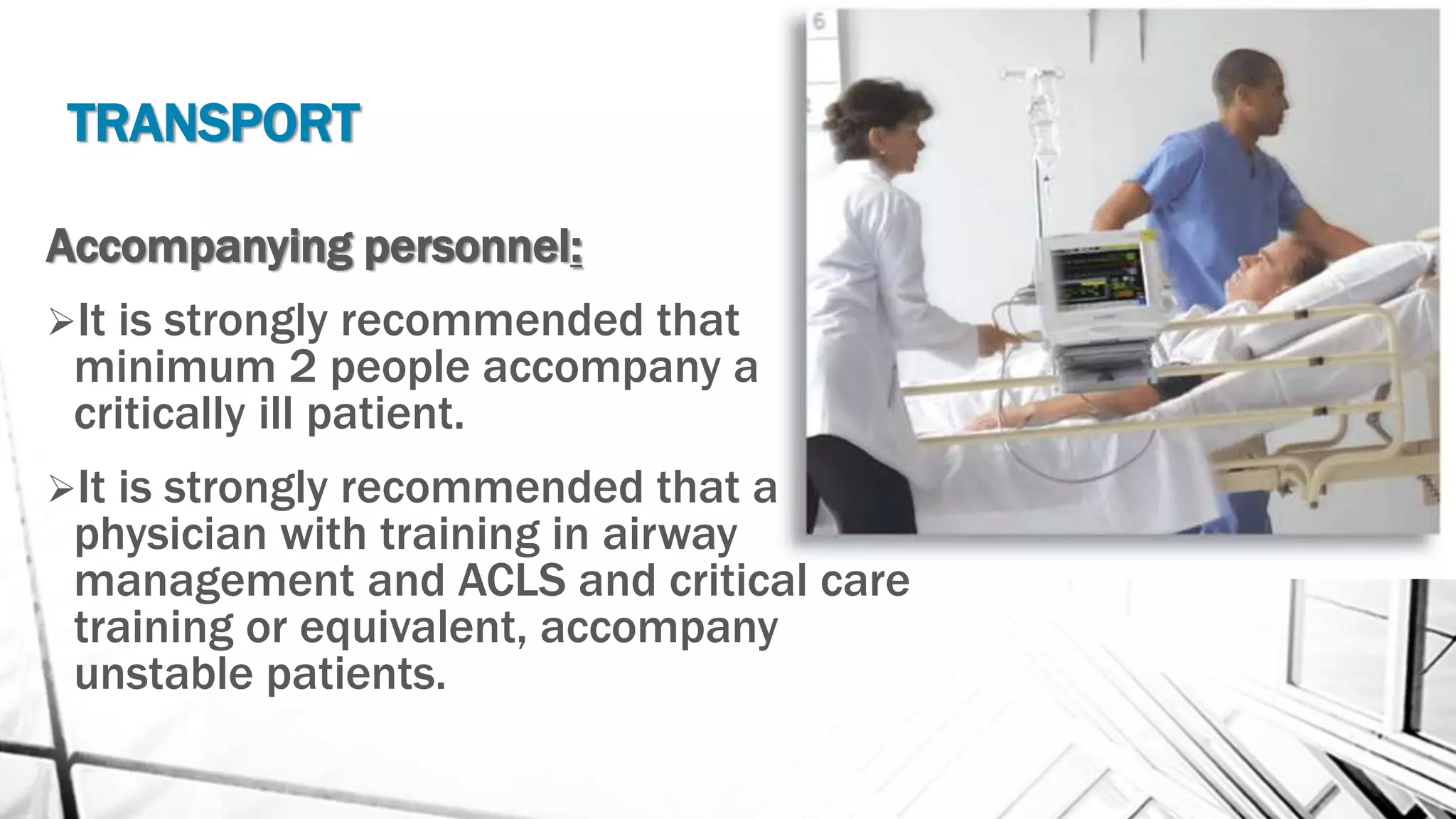
Accompanying personnel:
It is strongly recommended that
minimum 2 people accompany a
critically ill patient.
It is strongly recommended that a
physician with training in airway
management and ACLS and critical care
training or equivalent, accompany
unstable patients.
Accompanying equipment :
For practical reasons, bag valve ventilation is
most commonly employed during intra –
hospital transport.
In mechanically ventilated patients, ET tube
position is noted and secured before
transport, and the adequacy of oxygenation
and ventilation is reconfirmed.
Portable mechanical ventilators are gaining
increasing popularity in this area, as they
more reliably administer prescribed minute
ventilation and desired O2 concentrations.
MONITORING DURING TRANSPORT:
 All critically ill patients undergoing transport
receive the same level of basic physiologic
monitoring during transport as they had in the
ICU.
 This includes at a minimum, continuous ECG
monitoring, continuous pulse, periodic
measurement of BP, pulse rate, respiratory
rate.
 All battery operated equipment is fully
charged and capable of functioning for the
duration of transport.
DOCUMENTATION:
Clinical status before, during and after transfer
Patient condition – trend
Proper handing over referring transfer receiving
doctor
In the end evaluate process of transfer – for quality
improvement.
Adverse effects:
Adverse events during transport of critically ill patients fall into
2 general categories:
1. Mishaps related to intensive care
• Lead disconnection
• Loss of battery power
• Loss IV access
• Accidental extubation
• Occlusion of ET tube
• Exhaustion of O2 supply.
2. Physiologic deteriotion related to critical illness
• Worsening hypotension or hypoxemia.
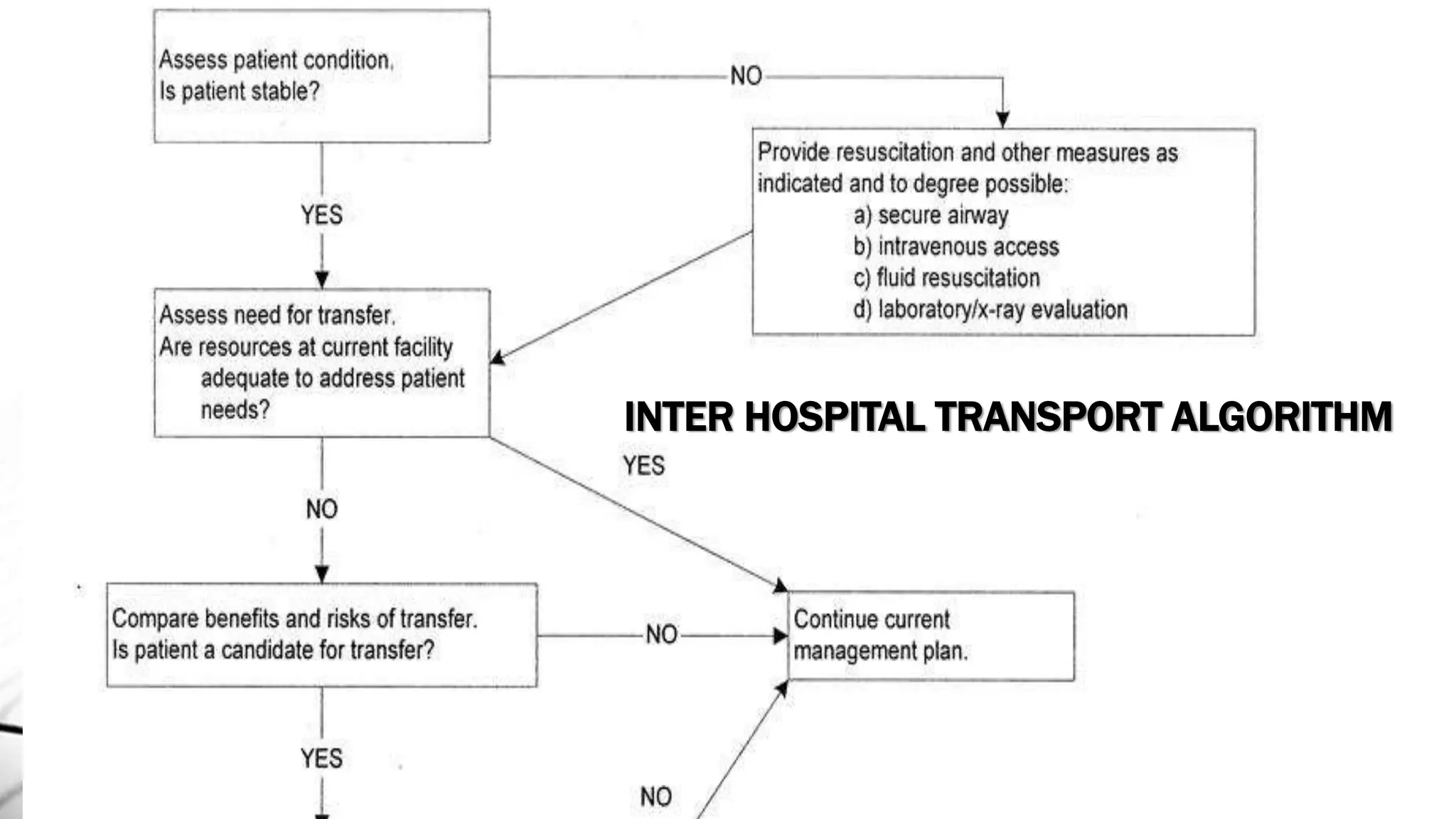
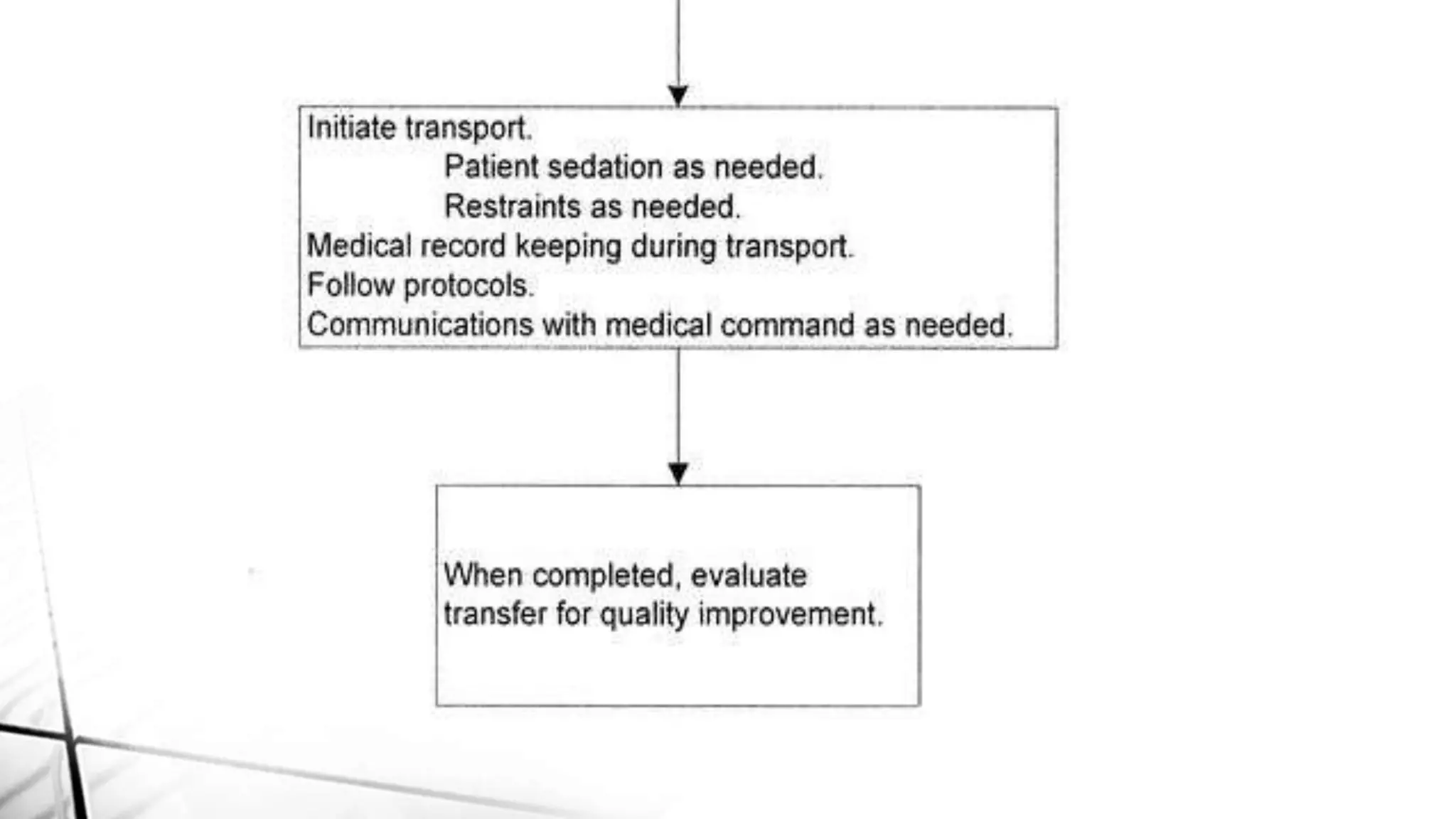
INTER HOSPITAL TRANSPORT ALGORITHM
THANK YOU

Transport of critically ill patients

  • 1.
    TRANSPORT OF CRITICALLY ILLPATIENTS RACHEL JEEVAKIRUBAI BSC CRITICAL CARE TECHNOLOGY
  • 2.
    INTRODUCTION • The safestplace for the critically ill patient is stationary in the ICU connected to a ventilator with all infusion pumps running smoothly, intensive monitoring installed and with a nurse present to care for the patient. • There may be situations when the patient has to leave these secure surroundings to be transported to the radiology dept., OT or to some other hospital.
  • 3.
    This transport maycreate an increased risk for mishaps and adverse events by,  Disconnecting such critically ill individuals from the equipment in the ICU to some kind of transport gear.  Shifting them to another stretcher.  Reducing the personal and equipment around. At some point in every therapist’s career, we will be involved in the medical transport of a sick or injured patient.
  • 4.
    TYPES OF TRANSPORT Intrahospital transport Transport of a patient from one location to another within the hospital. (OR to ICU, ED to ICU, ICU to CT,MRI, CATH LAB) Inter hospital transport Transport of a patient between hospitals. (hospital to tertiary referral centre, clinic to hospital) Scene run Transport of a patient from a non medical site to the nearest available or designated hospital. (crash site to the closest available hospital)
  • 5.
    Critically ill patientsare at increased risk of morbidity and mortality during transport. Risk can be minimized and outcomes can be improved with  Careful planning  Appropriately qualified personnel  Selection and availability of appropriate equipment. Because the transport of critically ill patients to procedures or tests outside ICU is potentially hazardous, the transport process must be organised and efficient.
  • 6.
  • 7.
    ASSESSMENT Initial assessment ofpatient and situation as a whole. Benefits must outweigh risks. Stabilise before transport. Degree of urgency to transfer. Assess if the patient is stable to transfer Refractory /Severe shock - high vasopressor/ inotropes. Hypoxemia – high ventilator settings/Fio2 100% Secure airway when in doubt – borderline indication – INTUBATE.
  • 8.
    Control, Communicate, Evaluate Communication within team and receiving end.  Continuous assessment of effectiveness of resuscitation and stabilisation process
  • 9.
    PREPARE AND PACKAGE Preparationof patient, equipment, supplies, accompanying medical personnel
  • 10.
    RESPIRATORY & CVSSUPPORT EQUIPMENTS Oral and nasal airways Facemask and bains circuit or AMBU bag O2 Mask with tubing/ reservoir mask. Suction equipments ET tubes, stylet Laryngoscope and blade Boogie, LMA IV cannula, syringes and needles Monitor with pulse oximetry, BP, ECG waves
  • 11.
    RESUSCITATION DRUGS DRUG DOSEQUANTITY ACTION Inj. propofol 200mg 1vial Sedative Inj. Adrenaline 1mg 2 amp Vasopressor Inj. Nor adrenaline 2mg 2 amp Vasopressor Inj. Atrac 25mg 1 amp Sedative & muscle relaxant. Inj. Midaz 5mg 4 amp Sedative & muscle relaxant Inj. Atropine 0.6mg 3 amp Bradycardia Inj. Scoline 50mg 1 vial Sedative and muscle relaxant
  • 12.
    CHECK AMBU BAG: Inletvalve Patient valve – pressure relief valve
  • 13.
    CHECK BAINS CIRCUIT( Pethick Test ): Check for continuity of inner O2 delivery tube. If there is a breach in the inner O2 tubing, the entire corrugated limb becomes dead space. This results in respiratory acidosis, which is unresponsive to increase minute ventilation.
  • 14.
    CALCULATE THE AMOUNTOF O2 NEEDED TO LAST FOR THE JOURNEY FORMULA - TO FIND THE AMOUNT OF O2 LEFT IN THE CYLINDER CAPACITY (L) (full vol.) = REMAINING CONTENTS (L) (vol left) SERVICE PRESSURE (PSI) (full pres.) GAUGE PRESSURE (IN PSI ) (present pres.) FORMULA – TIME PERIOD FOR WHICH THE CYLINDER WILL LAST CONVERSION FACTOR X GAUGE PRESSURE = DURATION OF FLOW (MIN) FLOW (L/MIN)
  • 15.
    SIZE CAPACITY (L)PRESSURE (psi) B 200 1900 D 400 1900 E 660 1900 F 1360 1900 G 3400 1900 OXYGEN CYLINDER - types
  • 17.
    TRANSPORT Accompanying personnel: It isstrongly recommended that minimum 2 people accompany a critically ill patient. It is strongly recommended that a physician with training in airway management and ACLS and critical care training or equivalent, accompany unstable patients.
  • 18.
    Accompanying equipment : Forpractical reasons, bag valve ventilation is most commonly employed during intra – hospital transport. In mechanically ventilated patients, ET tube position is noted and secured before transport, and the adequacy of oxygenation and ventilation is reconfirmed. Portable mechanical ventilators are gaining increasing popularity in this area, as they more reliably administer prescribed minute ventilation and desired O2 concentrations.
  • 19.
    MONITORING DURING TRANSPORT: All critically ill patients undergoing transport receive the same level of basic physiologic monitoring during transport as they had in the ICU.  This includes at a minimum, continuous ECG monitoring, continuous pulse, periodic measurement of BP, pulse rate, respiratory rate.  All battery operated equipment is fully charged and capable of functioning for the duration of transport.
  • 20.
    DOCUMENTATION: Clinical status before,during and after transfer Patient condition – trend Proper handing over referring transfer receiving doctor In the end evaluate process of transfer – for quality improvement.
  • 21.
    Adverse effects: Adverse eventsduring transport of critically ill patients fall into 2 general categories: 1. Mishaps related to intensive care • Lead disconnection • Loss of battery power • Loss IV access • Accidental extubation • Occlusion of ET tube • Exhaustion of O2 supply. 2. Physiologic deteriotion related to critical illness • Worsening hypotension or hypoxemia.
  • 22.
  • 25.