Presented by
Dr. Muhammad Mobarock Hossain
MD(card) Final part
BSMMU, Dhaka.
Date: Sunday,17 th November,2013
Practice essentials
 Cardiopulmonary resuscitation (CPR)
consists of the use of chest compressions
and artificial ventilation to maintain
circulatory flow and oxygenation during
cardiac arrest.
 Although survival rates and neurologic
outcomes are poor for patients with cardiac
arrest, early appropriate resuscitation-
involving early defibrillation and appropriate
implementation of post-cardiac arrest care
lead to improved survival and neurologic
outcomes.
Essential update:
A drug combination to improve CPR
outcome
 In a randomized trial involving 268 patients with in-
hospital cardiac arrest, treatment with a combination of
vasopressin, steroids, and epinephrine (VSE) during
CPR followed by treatment of survivors with daily
steroids was associated with a greater likelihood of
being discharged with a neurologically favorable
outcome compared with standard care with
epinephrine alone.
 VSE patients also had improved hemodynamics and
central venous oxygen saturation, as well as less
organ dysfunction.
Cont…
 Patients were randomly assigned to combination
treatment with vasopressin (20 IU/CPR cycle) plus
epinephrine (VSE group) or saline placebo plus
epinephrine (control group) for the first 5 CPR cycles
after randomization.
During the first CPR cycle, patients in the VSE group
received methylprednisolone (40 mg) and patients in
the control group received saline placebo.
 VSE patients who were successfully resuscitated but
still hemodynamically unstable were treated with an
intravenous infusion of hydrocortisone (300 mg daily
for 7 days), while control patients were given saline
placebo.
Cont…
 Patients in the VSE group had a significantly
higher probability of return of spontaneous
circulation of 20 minutes or longer after CPR
(83.9% of patients vs 65.9% in the control group)
and a higher chance of survival to hospital
discharge with a neurologically favorable outcome
(13.9% vs. 5.1%).
 Among patients surviving after CPR but with post-
resuscitation shock, those in the VSE group had a
higher probability of survival to hospital discharge
with a favorable neurologic outcome.
Indications
CPR should be performed immediately on any person
who has become unconscious and is found to be
pulseless.
The most common nonperfusing arrhythmias are…
 Ventricular fibrillation (VF)
 Pulseless ventricular tachycardia (VT)
 Pulseless electrical activity (PEA)
 Asystole
 Pulseless bradycardia
NB:CPR should be started before the rhythm is identified and should
be continued while the defibrillator is being applied and charged.
Additionally, CPR should be resumed immediately after a
defibrillatory shock until a pulsatile state is established.
Contraindications
 The only absolute contraindication to CPR is a
do-not-resuscitate (DNR) order or other advanced
directive indicating a person’s desire not to be
resuscitated in the event of cardiac arrest.
 A relative contraindication to performing CPR is if
a clinician justifiably feels that the intervention
would be medically futile(useless).
Equipment
 CPR, in its most basic form, can be performed
anywhere without the need for specialized
equipment. Universal precautions (ie, gloves, mask,
gown) should be taken.
However, CPR is delivered without such protections
in the vast majority of patients who are resuscitated
in the out-of-hospital setting, and no cases of
disease transmission via CPR delivery have been
reported.
 Some hospitals and EMS systems employ devices to
provide mechanical chest compressions.
 A cardiac defibrillator or AED provides an electrical
shock to the heart via 2 electrodes placed on the
patient’s torso and may restore the heart into a
normal perfusing rhythm.
Technique
 Cardiopulmonary resuscitation (CPR) comprises 3
steps (CAB) :
Chest compressions,
Airway, and
Breathing
 Lay rescuers should perform compression-only CPR
(COCPR).
 Healthcare providers, however, should perform all 3
components of CPR (chest
compressions, airway, and breathing).
Positioning for CPR :
 CPR is most easily and effectively performed by laying
the patient supine on a relatively hard surface, which
allows effective compression of the sternum .
 Delivery of CPR on a mattress or other soft material is
generally less effective.
 The person giving compressions should be positioned
high enough above the patient to achieve sufficient
leverage, so that he or she can use body weight to
adequately compress the chest .
For an unconscious
adult:
 Give 30 chest compressions.
 Perform the head-tilt chin-lift maneuver to open
the airway and determine if the patient is
breathing.
 Before beginning ventilations, look in the patient’s
mouth for a foreign body blocking the airway.
Please watch the Video of
Assessment of a patient
Ventilation
If the patient is not breathing
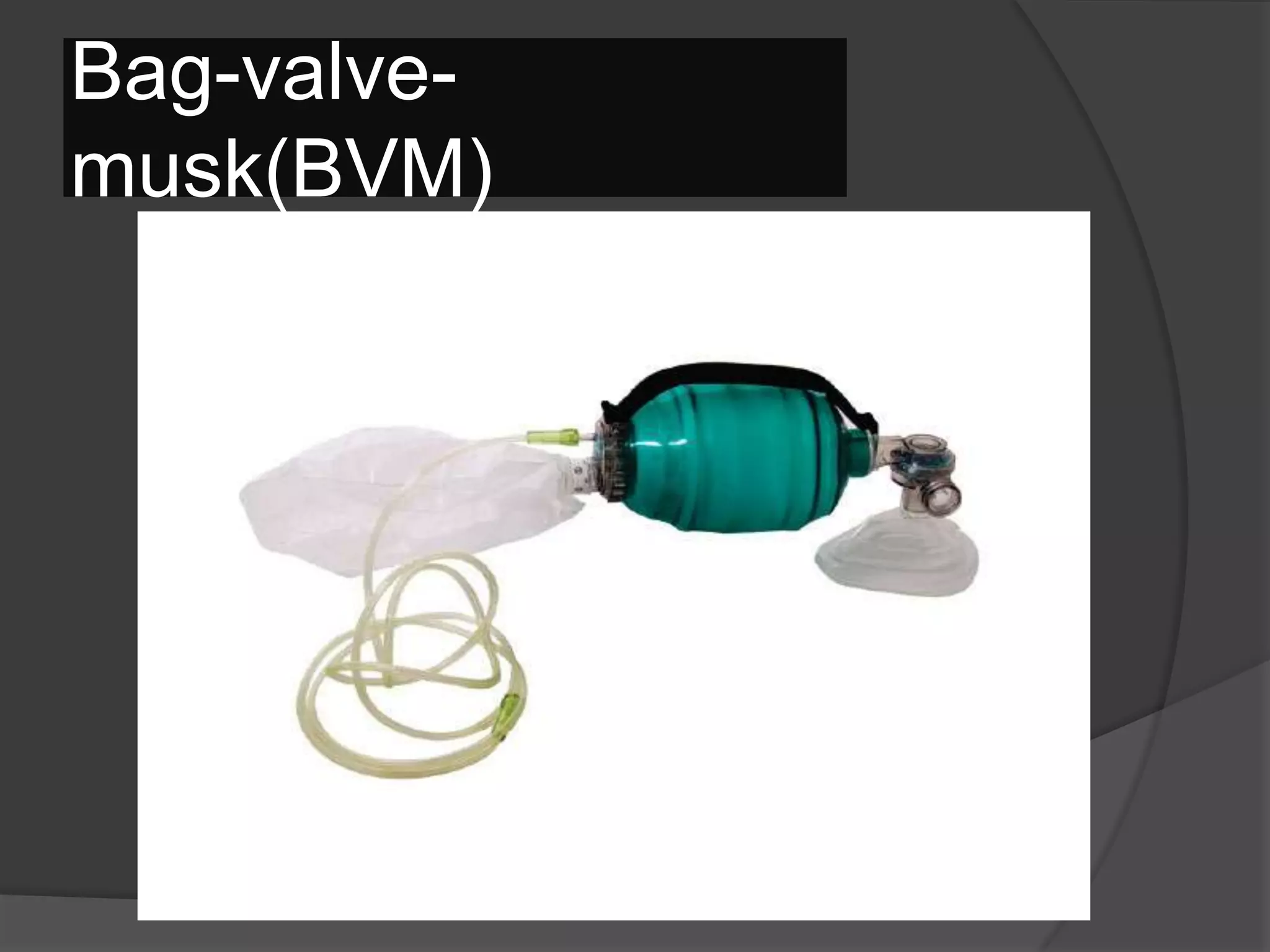
2 ventilations are given via the provider’s mouth or a bag-
Valve-mask (BVM). If available, a barrier device
(pocket mask or face shield) should be used.
To perform the BVM or invasive airway technique, the
provider does the following:
 Ensure a tight seal between the mask and the patient’s
face
 Squeeze the bag with one hand for approximately 1
second, forcing at least 500 mL of air into the patient’s
lungs.
 Next, the provider checks for a carotid or femoral
pulse. If the patient has no pulse, chest compressions
are begun.
 device (pocket mask or face shield) should be used.
Bag-valve-
musk(BVM)
Pocket musk
Mouth-to-mouth
technique:
To perform, the provider does the following:
 Pinch the patient’s nostrils closed to assist with an
airtight seal
 Put the mouth completely over the patient’s mouth
 After 30 chest compression, give 2 breaths (the
30:2 cycle of CPR)
 Give each breath for approximately 1 second with
enough force to make the patient’s chest rise.
 Failure to observe chest rise indicates an
inadequate mouth seal or airway occlusion
 After giving the 2 breaths, resume the CPR cycle
Please watch the Video of
Mouth to mouth breathing
Chest compression
Chest
compression
The provider should do the following:
 Place the heel of one hand on the patient’s sternum and
the other hand on top of the first, fingers interlaced.
 Extend the elbows and the provider leans directly over the
patient .
 Press down, compressing the chest at least 2 inches.
 Release the chest and allow it to recoil completely
 The compression depth for adults should be at least 2
inches (instead of up to 2 inches, as in the past)
 The compression rate should be at least 100/min
 The key phrase for chest compression is, “Push hard and
fast”.
NB: Untrained bystanders should perform chest compression–only CPR (COCPR)
Cont…
 After 30 compressions, 2 breaths are given;
however, an intubated patient should receive
continuous compressions while ventilations are given
8-10 times per minute.
 This entire process is repeated until a pulse returns or
the patient is transferred to definitive care
 To prevent provider fatigue or injury, new providers
should intervene every 2-3 minutes (ie, providers
should swap out, giving the chest compressor a rest
while another rescuer continues CPR .
Please watch the Video of
Chest compression
Please watch the Video of
Rescuer CPR
Please watch the Video of
Rescuer CPR and use of an AED
(automated external defibrillator)
Please watch the Video of
2 Rescuer CPR
Please watch the Video of
Infant Compression:
Please watch the Video of
Video of infant CPR
Please watch the Video of
Infant 1 rescuer CPR
Please watch the Video of
Child CPR
Post-Procedure
Complications:
 Performing chest compressions may result in the
fracturing of ribs or the sternum, though the
incidence of such fractures is widely considered to
be low.
 Artificial respiration using noninvasive ventilation
methods (eg, mouth-to-mouth, bag-valve-mask
[BVM]) can often result in gastric insufflation. This
can lead to vomiting, which can further lead to
airway compromise or aspiration. The problem is
eliminated by inserting an invasive airway, which
prevents air from entering the esophagus.
Cardiopulmonary resuscitation (cpr)

Cardiopulmonary resuscitation (cpr)

  • 1.
    Presented by Dr. MuhammadMobarock Hossain MD(card) Final part BSMMU, Dhaka. Date: Sunday,17 th November,2013
  • 2.
    Practice essentials  Cardiopulmonaryresuscitation (CPR) consists of the use of chest compressions and artificial ventilation to maintain circulatory flow and oxygenation during cardiac arrest.  Although survival rates and neurologic outcomes are poor for patients with cardiac arrest, early appropriate resuscitation- involving early defibrillation and appropriate implementation of post-cardiac arrest care lead to improved survival and neurologic outcomes.
  • 3.
    Essential update: A drugcombination to improve CPR outcome  In a randomized trial involving 268 patients with in- hospital cardiac arrest, treatment with a combination of vasopressin, steroids, and epinephrine (VSE) during CPR followed by treatment of survivors with daily steroids was associated with a greater likelihood of being discharged with a neurologically favorable outcome compared with standard care with epinephrine alone.  VSE patients also had improved hemodynamics and central venous oxygen saturation, as well as less organ dysfunction.
  • 4.
    Cont…  Patients wererandomly assigned to combination treatment with vasopressin (20 IU/CPR cycle) plus epinephrine (VSE group) or saline placebo plus epinephrine (control group) for the first 5 CPR cycles after randomization. During the first CPR cycle, patients in the VSE group received methylprednisolone (40 mg) and patients in the control group received saline placebo.  VSE patients who were successfully resuscitated but still hemodynamically unstable were treated with an intravenous infusion of hydrocortisone (300 mg daily for 7 days), while control patients were given saline placebo.
  • 5.
    Cont…  Patients inthe VSE group had a significantly higher probability of return of spontaneous circulation of 20 minutes or longer after CPR (83.9% of patients vs 65.9% in the control group) and a higher chance of survival to hospital discharge with a neurologically favorable outcome (13.9% vs. 5.1%).  Among patients surviving after CPR but with post- resuscitation shock, those in the VSE group had a higher probability of survival to hospital discharge with a favorable neurologic outcome.
  • 6.
    Indications CPR should beperformed immediately on any person who has become unconscious and is found to be pulseless. The most common nonperfusing arrhythmias are…  Ventricular fibrillation (VF)  Pulseless ventricular tachycardia (VT)  Pulseless electrical activity (PEA)  Asystole  Pulseless bradycardia NB:CPR should be started before the rhythm is identified and should be continued while the defibrillator is being applied and charged. Additionally, CPR should be resumed immediately after a defibrillatory shock until a pulsatile state is established.
  • 7.
    Contraindications  The onlyabsolute contraindication to CPR is a do-not-resuscitate (DNR) order or other advanced directive indicating a person’s desire not to be resuscitated in the event of cardiac arrest.  A relative contraindication to performing CPR is if a clinician justifiably feels that the intervention would be medically futile(useless).
  • 8.
    Equipment  CPR, inits most basic form, can be performed anywhere without the need for specialized equipment. Universal precautions (ie, gloves, mask, gown) should be taken. However, CPR is delivered without such protections in the vast majority of patients who are resuscitated in the out-of-hospital setting, and no cases of disease transmission via CPR delivery have been reported.  Some hospitals and EMS systems employ devices to provide mechanical chest compressions.  A cardiac defibrillator or AED provides an electrical shock to the heart via 2 electrodes placed on the patient’s torso and may restore the heart into a normal perfusing rhythm.
  • 9.
    Technique  Cardiopulmonary resuscitation(CPR) comprises 3 steps (CAB) : Chest compressions, Airway, and Breathing  Lay rescuers should perform compression-only CPR (COCPR).  Healthcare providers, however, should perform all 3 components of CPR (chest compressions, airway, and breathing).
  • 10.
    Positioning for CPR:  CPR is most easily and effectively performed by laying the patient supine on a relatively hard surface, which allows effective compression of the sternum .  Delivery of CPR on a mattress or other soft material is generally less effective.  The person giving compressions should be positioned high enough above the patient to achieve sufficient leverage, so that he or she can use body weight to adequately compress the chest .
  • 11.
    For an unconscious adult: Give 30 chest compressions.  Perform the head-tilt chin-lift maneuver to open the airway and determine if the patient is breathing.  Before beginning ventilations, look in the patient’s mouth for a foreign body blocking the airway.
  • 12.
    Please watch theVideo of Assessment of a patient
  • 14.
  • 15.
    If the patientis not breathing 2 ventilations are given via the provider’s mouth or a bag- Valve-mask (BVM). If available, a barrier device (pocket mask or face shield) should be used. To perform the BVM or invasive airway technique, the provider does the following:  Ensure a tight seal between the mask and the patient’s face  Squeeze the bag with one hand for approximately 1 second, forcing at least 500 mL of air into the patient’s lungs.  Next, the provider checks for a carotid or femoral pulse. If the patient has no pulse, chest compressions are begun.  device (pocket mask or face shield) should be used.
  • 16.
  • 17.
  • 18.
    Mouth-to-mouth technique: To perform, theprovider does the following:  Pinch the patient’s nostrils closed to assist with an airtight seal  Put the mouth completely over the patient’s mouth  After 30 chest compression, give 2 breaths (the 30:2 cycle of CPR)  Give each breath for approximately 1 second with enough force to make the patient’s chest rise.  Failure to observe chest rise indicates an inadequate mouth seal or airway occlusion  After giving the 2 breaths, resume the CPR cycle
  • 19.
    Please watch theVideo of Mouth to mouth breathing
  • 21.
  • 22.
    Chest compression The provider shoulddo the following:  Place the heel of one hand on the patient’s sternum and the other hand on top of the first, fingers interlaced.  Extend the elbows and the provider leans directly over the patient .  Press down, compressing the chest at least 2 inches.  Release the chest and allow it to recoil completely  The compression depth for adults should be at least 2 inches (instead of up to 2 inches, as in the past)  The compression rate should be at least 100/min  The key phrase for chest compression is, “Push hard and fast”. NB: Untrained bystanders should perform chest compression–only CPR (COCPR)
  • 23.
    Cont…  After 30compressions, 2 breaths are given; however, an intubated patient should receive continuous compressions while ventilations are given 8-10 times per minute.  This entire process is repeated until a pulse returns or the patient is transferred to definitive care  To prevent provider fatigue or injury, new providers should intervene every 2-3 minutes (ie, providers should swap out, giving the chest compressor a rest while another rescuer continues CPR .
  • 24.
    Please watch theVideo of Chest compression
  • 26.
    Please watch theVideo of Rescuer CPR
  • 28.
    Please watch theVideo of Rescuer CPR and use of an AED (automated external defibrillator)
  • 30.
    Please watch theVideo of 2 Rescuer CPR
  • 32.
    Please watch theVideo of Infant Compression:
  • 34.
    Please watch theVideo of Video of infant CPR
  • 36.
    Please watch theVideo of Infant 1 rescuer CPR
  • 38.
    Please watch theVideo of Child CPR
  • 40.
    Post-Procedure Complications:  Performing chestcompressions may result in the fracturing of ribs or the sternum, though the incidence of such fractures is widely considered to be low.  Artificial respiration using noninvasive ventilation methods (eg, mouth-to-mouth, bag-valve-mask [BVM]) can often result in gastric insufflation. This can lead to vomiting, which can further lead to airway compromise or aspiration. The problem is eliminated by inserting an invasive airway, which prevents air from entering the esophagus.