

CARDIO
PULMONARY
RESUSCITATION
Presenter : Ms Tarika Sharma
Nursing Tutor
MMCON, MMU
Ambala, HR
Introduction
According to recent statistics sudden cardiac arrest is
becoming one of the leading causes of death.
Once the heart ceases to function, a healthy human brain
may survive without oxygen for up to 4 minutes without
suffering any permanent damage.
Unfortunately, a typical EMS response may take 6, 8 or
even 10 minutes.
Introduction…
It is during those critical minutes that CPR (Cardio
Pulmonary Resuscitation) can provide oxygenated blood
to the victim's brain and the heart, dramatically increasing
his chance of survival. And if properly instructed, almost
anyone can learn and perform CPR.
Cardiopulmonary resuscitation (CPR) is an
emergency technique used when a person’s heart has
stopped beating and breathing has stopped.
It is a combination of rescue breathing and chest
compression delivered to victims thought to be in
cardiac arrest.
PURPOSE
To maintain the blood circulation (C).
To maintain an open and clear airway (A).
To maintain breathing by artificial ventilation (B).
To save life of the patient.
To provide basic life support till medical and
Advanced Life Support arrives.
To provide a flow of oxygenated blood to the brain
Sudden Cardiac arrest
Unconsciousness
No respirations or brief irregular, 'gasping' breaths
No Pulse
Contraindications
 Do-not-resuscitate (DNR) order
 A person’s desire to not be resuscitated in the
event of cardiac arrest.
 If a clinician justifiably feels that the intervention
would be medically futile.
Cardiac Arrest
Cardiac arrest is a sudden stop in effective blood
circulation due to failure of the heart to contract
effectively or at all.
Also known as cardiopulmonary arrest or circulatory
arrest.
It is a medical emergency
CAUSES OF CARDIAC ARREST
CARDIAC CAUSES
MI
Heart failure
Dysrythmia
Cardiac tamponade
PULMONARY CAUSES
Respiratory failure
Airway obstruction
ARDS
Pneumothorax
Pulmonary embolus
CAUSES OF CARDIAC ARREST…
ELECTROLYTE IMBALANCE
Hyper kalemia
Hyper/hypo calcemia
PROCEDURES
PA catheterisation
Cardiac catheterisation
Surgery
OTHERS
Drug toxicity
CLASSIFICATION
Basic life support
Advanced cardiac life support
ADULT BASIC LIFE SUPPORT
What is BLS?
Maintenance of airway
Support of breathing & circulation
Without using equipment other than a simple airway
device or protective shield.
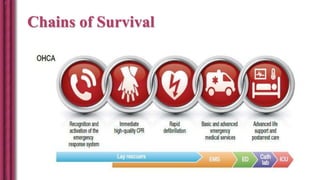
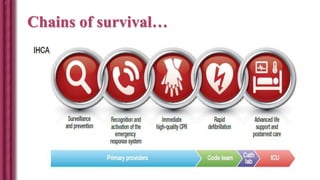
Chains of Survival
Chains of survival…
Adult Basic Life Support and CPR
Quality
Lay Rescuer CPR (Trained or untrained)
Health Care Provider BLS
(Rescuer – all, regardless of training, should provide
chest compression)
COMPONENTS OF BLS
1) Ensure safety
2) Recognition of cardiac arrest
3) Activation Emergency Response System
4) Chest compressions
5) Check airway and ventilate
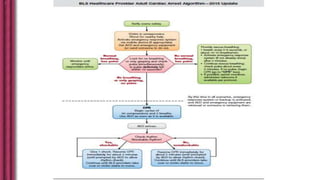
SIMPLIFIED ADULT –BLS
ALGORITHM (AHA 2015)
ENSURE SAFETY
Safety Of Self
Safety Of client
Movement of a trauma victim – only when absolutely
necessary
[unstable cervical spine – injured spinal cord]
Make sure the environment is safe for rescuers and victim
Recognition of cardiac arrest
Check for responsiveness(Ask the person “are you all
right?”Tap and shout)
No breathing or only gasping (ie, no normal breathing)
No definite pulse felt within 10 seconds
(Breathing and pulse check can be performed
simultaneously in less than 10 seconds)
Activation Of Emergency Response
System
If you are alone with no mobile phone, leave the victim
to activate the emergency response system and get
the AED before beginning CPR
Otherwise, send someone and begin CPR immediately;
use the AED as soon as it is available
Compression ventilation
ratio without advanced airway
1 or 2 rescuers
30:2
Compression ventilation ratio with
advanced airway
Continuous compressions at a rate of 100-120/min
Give 1 breath every 6 seconds (10 breaths/min)
Compression rate: 100-120/min
Compression depth: At least 2 inches (5 cm), should be no
more than 2.4 inches (6 cm).
Hand placement: 2 hands on the lower half of the
breastbone (sternum)
Chest recoil: Allow full recoil of chest after each
compression; do not lean on the chest after each
compression
Minimizing interruptions: Limit interruptions in chest
compressions to less than 10 seconds
Circulation
Airway
Breathing
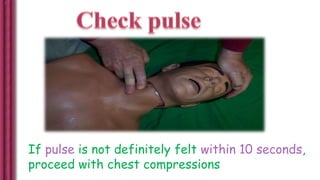
If pulse is not definitely felt within 10 seconds,
proceed with chest compressions
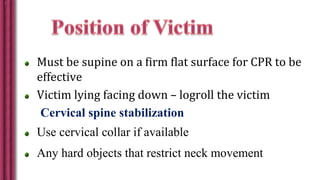
Must be supine on a firm flat surface for CPR to be
effective
Victim lying facing down – logroll the victim
Cervical spine stabilization
Use cervical collar if available
Any hard objects that restrict neck movement
Kneel beside victim’s chest or stand beside bed
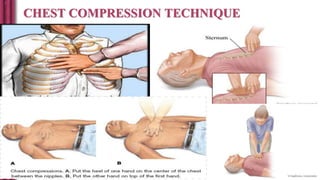
Heel of one hand on inter-mammary line (which is the
lower half of the sternum)
Heel of other hand on top of the first so that the hands are
overlapped and
parallel
Lock elbows
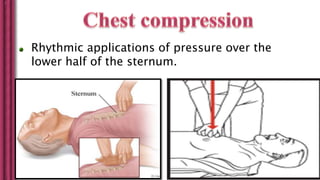
Rhythmic applications of pressure over the
lower half of the sternum.
CHEST COMPRESSION TECHNIQUE
Chest compression…
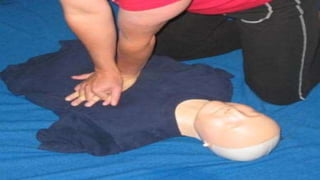
 Victim should lie supine on a hard surface.
 Place the heel of the hand on the sternum in the centre
(middle) of the chest between the nipples and then
place the heel of the second hand on top of the first so
that the hands are overlapped and parallel.
Chest compression…
 The rescuer should compress the lower half of the
victim’s sternum in the centre (middle) of the chest,
between the nipples.
 Depress the sternum approximately 2 to 2.4 inches.
 Allow complete chest recoil.
How do they work?
Increase intrathoracic pressure and directly compress heart
Creates a SBP peaks of 60 – 80 mmHg
MAP in carotid artery < 40 mmHg
Deliver a small but critical amount of O2 and substrate to brain
& myocardium
Rescuer fatigue – Decreased rate , depth, incomplete recoil -
switch every 2 min
Characteristics Of Good Compression
“Push hard Push fast”: push at a rate of 100 -120
minute.
Compression depth- 2 inches (5cm)- 2.4 inches (6cm)
Release completely to allow the chest to fully recoil.
Minimize interruptions in chest compressions.
A compression-ventilation ratio of 30:2 is
recommended.
Characteristics Of Good Compression …
 Perform 30 chest compressions at a rate of 100 to 120
compressions per minute.
 Your shoulders should be located over the victim's
chest.
 Your arms should be straight.
 Use your body weight to perform chest compressions
Characteristics Of Good Compression…
Keep constant contact between the heel of your
compression hand and the skin of the victim's chest.
Do not rock back and forth as you do chest
compressions.
Do not bounce your hands up and down on the victim's
chest.
NEVER use the PALM of your hand,
use the HEEL of your hand.
CHEST COMPRESSIONS
When 2 or more rescuers available,
switch the compressor about every 2 minutes (or after 5 cycles of
compressions and ventilations at a ratio of 30:2).
Accomplish this switch in ≤5 seconds.
Advanced airway and 2 rescuers-
continuous chest compressions at a rate of 100 to 120/min without
pauses for ventilation.
The rescuer delivering ventilation provides 8 to 10 breaths per
minute.
Lay rescuers should continue CPR until an AED arrives
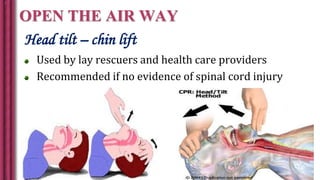
OPEN THE AIR WAY
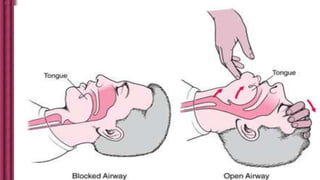
Head tilt – chin lift
Used by lay rescuers and health care providers
Recommended if no evidence of spinal cord injury
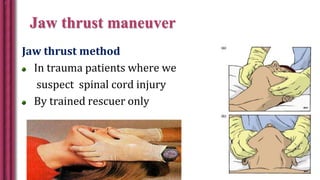
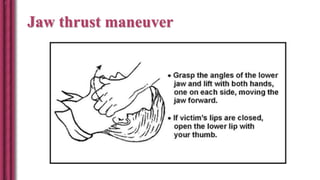
Jaw thrust maneuver
Jaw thrust method
In trauma patients where we
suspect spinal cord injury
By trained rescuer only
Jaw thrust maneuver
Look in the mouth
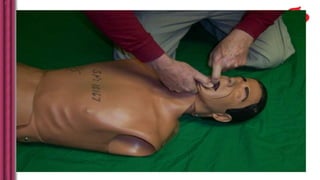
Do a jaw lift and look in the mouth.
If you see food or a foreign
object ,follow up with a finger sweep
Never do a blind finger sweep.
You should be able to see an object in the mouth
before you perform a finger sweep
3.BREATHING
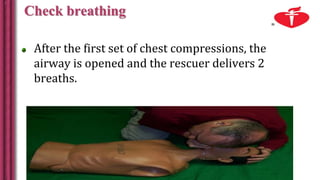
Check breathing
After the first set of chest compressions, the
airway is opened and the rescuer delivers 2
breaths.
How rescue breathing works ….
Rescue breaths contain 16% oxygen
Early arrest – O2 content of blood remains normal, O2
delivery to organs is limited more by reduced blood flow
( C.O.) than reduced O2.
Prolonged/Asphyxial arrest
- reduced O2 content also there
GIVING RESCUE BREATHS
Deliver each rescue breath over 1 second.
Give a sufficient tidal volume to produce visible chest rise
(500-600ml).
Avoid rapid or forceful breaths.
When an advanced airway is in place during 2-person
CPR, ventilate at a rate of 10 breaths per min.
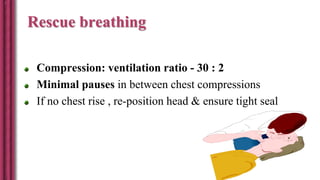
Rescue breathing
Compression: ventilation ratio - 30 : 2
Minimal pauses in between chest compressions
If no chest rise , re-position head & ensure tight seal
Rescue breathing
During CPR , C.O. is 25 – 33% of normal so oxygen
uptake from the lungs and CO2 delivery to the lungs are
also reduced.
Tidal vol : 6-7 ml/kg = 500-600 ml [ 1-2 L bag]
Risk of:
-Reduced venous return to heart.
-Gastric inflation – regurgitation , aspiration, splinting of lung
by diaphragm.
METHODS
Mouth-to-Mouth Rescue Breathing
Mouth-to–Barrier Device Breathing
Mouth-to-Nose and Mouth-to-Stoma
Ventilation
Ventilation With Bag and Mask
Ventilation With an Advanced Airway
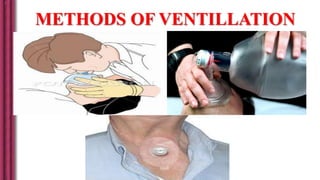
METHODS OF VENTILLATION
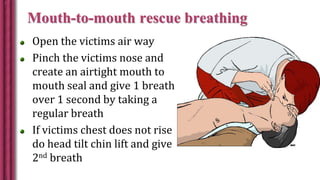
Mouth-to-mouth rescue breathing
Open the victims air way
Pinch the victims nose and
create an airtight mouth to
mouth seal and give 1 breath
over 1 second by taking a
regular breath
If victims chest does not rise
do head tilt chin lift and give
2nd breath
Mouth-to-barrier device
Use barrier devices like face shields, masks etc
Mouth-to-Nose and Mouth-to-Stoma
Ventilation
If impossible to ventilate through victims mouth
If mouth cannot be opened
If mouth to mouth seal is difficult to achieve
VENTILLATION WITH BAG AND
MASK
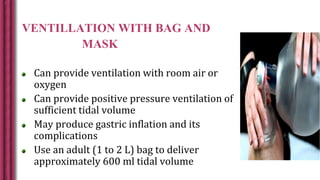
Can provide ventilation with room air or
oxygen
Can provide positive pressure ventilation of
sufficient tidal volume
May produce gastric inflation and its
complications
Use an adult (1 to 2 L) bag to deliver
approximately 600 ml tidal volume
Recovery position
The recovery position is used for unresponsive adult victims
who have normal breathing and effective circulation.
Designed to maintain a patent airway and reduce the risk of
airway obstruction and aspiration.
The victim is placed on his or her side with the lower arm in
front of the body. Adjust the top leg so that both the hip and
knee are bent at right angles. Gently tilt the head back to keep
the airway open
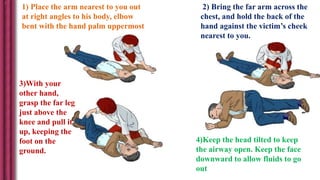
1) Place the arm nearest to you out
at right angles to his body, elbow
bent with the hand palm uppermost
2) Bring the far arm across the
chest, and hold the back of the
hand against the victim’s cheek
nearest to you.
4)Keep the head tilted to keep
the airway open. Keep the face
downward to allow fluids to go
out
3)With your
other hand,
grasp the far leg
just above the
knee and pull it
up, keeping the
foot on the
ground.
COMPLICATIONS
 Spinal cord Injury
 Internal organ damage
 Vomiting
 Risk for aspiration
 Gastric distension
 Punctured lungs, lacerated liver, fractured ribs and
sternum--caused by chest compressions
 Disease transmission, including Influenza, Staph infection,
and TB etc- due to inadequate or no protective mask.
CPR CONSIDERATIONS FOR OLDER
CLIENT
Assess for fractured sternum after CPR
Be certain the health care team implements the patient’s
desire for Do Not Resusitate or Do not intubate orders
Consider family presence
Keep in mind the effect of medications due to delayed
clearance & altered metabolic response
Difference between BLS & ACLS
SUMMARY
Introduction
Definition
Indications
Classification
Adult BLS
Conclusion
In the years since the publication of the 2005 AHA
Guidelines for CPR and ECC, many resuscitation systems
and communities have documented improved survival for
victims of cardiac arrest.
However, too few victims of cardiac arrest receive
bystander CPR.
We know that CPR quality must be high and that victims
require excellent post–cardiac arrest care by organized
teams with members who function well together.
Education and frequent refresher training are likely the
keys to improving resuscitation performance.
Cardio pulmonary resuscitation (BLS)

Cardio pulmonary resuscitation (BLS)

  • 1.
    CARDIO PULMONARY RESUSCITATION Presenter : MsTarika Sharma Nursing Tutor MMCON, MMU Ambala, HR
  • 2.
    Introduction According to recentstatistics sudden cardiac arrest is becoming one of the leading causes of death. Once the heart ceases to function, a healthy human brain may survive without oxygen for up to 4 minutes without suffering any permanent damage. Unfortunately, a typical EMS response may take 6, 8 or even 10 minutes.
  • 3.
    Introduction… It is duringthose critical minutes that CPR (Cardio Pulmonary Resuscitation) can provide oxygenated blood to the victim's brain and the heart, dramatically increasing his chance of survival. And if properly instructed, almost anyone can learn and perform CPR.
  • 4.
    Cardiopulmonary resuscitation (CPR)is an emergency technique used when a person’s heart has stopped beating and breathing has stopped. It is a combination of rescue breathing and chest compression delivered to victims thought to be in cardiac arrest.
  • 5.
    PURPOSE To maintain theblood circulation (C). To maintain an open and clear airway (A). To maintain breathing by artificial ventilation (B). To save life of the patient. To provide basic life support till medical and Advanced Life Support arrives. To provide a flow of oxygenated blood to the brain
  • 6.
    Sudden Cardiac arrest Unconsciousness Norespirations or brief irregular, 'gasping' breaths No Pulse
  • 7.
    Contraindications  Do-not-resuscitate (DNR)order  A person’s desire to not be resuscitated in the event of cardiac arrest.  If a clinician justifiably feels that the intervention would be medically futile.
  • 8.
    Cardiac Arrest Cardiac arrestis a sudden stop in effective blood circulation due to failure of the heart to contract effectively or at all. Also known as cardiopulmonary arrest or circulatory arrest. It is a medical emergency
  • 9.
    CAUSES OF CARDIACARREST CARDIAC CAUSES MI Heart failure Dysrythmia Cardiac tamponade PULMONARY CAUSES Respiratory failure Airway obstruction ARDS Pneumothorax Pulmonary embolus
  • 10.
    CAUSES OF CARDIACARREST… ELECTROLYTE IMBALANCE Hyper kalemia Hyper/hypo calcemia PROCEDURES PA catheterisation Cardiac catheterisation Surgery OTHERS Drug toxicity
  • 11.
  • 12.
  • 13.
    What is BLS? Maintenanceof airway Support of breathing & circulation Without using equipment other than a simple airway device or protective shield.
  • 14.
  • 15.
  • 16.
    Adult Basic LifeSupport and CPR Quality Lay Rescuer CPR (Trained or untrained) Health Care Provider BLS (Rescuer – all, regardless of training, should provide chest compression)
  • 17.
    COMPONENTS OF BLS 1)Ensure safety 2) Recognition of cardiac arrest 3) Activation Emergency Response System 4) Chest compressions 5) Check airway and ventilate
  • 18.
  • 20.
    ENSURE SAFETY Safety OfSelf Safety Of client Movement of a trauma victim – only when absolutely necessary [unstable cervical spine – injured spinal cord] Make sure the environment is safe for rescuers and victim
  • 21.
    Recognition of cardiacarrest Check for responsiveness(Ask the person “are you all right?”Tap and shout) No breathing or only gasping (ie, no normal breathing) No definite pulse felt within 10 seconds (Breathing and pulse check can be performed simultaneously in less than 10 seconds)
  • 22.
    Activation Of EmergencyResponse System If you are alone with no mobile phone, leave the victim to activate the emergency response system and get the AED before beginning CPR Otherwise, send someone and begin CPR immediately; use the AED as soon as it is available
  • 23.
    Compression ventilation ratio withoutadvanced airway 1 or 2 rescuers 30:2 Compression ventilation ratio with advanced airway Continuous compressions at a rate of 100-120/min Give 1 breath every 6 seconds (10 breaths/min)
  • 24.
    Compression rate: 100-120/min Compressiondepth: At least 2 inches (5 cm), should be no more than 2.4 inches (6 cm). Hand placement: 2 hands on the lower half of the breastbone (sternum) Chest recoil: Allow full recoil of chest after each compression; do not lean on the chest after each compression Minimizing interruptions: Limit interruptions in chest compressions to less than 10 seconds
  • 25.
  • 27.
    If pulse isnot definitely felt within 10 seconds, proceed with chest compressions
  • 28.
    Must be supineon a firm flat surface for CPR to be effective Victim lying facing down – logroll the victim Cervical spine stabilization Use cervical collar if available Any hard objects that restrict neck movement
  • 29.
    Kneel beside victim’schest or stand beside bed Heel of one hand on inter-mammary line (which is the lower half of the sternum) Heel of other hand on top of the first so that the hands are overlapped and parallel Lock elbows
  • 30.
    Rhythmic applications ofpressure over the lower half of the sternum.
  • 31.
  • 32.
    Chest compression…  Victimshould lie supine on a hard surface.  Place the heel of the hand on the sternum in the centre (middle) of the chest between the nipples and then place the heel of the second hand on top of the first so that the hands are overlapped and parallel.
  • 33.
    Chest compression…  Therescuer should compress the lower half of the victim’s sternum in the centre (middle) of the chest, between the nipples.  Depress the sternum approximately 2 to 2.4 inches.  Allow complete chest recoil.
  • 35.
    How do theywork? Increase intrathoracic pressure and directly compress heart Creates a SBP peaks of 60 – 80 mmHg MAP in carotid artery < 40 mmHg Deliver a small but critical amount of O2 and substrate to brain & myocardium Rescuer fatigue – Decreased rate , depth, incomplete recoil - switch every 2 min
  • 36.
    Characteristics Of GoodCompression “Push hard Push fast”: push at a rate of 100 -120 minute. Compression depth- 2 inches (5cm)- 2.4 inches (6cm) Release completely to allow the chest to fully recoil. Minimize interruptions in chest compressions. A compression-ventilation ratio of 30:2 is recommended.
  • 37.
    Characteristics Of GoodCompression …  Perform 30 chest compressions at a rate of 100 to 120 compressions per minute.  Your shoulders should be located over the victim's chest.  Your arms should be straight.  Use your body weight to perform chest compressions
  • 38.
    Characteristics Of GoodCompression… Keep constant contact between the heel of your compression hand and the skin of the victim's chest. Do not rock back and forth as you do chest compressions. Do not bounce your hands up and down on the victim's chest. NEVER use the PALM of your hand, use the HEEL of your hand.
  • 39.
    CHEST COMPRESSIONS When 2or more rescuers available, switch the compressor about every 2 minutes (or after 5 cycles of compressions and ventilations at a ratio of 30:2). Accomplish this switch in ≤5 seconds. Advanced airway and 2 rescuers- continuous chest compressions at a rate of 100 to 120/min without pauses for ventilation. The rescuer delivering ventilation provides 8 to 10 breaths per minute. Lay rescuers should continue CPR until an AED arrives
  • 41.
    OPEN THE AIRWAY Head tilt – chin lift Used by lay rescuers and health care providers Recommended if no evidence of spinal cord injury
  • 43.
    Jaw thrust maneuver Jawthrust method In trauma patients where we suspect spinal cord injury By trained rescuer only
  • 44.
  • 45.
    Look in themouth Do a jaw lift and look in the mouth. If you see food or a foreign object ,follow up with a finger sweep Never do a blind finger sweep. You should be able to see an object in the mouth before you perform a finger sweep
  • 47.
  • 48.
    Check breathing After thefirst set of chest compressions, the airway is opened and the rescuer delivers 2 breaths.
  • 49.
    How rescue breathingworks …. Rescue breaths contain 16% oxygen Early arrest – O2 content of blood remains normal, O2 delivery to organs is limited more by reduced blood flow ( C.O.) than reduced O2. Prolonged/Asphyxial arrest - reduced O2 content also there
  • 50.
    GIVING RESCUE BREATHS Delivereach rescue breath over 1 second. Give a sufficient tidal volume to produce visible chest rise (500-600ml). Avoid rapid or forceful breaths. When an advanced airway is in place during 2-person CPR, ventilate at a rate of 10 breaths per min.
  • 51.
    Rescue breathing Compression: ventilationratio - 30 : 2 Minimal pauses in between chest compressions If no chest rise , re-position head & ensure tight seal
  • 52.
    Rescue breathing During CPR, C.O. is 25 – 33% of normal so oxygen uptake from the lungs and CO2 delivery to the lungs are also reduced. Tidal vol : 6-7 ml/kg = 500-600 ml [ 1-2 L bag] Risk of: -Reduced venous return to heart. -Gastric inflation – regurgitation , aspiration, splinting of lung by diaphragm.
  • 53.
    METHODS Mouth-to-Mouth Rescue Breathing Mouth-to–BarrierDevice Breathing Mouth-to-Nose and Mouth-to-Stoma Ventilation Ventilation With Bag and Mask Ventilation With an Advanced Airway
  • 54.
  • 55.
    Mouth-to-mouth rescue breathing Openthe victims air way Pinch the victims nose and create an airtight mouth to mouth seal and give 1 breath over 1 second by taking a regular breath If victims chest does not rise do head tilt chin lift and give 2nd breath
  • 56.
    Mouth-to-barrier device Use barrierdevices like face shields, masks etc Mouth-to-Nose and Mouth-to-Stoma Ventilation If impossible to ventilate through victims mouth If mouth cannot be opened If mouth to mouth seal is difficult to achieve
  • 57.
    VENTILLATION WITH BAGAND MASK Can provide ventilation with room air or oxygen Can provide positive pressure ventilation of sufficient tidal volume May produce gastric inflation and its complications Use an adult (1 to 2 L) bag to deliver approximately 600 ml tidal volume
  • 58.
    Recovery position The recoveryposition is used for unresponsive adult victims who have normal breathing and effective circulation. Designed to maintain a patent airway and reduce the risk of airway obstruction and aspiration. The victim is placed on his or her side with the lower arm in front of the body. Adjust the top leg so that both the hip and knee are bent at right angles. Gently tilt the head back to keep the airway open
  • 59.
    1) Place thearm nearest to you out at right angles to his body, elbow bent with the hand palm uppermost 2) Bring the far arm across the chest, and hold the back of the hand against the victim’s cheek nearest to you. 4)Keep the head tilted to keep the airway open. Keep the face downward to allow fluids to go out 3)With your other hand, grasp the far leg just above the knee and pull it up, keeping the foot on the ground.
  • 60.
    COMPLICATIONS  Spinal cordInjury  Internal organ damage  Vomiting  Risk for aspiration  Gastric distension  Punctured lungs, lacerated liver, fractured ribs and sternum--caused by chest compressions  Disease transmission, including Influenza, Staph infection, and TB etc- due to inadequate or no protective mask.
  • 61.
    CPR CONSIDERATIONS FOROLDER CLIENT Assess for fractured sternum after CPR Be certain the health care team implements the patient’s desire for Do Not Resusitate or Do not intubate orders Consider family presence Keep in mind the effect of medications due to delayed clearance & altered metabolic response
  • 62.
  • 63.
  • 64.
    Conclusion In the yearssince the publication of the 2005 AHA Guidelines for CPR and ECC, many resuscitation systems and communities have documented improved survival for victims of cardiac arrest. However, too few victims of cardiac arrest receive bystander CPR. We know that CPR quality must be high and that victims require excellent post–cardiac arrest care by organized teams with members who function well together. Education and frequent refresher training are likely the keys to improving resuscitation performance.