IABP(INTRA-AORTIC
BALLOON PUMP)
INTRODUCTION:
 IABP gives temporary support for the left ventricle by
mechanically displacing blood within the aorta.
 It is the most common and widely available methods of
mechanical circulatory support.
 Traditionally used in surgical and non surgical patients
with cardiogenic shock.
HISTORY:
• In 1958 Harken described a method to treat left
ventricular failure .
• In 1979 after subsequent development a
percutaneous IAB with a size of 8,5 to 9,5 French
was achieved.
• In 1985 the first prefolded IAB was developed.
• Today continued improvements in IABP
technology permit safer use.
PURPOSE:
The primary goals of IABP treatment are:
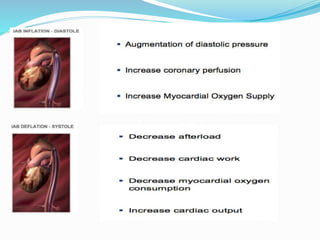
• To increase myocardial oxygen supply and
• To decrease myocardial oxygen demand.
• Improvement of cardiac output (CO), an increase of
coronary perfusion pressure.
INDICATIONS
 Cardiac failure.
 Refractory Unstable angina.
 Perioperative treatment of complications due to myocardial
infarction.
 As a bridge to cardiac transplantation.
Physiologic Effects of IABP Therapy
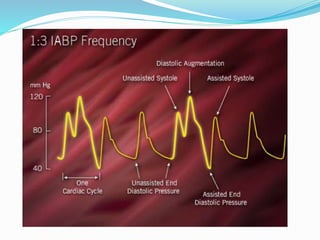
 IABP inflates at the onset of diastole and
 Deflates just before systole .
 The magnitude of these effects depends upon:
 Balloon volume,Heart rate,Aortic compliance.
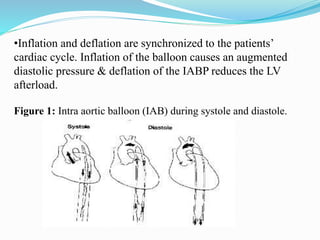
•Inflation and deflation are synchronized to the patients’
cardiac cycle. Inflation of the balloon causes an augmented
diastolic pressure & deflation of the IABP reduces the LV
afterload.
Figure 1: Intra aortic balloon (IAB) during systole and diastole.
The IAB Counter pulsation system
- two principal parts
 A flexible catheter -2 lumen
• first - for distal aspiration/flushing or pressure
monitoring
• second - for the periodic delivery and removal of
helium gas to a closed balloon.
 A mobile console
• system for helium transfer
• computer for control of the inflation and deflation
cycle.
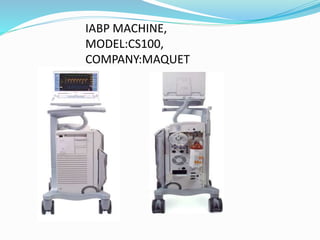
IABP MACHINE,
MODEL:CS100,
COMPANY:MAQUET
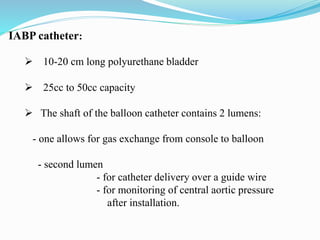
IABP catheter:
 10-20 cm long polyurethane bladder
 25cc to 50cc capacity
 The shaft of the balloon catheter contains 2 lumens:
- one allows for gas exchange from console to balloon
- second lumen
- for catheter delivery over a guide wire
- for monitoring of central aortic pressure
after installation.
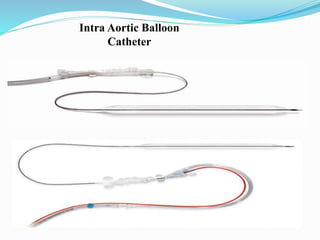
Intra Aortic Balloon
Catheter
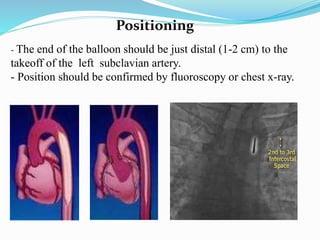
Positioning
- The end of the balloon should be just distal (1-2 cm) to the
takeoff of the left subclavian artery.
- Position should be confirmed by fluoroscopy or chest x-ray.
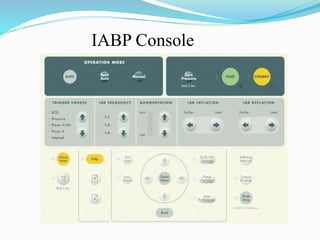
IABP Console
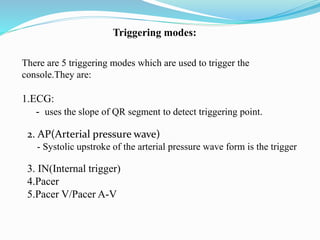
Triggering modes:
There are 5 triggering modes which are used to trigger the
console.They are:
1.ECG:
- uses the slope of QR segment to detect triggering point.
2. AP(Arterial pressure wave)
- Systolic upstroke of the arterial pressure wave form is the trigger
3. IN(Internal trigger)
4.Pacer
5.Pacer V/Pacer A-V
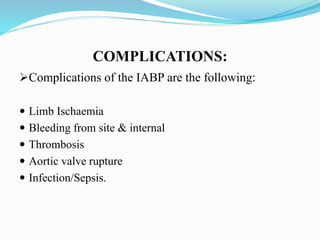
COMPLICATIONS:
Complications of the IABP are the following:
 Limb Ischaemia
 Bleeding from site & internal
 Thrombosis
 Aortic valve rupture
 Infection/Sepsis.
TROUBLESHOOTING
The following are common problems that may occur when using an IABP.
a) No trigger – This means that the IABP has lost its tracing of ECG or
Pressure and is unable to time the inflation and deflation:
Action: To reconnect the ECG leads or pressure cable, or change the ECG
leads or tracing lead to obtain a better trace.
b) Check IAB Catheter – this means that the IAB Catheter is either
kinked insitu or at the insertion site or it has not unwrapped fully insitu.
Action: Examine the catheter and extension tubing for any signs of
kinking. Ensure that full augmentation is on, making sure the balloon has
the ability to expand. Examine the skin insertion, as this is a common place
for kinking.
c) Rapid Gas Loss - This will appear if there is a leak or hole in the
balloon or extension tubing. This means the balloon may be ruptured,
you will see flecks of blood in the tubing.
Action: If the balloon is losing its gas and filling is frequently necessary,
or blood flecks have been identified in the tubing, then stop pumping. It
will mean that the catheter will need to removed and replaced. Check all
connections for any leaks or disconnections.
d) IAB Disconnected – this means the IAB catheter extension tubing
has been disconnected and the pump will stop working.
Action: Reconnect the extension tubing, PRESS IAB Fill for 3 seconds
till prompt is on the screen and the PRESS Assist/Standby to start
pumping.
Thank you

IABP

  • 1.
    IABP(INTRA-AORTIC BALLOON PUMP) INTRODUCTION:  IABPgives temporary support for the left ventricle by mechanically displacing blood within the aorta.  It is the most common and widely available methods of mechanical circulatory support.  Traditionally used in surgical and non surgical patients with cardiogenic shock.
  • 2.
    HISTORY: • In 1958Harken described a method to treat left ventricular failure . • In 1979 after subsequent development a percutaneous IAB with a size of 8,5 to 9,5 French was achieved. • In 1985 the first prefolded IAB was developed. • Today continued improvements in IABP technology permit safer use.
  • 3.
    PURPOSE: The primary goalsof IABP treatment are: • To increase myocardial oxygen supply and • To decrease myocardial oxygen demand. • Improvement of cardiac output (CO), an increase of coronary perfusion pressure.
  • 4.
    INDICATIONS  Cardiac failure. Refractory Unstable angina.  Perioperative treatment of complications due to myocardial infarction.  As a bridge to cardiac transplantation.
  • 5.
    Physiologic Effects ofIABP Therapy  IABP inflates at the onset of diastole and  Deflates just before systole .  The magnitude of these effects depends upon:  Balloon volume,Heart rate,Aortic compliance.
  • 6.
    •Inflation and deflationare synchronized to the patients’ cardiac cycle. Inflation of the balloon causes an augmented diastolic pressure & deflation of the IABP reduces the LV afterload. Figure 1: Intra aortic balloon (IAB) during systole and diastole.
  • 8.
    The IAB Counterpulsation system - two principal parts  A flexible catheter -2 lumen • first - for distal aspiration/flushing or pressure monitoring • second - for the periodic delivery and removal of helium gas to a closed balloon.  A mobile console • system for helium transfer • computer for control of the inflation and deflation cycle.
  • 9.
  • 10.
    IABP catheter:  10-20cm long polyurethane bladder  25cc to 50cc capacity  The shaft of the balloon catheter contains 2 lumens: - one allows for gas exchange from console to balloon - second lumen - for catheter delivery over a guide wire - for monitoring of central aortic pressure after installation.
  • 11.
  • 12.
    Positioning - The endof the balloon should be just distal (1-2 cm) to the takeoff of the left subclavian artery. - Position should be confirmed by fluoroscopy or chest x-ray.
  • 13.
  • 14.
    Triggering modes: There are5 triggering modes which are used to trigger the console.They are: 1.ECG: - uses the slope of QR segment to detect triggering point. 2. AP(Arterial pressure wave) - Systolic upstroke of the arterial pressure wave form is the trigger 3. IN(Internal trigger) 4.Pacer 5.Pacer V/Pacer A-V
  • 16.
    COMPLICATIONS: Complications of theIABP are the following:  Limb Ischaemia  Bleeding from site & internal  Thrombosis  Aortic valve rupture  Infection/Sepsis.
  • 17.
    TROUBLESHOOTING The following arecommon problems that may occur when using an IABP. a) No trigger – This means that the IABP has lost its tracing of ECG or Pressure and is unable to time the inflation and deflation: Action: To reconnect the ECG leads or pressure cable, or change the ECG leads or tracing lead to obtain a better trace. b) Check IAB Catheter – this means that the IAB Catheter is either kinked insitu or at the insertion site or it has not unwrapped fully insitu. Action: Examine the catheter and extension tubing for any signs of kinking. Ensure that full augmentation is on, making sure the balloon has the ability to expand. Examine the skin insertion, as this is a common place for kinking.
  • 18.
    c) Rapid GasLoss - This will appear if there is a leak or hole in the balloon or extension tubing. This means the balloon may be ruptured, you will see flecks of blood in the tubing. Action: If the balloon is losing its gas and filling is frequently necessary, or blood flecks have been identified in the tubing, then stop pumping. It will mean that the catheter will need to removed and replaced. Check all connections for any leaks or disconnections. d) IAB Disconnected – this means the IAB catheter extension tubing has been disconnected and the pump will stop working. Action: Reconnect the extension tubing, PRESS IAB Fill for 3 seconds till prompt is on the screen and the PRESS Assist/Standby to start pumping.
  • 19.