Defibrillation and Cardioversion
Dr.Venugopalan P P
DA,DNB,MNAMS,MEM-GW
Director ,Emergency Medicine Aster DM healthcare
PG Teacher -EM NBE
Deputy Director -MIMS Academy
Defibrillation
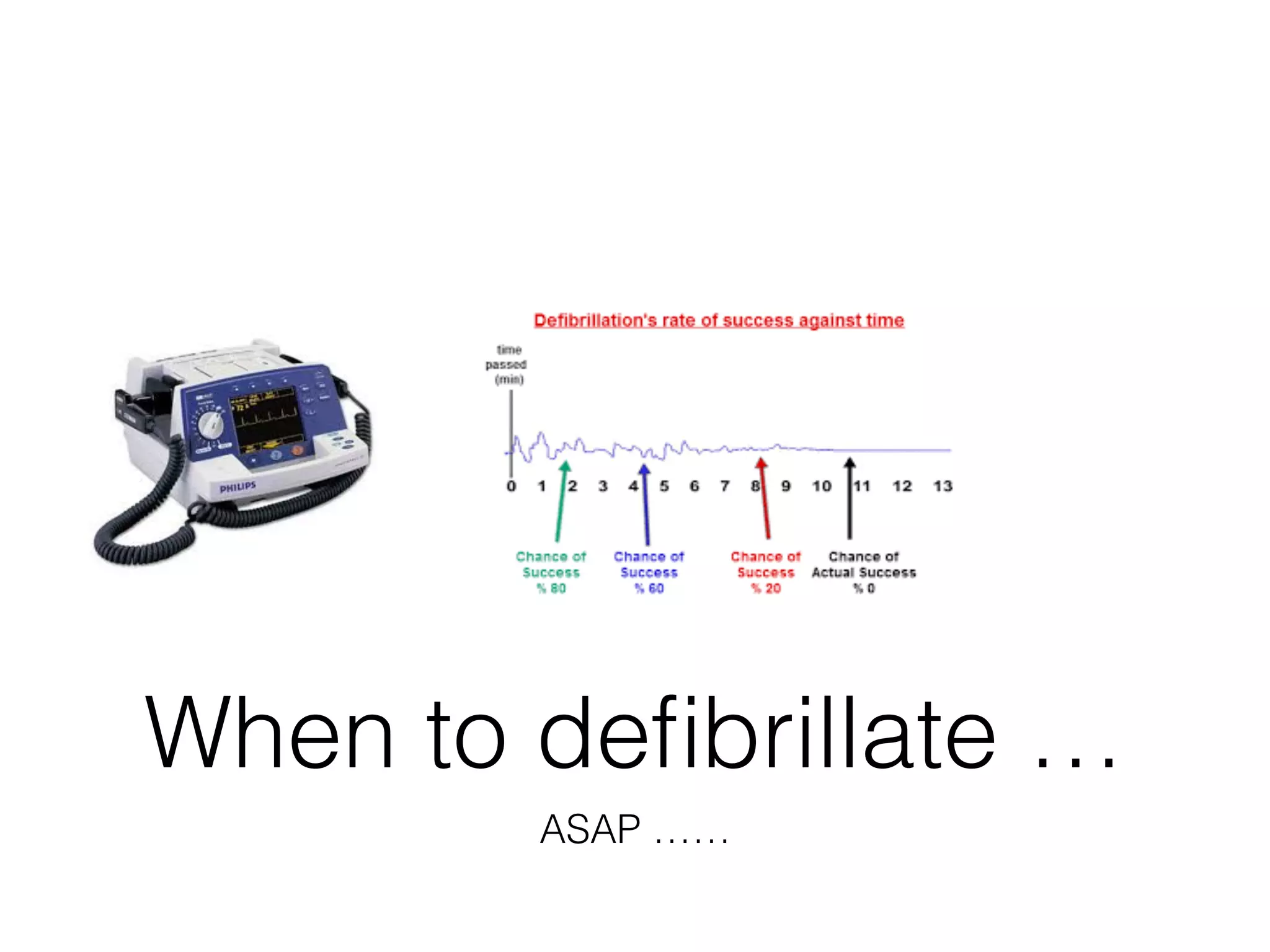
• Defibrillation - is the
treatment for immediately
life-threatening
arrhythmias with which
the patient does not have
a pulse
• Ventricular fibrillation
(VF) or pulseless
ventricular tachycardia
(VT)
Cardioversion
Cardioversion - is any process that
aims to convert an arrhythmia back
to sinus rhythm.
Electrical cardioversion is used
when the patient has a pulse but is
either unstable, or chemical
cardioversion has failed or is
unlikely to be successful
Scenarios may be associated with
chest pain, pulmonary oedema,
syncope or hypotension.
Used in less urgent cases - eg,
atrial fibrillation (AF) - to try to
revert the rhythm back to sinus
The aim in both are to deliver electrical energy to the heart to stun the heart momentarily and thus
allow a normal sinus rhythm to kick in via the heart's normal pacemaker, ie the sinoatrial node.
Defibrillation and Cardioversion
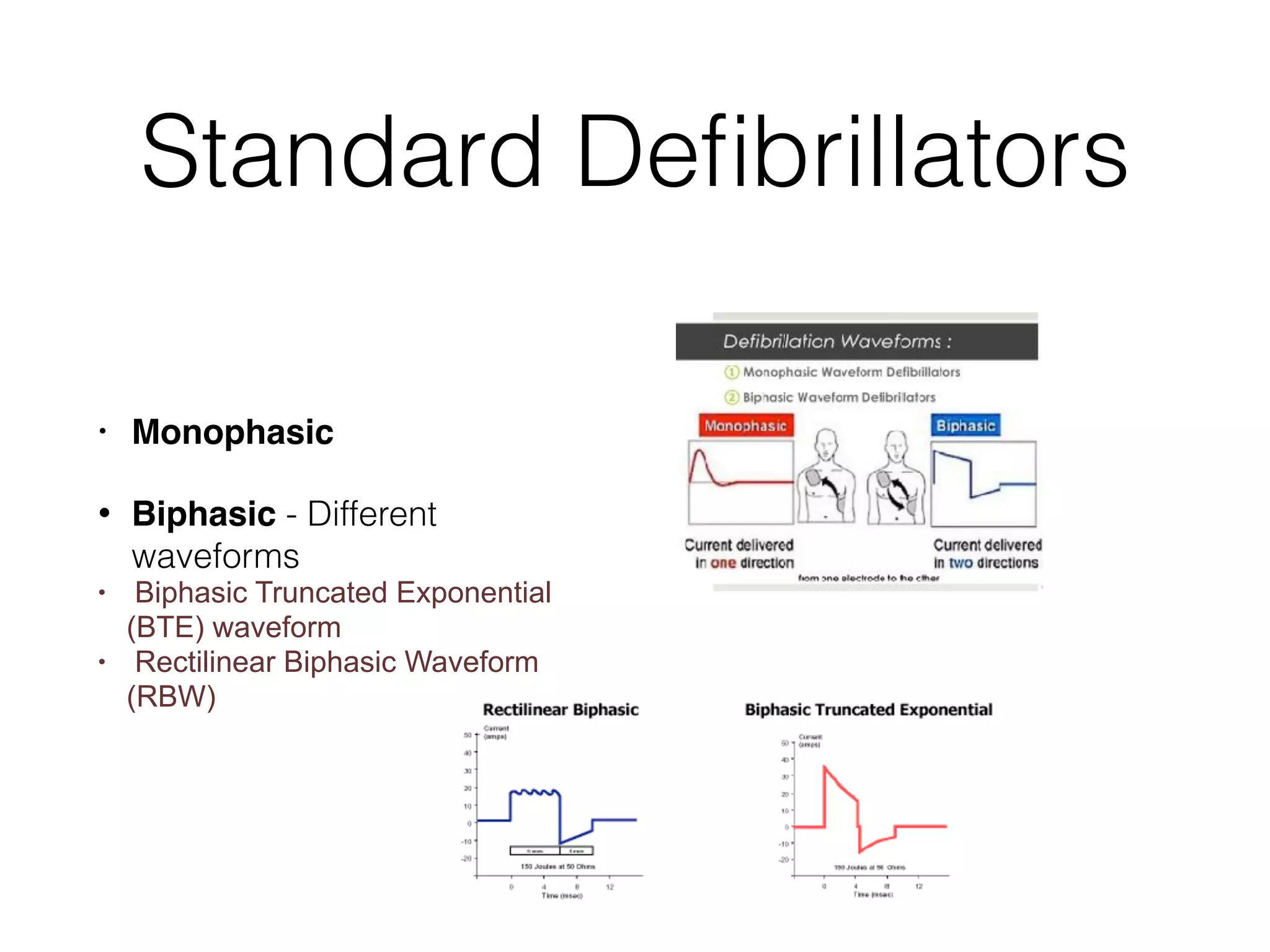
When to defibrillate …
ASAP ……
Defibrillation- A bit of history
• 18th century two
physiologists, Prévost
and Batelli, performed
shock experiments on the
hearts of dogs.
• Applied electrical shocks
and discovered that small
shocks put the dogs'
hearts into VF and this
was successfully reversed
with a larger shock
Defibrillation-A bit of history
It was first used in humans
by Claude Beck, a cardio-
thoracic surgeon - on a boy
aged 14 years who was
undergoing cardio-thoracic
surgery for congenital heart
disease.
Defibrillation- A bit of history
1959-Bernard Lown
designed the modern day
monophasic defibrillator
This is based on the
charging of capacitors
and then delivering of a
shock by paddles over a
few milliseconds.
Defibrillation-A bit of history
1980s the biphasic
waveform was
discovered.
This provided a shock at
lower levels of energy
which were just as
efficacious as
monophasic shocks.
Mono phasic Vs Biphasic
Monophasic systems, the current travels only in one direction - from one paddle to the
other.
Biphasic systems, the current travels towards the positive paddle and then reverses and
goes back; this occurs several times
Biphasic shocks deliver one cycle every 10 milliseconds and they are associated with
fewer burns and less myocardial damage
Mono phasic shocks, the rate of first shock success in cardiac arrests due to a shockable
rhythm is only 60%, whereas with biphasic shocks, this increases to 90%.

However, this efficacy of biphasic defibrillators over mono phasic defibrillators has not
been consistently reported
Type of Defibrillators
• Automated External Defibrillators [AED]
• Semi- Automated AEDs
• Standard defibrillators with Monitor
• Trans-venous or Implanted defibrillators
AED
Does not require special medical
training to use 

Found in public places - eg, offices,
airports, train stations, shopping
centres.
Analyse the heart rhythm and then
charge and deliver a shock if
appropriate.
It cannot be overridden manually
and can take 10-20 seconds to
determine arrhythmias.
Unsurprisingly ease of use and
speed of use are important factors
for success
Four steps of AED
operations
• Power on
• Attach paddle
• Analyse Rhythm -Stand clear
• Shock- Stand clear
Semi Automated AEDs
Similar to AEDs but can
be overridden and usually
have an ECG display.
They tend to be used by
paramedics.
They also have the ability
to pace.
Standard Defibrillators
• Monophasic
• Biphasic - Different
waveforms
• Biphasic Truncated Exponential
(BTE) waveform
• Rectilinear Biphasic Waveform
(RBW)
Implantable Cardiac
Defibrillators -ICD
• Trans-venous
• Implanted
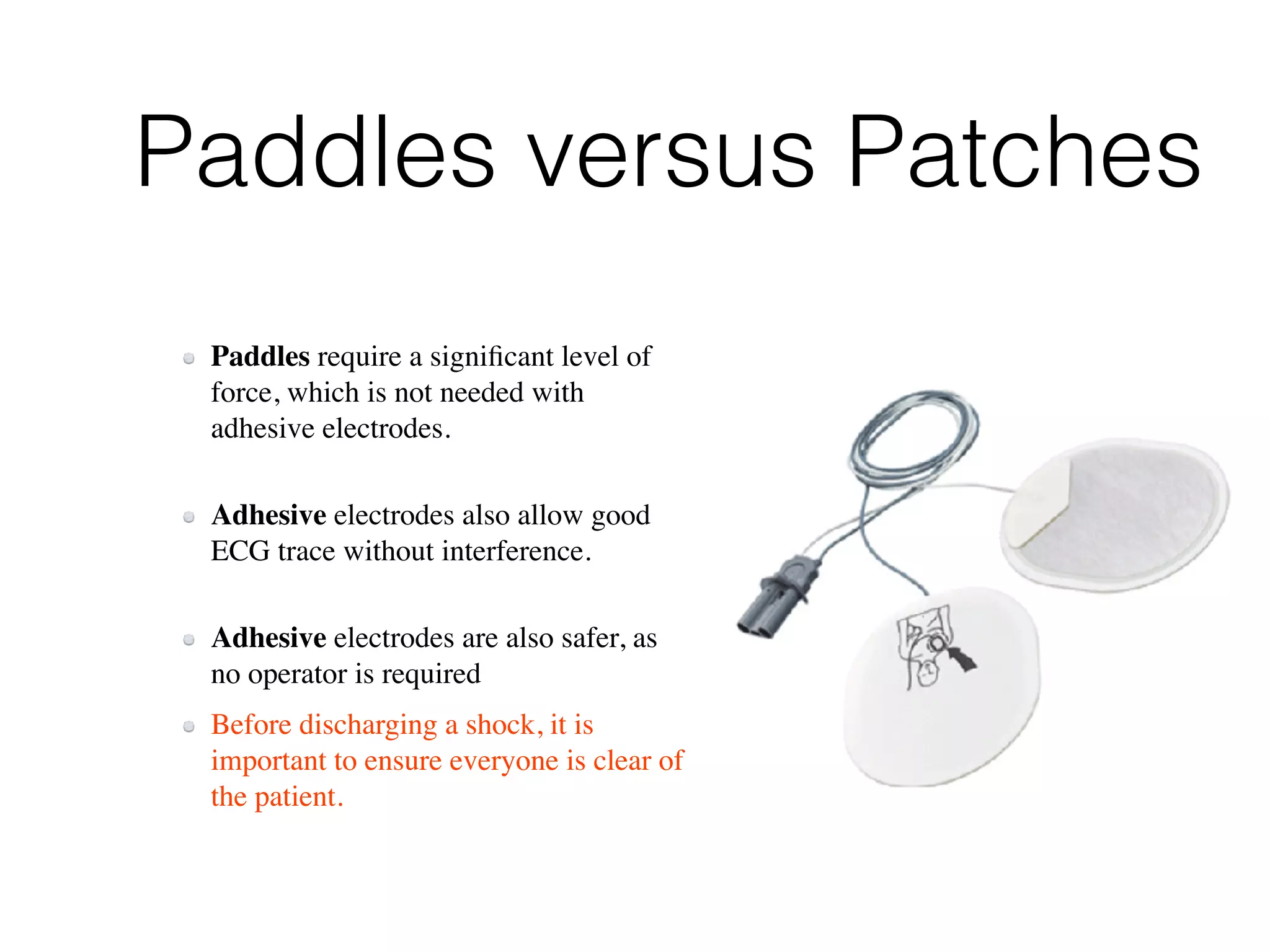
Paddles versus Patches
Paddles were originally used but their
use is being superseded by adhesive
patches.

Adhesive patches are placed most
commonly antero-apically - the anterior
patch goes under the right clavicle and
the apical patch is placed at the apex.

Adhesive electrodes are better, as they
stick to the chest wall, so there is no
mess with gels.

Paddles versus Patches
Paddles require a significant level of
force, which is not needed with
adhesive electrodes.

Adhesive electrodes also allow good
ECG trace without interference.

Adhesive electrodes are also safer, as
no operator is required
Before discharging a shock, it is
important to ensure everyone is clear of
the patient.
Energy Level
Cardiac Arrest
Monophasic - Single
shocks started at and
repeated at 360 J.

Biphasic -Single and
repeated shock 200 J
Use maximum energy
available in your machine
COACHED
Continue Chest Compressions
Oxygen Away

All Else Clear

Charging
Hands Off

Evaluate the Rhythm -
Shockable vs Non-shockable
Defibrillate or Disarm
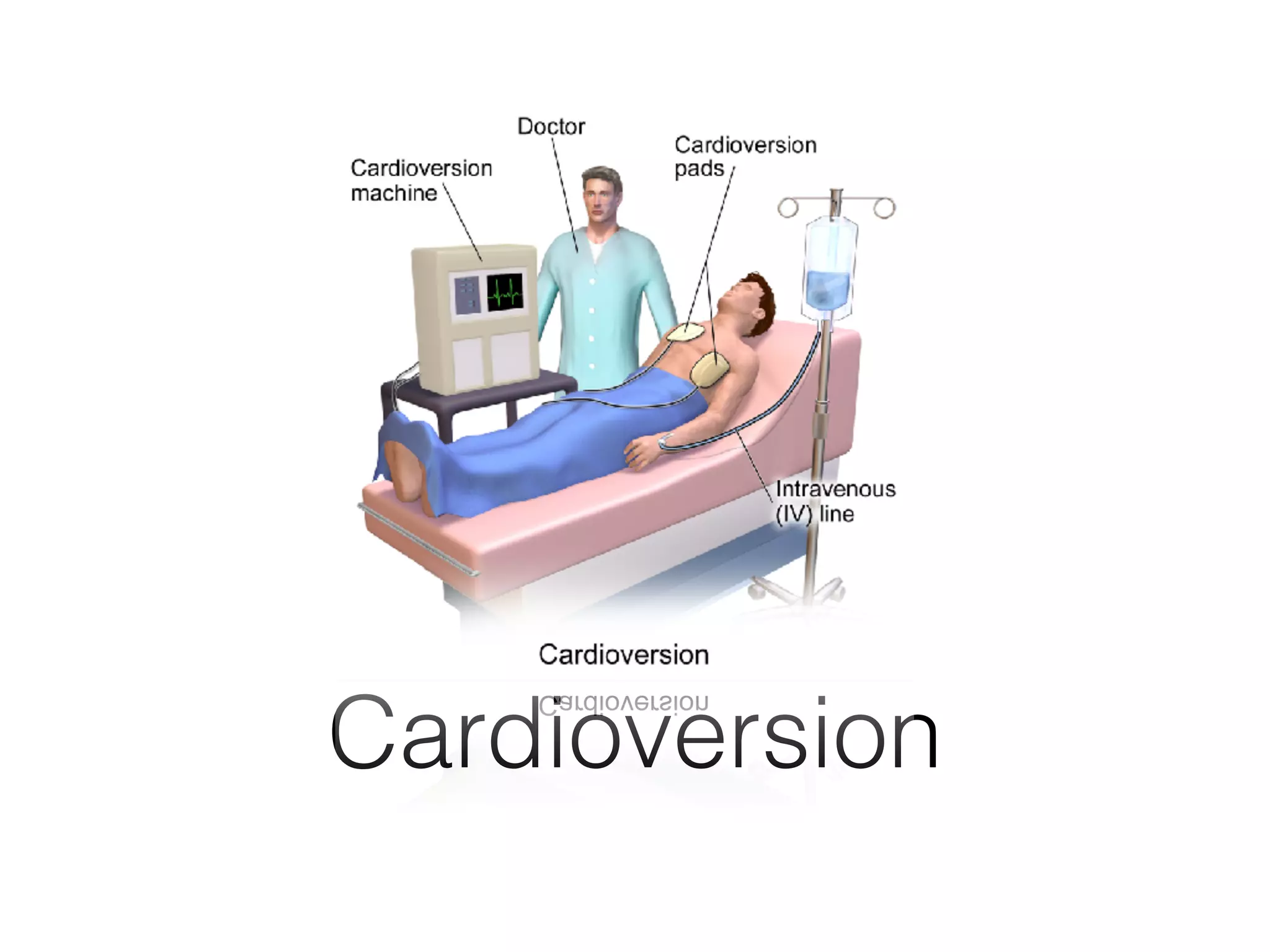
Cardioversion
Indications
• Unstable tachycardia
• Decompensated rapid AF with a rapid ventricular
response - eg, a hypotensive patient, not
responding to medical therapy
• VT with a pulse
• Supraventricular tachycardias including AF without
decompensation; not acutely urgent
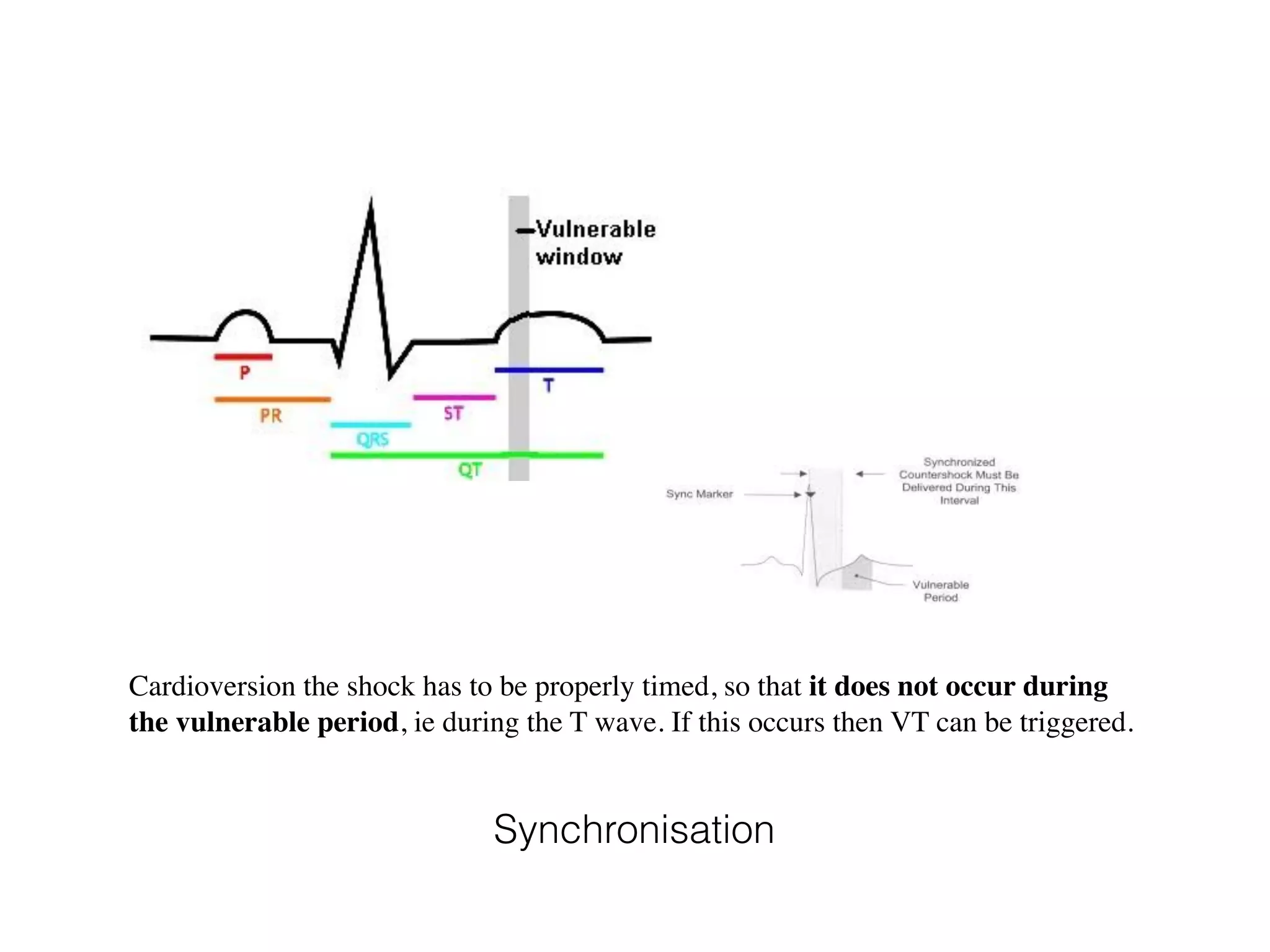
Cardioversion the shock has to be properly timed, so that it does not occur during
the vulnerable period, ie during the T wave. If this occurs then VT can be triggered.
Synchronisation
Signs of Unstable
Tachycardia
• AMS
• Cold and clammy extremities
• Chest pain
• Dyspnea
• Diaphoresis
• Hypotension
• Rapid thready pulse
• Syncope
Atrial Fibrillation-Special
considerations
Cardioversion is used for rhythm
control.

Not all cardioversion is successful
and, at one year, 50% redevelop AF 

Medical treatments and
cardioversion are of similar efficacy
(unless permanent AF).
Cardioversion of AF is associated
with increased risk of
thromboembolic disease (TED)
Anticoagulation is required for at
least three weeks before and at least
four weeks afterwards
Atrial Fibrillation-Special
considerations
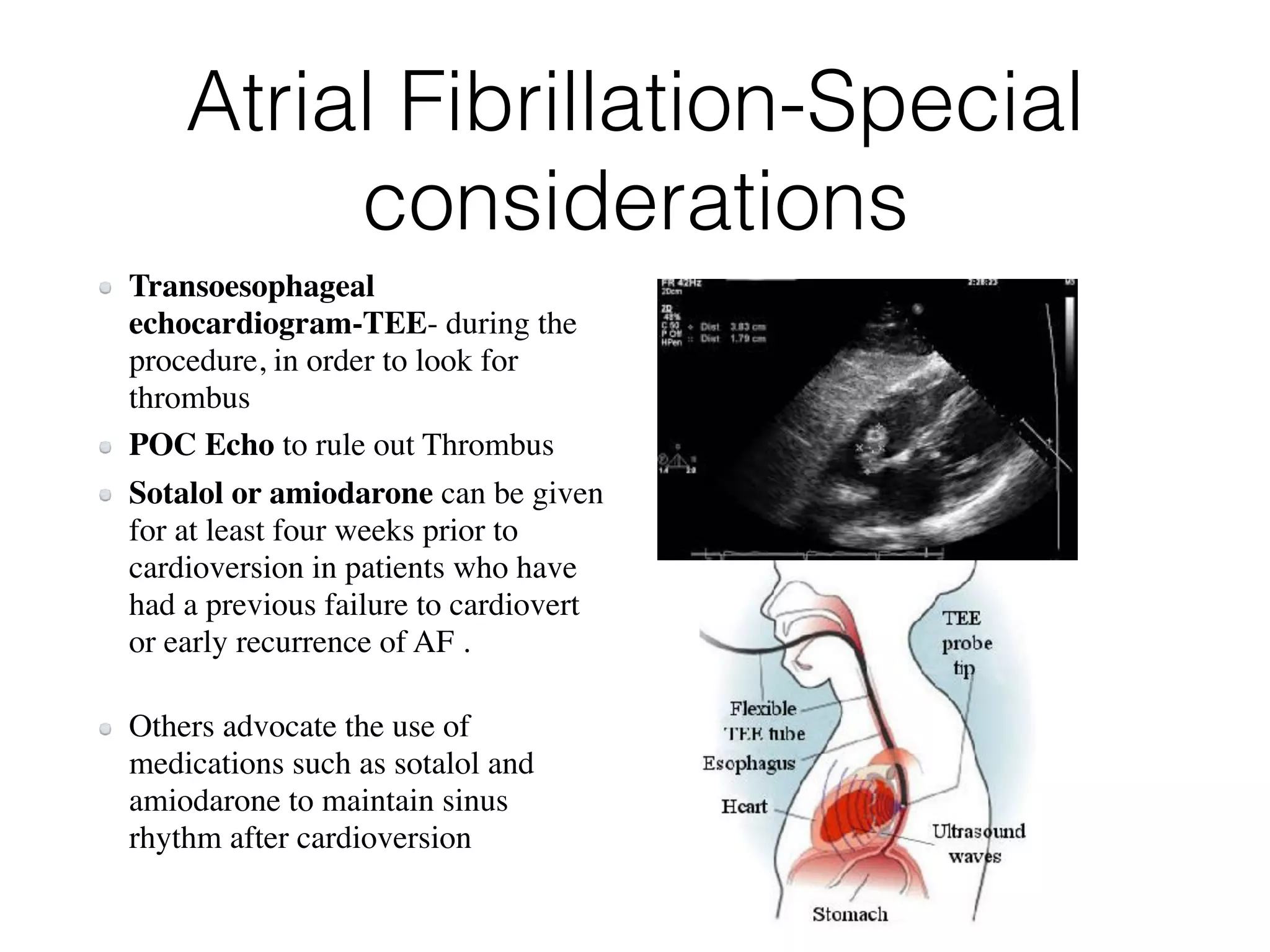
Transoesophageal
echocardiogram-TEE- during the
procedure, in order to look for
thrombus
POC Echo to rule out Thrombus
Sotalol or amiodarone can be given
for at least four weeks prior to
cardioversion in patients who have
had a previous failure to cardiovert
or early recurrence of AF .

Others advocate the use of
medications such as sotalol and
amiodarone to maintain sinus
rhythm after cardioversion
How to Cardiovert ?
Cardioversions are performed under general anaesthesia or sedation.
Sedation decisions need to be made carefully
Get consent
Usually done in theatres or Cardiac ICU or Resuscitation bay with
the support of an anaesthetist , Cardiologist or Emergency physician
or Intensivist
The majority of cardioversions are elective procedures; however,
some are performed when patients are acutely unwell with
tachycardia - eg, chest pain, breathlessness.
Decisions regarding sedation will need to be made and in practice
this involves the anaesthetist.
How to Cardiovert ?
Get Crash cart ready
Turn on the machine and attach adhesive electrodes (efficacy may be better with anterior-
posterior electrodes)

Choose the energy level.
IV-O2 -Monitor - Get a clearly visible trace on the monitor - eg, using lead II.

Hit the 'sync' button - usually a blip or dot appears on the monitor, marking each QRS
complex. Higher starting energy is associated with better success and fewer shocks 

Broad complex tachycardia and AF: monophasic - begin with 200 J, or biphasic - 120-150
J.

Atrial flutter and narrow complex tachycardia: monophasic - 100 J, or biphasic - 70-120 J.

Charge.

Synchronisation mark in Monitor
How to Cardiovert ?
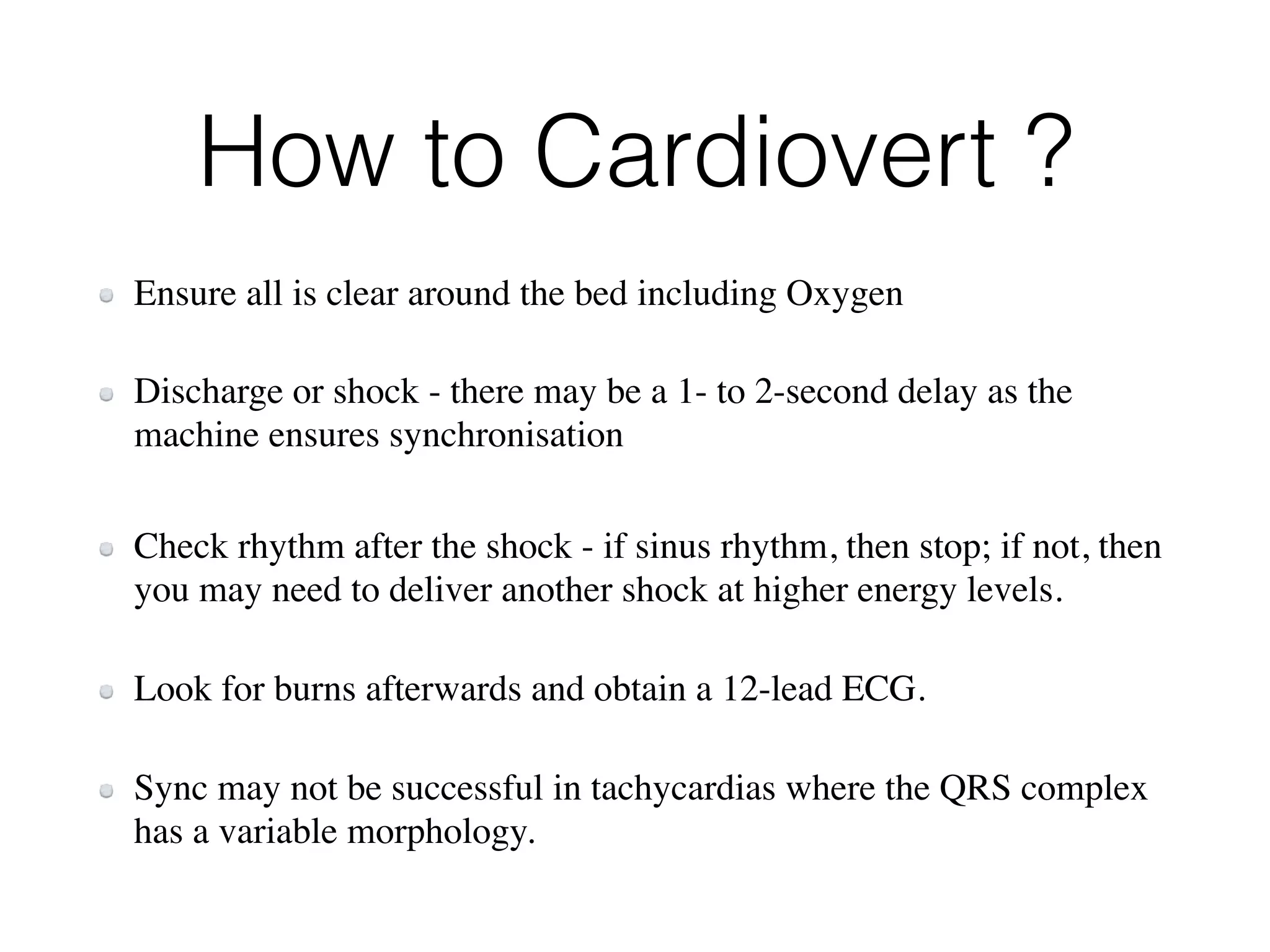
Ensure all is clear around the bed including Oxygen

Discharge or shock - there may be a 1- to 2-second delay as the
machine ensures synchronisation
Check rhythm after the shock - if sinus rhythm, then stop; if not, then
you may need to deliver another shock at higher energy levels.

Look for burns afterwards and obtain a 12-lead ECG.

Sync may not be successful in tachycardias where the QRS complex
has a variable morphology.
Consider Nine C’s of
Cardioversion
• Consent
• Consult as needed
• Consider sedation
• Crash Cart
• Confirm Synchronization
• Confirm shock delivery
• Continuous monitoring
• Consider POC Echo and TEE
• Consider Anticoagulant in AF
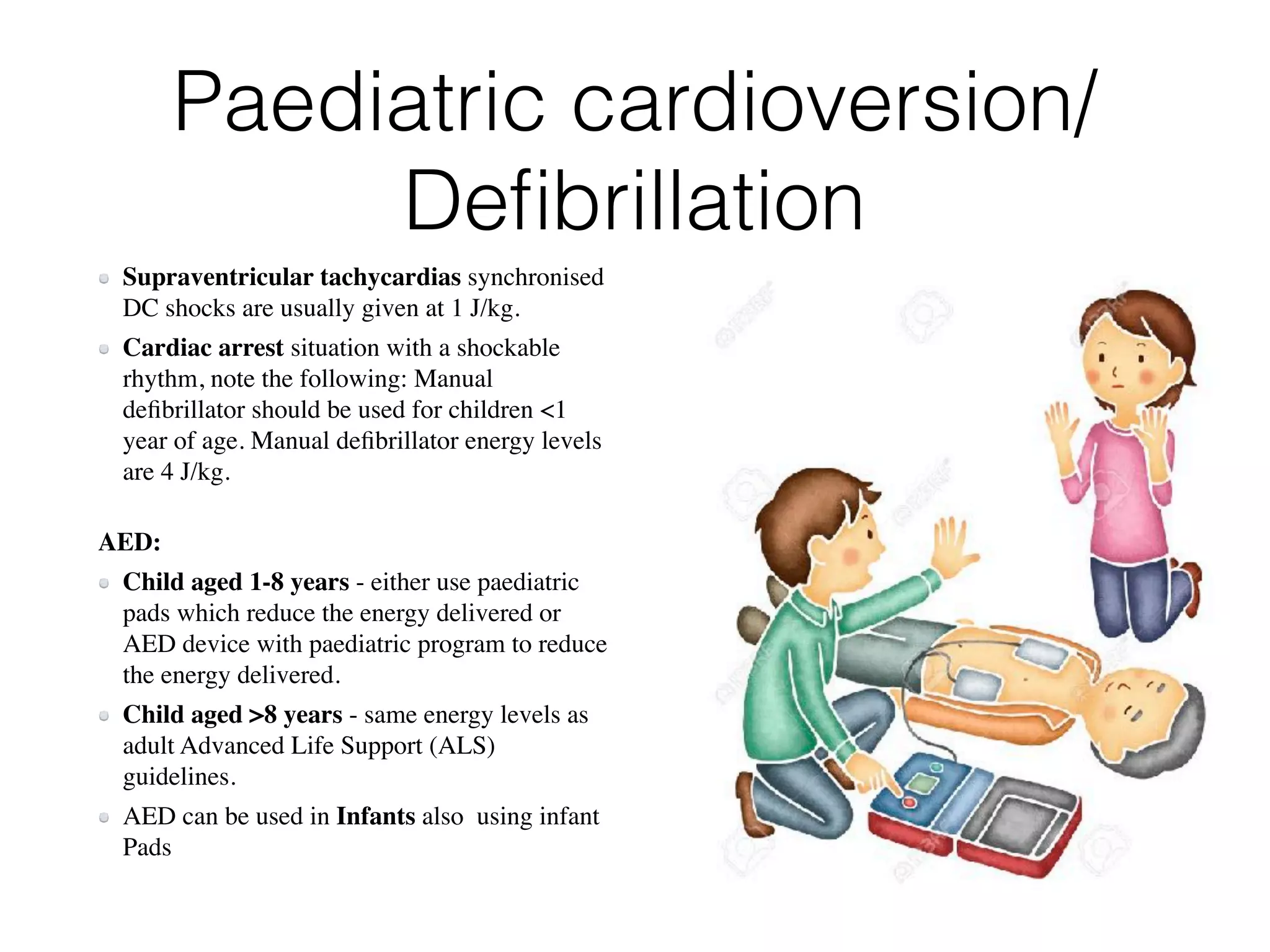
Paediatric cardioversion/
Defibrillation
Supraventricular tachycardias synchronised
DC shocks are usually given at 1 J/kg.
Cardiac arrest situation with a shockable
rhythm, note the following: Manual
defibrillator should be used for children <1
year of age. Manual defibrillator energy levels
are 4 J/kg.

AED:
Child aged 1-8 years - either use paediatric
pads which reduce the energy delivered or
AED device with paediatric program to reduce
the energy delivered.
Child aged >8 years - same energy levels as
adult Advanced Life Support (ALS)
guidelines.
AED can be used in Infants also using infant
Pads
Thanks a lot for Patient listening
drvenugopalpp@gmail.com
www.drvenu.blogspot.com
91 9847054747

Defibrillation and cardioversion

  • 1.
    Defibrillation and Cardioversion Dr.VenugopalanP P DA,DNB,MNAMS,MEM-GW Director ,Emergency Medicine Aster DM healthcare PG Teacher -EM NBE Deputy Director -MIMS Academy
  • 2.
    Defibrillation • Defibrillation -is the treatment for immediately life-threatening arrhythmias with which the patient does not have a pulse • Ventricular fibrillation (VF) or pulseless ventricular tachycardia (VT)
  • 3.
    Cardioversion Cardioversion - isany process that aims to convert an arrhythmia back to sinus rhythm. Electrical cardioversion is used when the patient has a pulse but is either unstable, or chemical cardioversion has failed or is unlikely to be successful Scenarios may be associated with chest pain, pulmonary oedema, syncope or hypotension. Used in less urgent cases - eg, atrial fibrillation (AF) - to try to revert the rhythm back to sinus
  • 4.
    The aim inboth are to deliver electrical energy to the heart to stun the heart momentarily and thus allow a normal sinus rhythm to kick in via the heart's normal pacemaker, ie the sinoatrial node. Defibrillation and Cardioversion
  • 5.
    When to defibrillate… ASAP ……
  • 6.
    Defibrillation- A bitof history • 18th century two physiologists, Prévost and Batelli, performed shock experiments on the hearts of dogs. • Applied electrical shocks and discovered that small shocks put the dogs' hearts into VF and this was successfully reversed with a larger shock
  • 7.
    Defibrillation-A bit ofhistory It was first used in humans by Claude Beck, a cardio- thoracic surgeon - on a boy aged 14 years who was undergoing cardio-thoracic surgery for congenital heart disease.
  • 8.
    Defibrillation- A bitof history 1959-Bernard Lown designed the modern day monophasic defibrillator This is based on the charging of capacitors and then delivering of a shock by paddles over a few milliseconds.
  • 9.
    Defibrillation-A bit ofhistory 1980s the biphasic waveform was discovered. This provided a shock at lower levels of energy which were just as efficacious as monophasic shocks.
  • 10.
    Mono phasic VsBiphasic Monophasic systems, the current travels only in one direction - from one paddle to the other. Biphasic systems, the current travels towards the positive paddle and then reverses and goes back; this occurs several times Biphasic shocks deliver one cycle every 10 milliseconds and they are associated with fewer burns and less myocardial damage Mono phasic shocks, the rate of first shock success in cardiac arrests due to a shockable rhythm is only 60%, whereas with biphasic shocks, this increases to 90%.
 However, this efficacy of biphasic defibrillators over mono phasic defibrillators has not been consistently reported
  • 11.
    Type of Defibrillators •Automated External Defibrillators [AED] • Semi- Automated AEDs • Standard defibrillators with Monitor • Trans-venous or Implanted defibrillators
  • 12.
    AED Does not requirespecial medical training to use 
 Found in public places - eg, offices, airports, train stations, shopping centres. Analyse the heart rhythm and then charge and deliver a shock if appropriate. It cannot be overridden manually and can take 10-20 seconds to determine arrhythmias. Unsurprisingly ease of use and speed of use are important factors for success
  • 13.
    Four steps ofAED operations • Power on • Attach paddle • Analyse Rhythm -Stand clear • Shock- Stand clear
  • 14.
    Semi Automated AEDs Similarto AEDs but can be overridden and usually have an ECG display. They tend to be used by paramedics. They also have the ability to pace.
  • 15.
    Standard Defibrillators • Monophasic •Biphasic - Different waveforms • Biphasic Truncated Exponential (BTE) waveform • Rectilinear Biphasic Waveform (RBW)
  • 16.
  • 17.
    Paddles versus Patches Paddleswere originally used but their use is being superseded by adhesive patches.
 Adhesive patches are placed most commonly antero-apically - the anterior patch goes under the right clavicle and the apical patch is placed at the apex.
 Adhesive electrodes are better, as they stick to the chest wall, so there is no mess with gels.

  • 18.
    Paddles versus Patches Paddlesrequire a significant level of force, which is not needed with adhesive electrodes.
 Adhesive electrodes also allow good ECG trace without interference.
 Adhesive electrodes are also safer, as no operator is required Before discharging a shock, it is important to ensure everyone is clear of the patient.
  • 19.
    Energy Level Cardiac Arrest Monophasic- Single shocks started at and repeated at 360 J.
 Biphasic -Single and repeated shock 200 J Use maximum energy available in your machine
  • 20.
    COACHED Continue Chest Compressions OxygenAway
 All Else Clear
 Charging Hands Off
 Evaluate the Rhythm - Shockable vs Non-shockable Defibrillate or Disarm
  • 21.
  • 22.
    Indications • Unstable tachycardia •Decompensated rapid AF with a rapid ventricular response - eg, a hypotensive patient, not responding to medical therapy • VT with a pulse • Supraventricular tachycardias including AF without decompensation; not acutely urgent
  • 23.
    Cardioversion the shockhas to be properly timed, so that it does not occur during the vulnerable period, ie during the T wave. If this occurs then VT can be triggered. Synchronisation
  • 24.
    Signs of Unstable Tachycardia •AMS • Cold and clammy extremities • Chest pain • Dyspnea • Diaphoresis • Hypotension • Rapid thready pulse • Syncope
  • 25.
    Atrial Fibrillation-Special considerations Cardioversion isused for rhythm control.
 Not all cardioversion is successful and, at one year, 50% redevelop AF 
 Medical treatments and cardioversion are of similar efficacy (unless permanent AF). Cardioversion of AF is associated with increased risk of thromboembolic disease (TED) Anticoagulation is required for at least three weeks before and at least four weeks afterwards
  • 26.
    Atrial Fibrillation-Special considerations Transoesophageal echocardiogram-TEE- duringthe procedure, in order to look for thrombus POC Echo to rule out Thrombus Sotalol or amiodarone can be given for at least four weeks prior to cardioversion in patients who have had a previous failure to cardiovert or early recurrence of AF .
 Others advocate the use of medications such as sotalol and amiodarone to maintain sinus rhythm after cardioversion
  • 27.
    How to Cardiovert? Cardioversions are performed under general anaesthesia or sedation. Sedation decisions need to be made carefully Get consent Usually done in theatres or Cardiac ICU or Resuscitation bay with the support of an anaesthetist , Cardiologist or Emergency physician or Intensivist The majority of cardioversions are elective procedures; however, some are performed when patients are acutely unwell with tachycardia - eg, chest pain, breathlessness. Decisions regarding sedation will need to be made and in practice this involves the anaesthetist.
  • 28.
    How to Cardiovert? Get Crash cart ready Turn on the machine and attach adhesive electrodes (efficacy may be better with anterior- posterior electrodes)
 Choose the energy level. IV-O2 -Monitor - Get a clearly visible trace on the monitor - eg, using lead II.
 Hit the 'sync' button - usually a blip or dot appears on the monitor, marking each QRS complex. Higher starting energy is associated with better success and fewer shocks 
 Broad complex tachycardia and AF: monophasic - begin with 200 J, or biphasic - 120-150 J.
 Atrial flutter and narrow complex tachycardia: monophasic - 100 J, or biphasic - 70-120 J.
 Charge.

  • 29.
  • 30.
    How to Cardiovert? Ensure all is clear around the bed including Oxygen
 Discharge or shock - there may be a 1- to 2-second delay as the machine ensures synchronisation Check rhythm after the shock - if sinus rhythm, then stop; if not, then you may need to deliver another shock at higher energy levels.
 Look for burns afterwards and obtain a 12-lead ECG.
 Sync may not be successful in tachycardias where the QRS complex has a variable morphology.
  • 31.
    Consider Nine C’sof Cardioversion • Consent • Consult as needed • Consider sedation • Crash Cart • Confirm Synchronization • Confirm shock delivery • Continuous monitoring • Consider POC Echo and TEE • Consider Anticoagulant in AF
  • 32.
    Paediatric cardioversion/ Defibrillation Supraventricular tachycardiassynchronised DC shocks are usually given at 1 J/kg. Cardiac arrest situation with a shockable rhythm, note the following: Manual defibrillator should be used for children <1 year of age. Manual defibrillator energy levels are 4 J/kg.
 AED: Child aged 1-8 years - either use paediatric pads which reduce the energy delivered or AED device with paediatric program to reduce the energy delivered. Child aged >8 years - same energy levels as adult Advanced Life Support (ALS) guidelines. AED can be used in Infants also using infant Pads
  • 33.
    Thanks a lotfor Patient listening drvenugopalpp@gmail.com www.drvenu.blogspot.com 91 9847054747