WARM AND HUMID CLIMATE
PRESENTED BY-AR.ROOPA CHIKKALGI. BGS SAP
WARM AND HUMID CLIMATE
2
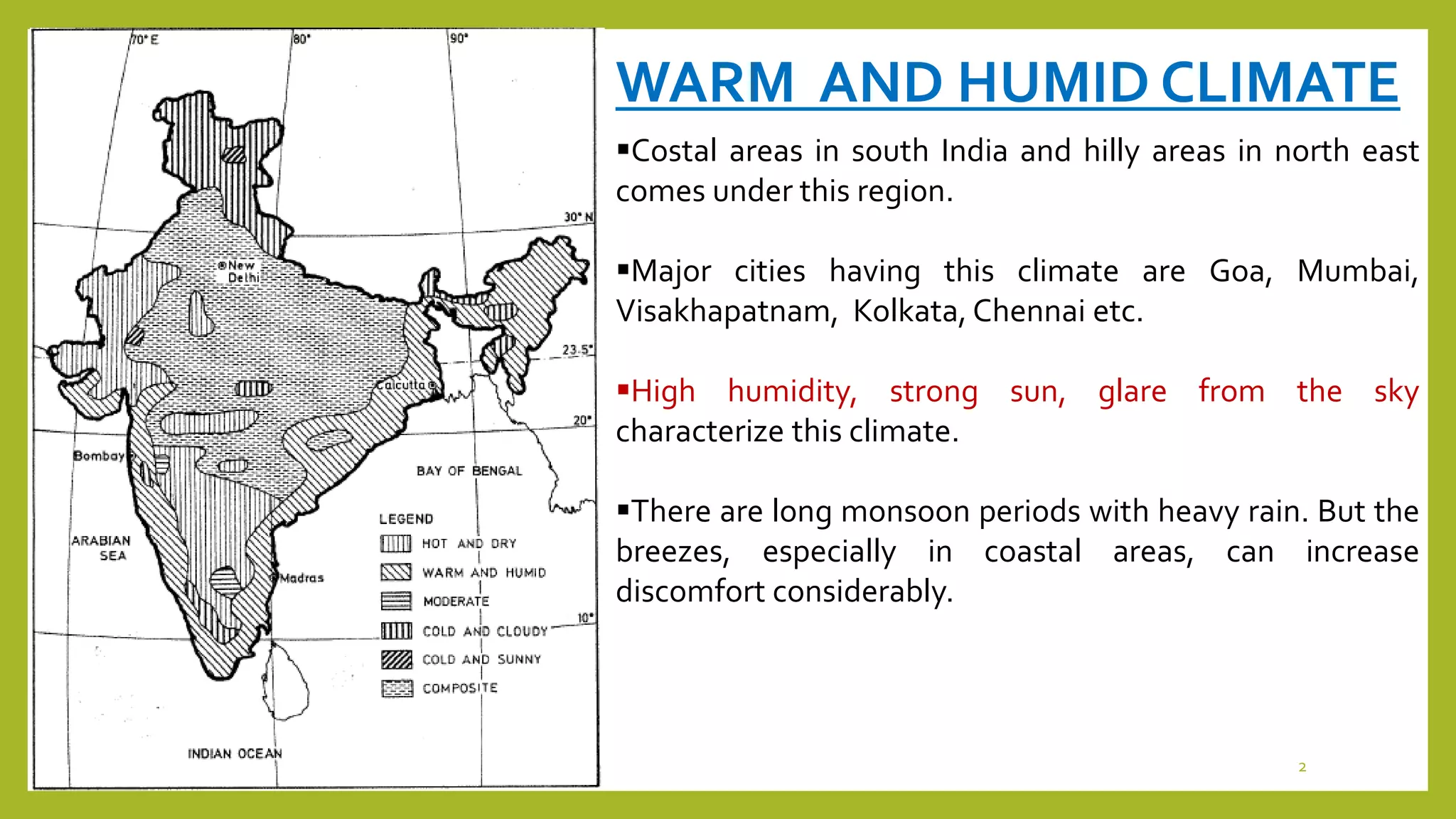
▪Costal areas in south India and hilly areas in north east
comes under this region.
▪Major cities having this climate are Goa, Mumbai,
Visakhapatnam, Kolkata, Chennai etc.
▪High humidity, strong sun, glare from the sky
characterize this climate.
▪There are long monsoon periods with heavy rain. But the
breezes, especially in coastal areas, can increase
discomfort considerably.
CHARACTERISTICS OF WARM AND
HUMID CLIMATE
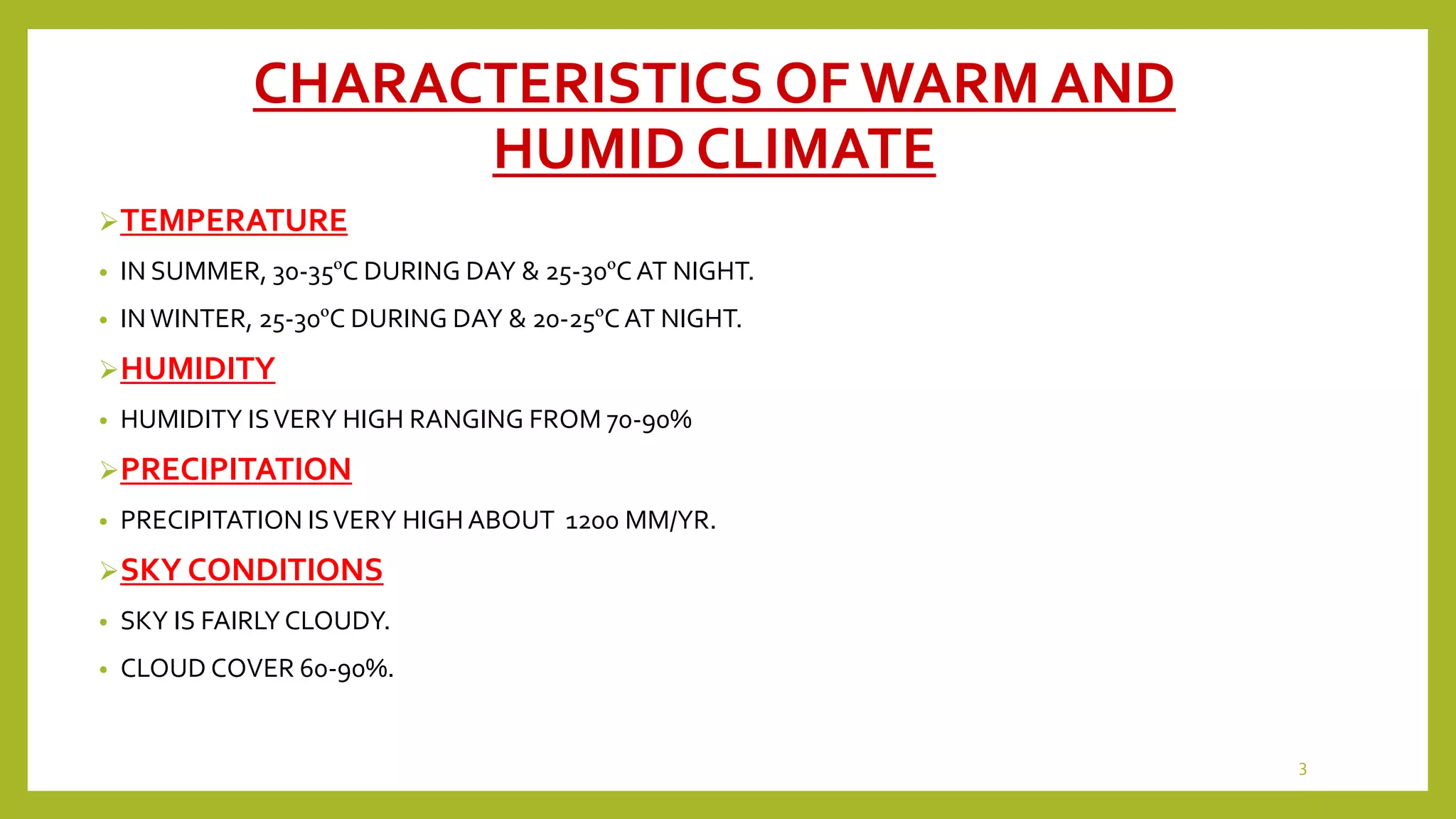
➢TEMPERATURE
• IN SUMMER, 30-35ºC DURING DAY & 25-30ºC AT NIGHT.
• INWINTER, 25-30ºC DURING DAY & 20-25ºC AT NIGHT.
➢HUMIDITY
• HUMIDITY ISVERY HIGH RANGING FROM 70-90%
➢PRECIPITATION
• PRECIPITATION ISVERY HIGH ABOUT 1200 MM/YR.
➢SKY CONDITIONS
• SKY IS FAIRLY CLOUDY.
• CLOUD COVER 60-90%.
3
CHARACTERISTICS OF WARM AND HUMID
CLIMATE
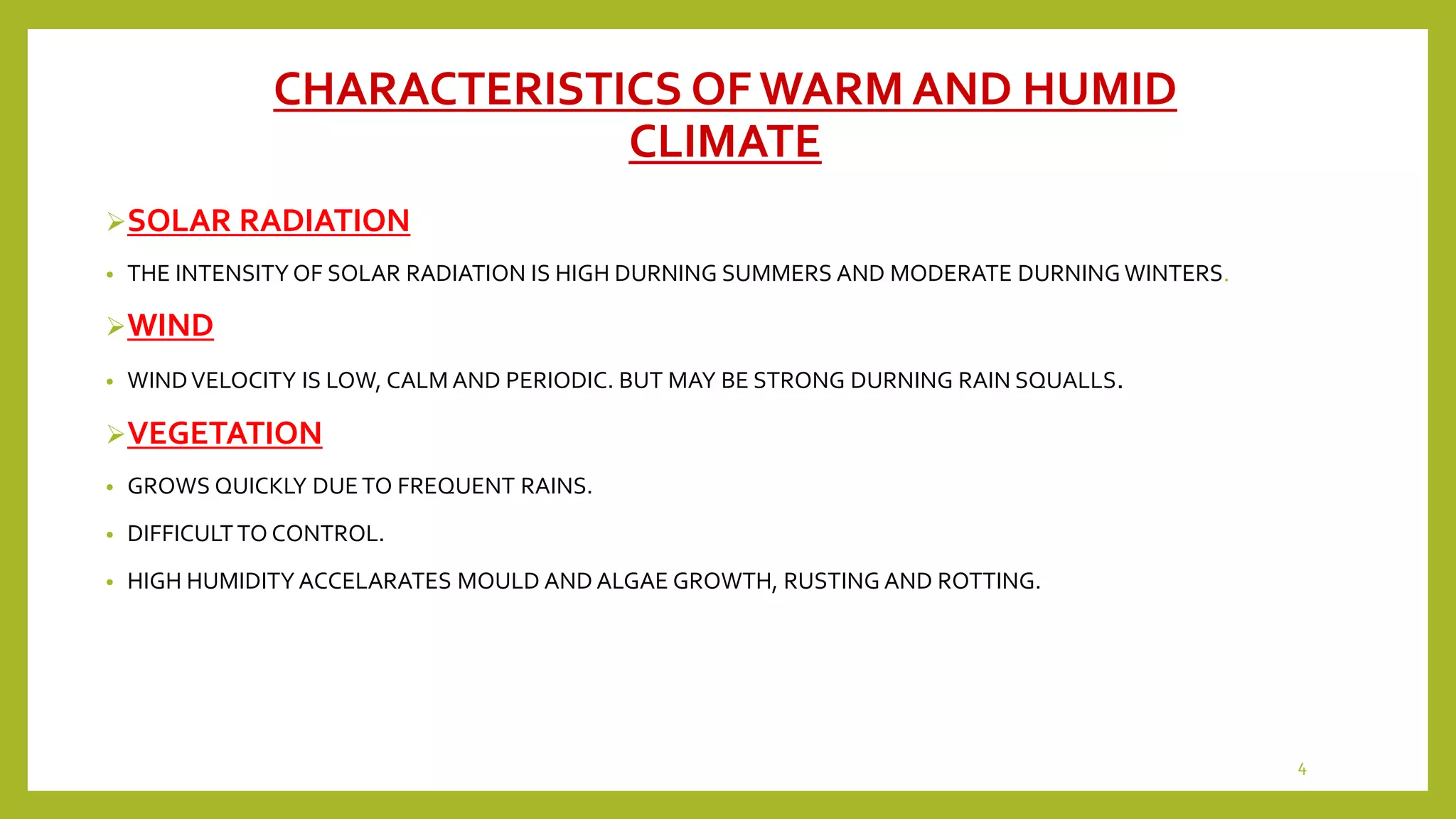
➢SOLAR RADIATION
• THE INTENSITY OF SOLAR RADIATION IS HIGH DURNING SUMMERS AND MODERATE DURNING WINTERS.
➢WIND
• WINDVELOCITY IS LOW, CALM AND PERIODIC. BUT MAY BE STRONG DURNING RAIN SQUALLS.
➢VEGETATION
• GROWS QUICKLY DUETO FREQUENT RAINS.
• DIFFICULT TO CONTROL.
• HIGH HUMIDITY ACCELARATES MOULD AND ALGAE GROWTH, RUSTING AND ROTTING.
4
• Resisting heat gain:
Measures that are convenient to avoid heat gain are:
(a)Decreasing surface area of the building exposed to the outside.
(b)Using materials that take a longer time to heat.
(c)Providing buffer spaces between the outside and the inside.
(d)Increase the shade of the building in general.
(e)Using materials that reflect heat.
• Promoting heat loss:
To promote heat lost it is essential to ensure:
(a) Building is well ventilated.
(b) Proper ventilation occurs throughout the day.
(c) Humidity levels are reduced as much as possible.
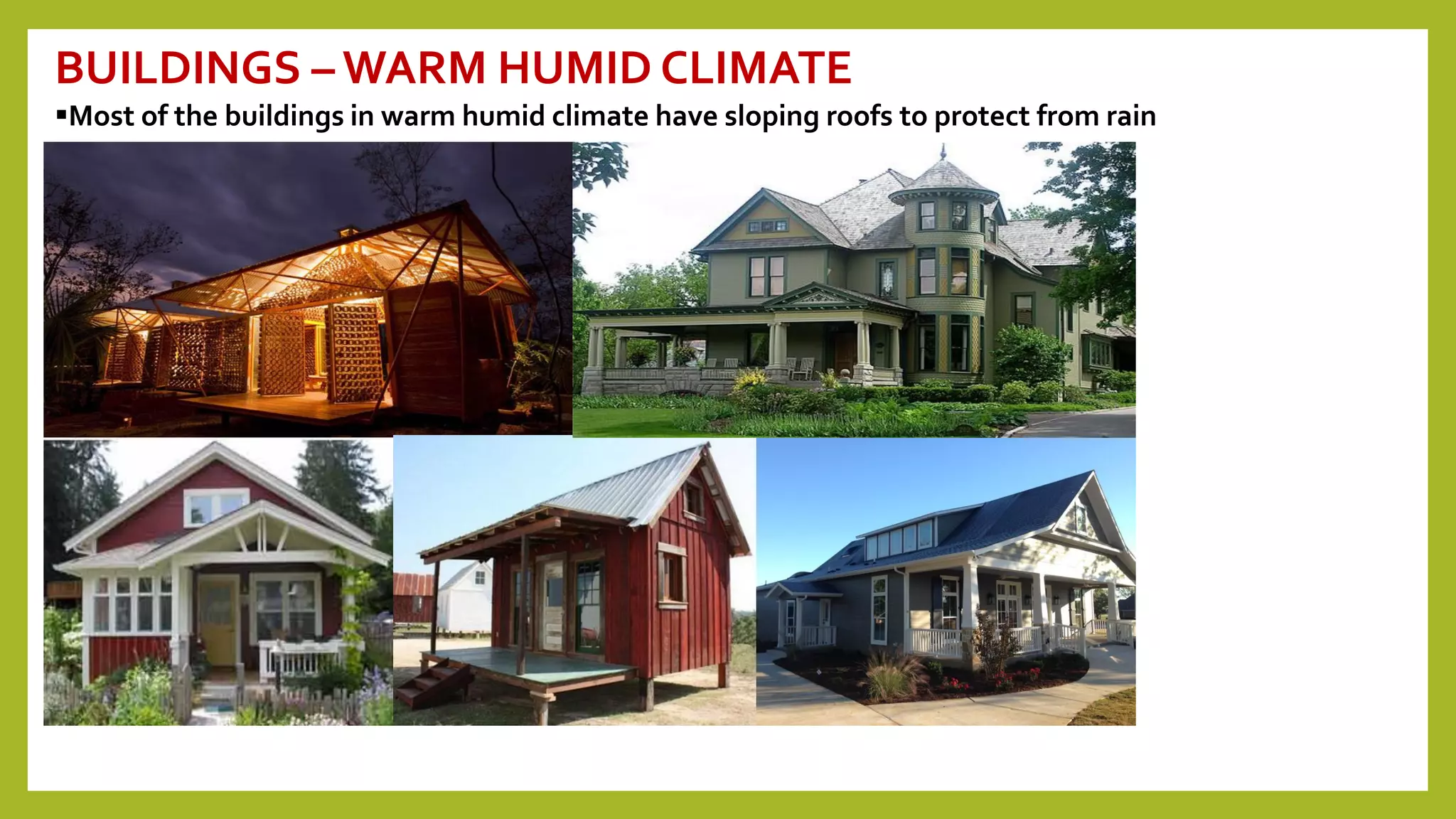
▪Most of the buildings in warm humid climate have sloping roofs to protect from rain
BUILDINGS – WARM HUMID CLIMATE
WARM AND HUMID CLIMATE
BUILDING CHARACTERISTICS
8
1. BUILDINGS SHOULD BE SPREAD OUT WITH LARGE OPEN SPACES IN BETWEEN FOR UNRESTRICTED AIR MOVEMENT.
2. CROSS VENTILATION ISVERY IMPORTANT. LARGE OPENINGSTO UNOBSTRUCT AIR PATH ANDTO ENSURE PROPER
VENTILATION.
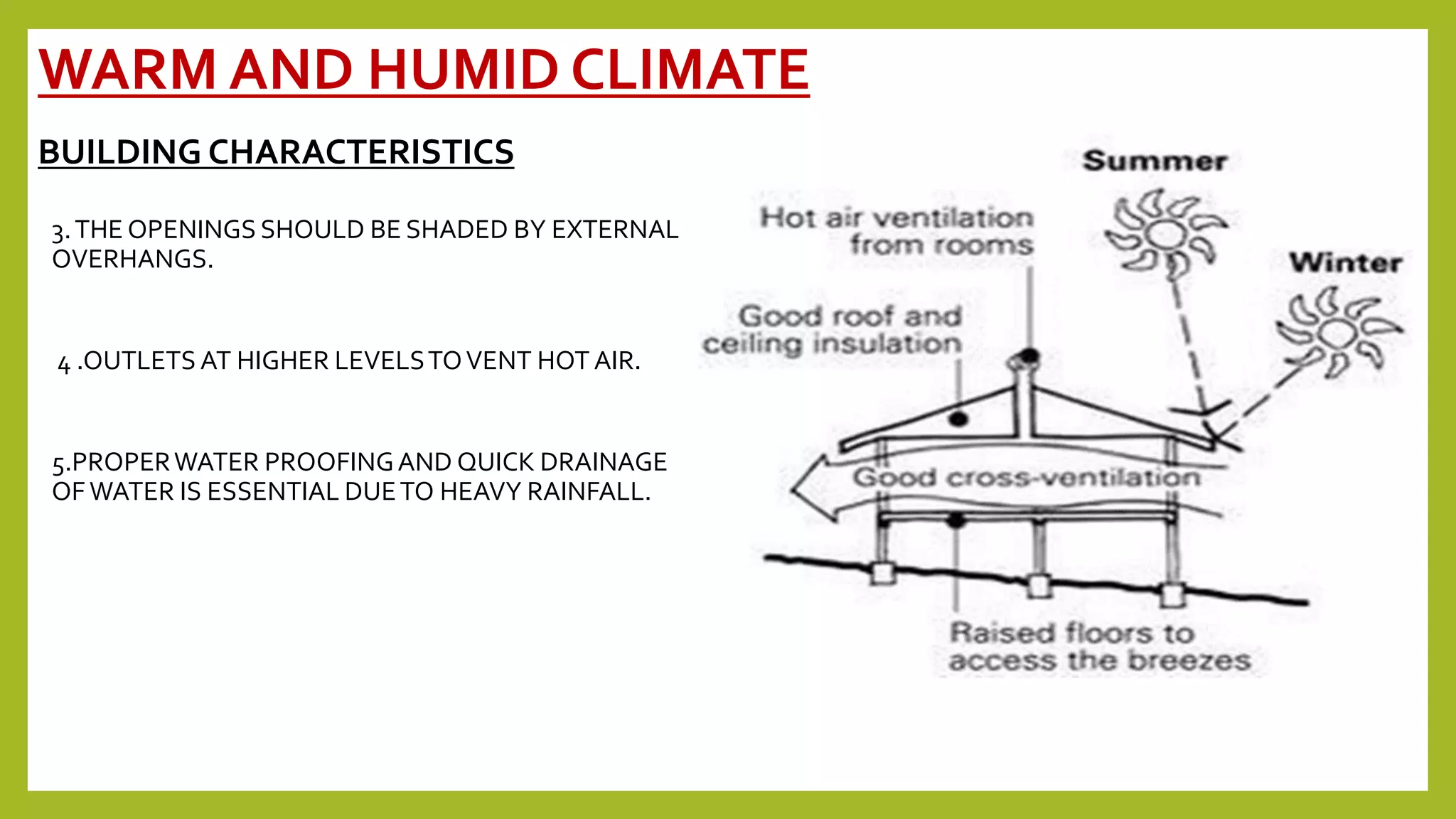
3.THE OPENINGS SHOULD BE SHADED BY EXTERNAL
OVERHANGS.
4 .OUTLETS AT HIGHER LEVELSTOVENT HOT AIR.
5.PROPERWATER PROOFINGAND QUICK DRAINAGE
OFWATER IS ESSENTIAL DUETO HEAVY RAINFALL.
WARM AND HUMID CLIMATE
BUILDING CHARACTERISTICS
General recommendations for building design in
warm and humid climate
➢ Site:
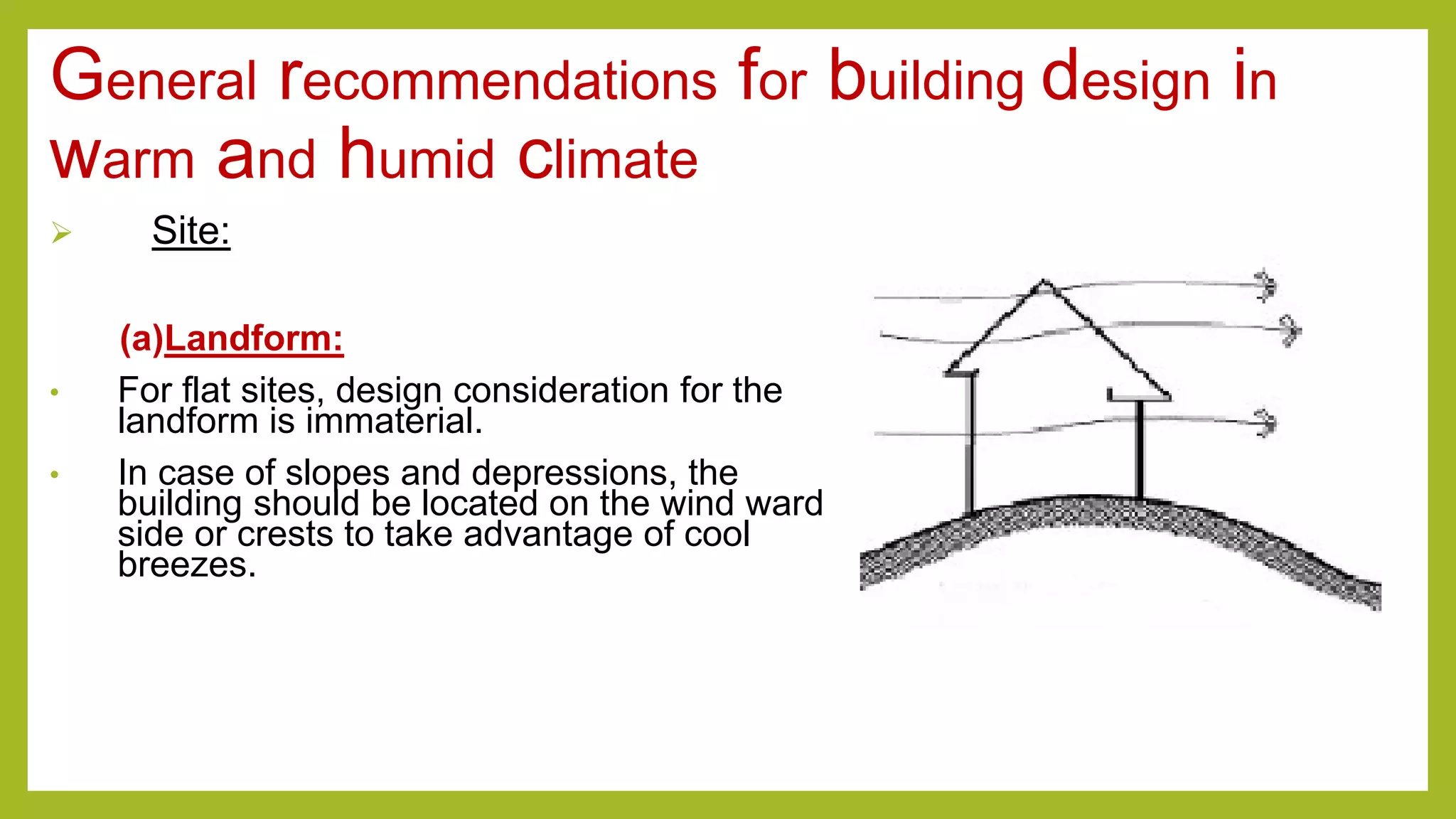
(a)Landform:
• For flat sites, design consideration for the
landform is immaterial.
• In case of slopes and depressions, the
building should be located on the wind ward
side or crests to take advantage of cool
breezes.
(b) Waterbodies:
• Waterbodies are not essential as they would tend to further
increase the humidity.
(c) Street width and orientation:
• Major streets should be oriented parallel to or within 30 of the
prevailing wind direction during summer months to encourage
ventilation in warm and humid regions.
• A north-south direction is ideal from the point of view of blocking solar
radiation.
• The width of the streets should be such that the intense solar radiation
during late mornings and early afternoon is avoided during the
summers.
(C) Open spaces and built form:
• Buildings should be spread out with large open spaces in between for unrestricted air
movement.
• In cities, buildings on stilts can promote ventilation and cause cooling at the ground
level.
BUILDING SPACING SUCH THAT AIR FLOW IS PROMOTED
(2) Orientation and planform:
• As the temperatures are very high, free plans and can be evolved as long as the house is
under protective shade.
• An unobstructed air path through the interiors is important to ensure proper ventilation.
• The buildings could be long and narrow to allow cross ventilation.
ELONGATED PLANS FOR MAXIMUM CROSS VENTILATION
Heat and moisture producing areas like toilets and kitchens must be ventilated
and separated from the rest of the structure.
VENTILATE KITCHENSAND BATHSTO EXHAUST HOTAIR
• Semi open spaces such as balconies, verandahs and porches can be
used advantageously for day time activities as well as give protection
from rainfall.
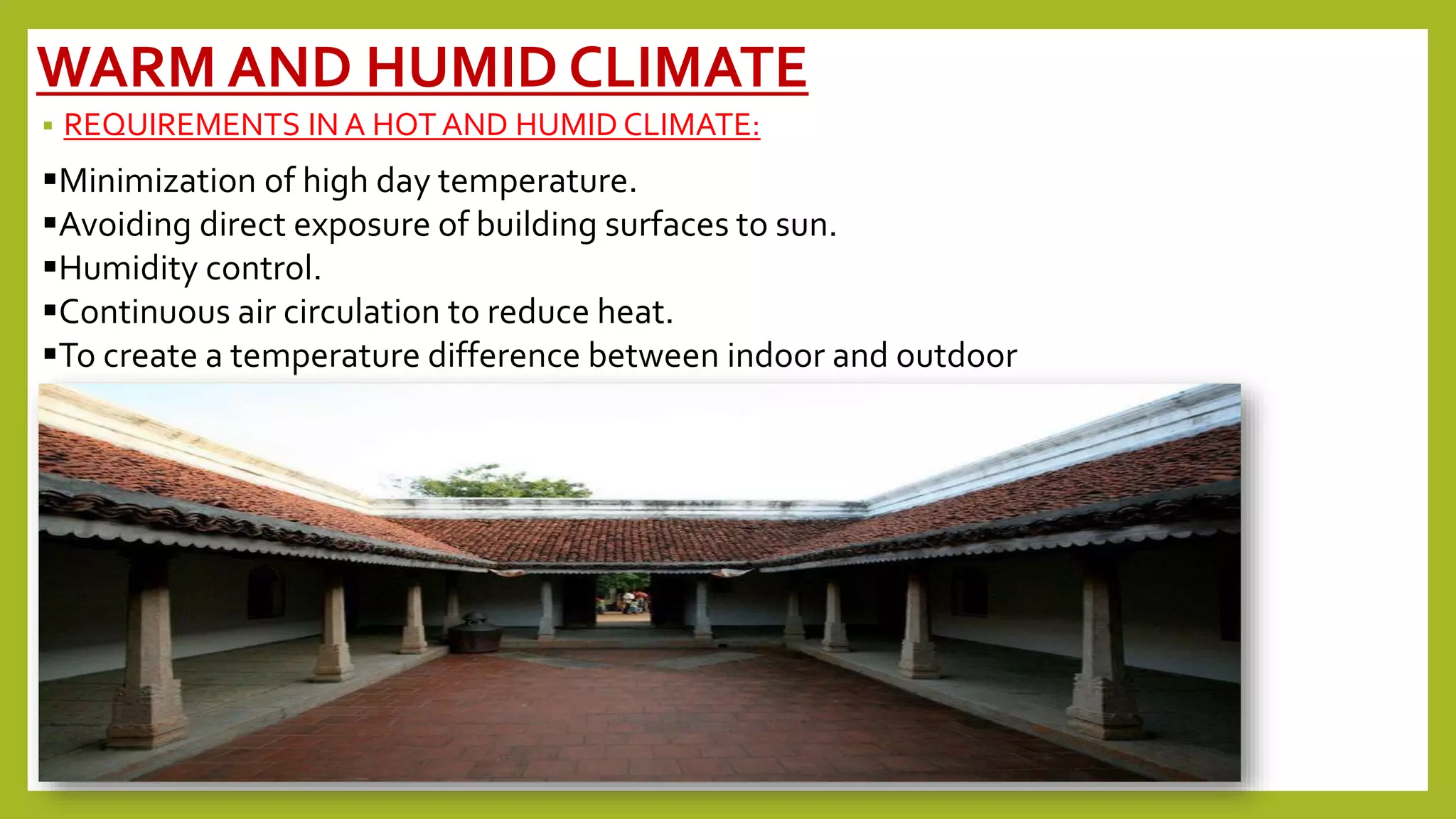
• In buildings a central courtyard can be provided with vents at higher
levels to draw away the rising hot air.
WINDOWS AT HIGH LEVELTOVENT HOTAIR
HIGH PITCHED ROOFSWITH LOUVERS FOR VENTILATION
(3) Building envelope:
(a)Roof:
In addition to providing shelter from rain and heat, the form of the roof should be
planned to promote airflow. Vents at the rooftop effectively induce ventilation and draw
hot air out.
The openings should be shaded by external overhangs. Outlets at higher levels serve
to vent hot air.
OUTLET LARGERTHAN INLET
INLET AT LOWER LEVELANDOUTLETAT HIGHER LEVEL
Examples illustrating how the air movement within a room can be better
distributed.
DISTRIBUTEAIRTHROUGHOUTTHE ROOM
(d) Colour and Texture:
• The walls should be pasted with light pastel shades or white
washed while the surface of the roof can be of broken glazed tile
(china mosaic flooring) to reflect the sunlight back to the
environment, and hence reduce heat gain of the building.
• The use of appropriate colours and surface finishes is a cheap and
very effective technique to lower indoor temperatures.
• The surface finished should be protected from/resistant to the
effects of moisture.
▪ REQUIREMENTS IN A HOT AND HUMID CLIMATE:
WARM AND HUMID CLIMATE
▪Minimization of high day temperature.
▪Avoiding direct exposure of building surfaces to sun.
▪Humidity control.
▪Continuous air circulation to reduce heat.
▪To create a temperature difference between indoor and outdoor
HOT AND HUMID
▪ Orientation and ventilation:
▪Semi – open spaces for light and air movement .
▪Buildings should be spread out with large open spaces in between for uninterrupted
air movement.
▪Cross ventilation is very important. large openings to unobstructed air path and to
ensure proper ventilation.
▪The openings should be shaded by external overhangs. Outlets at higher levels to
vent hot air.
▪Proper water proofing and quick drainage of water is essential due to heavy
Rainfall.
WARM AND HUMID
▪ Shading:
▪Keep sunlight off of building walls:After aiming the building
to catch the breeze, try to face the long sides (with most of
the windows) towards the south and north so the roof
overhang shades walls and windows in the middle of the day.
▪Shade in the afternoon: Keep west and east sides short to let
less of the hot, low angle morning and afternoon sun heat up
walls, especially during the hottest season. Be sure you are
considering whether the sun is in the northern or southern sky
at this time of year.
▪Cover openings on west and
east ends. Use few windows
and doors. For openings use
vertical sunscreens, climbing
vines,or shrubs to reduce heat
gain on western walls.
HOT AND HUMID▪ Building materials:
The locally available materials which
dominate building construction in these
climatic zones are;
▪ Timber
▪ Sun dried and kiln burn brick
▪ Thatch and Bamboo
▪ Clay tiles for roofing
Cavity wall detail
Above: typical thatch roof.
Left: half round country clay tiles.
HOT AND HUMID
▪ Extensive use of bamboo in building construction.
▪Timber used as vertical and horizontal support.
DESIGN / PLANNING CONCEPTS
25
ORIENTATION
Orientation to minimize sun
radiation impact.
STONE PILLARS
CENTRAL
COURTYARDS
• The advantage of courtyard and veranda is proper ventilation and controlled humidity.
• Cross ventilation is done properly.
• Movement of air is perfect in the building by central courtyard.
USE OF STONE

Climatic zones. warm and humid

  • 1.
    WARM AND HUMIDCLIMATE PRESENTED BY-AR.ROOPA CHIKKALGI. BGS SAP
  • 2.
    WARM AND HUMIDCLIMATE 2 ▪Costal areas in south India and hilly areas in north east comes under this region. ▪Major cities having this climate are Goa, Mumbai, Visakhapatnam, Kolkata, Chennai etc. ▪High humidity, strong sun, glare from the sky characterize this climate. ▪There are long monsoon periods with heavy rain. But the breezes, especially in coastal areas, can increase discomfort considerably.
  • 3.
    CHARACTERISTICS OF WARMAND HUMID CLIMATE ➢TEMPERATURE • IN SUMMER, 30-35ºC DURING DAY & 25-30ºC AT NIGHT. • INWINTER, 25-30ºC DURING DAY & 20-25ºC AT NIGHT. ➢HUMIDITY • HUMIDITY ISVERY HIGH RANGING FROM 70-90% ➢PRECIPITATION • PRECIPITATION ISVERY HIGH ABOUT 1200 MM/YR. ➢SKY CONDITIONS • SKY IS FAIRLY CLOUDY. • CLOUD COVER 60-90%. 3
  • 4.
    CHARACTERISTICS OF WARMAND HUMID CLIMATE ➢SOLAR RADIATION • THE INTENSITY OF SOLAR RADIATION IS HIGH DURNING SUMMERS AND MODERATE DURNING WINTERS. ➢WIND • WINDVELOCITY IS LOW, CALM AND PERIODIC. BUT MAY BE STRONG DURNING RAIN SQUALLS. ➢VEGETATION • GROWS QUICKLY DUETO FREQUENT RAINS. • DIFFICULT TO CONTROL. • HIGH HUMIDITY ACCELARATES MOULD AND ALGAE GROWTH, RUSTING AND ROTTING. 4
  • 5.
    • Resisting heatgain: Measures that are convenient to avoid heat gain are: (a)Decreasing surface area of the building exposed to the outside. (b)Using materials that take a longer time to heat. (c)Providing buffer spaces between the outside and the inside. (d)Increase the shade of the building in general. (e)Using materials that reflect heat.
  • 6.
    • Promoting heatloss: To promote heat lost it is essential to ensure: (a) Building is well ventilated. (b) Proper ventilation occurs throughout the day. (c) Humidity levels are reduced as much as possible.
  • 7.
    ▪Most of thebuildings in warm humid climate have sloping roofs to protect from rain BUILDINGS – WARM HUMID CLIMATE
  • 8.
    WARM AND HUMIDCLIMATE BUILDING CHARACTERISTICS 8 1. BUILDINGS SHOULD BE SPREAD OUT WITH LARGE OPEN SPACES IN BETWEEN FOR UNRESTRICTED AIR MOVEMENT. 2. CROSS VENTILATION ISVERY IMPORTANT. LARGE OPENINGSTO UNOBSTRUCT AIR PATH ANDTO ENSURE PROPER VENTILATION.
  • 9.
    3.THE OPENINGS SHOULDBE SHADED BY EXTERNAL OVERHANGS. 4 .OUTLETS AT HIGHER LEVELSTOVENT HOT AIR. 5.PROPERWATER PROOFINGAND QUICK DRAINAGE OFWATER IS ESSENTIAL DUETO HEAVY RAINFALL. WARM AND HUMID CLIMATE BUILDING CHARACTERISTICS
  • 10.
    General recommendations forbuilding design in warm and humid climate ➢ Site: (a)Landform: • For flat sites, design consideration for the landform is immaterial. • In case of slopes and depressions, the building should be located on the wind ward side or crests to take advantage of cool breezes.
  • 11.
    (b) Waterbodies: • Waterbodiesare not essential as they would tend to further increase the humidity. (c) Street width and orientation: • Major streets should be oriented parallel to or within 30 of the prevailing wind direction during summer months to encourage ventilation in warm and humid regions. • A north-south direction is ideal from the point of view of blocking solar radiation. • The width of the streets should be such that the intense solar radiation during late mornings and early afternoon is avoided during the summers.
  • 12.
    (C) Open spacesand built form: • Buildings should be spread out with large open spaces in between for unrestricted air movement. • In cities, buildings on stilts can promote ventilation and cause cooling at the ground level. BUILDING SPACING SUCH THAT AIR FLOW IS PROMOTED
  • 13.
    (2) Orientation andplanform: • As the temperatures are very high, free plans and can be evolved as long as the house is under protective shade. • An unobstructed air path through the interiors is important to ensure proper ventilation. • The buildings could be long and narrow to allow cross ventilation. ELONGATED PLANS FOR MAXIMUM CROSS VENTILATION
  • 14.
    Heat and moistureproducing areas like toilets and kitchens must be ventilated and separated from the rest of the structure. VENTILATE KITCHENSAND BATHSTO EXHAUST HOTAIR
  • 15.
    • Semi openspaces such as balconies, verandahs and porches can be used advantageously for day time activities as well as give protection from rainfall. • In buildings a central courtyard can be provided with vents at higher levels to draw away the rising hot air. WINDOWS AT HIGH LEVELTOVENT HOTAIR
  • 16.
    HIGH PITCHED ROOFSWITHLOUVERS FOR VENTILATION (3) Building envelope: (a)Roof: In addition to providing shelter from rain and heat, the form of the roof should be planned to promote airflow. Vents at the rooftop effectively induce ventilation and draw hot air out.
  • 17.
    The openings shouldbe shaded by external overhangs. Outlets at higher levels serve to vent hot air. OUTLET LARGERTHAN INLET INLET AT LOWER LEVELANDOUTLETAT HIGHER LEVEL
  • 18.
    Examples illustrating howthe air movement within a room can be better distributed. DISTRIBUTEAIRTHROUGHOUTTHE ROOM
  • 19.
    (d) Colour andTexture: • The walls should be pasted with light pastel shades or white washed while the surface of the roof can be of broken glazed tile (china mosaic flooring) to reflect the sunlight back to the environment, and hence reduce heat gain of the building. • The use of appropriate colours and surface finishes is a cheap and very effective technique to lower indoor temperatures. • The surface finished should be protected from/resistant to the effects of moisture.
  • 20.
    ▪ REQUIREMENTS INA HOT AND HUMID CLIMATE: WARM AND HUMID CLIMATE ▪Minimization of high day temperature. ▪Avoiding direct exposure of building surfaces to sun. ▪Humidity control. ▪Continuous air circulation to reduce heat. ▪To create a temperature difference between indoor and outdoor
  • 21.
    HOT AND HUMID ▪Orientation and ventilation: ▪Semi – open spaces for light and air movement . ▪Buildings should be spread out with large open spaces in between for uninterrupted air movement. ▪Cross ventilation is very important. large openings to unobstructed air path and to ensure proper ventilation. ▪The openings should be shaded by external overhangs. Outlets at higher levels to vent hot air. ▪Proper water proofing and quick drainage of water is essential due to heavy Rainfall.
  • 22.
    WARM AND HUMID ▪Shading: ▪Keep sunlight off of building walls:After aiming the building to catch the breeze, try to face the long sides (with most of the windows) towards the south and north so the roof overhang shades walls and windows in the middle of the day. ▪Shade in the afternoon: Keep west and east sides short to let less of the hot, low angle morning and afternoon sun heat up walls, especially during the hottest season. Be sure you are considering whether the sun is in the northern or southern sky at this time of year. ▪Cover openings on west and east ends. Use few windows and doors. For openings use vertical sunscreens, climbing vines,or shrubs to reduce heat gain on western walls.
  • 23.
    HOT AND HUMID▪Building materials: The locally available materials which dominate building construction in these climatic zones are; ▪ Timber ▪ Sun dried and kiln burn brick ▪ Thatch and Bamboo ▪ Clay tiles for roofing Cavity wall detail Above: typical thatch roof. Left: half round country clay tiles.
  • 24.
    HOT AND HUMID ▪Extensive use of bamboo in building construction. ▪Timber used as vertical and horizontal support.
  • 25.
    DESIGN / PLANNINGCONCEPTS 25
  • 26.
  • 29.
  • 30.
  • 32.
    • The advantageof courtyard and veranda is proper ventilation and controlled humidity. • Cross ventilation is done properly. • Movement of air is perfect in the building by central courtyard.
  • 33.