MACRO AND MICRO CLIMATE
FACTORS AFFECTING LOCAL CLIMATE
LOCAL FACTORS
Factors affecting the local deviation are:
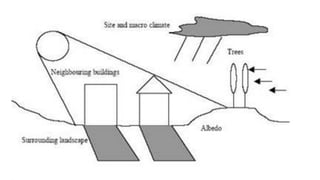
•Topography: Slope, orientation, exposure, elevation, hills or valleys at or near the
ground.
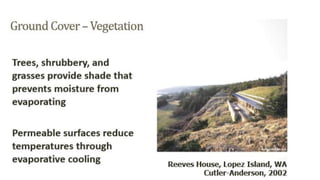
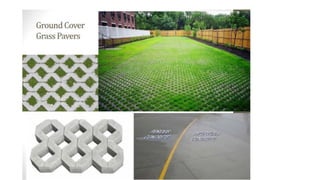
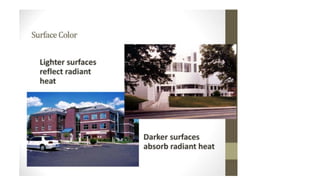
•Ground surface: (Whether natural or man‐made): affect in terms of reflectance,
permeability and the soil temperature as these affect the vegetation and this in tur
n affects the climate. (woods, shrubs, grass, paving, water, etc.).
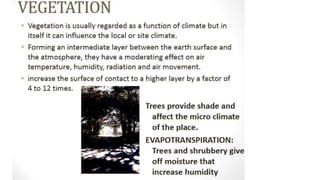
•Three dimensional objects: such as trees, tree belts, fences, walls and buildings as
these may influence air movement, cast a shadow, etc.
AIR TEMPERATURE
•The air temperature near the ground is dependent on heat gained/lost
by the earth surface.
•heat exchange varies with day/night, season, time of the year, latitude
and cloud cover.
•During the day, with the heating of the earth surface, the air nearest to
the ground(within 2 meters) gains most temperature. At night, the
direction of heat flow is reversed.
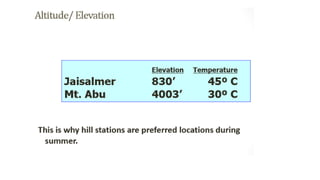
•A difference of 7‐8 m in height can cause 5‐6 deg drop in temp.
HUMIDITY
•Relative humidity is inversely proportional to temperature.
•During the day, when the lowest layer of air is heated by the ground
surface, RH decreases rapidly. This leads to higher rate of evaporation
(If there is water body, vegetation, etc.) leading to increase in Absolut
e Humidity.
•At night, When dew point temperature is reached, fog formation tak
es place and if there is no further rapid cooling nor air movement, a d
eep layer (40‐50m) of fog develops.
PRECIPITATION
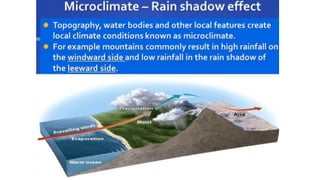
•When ground level changes by more than 300m, the windward side re
ceives more rainfall than the regional average.
•In an extreme case, on a large site located on the top of a hill and exte
nding down to both the slopes, the leeward side receives only 25% of t
he rain received by the windward side.
•REASON: hill forces the air mass to rise which cools it down and it is no
loner able to support the moisture carried. This effect can also be caus
ed by towns. The opposite is also true.
SKY CONDITIONS
•Abrupt change in topography may cause a permanent cloud cover like
in the rock of Gibraltar.
SOLAR RADIATION
•Transparency of the atmosphere: Cloud formation, air pollution, smog, smo
ke, dust, etc. affect the intensity of solar radiation on the horizontal plane.
•Slope and orientation of the site: Intensity on the actual ground surface. At
mid latitudes, a site sloping towards the pole will receive much less radiation
than the site sloping towards equator. (Effect is negligible around equator)
•Obstructions
like hills, trees, existing buildings which may cast a shadow on the site. The e
ffect is most pronounced wen the objects like on east or west of the site.
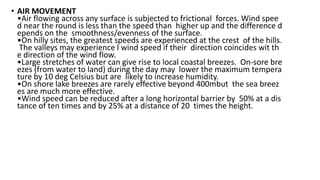
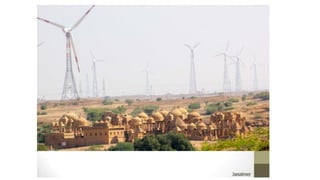
• AIR MOVEMENT
•Air flowing across any surface is subjected to frictional forces. Wind spee
d near the round is less than the speed than higher up and the difference d
epends on the smoothness/evenness of the surface.
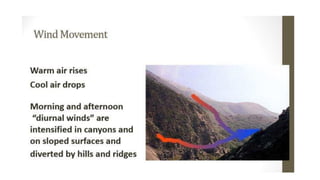
•On hilly sites, the greatest speeds are experienced at the crest of the hills.
The valleys may experience I wind speed if their direction coincides wit th
e direction of the wind flow.
•Large stretches of water can give rise to local coastal breezes. On‐sore bre
ezes (from water to land) during the day may lower the maximum tempera
ture by 10 deg Celsius but are likely to increase humidity.
•On shore lake breezes are rarely effective beyond 400mbut the sea breez
es are much more effective.
•Wind speed can be reduced after a long horizontal barrier by 50% at a dis
tance of ten times and by 25% at a distance of 20 times the height.
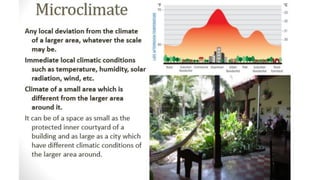
Macro and micro climate

Macro and micro climate

  • 1.
  • 4.
  • 5.
    LOCAL FACTORS Factors affectingthe local deviation are: •Topography: Slope, orientation, exposure, elevation, hills or valleys at or near the ground. •Ground surface: (Whether natural or man‐made): affect in terms of reflectance, permeability and the soil temperature as these affect the vegetation and this in tur n affects the climate. (woods, shrubs, grass, paving, water, etc.). •Three dimensional objects: such as trees, tree belts, fences, walls and buildings as these may influence air movement, cast a shadow, etc.
  • 7.
    AIR TEMPERATURE •The airtemperature near the ground is dependent on heat gained/lost by the earth surface. •heat exchange varies with day/night, season, time of the year, latitude and cloud cover. •During the day, with the heating of the earth surface, the air nearest to the ground(within 2 meters) gains most temperature. At night, the direction of heat flow is reversed. •A difference of 7‐8 m in height can cause 5‐6 deg drop in temp.
  • 9.
    HUMIDITY •Relative humidity isinversely proportional to temperature. •During the day, when the lowest layer of air is heated by the ground surface, RH decreases rapidly. This leads to higher rate of evaporation (If there is water body, vegetation, etc.) leading to increase in Absolut e Humidity. •At night, When dew point temperature is reached, fog formation tak es place and if there is no further rapid cooling nor air movement, a d eep layer (40‐50m) of fog develops.
  • 10.
    PRECIPITATION •When ground levelchanges by more than 300m, the windward side re ceives more rainfall than the regional average. •In an extreme case, on a large site located on the top of a hill and exte nding down to both the slopes, the leeward side receives only 25% of t he rain received by the windward side. •REASON: hill forces the air mass to rise which cools it down and it is no loner able to support the moisture carried. This effect can also be caus ed by towns. The opposite is also true. SKY CONDITIONS •Abrupt change in topography may cause a permanent cloud cover like in the rock of Gibraltar.
  • 11.
    SOLAR RADIATION •Transparency ofthe atmosphere: Cloud formation, air pollution, smog, smo ke, dust, etc. affect the intensity of solar radiation on the horizontal plane. •Slope and orientation of the site: Intensity on the actual ground surface. At mid latitudes, a site sloping towards the pole will receive much less radiation than the site sloping towards equator. (Effect is negligible around equator) •Obstructions like hills, trees, existing buildings which may cast a shadow on the site. The e ffect is most pronounced wen the objects like on east or west of the site.
  • 12.
    • AIR MOVEMENT •Airflowing across any surface is subjected to frictional forces. Wind spee d near the round is less than the speed than higher up and the difference d epends on the smoothness/evenness of the surface. •On hilly sites, the greatest speeds are experienced at the crest of the hills. The valleys may experience I wind speed if their direction coincides wit th e direction of the wind flow. •Large stretches of water can give rise to local coastal breezes. On‐sore bre ezes (from water to land) during the day may lower the maximum tempera ture by 10 deg Celsius but are likely to increase humidity. •On shore lake breezes are rarely effective beyond 400mbut the sea breez es are much more effective. •Wind speed can be reduced after a long horizontal barrier by 50% at a dis tance of ten times and by 25% at a distance of 20 times the height.