CLIMATIC RESPONSIVE ARCHITECTURE
ADARSH KUMAR
2nd SEMESTER
A PRESENTATION ON
WARM AND HUMID CLIMATIC ZONE
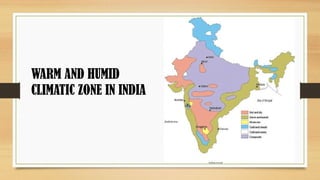
WARM AND HUMID
CLIMATIC ZONE IN INDIA
WARM AND HUMID
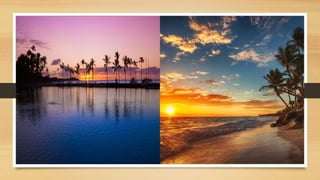
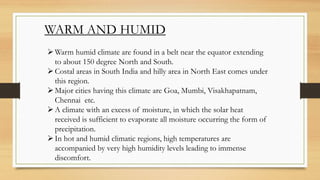
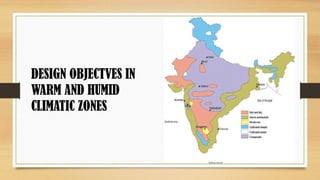
Warm humid climate are found in a belt near the equator extending
to about 150 degree North and South.
Costal areas in South India and hilly area in North East comes under
this region.
Major cities having this climate are Goa, Mumbi, Visakhapatnam,
Chennai etc.
A climate with an excess of moisture, in which the solar heat
received is sufficient to evaporate all moisture occurring the form of
precipitation.
In hot and humid climatic regions, high temperatures are
accompanied by very high humidity levels leading to immense
discomfort.
FEATURES OF WARM AND HUMID CLIMATIC ZONE
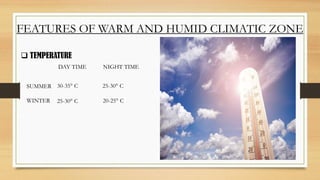
 TEMPERATURE
DAY TIME NIGHT TIME
SUMMER
WINTER
30-35° C 25-30° C
25-30° C 20-25° C
FEATURES OF WARM AND HUMID CLIMATIC ZONE
 PRECEPITATION
PRECEPIPITATION IS HIGH ABOUTB1200 MM PER YEAR.
 RELATIVE HUMIDITY
VERY HIGH 70%-90% THROUGOUT THE YEAR.
FEATURES OF WARM AND HUMID CLIMATIC ZONE
 SOLAR RADIATION
USUALLY DIFUSED RADITION DUE TO CLOUD
COVER OR VAPOUURS IN AIR. INTENSE RADIATION
ON CLEAR DAY.
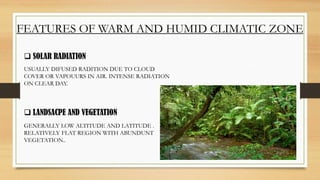
 LANDSACPE AND VEGETATION
GENERALLY LOW ALTITUDE AND LATITUDE .
RELATIVELY FLAT REGION WITH ABUNDUNT
VEGETATION..
DESIGN OBJECTVES IN
WARM AND HUMID
CLIMATIC ZONES
DESIGN OBJECTIVES IN WARM AND HUMID CLIMATIC ZONES
RESISTING HEAT GAIN
 USING HEAT INSULATING MTERIALS IN BUILDING.
 USING MATERIALS THAT REFLECT MORE AND MORE HEAT.
 INCREASE THE SHADE OF THE BUILDING IN GENERAL.
PROMOTE HEAT LOSS
 PROPER VENTILATION OCCURS THROUGHOUT THE DAY.
 HUMIDITY LEVELS SHOULD BE REDUCED AS MUCH AS POSSIBLE.
 CROSS VENTILATION IS ESSENTIAL IN THIS REGIONS.
DESIGN RECOMMENDATIONS IN WARM AND HUMID CLIMATE
1. SITE
 FOR FLAT SITES, FOR DESIGN CONSIDERATION FOR THE LANDFORM IS IMMATERIAL
 IN CASE OF SLOPES AND DEPRESSIONS, THE BUILDING SHOULD BE LOCATED ON
WINDWARD SITE OR CREST TO TAKE ADVANTAGE OF COOL BREEZE
(B) OPEN SPACE AND BUILD FORM
 BUILDING SHOULD BE SPREAD OUT WITH LARGE SPACES IN BETWEEN FOR
UNRESTRICTED AIR MOVEMENT.
 IN CITIES, BUILDINGS ON SLILTS CAN PROMOTE VENTILATION AND CAUSE COOLING
AT THE GROUND LEVEL.
(A) LANDFORM
DESIGN RECOMMENDATIONS IN WARM AND HUMID CLIMATE
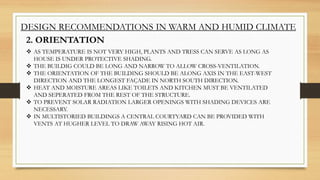
2. ORIENTATION
 AS TEMPERATURE IS NOT VERY HIGH, PLANTS AND TRESS CAN SERVE AS LONG AS
HOUSE IS UNDER PROTECTIVE SHADING.
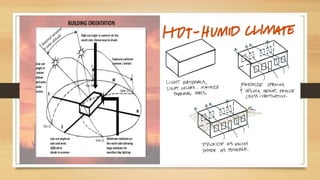
 THE BUILDIG COULD BE LONG AND NARROW TO ALLOW CROSS-VENTILATION.
 THE ORIENTATION OF THE BUILDING SHOULD BE ALONG AXIS IN THE EAST-WEST
DIRECTION AND THE LONGEST FAÇADE IN NORTH SOUTH DIRECTION.
 HEAT AND MOISTURE AREAS LIKE TOILETS AND KITCHEN MUST BE VENTILATED
AND SEPERATED FROM THE REST OF THE STRUCTURE.
 TO PREVENT SOLAR RADIATION LARGER OPENINGS WITH SHADING DEVICES ARE
NECESSARY.
 IN MULTISTORIED BUILDINGS A CENTRAL COURTYARD CAN BE PROVIDED WITH
VENTS AT HUGHER LEVEL TO DRAW AWAY RISING HOT AIR.
DESIGN RECOMMENDATIONS IN WARM AND HUMID CLIMATE
3. BUILDING ENVELOPE
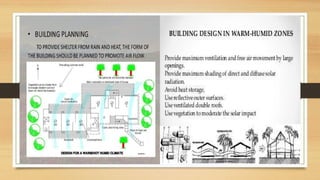
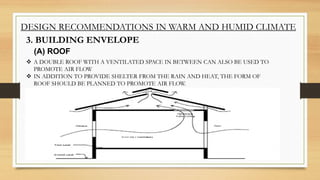
 A DOUBLE ROOF WITH A VENTILATED SPACE IN BETWEEN CAN ALSO BE USED TO
PROMOTE AIR FLOW
 IN ADDITION TO PROVIDE SHELTER FROM THE RAIN AND HEAT, THE FORM OF
ROOF SHOULD BE PLANNED TO PROMOTE AIR FLOW.
(A) ROOF
DESIGN RECOMMENDATIONS IN WARM AND HUMID CLIMATE
3. BUILDING ENVELOPE
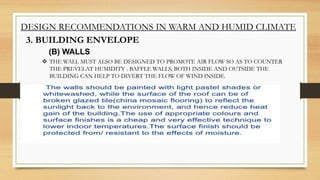
 THE WALL MUST ALSO BE DESIGNED TO PROMOTE AIR FLOW SO AS TO COUNTER
THE PREVELAT HUMIDITY . BAFFLE WALLS, BOTH INSIDE AND OUTSIDE THE
BUILDING CAN HELP TO DIVERT THE FLOW OF WIND INSIDE.
(B) WALLS
MATERIAL RECOMMENDATIONS IN WARM AND HUMID CLIMATE
Building Materials for Walls and Roofs
 Hollow Concrete Blocks are economical, environment
friendly and low maintenance, and have good thermal
insulation, fire resistance and load bearing capacity
.
Also, their strength can be specified according to the
site requirements.
 Timber has good thermal resistance, high heat
storage capacity, and good regulation of humidity as
a warm-humid region has high moisture content.
 Bamboo Roofing Sheet is a successful roofing material
as it has almost similar tensile strength as that of
steel. It is eco-friendly, lightweight, tough and long-
lasting and has minimum fire hazard.
MATERIAL RECOMMENDATIONS IN WARM AND HUMID CLIMATE
Building Materials for Walls and Roofs
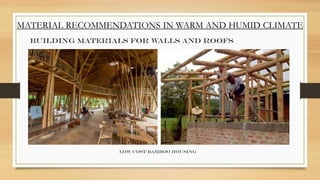
Low cost bamboo housing
MATERIAL RECOMMENDATIONS IN WARM AND HUMID CLIMATE
Building Materials for Walls and Roofs
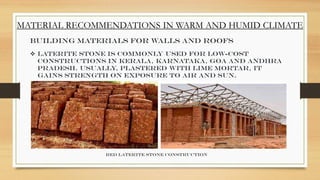
 Laterite stone is commonly used for low-cost
constructions in Kerala, Karnataka, Goa and Andhra
Pradesh. Usually, plastered with lime mortar, it
gains strength on exposure to air and sun.
Red Laterite stone construction
MATERIAL RECOMMENDATIONS IN WARM AND HUMID CLIMATE
Building Materials for Walls and Roofs
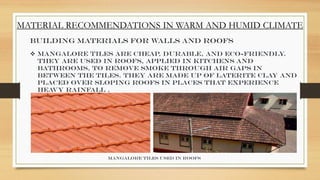
 Mangalore tiles are cheap, durable, and eco-friendly
.
They are used in roofs, applied in kitchens and
bathrooms, to remove smoke through air gaps in
between the tiles. They are made up of laterite clay and
placed over sloping roofs in places that experience
heavy rainfall .
Mangalore tiles used in roofs
MATERIAL RECOMMENDATIONS IN WARM AND HUMID CLIMATE
Building Materials for Walls and Roofs
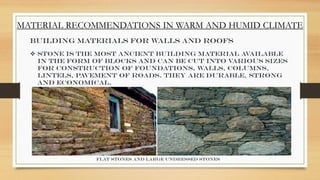
 Stone is the most ancient building material available
in the form of blocks and can be cut into various sizes
for construction of foundations, walls, columns,
lintels, pavement of roads. They are durable, strong
and economical.
Flat stones and large undressed stones
MATERIAL RECOMMENDATIONS IN WARM AND HUMID CLIMATE
Building Materials for Walls and Roofs
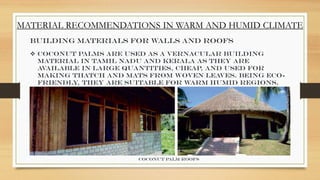
 Coconut palms are used as a vernacular building
material in Tamil Nadu and Kerala as they are
available in large quantities, cheap, and used for
making thatch and mats from woven leaves. Being eco-
friendly, they are suitable for warm humid regions.
Coconut palm roofs
MATERIAL RECOMMENDATIONS IN WARM AND HUMID CLIMATE
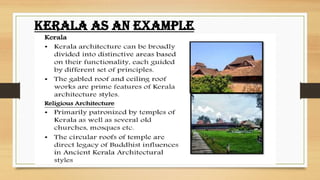
KERALA AS AN EXAMPLE.
.
CASE STUDY ON GOLCONDE DORMITORY, PONDICHERRY
.
CASE STUDY ON GOLCONDE DORMITORY, PONDICHERRY
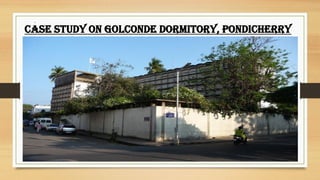
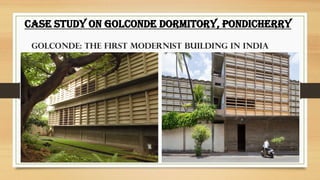
 Golconde, the first modern reinforced concrete
building in India, remains as one of the most
outstanding examples of climate responsive buildings
in the country.
 Among others, the building’s surrounding vegetation
promoting natural ventilation, its orientation
minimizing solar exposure, the ventilated double roof
reducing indoor temperatures and the louvres
working as solar shading devices are appropriate and
efficient strategies for the Indian tropical climate
context.
 This exemplary case study represents a strong case
for constructing climate responsive buildings which
could address the energy crisis in many countries.
.
CASE STUDY ON GOLCONDE DORMITORY, PONDICHERRY
Golconde: The First Modernist Building in India
.
CASE STUDY ON GOLCONDE DORMITORY, PONDICHERRY
PLANNING OF GOLCONDE DORMITORY
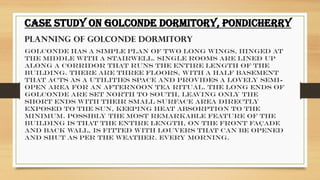
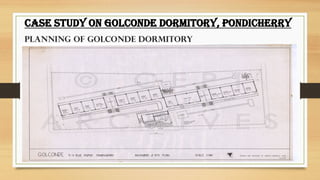
Golconde has a simple plan of two long wings, hinged at
the middle with a stairwell. Single rooms are lined up
along a corridor that runs the entire length of the
building. There are three floors, with a half basement
that acts as a utilities space and provides a lovely semi-
open area for an afternoon tea ritual. The long ends of
Golconde are set north to south, leaving only the
short ends with their small surface area directly
exposed to the sun, keeping heat absorption to the
minimum. Possibly the most remarkable feature of the
building is that the entire length, on the front façade
and back wall, is fitted with louvers that can be opened
and shut as per the weather. Every morning.
.
CASE STUDY ON GOLCONDE DORMITORY, PONDICHERRY
PLANNING OF GOLCONDE DORMITORY
.
CASE STUDY ON GOLCONDE DORMITORY, PONDICHERRY
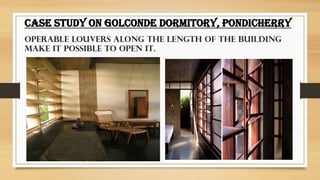
Operable louvers along the length of the building
make it possible to open it.
.
CASE STUDY ON GOLCONDE DORMITORY, PONDICHERRY
ABOUT THE ROOF AND FACDE .
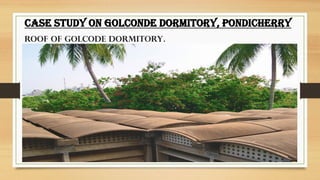
THE ROOF IS MADE OF LARGE AND THIN PRECAST CURVED CEMENT CONCRETE
ELEMENTS CREATING A VENTILATED SPACE OVER THE THIRD FLOOR CONCRETE SLAB.
THE ENDS OF THESE PRECAST CURVED ELEMENTS ON THE NORTH AND SOUTH ARE
SEALED WITH PERFORATED CONCRETE SLABS. THE DOUBLE ROOF WAS IMPORTANT
BECAUSE OF THE ALMOST CONTINUAL INTENSE HEAT OF TH TROPICS : THE
CONVECTION OF THE AIR KEEPS THE TOP FLOOR ROOMS ALMOST COOL AS THE ONE
BELOW.
BOTH NORTH AND SOUTH FACADES ARE FULLY OPENABLE WITH LOUVERS, WHICH CAN
BE FULLY OPENED, HALF OPENED OR CLOSED BY A SERIES OF SIMPLE STATE OF THE
ART BARS WTH NOTCHES TO ADJUST THE ANGLES. INTERESTINGLY , ALL ALONG THE
NORTH FAÇADE THERE IS FIRST THE CORRIDOR WHICH CONNECTS ALL THESE ROOMS .
THE DECISION TO KEEP THE CORRIDOR IS AN IMPORTANT ONE SINCE GOLCONDE IS
SITUATED ON 12 DEG. NORTH LATITUDE, WITH SUMMER SUN PENETRATING ON THE
NORTH. THIS IS HOW THE ROOMS ARE KEPT COOL, ALL THE YEAR AROUND, EVEN IN
HOT WEATHER.
.
CASE STUDY ON GOLCONDE DORMITORY, PONDICHERRY
ROOF OF GOLCODE DORMITORY.
.
THANK YOU………
A PRESENTATION BY ADARSH KUMAR

WARM AND HUMID-1.pdf

  • 1.
    CLIMATIC RESPONSIVE ARCHITECTURE ADARSHKUMAR 2nd SEMESTER A PRESENTATION ON WARM AND HUMID CLIMATIC ZONE
  • 3.
  • 4.
    WARM AND HUMID Warmhumid climate are found in a belt near the equator extending to about 150 degree North and South. Costal areas in South India and hilly area in North East comes under this region. Major cities having this climate are Goa, Mumbi, Visakhapatnam, Chennai etc. A climate with an excess of moisture, in which the solar heat received is sufficient to evaporate all moisture occurring the form of precipitation. In hot and humid climatic regions, high temperatures are accompanied by very high humidity levels leading to immense discomfort.
  • 5.
    FEATURES OF WARMAND HUMID CLIMATIC ZONE  TEMPERATURE DAY TIME NIGHT TIME SUMMER WINTER 30-35° C 25-30° C 25-30° C 20-25° C
  • 6.
    FEATURES OF WARMAND HUMID CLIMATIC ZONE  PRECEPITATION PRECEPIPITATION IS HIGH ABOUTB1200 MM PER YEAR.  RELATIVE HUMIDITY VERY HIGH 70%-90% THROUGOUT THE YEAR.
  • 7.
    FEATURES OF WARMAND HUMID CLIMATIC ZONE  SOLAR RADIATION USUALLY DIFUSED RADITION DUE TO CLOUD COVER OR VAPOUURS IN AIR. INTENSE RADIATION ON CLEAR DAY.  LANDSACPE AND VEGETATION GENERALLY LOW ALTITUDE AND LATITUDE . RELATIVELY FLAT REGION WITH ABUNDUNT VEGETATION..
  • 8.
    DESIGN OBJECTVES IN WARMAND HUMID CLIMATIC ZONES
  • 9.
    DESIGN OBJECTIVES INWARM AND HUMID CLIMATIC ZONES RESISTING HEAT GAIN  USING HEAT INSULATING MTERIALS IN BUILDING.  USING MATERIALS THAT REFLECT MORE AND MORE HEAT.  INCREASE THE SHADE OF THE BUILDING IN GENERAL. PROMOTE HEAT LOSS  PROPER VENTILATION OCCURS THROUGHOUT THE DAY.  HUMIDITY LEVELS SHOULD BE REDUCED AS MUCH AS POSSIBLE.  CROSS VENTILATION IS ESSENTIAL IN THIS REGIONS.
  • 10.
    DESIGN RECOMMENDATIONS INWARM AND HUMID CLIMATE 1. SITE  FOR FLAT SITES, FOR DESIGN CONSIDERATION FOR THE LANDFORM IS IMMATERIAL  IN CASE OF SLOPES AND DEPRESSIONS, THE BUILDING SHOULD BE LOCATED ON WINDWARD SITE OR CREST TO TAKE ADVANTAGE OF COOL BREEZE (B) OPEN SPACE AND BUILD FORM  BUILDING SHOULD BE SPREAD OUT WITH LARGE SPACES IN BETWEEN FOR UNRESTRICTED AIR MOVEMENT.  IN CITIES, BUILDINGS ON SLILTS CAN PROMOTE VENTILATION AND CAUSE COOLING AT THE GROUND LEVEL. (A) LANDFORM
  • 12.
    DESIGN RECOMMENDATIONS INWARM AND HUMID CLIMATE 2. ORIENTATION  AS TEMPERATURE IS NOT VERY HIGH, PLANTS AND TRESS CAN SERVE AS LONG AS HOUSE IS UNDER PROTECTIVE SHADING.  THE BUILDIG COULD BE LONG AND NARROW TO ALLOW CROSS-VENTILATION.  THE ORIENTATION OF THE BUILDING SHOULD BE ALONG AXIS IN THE EAST-WEST DIRECTION AND THE LONGEST FAÇADE IN NORTH SOUTH DIRECTION.  HEAT AND MOISTURE AREAS LIKE TOILETS AND KITCHEN MUST BE VENTILATED AND SEPERATED FROM THE REST OF THE STRUCTURE.  TO PREVENT SOLAR RADIATION LARGER OPENINGS WITH SHADING DEVICES ARE NECESSARY.  IN MULTISTORIED BUILDINGS A CENTRAL COURTYARD CAN BE PROVIDED WITH VENTS AT HUGHER LEVEL TO DRAW AWAY RISING HOT AIR.
  • 14.
    DESIGN RECOMMENDATIONS INWARM AND HUMID CLIMATE 3. BUILDING ENVELOPE  A DOUBLE ROOF WITH A VENTILATED SPACE IN BETWEEN CAN ALSO BE USED TO PROMOTE AIR FLOW  IN ADDITION TO PROVIDE SHELTER FROM THE RAIN AND HEAT, THE FORM OF ROOF SHOULD BE PLANNED TO PROMOTE AIR FLOW. (A) ROOF
  • 15.
    DESIGN RECOMMENDATIONS INWARM AND HUMID CLIMATE 3. BUILDING ENVELOPE  THE WALL MUST ALSO BE DESIGNED TO PROMOTE AIR FLOW SO AS TO COUNTER THE PREVELAT HUMIDITY . BAFFLE WALLS, BOTH INSIDE AND OUTSIDE THE BUILDING CAN HELP TO DIVERT THE FLOW OF WIND INSIDE. (B) WALLS
  • 16.
    MATERIAL RECOMMENDATIONS INWARM AND HUMID CLIMATE Building Materials for Walls and Roofs  Hollow Concrete Blocks are economical, environment friendly and low maintenance, and have good thermal insulation, fire resistance and load bearing capacity . Also, their strength can be specified according to the site requirements.  Timber has good thermal resistance, high heat storage capacity, and good regulation of humidity as a warm-humid region has high moisture content.  Bamboo Roofing Sheet is a successful roofing material as it has almost similar tensile strength as that of steel. It is eco-friendly, lightweight, tough and long- lasting and has minimum fire hazard.
  • 17.
    MATERIAL RECOMMENDATIONS INWARM AND HUMID CLIMATE Building Materials for Walls and Roofs Low cost bamboo housing
  • 18.
    MATERIAL RECOMMENDATIONS INWARM AND HUMID CLIMATE Building Materials for Walls and Roofs  Laterite stone is commonly used for low-cost constructions in Kerala, Karnataka, Goa and Andhra Pradesh. Usually, plastered with lime mortar, it gains strength on exposure to air and sun. Red Laterite stone construction
  • 19.
    MATERIAL RECOMMENDATIONS INWARM AND HUMID CLIMATE Building Materials for Walls and Roofs  Mangalore tiles are cheap, durable, and eco-friendly . They are used in roofs, applied in kitchens and bathrooms, to remove smoke through air gaps in between the tiles. They are made up of laterite clay and placed over sloping roofs in places that experience heavy rainfall . Mangalore tiles used in roofs
  • 20.
    MATERIAL RECOMMENDATIONS INWARM AND HUMID CLIMATE Building Materials for Walls and Roofs  Stone is the most ancient building material available in the form of blocks and can be cut into various sizes for construction of foundations, walls, columns, lintels, pavement of roads. They are durable, strong and economical. Flat stones and large undressed stones
  • 21.
    MATERIAL RECOMMENDATIONS INWARM AND HUMID CLIMATE Building Materials for Walls and Roofs  Coconut palms are used as a vernacular building material in Tamil Nadu and Kerala as they are available in large quantities, cheap, and used for making thatch and mats from woven leaves. Being eco- friendly, they are suitable for warm humid regions. Coconut palm roofs
  • 22.
    MATERIAL RECOMMENDATIONS INWARM AND HUMID CLIMATE
  • 23.
    KERALA AS ANEXAMPLE.
  • 24.
    . CASE STUDY ONGOLCONDE DORMITORY, PONDICHERRY
  • 25.
    . CASE STUDY ONGOLCONDE DORMITORY, PONDICHERRY  Golconde, the first modern reinforced concrete building in India, remains as one of the most outstanding examples of climate responsive buildings in the country.  Among others, the building’s surrounding vegetation promoting natural ventilation, its orientation minimizing solar exposure, the ventilated double roof reducing indoor temperatures and the louvres working as solar shading devices are appropriate and efficient strategies for the Indian tropical climate context.  This exemplary case study represents a strong case for constructing climate responsive buildings which could address the energy crisis in many countries.
  • 26.
    . CASE STUDY ONGOLCONDE DORMITORY, PONDICHERRY Golconde: The First Modernist Building in India
  • 27.
    . CASE STUDY ONGOLCONDE DORMITORY, PONDICHERRY PLANNING OF GOLCONDE DORMITORY Golconde has a simple plan of two long wings, hinged at the middle with a stairwell. Single rooms are lined up along a corridor that runs the entire length of the building. There are three floors, with a half basement that acts as a utilities space and provides a lovely semi- open area for an afternoon tea ritual. The long ends of Golconde are set north to south, leaving only the short ends with their small surface area directly exposed to the sun, keeping heat absorption to the minimum. Possibly the most remarkable feature of the building is that the entire length, on the front façade and back wall, is fitted with louvers that can be opened and shut as per the weather. Every morning.
  • 28.
    . CASE STUDY ONGOLCONDE DORMITORY, PONDICHERRY PLANNING OF GOLCONDE DORMITORY
  • 29.
    . CASE STUDY ONGOLCONDE DORMITORY, PONDICHERRY Operable louvers along the length of the building make it possible to open it.
  • 30.
    . CASE STUDY ONGOLCONDE DORMITORY, PONDICHERRY ABOUT THE ROOF AND FACDE . THE ROOF IS MADE OF LARGE AND THIN PRECAST CURVED CEMENT CONCRETE ELEMENTS CREATING A VENTILATED SPACE OVER THE THIRD FLOOR CONCRETE SLAB. THE ENDS OF THESE PRECAST CURVED ELEMENTS ON THE NORTH AND SOUTH ARE SEALED WITH PERFORATED CONCRETE SLABS. THE DOUBLE ROOF WAS IMPORTANT BECAUSE OF THE ALMOST CONTINUAL INTENSE HEAT OF TH TROPICS : THE CONVECTION OF THE AIR KEEPS THE TOP FLOOR ROOMS ALMOST COOL AS THE ONE BELOW. BOTH NORTH AND SOUTH FACADES ARE FULLY OPENABLE WITH LOUVERS, WHICH CAN BE FULLY OPENED, HALF OPENED OR CLOSED BY A SERIES OF SIMPLE STATE OF THE ART BARS WTH NOTCHES TO ADJUST THE ANGLES. INTERESTINGLY , ALL ALONG THE NORTH FAÇADE THERE IS FIRST THE CORRIDOR WHICH CONNECTS ALL THESE ROOMS . THE DECISION TO KEEP THE CORRIDOR IS AN IMPORTANT ONE SINCE GOLCONDE IS SITUATED ON 12 DEG. NORTH LATITUDE, WITH SUMMER SUN PENETRATING ON THE NORTH. THIS IS HOW THE ROOMS ARE KEPT COOL, ALL THE YEAR AROUND, EVEN IN HOT WEATHER.
  • 31.
    . CASE STUDY ONGOLCONDE DORMITORY, PONDICHERRY ROOF OF GOLCODE DORMITORY.
  • 32.