NIFT Delhi
Case Study
National Institute of
Fashion
Technology (NIFT)
• group of fashion colleges in India
• established in 1986 under the aegis of
the Ministry of Textiles, Government of India
• is an institution of design, management and
technology for the international fashion business
• granted statutory status in 2006
Campuses
NIFT currently has 16 campuses:
1. NIFT New Delhi
2. NIFT Bangalore
3. NIFT Bhopal
4. NIFT Bhubaneswar
5. NIFT Chennai
6. NIFT Gandhinagar
7. NIFT Hyderabad
8. NIFT Jodhpur
9. NIFT Kangra
10. NIFT Kannur
11. NIFT Kolkata
12. NIFT Mumbai
13. NIFT Patna
14. NIFT Raebareli
15. NIFT Shillong
16. NIFT Srinagar
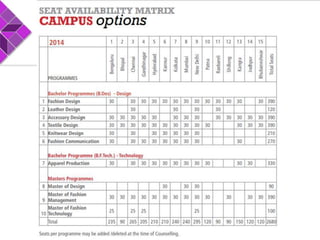
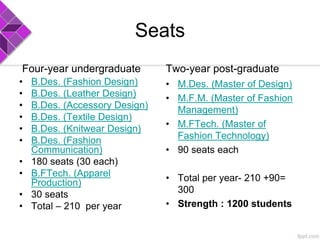
Seats
Four-year undergraduate
• B.Des. (Fashion Design)
• B.Des. (Leather Design)
• B.Des. (Accessory Design)
• B.Des. (Textile Design)
• B.Des. (Knitwear Design)
• B.Des. (Fashion
Communication)
• 180 seats (30 each)
• B.FTech. (Apparel
Production)
• 30 seats
• Total – 210 per year
Two-year post-graduate
• M.Des. (Master of Design)
• M.F.M. (Master of Fashion
Management)
• M.FTech. (Master of
Fashion Technology)
• 90 seats each
• Total per year- 210 +90=
300
• Strength : 1200 students
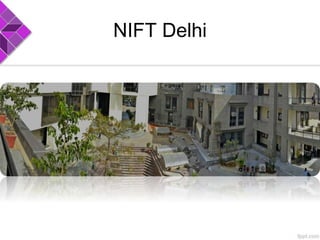
NIFT Delhi
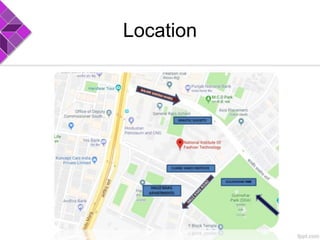
Location
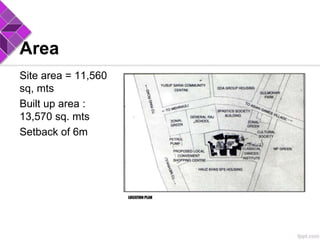
Area
Site area = 11,560
sq, mts
Built up area :
13,570 sq. mts
Setback of 6m
Architect
• BV Doshi
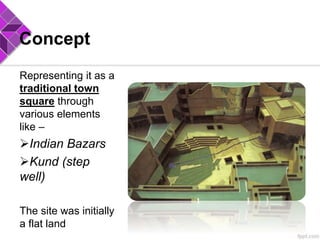
Concept
Representing it as a
traditional town
square through
various elements
like –
Indian Bazars
Kund (step
well)
The site was initially
a flat land
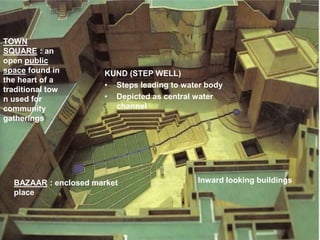
TOWN
SQUARE : an
open public
space found in
the heart of a
traditional tow
n used for
community
gatherings
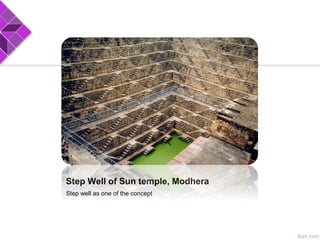
KUND (STEP WELL)
• Steps leading to water body
• Depicted as central water
channel
BAZAAR : enclosed market
place
Inward looking buildings
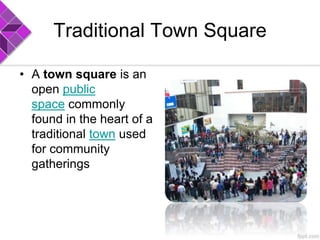
Traditional Town Square
• A town square is an
open public
space commonly
found in the heart of a
traditional town used
for community
gatherings
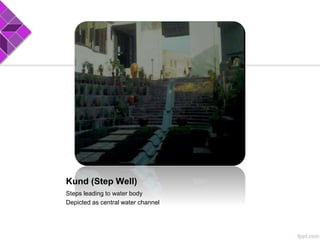
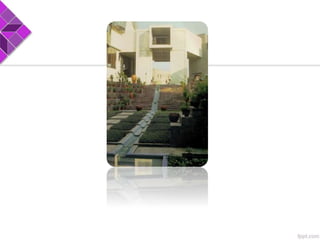
Kund (Step Well)
Steps leading to water body
Depicted as central water channel
Step Well of Sun temple, Modhera
Step well as one of the concept
Indian Bazars
• A bazaar is a permanently
enclosed market place or street where
goods and services are exchanged or sold
• origin from the Persian word bāzār
• The term bazaar is sometimes also used
to refer to the "network
of merchants, bankers and craftsmen" who
work in that area
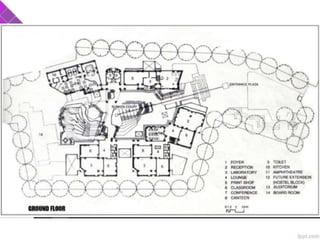
Zoning
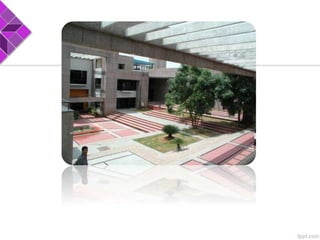
Planning revolves around the two courts-
 Sunken zone with stepped kund and
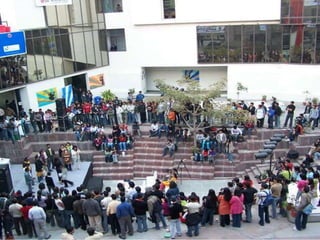
 Amphitheatre
3 Basic zones –
 Academic (occupying left portion of the site)
 Administrative
 Hostel block
Academic and Administrative placed on either side
of entrance
Administrative block along with canteen and library is
in right hand side
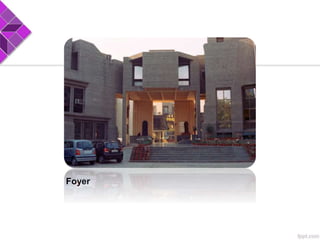
Foyer
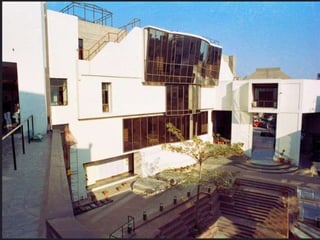
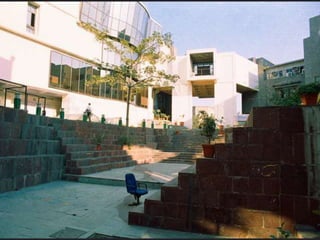
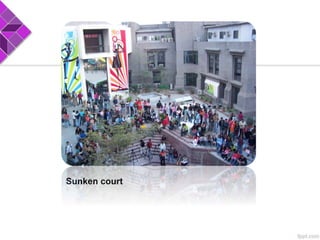
Sunken court
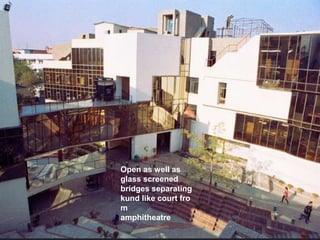
Open as well as
glass screened
bridges separating
kund like court fro
m
amphitheatre
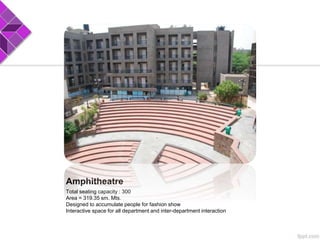
Amphitheatre
Total seating capacity : 300
Area = 319.35 sm. Mts.
Designed to accumulate people for fashion show
Interactive space for all department and inter-department interaction
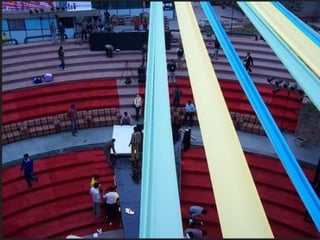
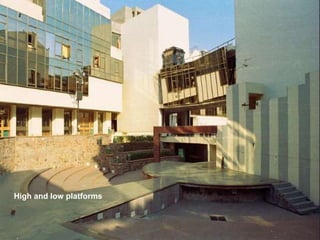
High and low platforms
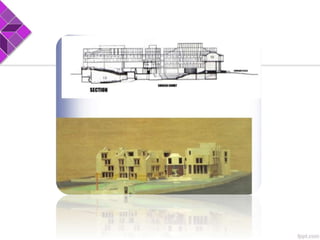
Basement
• Was planned for parking which is not in
use
• Now a, Storage space
• Labs –
Knitwear
Textile
Metal lab for accessory design
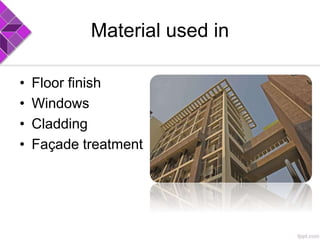
Material used in
• Floor finish
• Windows
• Cladding
• Façade treatment
Floor finish
• Black granite
• White marble
• Check flooring reception hall
• Kota green and Jaisalmer yellow in corridors
• Plain cement floor finish in classrooms and
laboratories
• Chip flooring in exhibition hall
• Stone in open spaces
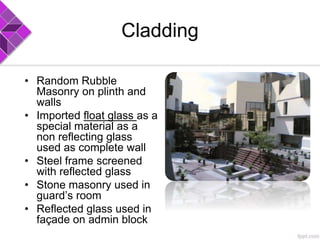
Cladding
• Random Rubble
Masonry on plinth and
walls
• Imported float glass as a
special material as a
non reflecting glass
used as complete wall
• Steel frame screened
with reflected glass
• Stone masonry used in
guard’s room
• Reflected glass used in
façade on admin block
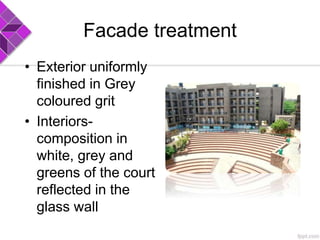
Facade treatment
• Exterior uniformly
finished in Grey
coloured grit
• Interiors-
composition in
white, grey and
greens of the court
reflected in the
glass wall
Structure
• RCC and Brick wall
• Based on frame structure
• Square module has been followed up
• External thickness acts as adequate sun
protection for the windows, providing
insulation
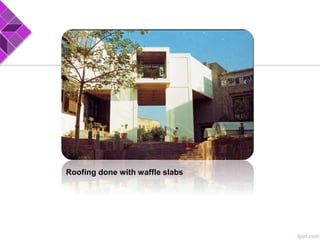
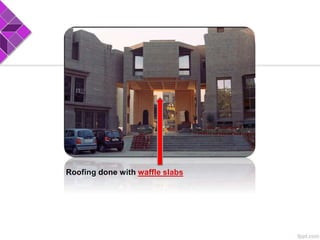
Roofing done with waffle slabs
By-
Amay Vikrama Chauhan
Chandigarh College of
Architecture

NIFT Delhi architecture

  • 1.
  • 2.
    National Institute of Fashion Technology(NIFT) • group of fashion colleges in India • established in 1986 under the aegis of the Ministry of Textiles, Government of India • is an institution of design, management and technology for the international fashion business • granted statutory status in 2006
  • 3.
    Campuses NIFT currently has16 campuses: 1. NIFT New Delhi 2. NIFT Bangalore 3. NIFT Bhopal 4. NIFT Bhubaneswar 5. NIFT Chennai 6. NIFT Gandhinagar 7. NIFT Hyderabad 8. NIFT Jodhpur 9. NIFT Kangra 10. NIFT Kannur 11. NIFT Kolkata 12. NIFT Mumbai 13. NIFT Patna 14. NIFT Raebareli 15. NIFT Shillong 16. NIFT Srinagar
  • 6.
    Seats Four-year undergraduate • B.Des.(Fashion Design) • B.Des. (Leather Design) • B.Des. (Accessory Design) • B.Des. (Textile Design) • B.Des. (Knitwear Design) • B.Des. (Fashion Communication) • 180 seats (30 each) • B.FTech. (Apparel Production) • 30 seats • Total – 210 per year Two-year post-graduate • M.Des. (Master of Design) • M.F.M. (Master of Fashion Management) • M.FTech. (Master of Fashion Technology) • 90 seats each • Total per year- 210 +90= 300 • Strength : 1200 students
  • 7.
  • 8.
  • 9.
    Area Site area =11,560 sq, mts Built up area : 13,570 sq. mts Setback of 6m
  • 10.
  • 11.
    Concept Representing it asa traditional town square through various elements like – Indian Bazars Kund (step well) The site was initially a flat land
  • 12.
    TOWN SQUARE : an openpublic space found in the heart of a traditional tow n used for community gatherings KUND (STEP WELL) • Steps leading to water body • Depicted as central water channel BAZAAR : enclosed market place Inward looking buildings
  • 13.
    Traditional Town Square •A town square is an open public space commonly found in the heart of a traditional town used for community gatherings
  • 14.
    Kund (Step Well) Stepsleading to water body Depicted as central water channel
  • 16.
    Step Well ofSun temple, Modhera Step well as one of the concept
  • 17.
    Indian Bazars • Abazaar is a permanently enclosed market place or street where goods and services are exchanged or sold • origin from the Persian word bāzār • The term bazaar is sometimes also used to refer to the "network of merchants, bankers and craftsmen" who work in that area
  • 19.
    Zoning Planning revolves aroundthe two courts-  Sunken zone with stepped kund and  Amphitheatre 3 Basic zones –  Academic (occupying left portion of the site)  Administrative  Hostel block Academic and Administrative placed on either side of entrance Administrative block along with canteen and library is in right hand side
  • 21.
  • 24.
  • 25.
    Open as wellas glass screened bridges separating kund like court fro m amphitheatre
  • 26.
    Amphitheatre Total seating capacity: 300 Area = 319.35 sm. Mts. Designed to accumulate people for fashion show Interactive space for all department and inter-department interaction
  • 28.
    High and lowplatforms
  • 30.
    Basement • Was plannedfor parking which is not in use • Now a, Storage space • Labs – Knitwear Textile Metal lab for accessory design
  • 32.
    Material used in •Floor finish • Windows • Cladding • Façade treatment
  • 33.
    Floor finish • Blackgranite • White marble • Check flooring reception hall • Kota green and Jaisalmer yellow in corridors • Plain cement floor finish in classrooms and laboratories • Chip flooring in exhibition hall • Stone in open spaces
  • 34.
    Cladding • Random Rubble Masonryon plinth and walls • Imported float glass as a special material as a non reflecting glass used as complete wall • Steel frame screened with reflected glass • Stone masonry used in guard’s room • Reflected glass used in façade on admin block
  • 35.
    Facade treatment • Exterioruniformly finished in Grey coloured grit • Interiors- composition in white, grey and greens of the court reflected in the glass wall
  • 36.
    Structure • RCC andBrick wall • Based on frame structure • Square module has been followed up • External thickness acts as adequate sun protection for the windows, providing insulation
  • 37.
    Roofing done withwaffle slabs
  • 38.
    Roofing done withwaffle slabs
  • 39.
    By- Amay Vikrama Chauhan ChandigarhCollege of Architecture