COMPOSITE CLIMATE
KRISHNAKANTH
KRITHIKA
HARISH
CONTENTS
 Introduction
 Nature of climate
 Design Criteria
 Orientation
 Form & planning
 Roofs & walls
 Openings
 External spaces
 Ventilation
 Building Materials
 Traditional Dwellings
 Contemporary Dwellings
 Comparative study
 Source
INTRODUCTION
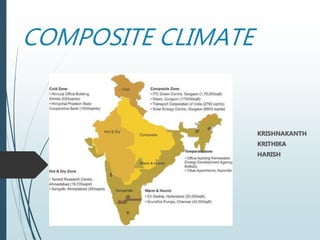
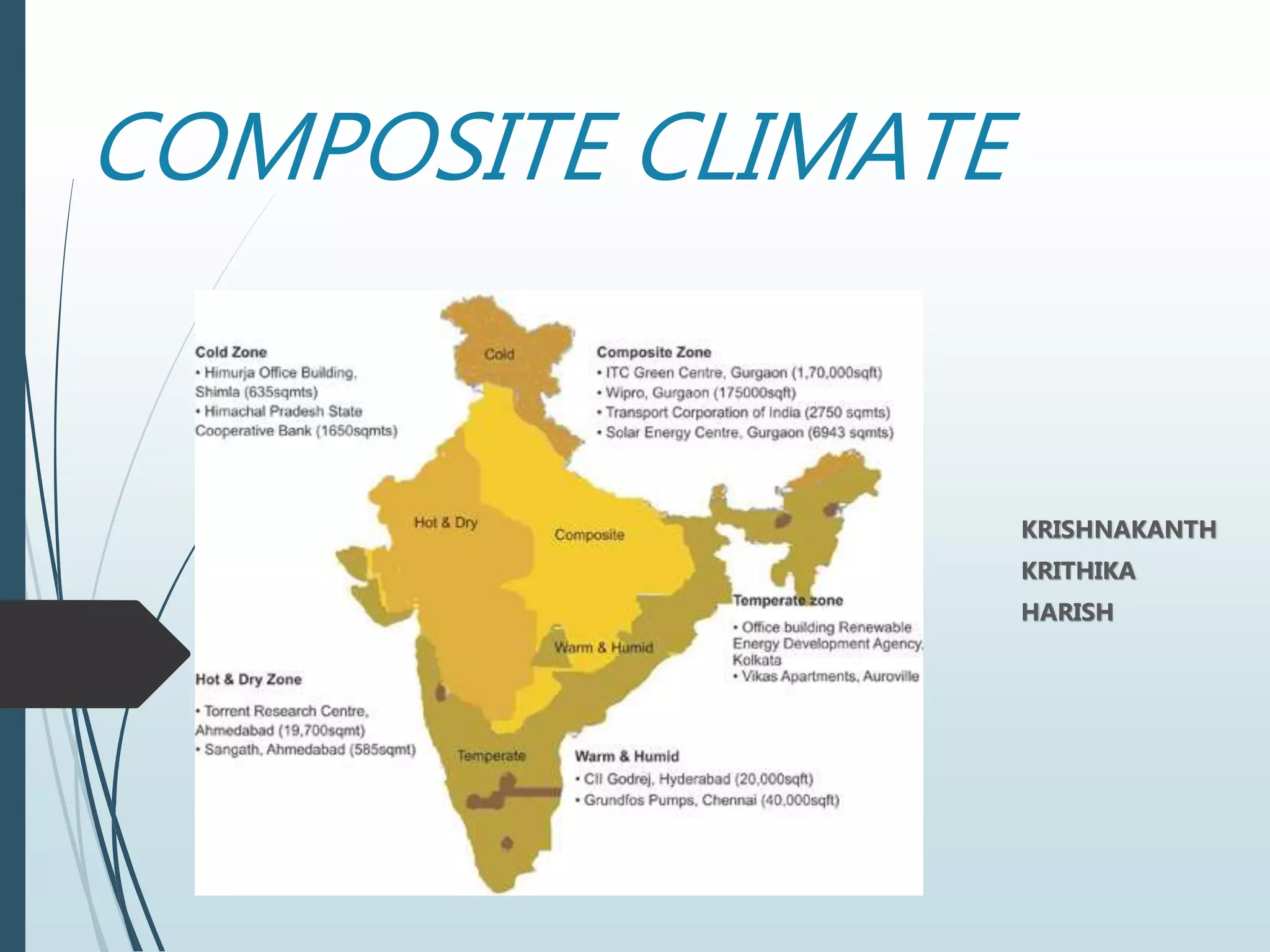
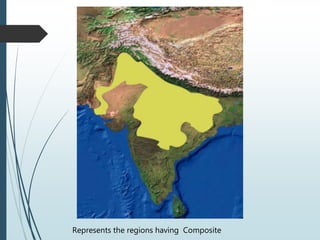
 The composite zone covers the central part of India.
 Composite climate displays the characteristics of hot & dry,
warm & humid as well as cold climates.
 Design here are guided by longer prevailing climatic conditions
. Their characteristics change from season to season alternating
between long hot, dry periods to shorter periods of
concentrated rainfall & high humidity.
 India being a tropical country, most of design decisions would
pertain to cooling.
 Examples:
 The general recommendations of hot & dry climates would be
applicable for New Delhi for most of the year except Monsoon
where Ventilation is essential.
 Eg:Kanpur, Allahabad.
Represents the regions having Composite
NATURE OF THE
CLIMATE
NATURE OF THE CLIMATE
Generally,
In summer:
 Day time temperature is 32-45degree Celsius.
 In Night time 27- 32 degree Celsius.
In winter:
 Day time temperature is 10-25degree Celsius.
 In Night time4 - 10 degree Celsius.
 Receives strong monsoon winds from South-east &
north-east.
DESIGN CRITERIA
DESIGN CRITERIA
Objectives :
1) Resist heat gain in summer & heat loss
in winter
 Decrease exposed surface area
 Increase Thermal resistance
 Increase Thermal capacity
 Increase Buffer space
 Decrease Air Exchange rate
 Increase shading
 Increase surface refelctivity
Solutions:
 Orientation & shape of the
building. Use of trees as wind
barriers.
 Roof & wall insulation
 Thicker Walls
 Balconies
 Weather Stripping
 Walls, glass surfaces
protected by overhangs
trees
 Pale colour
DESIGN CRITERIA
Promote Heat Loss in
Summer or Monsoon
 Ventilation of appliances
 Increase air exchange rate
 Increase humidity level in Dry
Summers
 Decrease humidity in Monsoon
Solutions
 Provide exhausts (Artificial)
 Courtyards or Wind towers or
Arrangement of openings
 Trees & water ponds for
evaporative cooling
 Dehumidifiers
ORIENTATION OF
BUILDING
ORIENTATION OF BUILDING
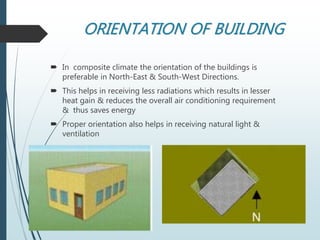
 In composite climate the orientation of the buildings is
preferable in North-East & South-West Directions.
 This helps in receiving less radiations which results in lesser
heat gain & reduces the overall air conditioning requirement
& thus saves energy
 Proper orientation also helps in receiving natural light &
ventilation
FORM & PLANNING
FORM & PLANNING
 Open spaces such as courtyards are beneficial.
 Buildings should be grouped in such a way as to take
advantage of prevailing breezes during the short periods
when air movement is necessary.
 A moderately dense low rise is also suitable for this
climate , which will ensure protection of outdoor spaces.
Mutual sharing of external walls , shelter from the wind
in the cold season, shelter from dust and reduction of
surfaces exposed to solar radiation.
ROOFS AND WALLS
ROOFS AND WALLS
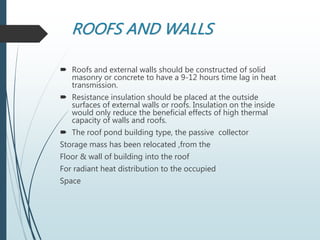
 Roofs and external walls should be constructed of solid
masonry or concrete to have a 9-12 hours time lag in heat
transmission.
 Resistance insulation should be placed at the outside
surfaces of external walls or roofs. Insulation on the inside
would only reduce the beneficial effects of high thermal
capacity of walls and roofs.
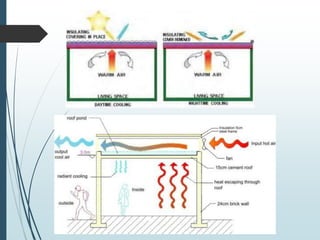
 The roof pond building type, the passive collector
Storage mass has been relocated ,from the
Floor & wall of building into the roof
For radiant heat distribution to the occupied
Space
ROOFS
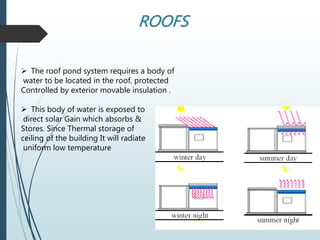
 The roof pond system requires a body of
water to be located in the roof, protected
Controlled by exterior movable insulation .
 This body of water is exposed to
direct solar Gain which absorbs &
Stores. Since Thermal storage of
ceiling of the building It will radiate
uniform low temperature
OPENINGS
OPENINGS
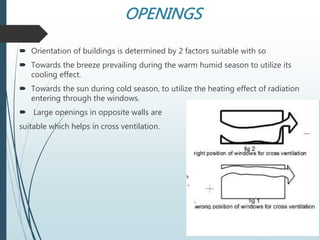
 Orientation of buildings is determined by 2 factors suitable with so
 Towards the breeze prevailing during the warm humid season to utilize its
cooling effect.
 Towards the sun during cold season, to utilize the heating effect of radiation
entering through the windows.
 Large openings in opposite walls are
suitable which helps in cross ventilation.
EXTERNAL SPACES
EXTERNAL SPACES
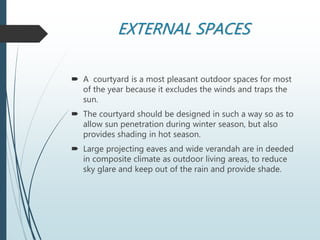
 A courtyard is a most pleasant outdoor spaces for most
of the year because it excludes the winds and traps the
sun.
 The courtyard should be designed in such a way so as to
allow sun penetration during winter season, but also
provides shading in hot season.
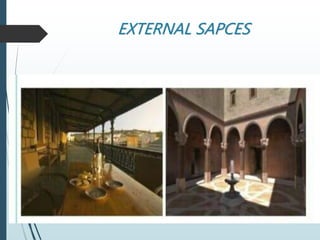
 Large projecting eaves and wide verandah are in deeded
in composite climate as outdoor living areas, to reduce
sky glare and keep out of the rain and provide shade.
EXTERNAL SAPCES
VENTILATION
VENTILATION
Position of openings :
 In buildings air movements must be insured through he
spaces mostly used by occupants through the living zone(
up to 2mts high).
Size of openings;
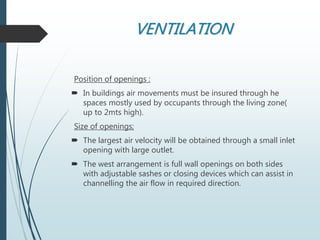
 The largest air velocity will be obtained through a small inlet
opening with large outlet.
 The west arrangement is full wall openings on both sides
with adjustable sashes or closing devices which can assist in
channelling the air flow in required direction.
VENTILATION
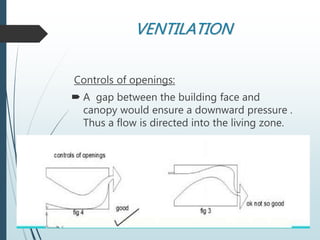
Controls of openings:
 A gap between the building face and
canopy would ensure a downward pressure .
Thus a flow is directed into the living zone.
BUILDING
MATERIALS
BUILDING MATERIALS
The general building materials:
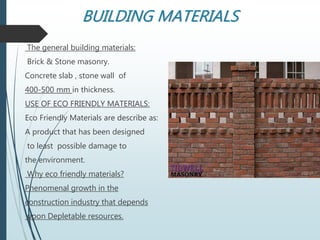
Brick & Stone masonry.
Concrete slab , stone wall of
400-500 mm in thickness.
USE OF ECO FRIENDLY MATERIALS:
Eco Friendly Materials are describe as:
A product that has been designed
to least possible damage to
the environment.
Why eco friendly materials?
Phenomenal growth in the
construction industry that depends
upon Depletable resources.
TRADITIONAL
DWELLINGS
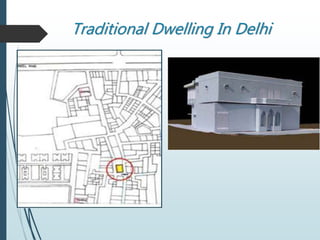
Traditional Dwelling In Delhi
TRADITIONAL DWELLINGS IN DELHI
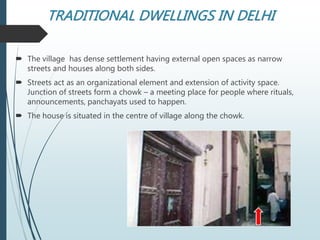
 The village has dense settlement having external open spaces as narrow
streets and houses along both sides.
 Streets act as an organizational element and extension of activity space.
Junction of streets form a chowk – a meeting place for people where rituals,
announcements, panchayats used to happen.
 The house is situated in the centre of village along the chowk.
GROUND FLOOR PLAN
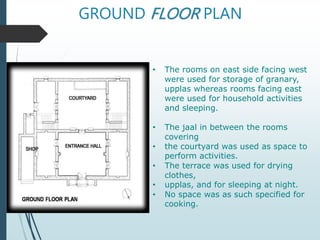
• The rooms on east side facing west
were used for storage of granary,
upplas whereas rooms facing east
were used for household activities
and sleeping.
• The jaal in between the rooms
covering
• the courtyard was used as space to
perform activities.
• The terrace was used for drying
clothes,
• upplas, and for sleeping at night.
• No space was as such specified for
cooking.
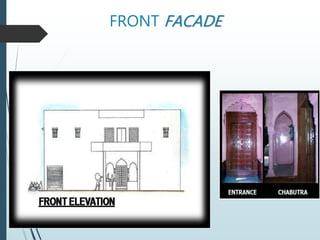
FRONT FACADE
CONTEMPORARY
DWELLINGS
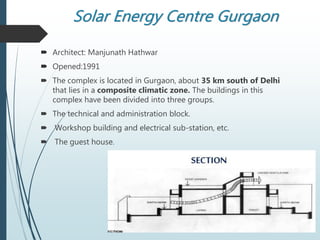
Solar Energy Centre Gurgaon
 Architect: Manjunath Hathwar
 Opened:1991
 The complex is located in Gurgaon, about 35 km south of Delhi
that lies in a composite climatic zone. The buildings in this
complex have been divided into three groups.
 The technical and administration block.
 Workshop building and electrical sub-station, etc.
 The guest house.
RoofAndWallTreatment
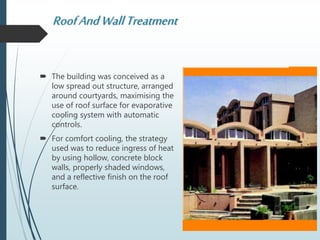
 The building was conceived as a
low spread out structure, arranged
around courtyards, maximising the
use of roof surface for evaporative
cooling system with automatic
controls.
 For comfort cooling, the strategy
used was to reduce ingress of heat
by using hollow, concrete block
walls, properly shaded windows,
and a reflective finish on the roof
surface.
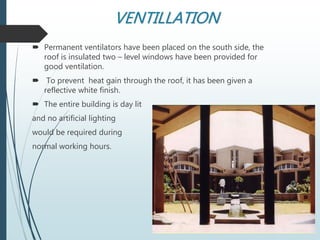
VENTILLATION
 Permanent ventilators have been placed on the south side, the
roof is insulated two – level windows have been provided for
good ventilation.
 To prevent heat gain through the roof, it has been given a
reflective white finish.
 The entire building is day lit
and no artificial lighting
would be required during
normal working hours.
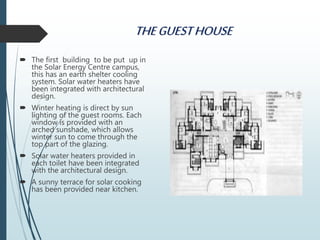
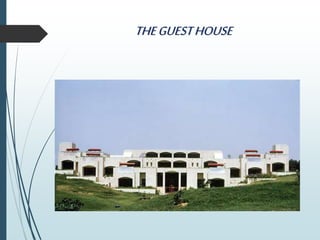
THEGUESTHOUSE
 The first building to be put up in
the Solar Energy Centre campus,
this has an earth shelter cooling
system. Solar water heaters have
been integrated with architectural
design.
 Winter heating is direct by sun
lighting of the guest rooms. Each
window is provided with an
arched sunshade, which allows
winter sun to come through the
top part of the glazing.
 Solar water heaters provided in
each toilet have been integrated
with the architectural design.
 A sunny terrace for solar cooking
has been provided near kitchen.
THEGUESTHOUSE
INTERNATIONAL DWELLINGS
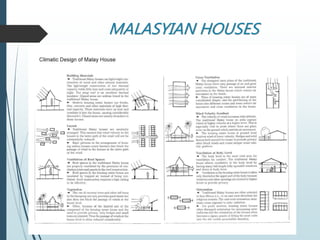
MALASYIAN HOUSES
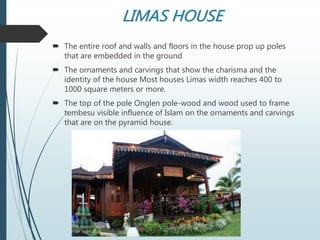
LIMAS HOUSE
 The entire roof and walls and floors in the house prop up poles
that are embedded in the ground
 The ornaments and carvings that show the charisma and the
identity of the house Most houses Limas width reaches 400 to
1000 square meters or more.
 The top of the pole Onglen pole-wood and wood used to frame
tembesu visible influence of Islam on the ornaments and carvings
that are on the pyramid house.
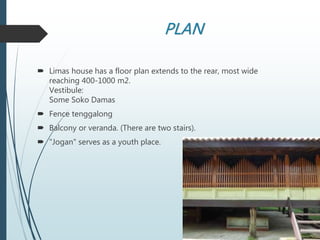
PLAN
 Limas house has a floor plan extends to the rear, most wide
reaching 400-1000 m2.
Vestibule:
Some Soko Damas
 Fence tenggalong
 Balcony or veranda. (There are two stairs).
 "Jogan" serves as a youth place.
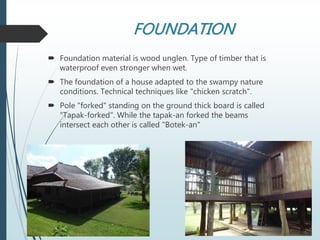
FOUNDATION
 Foundation material is wood unglen. Type of timber that is
waterproof even stronger when wet.
 The foundation of a house adapted to the swampy nature
conditions. Technical techniques like "chicken scratch".
 Pole "forked" standing on the ground thick board is called
"Tapak-forked". While the tapak-an forked the beams
intersect each other is called "Botek-an"
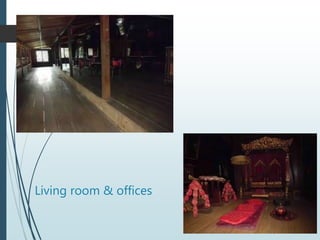
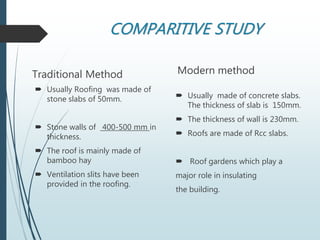
LIVING ROOM
 Kekijing 3 (Bengkalis below) is used for the officials.
 Kekijing 4 (Bengkalis shoots) is used to place his Datuk
maharaja.
 Gegajah as a hall / divan / hall discussion this room is the
center of the Limas house is located on the top floor and
the most honorable. And directly beneath the roof of the
Limas which sustained Alang Sunan and Soko Sunan
Living room & offices
COMPARITIVE
STUDY
COMPARITIVE STUDY
Traditional Method
 Usually Roofing was made of
stone slabs of 50mm.
 Stone walls of 400-500 mm in
thickness.
 The roof is mainly made of
bamboo hay
 Ventilation slits have been
provided in the roofing.
Modern method
 Usually made of concrete slabs.
The thickness of slab is 150mm.
 The thickness of wall is 230mm.
 Roofs are made of Rcc slabs.
 Roof gardens which play a
major role in insulating
the building.
SOURCE:
 Wikipedia
 Scribd- High Efficiency building in composite climate
 Manual of Tropical housing & building.
THANK YOU

Composite climate

  • 1.
  • 2.
    CONTENTS  Introduction  Natureof climate  Design Criteria  Orientation  Form & planning  Roofs & walls  Openings  External spaces  Ventilation  Building Materials  Traditional Dwellings  Contemporary Dwellings  Comparative study  Source
  • 3.
    INTRODUCTION  The compositezone covers the central part of India.  Composite climate displays the characteristics of hot & dry, warm & humid as well as cold climates.  Design here are guided by longer prevailing climatic conditions . Their characteristics change from season to season alternating between long hot, dry periods to shorter periods of concentrated rainfall & high humidity.  India being a tropical country, most of design decisions would pertain to cooling.  Examples:  The general recommendations of hot & dry climates would be applicable for New Delhi for most of the year except Monsoon where Ventilation is essential.  Eg:Kanpur, Allahabad.
  • 4.
    Represents the regionshaving Composite
  • 5.
  • 6.
    NATURE OF THECLIMATE Generally, In summer:  Day time temperature is 32-45degree Celsius.  In Night time 27- 32 degree Celsius. In winter:  Day time temperature is 10-25degree Celsius.  In Night time4 - 10 degree Celsius.  Receives strong monsoon winds from South-east & north-east.
  • 7.
  • 8.
    DESIGN CRITERIA Objectives : 1)Resist heat gain in summer & heat loss in winter  Decrease exposed surface area  Increase Thermal resistance  Increase Thermal capacity  Increase Buffer space  Decrease Air Exchange rate  Increase shading  Increase surface refelctivity Solutions:  Orientation & shape of the building. Use of trees as wind barriers.  Roof & wall insulation  Thicker Walls  Balconies  Weather Stripping  Walls, glass surfaces protected by overhangs trees  Pale colour
  • 9.
    DESIGN CRITERIA Promote HeatLoss in Summer or Monsoon  Ventilation of appliances  Increase air exchange rate  Increase humidity level in Dry Summers  Decrease humidity in Monsoon Solutions  Provide exhausts (Artificial)  Courtyards or Wind towers or Arrangement of openings  Trees & water ponds for evaporative cooling  Dehumidifiers
  • 10.
  • 11.
    ORIENTATION OF BUILDING In composite climate the orientation of the buildings is preferable in North-East & South-West Directions.  This helps in receiving less radiations which results in lesser heat gain & reduces the overall air conditioning requirement & thus saves energy  Proper orientation also helps in receiving natural light & ventilation
  • 12.
  • 13.
    FORM & PLANNING Open spaces such as courtyards are beneficial.  Buildings should be grouped in such a way as to take advantage of prevailing breezes during the short periods when air movement is necessary.  A moderately dense low rise is also suitable for this climate , which will ensure protection of outdoor spaces. Mutual sharing of external walls , shelter from the wind in the cold season, shelter from dust and reduction of surfaces exposed to solar radiation.
  • 14.
  • 15.
    ROOFS AND WALLS Roofs and external walls should be constructed of solid masonry or concrete to have a 9-12 hours time lag in heat transmission.  Resistance insulation should be placed at the outside surfaces of external walls or roofs. Insulation on the inside would only reduce the beneficial effects of high thermal capacity of walls and roofs.  The roof pond building type, the passive collector Storage mass has been relocated ,from the Floor & wall of building into the roof For radiant heat distribution to the occupied Space
  • 16.
    ROOFS  The roofpond system requires a body of water to be located in the roof, protected Controlled by exterior movable insulation .  This body of water is exposed to direct solar Gain which absorbs & Stores. Since Thermal storage of ceiling of the building It will radiate uniform low temperature
  • 18.
  • 19.
    OPENINGS  Orientation ofbuildings is determined by 2 factors suitable with so  Towards the breeze prevailing during the warm humid season to utilize its cooling effect.  Towards the sun during cold season, to utilize the heating effect of radiation entering through the windows.  Large openings in opposite walls are suitable which helps in cross ventilation.
  • 20.
  • 21.
    EXTERNAL SPACES  Acourtyard is a most pleasant outdoor spaces for most of the year because it excludes the winds and traps the sun.  The courtyard should be designed in such a way so as to allow sun penetration during winter season, but also provides shading in hot season.  Large projecting eaves and wide verandah are in deeded in composite climate as outdoor living areas, to reduce sky glare and keep out of the rain and provide shade.
  • 22.
  • 23.
  • 24.
    VENTILATION Position of openings:  In buildings air movements must be insured through he spaces mostly used by occupants through the living zone( up to 2mts high). Size of openings;  The largest air velocity will be obtained through a small inlet opening with large outlet.  The west arrangement is full wall openings on both sides with adjustable sashes or closing devices which can assist in channelling the air flow in required direction.
  • 25.
    VENTILATION Controls of openings: A gap between the building face and canopy would ensure a downward pressure . Thus a flow is directed into the living zone.
  • 26.
  • 27.
    BUILDING MATERIALS The generalbuilding materials: Brick & Stone masonry. Concrete slab , stone wall of 400-500 mm in thickness. USE OF ECO FRIENDLY MATERIALS: Eco Friendly Materials are describe as: A product that has been designed to least possible damage to the environment. Why eco friendly materials? Phenomenal growth in the construction industry that depends upon Depletable resources.
  • 28.
  • 29.
  • 30.
    TRADITIONAL DWELLINGS INDELHI  The village has dense settlement having external open spaces as narrow streets and houses along both sides.  Streets act as an organizational element and extension of activity space. Junction of streets form a chowk – a meeting place for people where rituals, announcements, panchayats used to happen.  The house is situated in the centre of village along the chowk.
  • 31.
    GROUND FLOOR PLAN •The rooms on east side facing west were used for storage of granary, upplas whereas rooms facing east were used for household activities and sleeping. • The jaal in between the rooms covering • the courtyard was used as space to perform activities. • The terrace was used for drying clothes, • upplas, and for sleeping at night. • No space was as such specified for cooking.
  • 32.
  • 33.
  • 34.
    Solar Energy CentreGurgaon  Architect: Manjunath Hathwar  Opened:1991  The complex is located in Gurgaon, about 35 km south of Delhi that lies in a composite climatic zone. The buildings in this complex have been divided into three groups.  The technical and administration block.  Workshop building and electrical sub-station, etc.  The guest house.
  • 35.
    RoofAndWallTreatment  The buildingwas conceived as a low spread out structure, arranged around courtyards, maximising the use of roof surface for evaporative cooling system with automatic controls.  For comfort cooling, the strategy used was to reduce ingress of heat by using hollow, concrete block walls, properly shaded windows, and a reflective finish on the roof surface.
  • 36.
    VENTILLATION  Permanent ventilatorshave been placed on the south side, the roof is insulated two – level windows have been provided for good ventilation.  To prevent heat gain through the roof, it has been given a reflective white finish.  The entire building is day lit and no artificial lighting would be required during normal working hours.
  • 37.
    THEGUESTHOUSE  The firstbuilding to be put up in the Solar Energy Centre campus, this has an earth shelter cooling system. Solar water heaters have been integrated with architectural design.  Winter heating is direct by sun lighting of the guest rooms. Each window is provided with an arched sunshade, which allows winter sun to come through the top part of the glazing.  Solar water heaters provided in each toilet have been integrated with the architectural design.  A sunny terrace for solar cooking has been provided near kitchen.
  • 38.
  • 39.
  • 40.
  • 41.
    LIMAS HOUSE  Theentire roof and walls and floors in the house prop up poles that are embedded in the ground  The ornaments and carvings that show the charisma and the identity of the house Most houses Limas width reaches 400 to 1000 square meters or more.  The top of the pole Onglen pole-wood and wood used to frame tembesu visible influence of Islam on the ornaments and carvings that are on the pyramid house.
  • 42.
    PLAN  Limas househas a floor plan extends to the rear, most wide reaching 400-1000 m2. Vestibule: Some Soko Damas  Fence tenggalong  Balcony or veranda. (There are two stairs).  "Jogan" serves as a youth place.
  • 43.
    FOUNDATION  Foundation materialis wood unglen. Type of timber that is waterproof even stronger when wet.  The foundation of a house adapted to the swampy nature conditions. Technical techniques like "chicken scratch".  Pole "forked" standing on the ground thick board is called "Tapak-forked". While the tapak-an forked the beams intersect each other is called "Botek-an"
  • 44.
    LIVING ROOM  Kekijing3 (Bengkalis below) is used for the officials.  Kekijing 4 (Bengkalis shoots) is used to place his Datuk maharaja.  Gegajah as a hall / divan / hall discussion this room is the center of the Limas house is located on the top floor and the most honorable. And directly beneath the roof of the Limas which sustained Alang Sunan and Soko Sunan
  • 45.
  • 46.
  • 47.
    COMPARITIVE STUDY Traditional Method Usually Roofing was made of stone slabs of 50mm.  Stone walls of 400-500 mm in thickness.  The roof is mainly made of bamboo hay  Ventilation slits have been provided in the roofing. Modern method  Usually made of concrete slabs. The thickness of slab is 150mm.  The thickness of wall is 230mm.  Roofs are made of Rcc slabs.  Roof gardens which play a major role in insulating the building.
  • 48.
    SOURCE:  Wikipedia  Scribd-High Efficiency building in composite climate  Manual of Tropical housing & building.
  • 49.