ATTENTION(AWARENESS)
• Attention is the 1st phase that will
spark the interest of a consumer.
What sparks attention is usually by
its unique design, pricing, and
marketing policy and other factors
that divert our attention towards
this product.
INTEREST
• Interest is the 2nd phase that can
create a desire for the product. A
consumer will want to know more
about the product, its functions and
features.
DESIRE
• Desire is the 3rd phase that
stimulates an action to buy. After
comparing the pros and cons of the
product/service and cross referencing
with multiple sources, desire may
grow which will lead to the purchase
of the product/service.
ACTION
• Action is the 4th phase and the last of
the AIDA. The consumer will purchase
the product/service after completing
the 3 phases. Desire triggers action,
and the consumer will buy it when
the product/service can fulfill his/her
desire.
The Marketing Model
AIDA
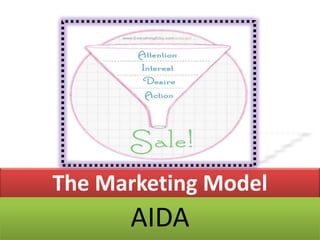
• AIDA is an acronym used in marketing and advertising
that describes a common list of events that may occur
when a consumer engages with an advertisement.
• A - Attention (Awareness): attract the attention of the
customer.
• I - Interest: raise customer interest by focusing on and
demonstrating advantages and benefits (instead of
focusing on features, as in traditional advertising).
• D - Desire: convince customers that they want and
desire the product or service and that it will satisfy
their needs.
• A - Action: lead customers towards taking action and/or
purchasing.
• One of a number of models that analyse the
customer journey from ignorance to purchase.
• A pursuasive sequence used in promotion
• Developed in 1898 by St. Elmo Lewis
• It describes the process a salesperson must
lead the potential customer through from
ignorance of the product to eventual
purchase.
• AIDA is a sequencial model showing steps that
marketing communications should lead
potential buyers through-
• Promotion seeks to-
• attract attention
• Create interest
• Develop desire and
• Prompt action
• Every day we're bombarded with headlines like these
that are designed to grab our attention. In a world full
of advertising and information – delivered in all sorts of
media from print to websites, billboards to radio, and
TV to text messages – every message has to work
extremely hard to get noticed.
• And it's not just advertising messages that have to work
hard; every report you write, presentation you deliver,
or email you send is competing for your audience's
attention.
• As the world of advertising becomes more and more
competitive, advertising becomes more and more
sophisticated. Yet the basic principles behind
advertising copy remain – that it must attract attention
and persuade someone to take action
And this idea remains true simply because human
nature doesn't really change. Sure, we become
increasingly discerning (judgmental), but to
persuade people to do something, you still need to
grab their attention, interest them in how your
product or service can help them, and then
persuade them to take the action you want them to
take, such as buying your product or visiting your
website
These are the four steps you need to take your
audience through if you want them to buy your
product or visit your website.
HISTORY OF AIDA
• The term and approach are commonly attributed to
American advertising and sales pioneer, E. St. Elmo
Lewis. In one of his publications on advertising, Lewis
postulated at least three principles to which an
advertisement should conform:
• According to Lewis:The mission of an advertisement is
to attract a reader, so that he will look at the
advertisement and start to read it; then to interest him,
so that he will continue to read it; then to convince him,
so that when he has read it he will believe it. If an
advertisement contains these three qualities of success,
it is a successful advertisement.
• These priciples were 1st highlighted in the February
9, 1898 issue of Printers' Ink.
• Prior to Lewis was Joseph Addison Richards (1859–
1928), an advertising agent from New York City who
succeeded his father in the direction of one of the
oldest advertising agencies in the United States. In
1893, Richards wrote an advertisement for his
business containing virtually all steps from the AIDA
model
• The first published instance of the general concept,
however, was in an article by Frank Hutchinson
Dukesmith in 1904. Dukesmith's four steps were
attention, interest, desire, and conviction.
ATTENTION(AWARENESS)
• In our media-filled world, you need to be quick and
direct to grab people's attention. Use powerful words,
or a picture that will catch the reader's eye and make
them stop and read what you have to say next.
• With most office workers suffering from e-mail
overload, action-seeking e-mails need subject lines that
will encourage recipients to open them and read the
contents. For example, to encourage people to attend a
company training session on giving feedback, the email
headline, "How effective is YOUR feedback?" is more
likely to grab attention than the purely factual one of,
"This week's seminar on feedback".
• Grab the attention of the audience
• Inform potential buyers about the
product
• Establish customer awareness of the
product
• At this stage advertising is the key
ingredient in the promotional mix
• The promotional objective at this stage is
to get the product seen and talked about.
INTEREST
• This is one of the most challenging stages: You've
got the attention of a chunk of your target
audience, but can you engage with them enough so
that they'll want to spend their precious time
understanding your message in more detail?
• Gaining the reader's interest is a deeper process
than grabbing their attention. They will give you a
little more time to do it, but you must stay focused
on their needs. This means helping them to pick out
the messages that are relevant to them quickly. So
use bullets and subheadings, and break up the text
to make your points stand out.
• Create and stimulate buyer interest
• This is achieved of the benefits of the
products in relation to the need of the
customer
• At this stage the promotional message
focuses on how the product meets these
needs
• Move the potential buyer from passive
awareness to a more active consideration
of the product’s merits.
DESIRE
• The Interest and Desire parts of AIDA go hand-in-
hand: As you're building the reader's interest, you
also need to help them understand how what
you're offering can help them in a real way. The
main way of doing this is by appealing to their
personal needs and wants.
• So, rather than simply saying "Our lunchtime
seminar will teach you feedback skills", explain to
the audience what's in it for them OR What’s in it
for you.
• Create desire
• Induce a favourable attitude to
competing products
• Arouse a desire for the products
above any desire for competitor
products.
ACTION
• Finally, be very clear about what action you want
your readers to take; for example, "Visit
www.mindtools.com now for more information"
rather than just leaving people to work out what to
do for themselves.
• You should be specific about what you want from
the customer.
• To prompt customer action
• The action sought is for the customer
to purchase the product
• Induce a purchase by stressing the
immediate desirability of the product
• Personal selling and sales promotion
play a major role at this stage.
Those PRODUCTS that followed AIDA
• Example no. 1- iphone , I mean THE IPHONE
• TVS Apache RTR Series(racing DNA unleashed)
• HONDA CBR Series (TO know the UNKNOWN)
• MARUTI SWIFT AND ALTO 800 -
ANY
QUESTIONS
Lavidge and Steiner’s Heirarchy of Effective
Model
• Awareness-potential customers become aware of
the existence of the product
• Knowledge-information about the features and
benefits of the product
• Liking-the development of a favourable attitude
towards the products
• Preference-the product is now the preferred choice
of the customer
• Conviction-the customer is now convinced their
preferred choice is right
• Purchase-the above 2pts translated into action
THE LAVIDGE AND STEINER MODEL
• Lavidge and Steiner believed that advertising had
long term effects rather than immediate effect.
• But to move people to the action stage there had to
be shorter term action to build conviction
• The 1st two stages are cognitive –they involve
thinking
• The next 3 are effective-they are about feelings
• The last is conative-it is about action.
DAGMAR
• Defining advertising goals for measured
advertising results
• A model of marketing communications
developed by Colley in 1961
• Developed for the measurement of
advertising effectiveness
• Maps out the state of mind through which
consumers pass
• Promotion is used to move the consumer
through the spectrum
Comparison of models
AIDA
ATTENTION
INTEREST
DESIRE
ACTION
Lavidge and
Steiner
AWARENESS
KNOWLEDGE
LIKING
PREFERENCE
PURCHASE
DAGMAR
UNAWARENESS
AWARENESS
COMPREHENSION
CONVICTION
ACTION
FINALLY
THANK YOU

AIDA

  • 1.
  • 2.
    • Attention isthe 1st phase that will spark the interest of a consumer. What sparks attention is usually by its unique design, pricing, and marketing policy and other factors that divert our attention towards this product.
  • 3.
  • 4.
    • Interest isthe 2nd phase that can create a desire for the product. A consumer will want to know more about the product, its functions and features.
  • 5.
  • 6.
    • Desire isthe 3rd phase that stimulates an action to buy. After comparing the pros and cons of the product/service and cross referencing with multiple sources, desire may grow which will lead to the purchase of the product/service.
  • 7.
  • 8.
    • Action isthe 4th phase and the last of the AIDA. The consumer will purchase the product/service after completing the 3 phases. Desire triggers action, and the consumer will buy it when the product/service can fulfill his/her desire.
  • 9.
  • 10.
    • AIDA isan acronym used in marketing and advertising that describes a common list of events that may occur when a consumer engages with an advertisement. • A - Attention (Awareness): attract the attention of the customer. • I - Interest: raise customer interest by focusing on and demonstrating advantages and benefits (instead of focusing on features, as in traditional advertising). • D - Desire: convince customers that they want and desire the product or service and that it will satisfy their needs. • A - Action: lead customers towards taking action and/or purchasing.
  • 11.
    • One ofa number of models that analyse the customer journey from ignorance to purchase. • A pursuasive sequence used in promotion • Developed in 1898 by St. Elmo Lewis • It describes the process a salesperson must lead the potential customer through from ignorance of the product to eventual purchase. • AIDA is a sequencial model showing steps that marketing communications should lead potential buyers through-
  • 12.
    • Promotion seeksto- • attract attention • Create interest • Develop desire and • Prompt action
  • 13.
    • Every daywe're bombarded with headlines like these that are designed to grab our attention. In a world full of advertising and information – delivered in all sorts of media from print to websites, billboards to radio, and TV to text messages – every message has to work extremely hard to get noticed. • And it's not just advertising messages that have to work hard; every report you write, presentation you deliver, or email you send is competing for your audience's attention. • As the world of advertising becomes more and more competitive, advertising becomes more and more sophisticated. Yet the basic principles behind advertising copy remain – that it must attract attention and persuade someone to take action
  • 14.
    And this idearemains true simply because human nature doesn't really change. Sure, we become increasingly discerning (judgmental), but to persuade people to do something, you still need to grab their attention, interest them in how your product or service can help them, and then persuade them to take the action you want them to take, such as buying your product or visiting your website These are the four steps you need to take your audience through if you want them to buy your product or visit your website.
  • 15.
    HISTORY OF AIDA •The term and approach are commonly attributed to American advertising and sales pioneer, E. St. Elmo Lewis. In one of his publications on advertising, Lewis postulated at least three principles to which an advertisement should conform: • According to Lewis:The mission of an advertisement is to attract a reader, so that he will look at the advertisement and start to read it; then to interest him, so that he will continue to read it; then to convince him, so that when he has read it he will believe it. If an advertisement contains these three qualities of success, it is a successful advertisement.
  • 16.
    • These pricipleswere 1st highlighted in the February 9, 1898 issue of Printers' Ink. • Prior to Lewis was Joseph Addison Richards (1859– 1928), an advertising agent from New York City who succeeded his father in the direction of one of the oldest advertising agencies in the United States. In 1893, Richards wrote an advertisement for his business containing virtually all steps from the AIDA model • The first published instance of the general concept, however, was in an article by Frank Hutchinson Dukesmith in 1904. Dukesmith's four steps were attention, interest, desire, and conviction.
  • 18.
    ATTENTION(AWARENESS) • In ourmedia-filled world, you need to be quick and direct to grab people's attention. Use powerful words, or a picture that will catch the reader's eye and make them stop and read what you have to say next. • With most office workers suffering from e-mail overload, action-seeking e-mails need subject lines that will encourage recipients to open them and read the contents. For example, to encourage people to attend a company training session on giving feedback, the email headline, "How effective is YOUR feedback?" is more likely to grab attention than the purely factual one of, "This week's seminar on feedback".
  • 19.
    • Grab theattention of the audience • Inform potential buyers about the product • Establish customer awareness of the product • At this stage advertising is the key ingredient in the promotional mix • The promotional objective at this stage is to get the product seen and talked about.
  • 20.
    INTEREST • This isone of the most challenging stages: You've got the attention of a chunk of your target audience, but can you engage with them enough so that they'll want to spend their precious time understanding your message in more detail? • Gaining the reader's interest is a deeper process than grabbing their attention. They will give you a little more time to do it, but you must stay focused on their needs. This means helping them to pick out the messages that are relevant to them quickly. So use bullets and subheadings, and break up the text to make your points stand out.
  • 21.
    • Create andstimulate buyer interest • This is achieved of the benefits of the products in relation to the need of the customer • At this stage the promotional message focuses on how the product meets these needs • Move the potential buyer from passive awareness to a more active consideration of the product’s merits.
  • 22.
    DESIRE • The Interestand Desire parts of AIDA go hand-in- hand: As you're building the reader's interest, you also need to help them understand how what you're offering can help them in a real way. The main way of doing this is by appealing to their personal needs and wants. • So, rather than simply saying "Our lunchtime seminar will teach you feedback skills", explain to the audience what's in it for them OR What’s in it for you.
  • 23.
    • Create desire •Induce a favourable attitude to competing products • Arouse a desire for the products above any desire for competitor products.
  • 24.
    ACTION • Finally, bevery clear about what action you want your readers to take; for example, "Visit www.mindtools.com now for more information" rather than just leaving people to work out what to do for themselves. • You should be specific about what you want from the customer.
  • 25.
    • To promptcustomer action • The action sought is for the customer to purchase the product • Induce a purchase by stressing the immediate desirability of the product • Personal selling and sales promotion play a major role at this stage.
  • 26.
    Those PRODUCTS thatfollowed AIDA • Example no. 1- iphone , I mean THE IPHONE
  • 27.
    • TVS ApacheRTR Series(racing DNA unleashed)
  • 28.
    • HONDA CBRSeries (TO know the UNKNOWN)
  • 29.
    • MARUTI SWIFTAND ALTO 800 -
  • 30.
  • 31.
    Lavidge and Steiner’sHeirarchy of Effective Model • Awareness-potential customers become aware of the existence of the product • Knowledge-information about the features and benefits of the product • Liking-the development of a favourable attitude towards the products • Preference-the product is now the preferred choice of the customer • Conviction-the customer is now convinced their preferred choice is right • Purchase-the above 2pts translated into action
  • 32.
    THE LAVIDGE ANDSTEINER MODEL • Lavidge and Steiner believed that advertising had long term effects rather than immediate effect. • But to move people to the action stage there had to be shorter term action to build conviction • The 1st two stages are cognitive –they involve thinking • The next 3 are effective-they are about feelings • The last is conative-it is about action.
  • 33.
  • 34.
    • Defining advertisinggoals for measured advertising results • A model of marketing communications developed by Colley in 1961 • Developed for the measurement of advertising effectiveness • Maps out the state of mind through which consumers pass • Promotion is used to move the consumer through the spectrum
  • 35.
    Comparison of models AIDA ATTENTION INTEREST DESIRE ACTION Lavidgeand Steiner AWARENESS KNOWLEDGE LIKING PREFERENCE PURCHASE DAGMAR UNAWARENESS AWARENESS COMPREHENSION CONVICTION ACTION
  • 36.