By:
Kuhu Pathak
MBA-Marketing
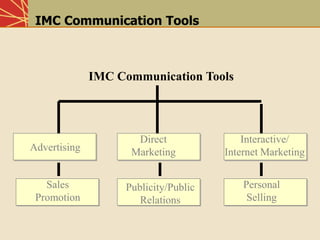
IMC Communication Tools
Advertising
Direct
Marketing
Interactive/
Internet Marketing
Sales
Promotion
Publicity/Public
Relations
Personal
Selling
Any paid form of nonpersonal communication about an
organization, product, service, idea or cause by an
identified sponsor.
Advertising
• Advertiser controls the message
• Cost effective way to communicate with
large audiences
• Effective way to create brand images and
symbolic appeals
• Often can be effective way to strike
responsive chord with consumers
Advantages of advertising
Disadvantages of advertising
–High costs of producing and running ads
–Credibility problems and consumer skepticism
–Clutter
–Difficulty in determining effectiveness
Classifications of Advertising
Advertising to Consumer Markets
• National advertising
• Retail/local advertising
• Advertising to increase demand
–Primary demand for the product category
–Selective demand for a specific brand
Business & professional advertising
•Business-to-business advertising
•Professional advertising
•Trade advertising
A system of marketing by which organizations communicate
directly with target customers to generate a response and/or
a transaction.
Direct Marketing
• Changes in society have made consumers more
receptive to direct-marketing
• Allows marketers to be very selective and target specific
segments of customers
• Messages can be customized for specific customers.
• Effectiveness easier to measure
Advantages of direct marketing
• Lack of customer receptivity and very low response
rates
• Clutter (too many messages)
• Image problems – particularly with telemarketing
Disadvantages of direct marketing
Direct Marketing
Direct marketing methods
–Direct mail
–Catalogs
–Telemarketing
–Direct response ads
–Direct selling
–Internet
A form of marketing communication through interactive
media which allow for a two-way flow of information
whereby users can participate in and modify the content
of the information they receive in real time.
Interactive/Internet Marketing
• Can be used for a variety of IMC functions
• Messages can be tailored to specific interests and needs
of customers
• Interactive nature of the Internet leads to higher level of
involvement
• Can provide large amounts of information to customers.
Advantages of interactive/ internet marketing
• Internet is not yet a mass medium as many
consumers lack access
• Attention to Internet ads is very low
• Great deal of clutter on the Internet
• Audience measurement is a problem on the
Internet
Disadvantages of interactive/ internet marketing
Interactive/Internet Marketing
Use of the Internet as an IMC Tool
• As an advertising medium to inform, educate and persuade
customers
• As a direct sales tool
• To obtain customer database information
• To communicate and interact with buyers
• To provide customer service and support
• To build and maintain customer relationships
• As a tool for implementing sales promotion
• As a tool for implementing publicity/public relations programs
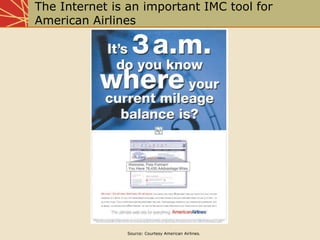
The Internet is an important IMC tool for
American Airlines
Source: Courtesy American Airlines.
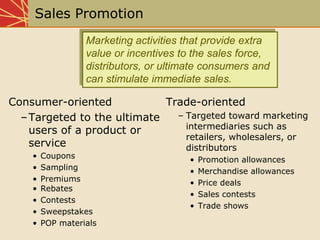
Marketing activities that provide extra
value or incentives to the sales force,
distributors, or ultimate consumers and
can stimulate immediate sales.
Sales Promotion
Trade-oriented
– Targeted toward marketing
intermediaries such as
retailers, wholesalers, or
distributors
• Promotion allowances
• Merchandise allowances
• Price deals
• Sales contests
• Trade shows
Consumer-oriented
–Targeted to the ultimate
users of a product or
service
• Coupons
• Sampling
• Premiums
• Rebates
• Contests
• Sweepstakes
• POP materials
Sales Promotion Uses
Introduce new products
Get existing customers to buy more
Attract new customers
Combat competition
Maintain sales in off season
Increase retail inventories
Tie in advertising & personal selling
Enhance personal selling efforts
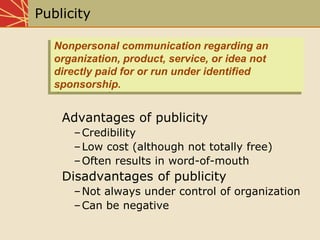
Publicity
Advantages of publicity
–Credibility
–Low cost (although not totally free)
–Often results in word-of-mouth
Disadvantages of publicity
–Not always under control of organization
–Can be negative
Nonpersonal communication regarding an
organization, product, service, or idea not
directly paid for or run under identified
sponsorship.
Publicity Vehicles
News Releases:
–Single-page news stories sent to
media who might print or broadcast
the content.
Feature Articles:
–Larger manuscripts composed and
edited for a particular medium.
Press Conferences:
–Meetings and presentations to
invited reporters and editors.
Special Events:
–Sponsorship of events, teams, or
programs of public value.
Advertising Versus Publicity
FACTOR ADVERTISING PUBLICITY
Control Great Little
Credibility Lower Higher
Reach Achievable Undetermined
Frequency Schedulable Undetermined
Cost Specific Unspecified/low
Flexibility High Low
Timing Specifiable Tentative
Public Relations
Tools used by Public Relations
 Publicity
 Special publications
 Community activity participation
 Fund-raising
 Special event sponsorship
The management function which evaluates public
attitudes, identifies the policies and procedures of
an individual or organization with the public interest,
and executes a program of action to earn public
understanding and acceptance.
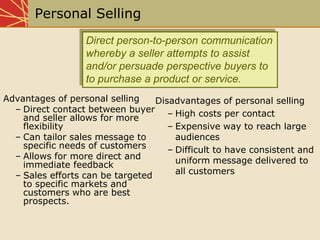
Direct person-to-person communication
whereby a seller attempts to assist
and/or persuade perspective buyers to
to purchase a product or service.
Personal Selling
Disadvantages of personal selling
– High costs per contact
– Expensive way to reach large
audiences
– Difficult to have consistent and
uniform message delivered to
all customers
Advantages of personal selling
– Direct contact between buyer
and seller allows for more
flexibility
– Can tailor sales message to
specific needs of customers
– Allows for more direct and
immediate feedback
– Sales efforts can be targeted
to specific markets and
customers who are best
prospects.
Coordinating the promotional mix
elements to develop a controlled,
integrated program of effective
marketing communications.
Promotional Management
Considerations for developing the
promotional program include:
 Type of product
 Buyer’s decision process
 Stage of product life cycle
 Channels of distribution
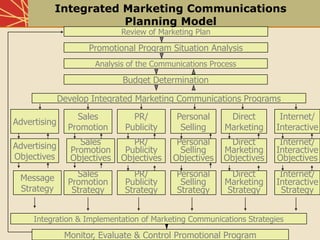
Promotional Program Situation Analysis
Analysis of the Communications Process
Budget Determination
Develop Integrated Marketing Communications Programs
Review of Marketing Plan
Advertising
Sales
Promotion
PR/
Publicity
Personal
Selling
Direct
Marketing
Advertising
Objectives
Sales
Promotion
Objectives
PR/
Publicity
Objectives
Personal
Selling
Objectives
Direct
Marketing
Objectives
Message
Strategy
Sales
Promotion
Strategy
PR/
Publicity
Strategy
Personal
Selling
Strategy
Direct
Marketing
Strategy
Integration & Implementation of Marketing Communications Strategies
Monitor, Evaluate & Control Promotional Program
Internet/
Interactive
Internet/
Interactive
Objectives
Internet/
Interactive
Strategy
Integrated Marketing Communications
Planning Model
The Marketing Plan
A document that describes the overall
marketing strategy and programs
developed for a company, product or
brand. The plan includes:
A detailed situation analysis
Specific marketing objectives
A marketing strategy and program that includes
selection of a target market and plans for
marketing mix elements
4. A program for implementing the strategy
5. A process for monitoring and evaluating
performance
Situation Analysis
Internal Factors
–Assessment of the firm’s
promotional organization and
capabilities
–Review of the firm’s previous
promotional programs
–Assessment of firm or brand image
and implications for promotion
–Assessment of relative strengths and
weaknesses of product/service
External Factors
–Customer analysis
–Competitive analysis
–Environmental analysis
IMC Program Situation Analysis
External Factors
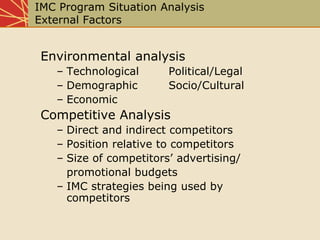
Environmental analysis
– Technological Political/Legal
– Demographic Socio/Cultural
– Economic
Competitive Analysis
– Direct and indirect competitors
– Position relative to competitors
– Size of competitors’ advertising/
promotional budgets
– IMC strategies being used by
competitors
IMC Program Situation Analysis
External Factors
Customer Analysis
Who buys our product or service?
Who initiates and makes the decision
to purchase and who influences the process?
How is the purchase decision made?
What attributes or criteria are important to
customers?
What are customers’ perceptions of and attitudes
toward our company, product/service or brands?
What factors influence the decision making process?
Contact points where customers can be reached?
Analysis of Communications Process
 Analyze best combination of source,
message and channel factors for
communicating with target audience.
 Establish communication goals and
objectives.
Potential Communications Objectives
Sales
Customer loyalty
Company image
Brand image
Store patronage
Service contract
An inquiry
A visit by a prospect
Product trial
Recommendation
Adoption of the product
Contact Points Where Customers
Can Be Effectively Reached
Mass media
 Broadcast - radio/TV
 Newspapers
 Magazines
Direct Marketing
Internet/interactive
Brochures, sales
literature
Publicity/PR
Events/sponsorships
 Local
 Regional
 National/international
Sales Promotions
In-store/POP
Product placements in movies
and television shows
Promotional products
Develop Integrated Marketing
Communications Program
Advertising
Determine objectives and budget
Message development
 Called “Creative Strategy”
 Determine basic appeal
 Determine main message
Media strategy
 Communication channels
 Type of media . . .
 Newspapers/Magazines
 Radio/Television
 Outdoor/Specialty
Select specific media
 Specific papers, magazines, TV
programs, radio stations, billboards, or
other media
Integrate and Implement Marketing
Communications Strategies
 Integrate promotional mix strategies.
 Create and produce ads.
 Purchase media time and space
 Design and implement direct
marketing programs
 Design and implement sales promotion
program
 Design and implement public relations/
publicity programs
 Design and implement interactive/
internet marketing programs
Monitor, Evaluate and Control Integrated
Marketing Communications Program
Evaluate promotional program
results and determine
effectiveness
Take actions to control and
adjust promotional programs
Thank You

Integrated Marketing communication Tools

  • 1.
  • 2.
    IMC Communication Tools IMCCommunication Tools Advertising Direct Marketing Interactive/ Internet Marketing Sales Promotion Publicity/Public Relations Personal Selling
  • 3.
    Any paid formof nonpersonal communication about an organization, product, service, idea or cause by an identified sponsor. Advertising
  • 4.
    • Advertiser controlsthe message • Cost effective way to communicate with large audiences • Effective way to create brand images and symbolic appeals • Often can be effective way to strike responsive chord with consumers Advantages of advertising
  • 5.
    Disadvantages of advertising –Highcosts of producing and running ads –Credibility problems and consumer skepticism –Clutter –Difficulty in determining effectiveness
  • 6.
    Classifications of Advertising Advertisingto Consumer Markets • National advertising • Retail/local advertising • Advertising to increase demand –Primary demand for the product category –Selective demand for a specific brand Business & professional advertising •Business-to-business advertising •Professional advertising •Trade advertising
  • 7.
    A system ofmarketing by which organizations communicate directly with target customers to generate a response and/or a transaction. Direct Marketing
  • 8.
    • Changes insociety have made consumers more receptive to direct-marketing • Allows marketers to be very selective and target specific segments of customers • Messages can be customized for specific customers. • Effectiveness easier to measure Advantages of direct marketing
  • 9.
    • Lack ofcustomer receptivity and very low response rates • Clutter (too many messages) • Image problems – particularly with telemarketing Disadvantages of direct marketing
  • 10.
    Direct Marketing Direct marketingmethods –Direct mail –Catalogs –Telemarketing –Direct response ads –Direct selling –Internet
  • 11.
    A form ofmarketing communication through interactive media which allow for a two-way flow of information whereby users can participate in and modify the content of the information they receive in real time. Interactive/Internet Marketing
  • 12.
    • Can beused for a variety of IMC functions • Messages can be tailored to specific interests and needs of customers • Interactive nature of the Internet leads to higher level of involvement • Can provide large amounts of information to customers. Advantages of interactive/ internet marketing
  • 13.
    • Internet isnot yet a mass medium as many consumers lack access • Attention to Internet ads is very low • Great deal of clutter on the Internet • Audience measurement is a problem on the Internet Disadvantages of interactive/ internet marketing
  • 14.
    Interactive/Internet Marketing Use ofthe Internet as an IMC Tool • As an advertising medium to inform, educate and persuade customers • As a direct sales tool • To obtain customer database information • To communicate and interact with buyers • To provide customer service and support • To build and maintain customer relationships • As a tool for implementing sales promotion • As a tool for implementing publicity/public relations programs
  • 15.
    The Internet isan important IMC tool for American Airlines Source: Courtesy American Airlines.
  • 16.
    Marketing activities thatprovide extra value or incentives to the sales force, distributors, or ultimate consumers and can stimulate immediate sales. Sales Promotion Trade-oriented – Targeted toward marketing intermediaries such as retailers, wholesalers, or distributors • Promotion allowances • Merchandise allowances • Price deals • Sales contests • Trade shows Consumer-oriented –Targeted to the ultimate users of a product or service • Coupons • Sampling • Premiums • Rebates • Contests • Sweepstakes • POP materials
  • 17.
    Sales Promotion Uses Introducenew products Get existing customers to buy more Attract new customers Combat competition Maintain sales in off season Increase retail inventories Tie in advertising & personal selling Enhance personal selling efforts
  • 18.
    Publicity Advantages of publicity –Credibility –Lowcost (although not totally free) –Often results in word-of-mouth Disadvantages of publicity –Not always under control of organization –Can be negative Nonpersonal communication regarding an organization, product, service, or idea not directly paid for or run under identified sponsorship.
  • 19.
    Publicity Vehicles News Releases: –Single-pagenews stories sent to media who might print or broadcast the content. Feature Articles: –Larger manuscripts composed and edited for a particular medium. Press Conferences: –Meetings and presentations to invited reporters and editors. Special Events: –Sponsorship of events, teams, or programs of public value.
  • 20.
    Advertising Versus Publicity FACTORADVERTISING PUBLICITY Control Great Little Credibility Lower Higher Reach Achievable Undetermined Frequency Schedulable Undetermined Cost Specific Unspecified/low Flexibility High Low Timing Specifiable Tentative
  • 21.
    Public Relations Tools usedby Public Relations  Publicity  Special publications  Community activity participation  Fund-raising  Special event sponsorship The management function which evaluates public attitudes, identifies the policies and procedures of an individual or organization with the public interest, and executes a program of action to earn public understanding and acceptance.
  • 22.
    Direct person-to-person communication wherebya seller attempts to assist and/or persuade perspective buyers to to purchase a product or service. Personal Selling Disadvantages of personal selling – High costs per contact – Expensive way to reach large audiences – Difficult to have consistent and uniform message delivered to all customers Advantages of personal selling – Direct contact between buyer and seller allows for more flexibility – Can tailor sales message to specific needs of customers – Allows for more direct and immediate feedback – Sales efforts can be targeted to specific markets and customers who are best prospects.
  • 23.
    Coordinating the promotionalmix elements to develop a controlled, integrated program of effective marketing communications. Promotional Management Considerations for developing the promotional program include:  Type of product  Buyer’s decision process  Stage of product life cycle  Channels of distribution
  • 24.
    Promotional Program SituationAnalysis Analysis of the Communications Process Budget Determination Develop Integrated Marketing Communications Programs Review of Marketing Plan Advertising Sales Promotion PR/ Publicity Personal Selling Direct Marketing Advertising Objectives Sales Promotion Objectives PR/ Publicity Objectives Personal Selling Objectives Direct Marketing Objectives Message Strategy Sales Promotion Strategy PR/ Publicity Strategy Personal Selling Strategy Direct Marketing Strategy Integration & Implementation of Marketing Communications Strategies Monitor, Evaluate & Control Promotional Program Internet/ Interactive Internet/ Interactive Objectives Internet/ Interactive Strategy Integrated Marketing Communications Planning Model
  • 25.
    The Marketing Plan Adocument that describes the overall marketing strategy and programs developed for a company, product or brand. The plan includes: A detailed situation analysis Specific marketing objectives A marketing strategy and program that includes selection of a target market and plans for marketing mix elements 4. A program for implementing the strategy 5. A process for monitoring and evaluating performance
  • 26.
    Situation Analysis Internal Factors –Assessmentof the firm’s promotional organization and capabilities –Review of the firm’s previous promotional programs –Assessment of firm or brand image and implications for promotion –Assessment of relative strengths and weaknesses of product/service External Factors –Customer analysis –Competitive analysis –Environmental analysis
  • 27.
    IMC Program SituationAnalysis External Factors Environmental analysis – Technological Political/Legal – Demographic Socio/Cultural – Economic Competitive Analysis – Direct and indirect competitors – Position relative to competitors – Size of competitors’ advertising/ promotional budgets – IMC strategies being used by competitors
  • 28.
    IMC Program SituationAnalysis External Factors Customer Analysis Who buys our product or service? Who initiates and makes the decision to purchase and who influences the process? How is the purchase decision made? What attributes or criteria are important to customers? What are customers’ perceptions of and attitudes toward our company, product/service or brands? What factors influence the decision making process? Contact points where customers can be reached?
  • 29.
    Analysis of CommunicationsProcess  Analyze best combination of source, message and channel factors for communicating with target audience.  Establish communication goals and objectives.
  • 30.
    Potential Communications Objectives Sales Customerloyalty Company image Brand image Store patronage Service contract An inquiry A visit by a prospect Product trial Recommendation Adoption of the product
  • 31.
    Contact Points WhereCustomers Can Be Effectively Reached Mass media  Broadcast - radio/TV  Newspapers  Magazines Direct Marketing Internet/interactive Brochures, sales literature Publicity/PR Events/sponsorships  Local  Regional  National/international Sales Promotions In-store/POP Product placements in movies and television shows Promotional products
  • 32.
    Develop Integrated Marketing CommunicationsProgram Advertising Determine objectives and budget Message development  Called “Creative Strategy”  Determine basic appeal  Determine main message Media strategy  Communication channels  Type of media . . .  Newspapers/Magazines  Radio/Television  Outdoor/Specialty Select specific media  Specific papers, magazines, TV programs, radio stations, billboards, or other media
  • 33.
    Integrate and ImplementMarketing Communications Strategies  Integrate promotional mix strategies.  Create and produce ads.  Purchase media time and space  Design and implement direct marketing programs  Design and implement sales promotion program  Design and implement public relations/ publicity programs  Design and implement interactive/ internet marketing programs
  • 34.
    Monitor, Evaluate andControl Integrated Marketing Communications Program Evaluate promotional program results and determine effectiveness Take actions to control and adjust promotional programs
  • 35.