Advertising and Advertising Planning Process
Guided By:
Dr.Jay Badiyani.
Prepared By:
Kartik H. Gohel
Submitted to:
Department of business administration
M. K. Bhavnagar university,
Bhavnagar.
Advertising Management
(Seminar Paper)
Advertising is a form of communication for
marketing and used to encourage, persuade or
manipulate an audience (viewers, readers or
listeners; sometimes a specific group) to continue
or take some new action.
The word advertising comes form the Latin
word "advertere” . That means "to turn the mind
toward“.
The process of delivering a
message about ideas, goods and
services, through the media, paid by an
identifiable sponsor.
Advertising –
A definition
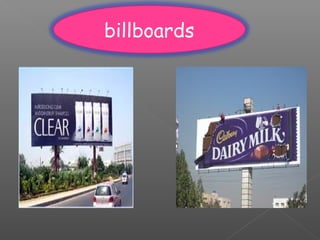
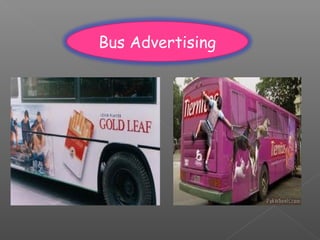
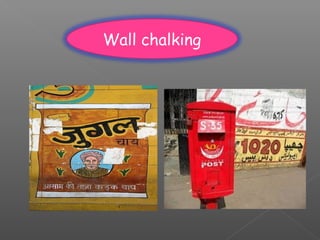
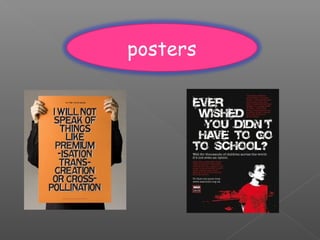
Advertising is the way by which companies tell
about the products and brands.
Advertising –Definitions continued….
According to American
Marketing Association:
“Advertising is any
paid form of non-
personal presentation and
promotion of ideas, goods
and services by an
identified sponsor.”
Advertising is a form of
communication that typically attempts to
persuade potential customers to
purchase or to consume more of a
particular brand of product or service.
Advertising –Definitions cont….
A few advertising
thoughts…
“
-
The business that considers itself
immune to the Necessity of advertising,
sooner or later finds itself immune to
business.”
Creative without strategy is called ‘art’.
Creative with strategy is called ‘advertising’”
- Ries and Trout
“I know half the money I spend on
advertising is wasted, but I can never find out
which half”
- John Wanamaker
“I have learned that you can’t have good
advertising without a good client and that you can’t
keep a good client without good advertising.”
-
Leo Burnett
The basic objective of advertisement is effective
communication b/w producers and consumers. Some
following objectives are:
Preparing ground for new product
Creation of demand
Facing the competition
Creating and enhancing goodwill
Informing the changes to the customers
Neutralizing the competitor’s advertisement
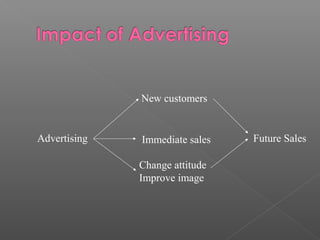
Advertising
New customers
Immediate sales
Change attitude
Improve image
Future Sales
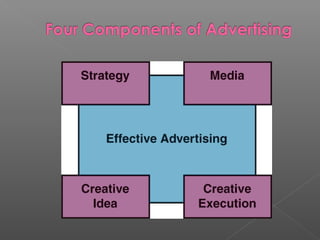
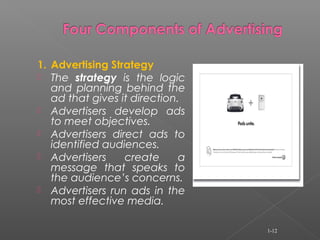
1. Advertising Strategy
 The strategy is the logic
and planning behind the
ad that gives it direction.
 Advertisers develop ads
to meet objectives.
 Advertisers direct ads to
identified audiences.
 Advertisers create a
message that speaks to
the audience’s concerns.
 Advertisers run ads in the
most effective media.
1-12
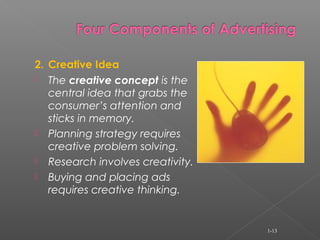
2. Creative Idea
 The creative concept is the
central idea that grabs the
consumer’s attention and
sticks in memory.
 Planning strategy requires
creative problem solving.
 Research involves creativity.
 Buying and placing ads
requires creative thinking.
1-13
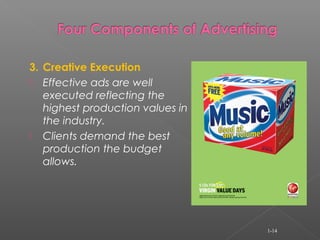
3. Creative Execution
 Effective ads are well
executed reflecting the
highest production values in
the industry.
 Clients demand the best
production the budget
allows.
1-14
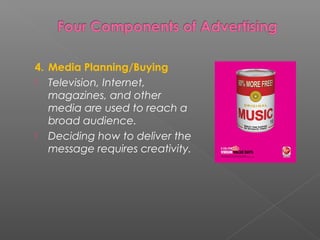
4. Media Planning/Buying
 Television, Internet,
magazines, and other
media are used to reach a
broad audience.
 Deciding how to deliver the
message requires creativity.
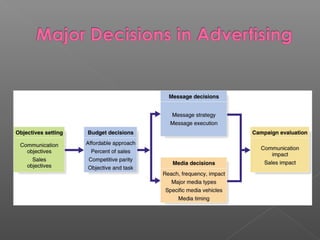
 The advertising objectives must be stated clearly in a precise and
measurable terms.
 The objectives stated clearly and precisely enable the advertiser to
measure the extent up to which the objectives have been met or
achieved.
 The advertising objectives can be “sales oriented” or
“communication oriented”.
 Although the long term objective of each ad is to have an increase
in sales, all ad campaigns are not designed with this specific
objective.
 Some ad campaigns may focus on increasing the awareness about
the product or service, changing the attitude, informing the new
product etc.
Methods:
 Affordable approach
 Percentage of sales method
 Competitive parity method
 Objective & task method
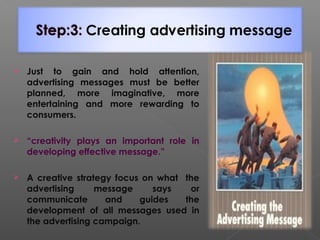
 Just to gain and hold attention,
advertising messages must be better
planned, more imaginative, more
entertaining and more rewarding to
consumers.
 “creativity plays an important role in
developing effective message.”
 A creative strategy focus on what the
advertising message says or
communicate and guides the
development of all messages used in
the advertising campaign.
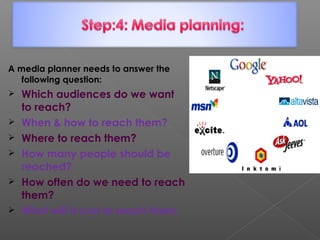
A media planner needs to answer the
following question:
 Which audiences do we want
to reach?
 When & how to reach them?
 Where to reach them?
 How many people should be
reached?
 How often do we need to reach
them?
 What will it cost to reach them.
 The advertising program should evaluate both the
communication effect and the sales effect of
advertising regularly.
 Measuring the communication effects of an
advertisement-copy testing- tells whether the ad is
communicating well.
 The sales effect of advertising are often harder to
measure than the communication effect because
sales are effected by many factors besides
advertising- such as product features, price and
availability.
Ways of advertising in our
Society
 Print advertising
 Broadcast advertising
 Public service advertising
 Outdoor advertising
 Social networking
 Covert advertising
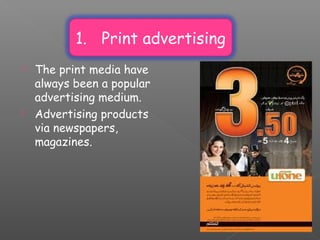
1. Print advertising
 The print media have
always been a popular
advertising medium.
 Advertising products
via newspapers,
magazines.
2. Broadcast Advertising
 Broadcast advertising is a very popular
advertising medium that constitutes of
several branches like;
 television
 Radio
 internet
 Attracts the customers outdoors
 Several events and tradeshows are
organized by the companies.
 Examples of outdoor advertising are;
3. Outdoor Advertising
billboards
Bus Advertising
Wall chalking
posters
Broachers &
pamphlets
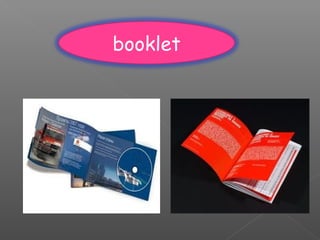
booklet
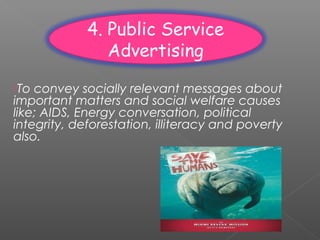
4. Public Service
Advertising
To convey socially relevant messages about
important matters and social welfare causes
like; AIDS, Energy conversation, political
integrity, deforestation, illiteracy and poverty
also.
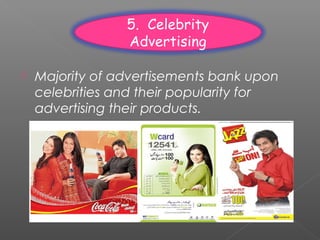
 Majority of advertisements bank upon
celebrities and their popularity for
advertising their products.
5. Celebrity
Advertising
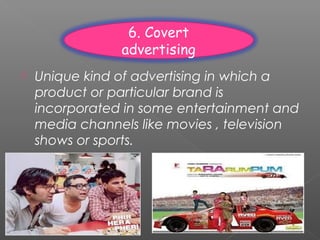
 Unique kind of advertising in which a
product or particular brand is
incorporated in some entertainment and
media channels like movies , television
shows or sports.
6. Covert
advertising
Covert advertising is presently a hot trend
in promoting products and services.
 It embeds a product or brand in
entertainment and media and uses
undercover tactics turning ordinary
entertainment into an extended ad.
Covert advertising
Hayabusa –
In Dhoom, John
Abraham
uses Hayabusa in the
movie as a thief,
from that time only
many of Indians
came to know about
that bike.
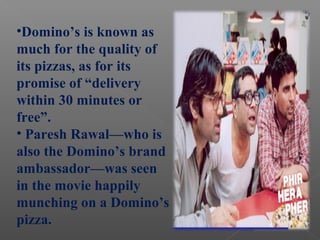
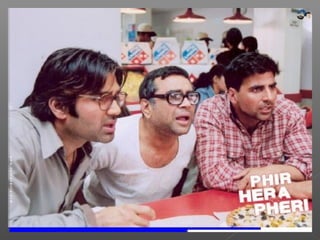
•Domino’s is known as
much for the quality of
its pizzas, as for its
promise of “delivery
within 30 minutes or
free”.
• Paresh Rawal—who is
also the Domino’s brand
ambassador—was seen
in the movie happily
munching on a Domino’s
pizza.
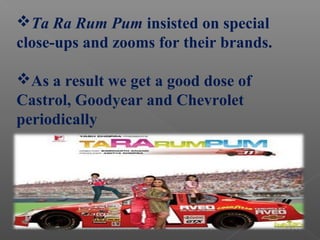
Ta Ra Rum Pum insisted on special
close-ups and zooms for their brands.
As a result we get a good dose of
Castrol, Goodyear and Chevrolet
periodically
 Advertising by Celebrities.
 Advertising by Mobile Phone.
 Classified Advertising .
 Un paid Advertising.
 Advertising Agency.
The American
Association of Advertising
Agency (AAAA) defines an
advertising agency as “ an
independent organization
of creative people and
business people who
specialize in developing
and preparing advertising
plans, advertisements and
other promotional tools.”
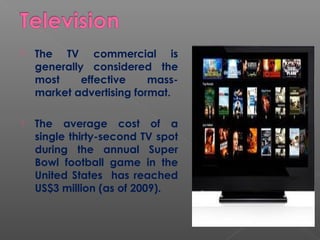
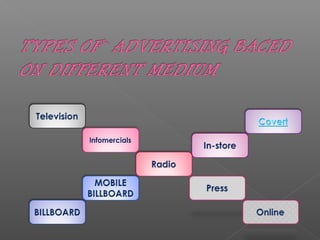
 The TV commercial is
generally considered the
most effective mass-
market advertising format.
 The average cost of a
single thirty-second TV spot
during the annual Super
Bowl football game in the
United States has reached
US$3 million (as of 2009).
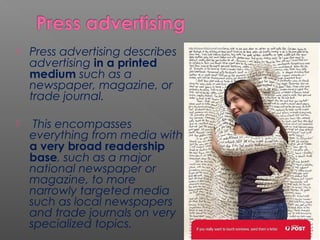
 Press advertising describes
advertising in a printed
medium such as a
newspaper, magazine, or
trade journal.
 This encompasses
everything from media with
a very broad readership
base, such as a major
national newspaper or
magazine, to more
narrowly targeted media
such as local newspapers
and trade journals on very
specialized topics.
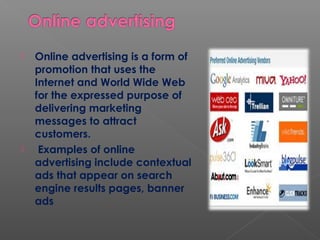
 Online advertising is a form of
promotion that uses the
Internet and World Wide Web
for the expressed purpose of
delivering marketing
messages to attract
customers.
 Examples of online
advertising include contextual
ads that appear on search
engine results pages, banner
ads
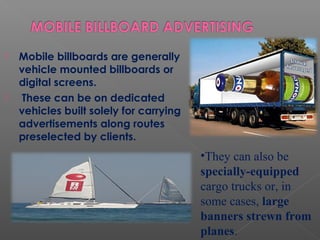
 Mobile billboards are generally
vehicle mounted billboards or
digital screens.
 These can be on dedicated
vehicles built solely for carrying
advertisements along routes
preselected by clients.
•They can also be
specially-equipped
cargo trucks or, in
some cases, large
banners strewn from
planes.
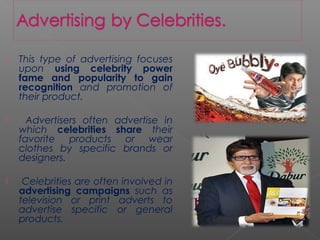
 This type of advertising focuses
upon using celebrity power
fame and popularity to gain
recognition and promotion of
their product.
 Advertisers often advertise in
which celebrities share their
favorite products or wear
clothes by specific brands or
designers.
 Celebrities are often involved in
advertising campaigns such as
television or print adverts to
advertise specific or general
products.
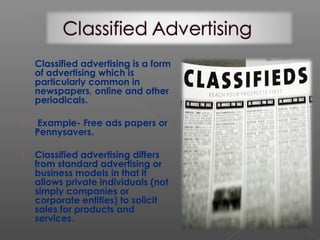
 Classified advertising is a form
of advertising which is
particularly common in
newspapers, online and other
periodicals.
 Example- Free ads papers or
Pennysavers.
 Classified advertising differs
from standard advertising or
business models in that it
allows private individuals (not
simply companies or
corporate entities) to solicit
sales for products and
services.
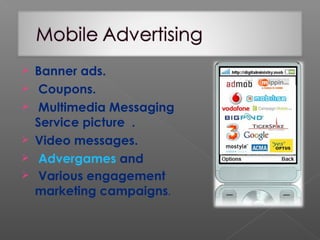
 Banner ads.
 Coupons.
 Multimedia Messaging
Service picture .
 Video messages.
 Advergames and
 Various engagement
marketing campaigns.
 Unpaid advertising (also called "publicity
advertising"), can provide good exposure at
minimal cost.
 Achieving the feat of equating a brand with a
common noun (in the United States, "Xerox" =
"photocopier") — these can be seen as the
pinnacle of any advertising campaign.
 Equating a brand with a common noun also
risks turning that brand into a genericized
trademark - turning it into a generic term which
means that its legal protection as a trademark is
lost.
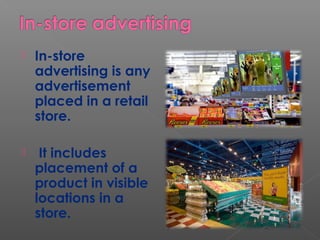
 In-store
advertising is any
advertisement
placed in a retail
store.
 It includes
placement of a
product in visible
locations in a
store.
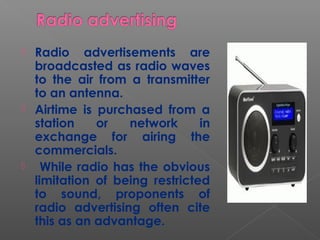
 Radio advertisements are
broadcasted as radio waves
to the air from a transmitter
to an antenna.
 Airtime is purchased from a
station or network in
exchange for airing the
commercials.
 While radio has the obvious
limitation of being restricted
to sound, proponents of
radio advertising often cite
this as an advantage.
The Functions of Advertising
• Builds awareness of products and
Brands
• Creates a brand image
• Provides product and brand
information
• Persuades people
• Provides incentives to take action
• Provides brand reminders
• Reinforces past purchases and
brand experiences
1. The Marketing Role
• Marketing is satisfying customer wants and
needs by providing products (goods, services,
and ideas).
• The marketing department is responsible for
selling the product using the 4 Ps (product,
price, place/distribution, and promotion) and
brand development.
2. The Communication Role
• Advertising is a message to a consumer
about a product, designed to create a
response.
• It is also a form of marketing
communication.
• Advertising uses mass communication to
transmit product information to connect
buyers and sellers in them marketplace.
1-58
3. The Economic Role
• Because it reaches large groups of people,
advertising makes marketing more cost-
efficient and lowers prices for consumers.
• Advertising creates a demand for a brand
using hard sell (persuading) and soft sell
(image building) techniques.
1-59
4. The Societal Role
• Informs consumers about innovations and issues
• Helps us compare products and features
• Mirrors fashion and design trends
• Teaches consumers about new products and how
to use them
• Helps shape consumer self-image
• Facilitates self-expression through purchases
• Presents images about diversity in our world
 Hindustan Unilever($376 m)
 Paras Pharmaceuticals ($120 m)
 Procter & Gamble ($114 m)
 Coca-Cola company ($95 m)
 Godrej industries ($80m)
 Colgate-palmolive ($67 m)
 Pepsico ($62 m)
 Nirma chemicals ($52 m)
 Nestle ($50 m)
 Dabur India ($49 m)
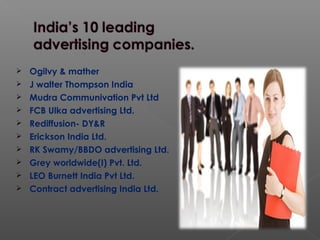
 Ogilvy & mather
 J walter Thompson India
 Mudra Communivation Pvt Ltd
 FCB Ulka advertising Ltd.
 Rediffusion- DY&R
 Erickson India Ltd.
 RK Swamy/BBDO advertising Ltd.
 Grey worldwide(I) Pvt. Ltd.
 LEO Burnett India Pvt Ltd.
 Contract advertising India Ltd.
Advertising and promotion provide a way for companies to achieve a
business objective usually to sell goods or services. It provides a medium
to transmit information to a prospective consumer, in a way that should
maximize the effectiveness of the message. Once the advertising message
has been delivered to the consumer, it is up to the individual to decode and
analyze the message, based upon previous experiences and pre-existing
beliefs. These experiences and beliefs change vastly between cultures and
therefore advertising must integrate and adopt to individual cultures &
societies.
Advertising and promotion has a crucial and key role specially in building
new customers , penetration and embedment of new product/service easily
into market.
Conclusion
Kotler Philip, “THE FRAMEWORK FOR MARKETING MANAGEMENT”, 5th
Edd. , 2002.
India
 William F. Schoell, “MARKETING- CONTEMPORARY CONCEPTS & PRACTICES”,10th
Edd. , 1990, Allyn And Bacon, INC. Boston.
http://www.managementstudyguide.com/advertising-agencies.htm (Date
01/09/2016, Time 12:48 AM)

http://www.referenceforbusiness.com/small/A-Bo/Advertising-Strategy.html#ixzz4J80FOU
(Date 1/9/2016, Time 1:30 AM)
 Advertising and Promotion by George A. Bealch & Michael A Bealch, Sixth
edition.

Advertising and advertising planning process

  • 1.
    Advertising and AdvertisingPlanning Process Guided By: Dr.Jay Badiyani. Prepared By: Kartik H. Gohel Submitted to: Department of business administration M. K. Bhavnagar university, Bhavnagar. Advertising Management (Seminar Paper)
  • 2.
    Advertising is aform of communication for marketing and used to encourage, persuade or manipulate an audience (viewers, readers or listeners; sometimes a specific group) to continue or take some new action. The word advertising comes form the Latin word "advertere” . That means "to turn the mind toward“.

  • 3.
    The process ofdelivering a message about ideas, goods and services, through the media, paid by an identifiable sponsor. Advertising – A definition Advertising is the way by which companies tell about the products and brands.

  • 4.
    Advertising –Definitions continued…. Accordingto American Marketing Association: “Advertising is any paid form of non- personal presentation and promotion of ideas, goods and services by an identified sponsor.”
  • 5.
    Advertising is aform of communication that typically attempts to persuade potential customers to purchase or to consume more of a particular brand of product or service. Advertising –Definitions cont….
  • 6.
  • 7.
    “ - The business thatconsiders itself immune to the Necessity of advertising, sooner or later finds itself immune to business.” Creative without strategy is called ‘art’. Creative with strategy is called ‘advertising’” - Ries and Trout
  • 8.
    “I know halfthe money I spend on advertising is wasted, but I can never find out which half” - John Wanamaker “I have learned that you can’t have good advertising without a good client and that you can’t keep a good client without good advertising.” - Leo Burnett
  • 9.
    The basic objectiveof advertisement is effective communication b/w producers and consumers. Some following objectives are: Preparing ground for new product Creation of demand Facing the competition Creating and enhancing goodwill Informing the changes to the customers Neutralizing the competitor’s advertisement
  • 10.
    Advertising New customers Immediate sales Changeattitude Improve image Future Sales
  • 12.
    1. Advertising Strategy The strategy is the logic and planning behind the ad that gives it direction.  Advertisers develop ads to meet objectives.  Advertisers direct ads to identified audiences.  Advertisers create a message that speaks to the audience’s concerns.  Advertisers run ads in the most effective media. 1-12
  • 13.
    2. Creative Idea The creative concept is the central idea that grabs the consumer’s attention and sticks in memory.  Planning strategy requires creative problem solving.  Research involves creativity.  Buying and placing ads requires creative thinking. 1-13
  • 14.
    3. Creative Execution Effective ads are well executed reflecting the highest production values in the industry.  Clients demand the best production the budget allows. 1-14
  • 15.
    4. Media Planning/Buying Television, Internet, magazines, and other media are used to reach a broad audience.  Deciding how to deliver the message requires creativity.
  • 17.
     The advertisingobjectives must be stated clearly in a precise and measurable terms.  The objectives stated clearly and precisely enable the advertiser to measure the extent up to which the objectives have been met or achieved.  The advertising objectives can be “sales oriented” or “communication oriented”.  Although the long term objective of each ad is to have an increase in sales, all ad campaigns are not designed with this specific objective.  Some ad campaigns may focus on increasing the awareness about the product or service, changing the attitude, informing the new product etc.
  • 18.
    Methods:  Affordable approach Percentage of sales method  Competitive parity method  Objective & task method
  • 19.
     Just togain and hold attention, advertising messages must be better planned, more imaginative, more entertaining and more rewarding to consumers.  “creativity plays an important role in developing effective message.”  A creative strategy focus on what the advertising message says or communicate and guides the development of all messages used in the advertising campaign.
  • 20.
    A media plannerneeds to answer the following question:  Which audiences do we want to reach?  When & how to reach them?  Where to reach them?  How many people should be reached?  How often do we need to reach them?  What will it cost to reach them.
  • 21.
     The advertisingprogram should evaluate both the communication effect and the sales effect of advertising regularly.  Measuring the communication effects of an advertisement-copy testing- tells whether the ad is communicating well.  The sales effect of advertising are often harder to measure than the communication effect because sales are effected by many factors besides advertising- such as product features, price and availability.
  • 22.
    Ways of advertisingin our Society  Print advertising  Broadcast advertising  Public service advertising  Outdoor advertising  Social networking  Covert advertising
  • 23.
    1. Print advertising The print media have always been a popular advertising medium.  Advertising products via newspapers, magazines.
  • 24.
    2. Broadcast Advertising Broadcast advertising is a very popular advertising medium that constitutes of several branches like;  television  Radio  internet
  • 25.
     Attracts thecustomers outdoors  Several events and tradeshows are organized by the companies.  Examples of outdoor advertising are; 3. Outdoor Advertising
  • 26.
  • 27.
  • 28.
  • 29.
  • 30.
  • 31.
  • 32.
    4. Public Service Advertising Toconvey socially relevant messages about important matters and social welfare causes like; AIDS, Energy conversation, political integrity, deforestation, illiteracy and poverty also.
  • 33.
     Majority ofadvertisements bank upon celebrities and their popularity for advertising their products. 5. Celebrity Advertising
  • 34.
     Unique kindof advertising in which a product or particular brand is incorporated in some entertainment and media channels like movies , television shows or sports. 6. Covert advertising
  • 36.
    Covert advertising ispresently a hot trend in promoting products and services.  It embeds a product or brand in entertainment and media and uses undercover tactics turning ordinary entertainment into an extended ad. Covert advertising
  • 38.
    Hayabusa – In Dhoom,John Abraham uses Hayabusa in the movie as a thief, from that time only many of Indians came to know about that bike.
  • 40.
    •Domino’s is knownas much for the quality of its pizzas, as for its promise of “delivery within 30 minutes or free”. • Paresh Rawal—who is also the Domino’s brand ambassador—was seen in the movie happily munching on a Domino’s pizza.
  • 42.
    Ta Ra RumPum insisted on special close-ups and zooms for their brands. As a result we get a good dose of Castrol, Goodyear and Chevrolet periodically
  • 43.
     Advertising byCelebrities.  Advertising by Mobile Phone.  Classified Advertising .  Un paid Advertising.  Advertising Agency.
  • 44.
    The American Association ofAdvertising Agency (AAAA) defines an advertising agency as “ an independent organization of creative people and business people who specialize in developing and preparing advertising plans, advertisements and other promotional tools.”
  • 45.
     The TVcommercial is generally considered the most effective mass- market advertising format.  The average cost of a single thirty-second TV spot during the annual Super Bowl football game in the United States has reached US$3 million (as of 2009).
  • 46.
     Press advertisingdescribes advertising in a printed medium such as a newspaper, magazine, or trade journal.  This encompasses everything from media with a very broad readership base, such as a major national newspaper or magazine, to more narrowly targeted media such as local newspapers and trade journals on very specialized topics.
  • 47.
     Online advertisingis a form of promotion that uses the Internet and World Wide Web for the expressed purpose of delivering marketing messages to attract customers.  Examples of online advertising include contextual ads that appear on search engine results pages, banner ads
  • 48.
     Mobile billboardsare generally vehicle mounted billboards or digital screens.  These can be on dedicated vehicles built solely for carrying advertisements along routes preselected by clients. •They can also be specially-equipped cargo trucks or, in some cases, large banners strewn from planes.
  • 49.
     This typeof advertising focuses upon using celebrity power fame and popularity to gain recognition and promotion of their product.  Advertisers often advertise in which celebrities share their favorite products or wear clothes by specific brands or designers.  Celebrities are often involved in advertising campaigns such as television or print adverts to advertise specific or general products.
  • 50.
     Classified advertisingis a form of advertising which is particularly common in newspapers, online and other periodicals.  Example- Free ads papers or Pennysavers.  Classified advertising differs from standard advertising or business models in that it allows private individuals (not simply companies or corporate entities) to solicit sales for products and services.
  • 51.
     Banner ads. Coupons.  Multimedia Messaging Service picture .  Video messages.  Advergames and  Various engagement marketing campaigns.
  • 52.
     Unpaid advertising(also called "publicity advertising"), can provide good exposure at minimal cost.  Achieving the feat of equating a brand with a common noun (in the United States, "Xerox" = "photocopier") — these can be seen as the pinnacle of any advertising campaign.  Equating a brand with a common noun also risks turning that brand into a genericized trademark - turning it into a generic term which means that its legal protection as a trademark is lost.
  • 53.
     In-store advertising isany advertisement placed in a retail store.  It includes placement of a product in visible locations in a store.
  • 54.
     Radio advertisementsare broadcasted as radio waves to the air from a transmitter to an antenna.  Airtime is purchased from a station or network in exchange for airing the commercials.  While radio has the obvious limitation of being restricted to sound, proponents of radio advertising often cite this as an advantage.
  • 55.
    The Functions ofAdvertising • Builds awareness of products and Brands • Creates a brand image • Provides product and brand information • Persuades people • Provides incentives to take action • Provides brand reminders • Reinforces past purchases and brand experiences
  • 56.
    1. The MarketingRole • Marketing is satisfying customer wants and needs by providing products (goods, services, and ideas). • The marketing department is responsible for selling the product using the 4 Ps (product, price, place/distribution, and promotion) and brand development.
  • 57.
    2. The CommunicationRole • Advertising is a message to a consumer about a product, designed to create a response. • It is also a form of marketing communication. • Advertising uses mass communication to transmit product information to connect buyers and sellers in them marketplace.
  • 58.
    1-58 3. The EconomicRole • Because it reaches large groups of people, advertising makes marketing more cost- efficient and lowers prices for consumers. • Advertising creates a demand for a brand using hard sell (persuading) and soft sell (image building) techniques.
  • 59.
    1-59 4. The SocietalRole • Informs consumers about innovations and issues • Helps us compare products and features • Mirrors fashion and design trends • Teaches consumers about new products and how to use them • Helps shape consumer self-image • Facilitates self-expression through purchases • Presents images about diversity in our world
  • 60.
     Hindustan Unilever($376m)  Paras Pharmaceuticals ($120 m)  Procter & Gamble ($114 m)  Coca-Cola company ($95 m)  Godrej industries ($80m)  Colgate-palmolive ($67 m)  Pepsico ($62 m)  Nirma chemicals ($52 m)  Nestle ($50 m)  Dabur India ($49 m)
  • 61.
     Ogilvy &mather  J walter Thompson India  Mudra Communivation Pvt Ltd  FCB Ulka advertising Ltd.  Rediffusion- DY&R  Erickson India Ltd.  RK Swamy/BBDO advertising Ltd.  Grey worldwide(I) Pvt. Ltd.  LEO Burnett India Pvt Ltd.  Contract advertising India Ltd.
  • 62.
    Advertising and promotionprovide a way for companies to achieve a business objective usually to sell goods or services. It provides a medium to transmit information to a prospective consumer, in a way that should maximize the effectiveness of the message. Once the advertising message has been delivered to the consumer, it is up to the individual to decode and analyze the message, based upon previous experiences and pre-existing beliefs. These experiences and beliefs change vastly between cultures and therefore advertising must integrate and adopt to individual cultures & societies. Advertising and promotion has a crucial and key role specially in building new customers , penetration and embedment of new product/service easily into market. Conclusion
  • 63.
    Kotler Philip, “THEFRAMEWORK FOR MARKETING MANAGEMENT”, 5th Edd. , 2002. India  William F. Schoell, “MARKETING- CONTEMPORARY CONCEPTS & PRACTICES”,10th Edd. , 1990, Allyn And Bacon, INC. Boston. http://www.managementstudyguide.com/advertising-agencies.htm (Date 01/09/2016, Time 12:48 AM)  http://www.referenceforbusiness.com/small/A-Bo/Advertising-Strategy.html#ixzz4J80FOU (Date 1/9/2016, Time 1:30 AM)  Advertising and Promotion by George A. Bealch & Michael A Bealch, Sixth edition.