
AIDA
Presented By:
Asst. Prof. Anil Sharma
 The AIDA model was developed by an American
marketing specialist, Elmo Lewis.
 The concept originates from advertising psychology
and describes the impact of communication on
advertising.
 It is comprised of four basic steps intended to make
an advertising campaign successful.
AIDA MODEL
 Research has identified that an advertisement to be
effective has to
(i) Attract Attention
(ii) Secure Interest
(iii) Build Desire for the product and finally
(iv) Obtain Action
 ATTENTION Attract the Customer Advertising is
intended to attract attention and ensure that the
potential customer "listens."
 It usually begins with an interesting, compelling
introduction that pulls focus. The objective is to avoid
boring messages that could possibly be ignored
LARGE
FONT SIZE
Provocative
Imagery
STRIKING
COLORS
 Interest
 Spark Curiosity
 Storytelling
 Telling a joke
 A funny punch line
 A clever riddle
 An enticing hint
 D - DESIRE Trigger Want or Need In a consumer society,
where many identical products are available, emotional
reasons play a decisive role in purchasing.
 The customers receive information about why they should
buy the product:
 BASIC ADVANTAGES OF THE PRODUCT:
 The product has an image that the buyer can relate to.
 The product symbolizes the success of the owner.
 The advertisement appeals to the hopes and doubts of
potential customers.
 A - ACTION Provoke Purchase
 Lead customers towards taking action and/or
purchasing.
 VARIANTS AIDAS
 When the term satisfaction (i.e. customer satisfaction
after the completed purchase) is added to the AIDA
formula it becomes AIDAS.
 The result is a sustainable relationship, not only with
the purchased product but with future purchasing as
well.
 SATISFACTION The customer’s desire is met.
VARIANTS AIDA MODEL
 VARIANTS AIDCAS
 ATTENTION Attract the customer
 INTEREST Spark curiosity
 DESIRE Trigger want or need
 CONVICTION A customer’s trust is gained.
 ACTION Provoke purchase
 SATISFACTION The customer’s desire is met.
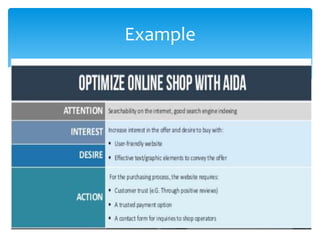
Example
 Thank you

Aida

  • 1.
  • 2.
     The AIDAmodel was developed by an American marketing specialist, Elmo Lewis.  The concept originates from advertising psychology and describes the impact of communication on advertising.  It is comprised of four basic steps intended to make an advertising campaign successful. AIDA MODEL
  • 3.
     Research hasidentified that an advertisement to be effective has to (i) Attract Attention (ii) Secure Interest (iii) Build Desire for the product and finally (iv) Obtain Action
  • 4.
     ATTENTION Attractthe Customer Advertising is intended to attract attention and ensure that the potential customer "listens."  It usually begins with an interesting, compelling introduction that pulls focus. The objective is to avoid boring messages that could possibly be ignored LARGE FONT SIZE Provocative Imagery STRIKING COLORS
  • 5.
     Interest  SparkCuriosity  Storytelling  Telling a joke  A funny punch line  A clever riddle  An enticing hint
  • 6.
     D -DESIRE Trigger Want or Need In a consumer society, where many identical products are available, emotional reasons play a decisive role in purchasing.  The customers receive information about why they should buy the product:  BASIC ADVANTAGES OF THE PRODUCT:  The product has an image that the buyer can relate to.  The product symbolizes the success of the owner.  The advertisement appeals to the hopes and doubts of potential customers.
  • 7.
     A -ACTION Provoke Purchase  Lead customers towards taking action and/or purchasing.
  • 8.
     VARIANTS AIDAS When the term satisfaction (i.e. customer satisfaction after the completed purchase) is added to the AIDA formula it becomes AIDAS.  The result is a sustainable relationship, not only with the purchased product but with future purchasing as well.  SATISFACTION The customer’s desire is met. VARIANTS AIDA MODEL
  • 9.
     VARIANTS AIDCAS ATTENTION Attract the customer  INTEREST Spark curiosity  DESIRE Trigger want or need  CONVICTION A customer’s trust is gained.  ACTION Provoke purchase  SATISFACTION The customer’s desire is met.
  • 10.
  • 11.