Presented By
Keshaw Kumar Sahu
Vachan toppo
Manjit Gauraw
Mohit Agrawal
Nikhil Rathod
THE DAGMAR APPROACH

    Define
    Advertising
    GOAL for
    Measuring
    Advertising
    Result
DAGMAR APPROCH

DAGMAR Approach is the task of measuring ad effectiveness as
well as the objectives or goals of advertising.

In 1961, Russel H. Colley wrote a book under the sponsorship of
the association of National Advertisers called Defining advertising
goals for measured advertising result. The book has become
know as the DAGMAR approach.

Colley distinguished 52 advertising goals that might be used with
respect to a single advertisement.
GOALS
The goals may pertain to sales, image, attitude
and awareness. Some of the goals are:

Persuade a prospect to visit a show room & ask for a
demonstration.

Build up the moral of the company’s sales force.

Facilitate sales by correcting false impression,
misinformation & other obstacles.

Provide information regarding benefits & superior
features of brand.
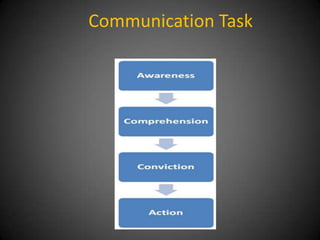
Communication Task
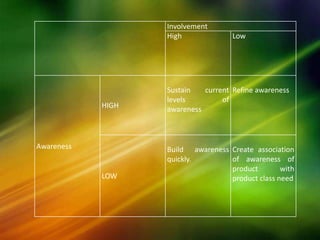
Involvement
                   High              Low


                   Sustain   current Refine awareness
                   levels         of
            HIGH   awareness


Awareness          Build awareness Create association
                   quickly.        of awareness of
                                   product        with
            LOW                    product class need
Awareness of the existence of a product or organization is
necessary before the purchase behavior can be expected.
Once the awareness has been created in the target audience, it
should not be neglected. If there is neglect, the audience may
become distracted by competing messages and the level of
awareness of focus product or organization will decline.
Awareness needs to be created, developed, refined or
sustained, according to the characteristics of the market and the
particular situation facing an organization at any one point of
time.
Awareness on its own may not be sufficient to stimulate a
purchase. Knowledge about the product or the organization is
necessary. This can be achieved by providing specific
information about key brand attributes.
In attempting to persuade people to try a different brand of
water, it may be necessary to compare the product with other
mineral water products and provide an additional usage benefit,
such as environmental claims.
The ad of Ganga mineral water, featuring Govinda, which
banked on the purity aspect. They related the purity of the water
with that of river Ganga.
The next step is to establish a sense of conviction. By creating
interest and preference, buyers are moved to a position where
they are convinced that a particular product in the class should
be tried at the next opportunity.
To do this, audience’s beliefs about the product have to be
moulded and this is often done through messages that
demonstrate the product’s superiority over a rival or by talking
about the rewards as a result of using the product.
Many ads like Thumbs Up featured the reward of social
acceptance as ‘grown up’. It almost hinted that those who
preferred other drinks were kids.
Communication must finally encourage buyers to engage in
purchase activity. Advertising can be directive and guide the
buyers into certain behavioural outcomes,
Use of toll free numbers, direct mail activities and reply cards
and coupons.
Tupperware, Aqua Guard, are famous in Indian cities as a result
of its personal selling efforts.
For high involvement decisions, the most effective tool in the
communication mix at this stage in the hierarchy is personal
selling. Through the use of interpersonal skills, buyers are more
likely to want to buy a product than if personal prompting is
absent.
Characteristics of Objectives
The second importance concept of DAGMAR
approach is that the advertising goal should be
specific. It should be consists of:

Measurement procedure: To indicate exactly what
appeal or image is to be communicated and to specify
the measurement procedure.
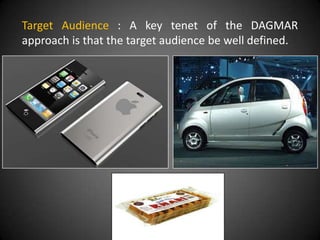
Target Audience : A key tenet of the DAGMAR
approach is that the target audience be well defined.
Benchmark: President lincolh has been quoted as
saying, “if we could first known where we are & whither
we are tending, we could better judge what to do and
how to do it.” Benchmarks can suggest how a certain
goal can best be reached.
Written Goals: Finally, goals should be committed to
paper.
Challenges to the DAGMAR
        Approach

• Sales Goal
• Measurement Problem
• Noise in the System
Conclusion
The DAGMAR approach to setting objectives is
a refinement & extension developed over a
decade ago. It gave emphasis on
communication task related to a define
audience in a given time period. So that each
& every advertisement can only be successful,
if they relate to involving awareness,
comprehension, attitude & action.
Dagmar

Dagmar

  • 1.
    Presented By Keshaw KumarSahu Vachan toppo Manjit Gauraw Mohit Agrawal Nikhil Rathod
  • 2.
    THE DAGMAR APPROACH Define Advertising GOAL for Measuring Advertising Result
  • 3.
    DAGMAR APPROCH DAGMAR Approachis the task of measuring ad effectiveness as well as the objectives or goals of advertising. In 1961, Russel H. Colley wrote a book under the sponsorship of the association of National Advertisers called Defining advertising goals for measured advertising result. The book has become know as the DAGMAR approach. Colley distinguished 52 advertising goals that might be used with respect to a single advertisement.
  • 4.
    GOALS The goals maypertain to sales, image, attitude and awareness. Some of the goals are: Persuade a prospect to visit a show room & ask for a demonstration. Build up the moral of the company’s sales force. Facilitate sales by correcting false impression, misinformation & other obstacles. Provide information regarding benefits & superior features of brand.
  • 5.
  • 6.
    Involvement High Low Sustain current Refine awareness levels of HIGH awareness Awareness Build awareness Create association quickly. of awareness of product with LOW product class need
  • 7.
    Awareness of theexistence of a product or organization is necessary before the purchase behavior can be expected. Once the awareness has been created in the target audience, it should not be neglected. If there is neglect, the audience may become distracted by competing messages and the level of awareness of focus product or organization will decline. Awareness needs to be created, developed, refined or sustained, according to the characteristics of the market and the particular situation facing an organization at any one point of time.
  • 8.
    Awareness on itsown may not be sufficient to stimulate a purchase. Knowledge about the product or the organization is necessary. This can be achieved by providing specific information about key brand attributes. In attempting to persuade people to try a different brand of water, it may be necessary to compare the product with other mineral water products and provide an additional usage benefit, such as environmental claims. The ad of Ganga mineral water, featuring Govinda, which banked on the purity aspect. They related the purity of the water with that of river Ganga.
  • 9.
    The next stepis to establish a sense of conviction. By creating interest and preference, buyers are moved to a position where they are convinced that a particular product in the class should be tried at the next opportunity. To do this, audience’s beliefs about the product have to be moulded and this is often done through messages that demonstrate the product’s superiority over a rival or by talking about the rewards as a result of using the product. Many ads like Thumbs Up featured the reward of social acceptance as ‘grown up’. It almost hinted that those who preferred other drinks were kids.
  • 10.
    Communication must finallyencourage buyers to engage in purchase activity. Advertising can be directive and guide the buyers into certain behavioural outcomes, Use of toll free numbers, direct mail activities and reply cards and coupons. Tupperware, Aqua Guard, are famous in Indian cities as a result of its personal selling efforts. For high involvement decisions, the most effective tool in the communication mix at this stage in the hierarchy is personal selling. Through the use of interpersonal skills, buyers are more likely to want to buy a product than if personal prompting is absent.
  • 11.
    Characteristics of Objectives Thesecond importance concept of DAGMAR approach is that the advertising goal should be specific. It should be consists of: Measurement procedure: To indicate exactly what appeal or image is to be communicated and to specify the measurement procedure.
  • 13.
    Target Audience :A key tenet of the DAGMAR approach is that the target audience be well defined.
  • 14.
    Benchmark: President lincolhhas been quoted as saying, “if we could first known where we are & whither we are tending, we could better judge what to do and how to do it.” Benchmarks can suggest how a certain goal can best be reached.
  • 15.
    Written Goals: Finally,goals should be committed to paper.
  • 16.
    Challenges to theDAGMAR Approach • Sales Goal • Measurement Problem • Noise in the System
  • 17.
    Conclusion The DAGMAR approachto setting objectives is a refinement & extension developed over a decade ago. It gave emphasis on communication task related to a define audience in a given time period. So that each & every advertisement can only be successful, if they relate to involving awareness, comprehension, attitude & action.

Editor's Notes

  • #12 Concrete and measurable — the communications task or objective should be a precise statementof what appeal or message the advertiser wants to communicate to the target audience.Furthermore the specification should include a description of the measurement procedure
  • #13 This isn’t the first time a soft drink brand has tried to launch a mid-calorie beverage with less sugar and calories than the regular version of the soft drink but more sugar and more calories than the diet version. It’s the middle-of-the road choice that Americans haven’t embraced in the past.The ad campaign was launched in 2006 and it’s main theme centers around people drinking Coke and feeling happy and positive. You drink Coke, you feel good. The campaign has optimistic and positive vibes, and it captures the very essence of life. It encourages people to love spontaneity and to see the world in full color.
  • #14 Target audience – a key tenet to DAGMAR is that the target audience be well defined. Forexample – if the goal was to increase awareness, it is essential to know the target audienceprecisely. The benchmark measure cannot be developed without a specification of the targetsegment
  • #15 Benchmark and degree of change soughtanother important part of setting objectives ishaving benchmark measures to determine where the target audience stands at the beginning of   the campaign with respect to various communication response variables such as awareness,knowledge, attitudes, image, etc. The objectives should also specify how much change ormovement is being sought such as increase in awareness levels, creation of favorable attitudes ornumber of consumers intending to purchase the brand, etc. a benchmark is also a prerequisite tothe ultimate measurement of results, an essential part of any planning program and DAGMAR inparticular.
  • #16 Written Goal- finally goals should be committed to paper. When the goals are clearly written , basic shortcomings and misunderstandings become exposed and it becomes easy to determine whether the goal contains the crucial aspects of the DAGMAR approach
  • #18 NIKHIL.RATHOD001@GMAIL.COM