



Brand Strategy
You can download this presentation at: www.studyMarketing.org Visit  www.studyMarketing.org   for more presentations on Marketing, Strategy, Innovation, and Branding
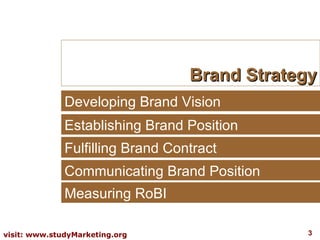
Brand Strategy Developing Brand Vision Establishing Brand Position Fulfilling Brand Contract Communicating Brand Position Measuring RoBI
Brand Vision A clear articulation of the strategic, financial, and brand goals that management has created for the brand A first step to strategic screens as to where the brand can and cannot go
Brand Vision Provides a vision that forces management to articulate what they want the brand to "do" for the organization over the next five years, relative to brand value, revenue, and profit contributions
A brand's positioning is  the place in consumers' minds that you want your brand to own—the benefit you want them to think of when they think of your brand.
A strong brand position means the brand has a unique, credible, sustainable, and valued place in customers' minds.  Good positioning gives you the direction required to focus the organization and focus your strategic efforts.
A good positioning is a single idea to be communicated to your customers.  It revolves around a benefit that helps your product or service stand apart from the competition.
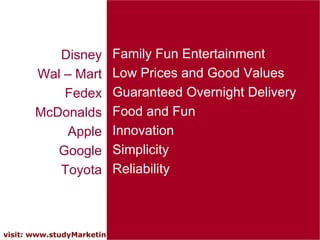
Disney Wal – Mart Fedex McDonalds Apple Google Toyota Family Fun Entertainment Low Prices and Good Values Guaranteed Overnight Delivery Food and Fun Innovation Simplicity Reliability
A well-crafted brand positioning has three primary components: A definition of the target market you wish to pursue A definition of the business your company is in or the industry or category it competes in A statement of your point of difference and key benefits
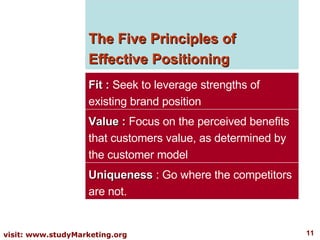
The Five Principles of Effective Positioning Fit :  Seek to leverage strengths of existing brand position Value :  Focus on the perceived benefits that customers value, as determined by the customer model Uniqueness  : Go where the competitors are not.
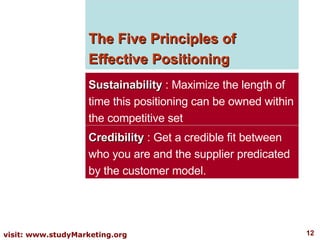
The Five Principles of Effective Positioning Sustainability  : Maximize the length of time this positioning can be owned within the competitive set  Credibility  : Get a credible fit between who you are and the supplier predicated by the customer model.
A Brand Contract is  a list of all promises the brand makes to customers. Such a contract is executed internally, but it is defined and validated externally by the marketplace.
Brand Contracts  can and should change over time. New promises can be added, other promises can be updated, and irrelevant promises can be deleted.
A Brand Contract  is a critical piece of the brand position because it helps to further define marketplace perceptions and expectations and forces managers to be honest with themselves.
In addition to positive promises to customers, a  Brand Contract  can contain negative promises or attributes. It is important to build on the strong brand promises and mitigate the negative ones.
Starbucks' Implicit Brand Contract Provide the highest quality coffee available on the market today Offer customers a wide variety of coffee options as well as com­plementary food and beverage items Have an atmosphere that is warm, friendly, homelike, and appropriate for having a conversation with a good friend or reading a book Recognize that visiting Starbucks is as much about the  experience  of drinking coffee as it is about the coffee itself
Successful Brand-Based Communications Use all communication strategies to help achieve your corporate strategy and brand vision. Let your brand positioning largely determine the right communications strategy to execute. Use an integrated marketing communications strategy to get maximum return from all dollar investments.
Some Metrics to Measure Return on Brand Investment: Brand name knowledge, awareness, recognition, recall : measures strength of the brand as reflected by customer's ability to identify the brand under varying conditions Contract fulfillment : measures the degree to which your brand is upholding its Brand Contract
Some Metrics to Measure Return on Brand Investment: Acquired customers : counts customers claiming they have come to your company based on the strength of the brand Customer loyalty :  measures the degree to which customers continue to purchase your brand and how long that loyalty has lasted
Financial value : reports the financial value of your brand in the marketplace  Price premium : finds the percentage of price premium your brand is able to command over private-label brands, as well as key competitor brands Some Metrics to Measure Return on Brand Investment:
Source of Reference: Scott M. Davis,  Brand Asset Management , Jossey Bass.

Brand Strategy

  • 1.
  • 2.
    You can downloadthis presentation at: www.studyMarketing.org Visit www.studyMarketing.org for more presentations on Marketing, Strategy, Innovation, and Branding
  • 3.
    Brand Strategy DevelopingBrand Vision Establishing Brand Position Fulfilling Brand Contract Communicating Brand Position Measuring RoBI
  • 4.
    Brand Vision Aclear articulation of the strategic, financial, and brand goals that management has created for the brand A first step to strategic screens as to where the brand can and cannot go
  • 5.
    Brand Vision Providesa vision that forces management to articulate what they want the brand to "do" for the organization over the next five years, relative to brand value, revenue, and profit contributions
  • 6.
    A brand's positioningis the place in consumers' minds that you want your brand to own—the benefit you want them to think of when they think of your brand.
  • 7.
    A strong brandposition means the brand has a unique, credible, sustainable, and valued place in customers' minds. Good positioning gives you the direction required to focus the organization and focus your strategic efforts.
  • 8.
    A good positioningis a single idea to be communicated to your customers. It revolves around a benefit that helps your product or service stand apart from the competition.
  • 9.
    Disney Wal –Mart Fedex McDonalds Apple Google Toyota Family Fun Entertainment Low Prices and Good Values Guaranteed Overnight Delivery Food and Fun Innovation Simplicity Reliability
  • 10.
    A well-crafted brandpositioning has three primary components: A definition of the target market you wish to pursue A definition of the business your company is in or the industry or category it competes in A statement of your point of difference and key benefits
  • 11.
    The Five Principlesof Effective Positioning Fit : Seek to leverage strengths of existing brand position Value : Focus on the perceived benefits that customers value, as determined by the customer model Uniqueness : Go where the competitors are not.
  • 12.
    The Five Principlesof Effective Positioning Sustainability : Maximize the length of time this positioning can be owned within the competitive set Credibility : Get a credible fit between who you are and the supplier predicated by the customer model.
  • 13.
    A Brand Contractis a list of all promises the brand makes to customers. Such a contract is executed internally, but it is defined and validated externally by the marketplace.
  • 14.
    Brand Contracts can and should change over time. New promises can be added, other promises can be updated, and irrelevant promises can be deleted.
  • 15.
    A Brand Contract is a critical piece of the brand position because it helps to further define marketplace perceptions and expectations and forces managers to be honest with themselves.
  • 16.
    In addition topositive promises to customers, a Brand Contract can contain negative promises or attributes. It is important to build on the strong brand promises and mitigate the negative ones.
  • 17.
    Starbucks' Implicit BrandContract Provide the highest quality coffee available on the market today Offer customers a wide variety of coffee options as well as com­plementary food and beverage items Have an atmosphere that is warm, friendly, homelike, and appropriate for having a conversation with a good friend or reading a book Recognize that visiting Starbucks is as much about the experience of drinking coffee as it is about the coffee itself
  • 18.
    Successful Brand-Based CommunicationsUse all communication strategies to help achieve your corporate strategy and brand vision. Let your brand positioning largely determine the right communications strategy to execute. Use an integrated marketing communications strategy to get maximum return from all dollar investments.
  • 19.
    Some Metrics toMeasure Return on Brand Investment: Brand name knowledge, awareness, recognition, recall : measures strength of the brand as reflected by customer's ability to identify the brand under varying conditions Contract fulfillment : measures the degree to which your brand is upholding its Brand Contract
  • 20.
    Some Metrics toMeasure Return on Brand Investment: Acquired customers : counts customers claiming they have come to your company based on the strength of the brand Customer loyalty : measures the degree to which customers continue to purchase your brand and how long that loyalty has lasted
  • 21.
    Financial value :reports the financial value of your brand in the marketplace Price premium : finds the percentage of price premium your brand is able to command over private-label brands, as well as key competitor brands Some Metrics to Measure Return on Brand Investment:
  • 22.
    Source of Reference:Scott M. Davis, Brand Asset Management , Jossey Bass.