Facilitator: Thawban Anwar Baig
A Case Study presentation
Background
Must understand the consumers interests and their
reaction about advertisement
This note presents
How advertising works from a consumer point of view
How consumers interpret the advertisement
Advertising is a huge industry where firms invest billions
of dollars
Background
What advertising is ?
Why companies advertise ?
Traditional hierarchical approaches
Limitations of models
Elaboration of likelihood model (ELM)
Subliminal advertising
Issues related to measurement of advertising effectiveness
What Is Advertising ?
Advertising means different things to different people
“Advertising is any paid form of non personal
communication about an organization, product,
service, idea or cause by an identified sponsor”
What Is Advertising ?
key elements of advertising
Unique form of communication that is paid
Delivered to an audience
Has a non personal nature
Non personal nature is diluted due to greater
frequency of firm-customer interactions
Why Companies Advertise ?
Companies invest in advertising due to several reasons:
That target market consider the product or service for purchase
To create perception in the mind of target market
Aim could be to inform, persuade or remind
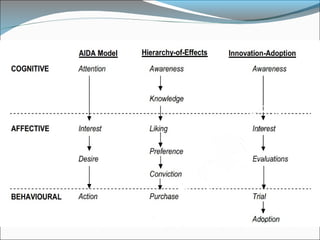
The Hierarchy Models
limitations
Ordering of stages is problematic
Consumers flow back and forth between stages before
progressing to the next stage
Consumers can be influenced by ad without paying
any attention
Measurement of advertising effectiveness is not easy
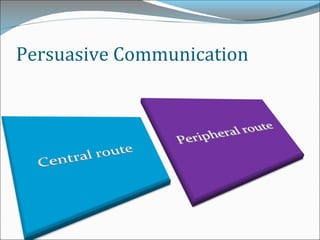
Persuasive Communication
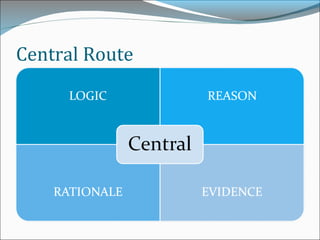
Central Route
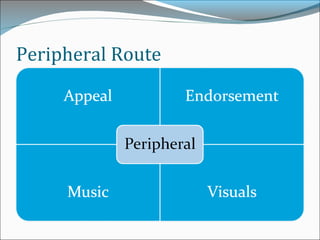
Peripheral Route
Purchase Example
Peripheral Route
peripheral Route
Example of Peripheral ADs.
E:funny indian commercial..mp4 - YouTube.m3u
Peripheral Vs Central
“Advertiser uses various stimuli which provoke desired
emotions.”
Emotional persuasion has certain advantages:
Does not raise the viewer’s natural defences.

Requires less effort from the viewer.
Emotional stimuli is more interesting.
Leads to a behaviour more quickly than a logical argument.
Peripheral Vs Central
Disadvantages of Emotional persuasion:
Emotion might distract consumer from focusing real
message.
Negative or too powerful emotions lead to misconception.
Peripheral Vs Central
Decision depends on Three Major factors:
Audience’s involvement in the purchase decision.
 The attributes of the product
 The mood of the target market.
Advertisers use different tools to arouse moods Like:
Music
Sexual Appeal
Celebrity endorsements
Mood Changer
Example:
E:Very funny Indian ad for Religare - Journey - YouTube.m
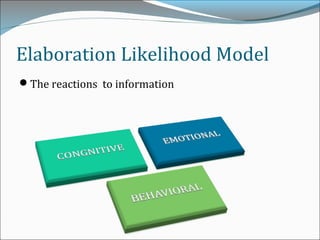
Elaboration Likelihood Model
The reactions to information
Elaboration likelihood Model
Is based on two important concepts:
Consumer’s thought process
Consumer’s involvement
Form attitudes along a continuum ranges:
 High elaboration
 Low elaboration
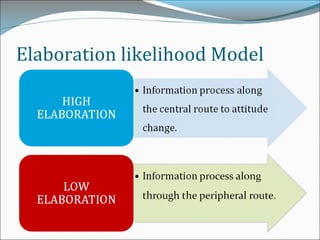
Elaboration likelihood Model
The persuasion will motivate or de- motivate
consumer to investigate the Advertisement.
Attitudes formed along the central route :
Resistant to change .
Predictive of Behavior.
Elaboration likelihood Model
Subliminal advertising
What is conscious mind ?
What is subconscious mind ?
What is subliminal advertising ?
Targeting subconscious mind
Stimulating below level of conscious awareness
TYPES OF SUBLIMINAL
ADVERTISING
Briefly presented visual stimuli.
Accelerated speech in low volume auditory messages.
Embedded or hidden imagery or words.
Principal approaches
Constant repetition of very weaker stimuli will have a
cumulative effect that builds over time
Subliminal attractive stimuli will arouse unconscious
motivations
Subliminal Messages
E:Subliminal Messages - YouTube.m3u
THE AIDA MODEL
Ad effectiveness measurement
 Identify “what advertising aims you want to achieve”????
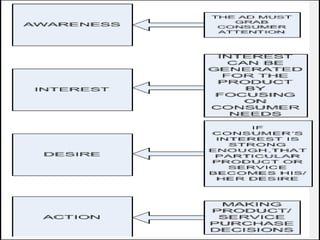
 Aida (awareness, interest, desire and action) model is used
as a framework to describe the key measures of advertising
effectiveness.
 The model is purely based on successive stages of
consumer response.
The aida model
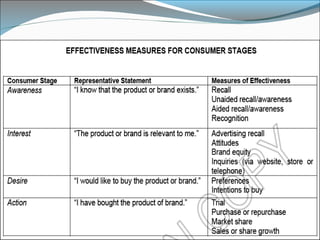
Awareness
 Following measures are used to measure effectiveness
of an ad’s ability to stimulate awareness:
A.Recall.
B.Un aided recall.
C.Aided recall.
D.Recognition.
Awareness (cont…)
 Recall measures verbal memory.
 Recognition measures visual memory.
 Most consumers have better visual memory.
 Emotional ads capture high scores on recognition as compared to
recall
Interest
 Following measures are used to measure effectiveness of
an ad’s ability to stimulate consumer’s interest:
A)Advertising recall.
B)Attitudes.
C)Brand equity.
D)Positioning.
E)Inquiries (through website,telephone or store etc.).
Interest (cont…)
 Recall can also be used to measure consumer’s interest.
 Attitudes are measures through questionnaires (attitude
scales).
 These attitudes can result in purchase intentions
 Researchs shows that both central and peripheral factors
of an ad can influence the consumer’s attitude
Interest (cont…)
 Assessment of brand equity.
 Brand equity is defined as “ differential effect of brand
knowledge on consumer response to marketing of that
brand”.
 Brand equity is a useful indicator of consumer’s interest.
Desire
 The effectiveness of an ad’s ability to stimulate desire for a
particular product or service.
 This can be measures with the help of conducting
interviews and surveys that are self-administered.
 Consumer’s intentions to buy a particular product or
service could be known through interviews and surveys.
Action
 An ad’s ability to stimulate consumer’s behavior and
actions.
 Identify your market share and sales growth in order to
measure consumer’s behavior.
 Records of purchases at retail stores or check-out points.
 Companies manage huge data-bases built to store data
related to their sales
Measuring advertising effectiveness
The work is not complete if the effectiveness of advertise is not
measured.
Most popular areas which need to be measured
 Communication effect
 Direct rating method
 Portfolio tests
 Laboratory tests
Difficulties of measurement
Measuring advertising effectiveness can be challenging
Effectiveness largely depends upon customer
themselves
Consumer’s mind is not a blank sheet
Consumers are exposed to numerous advertisements
Difficulties of measurement
An ad’s ability to break through the clutter is crucial
Customers possess conscious and unconscious
perceptions about the brand
Distinguishing the effect of particular ad on consumers
is daunting
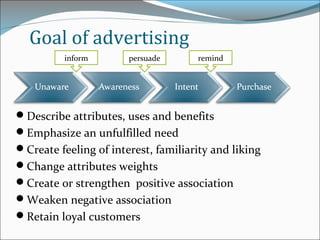
Goal of advertising
inform persuade remind
Describe attributes, uses and benefits
Emphasize an unfulfilled need
Create feeling of interest, familiarity and liking
Change attributes weights
Create or strengthen positive association
Weaken negative association
Retain loyal customers
Conclusion
Effective advertising and promotion campaigns are an
integral component of the overall marketing strategy
Should not be developed in isolation
Effective advertising and promotion campaigns begins with
a good situational analysis
Particularly a good customer analysis
Consumer should be at the forefront of all planning efforts

Imc

  • 1.
    Facilitator: Thawban AnwarBaig A Case Study presentation
  • 2.
    Background Must understand theconsumers interests and their reaction about advertisement This note presents How advertising works from a consumer point of view How consumers interpret the advertisement Advertising is a huge industry where firms invest billions of dollars
  • 3.
    Background What advertising is? Why companies advertise ? Traditional hierarchical approaches Limitations of models Elaboration of likelihood model (ELM) Subliminal advertising Issues related to measurement of advertising effectiveness
  • 4.
    What Is Advertising? Advertising means different things to different people “Advertising is any paid form of non personal communication about an organization, product, service, idea or cause by an identified sponsor”
  • 5.
    What Is Advertising? key elements of advertising Unique form of communication that is paid Delivered to an audience Has a non personal nature Non personal nature is diluted due to greater frequency of firm-customer interactions
  • 6.
    Why Companies Advertise? Companies invest in advertising due to several reasons: That target market consider the product or service for purchase To create perception in the mind of target market Aim could be to inform, persuade or remind
  • 7.
  • 8.
    limitations Ordering of stagesis problematic Consumers flow back and forth between stages before progressing to the next stage Consumers can be influenced by ad without paying any attention Measurement of advertising effectiveness is not easy
  • 9.
  • 10.
  • 11.
  • 12.
  • 13.
    peripheral Route Example ofPeripheral ADs. E:funny indian commercial..mp4 - YouTube.m3u
  • 14.
    Peripheral Vs Central “Advertiseruses various stimuli which provoke desired emotions.” Emotional persuasion has certain advantages: Does not raise the viewer’s natural defences. Requires less effort from the viewer. Emotional stimuli is more interesting. Leads to a behaviour more quickly than a logical argument.
  • 15.
    Peripheral Vs Central Disadvantagesof Emotional persuasion: Emotion might distract consumer from focusing real message. Negative or too powerful emotions lead to misconception.
  • 16.
    Peripheral Vs Central Decisiondepends on Three Major factors: Audience’s involvement in the purchase decision.  The attributes of the product  The mood of the target market. Advertisers use different tools to arouse moods Like: Music Sexual Appeal Celebrity endorsements
  • 17.
    Mood Changer Example: E:Very funnyIndian ad for Religare - Journey - YouTube.m
  • 18.
    Elaboration Likelihood Model Thereactions to information
  • 19.
    Elaboration likelihood Model Isbased on two important concepts: Consumer’s thought process Consumer’s involvement Form attitudes along a continuum ranges:  High elaboration  Low elaboration
  • 20.
  • 21.
    The persuasion willmotivate or de- motivate consumer to investigate the Advertisement. Attitudes formed along the central route : Resistant to change . Predictive of Behavior. Elaboration likelihood Model
  • 23.
    Subliminal advertising What isconscious mind ? What is subconscious mind ? What is subliminal advertising ? Targeting subconscious mind Stimulating below level of conscious awareness
  • 24.
    TYPES OF SUBLIMINAL ADVERTISING Brieflypresented visual stimuli. Accelerated speech in low volume auditory messages. Embedded or hidden imagery or words.
  • 25.
    Principal approaches Constant repetitionof very weaker stimuli will have a cumulative effect that builds over time Subliminal attractive stimuli will arouse unconscious motivations
  • 27.
  • 28.
  • 29.
    Ad effectiveness measurement Identify “what advertising aims you want to achieve”????  Aida (awareness, interest, desire and action) model is used as a framework to describe the key measures of advertising effectiveness.  The model is purely based on successive stages of consumer response.
  • 30.
  • 32.
    Awareness  Following measuresare used to measure effectiveness of an ad’s ability to stimulate awareness: A.Recall. B.Un aided recall. C.Aided recall. D.Recognition.
  • 33.
    Awareness (cont…)  Recallmeasures verbal memory.  Recognition measures visual memory.  Most consumers have better visual memory.  Emotional ads capture high scores on recognition as compared to recall
  • 34.
    Interest  Following measuresare used to measure effectiveness of an ad’s ability to stimulate consumer’s interest: A)Advertising recall. B)Attitudes. C)Brand equity. D)Positioning. E)Inquiries (through website,telephone or store etc.).
  • 35.
    Interest (cont…)  Recallcan also be used to measure consumer’s interest.  Attitudes are measures through questionnaires (attitude scales).  These attitudes can result in purchase intentions  Researchs shows that both central and peripheral factors of an ad can influence the consumer’s attitude
  • 36.
    Interest (cont…)  Assessmentof brand equity.  Brand equity is defined as “ differential effect of brand knowledge on consumer response to marketing of that brand”.  Brand equity is a useful indicator of consumer’s interest.
  • 37.
    Desire  The effectivenessof an ad’s ability to stimulate desire for a particular product or service.  This can be measures with the help of conducting interviews and surveys that are self-administered.  Consumer’s intentions to buy a particular product or service could be known through interviews and surveys.
  • 38.
    Action  An ad’sability to stimulate consumer’s behavior and actions.  Identify your market share and sales growth in order to measure consumer’s behavior.  Records of purchases at retail stores or check-out points.  Companies manage huge data-bases built to store data related to their sales
  • 41.
    Measuring advertising effectiveness Thework is not complete if the effectiveness of advertise is not measured. Most popular areas which need to be measured  Communication effect  Direct rating method  Portfolio tests  Laboratory tests
  • 43.
    Difficulties of measurement Measuringadvertising effectiveness can be challenging Effectiveness largely depends upon customer themselves Consumer’s mind is not a blank sheet Consumers are exposed to numerous advertisements
  • 44.
    Difficulties of measurement Anad’s ability to break through the clutter is crucial Customers possess conscious and unconscious perceptions about the brand Distinguishing the effect of particular ad on consumers is daunting
  • 45.
    Goal of advertising informpersuade remind Describe attributes, uses and benefits Emphasize an unfulfilled need Create feeling of interest, familiarity and liking Change attributes weights Create or strengthen positive association Weaken negative association Retain loyal customers
  • 46.
    Conclusion Effective advertising andpromotion campaigns are an integral component of the overall marketing strategy Should not be developed in isolation Effective advertising and promotion campaigns begins with a good situational analysis Particularly a good customer analysis Consumer should be at the forefront of all planning efforts