


Introduction
• This chapter builds on chapter 3 and
focuses on objects in equilibrium, ie) On
the point of moving but actually remaining
stationary

• As in chapter 3 it involves resolving forces
in different directions
• Statics is important in engineering for
calculating whether structures are stable
Statics of a Particle
y

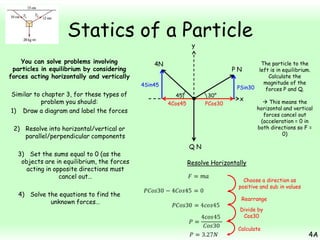
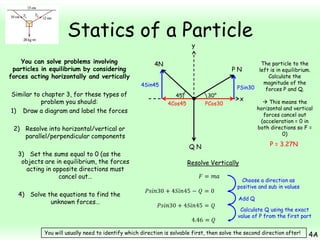
You can solve problems involving
particles in equilibrium by considering
forces acting horizontally and vertically

4N
4Sin45

Similar to chapter 3, for these types of
problem you should:
1) Draw a diagram and label the forces

45°
4Cos45

30°
PCos30

The particle to the
PN
left is in equilibrium.
Calculate the
magnitude of the
PSin30
forces P and Q.

x

2) Resolve into horizontal/vertical or
parallel/perpendicular components
3) Set the sums equal to 0 (as the
objects are in equilibrium, the forces
acting in opposite directions must
cancel out…
4) Solve the equations to find the
unknown forces…

 This means the
horizontal and vertical
forces cancel out
(acceleration = 0 in
both directions so F =
0)

QN
Resolve Horizontally
Choose a direction as
positive and sub in values
Rearrange
Divide by
Cos30
Calculate

4A
Statics of a Particle
y

You can solve problems involving
particles in equilibrium by considering
forces acting horizontally and vertically

4N
4Sin45

Similar to chapter 3, for these types of
problem you should:
1) Draw a diagram and label the forces

45°
4Cos45

30°
PCos30

The particle to the
PN
left is in equilibrium.
Calculate the
magnitude of the
PSin30
forces P and Q.

x

2) Resolve into horizontal/vertical or
parallel/perpendicular components
3) Set the sums equal to 0 (as the
objects are in equilibrium, the forces
acting in opposite directions must
cancel out…
4) Solve the equations to find the
unknown forces…

 This means the
horizontal and vertical
forces cancel out
(acceleration = 0 in
both directions so F =
0)

P = 3.27N

QN
Resolve Vertically

Choose a direction as
positive and sub in values
Add Q
Calculate Q using the exact
value of P from the first part

You will usually need to identify which direction is solvable first, then solve the second direction after!

4A
Statics of a Particle
y

You can solve problems involving
particles in equilibrium by considering
forces acting horizontally and vertically
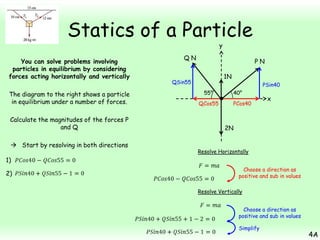
The diagram to the right shows a particle
in equilibrium under a number of forces.
Calculate the magnitudes of the forces P
and Q
 Start by resolving in both directions

QN

PN
1N

QSin55

PSin40
55°
QCos55

40°
PCos40

x

2N
Resolve Horizontally

1)
2)

Choose a direction as
positive and sub in values
Resolve Vertically
Choose a direction as
positive and sub in values
Simplify

4A
Statics of a Particle
y

You can solve problems involving
particles in equilibrium by considering
forces acting horizontally and vertically

QN

PN
1N

QSin55

PSin40
55°

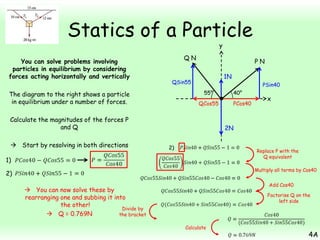
The diagram to the right shows a particle
in equilibrium under a number of forces.

QCos55

Calculate the magnitudes of the forces P
and Q
 Start by resolving in both directions

40°
PCos40

x

2N
2)

Replace P with the
Q equivalent

1)

Multiply all terms by Cos40

2)

Add Cos40

 You can now solve these by
rearranging one and subbing it into
the other!
Divide by
 Q = 0.769N
the bracket

Factorise Q on the
left side

Calculate

4A
Statics of a Particle
y

QN

You can solve problems involving
particles in equilibrium by considering
forces acting horizontally and vertically

PN
1N

QSin55

PSin40
55°

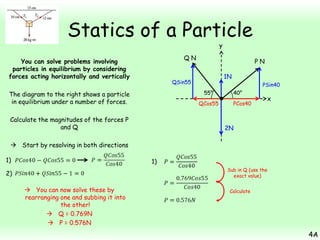
The diagram to the right shows a particle
in equilibrium under a number of forces.

QCos55

Calculate the magnitudes of the forces P
and Q

40°
PCos40

x

2N

 Start by resolving in both directions
1)

1)
Sub in Q (use the
exact value)

2)
 You can now solve these by
rearranging one and subbing it into
the other!
 Q = 0.769N
 P = 0.576N

Calculate

4A
Statics of a Particle
PN

You can solve problems involving
particles in equilibrium by considering
forces acting horizontally and vertically

θ

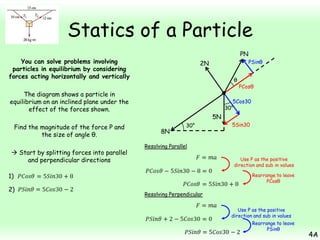
The diagram shows a particle in
equilibrium on an inclined plane under the
effect of the forces shown.
Find the magnitude of the force P and
the size of angle θ.
 Start by splitting forces into parallel
and perpendicular directions

PCosθ

5Cos30
30°

5N
8N

30°

5Sin30

Resolving Parallel
Use P as the positive
direction and sub in values

1)

2)

PSinθ

2N

Rearrange to leave
PCosθ

Resolving Perpendicular
Use P as the positive
direction and sub in values
Rearrange to leave
PSinθ

4A
Statics of a Particle
PN

You can solve problems involving
particles in equilibrium by considering
forces acting horizontally and vertically

θ

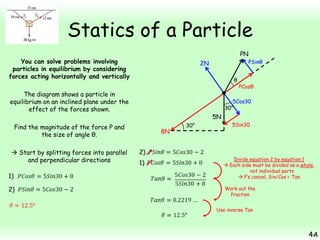
The diagram shows a particle in
equilibrium on an inclined plane under the
effect of the forces shown.

1)

2)

PCosθ

5Cos30
30°

5N

Find the magnitude of the force P and
the size of angle θ.
 Start by splitting forces into parallel
and perpendicular directions

PSinθ

2N

8N
2)
1)

30°

5Sin30

Divide equation 2 by equation 1
 Each side must be divided as a whole,
not individual parts
 P’s cancel, Sin/Cos = Tan

Work out the
fraction
Use inverse Tan

4A
Statics of a Particle
PN

You can solve problems involving
particles in equilibrium by considering
forces acting horizontally and vertically

θ

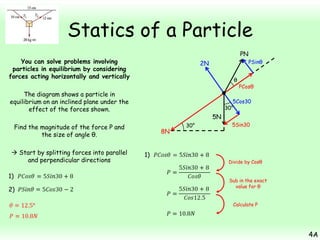
The diagram shows a particle in
equilibrium on an inclined plane under the
effect of the forces shown.

1)

2)

PCosθ

5Cos30
30°

5N

Find the magnitude of the force P and
the size of angle θ.
 Start by splitting forces into parallel
and perpendicular directions

PSinθ

2N

8N
1)

30°

5Sin30

Divide by Cosθ
Sub in the exact
value for θ
Calculate P

4A
Statics of a Particle
Q
You need to know when to include
additional forces on your diagrams,
such as weight, tension, thrust, the
normal reaction and friction
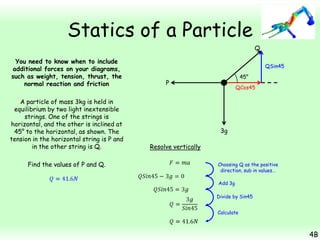
A particle of mass 3kg is held in
equilibrium by two light inextensible
strings. One of the strings is
horizontal, and the other is inclined at
45° to the horizontal, as shown. The
tension in the horizontal string is P and
in the other string is Q.
Find the values of P and Q.

QSin45
45°

P

QCos45

3g
Resolve vertically
Choosing Q as the positive
direction, sub in values…
Add 3g
Divide by Sin45
Calculate

4B
Statics of a Particle
Q
You need to know when to include
additional forces on your diagrams,
such as weight, tension, thrust, the
normal reaction and friction
A particle of mass 3kg is held in
equilibrium by two light inextensible
strings. One of the strings is
horizontal, and the other is inclined at
45° to the horizontal, as shown. The
tension in the horizontal string is P and
in the other string is Q.
Find the values of P and Q.

QSin45
45°

P

QCos45

3g
Resolve horizontally
Choosing Q as the positive
direction, sub in values…
Add P
Sub in the value of Q
from before
Calculate P

4B
Statics of a Particle
X

You need to know when to include
additional forces on your diagrams,
such as weight, tension, thrust, the
normal reaction and friction
A smooth bead, Y, is threaded on a light
inextensible string. The ends of the
string are attached to two fixed points
X and Z on the same horizontal level.
The bead is held in equilibrium by a
horizontal force of 8N acting in the
direction ZX. Bead Y hangs vertically
below X and angle XZY = 30°.
Find:
a) The tension in the string
b) The weight of the bead

Z
30°
T

T

8

Y

TSin30

30°
TCos30

Draw a diagram
 Since this is only one
string and it is
inextensible, the
tension in it will be
the same
 Call the mass m, since
we do not know it…

mg

Resolve Horizontally
Sub in values, choosing T as
the positive direction
Add 8
Divide by Cos30
Calculate

4B
Statics of a Particle
X

You need to know when to include
additional forces on your diagrams,
such as weight, tension, thrust, the
normal reaction and friction
A smooth bead, Y, is threaded on a light
inextensible string. The ends of the
string are attached to two fixed points
X and Z on the same horizontal level.
The bead is held in equilibrium by a
horizontal force of 8N acting in the
direction ZX. Bead Y hangs vertically
below X and angle XZY = 30°.
Find:
a) The tension in the string
b) The weight of the bead

Z
30°
T

T

8

Y

30°

TSin30

TCos30

Draw a diagram
 Since this is only one
string and it is
inextensible, the
tension in it will be
the same
 Call the mass m, since
we do not know it…

mg

Resolve Vertically
Sub in values, choosing T as
the positive direction
Add mg
Sub in the value of T
This is all we need!

Be careful on this type of question. If
particle is held by 2 different strings,
the tensions may be different in each!

The question asked for the weight, not the mass! (weight being mass x gravity…)

4B
Statics of a Particle
You need to know when to include
additional forces on your diagrams,
such as weight, tension, thrust, the
normal reaction and friction
A small bag of mass 10kg is attached at
C to the ends of two light inextensible
strings AC and BC. The other ends of
the strings are attached to fixed
points A and B on the same horizontal
line. The bag hangs in equilibrium with
AC and BC inclined to the horizontal at
30° and 60° respectively as shown.
Calculate:
a) The tension in AC
b) The tension in BC

A

B
Draw a diagram
T1

T1Sin30

T2
T2Sin60

30° C 60°
T1Cos30
T2Cos60

 The strings are
separate so use T1
and T2 as the
tensions

10g
Resolving Horizontally
Sub in values, choosing T2 as
the positive direction
Add T1Cos30
Divide by Cos60

4B
Statics of a Particle
You need to know when to include
additional forces on your diagrams,
such as weight, tension, thrust, the
normal reaction and friction
A small bag of mass 10kg is attached at
C to the ends of two light inextensible
strings AC and BC. The other ends of
the strings are attached to fixed
points A and B on the same horizontal
line. The bag hangs in equilibrium with
AC and BC inclined to the horizontal at
30° and 60° respectively as shown.

A

B
Draw a diagram
T1

T1Sin30

T2
T2Sin60

30° C 60°
T1Cos30
T2Cos60

Resolving Vertically

 The strings are
separate so use T1
and T2 as the
tensions

10g
Sub in values, choosing T2 as
the positive direction

Replace T2 with the
expression involving T1

Calculate:
a) The tension in AC
b) The tension in BC

Multiply all terms by Cos60
Add 10gCos60 and
factorise left side
Divide by
the bracket
Calculate!

4B
Statics of a Particle
You need to know when to include
additional forces on your diagrams,
such as weight, tension, thrust, the
normal reaction and friction
A small bag of mass 10kg is attached at
C to the ends of two light inextensible
strings AC and BC. The other ends of
the strings are attached to fixed
points A and B on the same horizontal
line. The bag hangs in equilibrium with
AC and BC inclined to the horizontal at
30° and 60° respectively as shown.
Calculate:
a) The tension in AC
b) The tension in BC

A

B
Draw a diagram
T1

T1Sin30

T2
T2Sin60

30° C 60°
T1Cos30
T2Cos60

 The strings are
separate so use T1
and T2 as the
tensions

10g
Find T2 by using the original equation…

Sub in the value of T1

Calculate!

4B
Statics of a Particle
R

You need to know when to include
additional forces on your diagrams,
such as weight, tension, thrust, the
normal reaction and friction
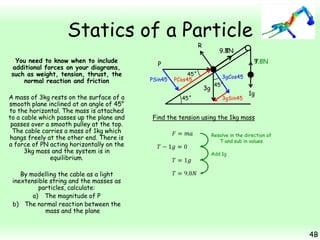
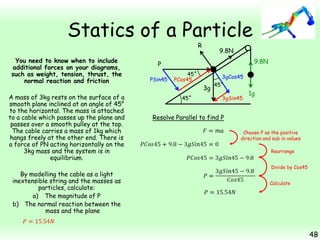
A mass of 3kg rests on the surface of a
smooth plane inclined at an angle of 45°
to the horizontal. The mass is attached
to a cable which passes up the plane and
passes over a smooth pulley at the top.
The cable carries a mass of 1kg which
hangs freely at the other end. There is
a force of PN acting horizontally on the
3kg mass and the system is in
equilibrium.

9.8N
T
T
9.8N

P
PSin45

45˚
PCos45

3gCos45

3g
45˚

45˚
3gSin45

1g

Find the tension using the 1kg mass
Resolve in the direction of
T and sub in values
Add 1g

By modelling the cable as a light
inextensible string and the masses as
particles, calculate:
a) The magnitude of P
b) The normal reaction between the
mass and the plane

4B
Statics of a Particle
R

You need to know when to include
additional forces on your diagrams,
such as weight, tension, thrust, the
normal reaction and friction
A mass of 3kg rests on the surface of a
smooth plane inclined at an angle of 45°
to the horizontal. The mass is attached
to a cable which passes up the plane and
passes over a smooth pulley at the top.
The cable carries a mass of 1kg which
hangs freely at the other end. There is
a force of PN acting horizontally on the
3kg mass and the system is in
equilibrium.
By modelling the cable as a light
inextensible string and the masses as
particles, calculate:
a) The magnitude of P
b) The normal reaction between the
mass and the plane

9.8N
9.8N

P
PSin45

45˚
PCos45

3gCos45

3g
45˚

45˚
3gSin45

1g

Resolve Parallel to find P
Choose P as the positive
direction and sub in values
Rearrange
Divide by Cos45
Calculate

4B
Statics of a Particle
R

You need to know when to include
additional forces on your diagrams,
such as weight, tension, thrust, the
normal reaction and friction
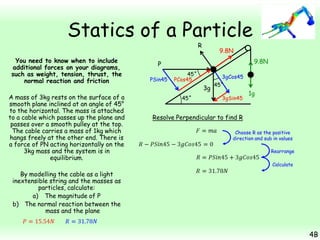
A mass of 3kg rests on the surface of a
smooth plane inclined at an angle of 45°
to the horizontal. The mass is attached
to a cable which passes up the plane and
passes over a smooth pulley at the top.
The cable carries a mass of 1kg which
hangs freely at the other end. There is
a force of PN acting horizontally on the
3kg mass and the system is in
equilibrium.

9.8N
9.8N

P
PSin45

45˚
PCos45

3gCos45

3g
45˚

45˚
3gSin45

1g

Resolve Perpendicular to find R
Choose R as the positive
direction and sub in values
Rearrange
Calculate

By modelling the cable as a light
inextensible string and the masses as
particles, calculate:
a) The magnitude of P
b) The normal reaction between the
mass and the plane

4B
Statics of a Particle
You can also solve statics problems
by using the relationship F = µR
We have seen before that FMAX is the
maximum frictional force possible
between two surfaces, and that it will
resist any force up to this amount
Remember that the frictional force
can be lower than this and still
prevent movement
In statics, FMAX is reached when a
body is in limiting equilibrium, ie) on
the point of moving

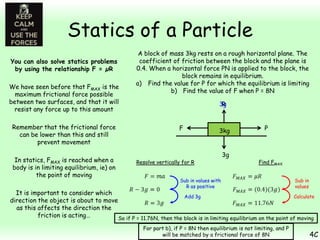
A block of mass 3kg rests on a rough horizontal plane. The
coefficient of friction between the block and the plane is
0.4. When a horizontal force PN is applied to the block, the
block remains in equilibrium.
a) Find the value for P for which the equilibrium is limiting
b) Find the value of F when P = 8N
3g
R
F

3kg

Resolve vertically for R

3g

P

Find FMAX

Sub in values with
R as positive

Sub in
values

It is important to consider which
Add 3g
Calculate
direction the object is about to move
as this affects the direction the
friction is acting…
So if P = 11.76N, then the block is in limiting equilibrium on the point of moving
For part b), if P = 8N then equilibrium is not limiting, and P
will be matched by a frictional force of 8N

4C
Statics of a Particle
You can also solve statics problems
by using the relationship F = µR
A mass of 8kg rests on a rough
horizontal plane. The mass may be
modelled as a particle, and the
coefficient of friction between the
mass and the plane is 0.5.

R
F

8kg

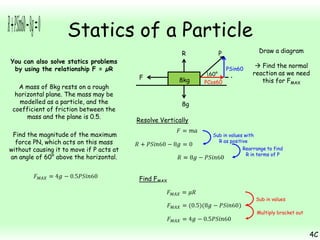
Draw a diagram

P
60°

PCos60

PSin60

 Find the normal
reaction as we need
this for FMAX

8g
Resolve Vertically

Find the magnitude of the maximum
force PN, which acts on this mass
without causing it to move if P acts at
an angle of 60° above the horizontal.

Sub in values with
R as positive
Rearrange to find
R in terms of P

Find FMAX
Sub in values
Multiply bracket out

4C
Statics of a Particle
You can also solve statics problems
by using the relationship F = µR
A mass of 8kg rests on a rough
horizontal plane. The mass may be
modelled as a particle, and the
coefficient of friction between the
mass and the plane is 0.5.
Find the magnitude of the maximum
force PN, which acts on this mass
without causing it to move if P acts at
an angle of 60° above the horizontal.

R
F

8kg
8g

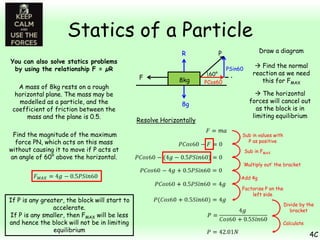
Resolve Horizontally

Draw a diagram

P
60°

PCos60

PSin60

 Find the normal
reaction as we need
this for FMAX
 The horizontal
forces will cancel out
as the block is in
limiting equilibrium

Sub in values with
P as positive
Sub in FMAX
‘Multiply out’ the bracket
Add 4g

If P is any greater, the block will start to
accelerate.
If P is any smaller, then FMAX will be less
and hence the block will not be in limiting
equilibrium

Factorise P on the
left side
Divide by the
bracket
Calculate

4C
Statics of a Particle
R

F

You can also solve statics problems
by using the relationship F = µR
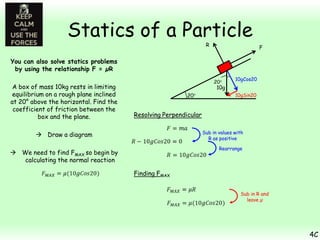
A box of mass 10kg rests in limiting
equilibrium on a rough plane inclined
at 20° above the horizontal. Find the
coefficient of friction between the
box and the plane.

10gCos20

10g
10gSin20

Resolving Perpendicular
Sub in values with
R as positive

 Draw a diagram

Rearrange

 We need to find FMAX so begin by
calculating the normal reaction
Finding FMAX

Sub in R and
leave µ

4C
Statics of a Particle
R

F

You can also solve statics problems
by using the relationship F = µR
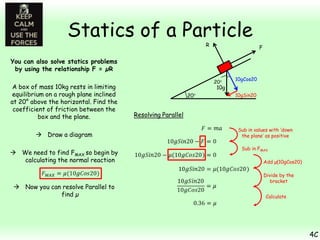
A box of mass 10kg rests in limiting
equilibrium on a rough plane inclined
at 20° above the horizontal. Find the
coefficient of friction between the
box and the plane.
 Draw a diagram
 We need to find FMAX so begin by
calculating the normal reaction

 Now you can resolve Parallel to
find µ

10gCos20

10g
10gSin20

Resolving Parallel
Sub in values with ‘down
the plane’ as positive
Sub in FMAX
Add µ(10gCos20)
Divide by the
bracket
Calculate

4C
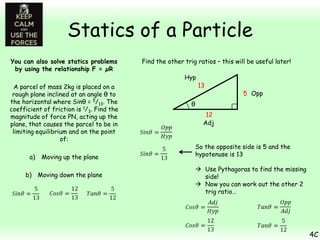
Statics of a Particle
You can also solve statics problems
by using the relationship F = µR
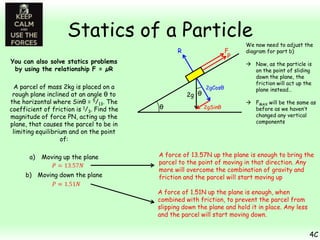
A parcel of mass 2kg is placed on a
rough plane inclined at an angle θ to
the horizontal where Sinθ = 5/13. The
coefficient of friction is 1/3. Find the
magnitude of force PN, acting up the
plane, that causes the parcel to be in
limiting equilibrium and on the point
of:
a)

Moving up the plane

b) Moving down the plane

Find the other trig ratios – this will be useful later!
Hyp

13

5 Opp

θ
12
Adj
So the opposite side is 5 and the
hypotenuse is 13
 Use Pythagoras to find the missing
side!
 Now you can work out the other 2
trig ratio…

4C
Statics of a Particle
R

P

You can also solve statics problems
by using the relationship F = µR
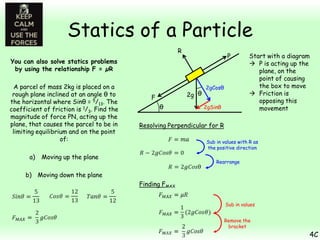
A parcel of mass 2kg is placed on a
rough plane inclined at an angle θ to
the horizontal where Sinθ = 5/13. The
coefficient of friction is 1/3. Find the
magnitude of force PN, acting up the
plane, that causes the parcel to be in
limiting equilibrium and on the point
of:
a)

2g θ

F
θ

2gCosθ
2gSinθ

Start with a diagram
 P is acting up the
plane, on the
point of causing
the box to move
 Friction is
opposing this
movement

Resolving Perpendicular for R
Sub in values with R as
the positive direction

Moving up the plane

Rearrange

b) Moving down the plane
Finding FMAX
Sub in values
Remove the
bracket

4C
Statics of a Particle
R

P

You can also solve statics problems
by using the relationship F = µR
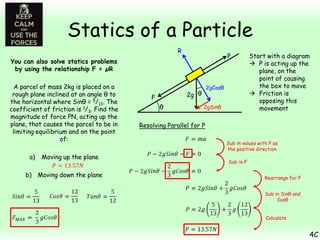
A parcel of mass 2kg is placed on a
rough plane inclined at an angle θ to
the horizontal where Sinθ = 5/13. The
coefficient of friction is 1/3. Find the
magnitude of force PN, acting up the
plane, that causes the parcel to be in
limiting equilibrium and on the point
of:
a)

Moving up the plane

b) Moving down the plane

2gCosθ

2g θ

F
θ

2gSinθ

Start with a diagram
 P is acting up the
plane, on the
point of causing
the box to move
 Friction is
opposing this
movement

Resolving Parallel for P
Sub in values with P as
the positive direction
Sub in F
Rearrange for P
Sub in Sinθ and
Cosθ
Calculate

4C
Statics of a Particle
F
P

R
You can also solve statics problems
by using the relationship F = µR
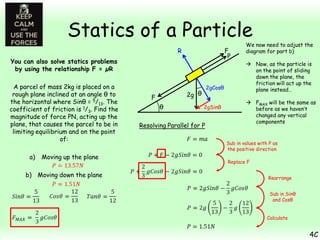
A parcel of mass 2kg is placed on a
rough plane inclined at an angle θ to
the horizontal where Sinθ = 5/13. The
coefficient of friction is 1/3. Find the
magnitude of force PN, acting up the
plane, that causes the parcel to be in
limiting equilibrium and on the point
of:
a)

Moving up the plane

b) Moving down the plane

2gCosθ

2g θ

F
θ

2gSinθ

Resolving Parallel for P

We now need to adjust the
diagram for part b)
 Now, as the particle is
on the point of sliding
down the plane, the
friction will act up the
plane instead…
 FMAX will be the same as
before as we haven’t
changed any vertical
components

Sub in values with P as
the positive direction
Replace F
Rearrange
Sub in Sinθ
and Cosθ
Calculate

4C
Statics of a Particle
F
P

R
You can also solve statics problems
by using the relationship F = µR
A parcel of mass 2kg is placed on a
rough plane inclined at an angle θ to
the horizontal where Sinθ = 5/13. The
coefficient of friction is 1/3. Find the
magnitude of force PN, acting up the
plane, that causes the parcel to be in
limiting equilibrium and on the point
of:
a)

Moving up the plane

b) Moving down the plane

2g θ
θ

2gCosθ
2gSinθ

We now need to adjust the
diagram for part b)
 Now, as the particle is
on the point of sliding
down the plane, the
friction will act up the
plane instead…
 FMAX will be the same as
before as we haven’t
changed any vertical
components

A force of 13.57N up the plane is enough to bring the
parcel to the point of moving in that direction. Any
more will overcome the combination of gravity and
friction and the parcel will start moving up

A force of 1.51N up the plane is enough, when
combined with friction, to prevent the parcel from
slipping down the plane and hold it in place. Any less
and the parcel will start moving down.

4C
Statics of a Particle
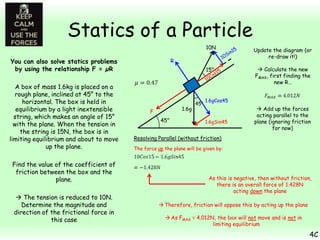
15N

You can also solve statics problems
by using the relationship F = µR
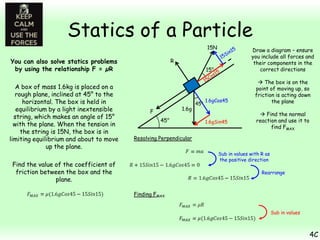
A box of mass 1.6kg is placed on a
rough plane, inclined at 45° to the
horizontal. The box is held in
equilibrium by a light inextensible
string, which makes an angle of 15°
with the plane. When the tension in
the string is 15N, the box is in
limiting equilibrium and about to move
up the plane.

Draw a diagram – ensure
you include all forces and
their components in the
correct directions

R
15°

1.6g

F
45°

45°

1.6gCos45

1.6gSin45

 The box is on the
point of moving up, so
friction is acting down
the plane
 Find the normal
reaction and use it to
find FMAX

Resolving Perpendicular
Sub in values with R as
the positive direction

Find the value of the coefficient of
friction between the box and the
plane.

Rearrange

Finding FMAX
Sub in values

4C
Statics of a Particle
15N

You can also solve statics problems
by using the relationship F = µR
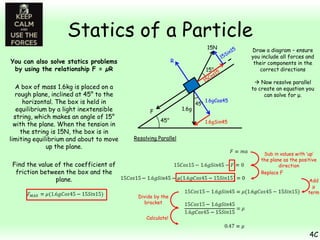
A box of mass 1.6kg is placed on a
rough plane, inclined at 45° to the
horizontal. The box is held in
equilibrium by a light inextensible
string, which makes an angle of 15°
with the plane. When the tension in
the string is 15N, the box is in
limiting equilibrium and about to move
up the plane.

R
15°

1.6g

F
45°

45°

1.6gCos45

Draw a diagram – ensure
you include all forces and
their components in the
correct directions

 Now resolve parallel
to create an equation you
can solve for μ.

1.6gSin45

Resolving Parallel
Sub in values with ‘up’
the plane as the positive
direction
Replace F

Find the value of the coefficient of
friction between the box and the
plane.
Divide by the
bracket

Add
μ
term

Calculate!

4C
Statics of a Particle
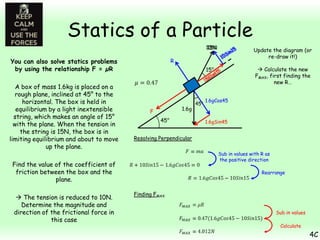
10N
15N

15°

You can also solve statics problems
by using the relationship F = µR
A box of mass 1.6kg is placed on a
rough plane, inclined at 45° to the
horizontal. The box is held in
equilibrium by a light inextensible
string, which makes an angle of 15°
with the plane. When the tension in
the string is 15N, the box is in
limiting equilibrium and about to move
up the plane.

 Calculate the new
FMAX, first finding the
new R…

R

1.6g

F
45°

45°

1.6gCos45

1.6gSin45

Resolving Perpendicular
Sub in values with R as
the positive direction

Find the value of the coefficient of
friction between the box and the
plane.
 The tension is reduced to 10N.
Determine the magnitude and
direction of the frictional force in
this case

Update the diagram (or
re-draw it!)

Rearrange

Finding FMAX
Sub in values
Calculate

4C
Statics of a Particle
10N

15°

You can also solve statics problems
by using the relationship F = µR
A box of mass 1.6kg is placed on a
rough plane, inclined at 45° to the
horizontal. The box is held in
equilibrium by a light inextensible
string, which makes an angle of 15°
with the plane. When the tension in
the string is 15N, the box is in
limiting equilibrium and about to move
up the plane.
Find the value of the coefficient of
friction between the box and the
plane.
 The tension is reduced to 10N.
Determine the magnitude and
direction of the frictional force in
this case

Update the diagram (or
re-draw it!)
 Calculate the new
FMAX, first finding the
new R…

R

1.6g

F
45°

45°

1.6gCos45

1.6gSin45

 Add up the forces
acting parallel to the
plane (ignoring friction
for now)

Resolving Parallel (without friction)
The force up the plane will be given by:

As this is negative, then without friction,
there is an overall force of 1.428N
acting down the plane
 Therefore, friction will oppose this by acting up the plane
 As FMAX = 4.012N, the box will not move and is not in
limiting equilibrium

4C
Summary
• We have learnt about resolving forces
when a particle is in limiting equilibrium
• We have seen when and how to include
additional forces such as tension and
friction

• We have looked at situations where
friction acts in different directions

statics

  • 2.
    Introduction • This chapterbuilds on chapter 3 and focuses on objects in equilibrium, ie) On the point of moving but actually remaining stationary • As in chapter 3 it involves resolving forces in different directions • Statics is important in engineering for calculating whether structures are stable
  • 4.
    Statics of aParticle y You can solve problems involving particles in equilibrium by considering forces acting horizontally and vertically 4N 4Sin45 Similar to chapter 3, for these types of problem you should: 1) Draw a diagram and label the forces 45° 4Cos45 30° PCos30 The particle to the PN left is in equilibrium. Calculate the magnitude of the PSin30 forces P and Q. x 2) Resolve into horizontal/vertical or parallel/perpendicular components 3) Set the sums equal to 0 (as the objects are in equilibrium, the forces acting in opposite directions must cancel out… 4) Solve the equations to find the unknown forces…  This means the horizontal and vertical forces cancel out (acceleration = 0 in both directions so F = 0) QN Resolve Horizontally Choose a direction as positive and sub in values Rearrange Divide by Cos30 Calculate 4A
  • 5.
    Statics of aParticle y You can solve problems involving particles in equilibrium by considering forces acting horizontally and vertically 4N 4Sin45 Similar to chapter 3, for these types of problem you should: 1) Draw a diagram and label the forces 45° 4Cos45 30° PCos30 The particle to the PN left is in equilibrium. Calculate the magnitude of the PSin30 forces P and Q. x 2) Resolve into horizontal/vertical or parallel/perpendicular components 3) Set the sums equal to 0 (as the objects are in equilibrium, the forces acting in opposite directions must cancel out… 4) Solve the equations to find the unknown forces…  This means the horizontal and vertical forces cancel out (acceleration = 0 in both directions so F = 0) P = 3.27N QN Resolve Vertically Choose a direction as positive and sub in values Add Q Calculate Q using the exact value of P from the first part You will usually need to identify which direction is solvable first, then solve the second direction after! 4A
  • 6.
    Statics of aParticle y You can solve problems involving particles in equilibrium by considering forces acting horizontally and vertically The diagram to the right shows a particle in equilibrium under a number of forces. Calculate the magnitudes of the forces P and Q  Start by resolving in both directions QN PN 1N QSin55 PSin40 55° QCos55 40° PCos40 x 2N Resolve Horizontally 1) 2) Choose a direction as positive and sub in values Resolve Vertically Choose a direction as positive and sub in values Simplify 4A
  • 7.
    Statics of aParticle y You can solve problems involving particles in equilibrium by considering forces acting horizontally and vertically QN PN 1N QSin55 PSin40 55° The diagram to the right shows a particle in equilibrium under a number of forces. QCos55 Calculate the magnitudes of the forces P and Q  Start by resolving in both directions 40° PCos40 x 2N 2) Replace P with the Q equivalent 1) Multiply all terms by Cos40 2) Add Cos40  You can now solve these by rearranging one and subbing it into the other! Divide by  Q = 0.769N the bracket Factorise Q on the left side Calculate 4A
  • 8.
    Statics of aParticle y QN You can solve problems involving particles in equilibrium by considering forces acting horizontally and vertically PN 1N QSin55 PSin40 55° The diagram to the right shows a particle in equilibrium under a number of forces. QCos55 Calculate the magnitudes of the forces P and Q 40° PCos40 x 2N  Start by resolving in both directions 1) 1) Sub in Q (use the exact value) 2)  You can now solve these by rearranging one and subbing it into the other!  Q = 0.769N  P = 0.576N Calculate 4A
  • 9.
    Statics of aParticle PN You can solve problems involving particles in equilibrium by considering forces acting horizontally and vertically θ The diagram shows a particle in equilibrium on an inclined plane under the effect of the forces shown. Find the magnitude of the force P and the size of angle θ.  Start by splitting forces into parallel and perpendicular directions PCosθ 5Cos30 30° 5N 8N 30° 5Sin30 Resolving Parallel Use P as the positive direction and sub in values 1) 2) PSinθ 2N Rearrange to leave PCosθ Resolving Perpendicular Use P as the positive direction and sub in values Rearrange to leave PSinθ 4A
  • 10.
    Statics of aParticle PN You can solve problems involving particles in equilibrium by considering forces acting horizontally and vertically θ The diagram shows a particle in equilibrium on an inclined plane under the effect of the forces shown. 1) 2) PCosθ 5Cos30 30° 5N Find the magnitude of the force P and the size of angle θ.  Start by splitting forces into parallel and perpendicular directions PSinθ 2N 8N 2) 1) 30° 5Sin30 Divide equation 2 by equation 1  Each side must be divided as a whole, not individual parts  P’s cancel, Sin/Cos = Tan Work out the fraction Use inverse Tan 4A
  • 11.
    Statics of aParticle PN You can solve problems involving particles in equilibrium by considering forces acting horizontally and vertically θ The diagram shows a particle in equilibrium on an inclined plane under the effect of the forces shown. 1) 2) PCosθ 5Cos30 30° 5N Find the magnitude of the force P and the size of angle θ.  Start by splitting forces into parallel and perpendicular directions PSinθ 2N 8N 1) 30° 5Sin30 Divide by Cosθ Sub in the exact value for θ Calculate P 4A
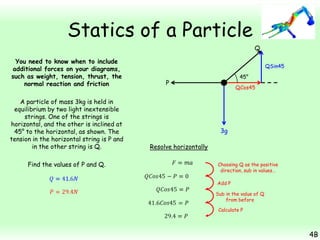
  • 13.
    Statics of aParticle Q You need to know when to include additional forces on your diagrams, such as weight, tension, thrust, the normal reaction and friction A particle of mass 3kg is held in equilibrium by two light inextensible strings. One of the strings is horizontal, and the other is inclined at 45° to the horizontal, as shown. The tension in the horizontal string is P and in the other string is Q. Find the values of P and Q. QSin45 45° P QCos45 3g Resolve vertically Choosing Q as the positive direction, sub in values… Add 3g Divide by Sin45 Calculate 4B
  • 14.
    Statics of aParticle Q You need to know when to include additional forces on your diagrams, such as weight, tension, thrust, the normal reaction and friction A particle of mass 3kg is held in equilibrium by two light inextensible strings. One of the strings is horizontal, and the other is inclined at 45° to the horizontal, as shown. The tension in the horizontal string is P and in the other string is Q. Find the values of P and Q. QSin45 45° P QCos45 3g Resolve horizontally Choosing Q as the positive direction, sub in values… Add P Sub in the value of Q from before Calculate P 4B
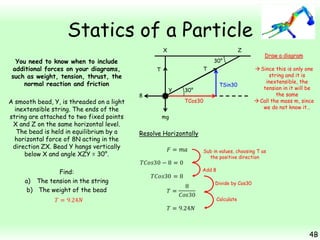
  • 15.
    Statics of aParticle X You need to know when to include additional forces on your diagrams, such as weight, tension, thrust, the normal reaction and friction A smooth bead, Y, is threaded on a light inextensible string. The ends of the string are attached to two fixed points X and Z on the same horizontal level. The bead is held in equilibrium by a horizontal force of 8N acting in the direction ZX. Bead Y hangs vertically below X and angle XZY = 30°. Find: a) The tension in the string b) The weight of the bead Z 30° T T 8 Y TSin30 30° TCos30 Draw a diagram  Since this is only one string and it is inextensible, the tension in it will be the same  Call the mass m, since we do not know it… mg Resolve Horizontally Sub in values, choosing T as the positive direction Add 8 Divide by Cos30 Calculate 4B
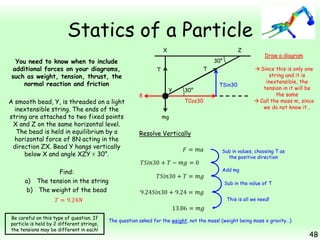
  • 16.
    Statics of aParticle X You need to know when to include additional forces on your diagrams, such as weight, tension, thrust, the normal reaction and friction A smooth bead, Y, is threaded on a light inextensible string. The ends of the string are attached to two fixed points X and Z on the same horizontal level. The bead is held in equilibrium by a horizontal force of 8N acting in the direction ZX. Bead Y hangs vertically below X and angle XZY = 30°. Find: a) The tension in the string b) The weight of the bead Z 30° T T 8 Y 30° TSin30 TCos30 Draw a diagram  Since this is only one string and it is inextensible, the tension in it will be the same  Call the mass m, since we do not know it… mg Resolve Vertically Sub in values, choosing T as the positive direction Add mg Sub in the value of T This is all we need! Be careful on this type of question. If particle is held by 2 different strings, the tensions may be different in each! The question asked for the weight, not the mass! (weight being mass x gravity…) 4B
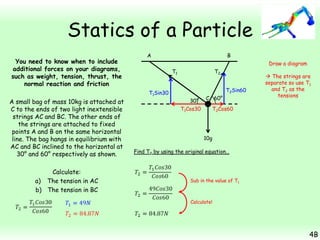
  • 17.
    Statics of aParticle You need to know when to include additional forces on your diagrams, such as weight, tension, thrust, the normal reaction and friction A small bag of mass 10kg is attached at C to the ends of two light inextensible strings AC and BC. The other ends of the strings are attached to fixed points A and B on the same horizontal line. The bag hangs in equilibrium with AC and BC inclined to the horizontal at 30° and 60° respectively as shown. Calculate: a) The tension in AC b) The tension in BC A B Draw a diagram T1 T1Sin30 T2 T2Sin60 30° C 60° T1Cos30 T2Cos60  The strings are separate so use T1 and T2 as the tensions 10g Resolving Horizontally Sub in values, choosing T2 as the positive direction Add T1Cos30 Divide by Cos60 4B
  • 18.
    Statics of aParticle You need to know when to include additional forces on your diagrams, such as weight, tension, thrust, the normal reaction and friction A small bag of mass 10kg is attached at C to the ends of two light inextensible strings AC and BC. The other ends of the strings are attached to fixed points A and B on the same horizontal line. The bag hangs in equilibrium with AC and BC inclined to the horizontal at 30° and 60° respectively as shown. A B Draw a diagram T1 T1Sin30 T2 T2Sin60 30° C 60° T1Cos30 T2Cos60 Resolving Vertically  The strings are separate so use T1 and T2 as the tensions 10g Sub in values, choosing T2 as the positive direction Replace T2 with the expression involving T1 Calculate: a) The tension in AC b) The tension in BC Multiply all terms by Cos60 Add 10gCos60 and factorise left side Divide by the bracket Calculate! 4B
  • 19.
    Statics of aParticle You need to know when to include additional forces on your diagrams, such as weight, tension, thrust, the normal reaction and friction A small bag of mass 10kg is attached at C to the ends of two light inextensible strings AC and BC. The other ends of the strings are attached to fixed points A and B on the same horizontal line. The bag hangs in equilibrium with AC and BC inclined to the horizontal at 30° and 60° respectively as shown. Calculate: a) The tension in AC b) The tension in BC A B Draw a diagram T1 T1Sin30 T2 T2Sin60 30° C 60° T1Cos30 T2Cos60  The strings are separate so use T1 and T2 as the tensions 10g Find T2 by using the original equation… Sub in the value of T1 Calculate! 4B
  • 20.
    Statics of aParticle R You need to know when to include additional forces on your diagrams, such as weight, tension, thrust, the normal reaction and friction A mass of 3kg rests on the surface of a smooth plane inclined at an angle of 45° to the horizontal. The mass is attached to a cable which passes up the plane and passes over a smooth pulley at the top. The cable carries a mass of 1kg which hangs freely at the other end. There is a force of PN acting horizontally on the 3kg mass and the system is in equilibrium. 9.8N T T 9.8N P PSin45 45˚ PCos45 3gCos45 3g 45˚ 45˚ 3gSin45 1g Find the tension using the 1kg mass Resolve in the direction of T and sub in values Add 1g By modelling the cable as a light inextensible string and the masses as particles, calculate: a) The magnitude of P b) The normal reaction between the mass and the plane 4B
  • 21.
    Statics of aParticle R You need to know when to include additional forces on your diagrams, such as weight, tension, thrust, the normal reaction and friction A mass of 3kg rests on the surface of a smooth plane inclined at an angle of 45° to the horizontal. The mass is attached to a cable which passes up the plane and passes over a smooth pulley at the top. The cable carries a mass of 1kg which hangs freely at the other end. There is a force of PN acting horizontally on the 3kg mass and the system is in equilibrium. By modelling the cable as a light inextensible string and the masses as particles, calculate: a) The magnitude of P b) The normal reaction between the mass and the plane 9.8N 9.8N P PSin45 45˚ PCos45 3gCos45 3g 45˚ 45˚ 3gSin45 1g Resolve Parallel to find P Choose P as the positive direction and sub in values Rearrange Divide by Cos45 Calculate 4B
  • 22.
    Statics of aParticle R You need to know when to include additional forces on your diagrams, such as weight, tension, thrust, the normal reaction and friction A mass of 3kg rests on the surface of a smooth plane inclined at an angle of 45° to the horizontal. The mass is attached to a cable which passes up the plane and passes over a smooth pulley at the top. The cable carries a mass of 1kg which hangs freely at the other end. There is a force of PN acting horizontally on the 3kg mass and the system is in equilibrium. 9.8N 9.8N P PSin45 45˚ PCos45 3gCos45 3g 45˚ 45˚ 3gSin45 1g Resolve Perpendicular to find R Choose R as the positive direction and sub in values Rearrange Calculate By modelling the cable as a light inextensible string and the masses as particles, calculate: a) The magnitude of P b) The normal reaction between the mass and the plane 4B
  • 24.
    Statics of aParticle You can also solve statics problems by using the relationship F = µR We have seen before that FMAX is the maximum frictional force possible between two surfaces, and that it will resist any force up to this amount Remember that the frictional force can be lower than this and still prevent movement In statics, FMAX is reached when a body is in limiting equilibrium, ie) on the point of moving A block of mass 3kg rests on a rough horizontal plane. The coefficient of friction between the block and the plane is 0.4. When a horizontal force PN is applied to the block, the block remains in equilibrium. a) Find the value for P for which the equilibrium is limiting b) Find the value of F when P = 8N 3g R F 3kg Resolve vertically for R 3g P Find FMAX Sub in values with R as positive Sub in values It is important to consider which Add 3g Calculate direction the object is about to move as this affects the direction the friction is acting… So if P = 11.76N, then the block is in limiting equilibrium on the point of moving For part b), if P = 8N then equilibrium is not limiting, and P will be matched by a frictional force of 8N 4C
  • 25.
    Statics of aParticle You can also solve statics problems by using the relationship F = µR A mass of 8kg rests on a rough horizontal plane. The mass may be modelled as a particle, and the coefficient of friction between the mass and the plane is 0.5. R F 8kg Draw a diagram P 60° PCos60 PSin60  Find the normal reaction as we need this for FMAX 8g Resolve Vertically Find the magnitude of the maximum force PN, which acts on this mass without causing it to move if P acts at an angle of 60° above the horizontal. Sub in values with R as positive Rearrange to find R in terms of P Find FMAX Sub in values Multiply bracket out 4C
  • 26.
    Statics of aParticle You can also solve statics problems by using the relationship F = µR A mass of 8kg rests on a rough horizontal plane. The mass may be modelled as a particle, and the coefficient of friction between the mass and the plane is 0.5. Find the magnitude of the maximum force PN, which acts on this mass without causing it to move if P acts at an angle of 60° above the horizontal. R F 8kg 8g Resolve Horizontally Draw a diagram P 60° PCos60 PSin60  Find the normal reaction as we need this for FMAX  The horizontal forces will cancel out as the block is in limiting equilibrium Sub in values with P as positive Sub in FMAX ‘Multiply out’ the bracket Add 4g If P is any greater, the block will start to accelerate. If P is any smaller, then FMAX will be less and hence the block will not be in limiting equilibrium Factorise P on the left side Divide by the bracket Calculate 4C
  • 27.
    Statics of aParticle R F You can also solve statics problems by using the relationship F = µR A box of mass 10kg rests in limiting equilibrium on a rough plane inclined at 20° above the horizontal. Find the coefficient of friction between the box and the plane. 10gCos20 10g 10gSin20 Resolving Perpendicular Sub in values with R as positive  Draw a diagram Rearrange  We need to find FMAX so begin by calculating the normal reaction Finding FMAX Sub in R and leave µ 4C
  • 28.
    Statics of aParticle R F You can also solve statics problems by using the relationship F = µR A box of mass 10kg rests in limiting equilibrium on a rough plane inclined at 20° above the horizontal. Find the coefficient of friction between the box and the plane.  Draw a diagram  We need to find FMAX so begin by calculating the normal reaction  Now you can resolve Parallel to find µ 10gCos20 10g 10gSin20 Resolving Parallel Sub in values with ‘down the plane’ as positive Sub in FMAX Add µ(10gCos20) Divide by the bracket Calculate 4C
  • 29.
    Statics of aParticle You can also solve statics problems by using the relationship F = µR A parcel of mass 2kg is placed on a rough plane inclined at an angle θ to the horizontal where Sinθ = 5/13. The coefficient of friction is 1/3. Find the magnitude of force PN, acting up the plane, that causes the parcel to be in limiting equilibrium and on the point of: a) Moving up the plane b) Moving down the plane Find the other trig ratios – this will be useful later! Hyp 13 5 Opp θ 12 Adj So the opposite side is 5 and the hypotenuse is 13  Use Pythagoras to find the missing side!  Now you can work out the other 2 trig ratio… 4C
  • 30.
    Statics of aParticle R P You can also solve statics problems by using the relationship F = µR A parcel of mass 2kg is placed on a rough plane inclined at an angle θ to the horizontal where Sinθ = 5/13. The coefficient of friction is 1/3. Find the magnitude of force PN, acting up the plane, that causes the parcel to be in limiting equilibrium and on the point of: a) 2g θ F θ 2gCosθ 2gSinθ Start with a diagram  P is acting up the plane, on the point of causing the box to move  Friction is opposing this movement Resolving Perpendicular for R Sub in values with R as the positive direction Moving up the plane Rearrange b) Moving down the plane Finding FMAX Sub in values Remove the bracket 4C
  • 31.
    Statics of aParticle R P You can also solve statics problems by using the relationship F = µR A parcel of mass 2kg is placed on a rough plane inclined at an angle θ to the horizontal where Sinθ = 5/13. The coefficient of friction is 1/3. Find the magnitude of force PN, acting up the plane, that causes the parcel to be in limiting equilibrium and on the point of: a) Moving up the plane b) Moving down the plane 2gCosθ 2g θ F θ 2gSinθ Start with a diagram  P is acting up the plane, on the point of causing the box to move  Friction is opposing this movement Resolving Parallel for P Sub in values with P as the positive direction Sub in F Rearrange for P Sub in Sinθ and Cosθ Calculate 4C
  • 32.
    Statics of aParticle F P R You can also solve statics problems by using the relationship F = µR A parcel of mass 2kg is placed on a rough plane inclined at an angle θ to the horizontal where Sinθ = 5/13. The coefficient of friction is 1/3. Find the magnitude of force PN, acting up the plane, that causes the parcel to be in limiting equilibrium and on the point of: a) Moving up the plane b) Moving down the plane 2gCosθ 2g θ F θ 2gSinθ Resolving Parallel for P We now need to adjust the diagram for part b)  Now, as the particle is on the point of sliding down the plane, the friction will act up the plane instead…  FMAX will be the same as before as we haven’t changed any vertical components Sub in values with P as the positive direction Replace F Rearrange Sub in Sinθ and Cosθ Calculate 4C
  • 33.
    Statics of aParticle F P R You can also solve statics problems by using the relationship F = µR A parcel of mass 2kg is placed on a rough plane inclined at an angle θ to the horizontal where Sinθ = 5/13. The coefficient of friction is 1/3. Find the magnitude of force PN, acting up the plane, that causes the parcel to be in limiting equilibrium and on the point of: a) Moving up the plane b) Moving down the plane 2g θ θ 2gCosθ 2gSinθ We now need to adjust the diagram for part b)  Now, as the particle is on the point of sliding down the plane, the friction will act up the plane instead…  FMAX will be the same as before as we haven’t changed any vertical components A force of 13.57N up the plane is enough to bring the parcel to the point of moving in that direction. Any more will overcome the combination of gravity and friction and the parcel will start moving up A force of 1.51N up the plane is enough, when combined with friction, to prevent the parcel from slipping down the plane and hold it in place. Any less and the parcel will start moving down. 4C
  • 34.
    Statics of aParticle 15N You can also solve statics problems by using the relationship F = µR A box of mass 1.6kg is placed on a rough plane, inclined at 45° to the horizontal. The box is held in equilibrium by a light inextensible string, which makes an angle of 15° with the plane. When the tension in the string is 15N, the box is in limiting equilibrium and about to move up the plane. Draw a diagram – ensure you include all forces and their components in the correct directions R 15° 1.6g F 45° 45° 1.6gCos45 1.6gSin45  The box is on the point of moving up, so friction is acting down the plane  Find the normal reaction and use it to find FMAX Resolving Perpendicular Sub in values with R as the positive direction Find the value of the coefficient of friction between the box and the plane. Rearrange Finding FMAX Sub in values 4C
  • 35.
    Statics of aParticle 15N You can also solve statics problems by using the relationship F = µR A box of mass 1.6kg is placed on a rough plane, inclined at 45° to the horizontal. The box is held in equilibrium by a light inextensible string, which makes an angle of 15° with the plane. When the tension in the string is 15N, the box is in limiting equilibrium and about to move up the plane. R 15° 1.6g F 45° 45° 1.6gCos45 Draw a diagram – ensure you include all forces and their components in the correct directions  Now resolve parallel to create an equation you can solve for μ. 1.6gSin45 Resolving Parallel Sub in values with ‘up’ the plane as the positive direction Replace F Find the value of the coefficient of friction between the box and the plane. Divide by the bracket Add μ term Calculate! 4C
  • 36.
    Statics of aParticle 10N 15N 15° You can also solve statics problems by using the relationship F = µR A box of mass 1.6kg is placed on a rough plane, inclined at 45° to the horizontal. The box is held in equilibrium by a light inextensible string, which makes an angle of 15° with the plane. When the tension in the string is 15N, the box is in limiting equilibrium and about to move up the plane.  Calculate the new FMAX, first finding the new R… R 1.6g F 45° 45° 1.6gCos45 1.6gSin45 Resolving Perpendicular Sub in values with R as the positive direction Find the value of the coefficient of friction between the box and the plane.  The tension is reduced to 10N. Determine the magnitude and direction of the frictional force in this case Update the diagram (or re-draw it!) Rearrange Finding FMAX Sub in values Calculate 4C
  • 37.
    Statics of aParticle 10N 15° You can also solve statics problems by using the relationship F = µR A box of mass 1.6kg is placed on a rough plane, inclined at 45° to the horizontal. The box is held in equilibrium by a light inextensible string, which makes an angle of 15° with the plane. When the tension in the string is 15N, the box is in limiting equilibrium and about to move up the plane. Find the value of the coefficient of friction between the box and the plane.  The tension is reduced to 10N. Determine the magnitude and direction of the frictional force in this case Update the diagram (or re-draw it!)  Calculate the new FMAX, first finding the new R… R 1.6g F 45° 45° 1.6gCos45 1.6gSin45  Add up the forces acting parallel to the plane (ignoring friction for now) Resolving Parallel (without friction) The force up the plane will be given by: As this is negative, then without friction, there is an overall force of 1.428N acting down the plane  Therefore, friction will oppose this by acting up the plane  As FMAX = 4.012N, the box will not move and is not in limiting equilibrium 4C
  • 38.
    Summary • We havelearnt about resolving forces when a particle is in limiting equilibrium • We have seen when and how to include additional forces such as tension and friction • We have looked at situations where friction acts in different directions