EQUILIBRIUM OF A PARTICLE, THE FREE-BODY
DIAGRAM & COPLANAR FORCE SYSTEMS
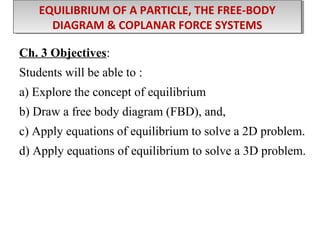
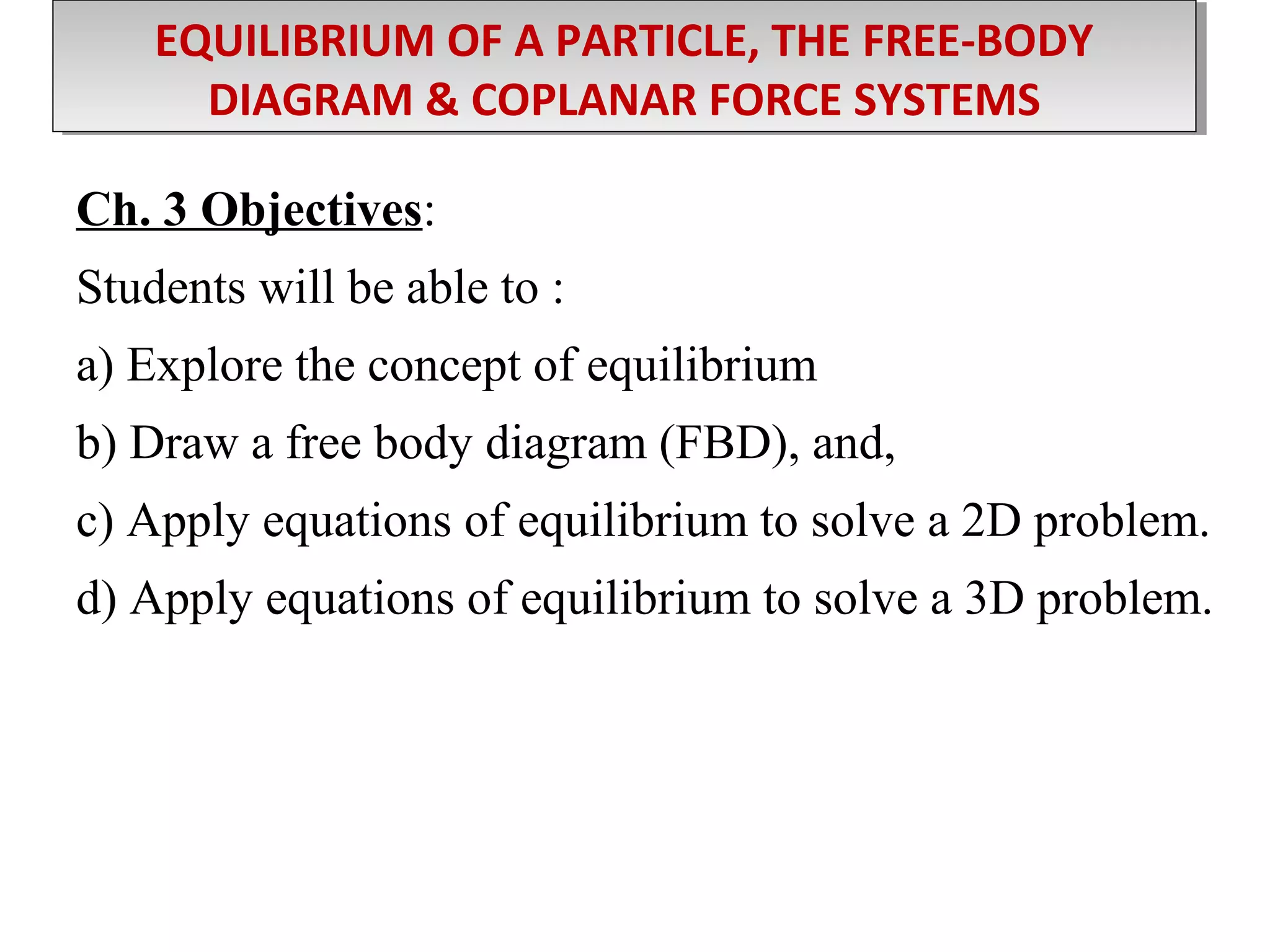
Ch. 3 Objectives:
Students will be able to :
a) Explore the concept of equilibrium
b) Draw a free body diagram (FBD), and,
c) Apply equations of equilibrium to solve a 2D problem.
d) Apply equations of equilibrium to solve a 3D problem.
EQUILIBRIUM OF A PARTICLE, THE FREE-BODY DIAGRAM &
COPLANAR FORCE SYSTEMS

Equilibrium
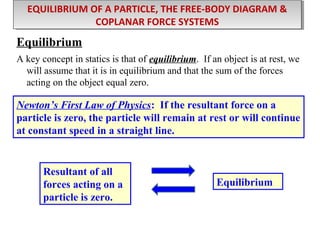
A key concept in statics is that of equilibrium. If an object is at rest, we
will assume that it is in equilibrium and that the sum of the forces
acting on the object equal zero.

Newton’s First Law of Physics: If the resultant force on a
particle is zero, the particle will remain at rest or will continue
at constant speed in a straight line.

Resultant of all
forces acting on a
particle is zero.

Equilibrium
EQUILIBRIUM OF A PARTICLE, THE FREE-BODY DIAGRAM &
COPLANAR FORCE SYSTEMS

Equilibrium
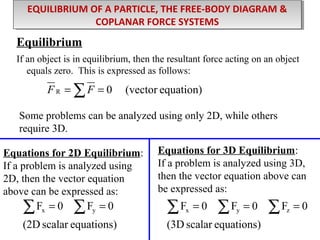
If an object is in equilibrium, then the resultant force acting on an object
equals zero. This is expressed as follows:

FR = ∑F = 0

(vector equation)

Some problems can be analyzed using only 2D, while others
require 3D.
Equations for 2D Equilibrium:
If a problem is analyzed using
2D, then the vector equation
above can be expressed as:
∑ Fx = 0 ∑ Fy = 0

(2D scalar equations)

Equations for 3D Equilibrium:
If a problem is analyzed using 3D,
then the vector equation above can
be expressed as:

∑F

x

=0

∑F

y

=0

(3D scalar equations)

∑F

z

=0
2D Equilibrium -- Applications
2D Equilibrium Applications

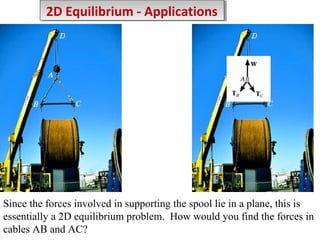
Since the forces involved in supporting the spool lie in a plane, this is
essentially a 2D equilibrium problem. How would you find the forces in
cables AB and AC?
2D Equilibrium -- Applications
2D Equilibrium Applications

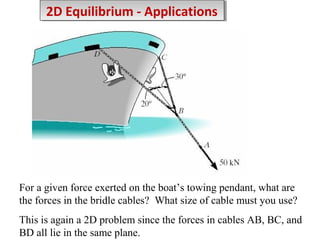
For a given force exerted on the boat’s towing pendant, what are
the forces in the bridle cables? What size of cable must you use?
This is again a 2D problem since the forces in cables AB, BC, and
BD all lie in the same plane.
3D Equilibrium -- Applications
3D Equilibrium Applications
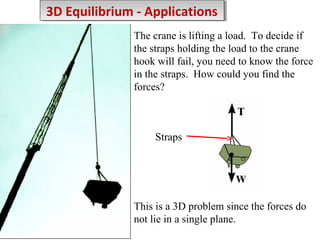
The crane is lifting a load. To decide if
the straps holding the load to the crane
hook will fail, you need to know the force
in the straps. How could you find the
forces?

Straps

This is a 3D problem since the forces do
not lie in a single plane.
3D Equilibrium -- Applications
3D Equilibrium Applications
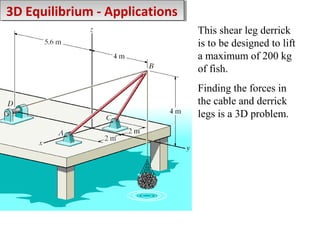
This shear leg derrick
is to be designed to lift
a maximum of 200 kg
of fish.
Finding the forces in
the cable and derrick
legs is a 3D problem.
Coplanar Force Systems (2D Equilibrium) -- (Section 3.3)
Coplanar Force Systems (2D Equilibrium) (Section 3.3)
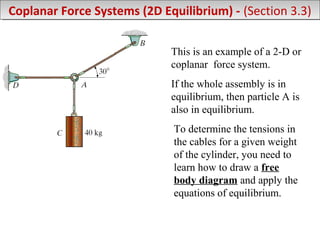
This is an example of a 2-D or
coplanar force system.
If the whole assembly is in
equilibrium, then particle A is
also in equilibrium.
To determine the tensions in
the cables for a given weight
of the cylinder, you need to
learn how to draw a free
body diagram and apply the
equations of equilibrium.
FREE BODY DIAGRAM (FBD)
Free Body Diagrams are an important part of a course in Statics as
well as other courses in mechanics (Dynamics, Mechanics of
Materials, Fluid Mechanics, etc.,)

Free Body Diagram -- A drawing that shows all
Free Body Diagram A drawing that shows all
external forces acting on the particle.
Why? -- It is key to being able to write the
Why? It is key to being able to write the
equations of equilibrium—which are used to
solve for the unknowns (usually forces or angles).
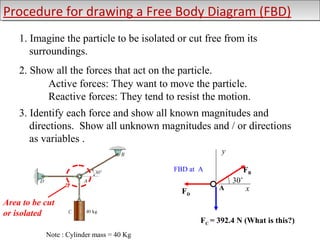
Procedure for drawing a Free Body Diagram (FBD)
1. Imagine the particle to be isolated or cut free from its
surroundings.
2. Show all the forces that act on the particle.
Active forces: They want to move the particle.
Reactive forces: They tend to resist the motion.
3. Identify each force and show all known magnitudes and
directions. Show all unknown magnitudes and / or directions
as variables .
y
FBD at A

FD A

Area to be cut
or isolated
Note : Cylinder mass = 40 Kg

FB
A

30˚

x

FC = 392.4 N (What is this?)
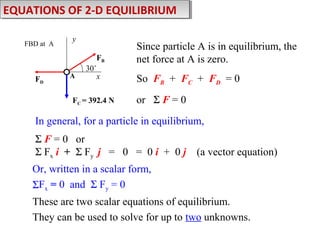
EQUATIONS OF 2-D EQUILIBRIUM
FBD at A

FD A

y

A

FB
30˚
x

A
FC = 392.4 N

Since particle A is in equilibrium, the
net force at A is zero.
So FB + FC + FD = 0
or Σ F = 0

FBD at A

In general, for a particle in equilibrium,
Σ F = 0 or
Σ Fx i + Σ Fy j = 0 = 0 i + 0 j

(a vector equation)

Or, written in a scalar form,
ΣFx = 0 and Σ Fy = 0
These are two scalar equations of equilibrium.
They can be used to solve for up to two unknowns.
EXAMPLE
EXAMPLE
FBD at A
FBD at A
FD A

y

A

30˚

FB
x

FC = 392.4 N
Note : Cylinder mass = 40 Kg

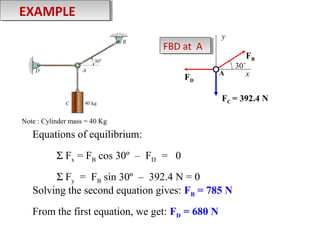
Equations of equilibrium:
Σ Fx = FB cos 30º – FD = 0
Σ Fy = FB sin 30º – 392.4 N = 0
Solving the second equation gives: FB = 785 N
From the first equation, we get: FD = 680 N
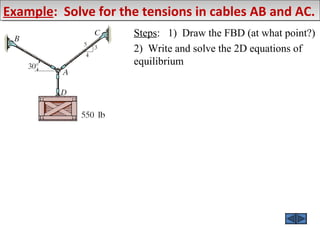
Example: Solve for the tensions in cables AB and AC.
Steps: 1) Draw the FBD (at what point?)
2) Write and solve the 2D equations of
equilibrium
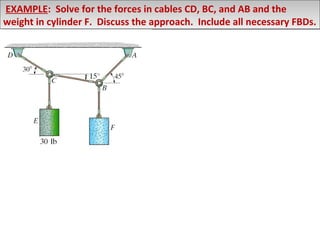
EXAMPLE: Solve for the forces in cables CD, BC, and AB and the
weight in cylinder F. Discuss the approach. Include all necessary FBDs.
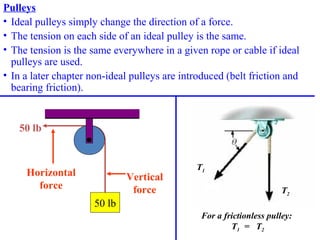
Pulleys
• Ideal pulleys simply change the direction of a force.
• The tension on each side of an ideal pulley is the same.
• The tension is the same everywhere in a given rope or cable if ideal
pulleys are used.
• In a later chapter non-ideal pulleys are introduced (belt friction and
bearing friction).

50 lb

Horizontal
force

Vertical
force
50 lb

T1
T2
T2

For a frictionless pulley:
T1 = T 2
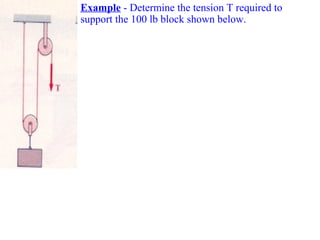
Example - Determine the tension T required to
support the 100 lb block shown below.
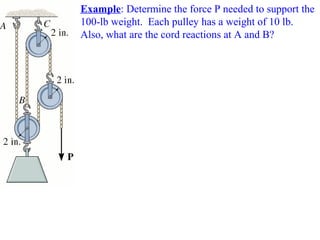
Example: Determine the force P needed to support the
100-lb weight. Each pulley has a weight of 10 lb.
Also, what are the cord reactions at A and B?
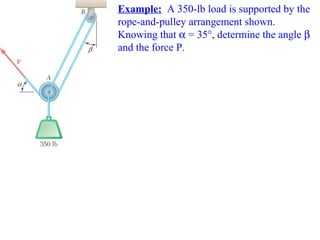
Example: A 350-lb load is supported by the
rope-and-pulley arrangement shown.
Knowing that α = 35°, determine the angle β
and the force P.
SPRINGS
SPRINGS
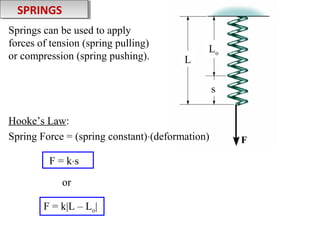
Springs can be used to apply
forces of tension (spring pulling)
or compression (spring pushing).

L

Lo
s

Hooke’s Law:
Spring Force = (spring constant)⋅(deformation)
F = k⋅s
or
F = k|L – Lo|
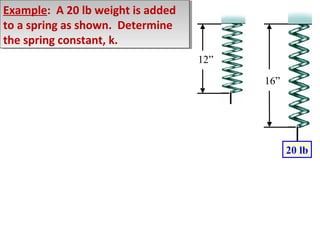
Example: A 20 lb weight is added
to a spring as shown. Determine
the spring constant, k.
12”
16”

20 lb
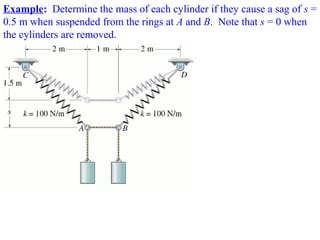
Example: Determine the mass of each cylinder if they cause a sag of s =
0.5 m when suspended from the rings at A and B. Note that s = 0 when
the cylinders are removed.
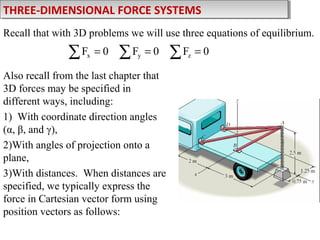
THREE-DIMENSIONAL FORCE SYSTEMS
Recall that with 3D problems we will use three equations of equilibrium.

∑F

x

=0

∑F

y

=0

Also recall from the last chapter that
3D forces may be specified in
different ways, including:
1) With coordinate direction angles
(α, β, and γ),
2)With angles of projection onto a
plane,
3)With distances. When distances are
specified, we typically express the
force in Cartesian vector form using
position vectors as follows:

∑F

z

=0
Example – 3D Equilibrium
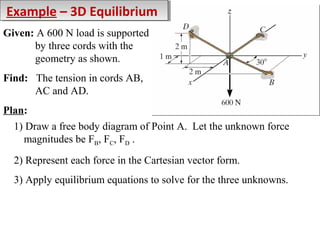
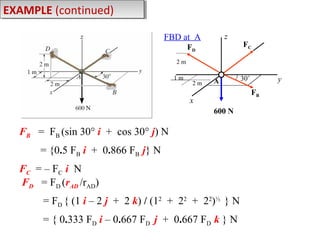
Given: A 600 N load is supported
by three cords with the
geometry as shown.
Find: The tension in cords AB,
AC and AD.
Plan:
1) Draw a free body diagram of Point A. Let the unknown force
magnitudes be FB, FC, FD .
2) Represent each force in the Cartesian vector form.
3) Apply equilibrium equations to solve for the three unknowns.
EXAMPLE (continued)
EXAMPLE (continued)
z

FBD at A
FD

FC

2m
1m

2m

A

30˚

y
FB

x
600 N

FB = FB (sin 30° i + cos 30° j) N
= {0.5 FB i + 0.866 FB j} N
FC = – FC i N
FD = FD (rAD /rAD)
= FD { (1 i – 2 j + 2 k) / (12 + 22 + 22)½ } N
= { 0.333 FD i – 0.667 FD j + 0.667 FD k } N
EXAMPLE (continued)
EXAMPLE (continued)
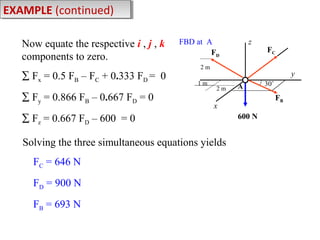
Now equate the respective i , j , k
components to zero.
∑ Fx = 0.5 FB – FC + 0.333 FD = 0
∑ Fy = 0.866 FB – 0.667 FD = 0

FBD at A
FD

1m

y
2m

FB = 693 N

A

30˚

FB

x

Solving the three simultaneous equations yields

FD = 900 N

FC

2m

∑ Fz = 0.667 FD – 600 = 0

FC = 646 N

z

600 N
Example – 3D Equilibrium
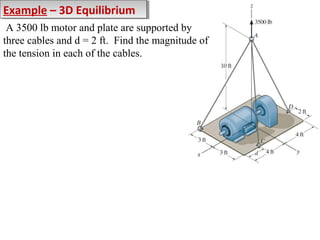
A 3500 lb motor and plate are supported by
three cables and d = 2 ft. Find the magnitude of
the tension in each of the cables.
Example – 3D Equilibrium
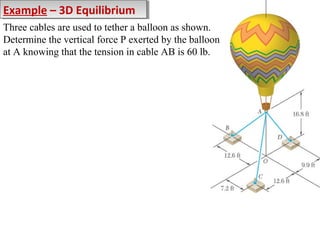
Three cables are used to tether a balloon as shown.
Determine the vertical force P exerted by the balloon
at A knowing that the tension in cable AB is 60 lb.

Ch3

  • 1.
    EQUILIBRIUM OF APARTICLE, THE FREE-BODY EQUILIBRIUM OF A PARTICLE, THE FREE-BODY DIAGRAM & COPLANAR FORCE SYSTEMS DIAGRAM & COPLANAR FORCE SYSTEMS Ch. 3 Objectives: Students will be able to : a) Explore the concept of equilibrium b) Draw a free body diagram (FBD), and, c) Apply equations of equilibrium to solve a 2D problem. d) Apply equations of equilibrium to solve a 3D problem.
  • 2.
    EQUILIBRIUM OF APARTICLE, THE FREE-BODY DIAGRAM & EQUILIBRIUM OF A PARTICLE, THE FREE-BODY DIAGRAM & COPLANAR FORCE SYSTEMS COPLANAR FORCE SYSTEMS Equilibrium A key concept in statics is that of equilibrium. If an object is at rest, we will assume that it is in equilibrium and that the sum of the forces acting on the object equal zero. Newton’s First Law of Physics: If the resultant force on a particle is zero, the particle will remain at rest or will continue at constant speed in a straight line. Resultant of all forces acting on a particle is zero. Equilibrium
  • 3.
    EQUILIBRIUM OF APARTICLE, THE FREE-BODY DIAGRAM & EQUILIBRIUM OF A PARTICLE, THE FREE-BODY DIAGRAM & COPLANAR FORCE SYSTEMS COPLANAR FORCE SYSTEMS Equilibrium If an object is in equilibrium, then the resultant force acting on an object equals zero. This is expressed as follows: FR = ∑F = 0 (vector equation) Some problems can be analyzed using only 2D, while others require 3D. Equations for 2D Equilibrium: If a problem is analyzed using 2D, then the vector equation above can be expressed as: ∑ Fx = 0 ∑ Fy = 0 (2D scalar equations) Equations for 3D Equilibrium: If a problem is analyzed using 3D, then the vector equation above can be expressed as: ∑F x =0 ∑F y =0 (3D scalar equations) ∑F z =0
  • 4.
    2D Equilibrium --Applications 2D Equilibrium Applications Since the forces involved in supporting the spool lie in a plane, this is essentially a 2D equilibrium problem. How would you find the forces in cables AB and AC?
  • 5.
    2D Equilibrium --Applications 2D Equilibrium Applications For a given force exerted on the boat’s towing pendant, what are the forces in the bridle cables? What size of cable must you use? This is again a 2D problem since the forces in cables AB, BC, and BD all lie in the same plane.
  • 6.
    3D Equilibrium --Applications 3D Equilibrium Applications The crane is lifting a load. To decide if the straps holding the load to the crane hook will fail, you need to know the force in the straps. How could you find the forces? Straps This is a 3D problem since the forces do not lie in a single plane.
  • 7.
    3D Equilibrium --Applications 3D Equilibrium Applications This shear leg derrick is to be designed to lift a maximum of 200 kg of fish. Finding the forces in the cable and derrick legs is a 3D problem.
  • 8.
    Coplanar Force Systems(2D Equilibrium) -- (Section 3.3) Coplanar Force Systems (2D Equilibrium) (Section 3.3) This is an example of a 2-D or coplanar force system. If the whole assembly is in equilibrium, then particle A is also in equilibrium. To determine the tensions in the cables for a given weight of the cylinder, you need to learn how to draw a free body diagram and apply the equations of equilibrium.
  • 9.
    FREE BODY DIAGRAM(FBD) FREE BODY DIAGRAM (FBD) Free Body Diagrams are an important part of a course in Statics as well as other courses in mechanics (Dynamics, Mechanics of Materials, Fluid Mechanics, etc.,) Free Body Diagram -- A drawing that shows all Free Body Diagram A drawing that shows all external forces acting on the particle. external forces acting on the particle. Why? -- It is key to being able to write the Why? It is key to being able to write the equations of equilibrium—which are used to equations of equilibrium—which are used to solve for the unknowns (usually forces or angles). solve for the unknowns (usually forces or angles).
  • 10.
    Procedure for drawinga Free Body Diagram (FBD) Procedure for drawing a Free Body Diagram (FBD) 1. Imagine the particle to be isolated or cut free from its surroundings. 2. Show all the forces that act on the particle. Active forces: They want to move the particle. Reactive forces: They tend to resist the motion. 3. Identify each force and show all known magnitudes and directions. Show all unknown magnitudes and / or directions as variables . y FBD at A FD A Area to be cut or isolated Note : Cylinder mass = 40 Kg FB A 30˚ x FC = 392.4 N (What is this?)
  • 11.
    EQUATIONS OF 2-DEQUILIBRIUM EQUATIONS OF 2-D EQUILIBRIUM FBD at A FD A y A FB 30˚ x A FC = 392.4 N Since particle A is in equilibrium, the net force at A is zero. So FB + FC + FD = 0 or Σ F = 0 FBD at A In general, for a particle in equilibrium, Σ F = 0 or Σ Fx i + Σ Fy j = 0 = 0 i + 0 j (a vector equation) Or, written in a scalar form, ΣFx = 0 and Σ Fy = 0 These are two scalar equations of equilibrium. They can be used to solve for up to two unknowns.
  • 12.
    EXAMPLE EXAMPLE FBD at A FBDat A FD A y A 30˚ FB x FC = 392.4 N Note : Cylinder mass = 40 Kg Equations of equilibrium: Σ Fx = FB cos 30º – FD = 0 Σ Fy = FB sin 30º – 392.4 N = 0 Solving the second equation gives: FB = 785 N From the first equation, we get: FD = 680 N
  • 13.
    Example: Solve forthe tensions in cables AB and AC. Example: Solve for the tensions in cables AB and AC. Steps: 1) Draw the FBD (at what point?) 2) Write and solve the 2D equations of equilibrium
  • 14.
    EXAMPLE: Solve forthe forces in cables CD, BC, and AB and the EXAMPLE: Solve for the forces in cables CD, BC, and AB and the weight in cylinder F. Discuss the approach. Include all necessary FBDs. weight in cylinder F. Discuss the approach. Include all necessary FBDs.
  • 15.
    Pulleys • Ideal pulleyssimply change the direction of a force. • The tension on each side of an ideal pulley is the same. • The tension is the same everywhere in a given rope or cable if ideal pulleys are used. • In a later chapter non-ideal pulleys are introduced (belt friction and bearing friction). 50 lb Horizontal force Vertical force 50 lb T1 T2 T2 For a frictionless pulley: T1 = T 2
  • 16.
    Example - Determinethe tension T required to support the 100 lb block shown below.
  • 17.
    Example: Determine theforce P needed to support the 100-lb weight. Each pulley has a weight of 10 lb. Also, what are the cord reactions at A and B?
  • 18.
    Example: A 350-lbload is supported by the rope-and-pulley arrangement shown. Knowing that α = 35°, determine the angle β and the force P.
  • 19.
    SPRINGS SPRINGS Springs can beused to apply forces of tension (spring pulling) or compression (spring pushing). L Lo s Hooke’s Law: Spring Force = (spring constant)⋅(deformation) F = k⋅s or F = k|L – Lo|
  • 20.
    Example: A 20lb weight is added Example: A 20 lb weight is added to a spring as shown. Determine to a spring as shown. Determine the spring constant, k. the spring constant, k. 12” 16” 20 lb
  • 21.
    Example: Determine themass of each cylinder if they cause a sag of s = 0.5 m when suspended from the rings at A and B. Note that s = 0 when the cylinders are removed.
  • 22.
    THREE-DIMENSIONAL FORCE SYSTEMS THREE-DIMENSIONALFORCE SYSTEMS Recall that with 3D problems we will use three equations of equilibrium. ∑F x =0 ∑F y =0 Also recall from the last chapter that 3D forces may be specified in different ways, including: 1) With coordinate direction angles (α, β, and γ), 2)With angles of projection onto a plane, 3)With distances. When distances are specified, we typically express the force in Cartesian vector form using position vectors as follows: ∑F z =0
  • 23.
    Example – 3DEquilibrium Example – 3D Equilibrium Given: A 600 N load is supported by three cords with the geometry as shown. Find: The tension in cords AB, AC and AD. Plan: 1) Draw a free body diagram of Point A. Let the unknown force magnitudes be FB, FC, FD . 2) Represent each force in the Cartesian vector form. 3) Apply equilibrium equations to solve for the three unknowns.
  • 24.
    EXAMPLE (continued) EXAMPLE (continued) z FBDat A FD FC 2m 1m 2m A 30˚ y FB x 600 N FB = FB (sin 30° i + cos 30° j) N = {0.5 FB i + 0.866 FB j} N FC = – FC i N FD = FD (rAD /rAD) = FD { (1 i – 2 j + 2 k) / (12 + 22 + 22)½ } N = { 0.333 FD i – 0.667 FD j + 0.667 FD k } N
  • 25.
    EXAMPLE (continued) EXAMPLE (continued) Nowequate the respective i , j , k components to zero. ∑ Fx = 0.5 FB – FC + 0.333 FD = 0 ∑ Fy = 0.866 FB – 0.667 FD = 0 FBD at A FD 1m y 2m FB = 693 N A 30˚ FB x Solving the three simultaneous equations yields FD = 900 N FC 2m ∑ Fz = 0.667 FD – 600 = 0 FC = 646 N z 600 N
  • 26.
    Example – 3DEquilibrium Example – 3D Equilibrium A 3500 lb motor and plate are supported by three cables and d = 2 ft. Find the magnitude of the tension in each of the cables.
  • 27.
    Example – 3DEquilibrium Example – 3D Equilibrium Three cables are used to tether a balloon as shown. Determine the vertical force P exerted by the balloon at A knowing that the tension in cable AB is 60 lb.

Editor's Notes

  • #9 Explain the following terms : Coplanar force system – The forces lie on a sheet of paper (plane). A particle – It has a mass, but a size that can be neglected. Equilibrium – A condition of rest or constant velocity.
  • #11 Mainly explain the three steps using the example .
  • #13 You may tell students that they should know how to solve linear simultaneous equations by hand and also using calculator . If they need help they can see you .
  • #15 You may ask the students to give a plan for solving. You may explain why they would analyze at E, first, and C, later
  • #16 You may ask the students to give a plan for solving. You may explain why they would analyze at E, first, and C, later