


JJ205
ENGINEERING MECHANICS
CHAPTER 3
EQUILIBRIUM OF PARTICLE
PREPARED BY:
AMRAN BIN AWANG @ MUDA
DEPARTMENT OF MECHANICAL ENGINEERING
CHAPTER OBJECTIVES
 To introduce the concept of the free-body diagram for a
particle.
 To show how to solve particle equilibrium problems using
the equations of equilibrium.
Chapter Outline
 Condition for the Equilibrium of a Particle
 The Free-Body Diagram
 Coplanar Systems
CONDITION FOR THE EQUILIBRIUM
OF A PARTICLE
Particle at equilibrium if
- At rest
-Moving at constant a constant velocity
Newton’s first law of motion
ΣF = 0
where ΣF is the vector sum of all the
forces acting on the particle
Newton’s second law of motion
ΣF = ma
When the force fulfill Newton's first law of motion,
ma = 0
a = 0
therefore, the particle is moving in constant velocity or at
rest
The Free-Body Diagram
 Best representation of all the unknownforces (ΣF)
which acts on a body
 A sketch showing the particle “free” from the
surroundings with all the forces acting on it
 Consider two common connections in this subject
 Spring
 Cables and Pulleys
Spring
 Linear elastic spring: change in length is directly
proportional to the force acting on it
 - spring constant or stiffness k:
 defines the elasticity of the spring
 - Magnitude of force when spring is elongated or
compressed
 F = ks
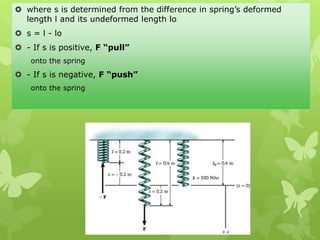
 where s is determined from the difference in spring’s deformed
length l and its undeformed length lo
 s = l - lo
 - If s is positive, F “pull”
onto the spring
 - If s is negative, F “push”
onto the spring
EXAMPLE
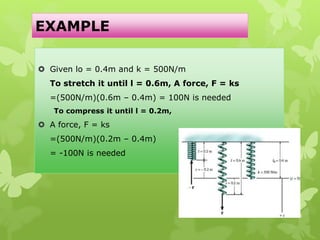
 Given lo = 0.4m and k = 500N/m
To stretch it until l = 0.6m, A force, F = ks
=(500N/m)(0.6m – 0.4m) = 100N is needed
To compress it until l = 0.2m,
 A force, F = ks
=(500N/m)(0.2m – 0.4m)
= -100N is needed
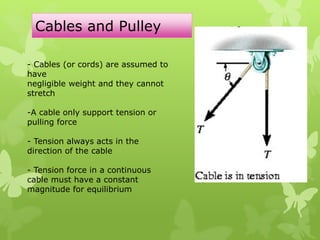
- Cables (or cords) are assumed to
have
negligible weight and they cannot
stretch
-A cable only support tension or
pulling force
- Tension always acts in the
direction of the cable
- Tension force in a continuous
cable must have a constant
magnitude for equilibrium
Cables and Pulley
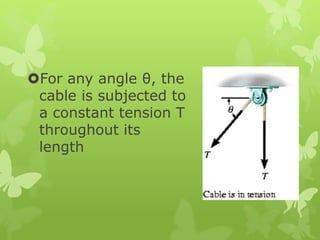
For any angle θ, the
cable is subjected to
a constant tension T
throughout its
length
1. Draw outlined shape
• Isolate particle from its surroundings
2. Show all the forces
• Indicate all the forces
• active forces: set the particle in motion
• Reactive forces: result of constraints and
supports that tend to prevent motion
Procedure for Drawing a
FBD
3. Identify each forces
 - Known forces should be labeled with proper magnitude
and direction
 - Letters are used to represent magnitude and directions
of unknown forces
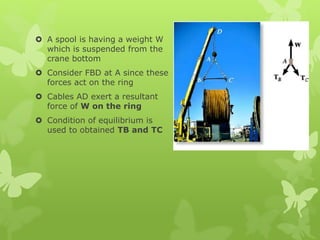
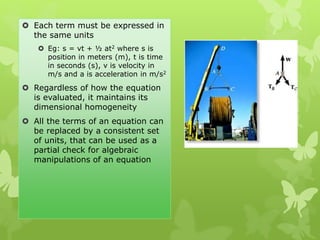
 A spool is having a weight W
which is suspended from the
crane bottom
 Consider FBD at A since these
forces act on the ring
 Cables AD exert a resultant
force of W on the ring
 Condition of equilibrium is
used to obtained TB and TC
 Each term must be expressed in
the same units
 Eg: s = vt + ½ at2 where s is
position in meters (m), t is time
in seconds (s), v is velocity in
m/s and a is acceleration in m/s2
 Regardless of how the equation
is evaluated, it maintains its
dimensional homogeneity
 All the terms of an equation can
be replaced by a consistent set
of units, that can be used as a
partial check for algebraic
manipulations of an equation
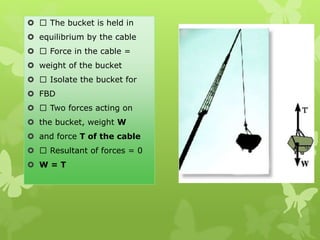
 The bucket is held in
 equilibrium by the cable
 Force in the cable =
 weight of the bucket
 Isolate the bucket for
 FBD
 Two forces acting on
 the bucket, weight W
 and force T of the cable
 Resultant of forces = 0
 W = T
Example 3.1
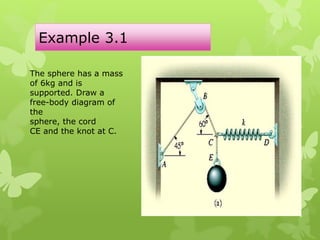
The sphere has a mass
of 6kg and is
supported. Draw a
free-body diagram of
the
sphere, the cord
CE and the knot at C.
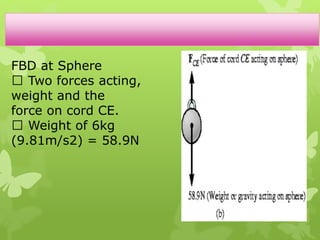
FBD at Sphere
Two forces acting,
weight and the
force on cord CE.
Weight of 6kg
(9.81m/s2) = 58.9N
Solution
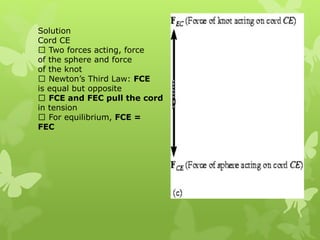
Cord CE
Two forces acting, force
of the sphere and force
of the knot
Newton’s Third Law: FCE
is equal but opposite
FCE and FEC pull the cord
in tension
For equilibrium, FCE =
FEC
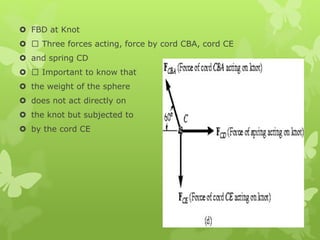
 FBD at Knot
 Three forces acting, force by cord CBA, cord CE
 and spring CD
 Important to know that
 the weight of the sphere
 does not act directly on
 the knot but subjected to
 by the cord CE
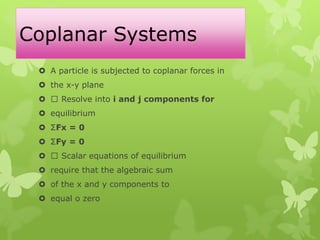
Coplanar Systems
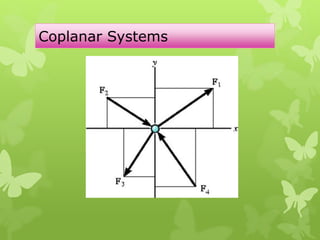
 A particle is subjected to coplanar forces in
 the x-y plane
 Resolve into i and j components for
 equilibrium
 ΣFx = 0
 ΣFy = 0
 Scalar equations of equilibrium
 require that the algebraic sum
 of the x and y components to
 equal o zero
Coplanar Systems
Scalar Notation
 Sense of direction = an algebraic sign that corresponds
to the arrowhead direction of the component along each
axis
 For unknown magnitude, assume arrowhead sense of
the force
 Since magnitude of the force is always positive, if the
scalar is negative, the force is acting in the opposite
direction
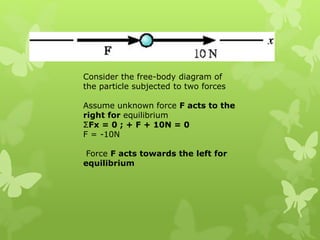
Consider the free-body diagram of
the particle subjected to two forces
Assume unknown force F acts to the
right for equilibrium
ΣFx = 0 ; + F + 10N = 0
F = -10N
Force F acts towards the left for
equilibrium
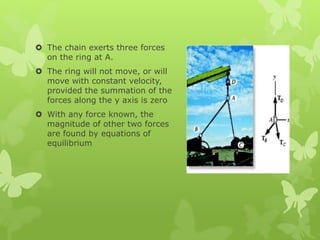
 The chain exerts three forces
on the ring at A.
 The ring will not move, or will
move with constant velocity,
provided the summation of the
forces along the y axis is zero
 With any force known, the
magnitude of other two forces
are found by equations of
equilibrium
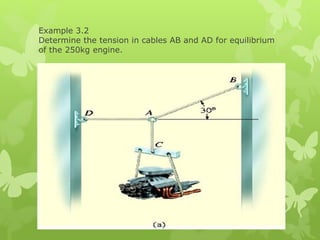
Example 3.2
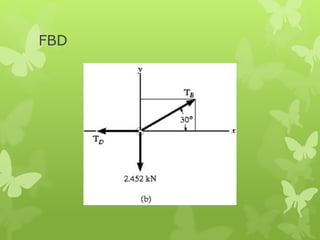
Determine the tension in cables AB and AD for equilibrium
of the 250kg engine.
FBD
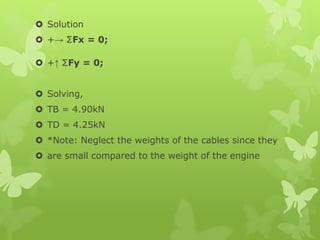
 Solution
 +→ ΣFx = 0;
 +↑ ΣFy = 0;
 Solving,
 TB = 4.90kN
 TD = 4.25kN
 *Note: Neglect the weights of the cables since they
 are small compared to the weight of the engine
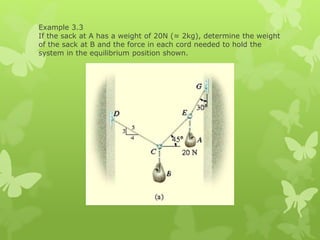
Example 3.3
If the sack at A has a weight of 20N (≈ 2kg), determine the weight
of the sack at B and the force in each cord needed to hold the
system in the equilibrium position shown.
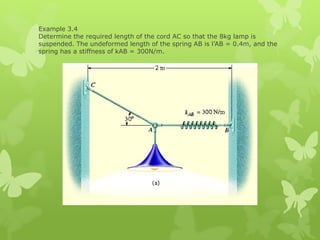
Example 3.4
Determine the required length of the cord AC so that the 8kg lamp is
suspended. The undeformed length of the spring AB is l’AB = 0.4m, and the
spring has a stiffness of kAB = 300N/m.
Chapter Summary
Two Dimensional
 Two scalars equations ΣFx = 0 and ΣFy =
 0 is applied to x, y coordinate system
 If the solution is negative, the sense of
 the force is opposite to that shown on
 the FBD.
 If problem involves a linear spring,
 stretch or compression can be related to
 force by
 F = ks

Mechanic Machine

  • 1.
    JJ205 ENGINEERING MECHANICS CHAPTER 3 EQUILIBRIUMOF PARTICLE PREPARED BY: AMRAN BIN AWANG @ MUDA DEPARTMENT OF MECHANICAL ENGINEERING
  • 2.
    CHAPTER OBJECTIVES  Tointroduce the concept of the free-body diagram for a particle.  To show how to solve particle equilibrium problems using the equations of equilibrium.
  • 3.
    Chapter Outline  Conditionfor the Equilibrium of a Particle  The Free-Body Diagram  Coplanar Systems
  • 4.
    CONDITION FOR THEEQUILIBRIUM OF A PARTICLE Particle at equilibrium if - At rest -Moving at constant a constant velocity Newton’s first law of motion ΣF = 0 where ΣF is the vector sum of all the forces acting on the particle
  • 5.
    Newton’s second lawof motion ΣF = ma When the force fulfill Newton's first law of motion, ma = 0 a = 0 therefore, the particle is moving in constant velocity or at rest
  • 6.
    The Free-Body Diagram Best representation of all the unknownforces (ΣF) which acts on a body  A sketch showing the particle “free” from the surroundings with all the forces acting on it  Consider two common connections in this subject  Spring  Cables and Pulleys
  • 7.
    Spring  Linear elasticspring: change in length is directly proportional to the force acting on it  - spring constant or stiffness k:  defines the elasticity of the spring  - Magnitude of force when spring is elongated or compressed  F = ks
  • 8.
     where sis determined from the difference in spring’s deformed length l and its undeformed length lo  s = l - lo  - If s is positive, F “pull” onto the spring  - If s is negative, F “push” onto the spring
  • 9.
    EXAMPLE  Given lo= 0.4m and k = 500N/m To stretch it until l = 0.6m, A force, F = ks =(500N/m)(0.6m – 0.4m) = 100N is needed To compress it until l = 0.2m,  A force, F = ks =(500N/m)(0.2m – 0.4m) = -100N is needed
  • 10.
    - Cables (orcords) are assumed to have negligible weight and they cannot stretch -A cable only support tension or pulling force - Tension always acts in the direction of the cable - Tension force in a continuous cable must have a constant magnitude for equilibrium Cables and Pulley
  • 11.
    For any angleθ, the cable is subjected to a constant tension T throughout its length
  • 12.
    1. Draw outlinedshape • Isolate particle from its surroundings 2. Show all the forces • Indicate all the forces • active forces: set the particle in motion • Reactive forces: result of constraints and supports that tend to prevent motion Procedure for Drawing a FBD
  • 13.
    3. Identify eachforces  - Known forces should be labeled with proper magnitude and direction  - Letters are used to represent magnitude and directions of unknown forces
  • 14.
     A spoolis having a weight W which is suspended from the crane bottom  Consider FBD at A since these forces act on the ring  Cables AD exert a resultant force of W on the ring  Condition of equilibrium is used to obtained TB and TC
  • 15.
     Each termmust be expressed in the same units  Eg: s = vt + ½ at2 where s is position in meters (m), t is time in seconds (s), v is velocity in m/s and a is acceleration in m/s2  Regardless of how the equation is evaluated, it maintains its dimensional homogeneity  All the terms of an equation can be replaced by a consistent set of units, that can be used as a partial check for algebraic manipulations of an equation
  • 16.
     The bucketis held in  equilibrium by the cable  Force in the cable =  weight of the bucket  Isolate the bucket for  FBD  Two forces acting on  the bucket, weight W  and force T of the cable  Resultant of forces = 0  W = T
  • 17.
    Example 3.1 The spherehas a mass of 6kg and is supported. Draw a free-body diagram of the sphere, the cord CE and the knot at C.
  • 18.
    FBD at Sphere Twoforces acting, weight and the force on cord CE. Weight of 6kg (9.81m/s2) = 58.9N
  • 19.
    Solution Cord CE Two forcesacting, force of the sphere and force of the knot Newton’s Third Law: FCE is equal but opposite FCE and FEC pull the cord in tension For equilibrium, FCE = FEC
  • 20.
     FBD atKnot  Three forces acting, force by cord CBA, cord CE  and spring CD  Important to know that  the weight of the sphere  does not act directly on  the knot but subjected to  by the cord CE
  • 21.
    Coplanar Systems  Aparticle is subjected to coplanar forces in  the x-y plane  Resolve into i and j components for  equilibrium  ΣFx = 0  ΣFy = 0  Scalar equations of equilibrium  require that the algebraic sum  of the x and y components to  equal o zero
  • 22.
  • 23.
    Scalar Notation  Senseof direction = an algebraic sign that corresponds to the arrowhead direction of the component along each axis  For unknown magnitude, assume arrowhead sense of the force  Since magnitude of the force is always positive, if the scalar is negative, the force is acting in the opposite direction
  • 24.
    Consider the free-bodydiagram of the particle subjected to two forces Assume unknown force F acts to the right for equilibrium ΣFx = 0 ; + F + 10N = 0 F = -10N Force F acts towards the left for equilibrium
  • 25.
     The chainexerts three forces on the ring at A.  The ring will not move, or will move with constant velocity, provided the summation of the forces along the y axis is zero  With any force known, the magnitude of other two forces are found by equations of equilibrium
  • 26.
    Example 3.2 Determine thetension in cables AB and AD for equilibrium of the 250kg engine.
  • 27.
  • 28.
     Solution  +→ΣFx = 0;  +↑ ΣFy = 0;  Solving,  TB = 4.90kN  TD = 4.25kN  *Note: Neglect the weights of the cables since they  are small compared to the weight of the engine
  • 29.
    Example 3.3 If thesack at A has a weight of 20N (≈ 2kg), determine the weight of the sack at B and the force in each cord needed to hold the system in the equilibrium position shown.
  • 30.
    Example 3.4 Determine therequired length of the cord AC so that the 8kg lamp is suspended. The undeformed length of the spring AB is l’AB = 0.4m, and the spring has a stiffness of kAB = 300N/m.
  • 31.
    Chapter Summary Two Dimensional Two scalars equations ΣFx = 0 and ΣFy =  0 is applied to x, y coordinate system  If the solution is negative, the sense of  the force is opposite to that shown on  the FBD.  If problem involves a linear spring,  stretch or compression can be related to  force by  F = ks