Engineering Mechanics: Statics
FifteenthEdition
Chapter 3
Equilibrium of a Particle
Section 3.1 Condition for the
Equilibrium of a Particle
Section 3.2 The Free-Body
Diagram
Section 3.3 Coplanar Force
Systems
2.
Equilibrium of AParticle, The Free-
body Diagram & Coplanar Force
Systems
Objectives:
a. Draw a free body diagram
(FBD)
b. Apply equations of equilibrium
to solve a 2-D problem.
3.
Reading Quiz (1of 2)
1. When a particle is in equilibrium, the sum of forces acting
on it equals ______ . (Choose the most appropriate
answer)
A. A constant
B. A positive number
C. Zero
D. A negative number
E. An integer
4.
Reading Quiz (2of 2)
2. For a frictionless pulley and cable, tensions in the cable
(T1 and T2) are related as _______.
A.
1 2
T T
B.
1 2
T T
C.
1 2
T T
D. 1 2
T T sin
5.
Applications (1 of3)
The crane is lifting a load. To decide if the straps holding the
load to the crane hook will fail, you need to know forces in the
straps. How could you find those forces?
6.
Applications (2 of3)
For a spool of given weight, how would you find the forces in
cables AB and AC? If designing a spreader bar like the one
being used here, you need to know the forces to make sure the
rigging doesn’t fail.
7.
Applications (3 of3)
For a given force exerted on the boat’s towing pendant, what
are the forces in the bridle cables? What size of cable must
you use?
8.
Section 3.3: CoplanarForce Systems
This is an example of a 2-D or
coplanar force system.
If the whole assembly is in
equilibrium, then particle A is
also in equilibrium.
To determine the tensions in
the cables for a given weight of
cylinder, you need to learn how
to draw a free-body diagram
and apply the equations of
equilibrium.
9.
The What, Whyand How of A Free
Body Diagram (FB D) (1 Of 2)
Free-body diagrams are one of the most important things
for you to know how to draw and use for statics!
What? - It is a drawing (sketch) that shows all external forces
acting on the particle (or body).
Why? - It is key to being able to write the equations of
equilibrium—which are used to solve for the unknowns (usually
forces or angles).
10.
The What, Whyand How of A Free
Body Diagram (FBD) (2 of 2)
How?
1. Imagine the particle to be isolated
(or cut free) from its surroundings.
2. Show all the forces that act on
the particle.
Active forces: They want to move
the particle.
Reactive forces: They tend to
resist the motion.
3. Identify each force and show
all known magnitudes and
directions. Show all unknown
magnitudes and / or directions as
variables Note: Given cylinder mass = 40Kg
11.
Equations of 2-DEquilibrium (1 of 2)
Particle A is in equilibrium, therefore the net force at A is zero.
So 0
B C D
F F F
or
0
F
In general, for a particle in
equilibrium,
0 or
F
X y
F F 0 0 0
i j i j (a vector equation)
Or, written in a scalar form,
X Y
F 0 and F 0
These are two scalar equations of equilibrium (E-of-E). They can be used
to solve for up to two unknowns.
12.
Equations of 2-DEquilibrium (2 of 2)
Write the scalar E-of-E:
o
X B D
F F cos 30 F 0
o
Y B
F F Sin30 392.4N 0
Solving the second equation gives:
B
F 785N
From the first equation, we get:
D
F 680N
Question: Suppose you chose the opposite direction for ?
How does this change the answer?
Cables and Pulleys
Witha frictionless pulley and cable
1 2
T T
Cable can support only a tension or “pulling” force, and this
force always acts in the direction of the cable.
Cable is in tension
15.
Smooth Contact
If anobject rests on a smooth
surface, then the surface will exert a
force on the object that is normal to
the surface at the point of contact.
In addition to this normal force N, the
cylinder is also subjected to its weight
W and the force T of the cord.
Since these three forces are concurrent
at the center of the cylinder, we can
apply the equation of equilibrium to this
“particle,” which is the same as
applying it to the cylinder.
16.
Example I (1of 2)
Given: The box weighs 550 lb and
geometry is as shown.
Find: The forces in the ropes AB
and AC.
Plan:
1. Draw a FB D for point A.
2. Apply the E-of-E to solve for the
forces in ropes AB and AC.
17.
Example I (2of 2)
Applying the scalar E-of-E at A, we get;
o
X B C
4
F F cos30 F 0
5
o
Y B C
3
F F sin30 F 550 lb 0
5
Solving the above equations, we get;
𝑭 𝑩=𝟒𝟕𝟖 𝒍𝒃 𝑭 𝑪=𝟓𝟏𝟖𝒍𝒃
18.
Example Ⅱ (1of 2)
Given: The mass of cylinder C
is 40 kgrand geometry
is as shown.
Find: The tensions in cables D
E, EA, and E B.
Plan:
1. Draw a FBD for point E.
2. Apply the E-of-E to solve for the forces
in cables DE, EA, and EB.
What are the implied assumptions?
19.
Example Ⅱ (2of 2)
Applying the scalar E-of-E at E, we get;
+→ ∑ 𝐹 𝑥=− T ED + ¿
+ ↑ ∑ 𝐹 𝑦 =¿
Solving the above equations, we get;
TED=340 N ←∧TEA=196 N ↓
20.
Concept Quiz
1. Assumingyou know the geometry of the ropes, in which
system above can you NO T determine forces in the
cables?
2. Why?
A. The weight is too heavy.
B. The cables are too thin.
C. There are more unknowns than equations.
D. There are too few cables for a 1000 lb weight.
21.
Group Problem Solving(1 of 3)
Given: The mass of lamp is 20kgr
and geometry is as shown.
Find: The force in each cable.
Plan:
1. Draw a FB D for Point D.
2. Apply E-of-E at Point D to solve for the unknowns (FCD & FDE).
3. Knowing FCD, repeat this process at point C.
22.
Group Problem Solving(2 of 3)
Applying the scalar E-of-E at D, we get;
o
Y DE
F F sin30 20 9.81 0
o
X DE CD
F F cos30 F 0
Solving the above equations, we get:
and
𝑭 𝑫𝑬=𝟑𝟗𝟐 𝑵 𝑭 𝑪𝑫=𝟑𝟒𝟎 𝑵
23.
Group Problem Solving(3 of 3)
Applying the scalar E-of-E at C, we get;
o
X BC AC
3
F 340 F sin45 F 0
5
o
Y AC BC
4
F F F cos 45 0
5
Solving the above equations, we get;
and
𝑭𝑩𝑪=𝟐𝟕𝟓 𝑵 𝑭 𝑨𝑪=𝟐𝟒𝟑𝑵
24.
Attention Quiz (1of 2)
1. Select the correct FB D of particle A.
A. B.
C. D.
25.
Attention Quiz (2of 2)
2. Using this FBD of Point C, the sum of forces in the x-direction
X
F
Is ______.
Use a sign convention of + .
A.
o
2
F sin50 20 0
B. o
2
F cos50 20 0
C.
o
2 1
F sin50 F 0
D.
o
2
F cos50 20 0
Reading Quiz (1of 1)
1. Particle P is in equilibrium with five (5) forces acting on it in
3-D space. How many scalar equations of equilibrium can
be written for point P?
A. 2
B. 3
C. 4
D. 5
E. 6
28.
Applications (1 of1)
You know the weight of the electromagnet and its load.
You need to know the forces in the chains to see if it is a safe
assembly. How would you do this?
29.
The Equations of3-D Equilibrium (1 of 2)
When a particle is in equilibrium, the
vector sum of all the forces acting on it
must be zero
This equation can be written in terms of its
x, y and z components.
∑Fx i+∑Fy j+∑Fz k=0
30.
The Equations of3-D Equilibrium (2 of 2)
This vector equation will be satisfied only when
These equations are the three scalar equations of equilibrium. They are
valid for any point in equilibrium and allow you to solve for up to three
unknowns.
31.
Example I (1of 3)
Given: The four forces and geometry
shown.
Find: The tension developed in cables
AB, AC, and AD.
Plan:
1. Draw a FBD of particle A.
2. Write the unknown cable forces TB, TC , and TD in Cartesian
vector form.
3. Apply the three equilibrium equations to solve for the
tension in cables.
32.
Example I (2of 3)
Solution:
TD=T D(−0.5i−0.5 j+0.7071k)
W =−300 k
TD=T D cos120°i+TD cos120° j+TD cos 45°k
In component form, the forces are:
33.
Example Ⅰ (3of 3)
Applying equilibrium equations:
Equating the respective i, j, k components to zero, we have
Using equations for and ,
we can determine
Substituting TC and TD into , we find
34.
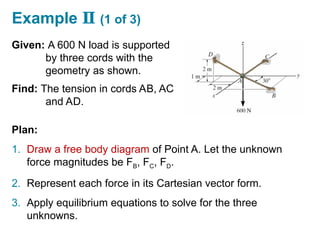
Example Ⅱ (1of 3)
Given: A 600 N load is supported
by three cords with the
geometry as shown.
Find: The tension in cords AB, AC
and AD.
Plan:
1. Draw a free body diagram of Point A. Let the unknown
force magnitudes be FB, FC, FD.
2. Represent each force in its Cartesian vector form.
3. Apply equilibrium equations to solve for the three
unknowns.
Example Ⅱ (3of 3)
Now equate the respective i, j, and k
components to zero.
Solving the three simultaneous equations
yields
FC=646 N (since it is positive, it is as assumed, e.g., in tension)
FD =900 N
FB=693 N
∑ Fx =0.5 FB – FC +0.333 FD=0
∑ F y=0.866 FB – 0.667 FD=0
∑ Fz =0 .667 F D – 600=0
37.
Concept Quiz (1of 2)
1. In 3-D, when you know the direction of a force but not its
magnitude, how many unknowns corresponding to that
force remain?
A. One
B. Two
C. Three
D. Four
38.
Concept Quiz (2of 2)
2. If a particle has 3-D forces acting on it and is in static
equilibrium, the components of the resultant force
(∑ Fx ,∑ Fy ,∧∑ Fz) ________.
A. have to sum to zero, e.g., −5 i + 3 j + 2 k
B. have to equal zero, e.g., 0 i + 0 j + 0 k
C. have to be positive, e.g., 5 i + 5 j + 5 k
D. have to be negative, e.g., −5 i −5 j − 5 k
39.
Group Problem Solving(1 of 4)
Given: A 400 lb crate, as shown, is in equilibrium and supported by
two cables and a strut AD.
Find: Magnitude of the tension in each of the cables and the force
developed along strut AD.
Plan:
1. Draw a free body diagram of Point A.
Let the unknown force magnitudes be
FB, FC, F D.
2. Represent each force in the Cartesian
vector form.
3. Apply equilibrium equations to solve for
the three unknowns.
40.
Group Problem Solving(2 of 4)
weight of crate 400 lb
W k
FB =FB (r AB
r AB
)=FB {(− 4 i− 12 j+3 k)
(13) }lb
F𝐶=F𝐶 (r A 𝐶
r A 𝐶
)=F𝐶 {(2i −6 j+3 k )
(7) }lb
F𝐷 =F𝐷 (r𝐷 A
r𝐷 A
)=F 𝐷 {(12 j+5 k)
(13) }lb
41.
Group Problem Solving(3 of 4)
The particle A is in equilibrium, hence
FB +FC +F D +W =0
Now equate the respective i, j, k components to zero
(i.e., apply the three scalar equations of equilibrium).
∑ Fx =−( 4
13 )FB +(2
7 )FC= 0
∑ F y=−(12
13 )FB −(6
7 )FC+(12
13 )F D=0
∑ Fz =( 3
13 )FB +(3
7 )FC +( 5
13 )FD – 400=0
42.
Group Problem Solving(4 of 4)
Solving the three simultaneous equations gives the forces
43.
Attention Quiz (1of 2)
1.
Four forces act at point A and point A is in equilibrium.
Select the correct force vector P.
A.
20 10 –1 l
{ }
0 b
i j k
B.
10 20 1
{ 0 lb
}
i j k
C.
20 10 10 } l
{ b
i j k
D. None of the above
44.
Attention Quiz (2of 2)
2. In 3-D, when you don’t know the direction or the magnitude
of a force, how many unknowns do you have
corresponding to that force?
A. One
B. Two
C. Three
D. Four
Editor's Notes
#1 If this PowerPoint presentation contains mathematical equations, you may need to check that your computer has the following installed:
1) MathType Plugin
2) Math Player (free versions available)
3) NVDA Reader (free versions available)
#2 Long Description:
The wires hold a hook, which holds rope attached at either end of the planks of wood. The rope and the planks form a triangle.
#6 Long Description 1:
The cable extends vertically down to a point, A where it splits to form a triangle with a bar B C, opposite the vertex A. An object hangs from cable that extend down on either side of the bar from vertices, B and C.
Long Description 2:
From the ring, a vector T sub B extends down to the left, vector T sub C extends down to the right, and vector T sub D extends up the y-axis.
#7 Long Description:
From A, a force vector extends away from the boat, 50 kilo newtons. A segment extends opposite the vector, toward the boat, 20 degrees from cable B D and 30 degrees from cable B C, to bisect the angle D B C.
#8 Explain the following terms :
Coplanar force system – The forces lie on a sheet of paper (plane).
A particle – It has a mass, but a size that can be neglected.
Equilibrium – A condition of rest or constant velocity.
Long Description:
A second cable rises at an angle, 30 degrees from the horizontal to a second pin, B. A 40 kilogram cylindrical weight, C hangs from a third cable that extends down from ring, A.
#10 Long Description:
Figure 1
A second cable rises at an angle, 30 degrees from the horizontal to a second pin, B. A 40 kilogram cylindrical weight, C hangs from a third cable that extends down from ring, A.
Figure 2
From A, a second vector, F sub B rises right, angle 30 degrees from the x-axis. A third vector, extends down from A along the y-axis.
#11 Long Description:
From A, a second vector, F sub B rises right, angle 30 degrees from the x-axis. A third vector, extends down from A along the y-axis.
#12 Long Description:
A second cable rises at an angle, 30 degrees from the horizontal to a second pin, B. A 40 kilogram cylindrical weight, C hangs from a third cable that extends down from ring, A.
#13 Long Description:
The other end of the spring is affixed to the ceiling. The nominal length of the spring is L sub 0. The stretched length is L. The amount that the spring is stretched is positive S.
#15 Long Description:
The cylinder is on a 30 degree ramp with a vector T extending from it, 20 degree clockwise from the vertical.
#16 Long Description:
A cable extends down-right from a fixed pin at B to a ring at A, 30 degrees from the horizontal at A. Another cable extends down left from a fixed pin at C to the ring at A, and a 5 unit segment of the vector forms the hypotenuse of a right triangle with horizontal and vertical legs of length 4 and 3 respectively. A third cable extends down from the ring at A to a ring on the top of a 550 pound crate at D.
#17 Long Description:
A cable extends down-right from a fixed pin at B to a ring at A, 30 degrees from the horizontal at A. Another cable extends down left from a fixed pin at C to the ring at A, and a 5 unit segment of the vector forms the hypotenuse of a right triangle with horizontal and vertical legs of length 4 and 3 respectively. A third cable extends down from the ring at A to a ring on the top of a 550 pound crate at D. The second diagram is a graph with a circle, A at the origin with 3 vectors that extend from the circle. The first vector falls down from A along the negative y-axis. The second vector, F of b rises left 30 degrees above the negative x-axis. The third vector F of c rises right with a 5 unit section as the hypotenuse of a right triangle with horizontal and vertical leg values, 4 and 3 respectively.
#20 Answers:
1. C
2. C
You may ask the students to record their answers, first, without group discussion and later after the group discussion with their neighbors. Again, like after reading quiz, they should verbally indicate the answers. You can comment on the answers, emphasizing statically indeterminate condition.
Long Description:
The first example, A has 2 cables that extend down perpendicular to the surface. The second example, B, has 2 cables that are further apart and extend down at an angle to meet at the weight. The third example, C has 4 cables that extend down with 2 having a greater angle that the other 2.
#21
Source : P3-29
Long Description:
Cord D F hangs from ring D to lamp F. Cord D E extends up to the right from ring D, 30 degree from horizontal to a fixed pin on a vertical surface. Cord D C extends left horizontally from ring D to ring C. Ring C is attached to two additional cords, cord A C extends up to the left, with a 5 unit segment as hypotenuse of a right triangle with horizontal and vertical legs measuring 3 and 4 respectively and cord B C extends down to the left, 45 degree above horizontal. Both cords extend to fixed pins on a vertical surface.
#22 Long Description:
The first diagram of a lamp hanging from a cord system. Cord D F hangs from ring D to lamp F. Cord D E extends up to the right from ring D, 30 degree from horizontal to a fixed pin on a vertical surface. Cord D C extends left horizontally from ring D to ring C. Ring C is attached to two additional cords, cord A C extends up to the left, with a 5 unit segment as hypotenuse of a right triangle with horizontal and vertical legs measuring 3 and 4 respectively and cord B C extends down to the left, 45 degree above horizontal. Both cords extend to fixed pins on a vertical surface. The second diagram is a graph with a circle D at the origin and 3 vectors that extend from D. A vector, F sub C D extends left horizontally along thee negative x-axis. A vector F sub D E rises 30 degrees from the x-axis. A vector D extends down along the negative y-axis.
#23 Long Description:
Cord D F hangs from ring D to lamp F. Cord D E extends up to the right from ring D, 30 degree from horizontal to a fixed pin on a vertical surface. Cord D C extends left horizontally from ring D to ring C. Ring C is attached to two additional cords, cord A C extends up to the left, with a 5 unit segment as hypotenuse of a right triangle with horizontal and vertical legs measuring 3 and 4 respectively and cord B C extends down to the left, 45 degree above horizontal. Both cords extend to fixed pins on a vertical surface. A graph has a circle, C at the origin and 3 vectors that extend from C. A vector, F sub A C rises left from C with a segment of 5 units the hypotenuse of a triangle with a horizontal leg of length 3 and a vertical leg of length 4. A second vector, F sub B C falls left, angle 45 degrees from the negative y-axis. A third vector, extends from C along the x-axis.
#26 Long Description:
A pole is attached to the flat bed at Points B, C, and D, and is connected to the other poles at Point A. The weight is suspended from Point A. An X Y Z coordinate system is superimposed on the flat bed. The X and Y axes form the horizontal plane, with the Y axis parallel to the longitudinal centerline of the truck, and Z is the vertical axis. The origin of the coordinate system is labeled Point B. Points A, B, C, and D, have the following X Y Z coordinates in meters. Point A. 0, 3, 2.5. Point B. 0, 0, 0. Point C. 0.75, negative 2, 0. Point D. Negative 1.25, negative 2, 0.
#31 Long Description:
Particle A is connected to three cables. Cable A B extends along the positive x-axis. Cable A C rises 60 degrees above the x y plane and 30 degrees from the positive y-axis to a fixed pin on a vertical surface. Cable A D extends 120 degrees from the positive x-axis, 60 degrees from the negative y-axis, and 45 degrees from the positive z-axis.
#32 Long Description:
From the origin, A, a vector extends down, 300 pounds. A second vector, T sub B extends from A along the x-axis. A third vector T sub D rises from A along the x z axis at an angle, 120 degrees from T sub B, 45 degrees from the z-axis and 60 degrees from the x-axis. The fourth vector T sub C extends from A At an angle, 60 degrees from the x y plane and 30 degrees from the y-axis.
#34 Long Description:
Particle A is connected to three cables. Cable A B extends into the positive x y-plane, 30 degree from the y-axis. Cable A C extends along the negative x-axis. Cable A D extends 2 meters from the positive x-axis, 1 meter from the negative y-axis, and 2 meters above the x y-plane.
#35 Long Description 1:
A vector F sub c extends from A with along the x-axis. A vector F sub D rises left from A to a segment, 2 meters. F sub B falls from A at an angle, measure 30 degrees from the y-axis.
Long Description 2:
A vector, F sub B extends from the origin 30 degrees from the y-axis. A vector F sub C extends from the origin. A vector F sub d extends left from A to a segment, 2 meters.A graph, F B D at A has a circle A at the origin on the z y-axis. A vector, 600 N extends down from the origin. A vector, F sub B extends from the origin 30 degrees from the y-axis. A vector F sub C extends from the origin. A vector F sub d extends left from A to a segment, 2 meters.
#36 Long Description:
A vector, F sub B extends from the origin 30 degrees from the y-axis. A vector F sub C extends from the origin. A vector F sub d extends left from A to a segment, 2 meters.
#39 Long Description:
Strut A D extends from a fixed point, D at the origin to A, 2.5 feet above the y-axis, 6 feet from the x-axis, with a crate hanging from A. Cable A B extends to the x z-plane, 4 feet above the negative x-axis and 2 feet from the z-axis. Cable A C extends to the x z-plane, 5.5 feet above the positive x-axis, 2 feet from the z-axis.
#40 Long Description1:
Strut A D extends from a fixed point, D at the origin to A, 2.5 feet above the y-axis, 6 feet from the x-axis, with a crate hanging from A. Cable A B extends to the x z-plane, 4 feet above the negative x-axis and 2 feet from the z-axis. Cable A C extends to the x z-plane, 5.5 feet above the positive x-axis, 2 feet from the z-axis.
Long Description 2:
Strut A D extends from D at the origin to A, 2.5 feet above the y-axis, 6 feet from the x-axis, with a crate hanging from A. Cable A B extends to the x z-plane, 4 feet above the negative x-axis and 2 feet from the z-axis. Cable A C extends to the x z=plane, 5.5 feet above the positive x-axis, 2 feet from the z-axis.
#43 Long Description:
Vector F sub 2 equals 10 pounds extends from A along the y-axis. Vector F sub 3 equals 10 pounds extends from A along the z-axis. A fourth vector<, P extends from A along the X z plane between F sub 1 and F sub 3.