Static Equilibrium — Lecture
Summary
Based on SlideShare: 'Lecture 4
static_equilibrium' (for classroom
use)
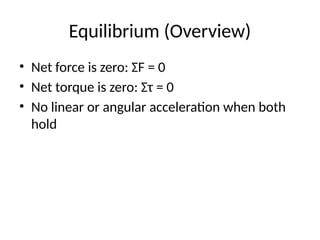
Equilibrium (Overview)
• Net force is zero: ΣF = 0
• Net torque is zero: Στ = 0
• No linear or angular acceleration when both
hold
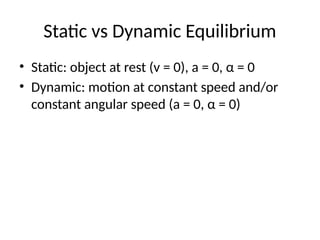
Static vs Dynamic Equilibrium
• Static: object at rest (v = 0), a = 0, α = 0
• Dynamic: motion at constant speed and/or
constant angular speed (a = 0, α = 0)
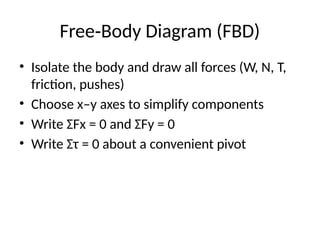
Free Body Diagram (FBD)
‑
• Isolate the body and draw all forces (W, N, T,
friction, pushes)
• Choose x–y axes to simplify components
• Write ΣFx = 0 and ΣFy = 0
• Write Στ = 0 about a convenient pivot
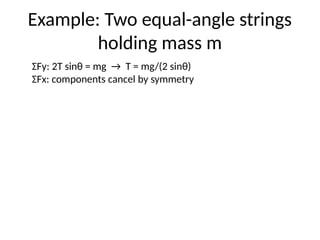
Example: Two equal-angle strings
holding mass m
ΣFy: 2T sinθ = mg → T = mg/(2 sinθ)
ΣFx: components cancel by symmetry
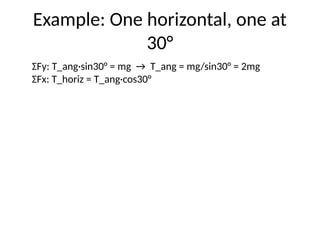
Example: One horizontal, one at
30°
ΣFy: T_ang·sin30° = mg → T_ang = mg/sin30° = 2mg
ΣFx: T_horiz = T_ang·cos30°
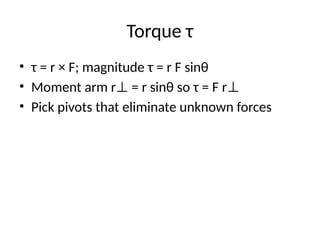
Torque τ
• τ = r × F; magnitude τ = r F sinθ
• Moment arm r = r sinθ so τ = F r
⊥ ⊥
• Pick pivots that eliminate unknown forces
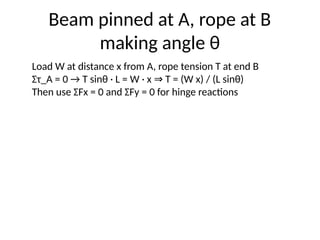
Beam pinned at A, rope at B
making angle θ
Load W at distance x from A, rope tension T at end B
Στ_A = 0 → T sinθ · L = W · x T = (W x) / (L sinθ)
⇒
Then use ΣFx = 0 and ΣFy = 0 for hinge reactions
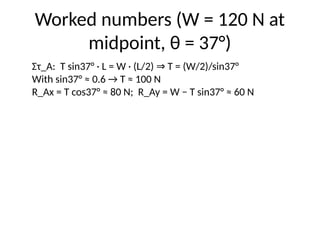
Worked numbers (W = 120 N at
midpoint, θ = 37°)
Στ_A: T sin37° · L = W · (L/2) T = (W/2)/sin37°
⇒
With sin37° ≈ 0.6 → T ≈ 100 N
R_Ax = T cos37° ≈ 80 N; R_Ay = W − T sin37° ≈ 60 N
Applications
• Signboard/Wall beam with cable
‑
• Push up reaction forces
‑
• Ladders against walls, scaffolds, cranes
Checklist & Pitfalls
• FBD → ΣF → Στ → solve
• Use perpendicular component for torque (sin
vs cos!)
• Weight acts at the center of mass
• Define clockwise/CCW signs consistently
Practice Problems
• 1) 2 kg mass held by two strings at 30° and 60°
→ find T1, T2
• 2) Beam L=2 m, W at 0.5 m, cable θ=45° →
find T, R_Ax, R_Ay
• 3) Ladder length 5 m against wall with
frictionless wall → find forces
Source
• Original deck on SlideShare: 'Lecture 4
static_equilibrium' (for reference)
• This PPT is a didactic summary for classroom
use.
Static_Equilibrium_Lecture_Summary.pptx physicsphysicsphysicsphysicsphysicsphysics

  • 1.
    Static Equilibrium —Lecture Summary Based on SlideShare: 'Lecture 4 static_equilibrium' (for classroom use)
  • 2.
    Equilibrium (Overview) • Netforce is zero: ΣF = 0 • Net torque is zero: Στ = 0 • No linear or angular acceleration when both hold
  • 3.
    Static vs DynamicEquilibrium • Static: object at rest (v = 0), a = 0, α = 0 • Dynamic: motion at constant speed and/or constant angular speed (a = 0, α = 0)
  • 4.
    Free Body Diagram(FBD) ‑ • Isolate the body and draw all forces (W, N, T, friction, pushes) • Choose x–y axes to simplify components • Write ΣFx = 0 and ΣFy = 0 • Write Στ = 0 about a convenient pivot
  • 5.
    Example: Two equal-anglestrings holding mass m ΣFy: 2T sinθ = mg → T = mg/(2 sinθ) ΣFx: components cancel by symmetry
  • 6.
    Example: One horizontal,one at 30° ΣFy: T_ang·sin30° = mg → T_ang = mg/sin30° = 2mg ΣFx: T_horiz = T_ang·cos30°
  • 7.
    Torque τ • τ= r × F; magnitude τ = r F sinθ • Moment arm r = r sinθ so τ = F r ⊥ ⊥ • Pick pivots that eliminate unknown forces
  • 8.
    Beam pinned atA, rope at B making angle θ Load W at distance x from A, rope tension T at end B Στ_A = 0 → T sinθ · L = W · x T = (W x) / (L sinθ) ⇒ Then use ΣFx = 0 and ΣFy = 0 for hinge reactions
  • 9.
    Worked numbers (W= 120 N at midpoint, θ = 37°) Στ_A: T sin37° · L = W · (L/2) T = (W/2)/sin37° ⇒ With sin37° ≈ 0.6 → T ≈ 100 N R_Ax = T cos37° ≈ 80 N; R_Ay = W − T sin37° ≈ 60 N
  • 10.
    Applications • Signboard/Wall beamwith cable ‑ • Push up reaction forces ‑ • Ladders against walls, scaffolds, cranes
  • 11.
    Checklist & Pitfalls •FBD → ΣF → Στ → solve • Use perpendicular component for torque (sin vs cos!) • Weight acts at the center of mass • Define clockwise/CCW signs consistently
  • 12.
    Practice Problems • 1)2 kg mass held by two strings at 30° and 60° → find T1, T2 • 2) Beam L=2 m, W at 0.5 m, cable θ=45° → find T, R_Ax, R_Ay • 3) Ladder length 5 m against wall with frictionless wall → find forces
  • 13.
    Source • Original deckon SlideShare: 'Lecture 4 static_equilibrium' (for reference) • This PPT is a didactic summary for classroom use.