Download free for 30 days
Sign in
Upload
Language (EN)
Support
Business
Mobile
Social Media
Marketing
Technology
Art & Photos
Career
Design
Education
Presentations & Public Speaking
Government & Nonprofit
Healthcare
Internet
Law
Leadership & Management
Automotive
Engineering
Software
Recruiting & HR
Retail
Sales
Services
Science
Small Business & Entrepreneurship
Food
Environment
Economy & Finance
Data & Analytics
Investor Relations
Sports
Spiritual
News & Politics
Travel
Self Improvement
Real Estate
Entertainment & Humor
Health & Medicine
Devices & Hardware
Lifestyle
Change Language
Language
English
Español
Português
Français
Deutsche
Cancel
Save
Submit search
EN
Uploaded by
angelramirez121317
PPTX, PDF
16 views
Ch 3 section 3.4 class notes statics .pptx
static notes from pearson
Engineering
◦
Read more
0
Save
Share
Embed
Embed presentation
Download
Download to read offline
1
/ 22
2
/ 22
3
/ 22
4
/ 22
5
/ 22
6
/ 22
7
/ 22
8
/ 22
9
/ 22
10
/ 22
11
/ 22
12
/ 22
13
/ 22
14
/ 22
15
/ 22
16
/ 22
17
/ 22
18
/ 22
19
/ 22
20
/ 22
21
/ 22
22
/ 22
More Related Content
PPTX
Ch 3 section 3.1-3.3 statics class notes.pptx
by
angelramirez121317
PPTX
013391545X_section5-3 - 5-4.pptx
by
RahulKumar85074
PPT
intro.ppt
by
anbh30
PPTX
Chapter_3.pptx statics presentation asdf
by
jwinterm1
PDF
Chapter 3
by
homari95
PPT
Ch3
by
jakeharo23
PPTX
1.4 - Forces in Space.pptx
by
Manikandan602030
PDF
Lecture slide on Equilibrium of a Particle.pdf
by
Khums Musopa
Ch 3 section 3.1-3.3 statics class notes.pptx
by
angelramirez121317
013391545X_section5-3 - 5-4.pptx
by
RahulKumar85074
intro.ppt
by
anbh30
Chapter_3.pptx statics presentation asdf
by
jwinterm1
Chapter 3
by
homari95
Ch3
by
jakeharo23
1.4 - Forces in Space.pptx
by
Manikandan602030
Lecture slide on Equilibrium of a Particle.pdf
by
Khums Musopa
Similar to Ch 3 section 3.4 class notes statics .pptx
PDF
Mech chapter 03
by
Inamullah Phulpoto
PDF
Chapter 3 and 5.pdfgyhgyyjhyyhgghgghhhhh
by
IrsyadIzzuddin2
PDF
07 Chapter 4, Part 1 (1).pdfawersxhcgfbhjbgfrdtes
by
nathayushkar07
PPT
Statics
by
Ramasubbu .P
PPS
Equilibrium
by
wallflower018
PPT
chapter1and2.ppt
by
RanaUmair74
PPTX
Lecture on Statics-Engineering Statics.pptx
by
poddarsajol
PPTX
project statics
by
Ahmed bssam
PDF
Lecture 4 static_equilibrium
by
Khairul Azhar
PPT
3.Chapter 3.ppt equilibrium of a particle
by
FarnazBatool2
PPT
Lecture 8- Rigid Bodies- Equilibrium 3D.ppt
by
ShvanHakim1
PDF
Lec_6(Static and Dynamic Equilibrium).pdf
by
k33884019
PPT
Lecture 5 (46)
by
Basel Samhouri
PPTX
STATIC EQUILIBRIUM FOR MIDTERM.pptx-engr.puno
by
RamsesPuno
PPTX
3.3 Beam 2 _ cables civil engineering .pptx
by
amitmeemroth00
PPTX
3.4 Cables civil engineering svnit.pptx
by
amitmeemroth00
PPTX
statics
by
Mohammed Ahmed
PPT
AR231_Chap05_EquilibriumofRigidBodies.ppt
by
aslhal
PPT
AR231_Chap05_EquilibriumofRigidBodies.ppt
by
ssuser523d4d
PPTX
Mechanic Machine
by
Malaysia
Mech chapter 03
by
Inamullah Phulpoto
Chapter 3 and 5.pdfgyhgyyjhyyhgghgghhhhh
by
IrsyadIzzuddin2
07 Chapter 4, Part 1 (1).pdfawersxhcgfbhjbgfrdtes
by
nathayushkar07
Statics
by
Ramasubbu .P
Equilibrium
by
wallflower018
chapter1and2.ppt
by
RanaUmair74
Lecture on Statics-Engineering Statics.pptx
by
poddarsajol
project statics
by
Ahmed bssam
Lecture 4 static_equilibrium
by
Khairul Azhar
3.Chapter 3.ppt equilibrium of a particle
by
FarnazBatool2
Lecture 8- Rigid Bodies- Equilibrium 3D.ppt
by
ShvanHakim1
Lec_6(Static and Dynamic Equilibrium).pdf
by
k33884019
Lecture 5 (46)
by
Basel Samhouri
STATIC EQUILIBRIUM FOR MIDTERM.pptx-engr.puno
by
RamsesPuno
3.3 Beam 2 _ cables civil engineering .pptx
by
amitmeemroth00
3.4 Cables civil engineering svnit.pptx
by
amitmeemroth00
statics
by
Mohammed Ahmed
AR231_Chap05_EquilibriumofRigidBodies.ppt
by
aslhal
AR231_Chap05_EquilibriumofRigidBodies.ppt
by
ssuser523d4d
Mechanic Machine
by
Malaysia
Recently uploaded
PPTX
Forouzan6e_ch02_PPTs_Physical.pptxmcgrawhill
by
shaiviadesh
PDF
convex_hull generation using the Quickhull
by
😀 Shahrokh Paravarzar, PhD, E.I.T
PPT
Network model of data communication subject
by
hackyourdailylife
PDF
22nd Safety Convention by IE(I) dt 27.12.25 by Rajesh Prasad.pdf
by
Rajesh Prasad
PPTX
PVD MNA 501 Recipe Review with understanding
by
NritaGaur1
PPTX
TR334_Foundation_Engineering_I_Slope stability _i.pptx
by
alexander402774
PPTX
cloud computing services and cloud types
by
kswanthana
PDF
lecture on Microprocessor: 8288 bus controller
by
sandeshupadhayay989
PDF
Unconventional reservoirs in petroleum engineering
by
MuhammadHaris61480
PPTX
PQ CHP-1 brief introduction to power quality
by
SureshEtukuriE1
PPT
Lecture Note on Forming processes for MME 213 2025-2026 Academic session.ppt...
by
OcheriCyril2
PPTX
PEMET413 -COMPOSITE MATERIALS -KTU MOD 1 LECTURE 4.pptx
by
VINAY B
PPT
plumbing design considerations for Federal High Court Sanitary PP.ppt
by
Miku87
PPTX
product design and development PL/CM ppt
by
PalakNaik6
PDF
LSI_Logic_Design_Chapter_1_for_computer_engineer.pdf
by
kumathong
PPTX
UNIT-1.pptx...................................
by
RavinderKaur647214
PPTX
Module 1 AGGREGATES, DEFINITION, TYPES .pptx
by
tkmmullonkal
PPTX
MOD 1 (concrete technology -cement,aggregates .pptx
by
tkmmullonkal
PPTX
SOFTWARE PROJECT MANAGEMENT PART 1-.pptx
by
ssuserbafe2d
PPTX
SOFTWARE PROJECT MANAGEMENT PART 2-2.pptx
by
ssuserbafe2d
Forouzan6e_ch02_PPTs_Physical.pptxmcgrawhill
by
shaiviadesh
convex_hull generation using the Quickhull
by
😀 Shahrokh Paravarzar, PhD, E.I.T
Network model of data communication subject
by
hackyourdailylife
22nd Safety Convention by IE(I) dt 27.12.25 by Rajesh Prasad.pdf
by
Rajesh Prasad
PVD MNA 501 Recipe Review with understanding
by
NritaGaur1
TR334_Foundation_Engineering_I_Slope stability _i.pptx
by
alexander402774
cloud computing services and cloud types
by
kswanthana
lecture on Microprocessor: 8288 bus controller
by
sandeshupadhayay989
Unconventional reservoirs in petroleum engineering
by
MuhammadHaris61480
PQ CHP-1 brief introduction to power quality
by
SureshEtukuriE1
Lecture Note on Forming processes for MME 213 2025-2026 Academic session.ppt...
by
OcheriCyril2
PEMET413 -COMPOSITE MATERIALS -KTU MOD 1 LECTURE 4.pptx
by
VINAY B
plumbing design considerations for Federal High Court Sanitary PP.ppt
by
Miku87
product design and development PL/CM ppt
by
PalakNaik6
LSI_Logic_Design_Chapter_1_for_computer_engineer.pdf
by
kumathong
UNIT-1.pptx...................................
by
RavinderKaur647214
Module 1 AGGREGATES, DEFINITION, TYPES .pptx
by
tkmmullonkal
MOD 1 (concrete technology -cement,aggregates .pptx
by
tkmmullonkal
SOFTWARE PROJECT MANAGEMENT PART 1-.pptx
by
ssuserbafe2d
SOFTWARE PROJECT MANAGEMENT PART 2-2.pptx
by
ssuserbafe2d
Ch 3 section 3.4 class notes statics .pptx
1.
Statics, Fourteenth Edition R.C.
Hibbeler Copyright ©2016 by Pearson Education, Inc. All rights reserved. In-class Activities: • Applications • Equations of Equilibrium • Reading Quiz • Concept Questions • Group Problem Solving • Attention Quiz Today’s Objectives: Students will be able to solve 3-D particle equilibrium problems by a) Drawing a 3-D free body diagram, and, b) Applying the three scalar equations (based on one vector equation) of equilibrium. THREE-DIMENSIONAL FORCE SYSTEMS
2.
Statics, Fourteenth Edition R.C.
Hibbeler Copyright ©2016 by Pearson Education, Inc. All rights reserved. You know the weight of the electromagnet and its load. But, you need to know the forces in the chains to see if it is a safe assembly. How would you do this? APPLICATIONS
3.
Statics, Fourteenth Edition R.C.
Hibbeler Copyright ©2016 by Pearson Education, Inc. All rights reserved. This shear-leg derrick is to be designed to lift a maximum of 200 kg of fish. How would you find the effect of different offset distances on the forces in the cable and derrick legs? Offset distance APPLICATIONS (continued)
4.
Statics, Fourteenth Edition R.C.
Hibbeler Copyright ©2016 by Pearson Education, Inc. All rights reserved. When a particle is in equilibrium, the vector sum of all the forces acting on it must be zero ( F = 0 ) . This equation can be written in terms of its x, y and z components. This form is written as follows. ( Fx) i + ( Fy) j + ( Fz) k = 0 THE EQUATIONS OF 3-D EQUILIBRIUM We have learnt the necessary and sufficient condition for particle equilibrium.
5.
Statics, Fourteenth Edition R.C.
Hibbeler Copyright ©2016 by Pearson Education, Inc. All rights reserved. This vector equation will be satisfied only when Fx = 0 Fy = 0 Fz = 0 These equations are the three scalar equations of equilibrium. They are valid for any point in equilibrium and allow you to solve for up to three unknowns. THE EQUATIONS OF 3-D EQUILIBRIUM ( Fx) i + ( Fy) j + ( Fz) k = 0
6.
Statics, Fourteenth Edition R.C.
Hibbeler Copyright ©2016 by Pearson Education, Inc. All rights reserved. 1. Particle P is in equilibrium with five (5) forces acting on it in 3-D space. How many scalar equations of equilibrium can be written for point P? A) 2 B) 3 C) 4 D) 5 E) 6 2. In 3-D, when a particle is in equilibrium, which of the following equations apply? A) ( Fx) i + ( Fy) j + ( Fz) k = 0 B) F = 0 C) Fx = Fy = Fz = 0 D) All of the above. E) None of the above. READING QUIZ
7.
Statics, Fourteenth Edition R.C.
Hibbeler Copyright ©2016 by Pearson Education, Inc. All rights reserved. 1. Particle P is in equilibrium with five (5) forces acting on it in 3-D space. How many scalar equations of equilibrium can be written for point P? A) 2 B) 3 C) 4 D) 5 E) 6 2. In 3-D, when a particle is in equilibrium, which of the following equations apply? A) ( Fx) i + ( Fy) j + ( Fz) k = 0 B) F = 0 C) Fx = Fy = Fz = 0 D) All of the above. E) None of the above. READING QUIZ
8.
Statics, Fourteenth Edition R.C.
Hibbeler Copyright ©2016 by Pearson Education, Inc. All rights reserved. 1. In 3-D, when you know the direction of a force but not its magnitude, how many unknowns corresponding to that force remain? A) One B) Two C) Three D) Four 2. If a particle has 3-D forces acting on it and is in static equilibrium, the components of the resultant force ( Fx, Fy, and Fz ) ___ . A) have to sum to zero, e.g., -5 i + 3 j + 2 k B) have to equal zero, e.g., 0 i + 0 j + 0 k C) have to be positive, e.g., 5 i + 5 j + 5 k D) have to be negative, e.g., -5 i - 5 j - 5 k CONCEPT QUIZ
9.
Statics, Fourteenth Edition R.C.
Hibbeler Copyright ©2016 by Pearson Education, Inc. All rights reserved. 1. In 3-D, when you know the direction of a force but not its magnitude, how many unknowns corresponding to that force remain? A) One B) Two C) Three D) Four 2. If a particle has 3-D forces acting on it and is in static equilibrium, the components of the resultant force ( Fx, Fy, and Fz ) ___ . A) have to sum to zero, e.g., -5 i + 3 j + 2 k B) have to equal zero, e.g., 0 i + 0 j + 0 k C) have to be positive, e.g., 5 i + 5 j + 5 k D) have to be negative, e.g., -5 i - 5 j - 5 k CONCEPT QUIZ
10.
Statics, Fourteenth Edition R.C.
Hibbeler Copyright ©2016 by Pearson Education, Inc. All rights reserved. 2. In 3-D, when you don’t know the direction or the magnitude of a force, how many unknowns do you have corresponding to that force? A) One B) Two C) Three D) Four 1. Four forces act at point A and point A is in equilibrium. Select the correct force vector P. A) {-20 i + 10 j – 10 k}lb B) {-10 i – 20 j – 10 k} lb C) {+ 20 i – 10 j – 10 k}lb D) None of the above. z F3 = 10 lb P F1 = 20 lb x A F2 = 10 lb y ATTENTION QUIZ
11.
Statics, Fourteenth Edition R.C.
Hibbeler Copyright ©2016 by Pearson Education, Inc. All rights reserved. 2. In 3-D, when you don’t know the direction or the magnitude of a force, how many unknowns do you have corresponding to that force? A) One B) Two C) Three D) Four 1. Four forces act at point A and point A is in equilibrium. Select the correct force vector P. A) {-20 i + 10 j – 10 k}lb B) {-10 i – 20 j – 10 k} lb C) {+ 20 i – 10 j – 10 k}lb D) None of the above. z F3 = 10 lb P F1 = 20 lb x A F2 = 10 lb y ATTENTION QUIZ
12.
Statics, Fourteenth Edition R.C.
Hibbeler Copyright ©2016 by Pearson Education, Inc. All rights reserved. 1) Draw a FBD of particle A. 2) Write the unknown cable forces TB, TC , and TD in Cartesian vector form. 3) Apply the three equilibrium equations to solve for the tension in cables. EXAMPLE I Given: The four forces and geometry shown. Find: The tension developed in cables AB, AC, and AD. Plan:
13.
Statics, Fourteenth Edition R.C.
Hibbeler Copyright ©2016 by Pearson Education, Inc. All rights reserved. W = -300 k Solution: EXAMPLE I (continued) TB = TB i TC = (TC cos 60) sin30 i + (TC cos 60) cos30 j + TC sin 60 k TC = TC (-0.25 i +0.433 j +0.866 k ) TD = TD cos 120 i + TD cos 120 j +TD cos 45 k TD = TD ( 0.5 i 0.5 j + 0.7071 k ) TC TD TB FBD at A
14.
Statics, Fourteenth Edition R.C.
Hibbeler Copyright ©2016 by Pearson Education, Inc. All rights reserved. Equating the respective i, j, k components to zero, we have SFx = TB – 0.25 TC – 0.5 TD = 0 (1) SFy = 0.433 TC – 0.5 TD = 0 (2) SFz = 0.866 TC + 0.7071 TD – 300 = 0 (3) EXAMPLE I (continued) FR = 0 = TB i + TC ( 0.25 i +0.433 j + 0.866 k ) + TD ( 0.5 i 0.5 j + 0.7071 k ) 300 k Applying equilibrium equations: Using (2) and (3), we can determine TC = 203 lb, TD = 176 lb Substituting TC and TD into (1), we can find TB = 139 lb
15.
Statics, Fourteenth Edition R.C.
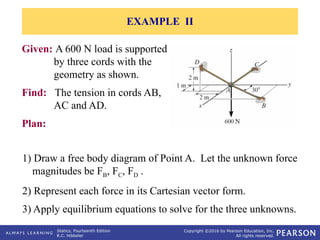
Hibbeler Copyright ©2016 by Pearson Education, Inc. All rights reserved. 1) Draw a free body diagram of Point A. Let the unknown force magnitudes be FB, FC, FD . 2) Represent each force in its Cartesian vector form. 3) Apply equilibrium equations to solve for the three unknowns. Given: A 600 N load is supported by three cords with the geometry as shown. Find: The tension in cords AB, AC and AD. Plan: EXAMPLE II
16.
Statics, Fourteenth Edition R.C.
Hibbeler Copyright ©2016 by Pearson Education, Inc. All rights reserved. FB = FB (sin 30 i + cos 30 j) N = {0.5 FB i + 0.866 FB j} N FC = – FC i N FD = FD (rAD /rAD) = FD { (1 i – 2 j + 2 k) / (12 + 22 + 22 )½ } N = { 0.333 FD i – 0.667 FD j + 0.667 FD k } N FBD at A FC FD A 600 N z y 30˚ FB x 1 m 2 m 2 m EXAMPLE II (continued)
17.
Statics, Fourteenth Edition R.C.
Hibbeler Copyright ©2016 by Pearson Education, Inc. All rights reserved. Solving the three simultaneous equations yields FC = 646 N (since it is positive, it is as assumed, e.g., in tension) FD = 900 N FB = 693 N y Now equate the respective i, j, and k components to zero. Fx = 0.5 FB – FC + 0.333 FD = 0 Fy = 0.866 FB – 0.667 FD = 0 Fz = 0.667 FD – 600 = 0 FBD at A FC FD A 600 N z 30˚ FB x 1 m 2 m 2 m EXAMPLE II (continued)
18.
Statics, Fourteenth Edition R.C.
Hibbeler Copyright ©2016 by Pearson Education, Inc. All rights reserved. 1) Draw a free body diagram of Point A. Let the unknown force magnitudes be FB, FC, FD . 2) Represent each force in the Cartesian vector form. 3) Apply equilibrium equations to solve for the three unknowns. Given: A 400 lb crate, as shown, is in equilibrium and supported by two cables and a strut AD. Find: Magnitude of the tension in each of the cables and the force developed along strut AD. Plan: GROUP PROBLEM SOLVING
19.
Statics, Fourteenth Edition R.C.
Hibbeler Copyright ©2016 by Pearson Education, Inc. All rights reserved. W = weight of crate = - 400 k lb FB = FB(rAB/rAB) = FB {(– 4 i – 12 j + 3 k) / (13)} lb FC = FC (rAC/rAC) = FC {(2 i – 6 j + 3 k) / (7)}lb FD = FD( rAD/rAD) = FD {(12 j + 5 k) / (13)}lb GROUP PROBLEM SOLVING (continued) FBD of Point A x y z W FB FC FD
20.
Statics, Fourteenth Edition R.C.
Hibbeler Copyright ©2016 by Pearson Education, Inc. All rights reserved. The particle A is in equilibrium, hence FB + FC + FD + W = 0 Now equate the respective i, j, k components to zero (i.e., apply the three scalar equations of equilibrium). Fx = – (4 / 13) FB + (2 / 7) FC = 0 (1) Fy = – (12 / 13) FB – (6 / 7) FC + (12 / 13) FD = 0 (2) Fz = (3 / 13) FB + (3 / 7) FC + (5 / 13) FD – 400 = 0 (3) Solving the three simultaneous equations gives the forces FB = 274 lb FC = 295 lb FD = 547 lb GROUP PROBLEM SOLVING (continued)
21.
Statics, Fourteenth Edition R.C.
Hibbeler Copyright ©2016 by Pearson Education, Inc. All rights reserved.
22.
Statics, Fourteenth Edition R.C.
Hibbeler Copyright ©2016 by Pearson Education, Inc. All rights reserved.
Editor's Notes
#6
Answers: 1. B 2. D
#7
Answers: 1. B 2. D
#8
Answers: 1. A 2. B
#9
Answers: 1. A 2. B
#10
Answer 1. D 2. C
#11
Answer 1. D 2. C
#12
Source : F3-10
#15
Source : F3-9
#18
Source : P3-52
Download