ENGINEERING MECHANICS
Unit – V
Rigid Body Dynamics
by
S.Thanga Kasi Rajan
Assistant Professor
Department of Mechanical Engineering
Kamaraj College of Engineering & Technology,
Virudhunagar – 626001.
Tamil Nadu, India
Email : stkrajan@gmail.com
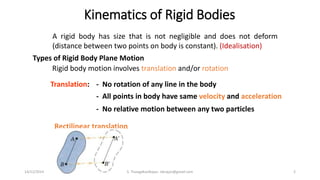
Kinematics of Rigid Bodies
A rigid body has size that is not negligible and does not deform
(distance between two points on body is constant). (Idealisation)
Rigid body motion involves translation and/or rotation
Types of Rigid Body Plane Motion
Translation: - No rotation of any line in the body
- All points in body have same velocity and acceleration
- No relative motion between any two particles
Rectilinear translation
14/12/2014 S. ThangaKasiRajan, stkrajan@gmail.com 2
Translation
Every line segment on the body remains parallel to its original direction
during the motion
14/12/2014 S. ThangaKasiRajan, stkrajan@gmail.com 3
Fixed-axis rotation:
- All points move in circular paths about axis of rotation
Curvilinear translation
14/12/2014 S. ThangaKasiRajan, stkrajan@gmail.com 4
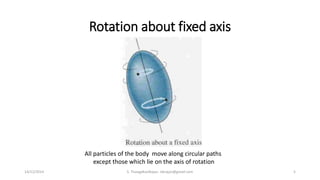
Rotation about fixed axis
All particles of the body move along circular paths
except those which lie on the axis of rotation
14/12/2014 S. ThangaKasiRajan, stkrajan@gmail.com 5
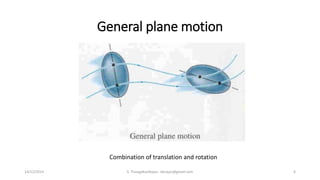
General plane motion
Combination of translation and rotation
14/12/2014 S. ThangaKasiRajan, stkrajan@gmail.com 6
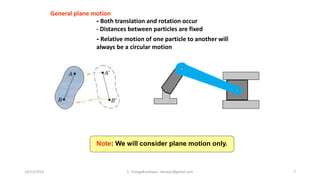
General plane motion
- Both translation and rotation occur
- Distances between particles are fixed
Note: We will consider plane motion only.
- Relative motion of one particle to another will
always be a circular motion
14/12/2014 S. ThangaKasiRajan, stkrajan@gmail.com 7
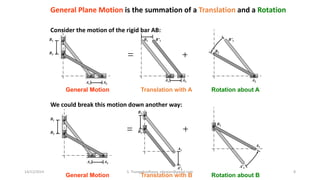
General Plane Motion is the summation of a Translation and a Rotation
Consider the motion of the rigid bar AB:
General Motion
B1
B2
A1 A2
Rotation about A
A2
B’1
B2
We could break this motion down another way:
General Motion
B1
B2
A1 A2
Translation with B
B1
B2
A1
A’1
Rotation about B
A’1
A2
B2
A1 A2
B1 B’1
Translation with A
14/12/2014 S. ThangaKasiRajan, stkrajan@gmail.com 8
Rigid Bodies:
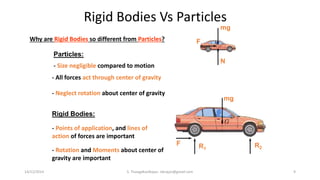
Why are Rigid Bodies so different from Particles?
- Size negligible compared to motion
Particles:
mg
N
F
- All forces act through center of gravity
- Neglect rotation about center of gravity
R2R1
F
mg
- Points of application, and lines of
action of forces are important
- Rotation and Moments about center of
gravity are important
Rigid Bodies Vs Particles
14/12/2014 S. ThangaKasiRajan, stkrajan@gmail.com 9
Types of rigid body planar motion
Translation – only linear direction
Rotational about fixed axis – rotational motion
General plane motion – consists of both linear and rotational motion
Rigid-Body Motion
14/12/2014 S. ThangaKasiRajan, stkrajan@gmail.com 10
Example
Rectilinear translation Rotation about a fixed axis
Curvilinear translation
General plane motion
14/12/2014 S. ThangaKasiRajan, stkrajan@gmail.com 11
Translation
ABAB /rrr 
Position
AB
AB
ABAB
const
dtd
vv
.r
/rvv
/
/



Velocity
Acceleration
AB aa 
All points move with same velocity and acceleration
14/12/2014S. ThangaKasiRajan, stkrajan@gmail.com12
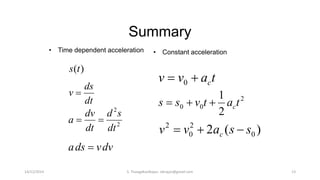
Summary
• Time dependent acceleration
dt
ds
v 
)(ts
2
2
dt
sd
dt
dv
a 
dvvdsa 
• Constant acceleration
tavv c 0
2
00
2
1
tatvss c
)(2 0
2
0
2
ssavv c 
14/12/2014 S. ThangaKasiRajan, stkrajan@gmail.com 13
Rotation About a Fixed axis
Angular Position ( q )
Defined by the angle q measured between a fixed
reference line and r
Measured in rad
Angular Displacement
Measured as dq
Vector quantity
Measured in radians or revolutions
1 rev = 2 p rad
14/12/2014 S. ThangaKasiRajan, stkrajan@gmail.com 14
q
q
 
dt
d
Angular velocity ( )
“the time rate of change in the angular position”
q

 
dt
d
Angular acceleration
“the time rate of change of the angular velocity”
q
q
  2
2
dt
d
 = f(q)
q dd 
14/12/2014 S. ThangaKasiRajan, stkrajan@gmail.com 15
Constant Angular Acceleration
)(2 0
2
0
2
qq  c
tc  0
2
00
2
1
tt cqq 
14/12/2014S. ThangaKasiRajan, stkrajan@gmail.com16
Comparison
)(2
2
1
0
2
0
2
2
00
0
qq
qq




c
c
c
tt
t
dt
ds
v )(ts 2
2
dt
sd
dt
dv
a 
dvvdsa 
tavv c 0
2
00
2
1
tatvss c
)(2 0
2
0
2
ssavv c 
dt
dq
  2
2
dt
d
dt
d q
 
q dd 
)(tq
14/12/2014S. ThangaKasiRajan, stkrajan@gmail.com17
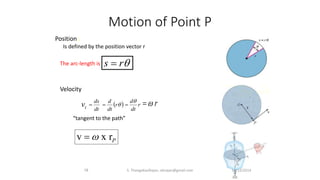
Motion of Point P
Prxv 
Position :
qrs The arc-length is
Is defined by the position vector r
tv
dt
ds
 ( )qr
dt
d
 r
dt
dq
 r
Velocity
“tangent to the path”
14/12/2014S. ThangaKasiRajan, stkrajan@gmail.com18
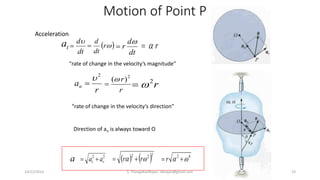
Acceleration
ta
dt
d
 ( )r
dt
d

dt
d
r

 r
r
an
2


r
r 2
)(
 r2

Direction of an is always toward O
“rate of change in the velocity’s magnitude”
“rate of change in the velocity’s direction”
a 22
rt aa  ( ) ( )222
 rr  42
  r
Motion of Point P
14/12/2014 S. ThangaKasiRajan, stkrajan@gmail.com 19
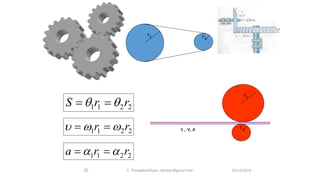
2211 rrS qq 
2211 rr  
2211 rra  
r1 r2
s , v, a
r1
r2
14/12/2014S. ThangaKasiRajan, stkrajan@gmail.com20
Rest
at = 4t m/s2
=?
q=?
ra tP )(
2
/20
)2.0()4(
sradt
t




t
dt
d
20


sradt
dttd
t
/10
20
2
0 0

 



2
10 t
dt
d

q

radt
dttd
t
3
0 0
2
33.3
10

 
q
q
q
Problem 1
14/12/2014 S. ThangaKasiRajan, stkrajan@gmail.com 21
Problem 2
Cable C has a constant acceleration of
225 mm/s2 and an initial velocity of 300
mm/s, both directed to the right.
Determine (a) the number of revolutions
of the pulley in 2 s, (b) the velocity and
change in position of the load B after 2 s,
and (c) the acceleration of the point D on
the rim of the inner pulley at t = 0.
SOLUTION:
• Due to the action of the cable, the
tangential velocity and acceleration of
D are equal to the velocity and
acceleration of C. Calculate the initial
angular velocity and acceleration.
• Apply the relations for uniformly
accelerated rotation to determine the
velocity and angular position of the
pulley after 2 s.
• Evaluate the initial tangential and
normal acceleration components of D.
14/12/2014 S. ThangaKasiRajan, stkrajan@gmail.com
Problem 2
SOLUTION:
• The tangential velocity and acceleration of D are equal to the
velocity and acceleration of C.
( ) ( )
( )
( )
srad4
75
300
smm300
0
0
00
00



r
v
rv
vv
D
D
CD



( )
( )
( ) 2
srad3
3
225
2/225



r
a
ra
smmaa
tD
tD
CtD



• Apply the relations for uniformly accelerated rotation to
determine velocity and angular position of pulley after 2 s.
( )( ) srad10s2srad3srad4 2
0  t
( )( ) ( )( )
rad14
s2srad3s2srad4 22
2
12
2
1
0

 tt q
( ) revsofnumber
rad2
rev1
rad14 






p
N rev23.2N
( )( )
( )( )rad14mm125
srad10mm125


q

ry
rv
B
B
m75.1
sm25.1


B
B
y
v

14/12/2014 S. ThangaKasiRajan, stkrajan@gmail.com 23
Problem 2
• Evaluate the initial tangential and normal acceleration
components of D.
( ) 
2
smm225CtD aa

( ) ( )( ) 222
0 smm1200srad4mm57  DnD ra
( ) ( )  22
smm1200smm225 nDtD aa

Magnitude and direction of the total acceleration,
( ) ( )
22
22
1200225 
 nDtDD aaa
2
smm1220Da
( )
( )
225
1200
tan


tD
nD
a
a

 4.79
14/12/2014 S. ThangaKasiRajan, stkrajan@gmail.com
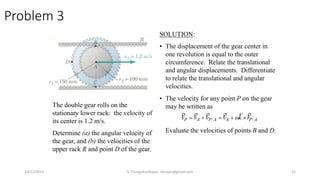
Problem 3
The double gear rolls on the
stationary lower rack: the velocity of
its center is 1.2 m/s.
Determine (a) the angular velocity of
the gear, and (b) the velocities of the
upper rack R and point D of the gear.
SOLUTION:
• The displacement of the gear center in
one revolution is equal to the outer
circumference. Relate the translational
and angular displacements. Differentiate
to relate the translational and angular
velocities.
• The velocity for any point P on the gear
may be written as
Evaluate the velocities of points B and D.
APAAPAP rkvvvv

 
14/12/2014 S. ThangaKasiRajan, stkrajan@gmail.com 25
Problem 3
SOLUTION:
• The displacement of the gear center in one revolution is
equal to the outer circumference.
For xA > 0 (moves to right),  < 0 (rotates clockwise).
q
p
q
p 1
22
rx
r
x
A
A 
Differentiate to relate the translational and angular
velocities.
m0.150
sm2.1
1
1


r
v
rv
A
A


( )kk

srad8 
14/12/2014 S. ThangaKasiRajan, stkrajan@gmail.com 26
Problem 3
• For any point P on the gear, APAAPAP rkvvvv

 
Velocity of the upper rack is equal to
velocity of point B:
( ) ( ) ( )
( ) ( )ii
jki
rkvvv ABABR



sm8.0sm2.1
m10.0srad8sm2.1


 
( )ivR

sm2
Velocity of the point D:
( ) ( ) ( )iki
rkvv ADAD


m150.0srad8sm2.1 
 
( ) ( )
sm697.1
sm2.1sm2.1


D
D
v
jiv

14/12/2014 S. ThangaKasiRajan, stkrajan@gmail.com 27
Slider Crank Mechanism
14/12/2014 S. ThangaKasiRajan, stkrajan@gmail.com 28
Slider Crank Mechanism consists of
1. Crank shaft – Pure Rotation
2. Connecting rod – Both Translation and
Rotation
3. Piston – Pure Rotation
The motion of Connecting rod depends on
motion of crank shaft
Similarly the motion of piston depends on
motion of connecting rod.
Slider Crank MechanismSlider Crank Mechanism
14/12/2014 S. ThangaKasiRajan, stkrajan@gmail.com 29
Slider Crank Mechanism
Motion of Crank AB
VB = VA + VB/A
here VA = 0 because A is fixed
therefore
VB = VB/A
= rAB . ωAB
14/12/2014 S. ThangaKasiRajan, stkrajan@gmail.com 30
Slider Crank Mechanism
Motion of Connecting Rod:
When crank rotates in clockwise direction, connecting rod rotates in anticlockwise direction.
Also VC/B is perpendicular to the axis of the connecting rod
Apply sine and
cosine rule to find
the magnitude
and direction the
velocity of each
component
Problem 4
14/12/2014 S. ThangaKasiRajan, stkrajan@gmail.com 31
In the reciprocating engine shown in the figure, the crank AB has a constant angular
velocity of 2000 rpm. For the crank position indicated determine
i). Angular velocity of Crank AB
ii). Angular Velocity of the Connecting Rod BC
iii). Velocity of Piston
Problem 4
14/12/2014 S. ThangaKasiRajan, stkrajan@gmail.com 32
14/12/2014 S. ThangaKasiRajan, stkrajan@gmail.com 33
Problem 4
Problem 4
14/12/2014 S. ThangaKasiRajan, stkrajan@gmail.com 34
References
1. Ferdinand P Beer & E.Russell Johnston “VECTOR MECHANICS FOR
ENGINEERS STATICS & Dynamics”, (Ninth Edition) Tata McGraw Hill
Education Private Limited, New Delhi.
2. Engineering Mechanics – Statics & Dynamics by S.Nagan,
M.S.Palanichamy, Tata McGraw-Hill (2001).
02/01/2017 S.ThangaKasiRajan, stkrajan@gmail.com 35
Thank you
Any Queries contact
S.Thanga Kasi Rajan
Assistant Professor
Department of Mechanical Engineering
Kamaraj College of Engineering & Technology,
Virudhunagar – 626001.
Tamil Nadu, India
Email : stkrajan@gmail.com
02/01/2017 S.ThangaKasiRajan, stkrajan@gmail.com 36

Unit 5 rigid body dynamics

  • 1.
    ENGINEERING MECHANICS Unit –V Rigid Body Dynamics by S.Thanga Kasi Rajan Assistant Professor Department of Mechanical Engineering Kamaraj College of Engineering & Technology, Virudhunagar – 626001. Tamil Nadu, India Email : stkrajan@gmail.com
  • 2.
    Kinematics of RigidBodies A rigid body has size that is not negligible and does not deform (distance between two points on body is constant). (Idealisation) Rigid body motion involves translation and/or rotation Types of Rigid Body Plane Motion Translation: - No rotation of any line in the body - All points in body have same velocity and acceleration - No relative motion between any two particles Rectilinear translation 14/12/2014 S. ThangaKasiRajan, stkrajan@gmail.com 2
  • 3.
    Translation Every line segmenton the body remains parallel to its original direction during the motion 14/12/2014 S. ThangaKasiRajan, stkrajan@gmail.com 3
  • 4.
    Fixed-axis rotation: - Allpoints move in circular paths about axis of rotation Curvilinear translation 14/12/2014 S. ThangaKasiRajan, stkrajan@gmail.com 4
  • 5.
    Rotation about fixedaxis All particles of the body move along circular paths except those which lie on the axis of rotation 14/12/2014 S. ThangaKasiRajan, stkrajan@gmail.com 5
  • 6.
    General plane motion Combinationof translation and rotation 14/12/2014 S. ThangaKasiRajan, stkrajan@gmail.com 6
  • 7.
    General plane motion -Both translation and rotation occur - Distances between particles are fixed Note: We will consider plane motion only. - Relative motion of one particle to another will always be a circular motion 14/12/2014 S. ThangaKasiRajan, stkrajan@gmail.com 7
  • 8.
    General Plane Motionis the summation of a Translation and a Rotation Consider the motion of the rigid bar AB: General Motion B1 B2 A1 A2 Rotation about A A2 B’1 B2 We could break this motion down another way: General Motion B1 B2 A1 A2 Translation with B B1 B2 A1 A’1 Rotation about B A’1 A2 B2 A1 A2 B1 B’1 Translation with A 14/12/2014 S. ThangaKasiRajan, stkrajan@gmail.com 8
  • 9.
    Rigid Bodies: Why areRigid Bodies so different from Particles? - Size negligible compared to motion Particles: mg N F - All forces act through center of gravity - Neglect rotation about center of gravity R2R1 F mg - Points of application, and lines of action of forces are important - Rotation and Moments about center of gravity are important Rigid Bodies Vs Particles 14/12/2014 S. ThangaKasiRajan, stkrajan@gmail.com 9
  • 10.
    Types of rigidbody planar motion Translation – only linear direction Rotational about fixed axis – rotational motion General plane motion – consists of both linear and rotational motion Rigid-Body Motion 14/12/2014 S. ThangaKasiRajan, stkrajan@gmail.com 10
  • 11.
    Example Rectilinear translation Rotationabout a fixed axis Curvilinear translation General plane motion 14/12/2014 S. ThangaKasiRajan, stkrajan@gmail.com 11
  • 12.
    Translation ABAB /rrr  Position AB AB ABAB const dtd vv .r /rvv / /    Velocity Acceleration ABaa  All points move with same velocity and acceleration 14/12/2014S. ThangaKasiRajan, stkrajan@gmail.com12
  • 13.
    Summary • Time dependentacceleration dt ds v  )(ts 2 2 dt sd dt dv a  dvvdsa  • Constant acceleration tavv c 0 2 00 2 1 tatvss c )(2 0 2 0 2 ssavv c  14/12/2014 S. ThangaKasiRajan, stkrajan@gmail.com 13
  • 14.
    Rotation About aFixed axis Angular Position ( q ) Defined by the angle q measured between a fixed reference line and r Measured in rad Angular Displacement Measured as dq Vector quantity Measured in radians or revolutions 1 rev = 2 p rad 14/12/2014 S. ThangaKasiRajan, stkrajan@gmail.com 14
  • 15.
    q q   dt d Angular velocity( ) “the time rate of change in the angular position” q    dt d Angular acceleration “the time rate of change of the angular velocity” q q   2 2 dt d  = f(q) q dd  14/12/2014 S. ThangaKasiRajan, stkrajan@gmail.com 15
  • 16.
    Constant Angular Acceleration )(20 2 0 2 qq  c tc  0 2 00 2 1 tt cqq  14/12/2014S. ThangaKasiRajan, stkrajan@gmail.com16
  • 17.
    Comparison )(2 2 1 0 2 0 2 2 00 0 qq qq     c c c tt t dt ds v )(ts 2 2 dt sd dt dv a dvvdsa  tavv c 0 2 00 2 1 tatvss c )(2 0 2 0 2 ssavv c  dt dq   2 2 dt d dt d q   q dd  )(tq 14/12/2014S. ThangaKasiRajan, stkrajan@gmail.com17
  • 18.
    Motion of PointP Prxv  Position : qrs The arc-length is Is defined by the position vector r tv dt ds  ( )qr dt d  r dt dq  r Velocity “tangent to the path” 14/12/2014S. ThangaKasiRajan, stkrajan@gmail.com18
  • 19.
    Acceleration ta dt d  ( )r dt d  dt d r  r r an 2   r r 2 )(  r2  Direction of an is always toward O “rate of change in the velocity’s magnitude” “rate of change in the velocity’s direction” a 22 rt aa  ( ) ( )222  rr  42   r Motion of Point P 14/12/2014 S. ThangaKasiRajan, stkrajan@gmail.com 19
  • 20.
    2211 rrS qq 2211 rr   2211 rra   r1 r2 s , v, a r1 r2 14/12/2014S. ThangaKasiRajan, stkrajan@gmail.com20
  • 21.
    Rest at = 4tm/s2 =? q=? ra tP )( 2 /20 )2.0()4( sradt t     t dt d 20   sradt dttd t /10 20 2 0 0       2 10 t dt d  q  radt dttd t 3 0 0 2 33.3 10    q q q Problem 1 14/12/2014 S. ThangaKasiRajan, stkrajan@gmail.com 21
  • 22.
    Problem 2 Cable Chas a constant acceleration of 225 mm/s2 and an initial velocity of 300 mm/s, both directed to the right. Determine (a) the number of revolutions of the pulley in 2 s, (b) the velocity and change in position of the load B after 2 s, and (c) the acceleration of the point D on the rim of the inner pulley at t = 0. SOLUTION: • Due to the action of the cable, the tangential velocity and acceleration of D are equal to the velocity and acceleration of C. Calculate the initial angular velocity and acceleration. • Apply the relations for uniformly accelerated rotation to determine the velocity and angular position of the pulley after 2 s. • Evaluate the initial tangential and normal acceleration components of D. 14/12/2014 S. ThangaKasiRajan, stkrajan@gmail.com
  • 23.
    Problem 2 SOLUTION: • Thetangential velocity and acceleration of D are equal to the velocity and acceleration of C. ( ) ( ) ( ) ( ) srad4 75 300 smm300 0 0 00 00    r v rv vv D D CD    ( ) ( ) ( ) 2 srad3 3 225 2/225    r a ra smmaa tD tD CtD    • Apply the relations for uniformly accelerated rotation to determine velocity and angular position of pulley after 2 s. ( )( ) srad10s2srad3srad4 2 0  t ( )( ) ( )( ) rad14 s2srad3s2srad4 22 2 12 2 1 0   tt q ( ) revsofnumber rad2 rev1 rad14        p N rev23.2N ( )( ) ( )( )rad14mm125 srad10mm125   q  ry rv B B m75.1 sm25.1   B B y v  14/12/2014 S. ThangaKasiRajan, stkrajan@gmail.com 23
  • 24.
    Problem 2 • Evaluatethe initial tangential and normal acceleration components of D. ( )  2 smm225CtD aa  ( ) ( )( ) 222 0 smm1200srad4mm57  DnD ra ( ) ( )  22 smm1200smm225 nDtD aa  Magnitude and direction of the total acceleration, ( ) ( ) 22 22 1200225   nDtDD aaa 2 smm1220Da ( ) ( ) 225 1200 tan   tD nD a a   4.79 14/12/2014 S. ThangaKasiRajan, stkrajan@gmail.com
  • 25.
    Problem 3 The doublegear rolls on the stationary lower rack: the velocity of its center is 1.2 m/s. Determine (a) the angular velocity of the gear, and (b) the velocities of the upper rack R and point D of the gear. SOLUTION: • The displacement of the gear center in one revolution is equal to the outer circumference. Relate the translational and angular displacements. Differentiate to relate the translational and angular velocities. • The velocity for any point P on the gear may be written as Evaluate the velocities of points B and D. APAAPAP rkvvvv    14/12/2014 S. ThangaKasiRajan, stkrajan@gmail.com 25
  • 26.
    Problem 3 SOLUTION: • Thedisplacement of the gear center in one revolution is equal to the outer circumference. For xA > 0 (moves to right),  < 0 (rotates clockwise). q p q p 1 22 rx r x A A  Differentiate to relate the translational and angular velocities. m0.150 sm2.1 1 1   r v rv A A   ( )kk  srad8  14/12/2014 S. ThangaKasiRajan, stkrajan@gmail.com 26
  • 27.
    Problem 3 • Forany point P on the gear, APAAPAP rkvvvv    Velocity of the upper rack is equal to velocity of point B: ( ) ( ) ( ) ( ) ( )ii jki rkvvv ABABR    sm8.0sm2.1 m10.0srad8sm2.1     ( )ivR  sm2 Velocity of the point D: ( ) ( ) ( )iki rkvv ADAD   m150.0srad8sm2.1    ( ) ( ) sm697.1 sm2.1sm2.1   D D v jiv  14/12/2014 S. ThangaKasiRajan, stkrajan@gmail.com 27
  • 28.
    Slider Crank Mechanism 14/12/2014S. ThangaKasiRajan, stkrajan@gmail.com 28 Slider Crank Mechanism consists of 1. Crank shaft – Pure Rotation 2. Connecting rod – Both Translation and Rotation 3. Piston – Pure Rotation The motion of Connecting rod depends on motion of crank shaft Similarly the motion of piston depends on motion of connecting rod. Slider Crank MechanismSlider Crank Mechanism
  • 29.
    14/12/2014 S. ThangaKasiRajan,stkrajan@gmail.com 29 Slider Crank Mechanism Motion of Crank AB VB = VA + VB/A here VA = 0 because A is fixed therefore VB = VB/A = rAB . ωAB
  • 30.
    14/12/2014 S. ThangaKasiRajan,stkrajan@gmail.com 30 Slider Crank Mechanism Motion of Connecting Rod: When crank rotates in clockwise direction, connecting rod rotates in anticlockwise direction. Also VC/B is perpendicular to the axis of the connecting rod Apply sine and cosine rule to find the magnitude and direction the velocity of each component
  • 31.
    Problem 4 14/12/2014 S.ThangaKasiRajan, stkrajan@gmail.com 31 In the reciprocating engine shown in the figure, the crank AB has a constant angular velocity of 2000 rpm. For the crank position indicated determine i). Angular velocity of Crank AB ii). Angular Velocity of the Connecting Rod BC iii). Velocity of Piston
  • 32.
    Problem 4 14/12/2014 S.ThangaKasiRajan, stkrajan@gmail.com 32
  • 33.
    14/12/2014 S. ThangaKasiRajan,stkrajan@gmail.com 33 Problem 4
  • 34.
    Problem 4 14/12/2014 S.ThangaKasiRajan, stkrajan@gmail.com 34
  • 35.
    References 1. Ferdinand PBeer & E.Russell Johnston “VECTOR MECHANICS FOR ENGINEERS STATICS & Dynamics”, (Ninth Edition) Tata McGraw Hill Education Private Limited, New Delhi. 2. Engineering Mechanics – Statics & Dynamics by S.Nagan, M.S.Palanichamy, Tata McGraw-Hill (2001). 02/01/2017 S.ThangaKasiRajan, stkrajan@gmail.com 35
  • 36.
    Thank you Any Queriescontact S.Thanga Kasi Rajan Assistant Professor Department of Mechanical Engineering Kamaraj College of Engineering & Technology, Virudhunagar – 626001. Tamil Nadu, India Email : stkrajan@gmail.com 02/01/2017 S.ThangaKasiRajan, stkrajan@gmail.com 36