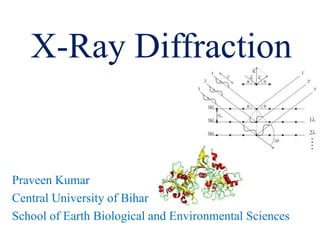
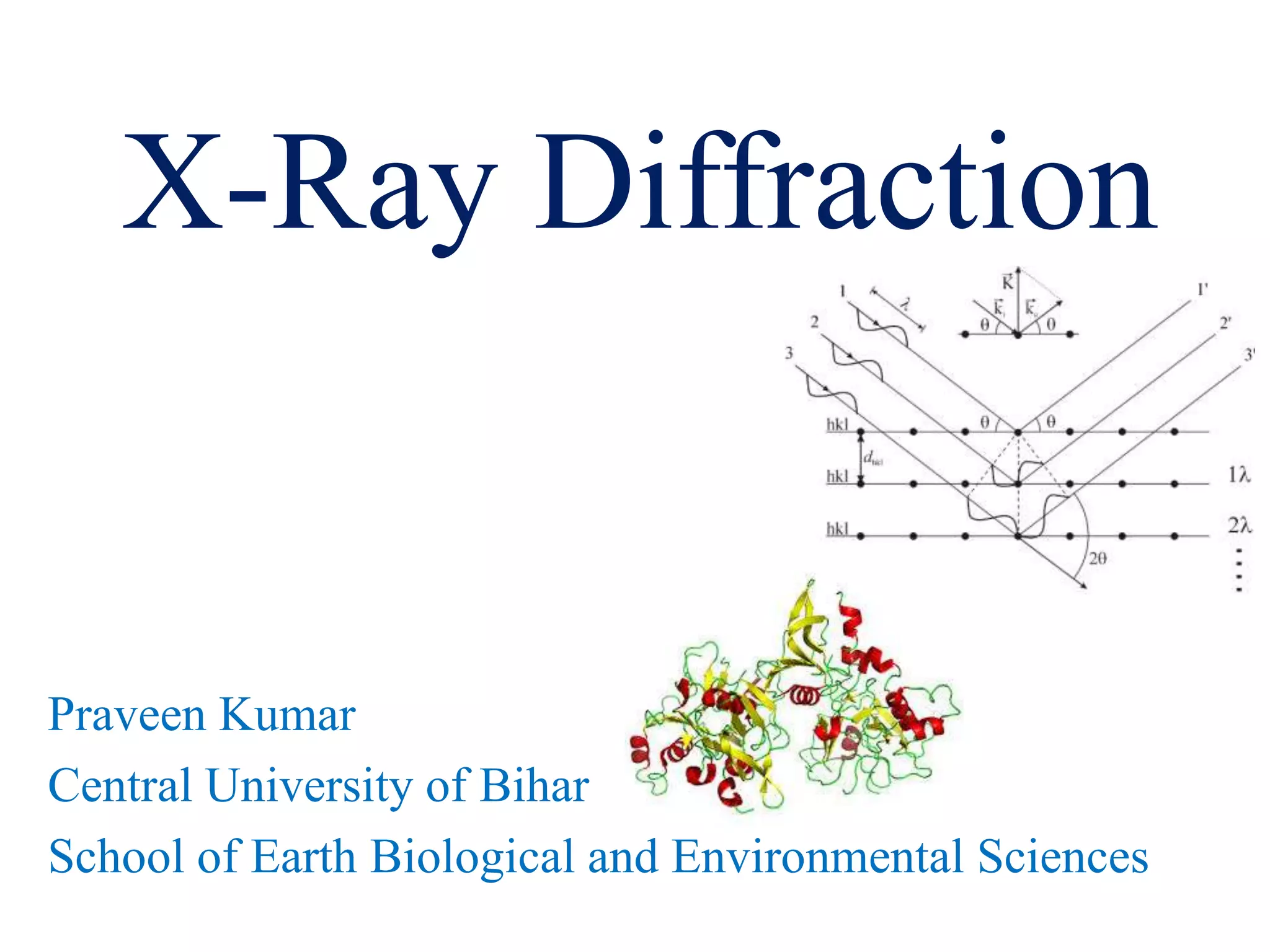
X-Ray Diffraction
Praveen Kumar
Central University of Bihar
School of Earth Biological and Environmental Sciences
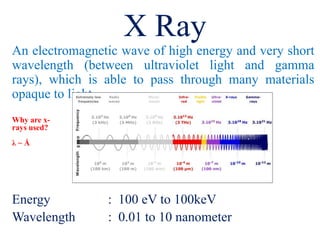
An electromagnetic wave of high energy and very short
wavelength (between ultraviolet light and gamma
rays), which is able to pass through many materials
opaque to light.
Energy : 100 eV to 100keV
Wavelength : 0.01 to 10 nanometer
X Ray
Why are x-
rays used?
λ ~ Å
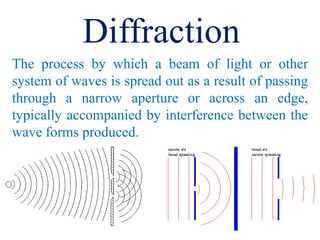
The process by which a beam of light or other
system of waves is spread out as a result of passing
through a narrow aperture or across an edge,
typically accompanied by interference between the
wave forms produced.
Diffraction
X Ray Diffraction
A technique used to determine the atomic and molecular
structure of a crystal, in which the crystalline atoms cause a
beam of incident X-rays to diffract into many specific
directions.
The atomic planes of a crystal cause an incident beam of X-
rays to interfere with one another as they leave the crystal. The
phenomenon is called X-ray diffraction.
A stream of X-rays directed at a crystal diffract and scatter as
they encounter atoms. The scattered rays interfere with each
other and produce spots of different intensities that can be
recorded on film.
Working Principle
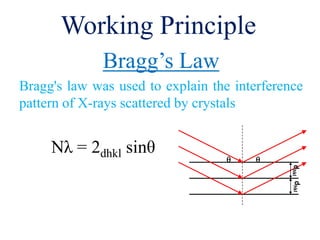
Bragg’s Law
Bragg's law was used to explain the interference
pattern of X-rays scattered by crystals
Nλ = 2dhkl sinθ
q q
dhkldhkl
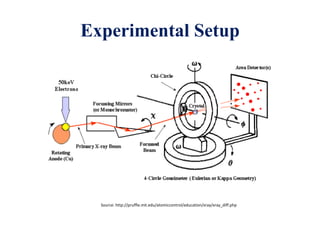
Experimental Setup
Source: http://pruffle.mit.edu/atomiccontrol/education/xray/xray_diff.php
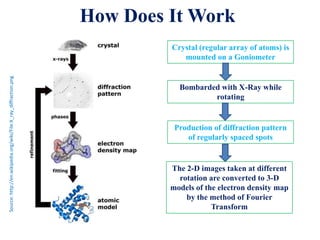
How Does It WorkSource:http://en.wikipedia.org/wiki/File:X_ray_diffraction.png
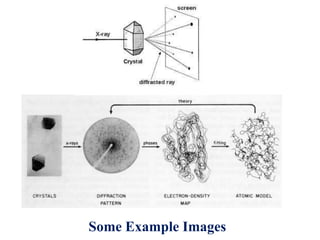
Crystal (regular array of atoms) is
mounted on a Goniometer
Bombarded with X-Ray while
rotating
Production of diffraction pattern
of regularly spaced spots
The 2-D images taken at different
rotation are converted to 3-D
models of the electron density map
by the method of Fourier
Transform
Some Example Images
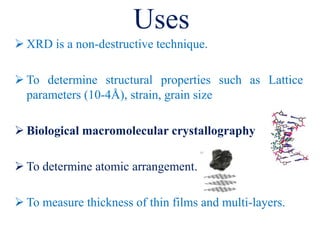
Uses
 XRD is a non-destructive technique.
 To determine structural properties such as Lattice
parameters (10-4Å), strain, grain size
 Biological macromolecular crystallography
 To determine atomic arrangement.
 To measure thickness of thin films and multi-layers.
Thanks

X ray diffraction

  • 1.
    X-Ray Diffraction Praveen Kumar CentralUniversity of Bihar School of Earth Biological and Environmental Sciences
  • 2.
    An electromagnetic waveof high energy and very short wavelength (between ultraviolet light and gamma rays), which is able to pass through many materials opaque to light. Energy : 100 eV to 100keV Wavelength : 0.01 to 10 nanometer X Ray Why are x- rays used? λ ~ Å
  • 3.
    The process bywhich a beam of light or other system of waves is spread out as a result of passing through a narrow aperture or across an edge, typically accompanied by interference between the wave forms produced. Diffraction
  • 4.
    X Ray Diffraction Atechnique used to determine the atomic and molecular structure of a crystal, in which the crystalline atoms cause a beam of incident X-rays to diffract into many specific directions. The atomic planes of a crystal cause an incident beam of X- rays to interfere with one another as they leave the crystal. The phenomenon is called X-ray diffraction. A stream of X-rays directed at a crystal diffract and scatter as they encounter atoms. The scattered rays interfere with each other and produce spots of different intensities that can be recorded on film.
  • 5.
    Working Principle Bragg’s Law Bragg'slaw was used to explain the interference pattern of X-rays scattered by crystals Nλ = 2dhkl sinθ q q dhkldhkl
  • 6.
  • 7.
    How Does ItWorkSource:http://en.wikipedia.org/wiki/File:X_ray_diffraction.png Crystal (regular array of atoms) is mounted on a Goniometer Bombarded with X-Ray while rotating Production of diffraction pattern of regularly spaced spots The 2-D images taken at different rotation are converted to 3-D models of the electron density map by the method of Fourier Transform
  • 8.
  • 9.
    Uses  XRD isa non-destructive technique.  To determine structural properties such as Lattice parameters (10-4Å), strain, grain size  Biological macromolecular crystallography  To determine atomic arrangement.  To measure thickness of thin films and multi-layers.
  • 10.