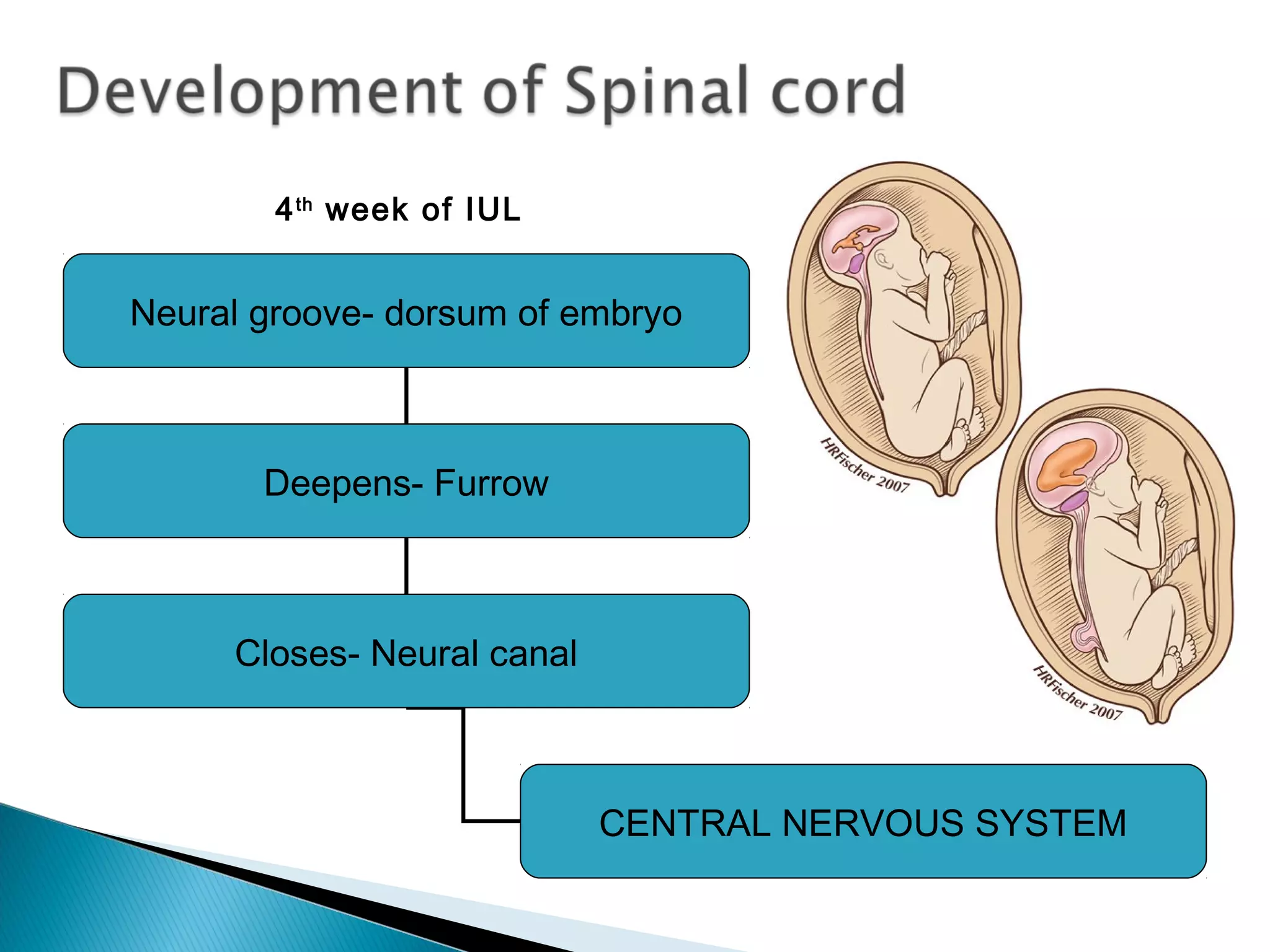
Neural groove- dorsum of embryo
Deepens- Furrow
Closes- Neural canal
CENTRAL NERVOUS SYSTEM
4th
week of IUL
 Lumen persists as – Central neural canal.
 Closure
◦ Starts in cervical region
◦ Proceeds caudally & cranially
◦ Cranium closing last – 26 days
 Neural tube
◦ Proliferating cells of neuroepithelium differentiate –
NEUROBLASTS or NEURONS.
 Motor axons – out growing processes.
 Sensory neurons – from neural crests (Ectoderm & Post
surface of neural tube).
 Meninges – arise from loose mesenchymal
tissue surrounding the N. tube.
◦ Pia mater – 40 days
◦ Dura – later.
 Neural canal separates from ectodermal
covering – ingrowth of mesoderm.
 Notochord –
◦ solid rod of cells
◦ Anterior to N. canal
 Vertebral bodies develop around this all.
 From each of the Vertebral bodies
◦ Extend backwards 2 projections
◦ Grow around N. canal
◦ Form – Vertebral arch
◦ Fuse behind thoracic region – extend up & down.
 FUSION FAILS – Gap in vertebral N arch
 SPINA BIFIDA
◦ m.c. in Lumbosacral region
 Latin word for “split spine”.
 Literally means “cleft spine,”
 Most common group of birth defects called neural
tube defects (NTD).
 Incidence
◦ World wide about 1 per 1000 live births.
 Antenatal screening of AFP - 15–18 mths.
◦ Identify at risk women.
◦ If high AFP – Amniocentesis and USG.
 Previous neural tube defect fetus –
◦ 10 fold increased risk
◦ 50 fold for third pregnancy.
 Genetic predisposition.
 Some environmental factors
 The exact cause of spina bifida remains a
mystery. 
 Genetic, nutritional, and environmental
factors may play a role. 
 Combination of genetic and environmental risk
factors, such as a family history of neural tube
defects, folic acid deficiency and medical
conditions such as diabetes and obesity.
 Race: more common among Hispanics and
whites of European descent.
 Family history of neural tube defects.
However, most babies with spina bifida are born
to parents with no known family history of the
condition.
 Folic acid deficiency (vitamin B-9)
increases the risk of spina bifida and other
neural tube defects.
◦ MRC recommend F. acid supplimentation for high risk
mothers.
 Some medications. Anti-seizure medications,
such as valproic acid, seem to cause neural
tube defects when taken during pregnancy,
perhaps because they interfere with the body's
ability to use folic acid.
 Diabetes: Especially when the mother's blood
sugar is elevated early in her pregnancy. Much
of this risk is preventable by careful blood sugar
control and management.
 Obesity. There's a link between pre-pregnancy
obesity and neural tube birth defects, including
spina bifida. Obese women may have more
babies with spina bifida possibly because of
nutritional deficits from poor eating habits or
because they may have diabetes.
 Increased body temperature. Some evidence
suggests that increased body temperature
(hyperthermia) in the early months of pregnancy
may increase the risk of spina bifida.
 Contaminated potatoes – blamed in humans.
 Experimental defects – Vit A def., Azodyes, X rays
& disturbed Zn metabolism.
 Von Recklinghausen 1886
◦ Due to failure of the posterior mass of neural tube.
 Two headings:
1. Spina bifida cystica
1. Meningocele
2. Myelomeningocele
3. Syringomyelocele
4. Myelocele
5. Anterior spina bifida
2. Spina bifida occulta
 Saccular trusion of
only meninges
 Pia &
 Arachnoid
 Dura stops at bony
margins
 Spinal cord is not involved
 No paralysis
 Sac contains only CSF
 5 % of Spina bifida cystica.
 Surgical closure required – to prevent rupture and
meningitis.
 Associated lesions
◦ Lipomata
◦ Cyst formation
◦ Dilation of spinal canal – hydromyelin.
 Majority of SBC
 Gap in spinal column
through which protrudes
1. Flat plaque of N. tissue.
2. Meninges surrounding it.
 Spinal cord – open on the
back surface for 3-4
segments.
 Plaque and meninges – enlarge to sac –
increasing CSF within few hours of birth.
 Sac – burst – during or just after birth.
 CSF leak – infection.
 3 Zones on surface:
1. Central neural plaque (Vasculosa)
2. The meninges (Serosa)
3. Surrounding hairy & thickened skin (Dermatica)
 Spinal cord is spread out to form lining of the sac
& is thinned into a cyst by distension of central
canal of the cord.
 Myelocele:
◦ Gross spinal cord deformity
◦ Elongated fissure surrounded by telangiectases or hair –
in direct contact with central canal.
◦ m.c. in lumbosacral region.
 Anterior Spina Bifida
◦ Very rare – anterior defect.
 Often unnoticed
 Incidentally on radiograph.
 Spinal cord and meninges normal
 One or more bony arches are incompletely closed
posteriorly.
 Dura may be attached to skin – fibrous band –
MEMBRANA REUNIENS
 Lipomata or Angiomata – in or outside the
vertebral canal.
 Hairy patch – overlying skin.
 Membrana reuniens doesn’t elongate with growth
– traction lesion of cord – praralytic deformity of L
limbs or bladder.
 Called by Till - Occult spinal dysraphism:
1. Diplomyelia
2. Diastematomyelia
3. Others – Intraspinal lipomata or hydromyelia of central
canal.
 Urinary incontinence, neurological abnormalities
(esp in L limbs) or meningitis by infected dermal
sinus.
 Need Radiography, myelography or MRI before
surgery.
 The American Academy of Orthopaedic
Surgeons Committee for the Care of the
Handicapped Child (1974)
1. Open defects:
1. Myelomeningocele (Hydromyelia, dysraphism
rachischisis)
2. Meningocele
3. Dermal sinus.
 Closed defects:
1. Spina bifida occulta:
1. Diastematomyelia
2. Intraspinal tumor (Lipoma, chondroangioma,
dermoid).
2. Myelodysplasia:
1. Aplasia or hypoplasia of nerve roots or cord.
2. Absent anterior horn cells (Arthrogryposis)
3. Diplomyelia (Double cord)
3. Errors in skeletal segmentation:
1. Absence of sacrum
2. Absent lumbar vertebrae
3. Hemivertebrae
4. Congenital segmental fusion
5. Failure of fusion or absent odontoid process
6. Others.
 Stark & Baker (1967) – two main types:
◦ TYPE-I (~33%) – Complete loss of all spinal cord funtion
below the lesion level – flaccid paralysis, sensory
deficiency & absent reflexes.
◦ TYPE-II (~66%) – Preservation of reflex activities from
intact distal segment but interruption corticospinal tracts
with paralysis. Three subgroups depending on severity.
 Early operation at 48 hrs. without selection – Initial
optimism – by Sharrard
◦ Survival rate improved
◦ Quality of life – pitiful.
 Lorber 1971 defined factors associated with bad
prognosis – used as basis for selection:
◦ Gross paralysis in TLS region.
◦ Esp with scoliosis or kyphosis
◦ Enlarging hydrocephalus
◦ Intracerebral injury
◦ Heart abnormality
◦ Meningitis or gross mental disturbance.
 Principles of combined management – by
Sharrard et. al in Sheffield – directed to 5 major
problems:
1. Myelomeningocele
2. Hydrocephalus
3. Urinary tract paralysis
4. Locomotor system
5. Education
 To achieve INDEPENDENCE as
far as possible.
 Role of Orthopaedic surgeon –
provide – by surgical or non
surgical means, the ability to sit
and stand as well as effective but
not excessive demanding
walking.
 Surgical closure of myelomeningocele – whenever
indicated – within 48hrs.
 Baseline neurological examination, head
circumference & assessment of any hip
dislocation.
 Hydrocephalus drained from dilated lateral
ventricle.
Thank You!

Spina bifida

  • 2.
    Neural groove- dorsumof embryo Deepens- Furrow Closes- Neural canal CENTRAL NERVOUS SYSTEM 4th week of IUL
  • 3.
     Lumen persistsas – Central neural canal.  Closure ◦ Starts in cervical region ◦ Proceeds caudally & cranially ◦ Cranium closing last – 26 days  Neural tube ◦ Proliferating cells of neuroepithelium differentiate – NEUROBLASTS or NEURONS.  Motor axons – out growing processes.  Sensory neurons – from neural crests (Ectoderm & Post surface of neural tube).
  • 4.
     Meninges –arise from loose mesenchymal tissue surrounding the N. tube. ◦ Pia mater – 40 days ◦ Dura – later.  Neural canal separates from ectodermal covering – ingrowth of mesoderm.  Notochord – ◦ solid rod of cells ◦ Anterior to N. canal  Vertebral bodies develop around this all.
  • 5.
     From eachof the Vertebral bodies ◦ Extend backwards 2 projections ◦ Grow around N. canal ◦ Form – Vertebral arch ◦ Fuse behind thoracic region – extend up & down.
  • 6.
     FUSION FAILS– Gap in vertebral N arch  SPINA BIFIDA ◦ m.c. in Lumbosacral region
  • 7.
     Latin wordfor “split spine”.  Literally means “cleft spine,”  Most common group of birth defects called neural tube defects (NTD).  Incidence ◦ World wide about 1 per 1000 live births.
  • 8.
     Antenatal screeningof AFP - 15–18 mths. ◦ Identify at risk women. ◦ If high AFP – Amniocentesis and USG.  Previous neural tube defect fetus – ◦ 10 fold increased risk ◦ 50 fold for third pregnancy.  Genetic predisposition.  Some environmental factors
  • 9.
     The exactcause of spina bifida remains a mystery.   Genetic, nutritional, and environmental factors may play a role.   Combination of genetic and environmental risk factors, such as a family history of neural tube defects, folic acid deficiency and medical conditions such as diabetes and obesity.
  • 10.
     Race: morecommon among Hispanics and whites of European descent.  Family history of neural tube defects. However, most babies with spina bifida are born to parents with no known family history of the condition.
  • 11.
     Folic aciddeficiency (vitamin B-9) increases the risk of spina bifida and other neural tube defects. ◦ MRC recommend F. acid supplimentation for high risk mothers.  Some medications. Anti-seizure medications, such as valproic acid, seem to cause neural tube defects when taken during pregnancy, perhaps because they interfere with the body's ability to use folic acid.
  • 12.
     Diabetes: Especiallywhen the mother's blood sugar is elevated early in her pregnancy. Much of this risk is preventable by careful blood sugar control and management.  Obesity. There's a link between pre-pregnancy obesity and neural tube birth defects, including spina bifida. Obese women may have more babies with spina bifida possibly because of nutritional deficits from poor eating habits or because they may have diabetes.
  • 13.
     Increased bodytemperature. Some evidence suggests that increased body temperature (hyperthermia) in the early months of pregnancy may increase the risk of spina bifida.  Contaminated potatoes – blamed in humans.  Experimental defects – Vit A def., Azodyes, X rays & disturbed Zn metabolism.
  • 14.
     Von Recklinghausen1886 ◦ Due to failure of the posterior mass of neural tube.
  • 15.
     Two headings: 1.Spina bifida cystica 1. Meningocele 2. Myelomeningocele 3. Syringomyelocele 4. Myelocele 5. Anterior spina bifida 2. Spina bifida occulta
  • 16.
     Saccular trusionof only meninges  Pia &  Arachnoid  Dura stops at bony margins  Spinal cord is not involved  No paralysis  Sac contains only CSF
  • 17.
     5 %of Spina bifida cystica.  Surgical closure required – to prevent rupture and meningitis.  Associated lesions ◦ Lipomata ◦ Cyst formation ◦ Dilation of spinal canal – hydromyelin.
  • 18.
     Majority ofSBC  Gap in spinal column through which protrudes 1. Flat plaque of N. tissue. 2. Meninges surrounding it.  Spinal cord – open on the back surface for 3-4 segments.
  • 19.
     Plaque andmeninges – enlarge to sac – increasing CSF within few hours of birth.  Sac – burst – during or just after birth.  CSF leak – infection.  3 Zones on surface: 1. Central neural plaque (Vasculosa) 2. The meninges (Serosa) 3. Surrounding hairy & thickened skin (Dermatica)
  • 20.
     Spinal cordis spread out to form lining of the sac & is thinned into a cyst by distension of central canal of the cord.
  • 21.
     Myelocele: ◦ Grossspinal cord deformity ◦ Elongated fissure surrounded by telangiectases or hair – in direct contact with central canal. ◦ m.c. in lumbosacral region.  Anterior Spina Bifida ◦ Very rare – anterior defect.
  • 22.
     Often unnoticed Incidentally on radiograph.  Spinal cord and meninges normal  One or more bony arches are incompletely closed posteriorly.  Dura may be attached to skin – fibrous band – MEMBRANA REUNIENS
  • 23.
     Lipomata orAngiomata – in or outside the vertebral canal.  Hairy patch – overlying skin.  Membrana reuniens doesn’t elongate with growth – traction lesion of cord – praralytic deformity of L limbs or bladder.
  • 24.
     Called byTill - Occult spinal dysraphism: 1. Diplomyelia 2. Diastematomyelia 3. Others – Intraspinal lipomata or hydromyelia of central canal.  Urinary incontinence, neurological abnormalities (esp in L limbs) or meningitis by infected dermal sinus.  Need Radiography, myelography or MRI before surgery.
  • 25.
     The AmericanAcademy of Orthopaedic Surgeons Committee for the Care of the Handicapped Child (1974) 1. Open defects: 1. Myelomeningocele (Hydromyelia, dysraphism rachischisis) 2. Meningocele 3. Dermal sinus.
  • 26.
     Closed defects: 1.Spina bifida occulta: 1. Diastematomyelia 2. Intraspinal tumor (Lipoma, chondroangioma, dermoid). 2. Myelodysplasia: 1. Aplasia or hypoplasia of nerve roots or cord. 2. Absent anterior horn cells (Arthrogryposis) 3. Diplomyelia (Double cord)
  • 27.
    3. Errors inskeletal segmentation: 1. Absence of sacrum 2. Absent lumbar vertebrae 3. Hemivertebrae 4. Congenital segmental fusion 5. Failure of fusion or absent odontoid process 6. Others.
  • 28.
     Stark &Baker (1967) – two main types: ◦ TYPE-I (~33%) – Complete loss of all spinal cord funtion below the lesion level – flaccid paralysis, sensory deficiency & absent reflexes. ◦ TYPE-II (~66%) – Preservation of reflex activities from intact distal segment but interruption corticospinal tracts with paralysis. Three subgroups depending on severity.
  • 29.
     Early operationat 48 hrs. without selection – Initial optimism – by Sharrard ◦ Survival rate improved ◦ Quality of life – pitiful.
  • 30.
     Lorber 1971defined factors associated with bad prognosis – used as basis for selection: ◦ Gross paralysis in TLS region. ◦ Esp with scoliosis or kyphosis ◦ Enlarging hydrocephalus ◦ Intracerebral injury ◦ Heart abnormality ◦ Meningitis or gross mental disturbance.
  • 31.
     Principles ofcombined management – by Sharrard et. al in Sheffield – directed to 5 major problems: 1. Myelomeningocele 2. Hydrocephalus 3. Urinary tract paralysis 4. Locomotor system 5. Education
  • 32.
     To achieveINDEPENDENCE as far as possible.  Role of Orthopaedic surgeon – provide – by surgical or non surgical means, the ability to sit and stand as well as effective but not excessive demanding walking.
  • 33.
     Surgical closureof myelomeningocele – whenever indicated – within 48hrs.  Baseline neurological examination, head circumference & assessment of any hip dislocation.  Hydrocephalus drained from dilated lateral ventricle.
  • 34.