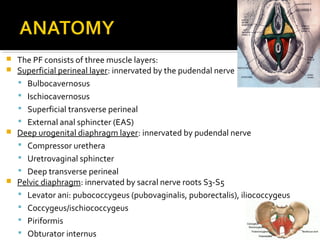
 The PF consists of three muscle layers:
 Superficial perineal layer: innervated by the pudendal nerve
 Bulbocavernosus
 Ischiocavernosus
 Superficial transverse perineal
 External anal sphincter (EAS)
 Deep urogenital diaphragm layer: innervated by pudendal nerve
 Compressor urethera
 Uretrovaginal sphincter
 Deep transverse perineal
 Pelvic diaphragm: innervated by sacral nerve roots S3-S5
 Levator ani: pubococcygeus (pubovaginalis, puborectalis), iliococcygeus
 Coccygeus/ischiococcygeus
 Piriformis
 Obturator internus
2 types of muscle fibres
Type I slow twitch fibers
Type II fast twitch fibres
70% PFM are slow twitch fibres
The PFM are the only transverse load
bearing muscle group in the body.
 In females, supports and gives tone to
the vaginal wall
 Supports pelvic organs against gravity
 Increase intra abdominal pressure
 Maintain anorectal angle.
 Relaxation for defecation/contraction
 Prevent incontinence (urinary & fecal)
Allow for opening of the pelvic floor to
accommodate excretory functions and
parturition
Reinforce urethral closure during increase
of intra abdominal pressure
Has an inhibitory effect on bladder activity
Assist in unloading the spine
Assists in pelvispinal stability
Contribute to sexual arousal and
performance
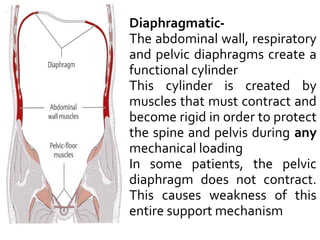
 Diaphragmatic-
 The abdominal wall, respiratory
and pelvic diaphragms create a
functional cylinder
 This cylinder is created by
muscles that must contract and
become rigid in order to protect
the spine and pelvis during any
mechanical loading
 In some patients, the pelvic
diaphragm does not contract.
This causes weakness of this
entire support mechanism
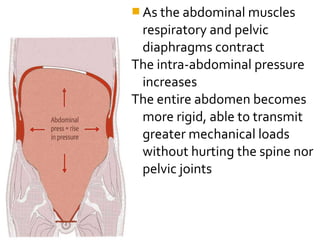
 As the abdominal muscles
respiratory and pelvic
diaphragms contract
The intra-abdominal pressure
increases
The entire abdomen becomes
more rigid, able to transmit
greater mechanical loads
without hurting the spine nor
pelvic joints
 Anatomic impairment
Birth injuries
Neurological dysfunction
 Psychological impairement
Motivation
Sexual abuse
 Pt assessment should include
 Presenting symptoms in order of importance
 Relevant obstetric , medical , gynecological
and surgical h/o
 Investigation, and previous and current
treatment
 Details of voiding dysfunction/ incontinence
 Details from frequency / volume charts, fluid
intake
 Rectal function-defecation pattern
 Objective assessment
 Digital per vaginal examination
 Digital per anal muscle assessment
 Effect of coughing and straining on vaginal wall and
organ position
 Six point scale- ( 0 for nil contraction, 1- flicker, 2- weak,
3- moderate, 4- good, 5- strong)
 Position – supine or standing
 One finger or two finger
 Perineometer- records vaginal pressure
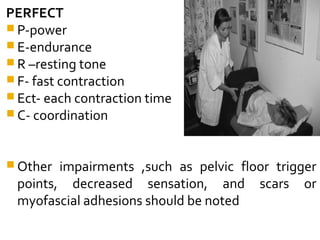
PERFECT
 P-power
 E-endurance
 R –resting tone
 F- fast contraction
 Ect- each contraction time
 C- coordination
 Other impairments ,such as pelvic floor trigger
points, decreased sensation, and scars or
myofascial adhesions should be noted
 1.vaginal examination by the physiotherapist
 2. self-examination by the patient
 3. hand on perineum by the physiotherapist
 4. hand on perineum by the patient
 5. observation of perineum by the
physiotherapist
 6. observation of perineum by the patient –
using a mirror
 7. perineometer
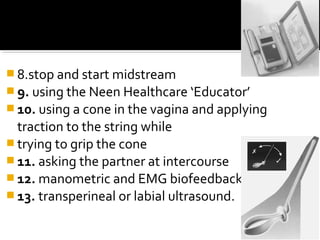
 8.stop and start midstream
 9. using the Neen Healthcare ‘Educator’
 10. using a cone in the vagina and applying
traction to the string while
 trying to grip the cone
 11. asking the partner at intercourse
 12. manometric and EMG biofeedback
 13. transperineal or labial ultrasound.
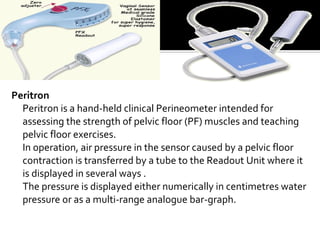
Peritron
Peritron is a hand-held clinical Perineometer intended for
assessing the strength of pelvic floor (PF) muscles and teaching
pelvic floor exercises.
In operation, air pressure in the sensor caused by a pelvic floor
contraction is transferred by a tube to the Readout Unit where it
is displayed in several ways .
The pressure is displayed either numerically in centimetres water
pressure or as a multi-range analogue bar-graph.
 Grades
 1/5- unable to slow the stream of urine
 2/5- can slow the stream of urine but cannot stop
it
 3/5- can stop the flow of urine slowly and with
difficulty
 4/5- urine stop abruptly but cannot be repeated
 5/5- urine stops abruptly and stopping can be
repeated.
 Jumping jack test
 Pad test
 EMG
 Urodynamic assessment
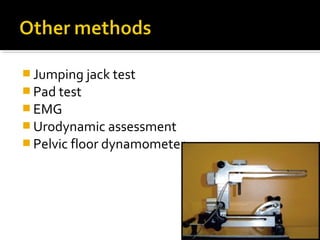
 Pelvic floor dynamometer
 Pregnancy
 Within 6 weeks of vaginal or cesarean delivery
and pelvic surgery
 Atrophic vaginitis
 Active pelvic infection
 severe pelvic or vaginal pain
 Childern and pre sexual adolescents
 Lack of informed concent
 Lack of therapist training
Endurance impairment
Mobility impairment
Posture impairment
Coordination impairment
Supportive dysfunction
Hypertonic dysfunction
In coordination dysfunction
Visceral dysfunction
 Results from loss of strength and integrity of
contractile and non contractile tissues.
 This dysfunction is weakness and sagging of
PFM.
 Common diagnosis associated with
supportive dysfunction are stress
incontinence, mixed incontinence and pelvic
organ prolapse.
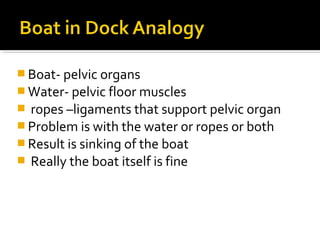
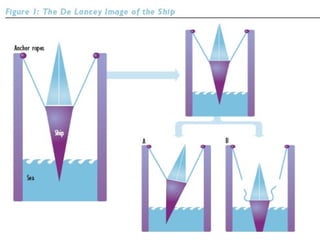
 Boat- pelvic organs
 Water- pelvic floor muscles
 ropes –ligaments that support pelvic organ
 Problem is with the water or ropes or both
 Result is sinking of the boat
 Really the boat itself is fine
 Anatomic impairment of PFM and nerves in
the area
 Vaginal delivery
 Muscle atrophy due to central and peripheral
nervous system defect
 Decrease awareness leads to weakness
 Prolong intra abdominal pressure may result
in stretching of PFM or their tendons.
 obesity
 Impaired performance and endurance of PFM
 Increased PFM length
 Increased connective tissue length and
muscle atrophy
 Impaired abdominal muscle performance
 Coordination of the PFM decreased
 Pain in PFM
 Mobility impairment of pelvic joint.
 Symptom of incontinence
 Related to pain and spasm
 Medical diagnosis associated with hypertonia
dysfunction, include levator ani syndrome,
pelvic floor tension myalgia, coccygodynia,
vulvodynia , vestibulitis, vaginismus, chronic
pelvic pain and dyspareunia.
 Hypertonic dysfunction may result from pelvic
joint dysfunctions, hip muscle imbalance, and
abdomino pelvic adhesions and scars affecting
the PFM function.
 Lumbo pelvic joint mobility impairments or
pathology.
 Injuries, such as fall onto the coccyx or pubic
ramus.
 Hip muscle imbalance with coordination, pain,
altered tone, and muscle performance
impairments.
 Abdominal and perineal adhesions due to pelvic or
abdominal surgery or inflammatory condition of
abdomen, such as endometriosis.
 Altered tone of the PFM, associated muscle of
hip, buttock and trunk.
 Mobility impairment of scar and connective
tissue
 Mobility impairment( hypermobility,
hypomobility) of pelvic joints: SI joint, pubic,
lumbar, hip and sacrococcygeal.
 Faulty posture
 Pain in perineum
 Hypersensitivity of skin and mucosa.
 Divided into neurological and non neurological
 Detrusor sphincter dyssynergia is a type of
incoordination resulting from neurological lesion in
the spinal cord between brain stem and T10.the
PFM and smooth internal sphincter contract during
a bladder contraction so that urine is unable to be
expelled.
 Non-neurological incoordination dysfunction is
characterized by absent or inappropriate patterns
of timing and recruitment of the PFM.
 Discuse and decrease awareness of PFM.
 Pain in the pelvic or abdominal area may
disrupt recruitment pattern.
 PFM weakness
 Coordination impairment
 Pseudo- PFM dysfunction dysfunction.
 It is an abnormlity in mobility or motility of
the abdominopelvic visceral tissue that leads
to pain and musculoskeletal impairment.
 Detrusor instability
 Endometriosis
 pelvic inflammatory disease.
 Dysmenorrhea
 Surgical scars
 Irritable bowel syndrome
 Interstitial cystitis.
 Weakness of the abdominal muscles, especially the
oblique and transverse layers may occur in
response to pain in the abdomen, causing a
pendulous abdomen with poor visceral and lumbar
support.
 Secondary lumbo pelvic joint mobility impairment
and posture impairments may result.
 Altered tone or impaired muscle performance of
the PFM may also occur as result of pain in the
lower pelvic pain.

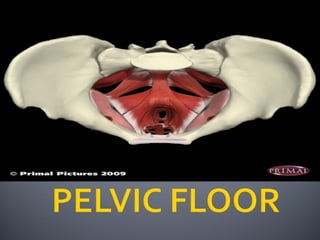
Pelvic floor

  • 2.
     The PFconsists of three muscle layers:  Superficial perineal layer: innervated by the pudendal nerve  Bulbocavernosus  Ischiocavernosus  Superficial transverse perineal  External anal sphincter (EAS)  Deep urogenital diaphragm layer: innervated by pudendal nerve  Compressor urethera  Uretrovaginal sphincter  Deep transverse perineal  Pelvic diaphragm: innervated by sacral nerve roots S3-S5  Levator ani: pubococcygeus (pubovaginalis, puborectalis), iliococcygeus  Coccygeus/ischiococcygeus  Piriformis  Obturator internus
  • 3.
    2 types ofmuscle fibres Type I slow twitch fibers Type II fast twitch fibres 70% PFM are slow twitch fibres The PFM are the only transverse load bearing muscle group in the body.
  • 4.
     In females,supports and gives tone to the vaginal wall  Supports pelvic organs against gravity  Increase intra abdominal pressure  Maintain anorectal angle.  Relaxation for defecation/contraction  Prevent incontinence (urinary & fecal)
  • 5.
    Allow for openingof the pelvic floor to accommodate excretory functions and parturition Reinforce urethral closure during increase of intra abdominal pressure Has an inhibitory effect on bladder activity Assist in unloading the spine Assists in pelvispinal stability Contribute to sexual arousal and performance
  • 6.
     Diaphragmatic-  Theabdominal wall, respiratory and pelvic diaphragms create a functional cylinder  This cylinder is created by muscles that must contract and become rigid in order to protect the spine and pelvis during any mechanical loading  In some patients, the pelvic diaphragm does not contract. This causes weakness of this entire support mechanism
  • 7.
     As theabdominal muscles respiratory and pelvic diaphragms contract The intra-abdominal pressure increases The entire abdomen becomes more rigid, able to transmit greater mechanical loads without hurting the spine nor pelvic joints
  • 8.
     Anatomic impairment Birthinjuries Neurological dysfunction  Psychological impairement Motivation Sexual abuse
  • 9.
     Pt assessmentshould include  Presenting symptoms in order of importance  Relevant obstetric , medical , gynecological and surgical h/o  Investigation, and previous and current treatment  Details of voiding dysfunction/ incontinence  Details from frequency / volume charts, fluid intake
  • 10.
     Rectal function-defecationpattern  Objective assessment  Digital per vaginal examination  Digital per anal muscle assessment  Effect of coughing and straining on vaginal wall and organ position  Six point scale- ( 0 for nil contraction, 1- flicker, 2- weak, 3- moderate, 4- good, 5- strong)  Position – supine or standing  One finger or two finger  Perineometer- records vaginal pressure
  • 11.
    PERFECT  P-power  E-endurance R –resting tone  F- fast contraction  Ect- each contraction time  C- coordination  Other impairments ,such as pelvic floor trigger points, decreased sensation, and scars or myofascial adhesions should be noted
  • 12.
     1.vaginal examinationby the physiotherapist  2. self-examination by the patient  3. hand on perineum by the physiotherapist  4. hand on perineum by the patient  5. observation of perineum by the physiotherapist  6. observation of perineum by the patient – using a mirror  7. perineometer
  • 13.
     8.stop andstart midstream  9. using the Neen Healthcare ‘Educator’  10. using a cone in the vagina and applying traction to the string while  trying to grip the cone  11. asking the partner at intercourse  12. manometric and EMG biofeedback  13. transperineal or labial ultrasound.
  • 14.
    Peritron Peritron is ahand-held clinical Perineometer intended for assessing the strength of pelvic floor (PF) muscles and teaching pelvic floor exercises. In operation, air pressure in the sensor caused by a pelvic floor contraction is transferred by a tube to the Readout Unit where it is displayed in several ways . The pressure is displayed either numerically in centimetres water pressure or as a multi-range analogue bar-graph.
  • 15.
     Grades  1/5-unable to slow the stream of urine  2/5- can slow the stream of urine but cannot stop it  3/5- can stop the flow of urine slowly and with difficulty  4/5- urine stop abruptly but cannot be repeated  5/5- urine stops abruptly and stopping can be repeated.
  • 16.
     Jumping jacktest  Pad test  EMG  Urodynamic assessment  Pelvic floor dynamometer
  • 17.
     Pregnancy  Within6 weeks of vaginal or cesarean delivery and pelvic surgery  Atrophic vaginitis  Active pelvic infection  severe pelvic or vaginal pain  Childern and pre sexual adolescents  Lack of informed concent  Lack of therapist training
  • 18.
    Endurance impairment Mobility impairment Postureimpairment Coordination impairment
  • 19.
    Supportive dysfunction Hypertonic dysfunction Incoordination dysfunction Visceral dysfunction
  • 20.
     Results fromloss of strength and integrity of contractile and non contractile tissues.  This dysfunction is weakness and sagging of PFM.  Common diagnosis associated with supportive dysfunction are stress incontinence, mixed incontinence and pelvic organ prolapse.
  • 21.
     Boat- pelvicorgans  Water- pelvic floor muscles  ropes –ligaments that support pelvic organ  Problem is with the water or ropes or both  Result is sinking of the boat  Really the boat itself is fine
  • 23.
     Anatomic impairmentof PFM and nerves in the area  Vaginal delivery  Muscle atrophy due to central and peripheral nervous system defect  Decrease awareness leads to weakness  Prolong intra abdominal pressure may result in stretching of PFM or their tendons.  obesity
  • 24.
     Impaired performanceand endurance of PFM  Increased PFM length  Increased connective tissue length and muscle atrophy  Impaired abdominal muscle performance  Coordination of the PFM decreased  Pain in PFM  Mobility impairment of pelvic joint.  Symptom of incontinence
  • 25.
     Related topain and spasm  Medical diagnosis associated with hypertonia dysfunction, include levator ani syndrome, pelvic floor tension myalgia, coccygodynia, vulvodynia , vestibulitis, vaginismus, chronic pelvic pain and dyspareunia.  Hypertonic dysfunction may result from pelvic joint dysfunctions, hip muscle imbalance, and abdomino pelvic adhesions and scars affecting the PFM function.
  • 26.
     Lumbo pelvicjoint mobility impairments or pathology.  Injuries, such as fall onto the coccyx or pubic ramus.  Hip muscle imbalance with coordination, pain, altered tone, and muscle performance impairments.  Abdominal and perineal adhesions due to pelvic or abdominal surgery or inflammatory condition of abdomen, such as endometriosis.
  • 27.
     Altered toneof the PFM, associated muscle of hip, buttock and trunk.  Mobility impairment of scar and connective tissue  Mobility impairment( hypermobility, hypomobility) of pelvic joints: SI joint, pubic, lumbar, hip and sacrococcygeal.  Faulty posture  Pain in perineum  Hypersensitivity of skin and mucosa.
  • 28.
     Divided intoneurological and non neurological  Detrusor sphincter dyssynergia is a type of incoordination resulting from neurological lesion in the spinal cord between brain stem and T10.the PFM and smooth internal sphincter contract during a bladder contraction so that urine is unable to be expelled.  Non-neurological incoordination dysfunction is characterized by absent or inappropriate patterns of timing and recruitment of the PFM.
  • 29.
     Discuse anddecrease awareness of PFM.  Pain in the pelvic or abdominal area may disrupt recruitment pattern.  PFM weakness  Coordination impairment
  • 30.
     Pseudo- PFMdysfunction dysfunction.  It is an abnormlity in mobility or motility of the abdominopelvic visceral tissue that leads to pain and musculoskeletal impairment.  Detrusor instability
  • 31.
     Endometriosis  pelvicinflammatory disease.  Dysmenorrhea  Surgical scars  Irritable bowel syndrome  Interstitial cystitis.
  • 32.
     Weakness ofthe abdominal muscles, especially the oblique and transverse layers may occur in response to pain in the abdomen, causing a pendulous abdomen with poor visceral and lumbar support.  Secondary lumbo pelvic joint mobility impairment and posture impairments may result.  Altered tone or impaired muscle performance of the PFM may also occur as result of pain in the lower pelvic pain.