1|Antiderivative

Chapter 1
Antiderivatives
Most of the mathematical operations that we work with come in inverse pairs:
addition and subraction, multiplication and division, exponentiation and root taking.
We have studied how to find the derivative of a function. However, many problems
require that we recover a function from its known derivative (from its known rate of
change). For instance, we may know the velocity function of an object falling from
an initial height and need to know its height at any time over some period. More
generally, we want to find a function F from its derivative ƒ. If such a function F
exists, it is called an anti-derivative of ƒ.

DEFINITION 1.1 Antiderivative
A function F is an antiderivative of ƒ on an interval I if

The process of recovering a function

for all x in I.

F(x) from its derivative ƒ(x) is called

antidifferentiation. We use capital letters such as F to represent an antiderivative of a
function ƒ, G to represent an antiderivative of g, and so forth.

EXAMPLE 1.1
Find an antiderivative of the function

on

SOLUTION
We seek a function F satisfying
with differentiation, we know that

for all real x. From our experience
is one such function.

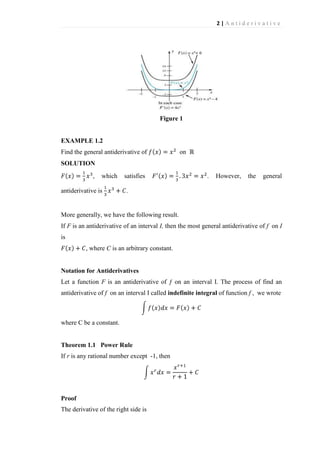
A moment’s thought will suggest other solution to Example 1. The function
also satisfies
In fact,
(see Figure 1).

, it too is an antiderivative of

, where C is any constant, is an antiderivative of

.
on
2|Antiderivative

Figure 1

EXAMPLE 1.2
Find the general antiderivative of

on

SOLUTION
,

which

antiderivative is

satisfies

.

However,

the

general

.

More generally, we have the following result.
If F is an antiderivative of an interval I, then the most general antiderivative of f on I
is
, where C is an arbitrary constant.

Notation for Antiderivatives
Let a function F is an antiderivative of ƒ on an interval I. The process of find an
antiderivative of f on an interval I called indefinite integral of function f , we wrote

where C be a constant.

Theorem 1.1 Power Rule
If r is any rational number except -1, then

Proof
The derivative of the right side is
3|Antiderivative

We make two comments about Theorem 1.1. First, it is meant to include the
case r = 0; that is,

Second, since no interval I is specified, the conclusion is understood to be valid only
on interval on which

is defined. In particular, we must exclude any interval

containing the origin if r < 0.

EXAMPLE 1.3
Find the general antiderivative of
SOLUTION

Theorem 1.2
and

Proof
Simply note that

and

Theorem 1.3 Indefinite Integral is a Linier Operator
Let f and g have antiderivatives (indefinite integrals) and let k be a constant.
Then
(i)
(ii)
(iii)
4|Antiderivative

Proof
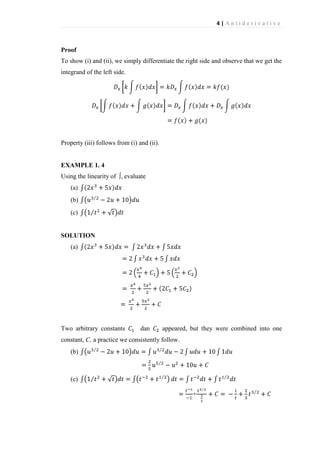
To show (i) and (ii), we simply differentiate the right side and observe that we get the
integrand of the left side.

Property (iii) follows from (i) and (ii).

EXAMPLE 1. 4
Using the linearity of ∫, evaluate
(a)
(b)
(c)

SOLUTION
(a)

Two arbitrary constants

dan

appeared, but they were combined into one

constant, C, a practice we consistently follow.
(b)

(c)
+
5|Antiderivative

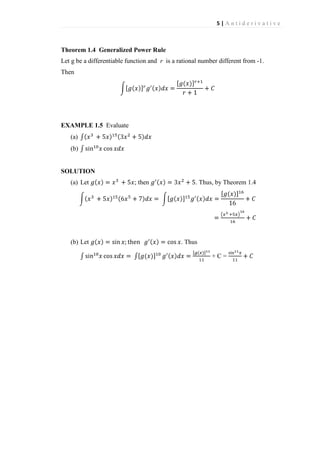
Theorem 1.4 Generalized Power Rule
Let g be a differentiable function and r is a rational number different from -1.
Then

EXAMPLE 1.5 Evaluate
(a)
(b)

SOLUTION
(a) Let

(b) Let

; then

. Thus, by Theorem 1.4

. Thus
+C=
6|Antiderivative

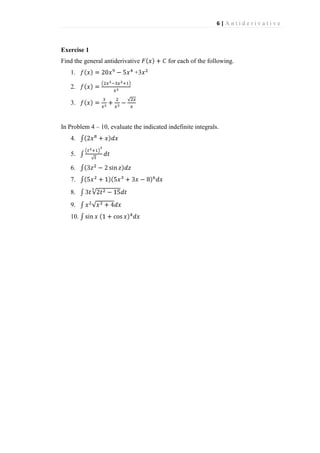
Exercise 1
Find the general antiderivative
1.

for each of the following.

+3

2.
3.

In Problem 4 – 10, evaluate the indicated indefinite integrals.
4.
5.
6.
7.
8.
9.
10.

Chapter 1

  • 1.
    1|Antiderivative Chapter 1 Antiderivatives Most ofthe mathematical operations that we work with come in inverse pairs: addition and subraction, multiplication and division, exponentiation and root taking. We have studied how to find the derivative of a function. However, many problems require that we recover a function from its known derivative (from its known rate of change). For instance, we may know the velocity function of an object falling from an initial height and need to know its height at any time over some period. More generally, we want to find a function F from its derivative ƒ. If such a function F exists, it is called an anti-derivative of ƒ. DEFINITION 1.1 Antiderivative A function F is an antiderivative of ƒ on an interval I if The process of recovering a function for all x in I. F(x) from its derivative ƒ(x) is called antidifferentiation. We use capital letters such as F to represent an antiderivative of a function ƒ, G to represent an antiderivative of g, and so forth. EXAMPLE 1.1 Find an antiderivative of the function on SOLUTION We seek a function F satisfying with differentiation, we know that for all real x. From our experience is one such function. A moment’s thought will suggest other solution to Example 1. The function also satisfies In fact, (see Figure 1). , it too is an antiderivative of , where C is any constant, is an antiderivative of . on
  • 2.
    2|Antiderivative Figure 1 EXAMPLE 1.2 Findthe general antiderivative of on SOLUTION , which antiderivative is satisfies . However, the general . More generally, we have the following result. If F is an antiderivative of an interval I, then the most general antiderivative of f on I is , where C is an arbitrary constant. Notation for Antiderivatives Let a function F is an antiderivative of ƒ on an interval I. The process of find an antiderivative of f on an interval I called indefinite integral of function f , we wrote where C be a constant. Theorem 1.1 Power Rule If r is any rational number except -1, then Proof The derivative of the right side is
  • 3.
    3|Antiderivative We make twocomments about Theorem 1.1. First, it is meant to include the case r = 0; that is, Second, since no interval I is specified, the conclusion is understood to be valid only on interval on which is defined. In particular, we must exclude any interval containing the origin if r < 0. EXAMPLE 1.3 Find the general antiderivative of SOLUTION Theorem 1.2 and Proof Simply note that and Theorem 1.3 Indefinite Integral is a Linier Operator Let f and g have antiderivatives (indefinite integrals) and let k be a constant. Then (i) (ii) (iii)
  • 4.
    4|Antiderivative Proof To show (i)and (ii), we simply differentiate the right side and observe that we get the integrand of the left side. Property (iii) follows from (i) and (ii). EXAMPLE 1. 4 Using the linearity of ∫, evaluate (a) (b) (c) SOLUTION (a) Two arbitrary constants dan appeared, but they were combined into one constant, C, a practice we consistently follow. (b) (c) +
  • 5.
    5|Antiderivative Theorem 1.4 GeneralizedPower Rule Let g be a differentiable function and r is a rational number different from -1. Then EXAMPLE 1.5 Evaluate (a) (b) SOLUTION (a) Let (b) Let ; then . Thus, by Theorem 1.4 . Thus +C=
  • 6.
    6|Antiderivative Exercise 1 Find thegeneral antiderivative 1. for each of the following. +3 2. 3. In Problem 4 – 10, evaluate the indicated indefinite integrals. 4. 5. 6. 7. 8. 9. 10.