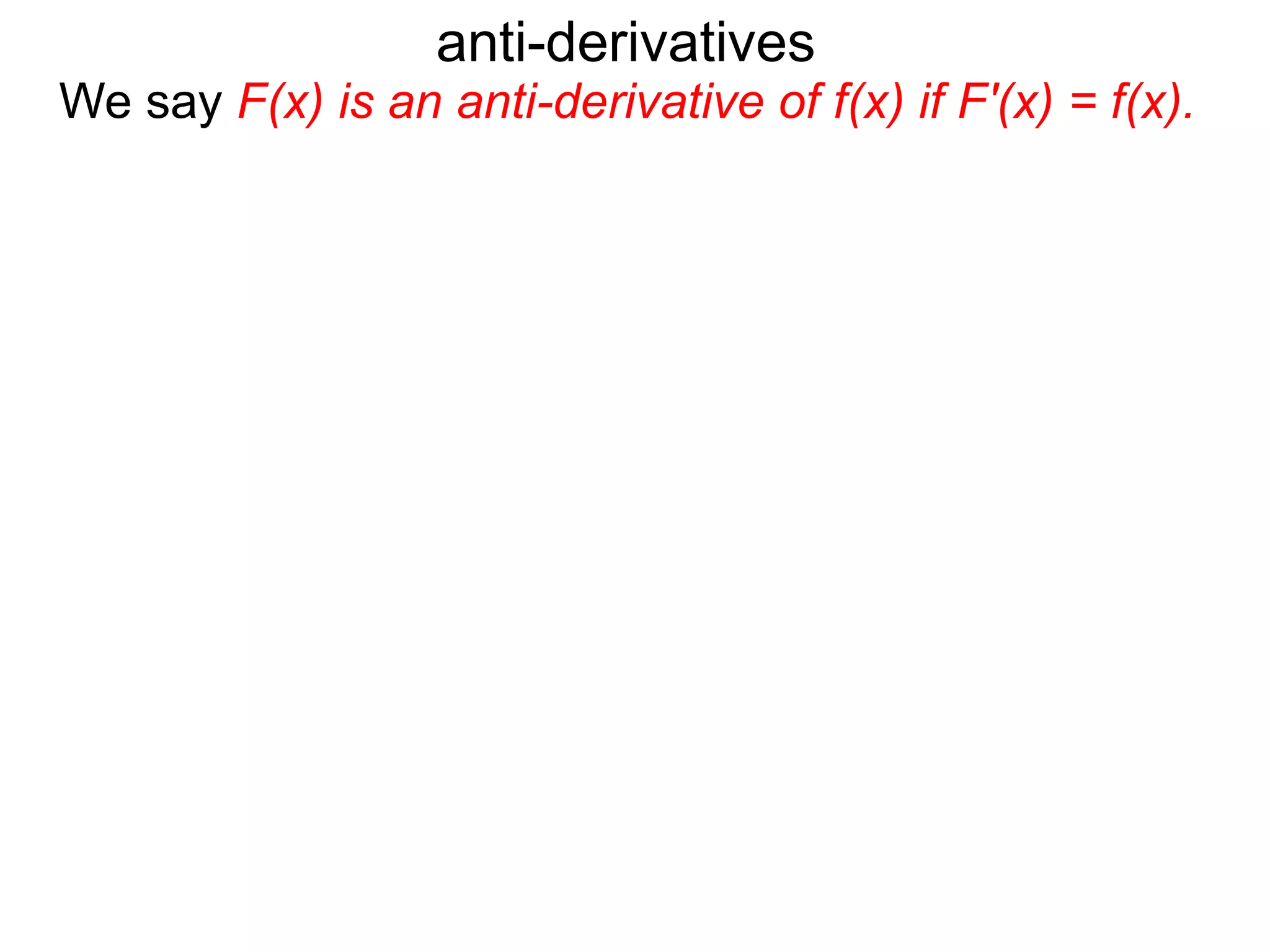
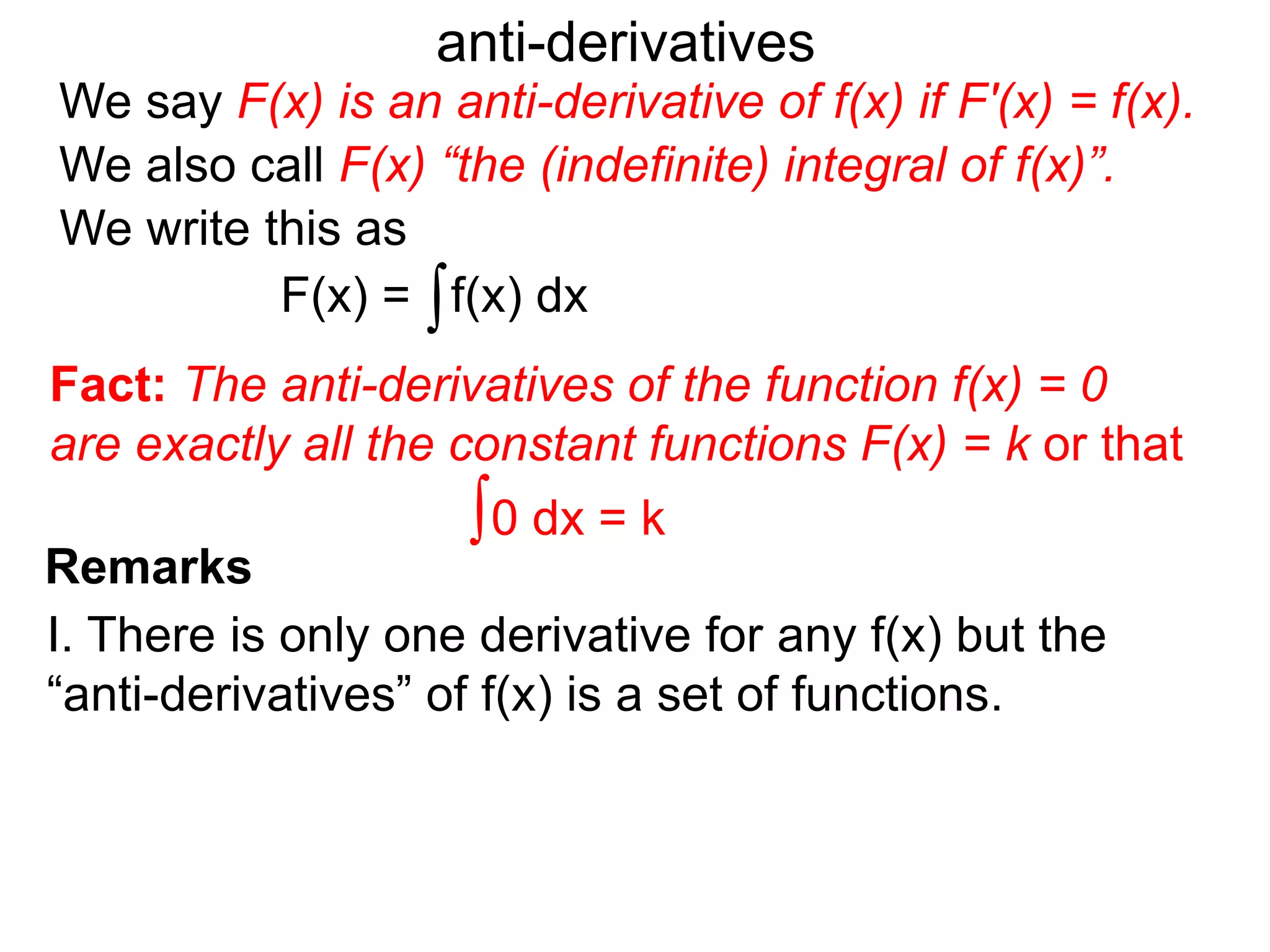
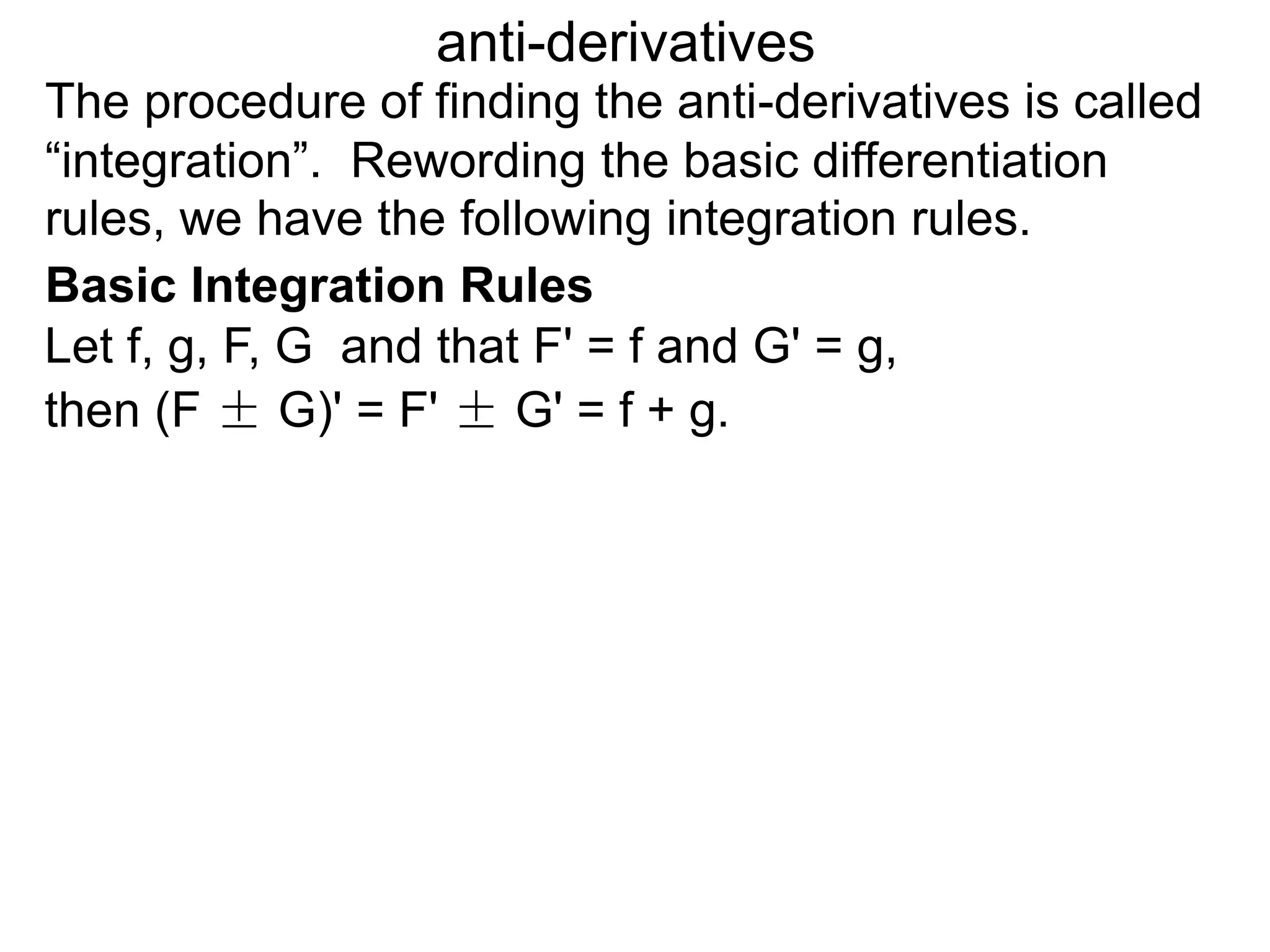
We say F(x) is an anti-derivative of f(x) if F'(x) = f(x).
anti-derivatives
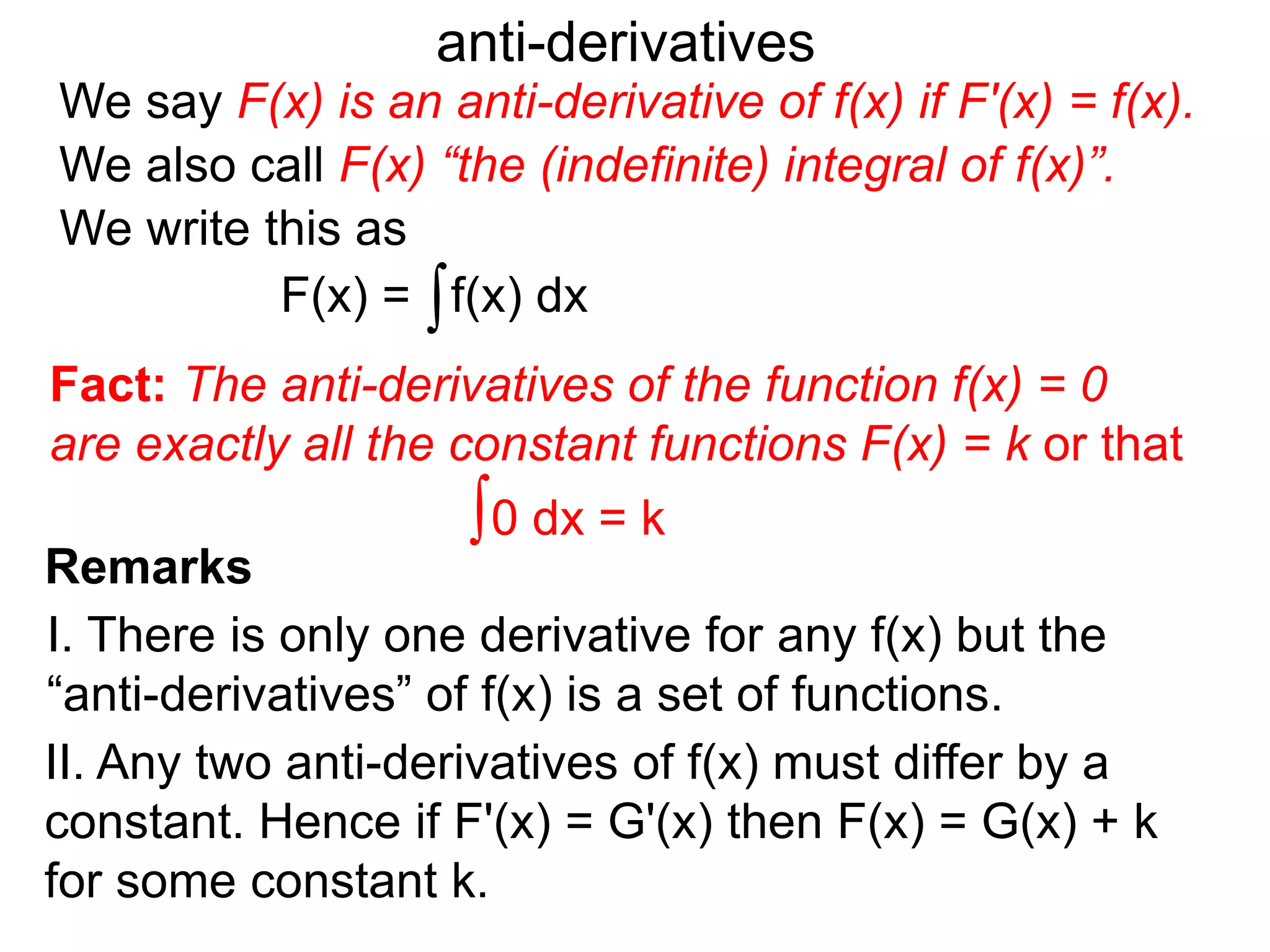
We say F(x) is an anti-derivative of f(x) if F'(x) = f(x).
anti-derivatives
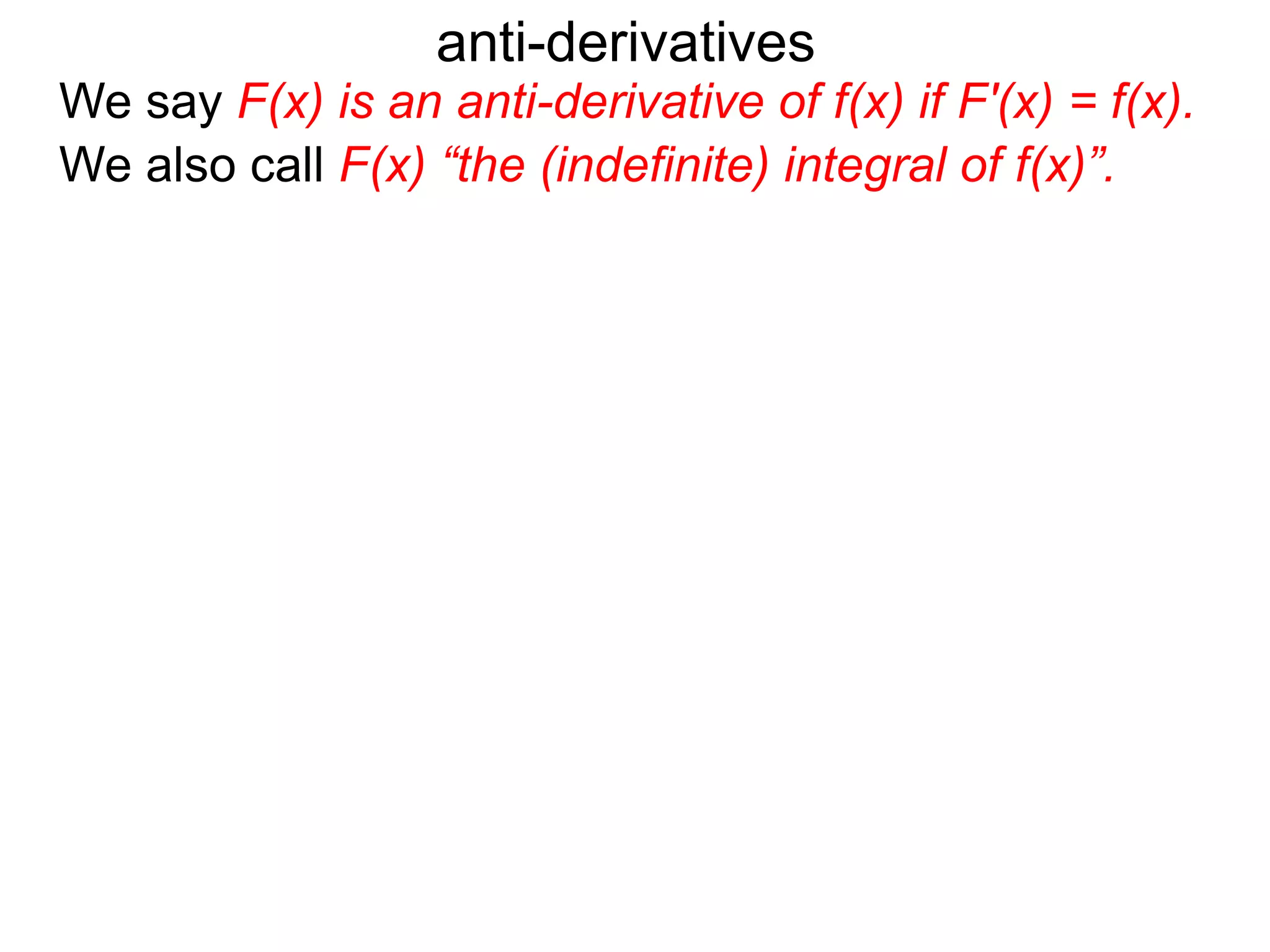
We also call F(x) “the (indefinite) integral of f(x)”.
We say F(x) is an anti-derivative of f(x) if F'(x) = f(x).
anti-derivatives
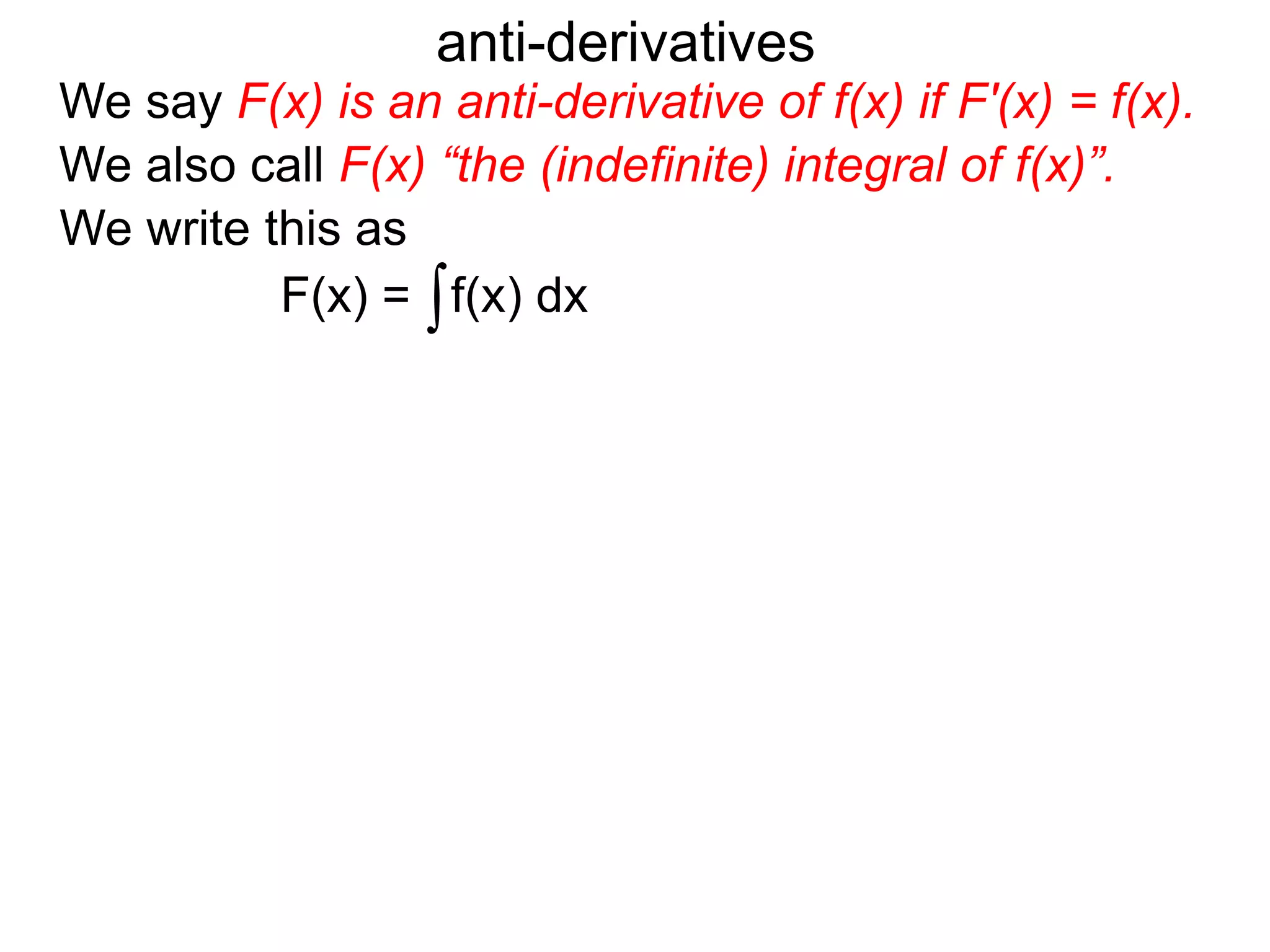
We write this as
∫f(x) dxF(x) =
We also call F(x) “the (indefinite) integral of f(x)”.
We say F(x) is an anti-derivative of f(x) if F'(x) = f(x).
anti-derivatives
We write this as
∫f(x) dxF(x) =
We also call F(x) “the (indefinite) integral of f(x)”.
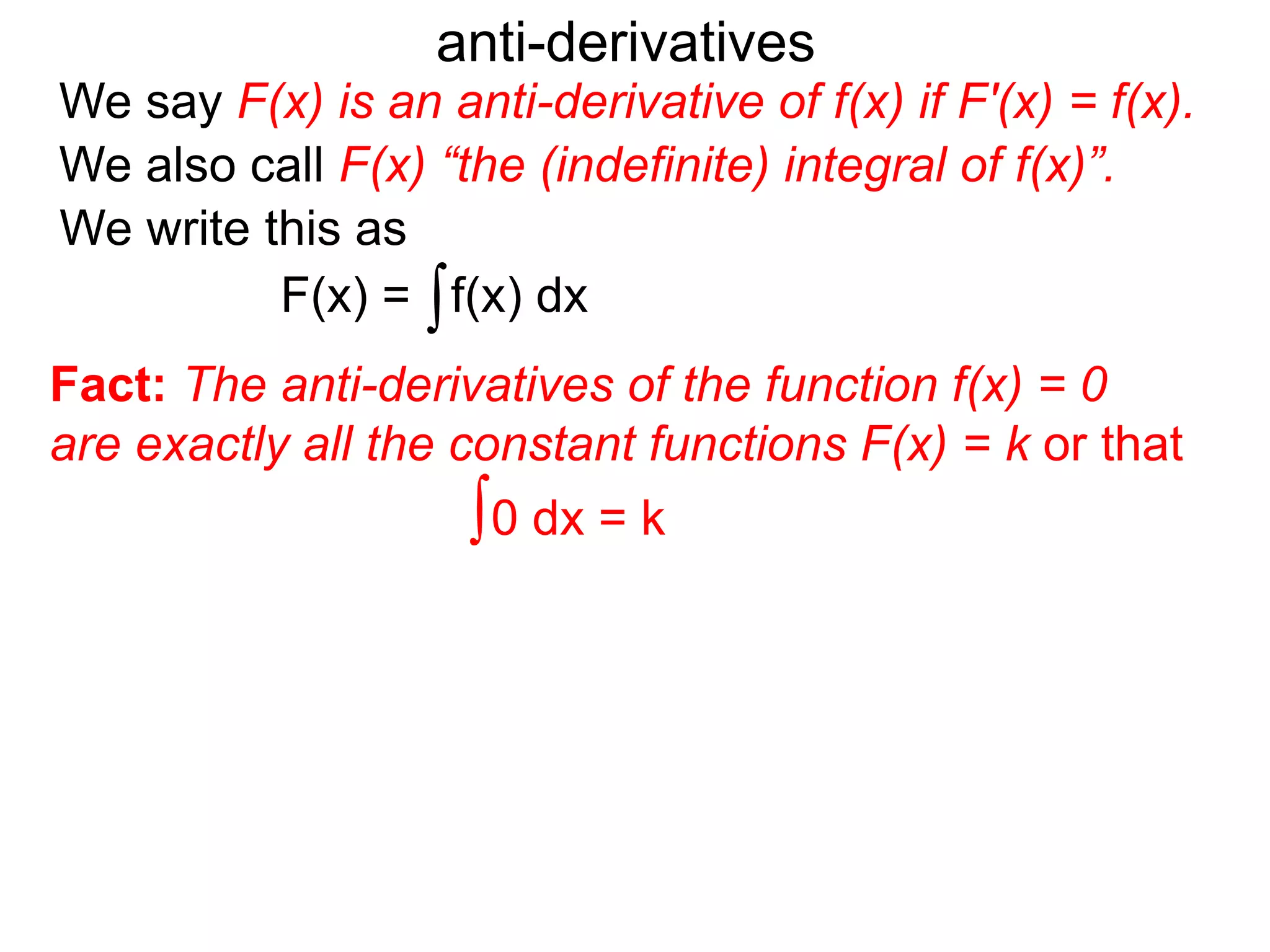
∫0 dx = k
Fact: The anti-derivatives of the function f(x) = 0
are exactly all the constant functions F(x) = k or that
We say F(x) is an anti-derivative of f(x) if F'(x) = f(x).
anti-derivatives
We write this as
∫f(x) dxF(x) =
We also call F(x) “the (indefinite) integral of f(x)”.
Remarks
I. There is only one derivative for any f(x) but the
“anti-derivatives” of f(x) is a set of functions.
∫0 dx = k
Fact: The anti-derivatives of the function f(x) = 0
are exactly all the constant functions F(x) = k or that
We say F(x) is an anti-derivative of f(x) if F'(x) = f(x).
anti-derivatives
We write this as
∫f(x) dx
∫0 dx = k
F(x) =
We also call F(x) “the (indefinite) integral of f(x)”.
Remarks
I. There is only one derivative for any f(x) but the
“anti-derivatives” of f(x) is a set of functions.
II. Any two anti-derivatives of f(x) must differ by a
constant. Hence if F'(x) = G'(x) then F(x) = G(x) + k
for some constant k.
Fact: The anti-derivatives of the function f(x) = 0
are exactly all the constant functions F(x) = k or that
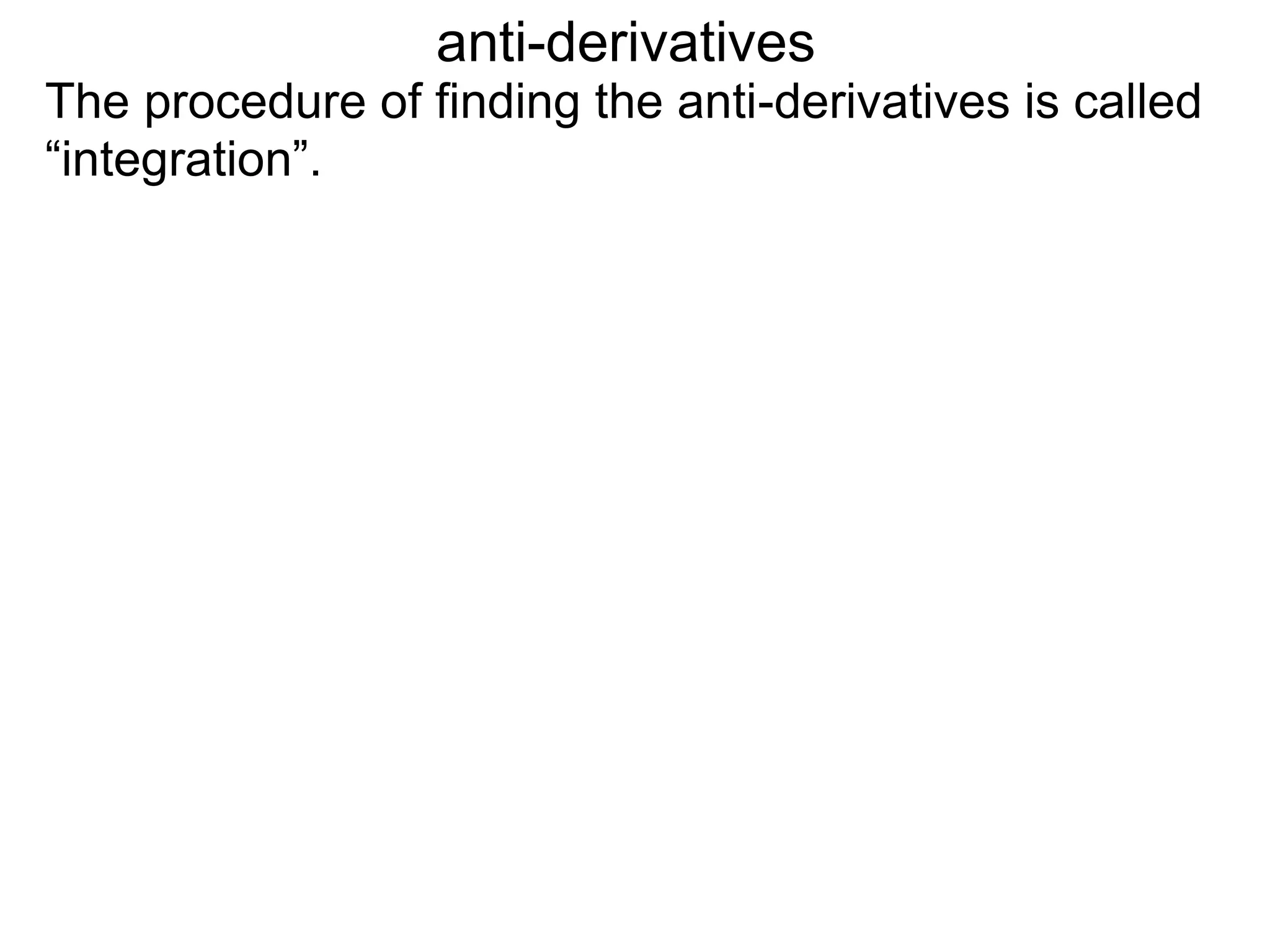
The procedure of finding the anti-derivatives is called
“integration”.
anti-derivatives
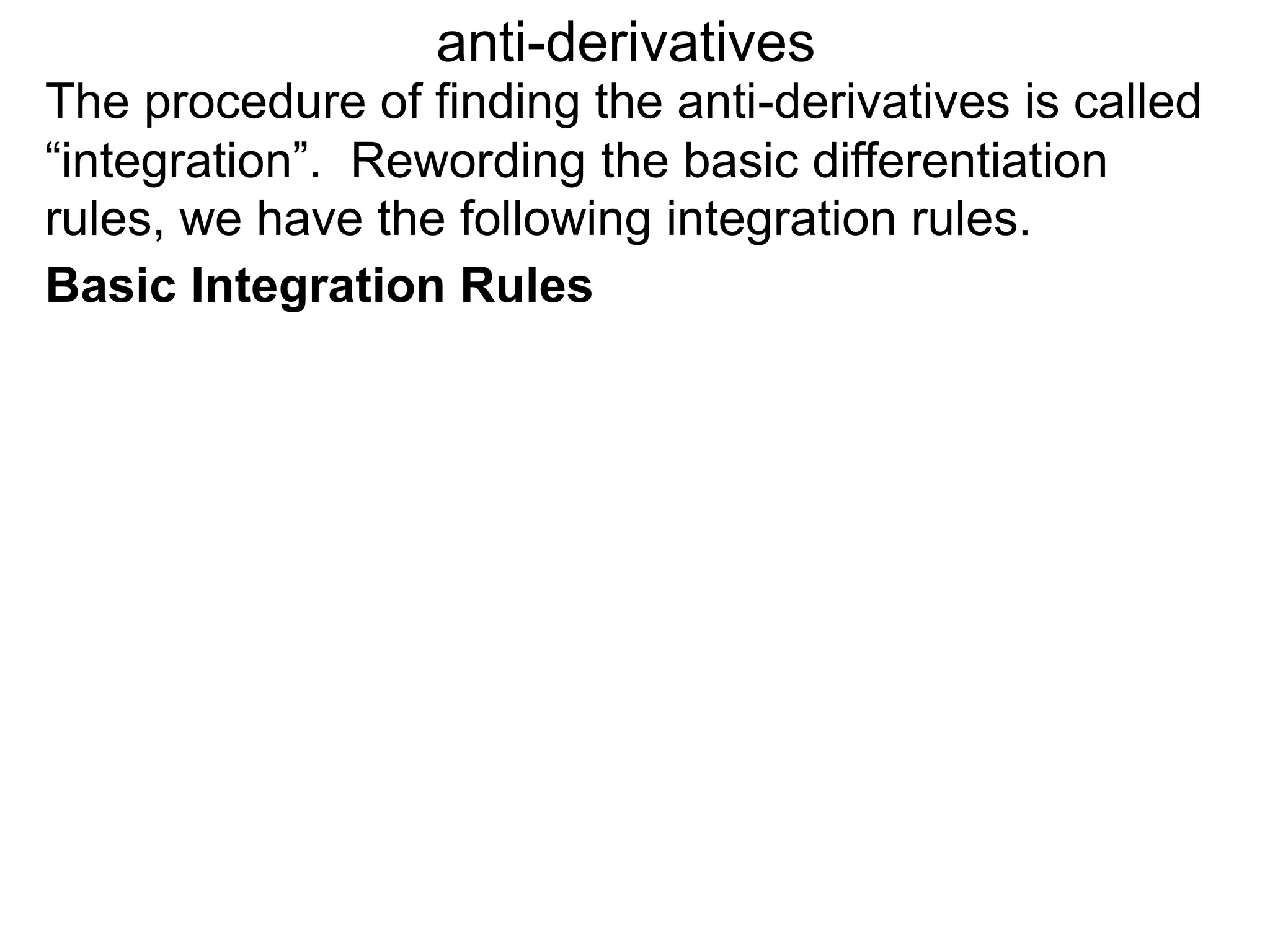
The procedure of finding the anti-derivatives is called
“integration”. Rewording the basic differentiation
rules, we have the following integration rules.
anti-derivatives
Basic Integration Rules
The procedure of finding the anti-derivatives is called
“integration”. Rewording the basic differentiation
rules, we have the following integration rules.
anti-derivatives
then (F ± G)' = F' ± G' = f + g.
Let f, g, F, G and that F' = f and G' = g,
Basic Integration Rules
The procedure of finding the anti-derivatives is called
“integration”. Rewording the basic differentiation
rules, we have the following integration rules.
anti-derivatives
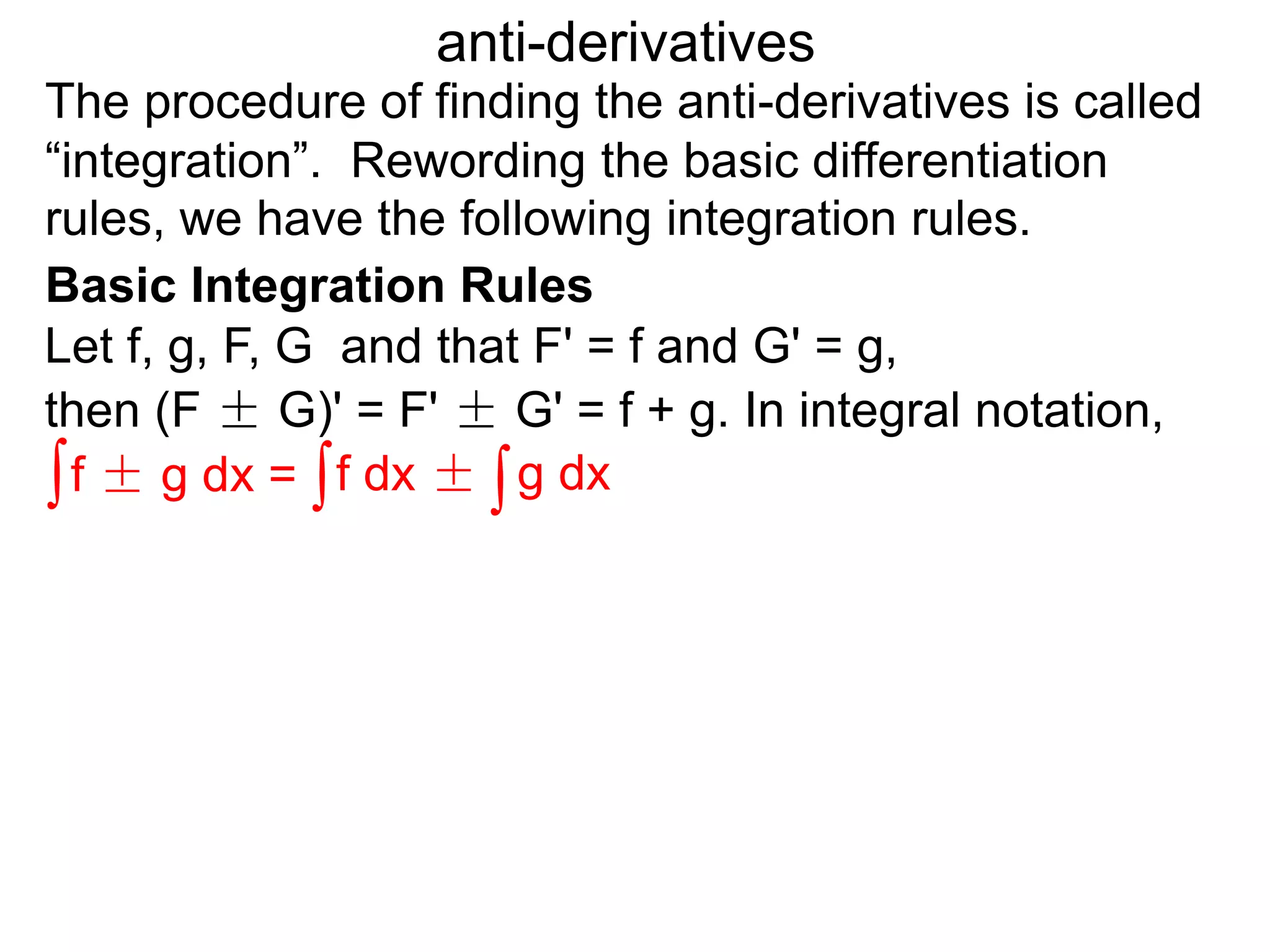
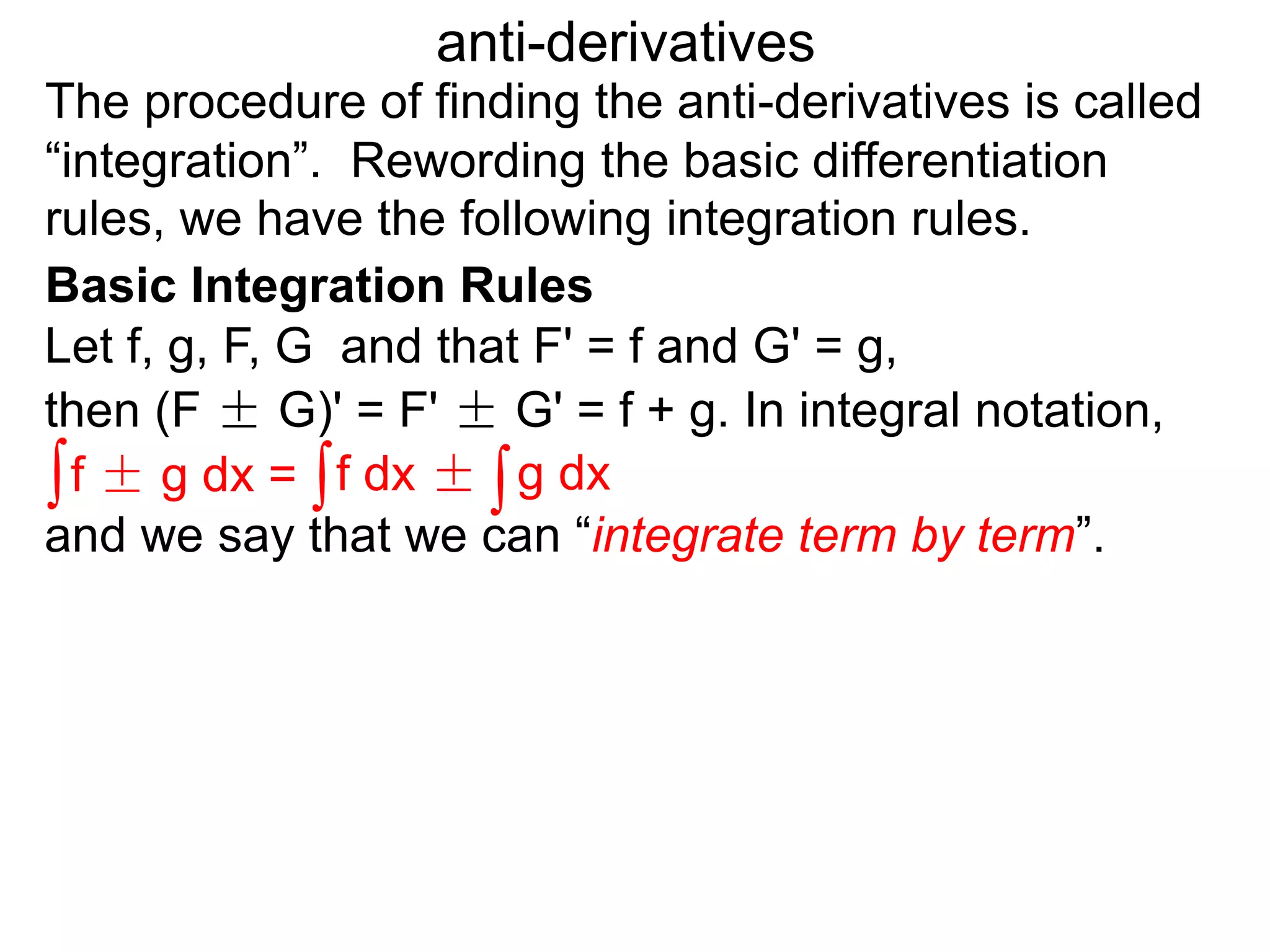
then (F ± G)' = F' ± G' = f + g. In integral notation,
Let f, g, F, G and that F' = f and G' = g,
∫f ± g dx = ∫f dx ± ∫g dx
Basic Integration Rules
The procedure of finding the anti-derivatives is called
“integration”. Rewording the basic differentiation
rules, we have the following integration rules.
anti-derivatives
then (F ± G)' = F' ± G' = f + g. In integral notation,
Let f, g, F, G and that F' = f and G' = g,
∫f ± g dx = ∫f dx ± ∫g dx
and we say that we can “integrate term by term”.
Basic Integration Rules
The procedure of finding the anti-derivatives is called
“integration”. Rewording the basic differentiation
rules, we have the following integration rules.
anti-derivatives
then (F ± G)' = F' ± G' = f + g. In integral notation,
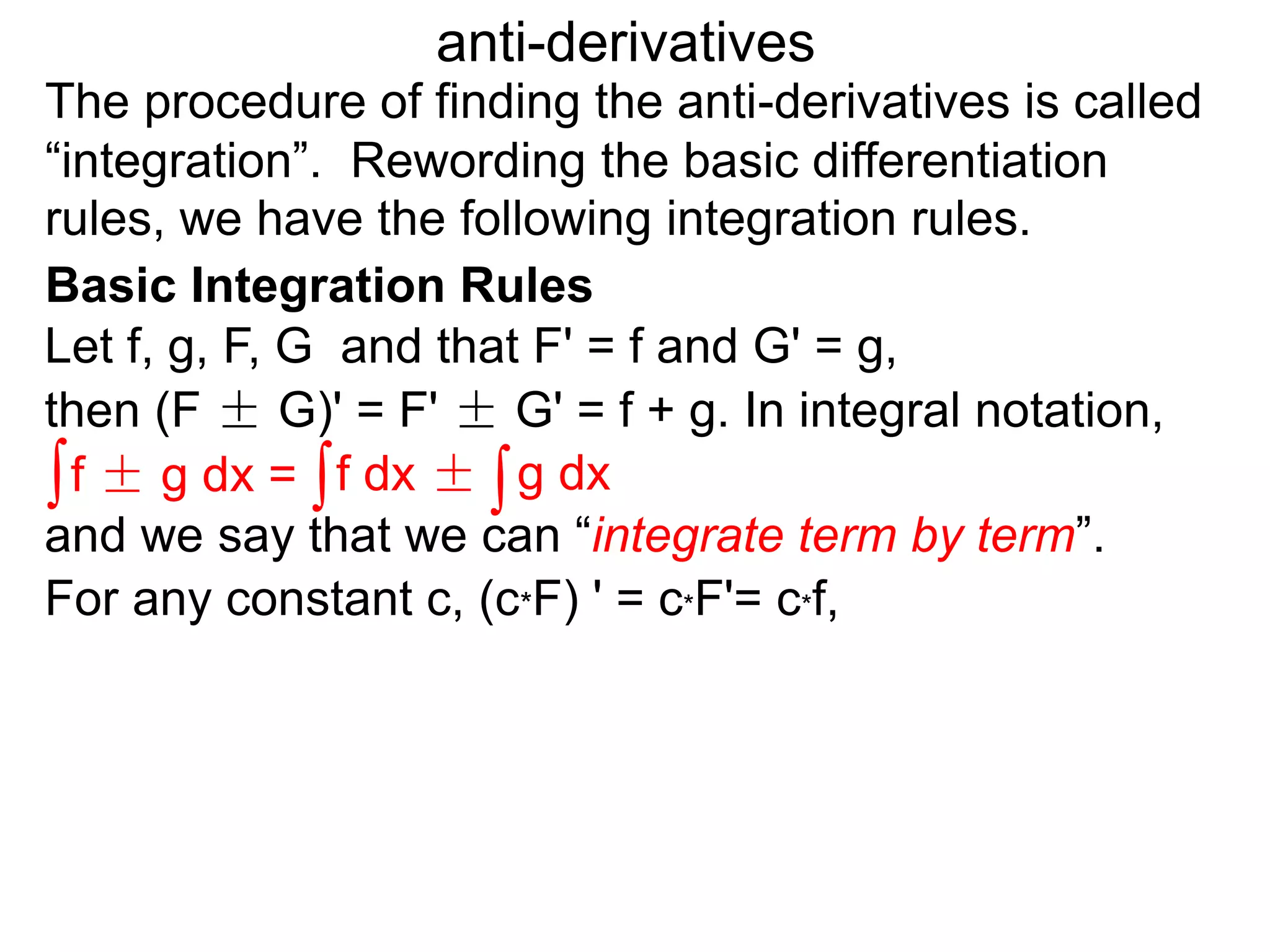
For any constant c, (c*F) ' = c*F'= c*f,
Let f, g, F, G and that F' = f and G' = g,
∫f ± g dx = ∫f dx ± ∫g dx
and we say that we can “integrate term by term”.
Basic Integration Rules
The procedure of finding the anti-derivatives is called
“integration”. Rewording the basic differentiation
rules, we have the following integration rules.
anti-derivatives
then (F ± G)' = F' ± G' = f + g. In integral notation,
For any constant c, (c*F) ' = c*F'= c*f, so in integrals,
Let f, g, F, G and that F' = f and G' = g,
∫f ± g dx = ∫f dx ± ∫g dx
∫cf dx = c∫f dx
and we say that we can “integrate term by term”.
Basic Integration Rules
The procedure of finding the anti-derivatives is called
“integration”. Rewording the basic differentiation
rules, we have the following integration rules.
anti-derivatives
then (F ± G)' = F' ± G' = f + g. In integral notation,
For any constant c, (c*F) ' = c*F'= c*f, so in integrals,
Let f, g, F, G and that F' = f and G' = g,
∫f ± g dx = ∫f dx ± ∫g dx
∫cf dx = c∫f dx
and we say that we can “integrate term by term”.
We say that we can “pull out the constant multiple.”
Basic Integration Rules
The procedure of finding the anti-derivatives is called
“integration”. Rewording the basic differentiation
rules, we have the following integration rules.
anti-derivatives
then (F ± G)' = F' ± G' = f + g. In integral notation,
For any constant c, (c*F) ' = c*F'= c*f, so in integrals,
Let f, g, F, G and that F' = f and G' = g,
∫f ± g dx = ∫f dx ± ∫g dx
∫cf dx = c∫f dx
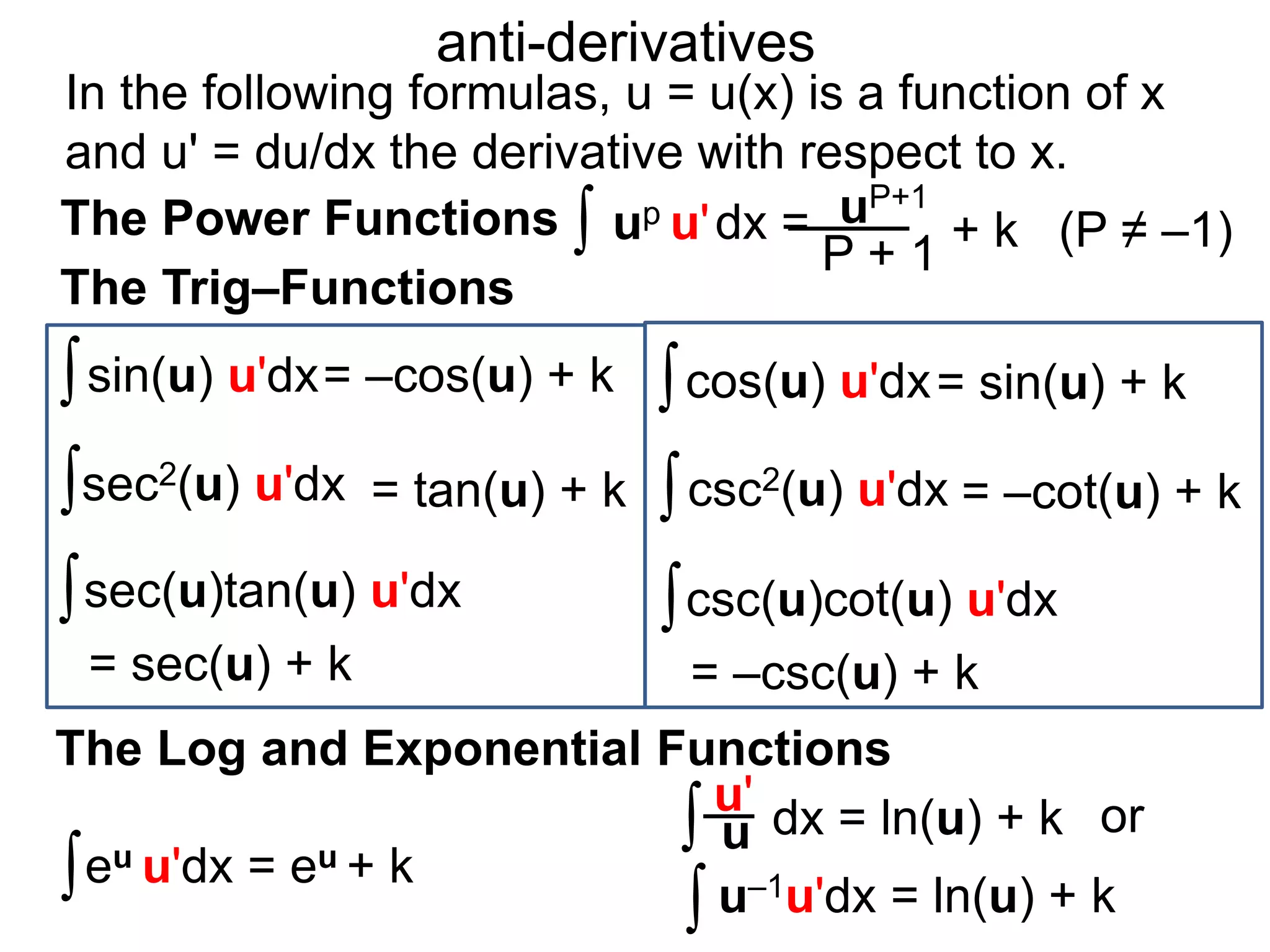
The following is a list of integration formulas for basic
functions.
and we say that we can “integrate term by term”.
We say that we can “pull out the constant multiple.”
Basic Integration Rules
The procedure of finding the anti-derivatives is called
“integration”. Rewording the basic differentiation
rules, we have the following integration rules.
anti-derivatives
then (F ± G)' = F' ± G' = f + g. In integral notation,
For any constant c, (c*F) ' = c*F'= c*f, so in integrals,
Let f, g, F, G and that F' = f and G' = g,
∫f ± g dx = ∫f dx ± ∫g dx
∫cf dx = c∫f dx
The following is a list of integration formulas for basic
functions. These formulas are just the derivatives of
the basic functions written in the integral forms.
and we say that we can “integrate term by term”.
We say that we can “pull out the constant multiple.”
Basic Integration Rules
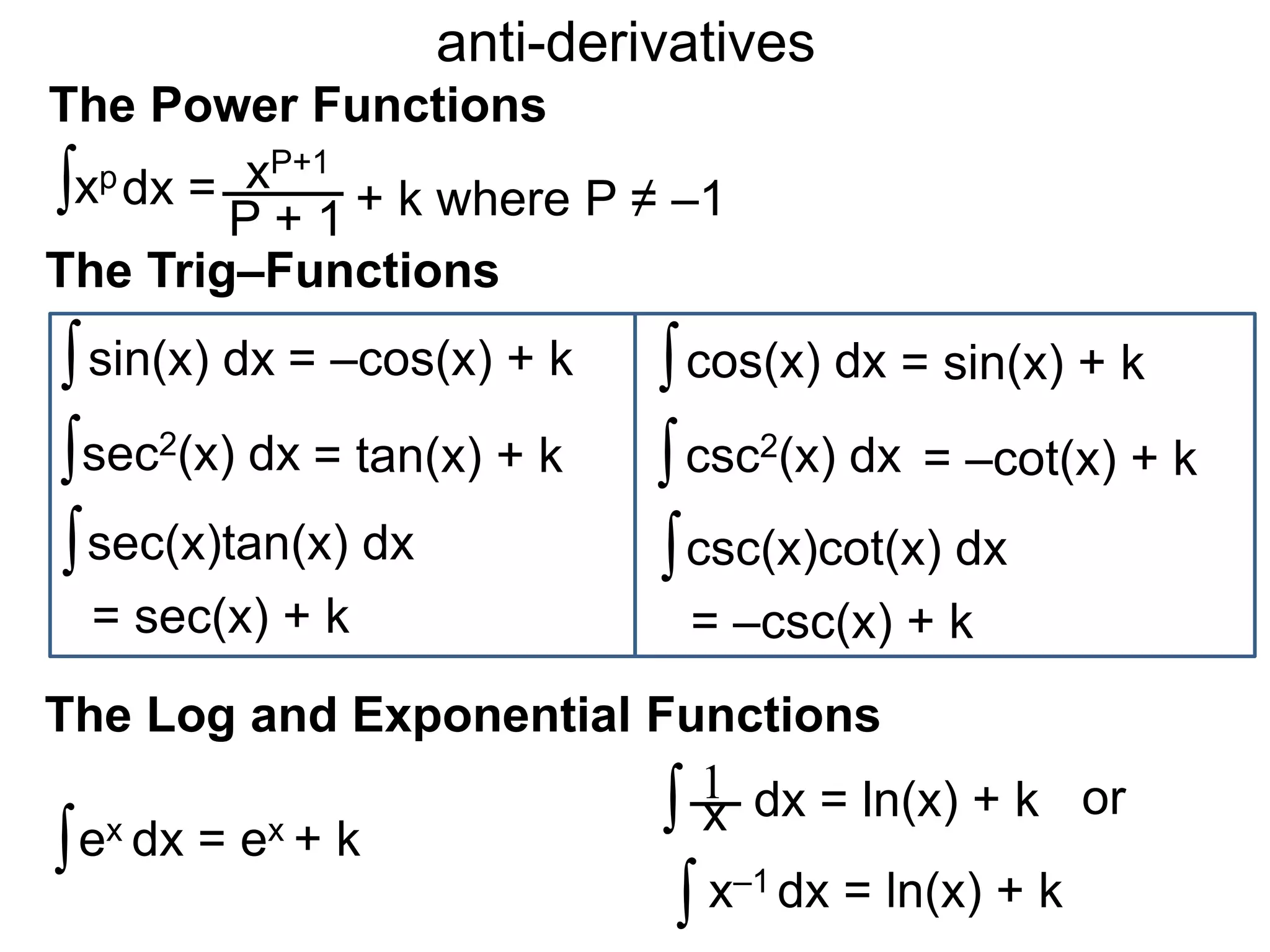
xpdx =
sin(x) dx = –cos(x) + k
sec(x)tan(x) dx
ex dx = ex + k
dx = ln(x) + kx
1
anti-derivatives
∫
∫
∫
∫ xP+1
P + 1 + k where P ≠ –1
cos(x) dx = sin(x) + k∫
sec2(x) dx = tan(x) + k∫ = –cot(x) + k∫
∫
= sec(x) + k
csc(x)cot(x) dx∫
= –csc(x) + k
csc2(x) dx
The Power Functions
The Trig–Functions
The Log and Exponential Functions
x–1 dx = ln(x) + k∫
or
anti-derivatives
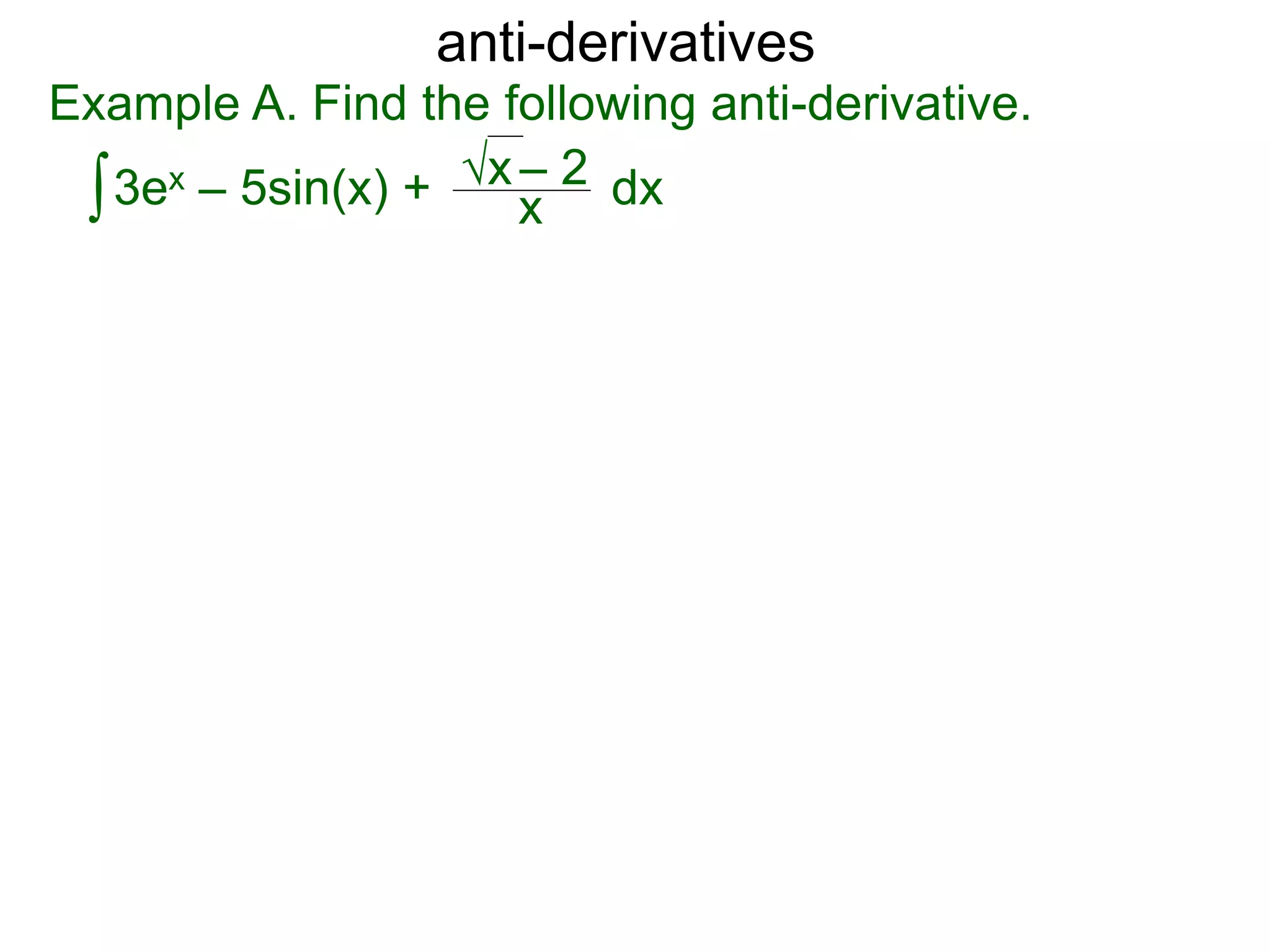
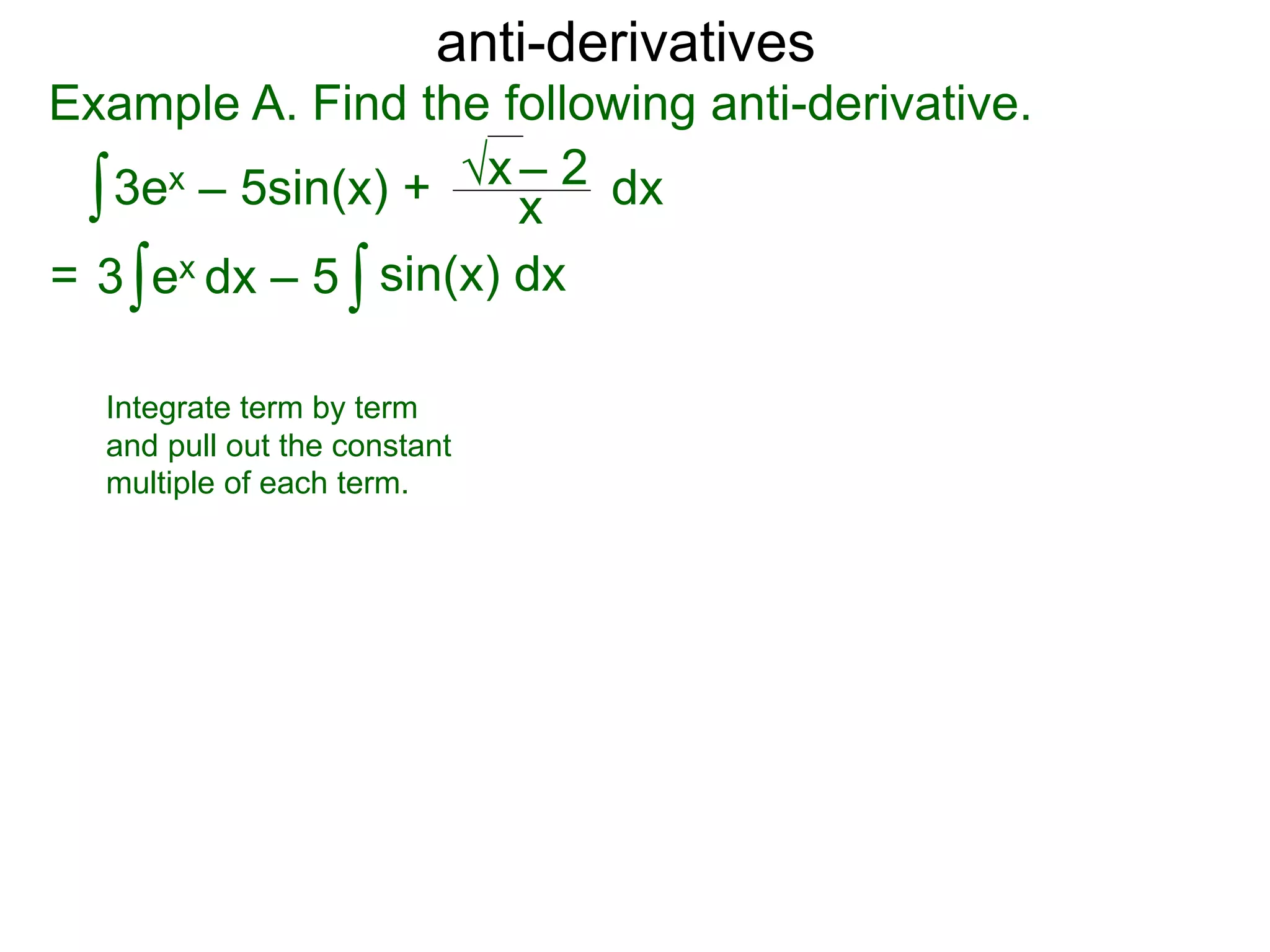
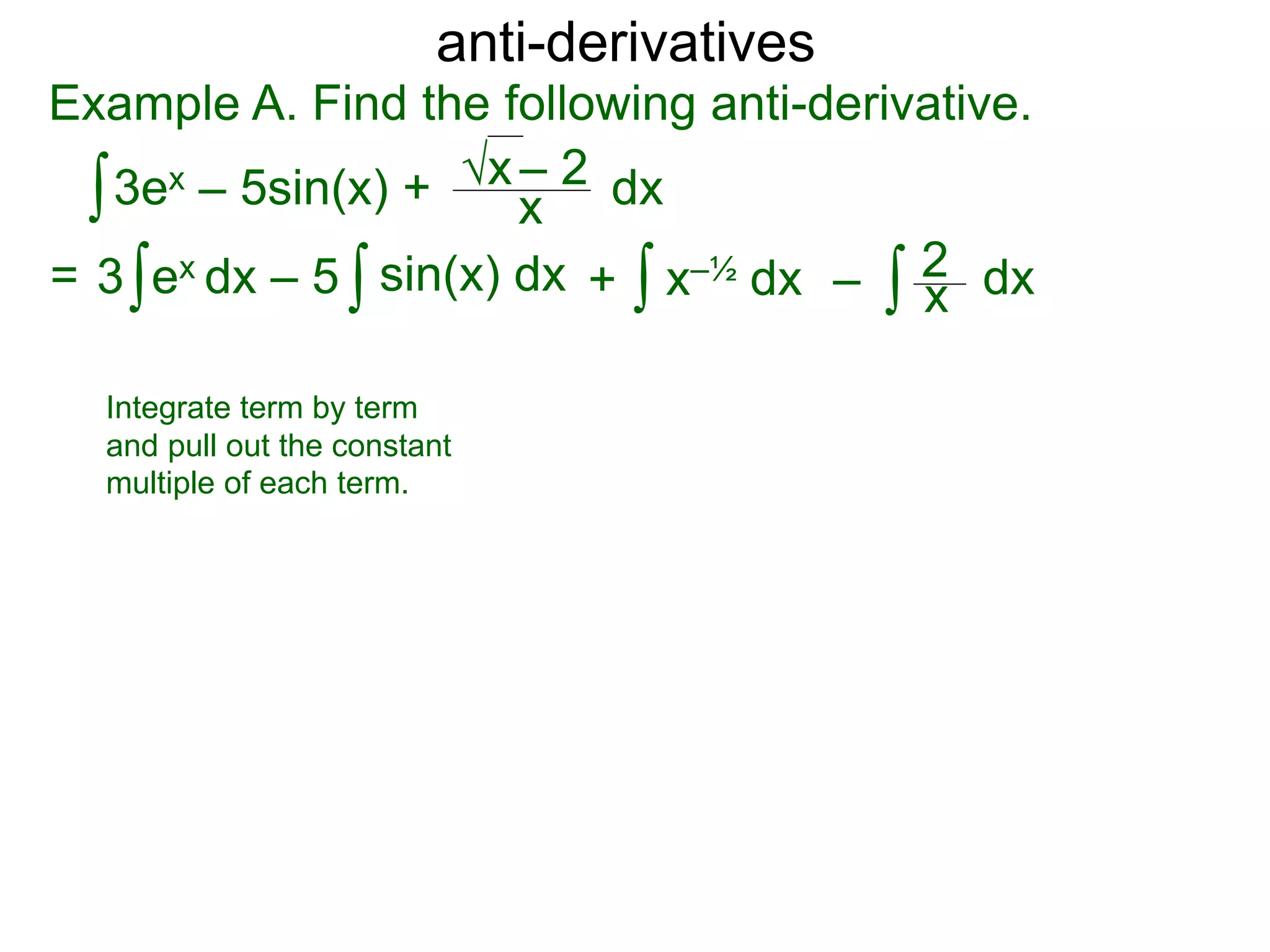
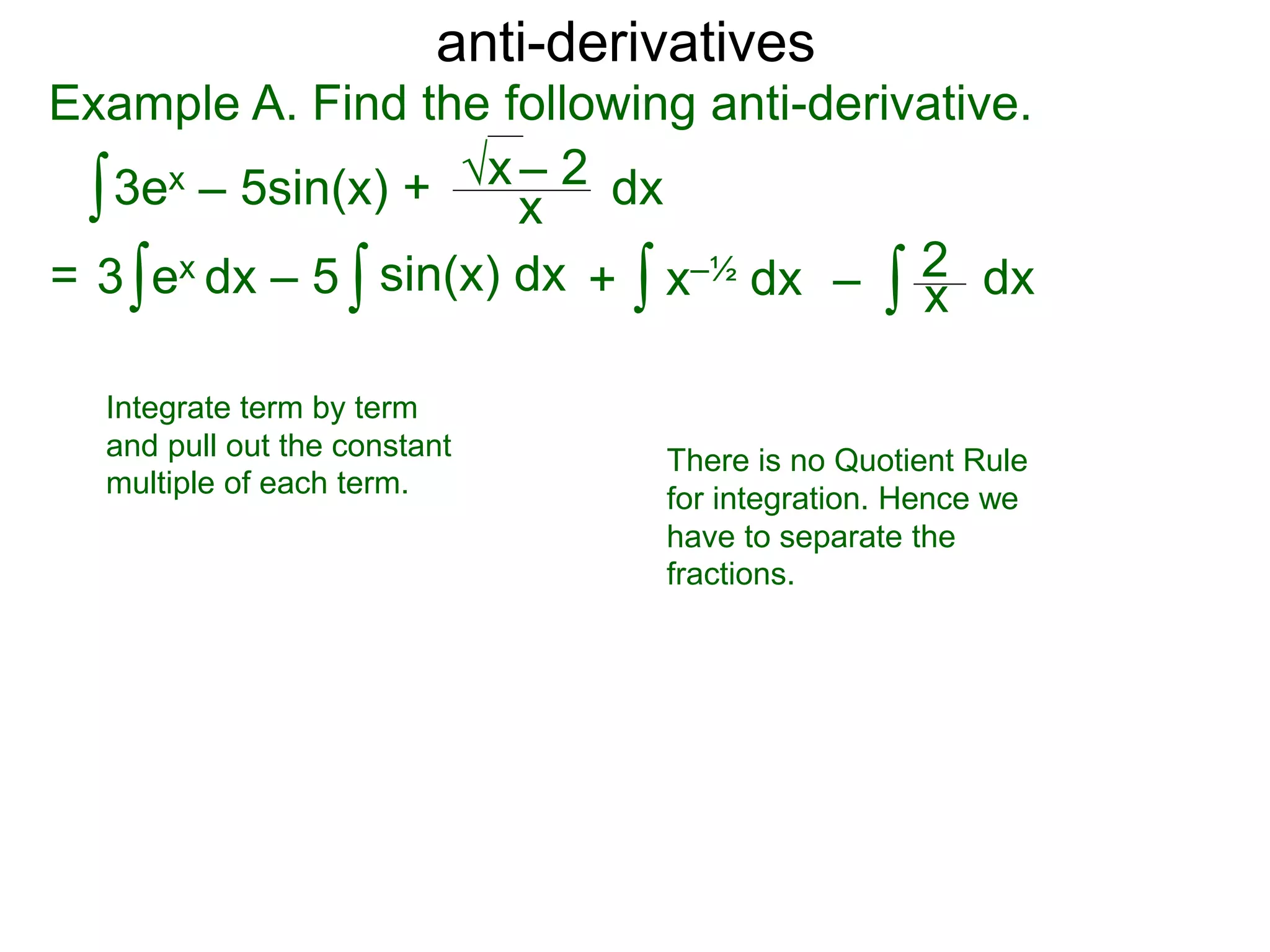
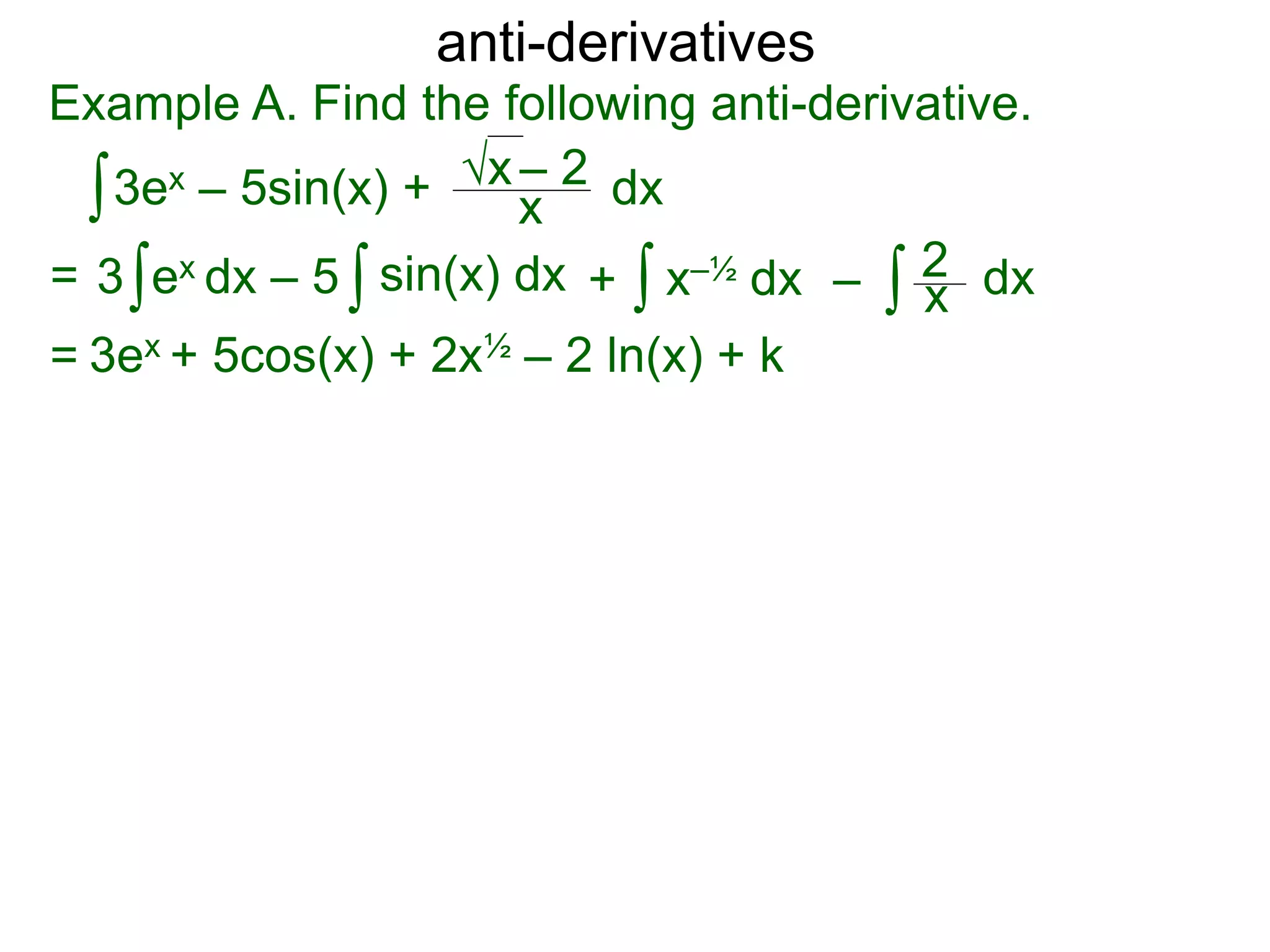
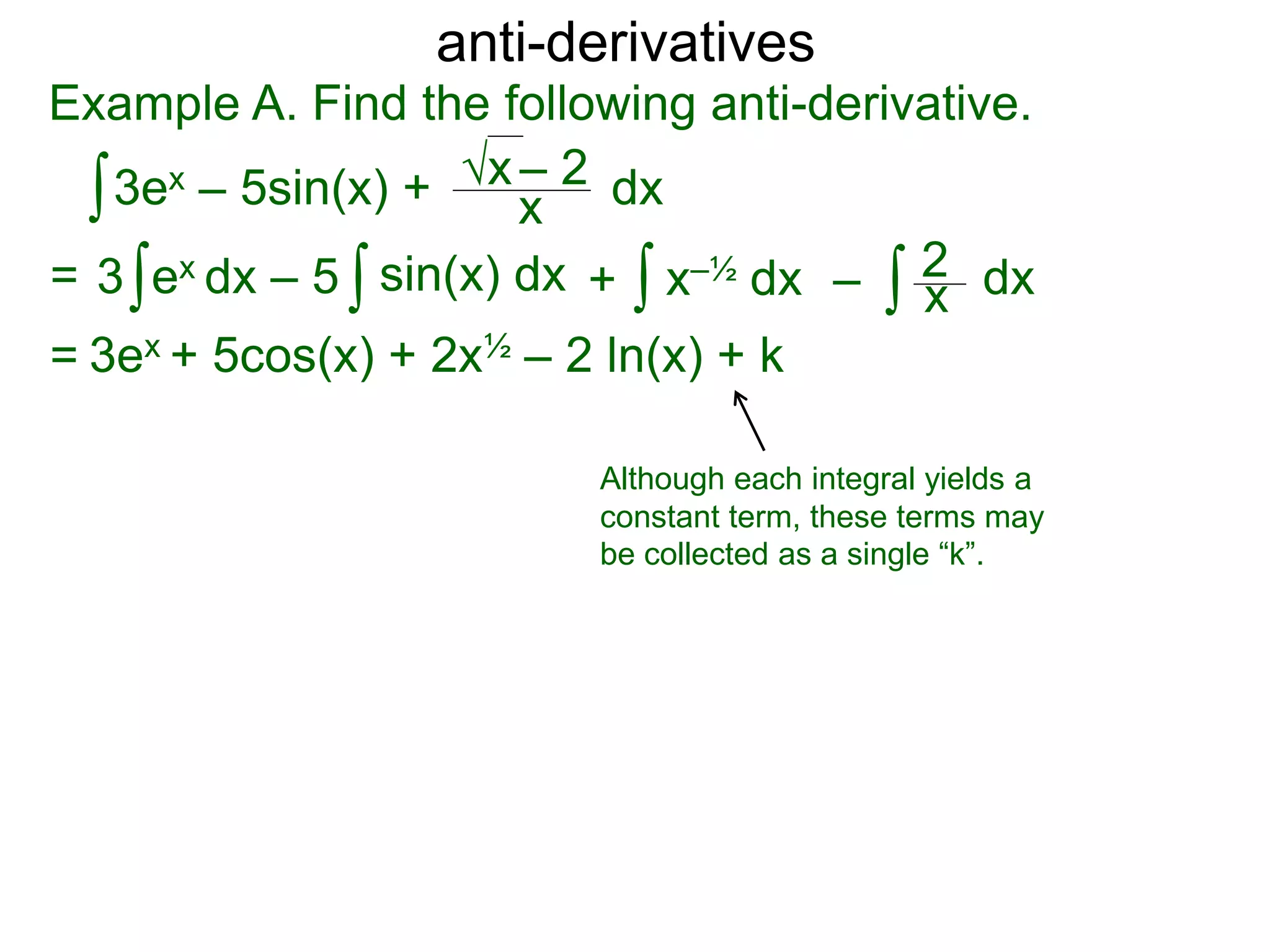
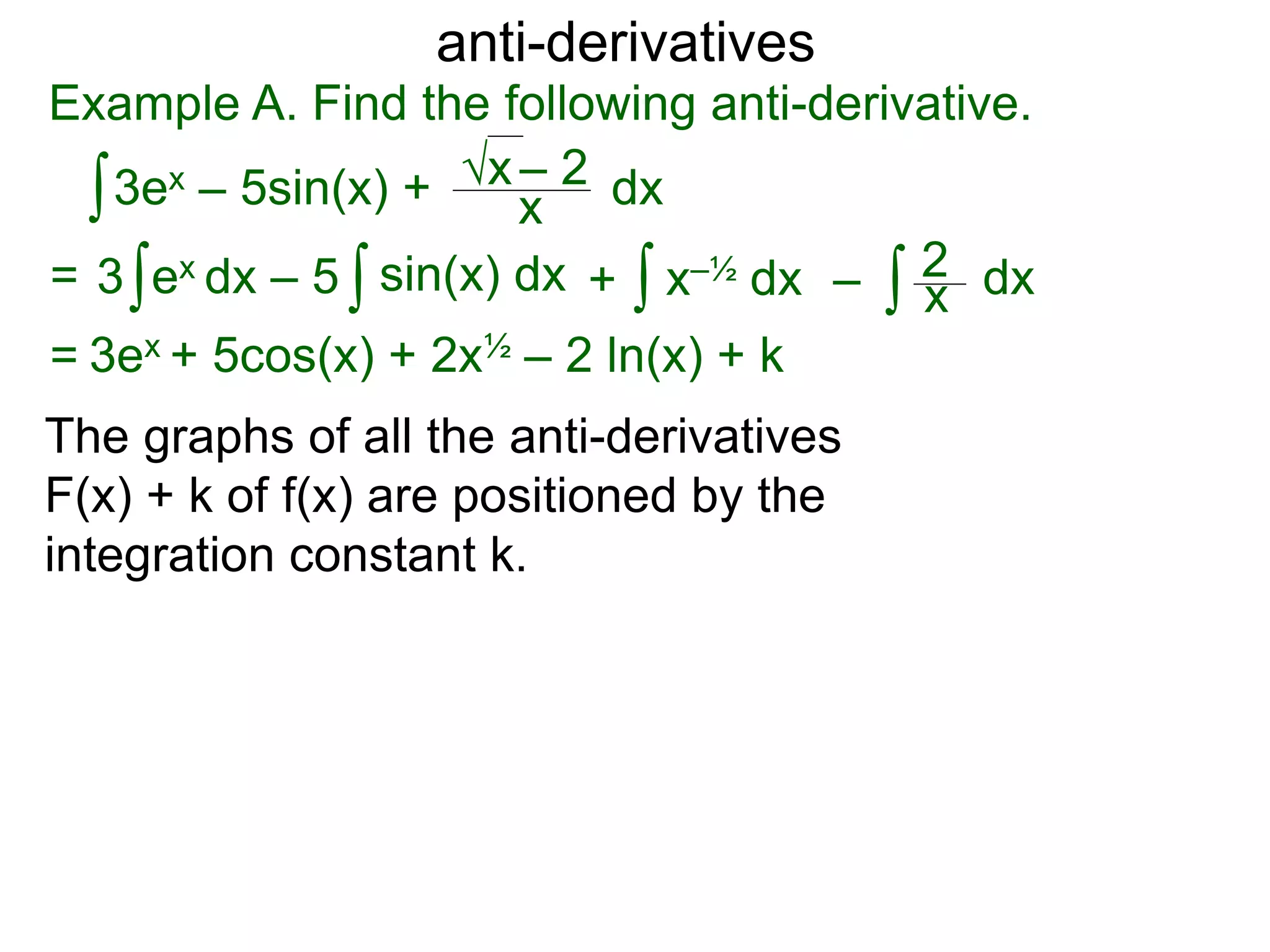
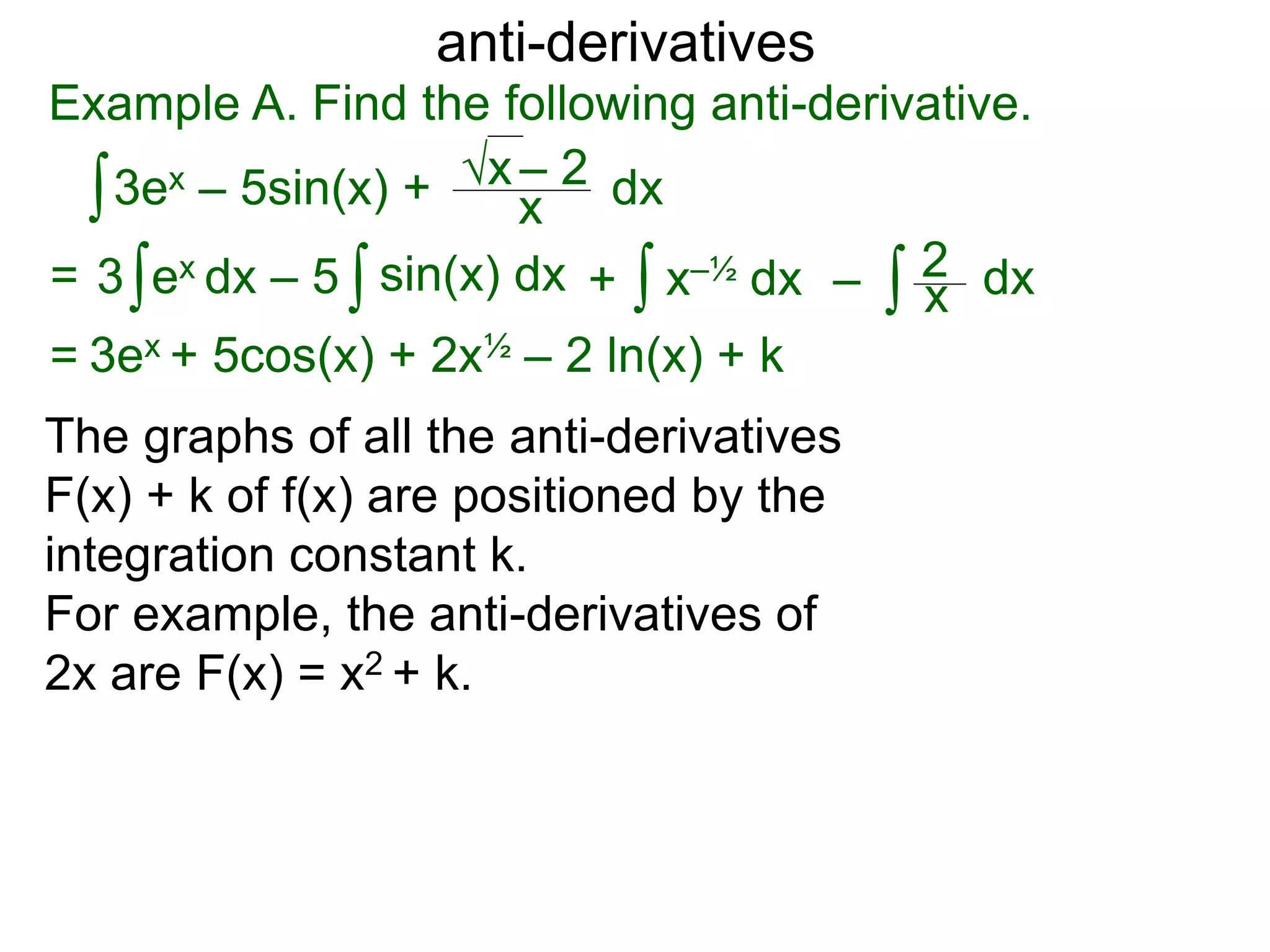
Example A. Find the following anti-derivative.
∫3ex – 5sin(x) + x
√x – 2 dx
anti-derivatives
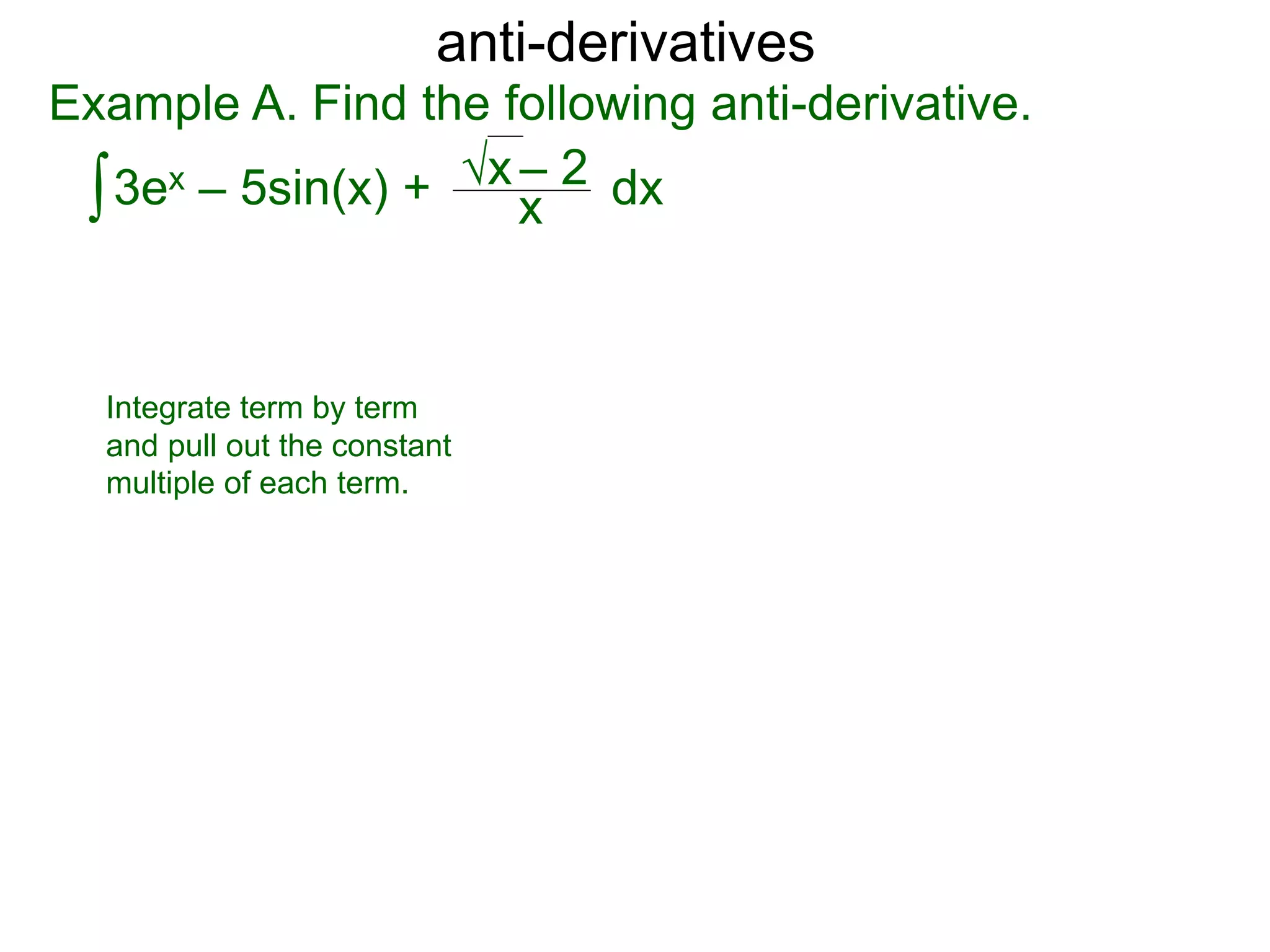
Example A. Find the following anti-derivative.
∫3ex – 5sin(x) + x
√x – 2 dx
Integrate term by term
and pull out the constant
multiple of each term.
anti-derivatives
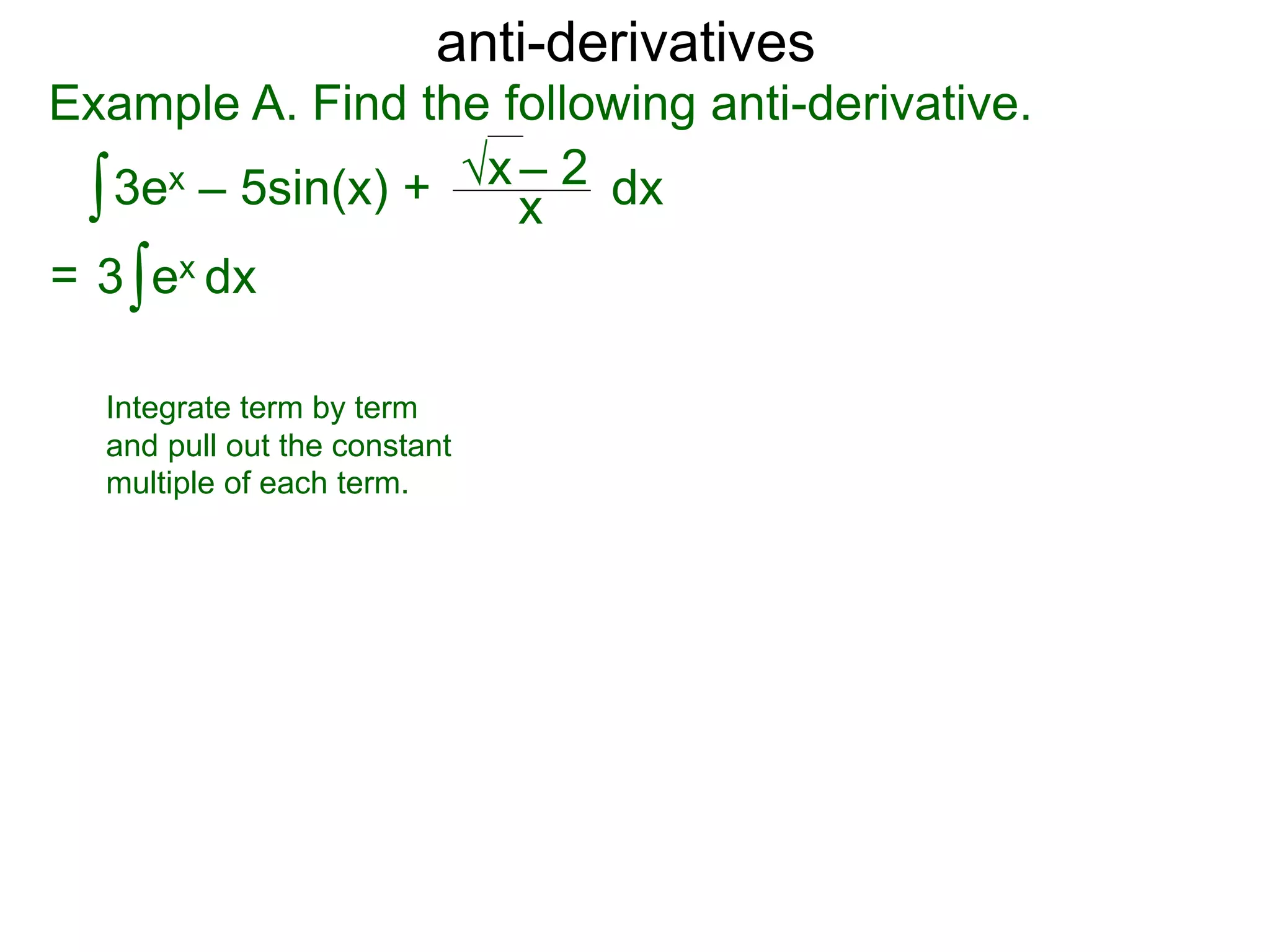
Example A. Find the following anti-derivative.
∫3ex – 5sin(x) + x
√x – 2
= ∫3 ex dx
dx
Integrate term by term
and pull out the constant
multiple of each term.
anti-derivatives
Example A. Find the following anti-derivative.
∫3ex – 5sin(x) + x
√x – 2
= ∫3 ex dx – 5 ∫ sin(x) dx
dx
Integrate term by term
and pull out the constant
multiple of each term.
anti-derivatives
Example A. Find the following anti-derivative.
∫3ex – 5sin(x) + x
√x – 2
= ∫3 ex dx – 5 x–½ dx∫ dx∫ ∫ x
2sin(x) dx + –
dx
Integrate term by term
and pull out the constant
multiple of each term.
anti-derivatives
Example A. Find the following anti-derivative.
∫3ex – 5sin(x) + x
√x – 2
= ∫3 ex dx – 5 x–½ dx∫ dx∫ ∫ x
2sin(x) dx + –
dx
Integrate term by term
and pull out the constant
multiple of each term.
There is no Quotient Rule
for integration. Hence we
have to separate the
fractions.
anti-derivatives
Example A. Find the following anti-derivative.
∫3ex – 5sin(x) + x
√x – 2
= ∫3 ex dx – 5 x–½ dx∫ dx∫ ∫ x
2sin(x) dx + –
= 3ex + 5cos(x) + 2x½ – 2 ln(x) + k
dx
anti-derivatives
Example A. Find the following anti-derivative.
∫3ex – 5sin(x) + x
√x – 2
= ∫3 ex dx – 5 x–½ dx∫ dx∫ ∫ x
2sin(x) dx + –
= 3ex + 5cos(x) + 2x½ – 2 ln(x) + k
dx
Although each integral yields a
constant term, these terms may
be collected as a single “k”.
anti-derivatives
Example A. Find the following anti-derivative.
∫3ex – 5sin(x) + x
√x – 2
= ∫3 ex dx – 5 x–½ dx∫ dx∫ ∫ x
2sin(x) dx + –
= 3ex + 5cos(x) + 2x½ – 2 ln(x) + k
dx
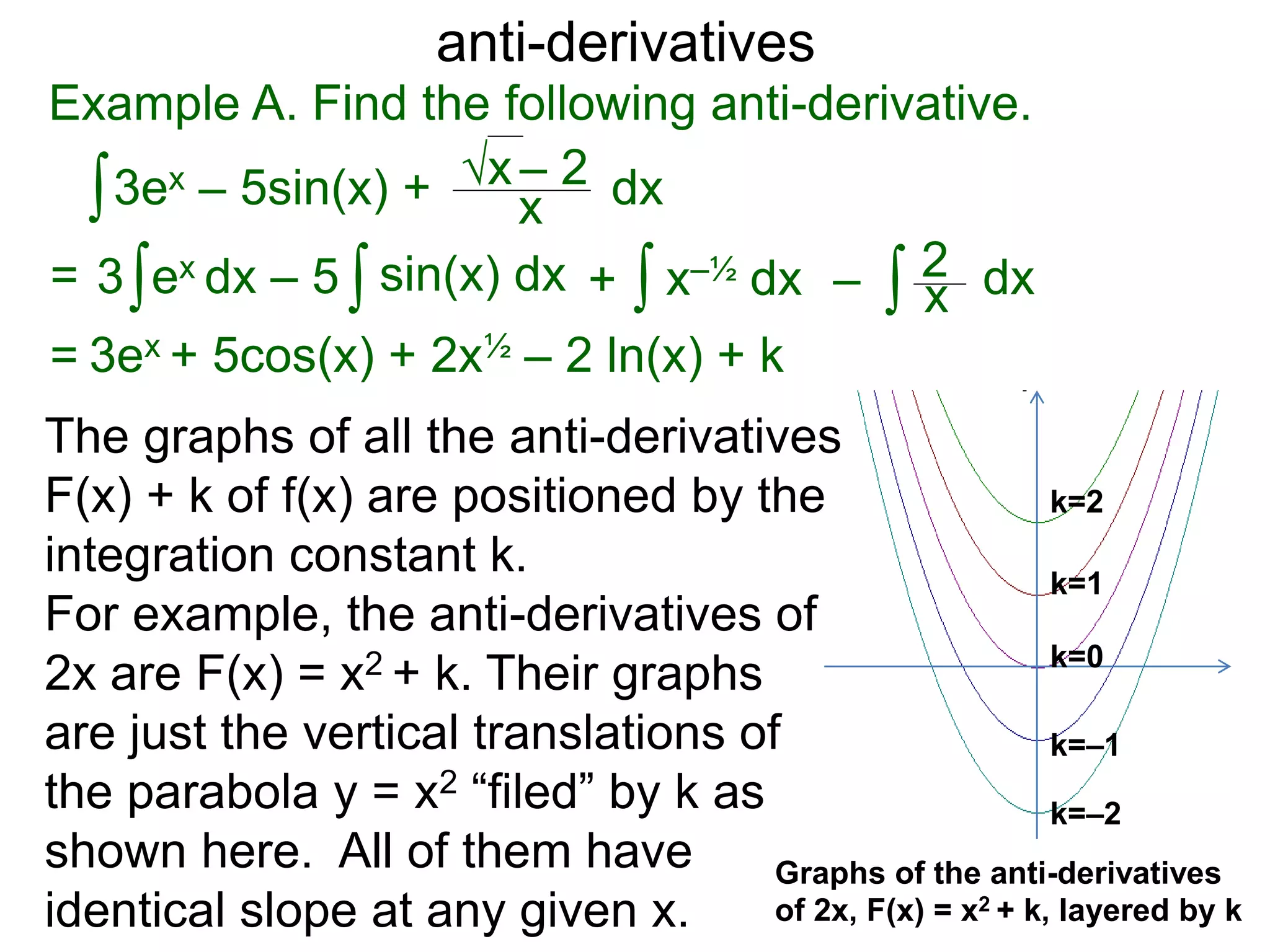
The graphs of all the anti-derivatives
F(x) + k of f(x) are positioned by the
integration constant k.
anti-derivatives
Example A. Find the following anti-derivative.
∫3ex – 5sin(x) + x
√x – 2
= ∫3 ex dx – 5 x–½ dx∫ dx∫ ∫ x
2sin(x) dx + –
= 3ex + 5cos(x) + 2x½ – 2 ln(x) + k
dx
The graphs of all the anti-derivatives
F(x) + k of f(x) are positioned by the
integration constant k.
For example, the anti-derivatives of
2x are F(x) = x2 + k.
anti-derivatives
Example A. Find the following anti-derivative.
∫3ex – 5sin(x) + x
√x – 2
= ∫3 ex dx – 5 x–½ dx∫ dx∫ ∫ x
2sin(x) dx + –
= 3ex + 5cos(x) + 2x½ – 2 ln(x) + k
dx
The graphs of all the anti-derivatives
F(x) + k of f(x) are positioned by the
integration constant k.
For example, the anti-derivatives of
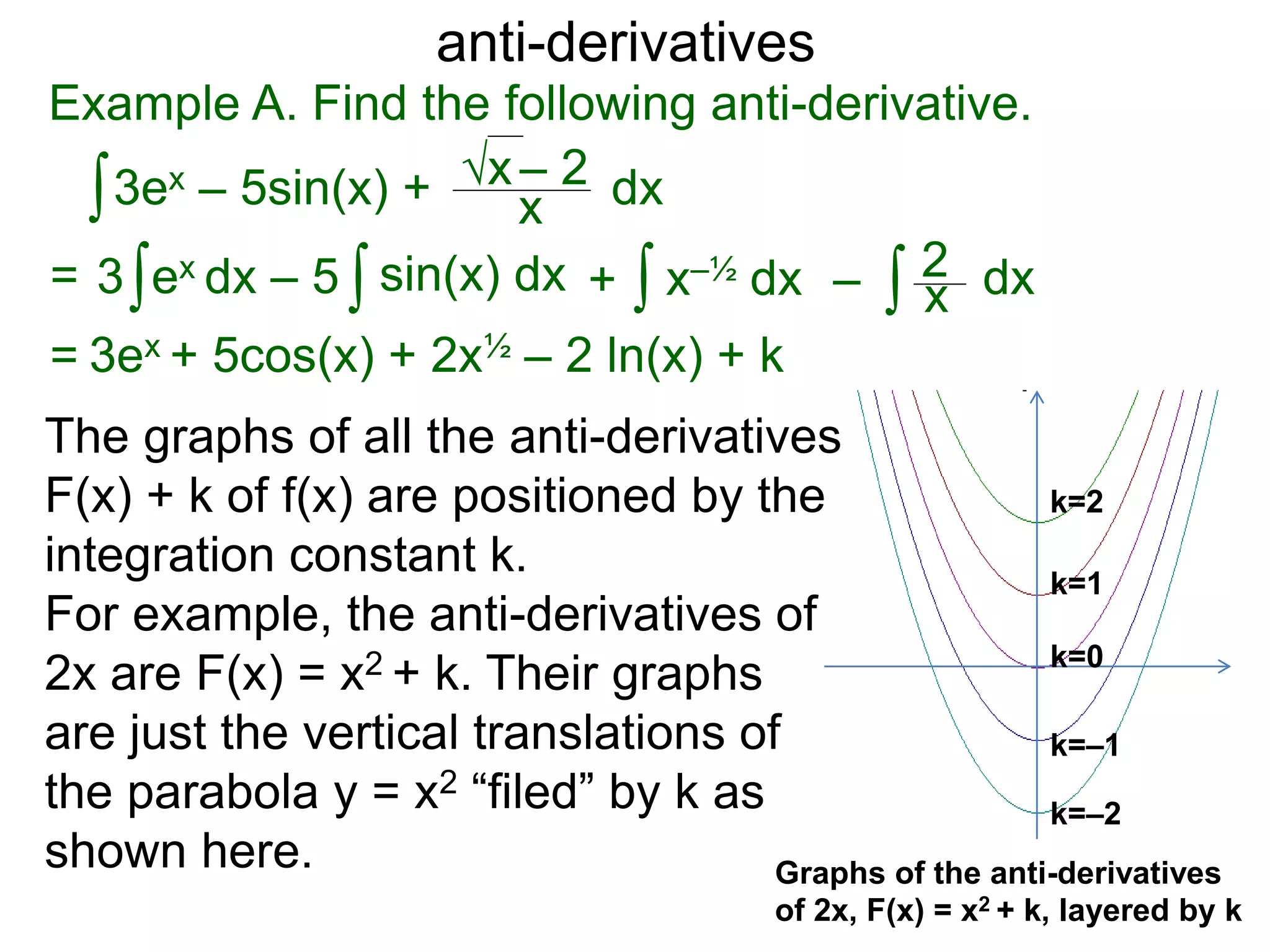
2x are F(x) = x2 + k. Their graphs
are just the vertical translations of
the parabola y = x2 “filed” by k as
shown here. Graphs of the anti-derivatives
of 2x, F(x) = x2 + k, layered by k
k=–2
k=–1
k=0
k=1
k=2
anti-derivatives
Example A. Find the following anti-derivative.
∫3ex – 5sin(x) + x
√x – 2
= ∫3 ex dx – 5 x–½ dx∫ dx∫ ∫ x
2sin(x) dx + –
= 3ex + 5cos(x) + 2x½ – 2 ln(x) + k
dx
The graphs of all the anti-derivatives
F(x) + k of f(x) are positioned by the
integration constant k.
For example, the anti-derivatives of
2x are F(x) = x2 + k. Their graphs
are just the vertical translations of
the parabola y = x2 “filed” by k as
shown here. All of them have
identical slope at any given x.
Graphs of the anti-derivatives
of 2x, F(x) = x2 + k, layered by k
k=–2
k=–1
k=0
k=1
k=2
anti-derivatives
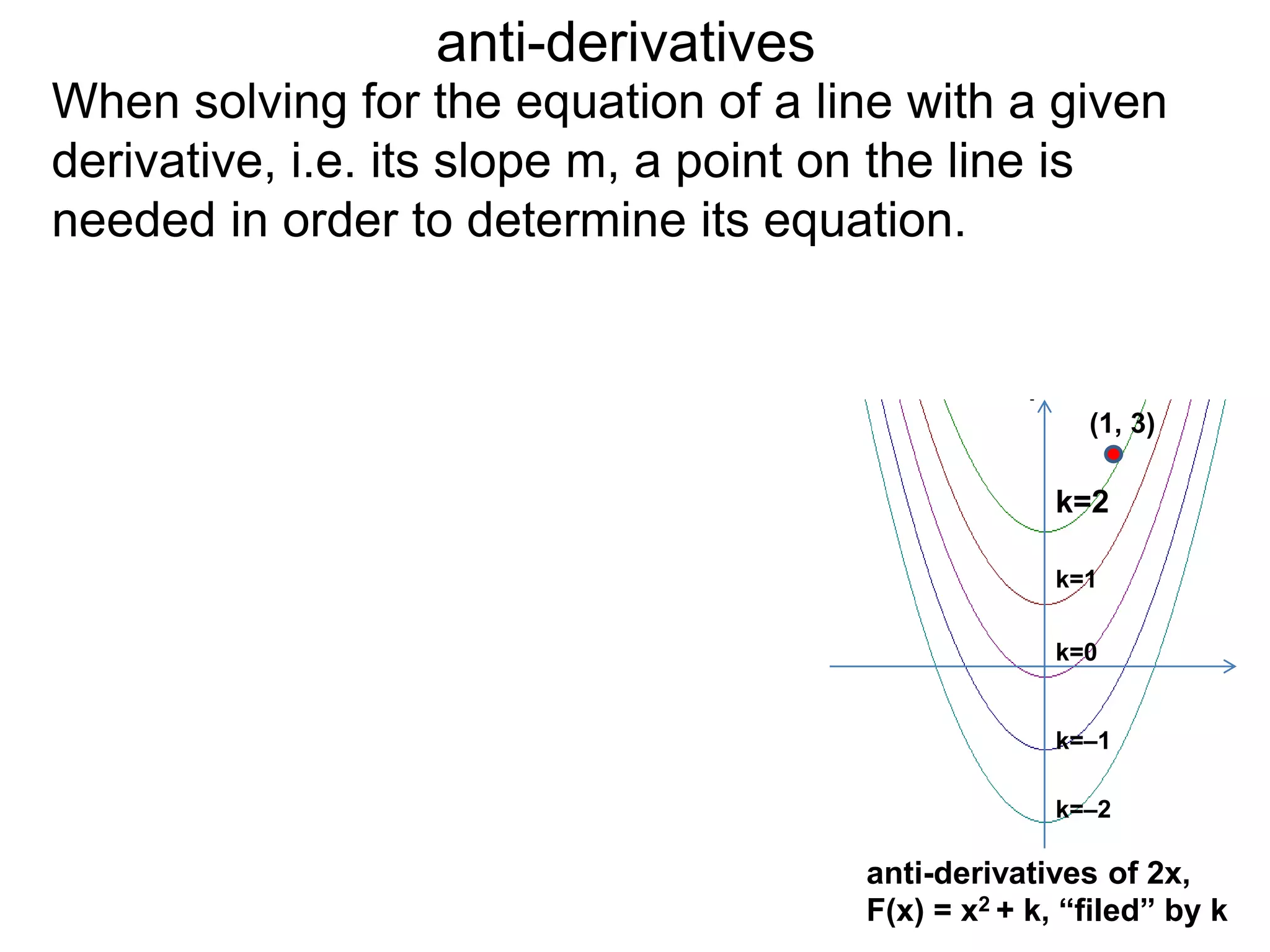
When solving for the equation of a line with a given
derivative, i.e. its slope m, a point on the line is
needed in order to determine its equation.
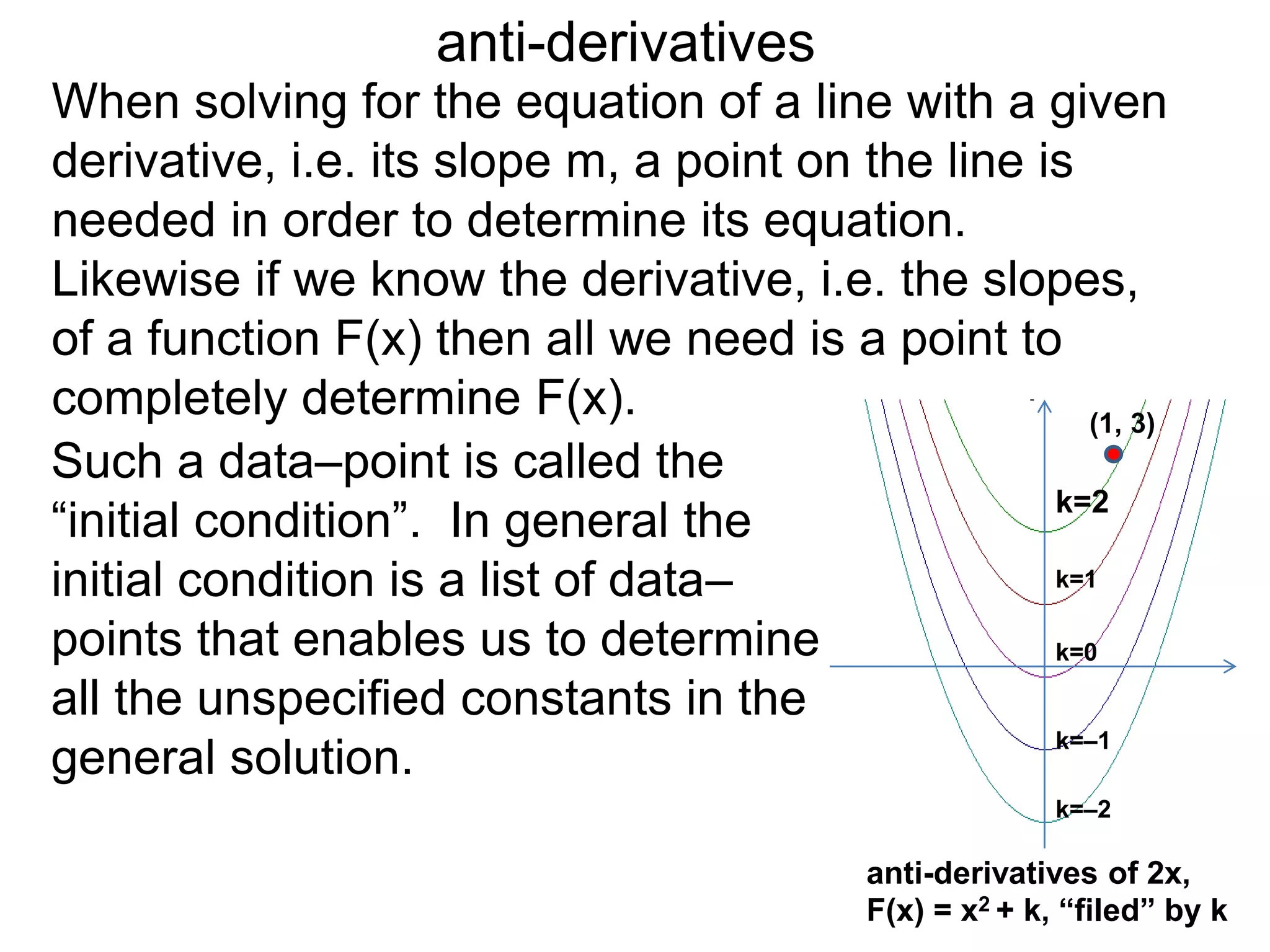
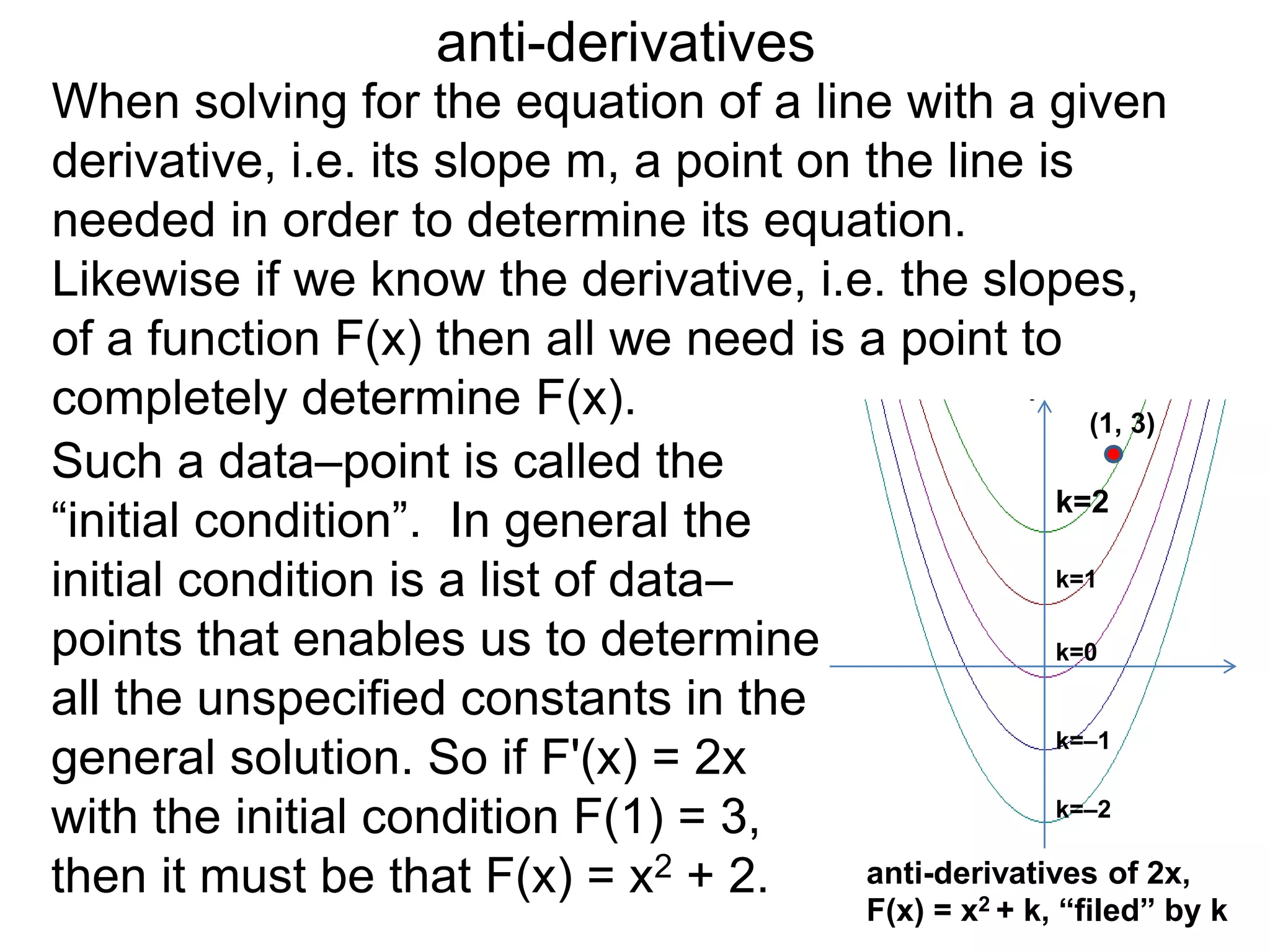
anti-derivatives of 2x,
F(x) = x2 + k, “filed” by k
k=–2
k=–1
k=0
k=1
k=2
(1, 3)
anti-derivatives
When solving for the equation of a line with a given
derivative, i.e. its slope m, a point on the line is
needed in order to determine its equation.
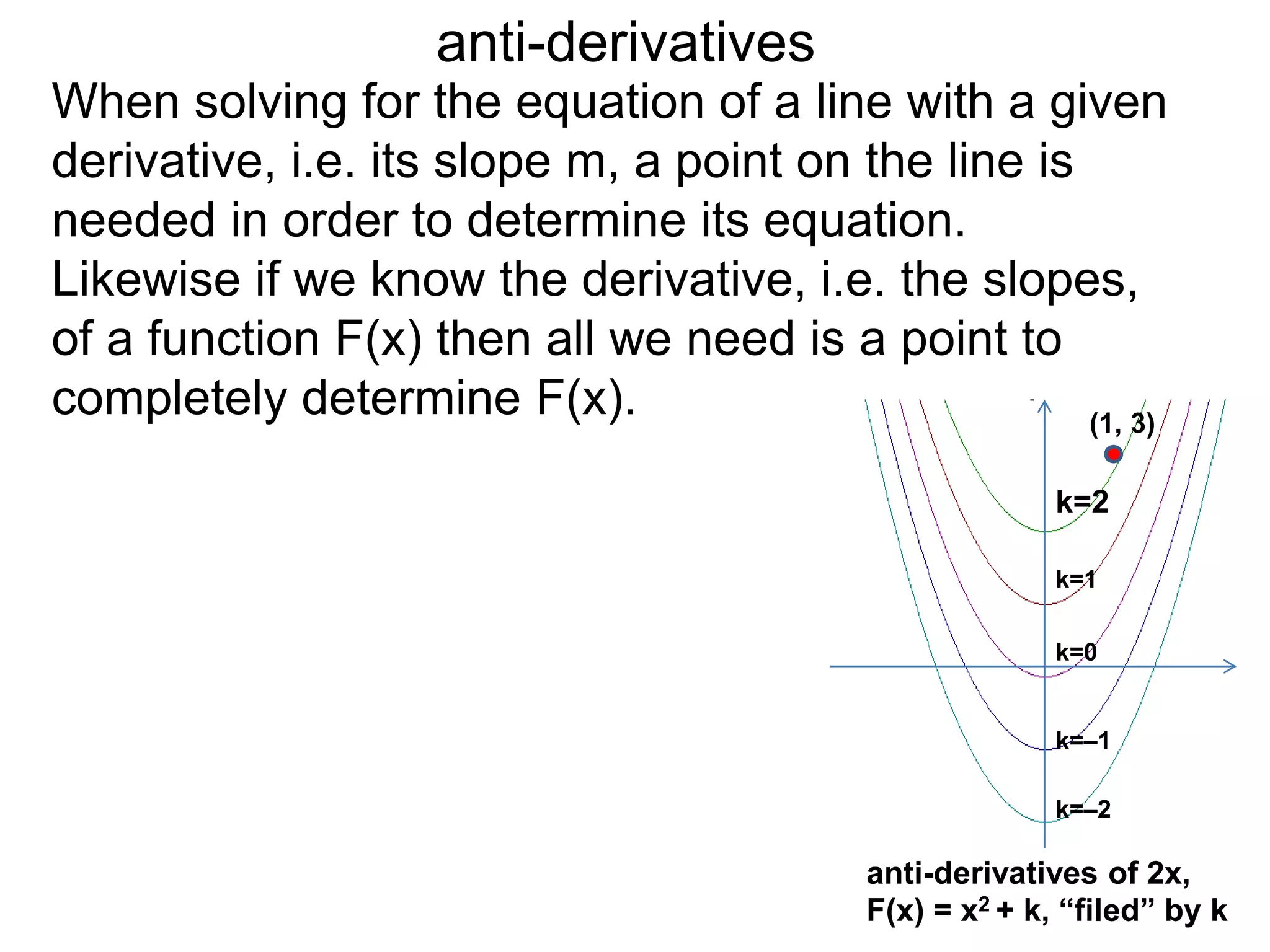
Likewise if we know the derivative, i.e. the slopes,
of a function F(x) then all we need is a point to
completely determine F(x).
anti-derivatives of 2x,
F(x) = x2 + k, “filed” by k
k=–2
k=–1
k=0
k=1
k=2
(1, 3)
anti-derivatives
When solving for the equation of a line with a given
derivative, i.e. its slope m, a point on the line is
needed in order to determine its equation.
Likewise if we know the derivative, i.e. the slopes,
of a function F(x) then all we need is a point to
completely determine F(x).
anti-derivatives of 2x,
F(x) = x2 + k, “filed” by k
k=–2
k=–1
k=0
k=1
k=2
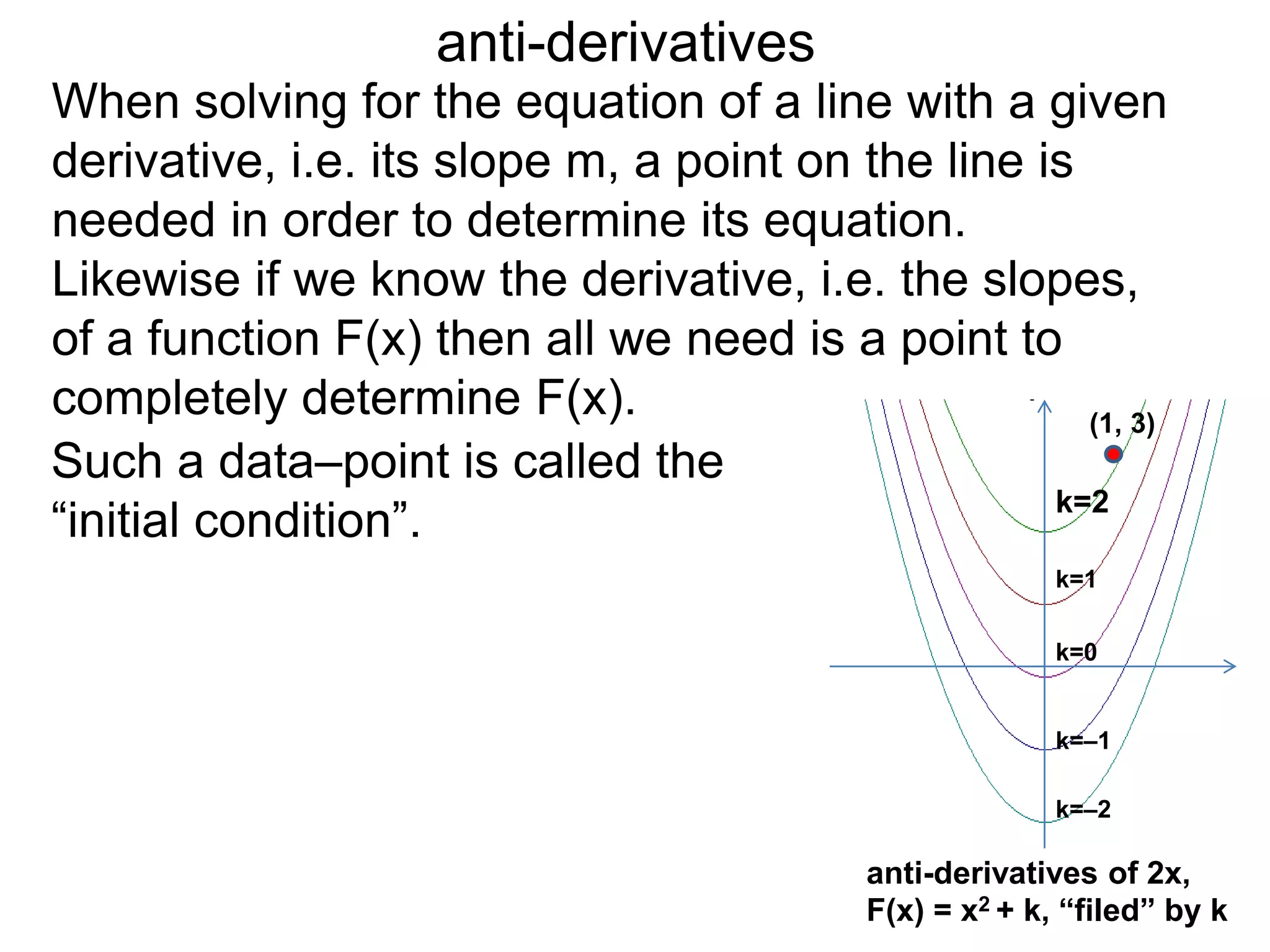
Such a data–point is called the
“initial condition”.
(1, 3)
anti-derivatives
When solving for the equation of a line with a given
derivative, i.e. its slope m, a point on the line is
needed in order to determine its equation.
Likewise if we know the derivative, i.e. the slopes,
of a function F(x) then all we need is a point to
completely determine F(x).
anti-derivatives of 2x,
F(x) = x2 + k, “filed” by k
k=–2
k=–1
k=0
k=1
k=2
Such a data–point is called the
“initial condition”. In general the
initial condition is a list of data–
points that enables us to determine
all the unspecified constants in the
general solution.
(1, 3)
anti-derivatives
When solving for the equation of a line with a given
derivative, i.e. its slope m, a point on the line is
needed in order to determine its equation.
Likewise if we know the derivative, i.e. the slopes,
of a function F(x) then all we need is a point to
completely determine F(x).
anti-derivatives of 2x,
F(x) = x2 + k, “filed” by k
k=–2
k=–1
k=0
k=1
k=2
Such a data–point is called the
“initial condition”. In general the
initial condition is a list of data–
points that enables us to determine
all the unspecified constants in the
general solution. So if F'(x) = 2x
with the initial condition F(1) = 3,
then it must be that F(x) = x2 + 2.
(1, 3)
anti-derivatives
We may recover a function completely through its
higher order derivative if we have sufficient information.
anti-derivatives
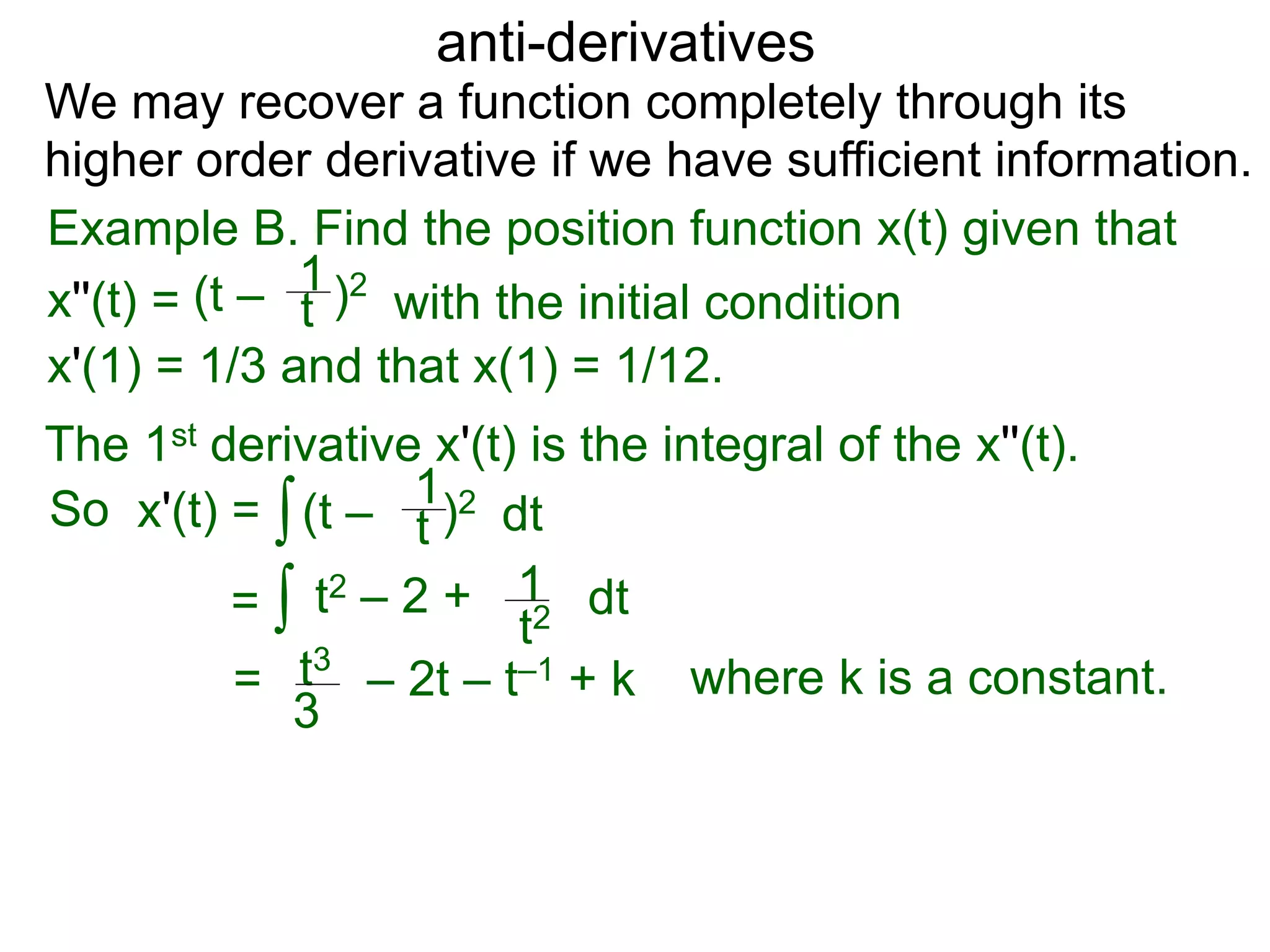
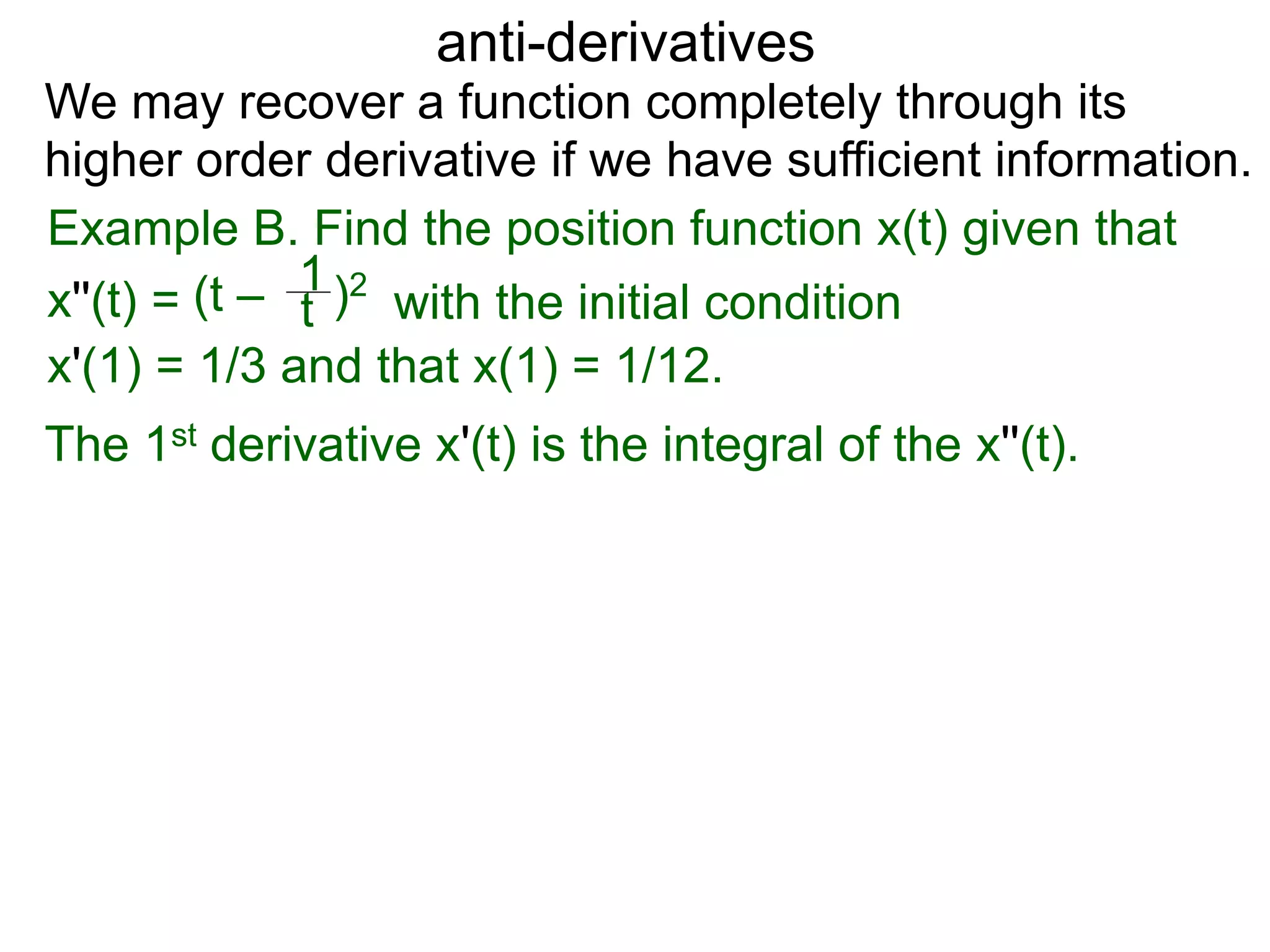
Example B. Find the position function x(t) given that
x''(t) = (t – )2
t
1
x'(1) = 1/3 and that x(1) = 1/12.
We may recover a function completely through its
higher order derivative if we have sufficient information.
with the initial condition
anti-derivatives
Example B. Find the position function x(t) given that
x''(t) = (t – )2
t
1
x'(1) = 1/3 and that x(1) = 1/12.
We may recover a function completely through its
higher order derivative if we have sufficient information.
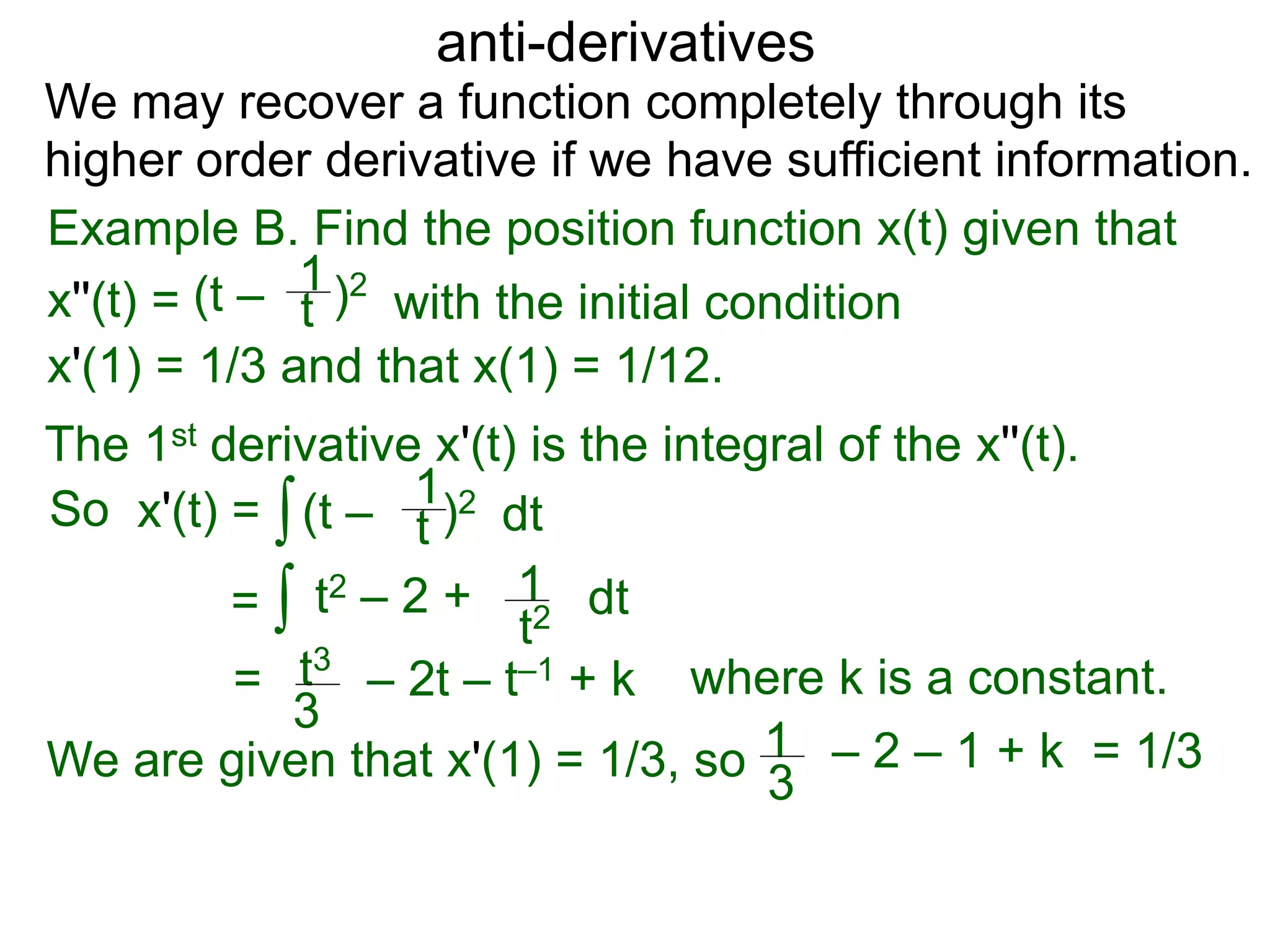
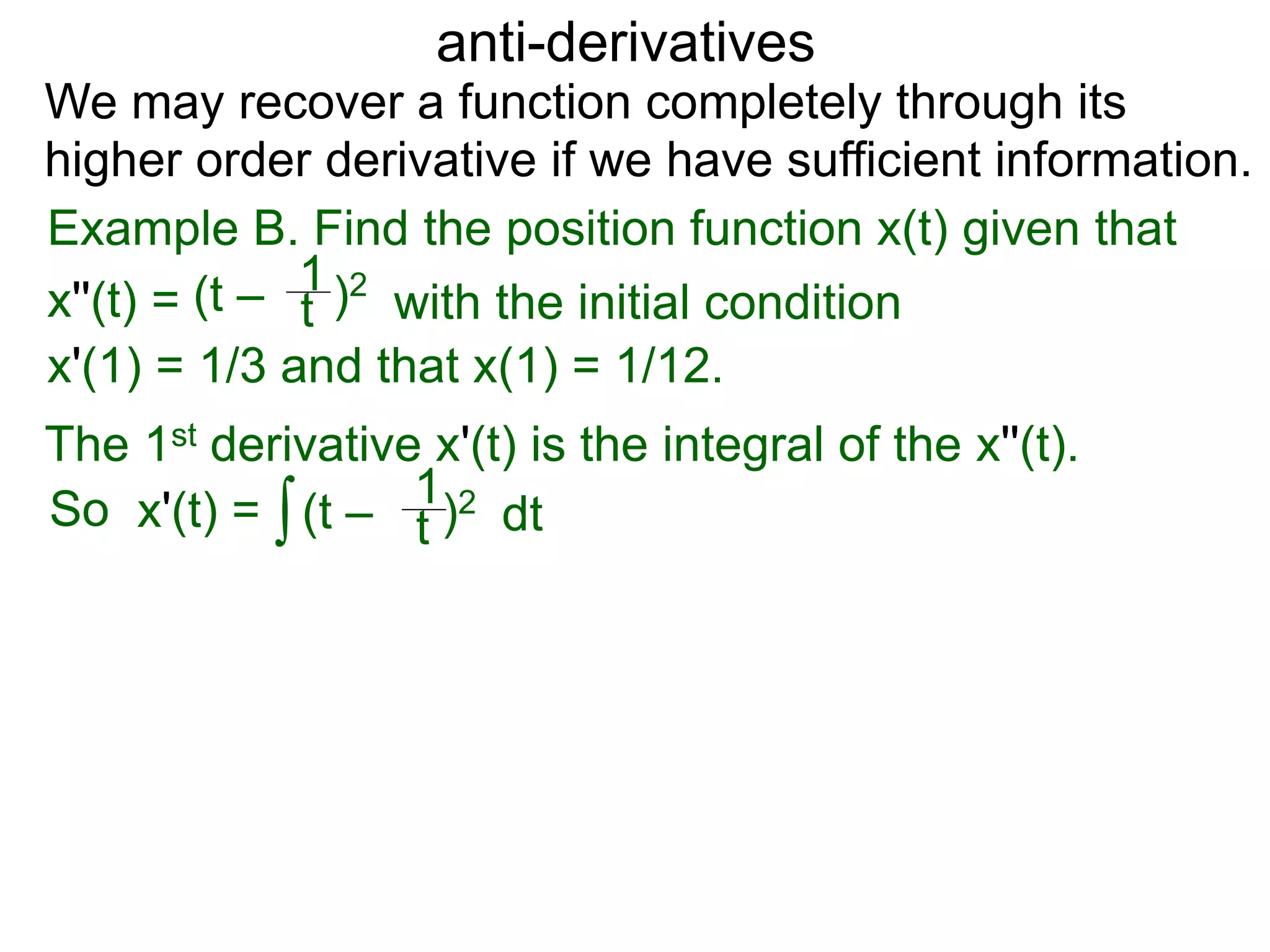
The 1st derivative x'(t) is the integral of the x''(t).
with the initial condition
anti-derivatives
Example B. Find the position function x(t) given that
x''(t) =
∫
(t – )2
t
1
x'(1) = 1/3 and that x(1) = 1/12.
We may recover a function completely through its
higher order derivative if we have sufficient information.
The 1st derivative x'(t) is the integral of the x''(t).
x'(t) = (t – )2
t
1
dtSo
with the initial condition
anti-derivatives
Example B. Find the position function x(t) given that
x''(t) =
∫
(t – )2
t
1
x'(1) = 1/3 and that x(1) = 1/12.
We may recover a function completely through its
higher order derivative if we have sufficient information.
The 1st derivative x'(t) is the integral of the x''(t).
x'(t) = (t – )2
t
1
dt
= ∫ t2 – 2 +
t2
1 dt
So
with the initial condition
anti-derivatives
Example B. Find the position function x(t) given that
x''(t) =
∫
(t – )2
t
1
x'(1) = 1/3 and that x(1) = 1/12.
We may recover a function completely through its
higher order derivative if we have sufficient information.
The 1st derivative x'(t) is the integral of the x''(t).
x'(t) = (t – )2
t
1
dt
= ∫ t2 – 2 +
t2
1 dt
= t3
3
– 2t – t–1 + k
So
where k is a constant.
with the initial condition
anti-derivatives
Example B. Find the position function x(t) given that
x''(t) =
∫
(t – )2
t
1
x'(1) = 1/3 and that x(1) = 1/12.
We may recover a function completely through its
higher order derivative if we have sufficient information.
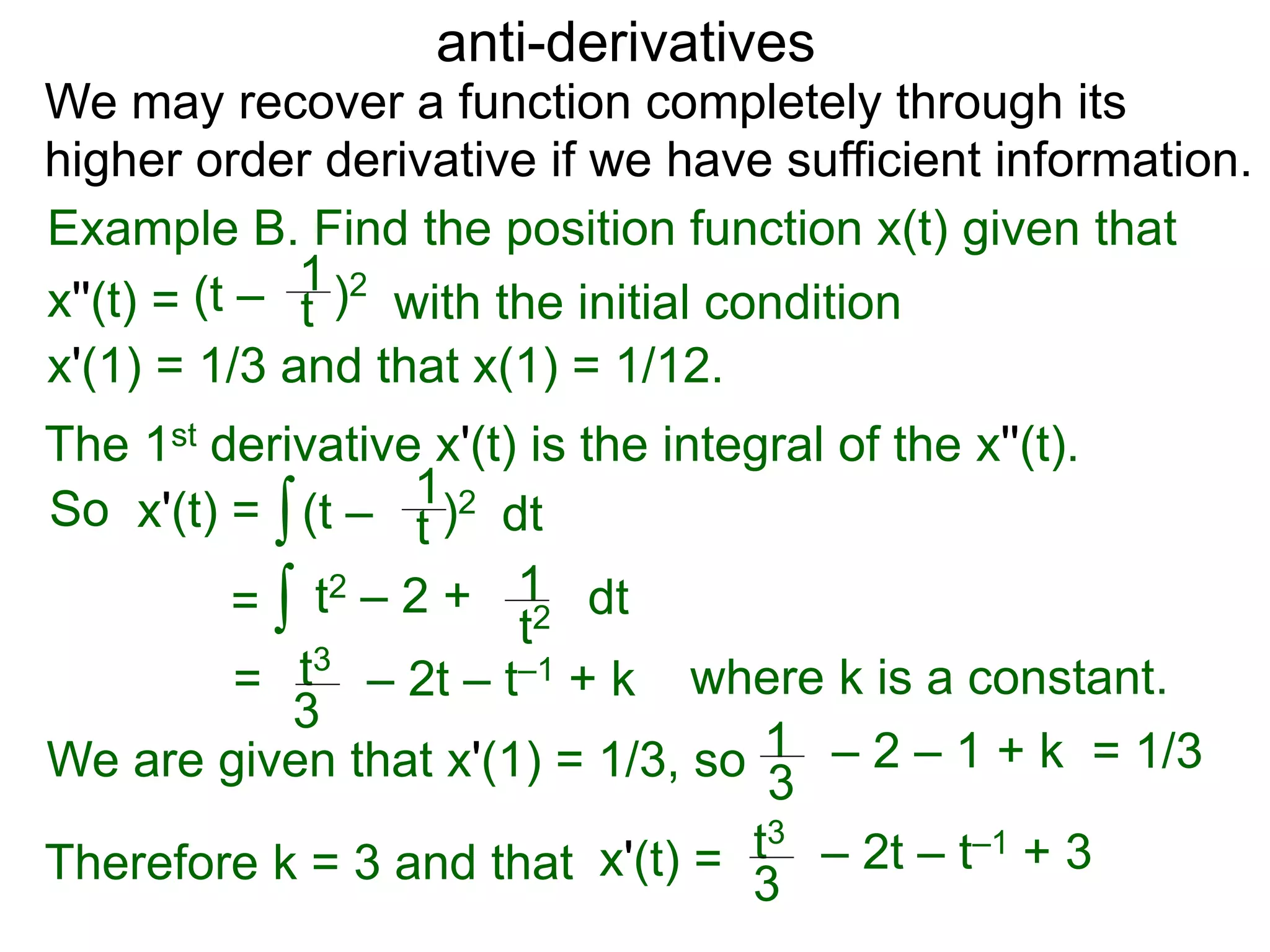
The 1st derivative x'(t) is the integral of the x''(t).
x'(t) = (t – )2
t
1
dt
= ∫ t2 – 2 +
t2
1 dt
= t3
3
– 2t – t–1 + k
So
We are given that x'(1) = 1/3, so = 1/31
3
– 2 – 1 + k
where k is a constant.
with the initial condition
anti-derivatives
Example B. Find the position function x(t) given that
x''(t) =
∫
(t – )2
t
1
x'(1) = 1/3 and that x(1) = 1/12.
We may recover a function completely through its
higher order derivative if we have sufficient information.
The 1st derivative x'(t) is the integral of the x''(t).
x'(t) = (t – )2
t
1
dt
= ∫ t2 – 2 +
t2
1 dt
= t3
3
– 2t – t–1 + k
So
We are given that x'(1) = 1/3, so = 1/31
3
– 2 – 1 + k
Therefore k = 3 and that t3
3
– 2t – t–1 + 3x'(t) =
where k is a constant.
with the initial condition
anti-derivatives
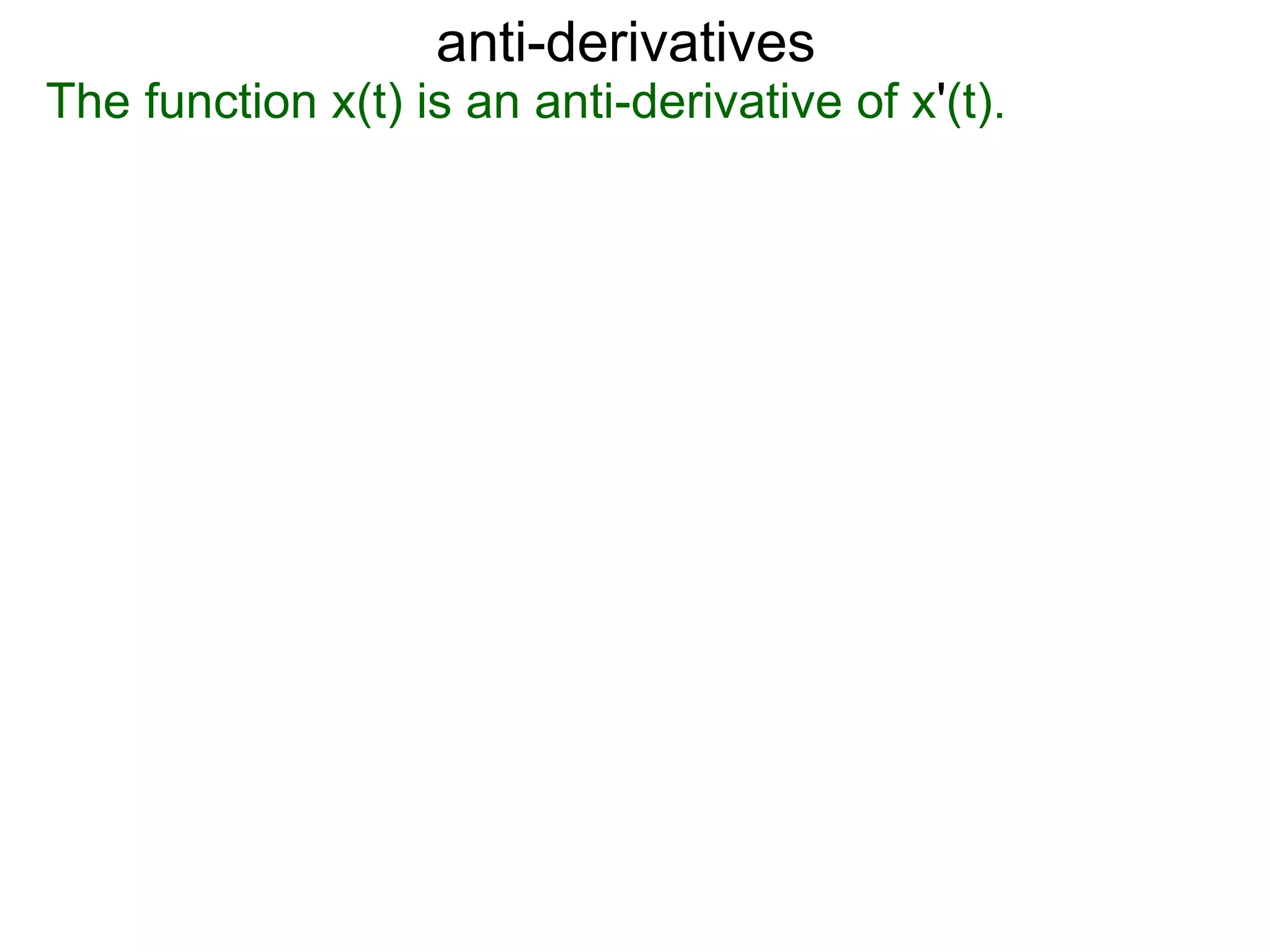
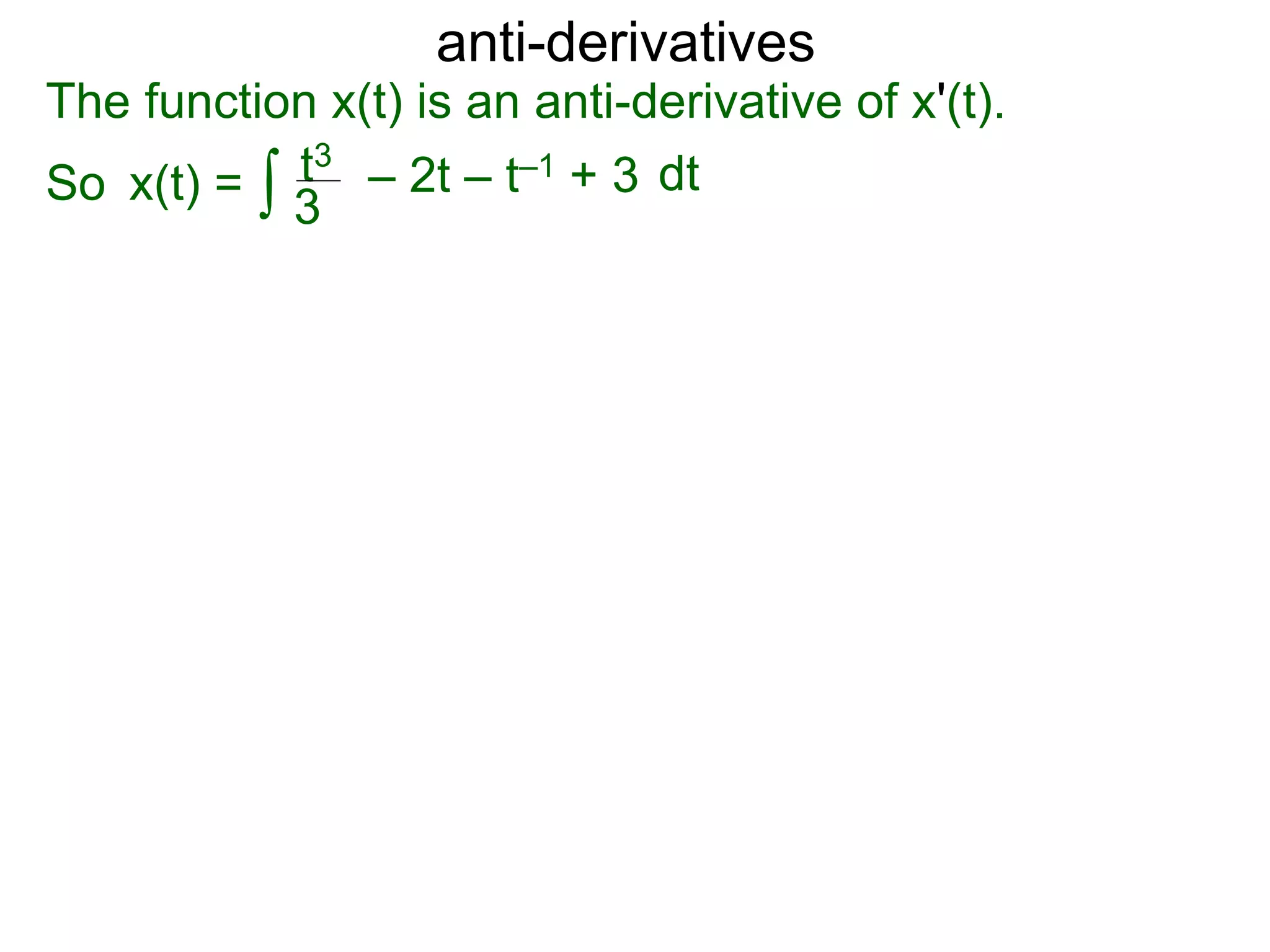
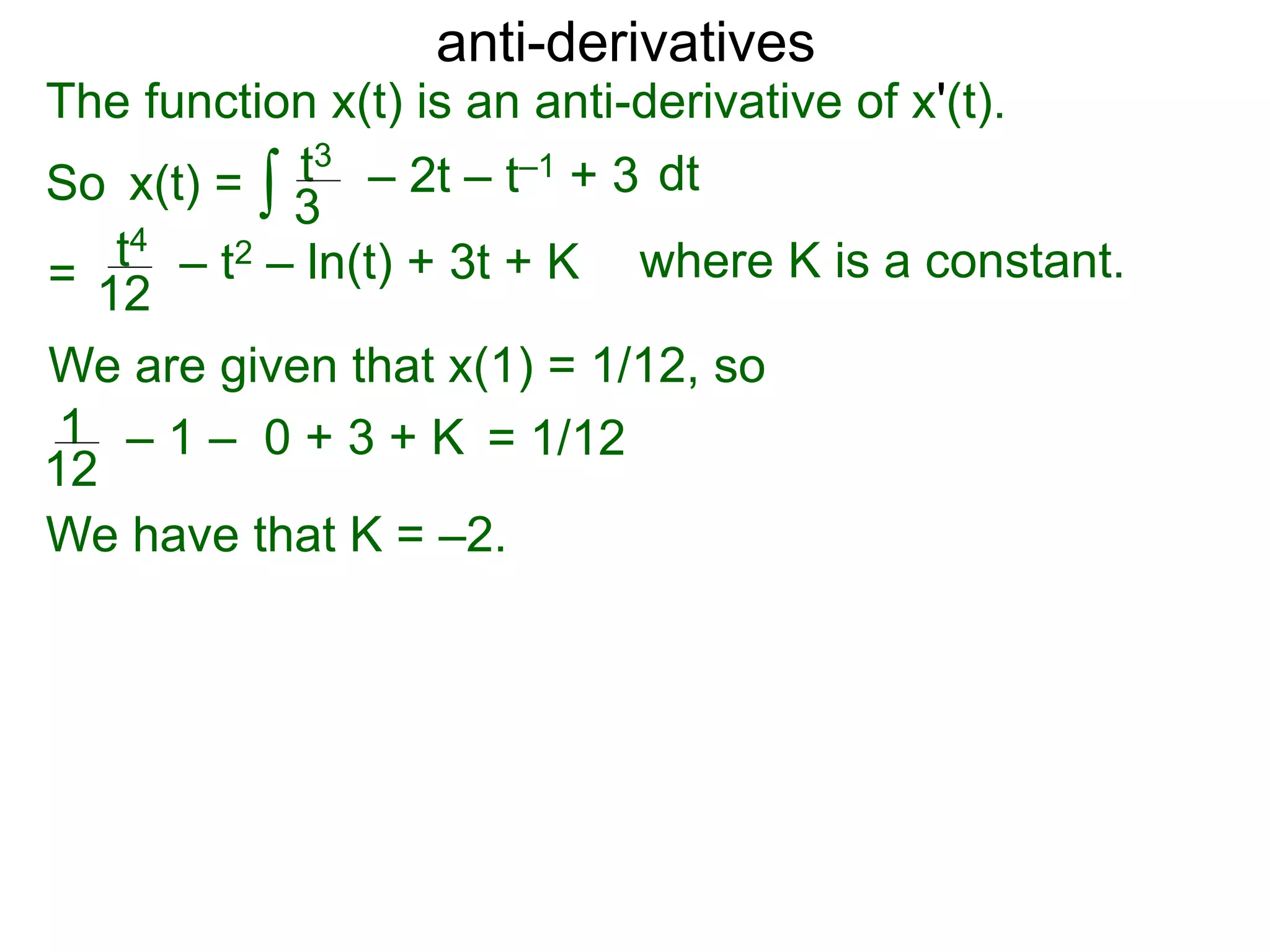
The function x(t) is an anti-derivative of x'(t).
anti-derivatives
The function x(t) is an anti-derivative of x'(t).
So x(t) = ∫ dtt3
3
– 2t – t–1 + 3
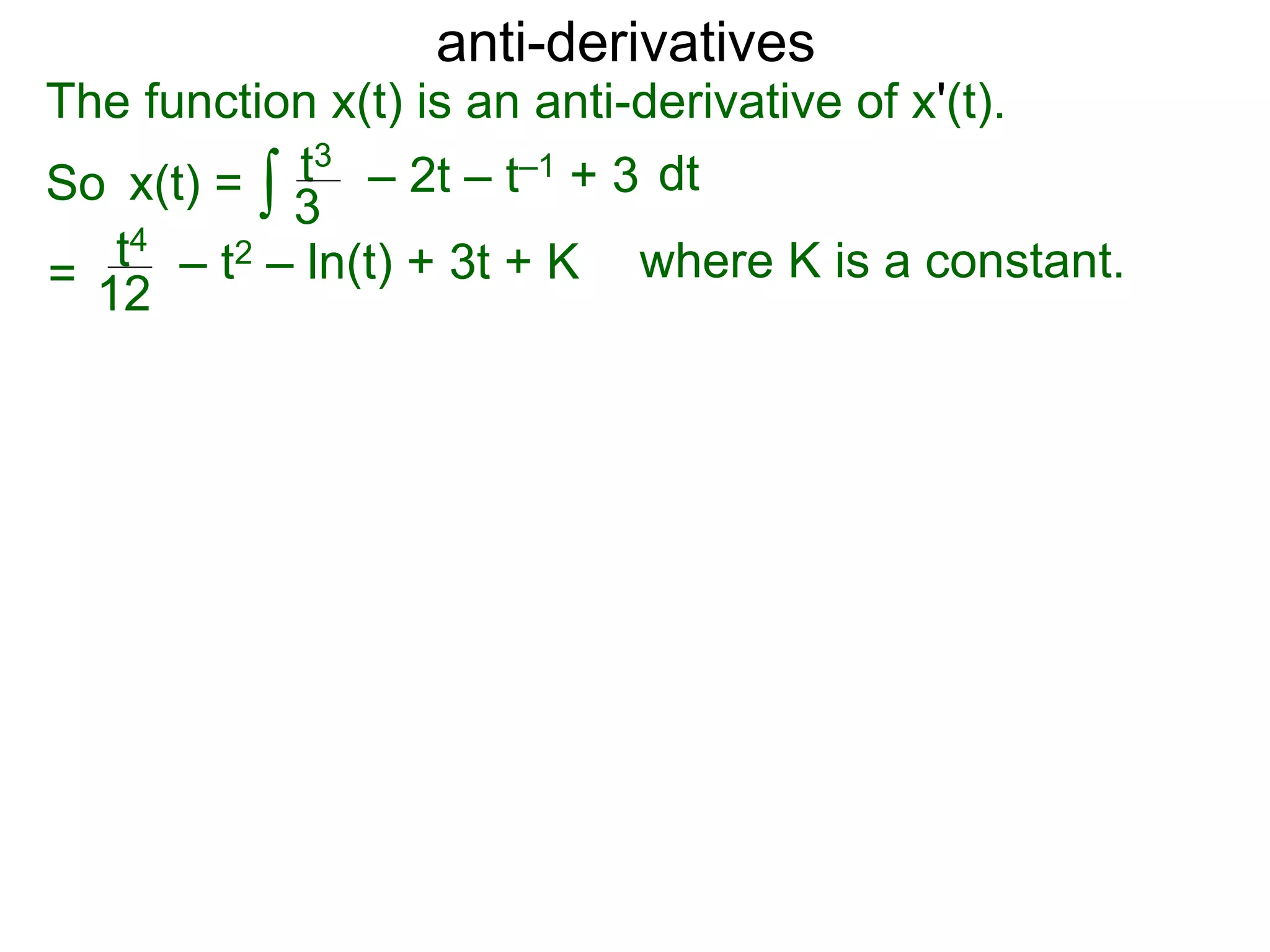
anti-derivatives
The function x(t) is an anti-derivative of x'(t).
So x(t) =
=
∫ dtt3
3
– 2t – t–1 + 3
t4
12
– t2 – ln(t) + 3t + K where K is a constant.
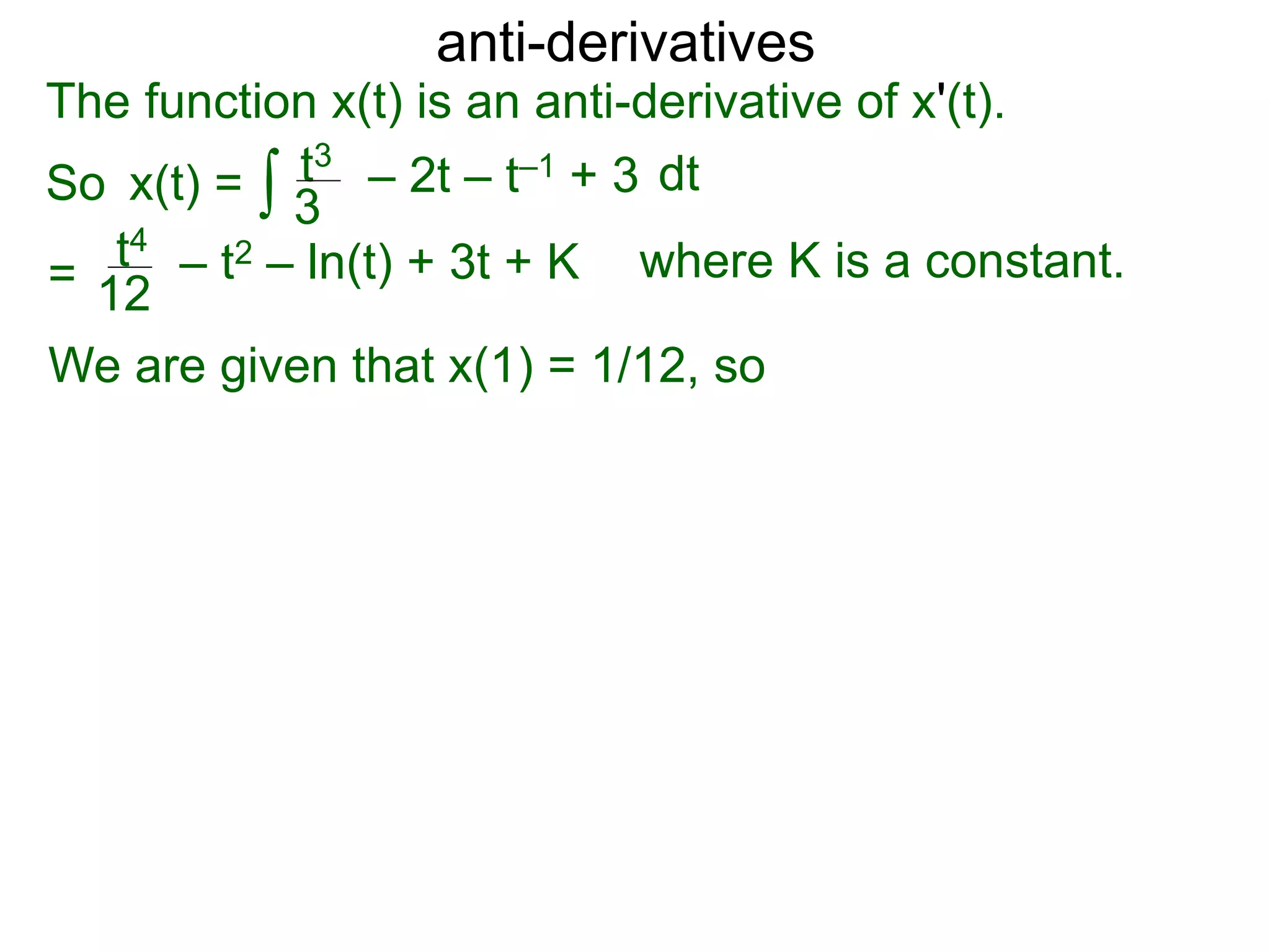
anti-derivatives
The function x(t) is an anti-derivative of x'(t).
So x(t) =
=
∫ dtt3
3
– 2t – t–1 + 3
t4
12
– t2 – ln(t) + 3t + K
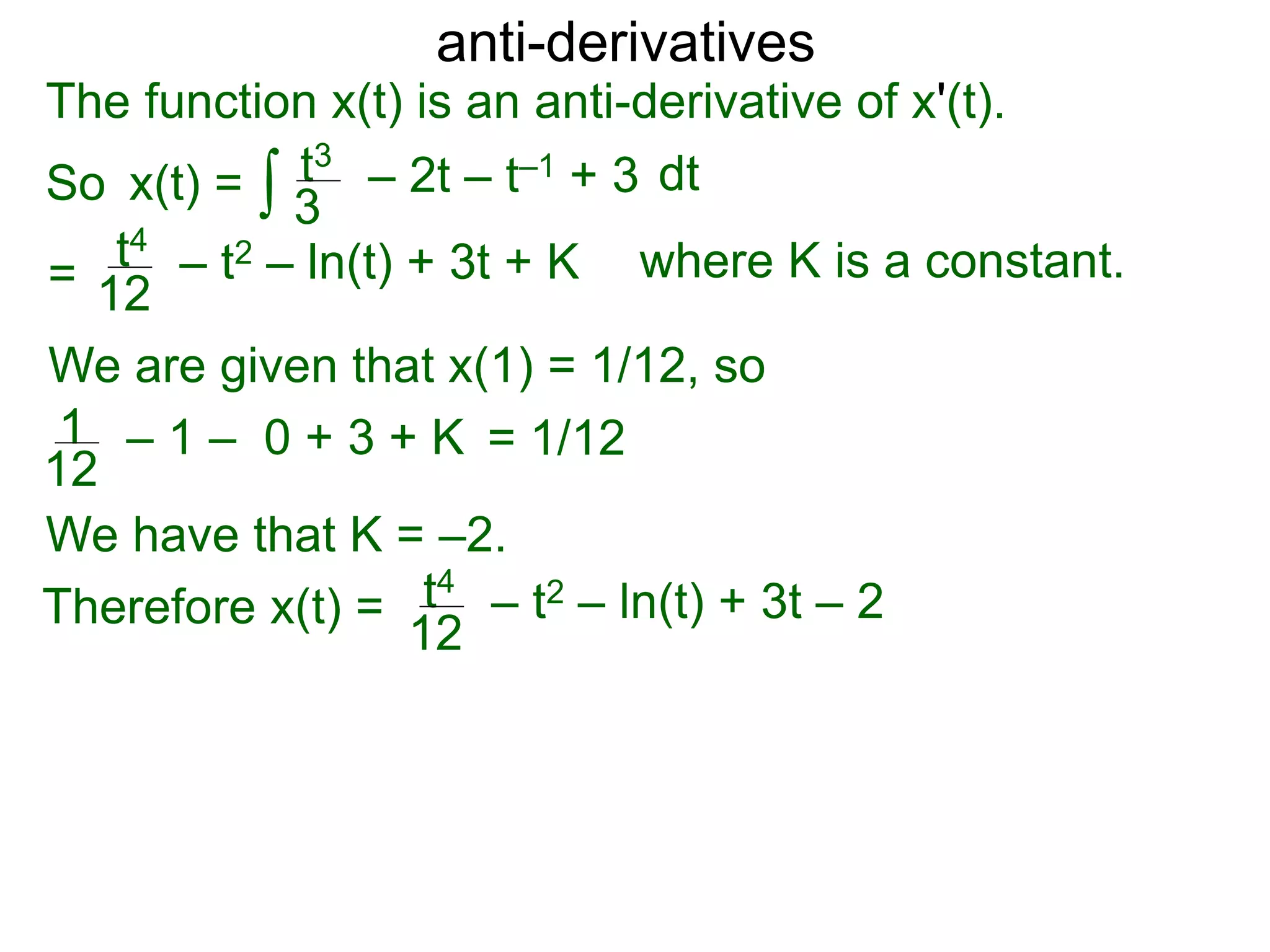
We are given that x(1) = 1/12, so
where K is a constant.
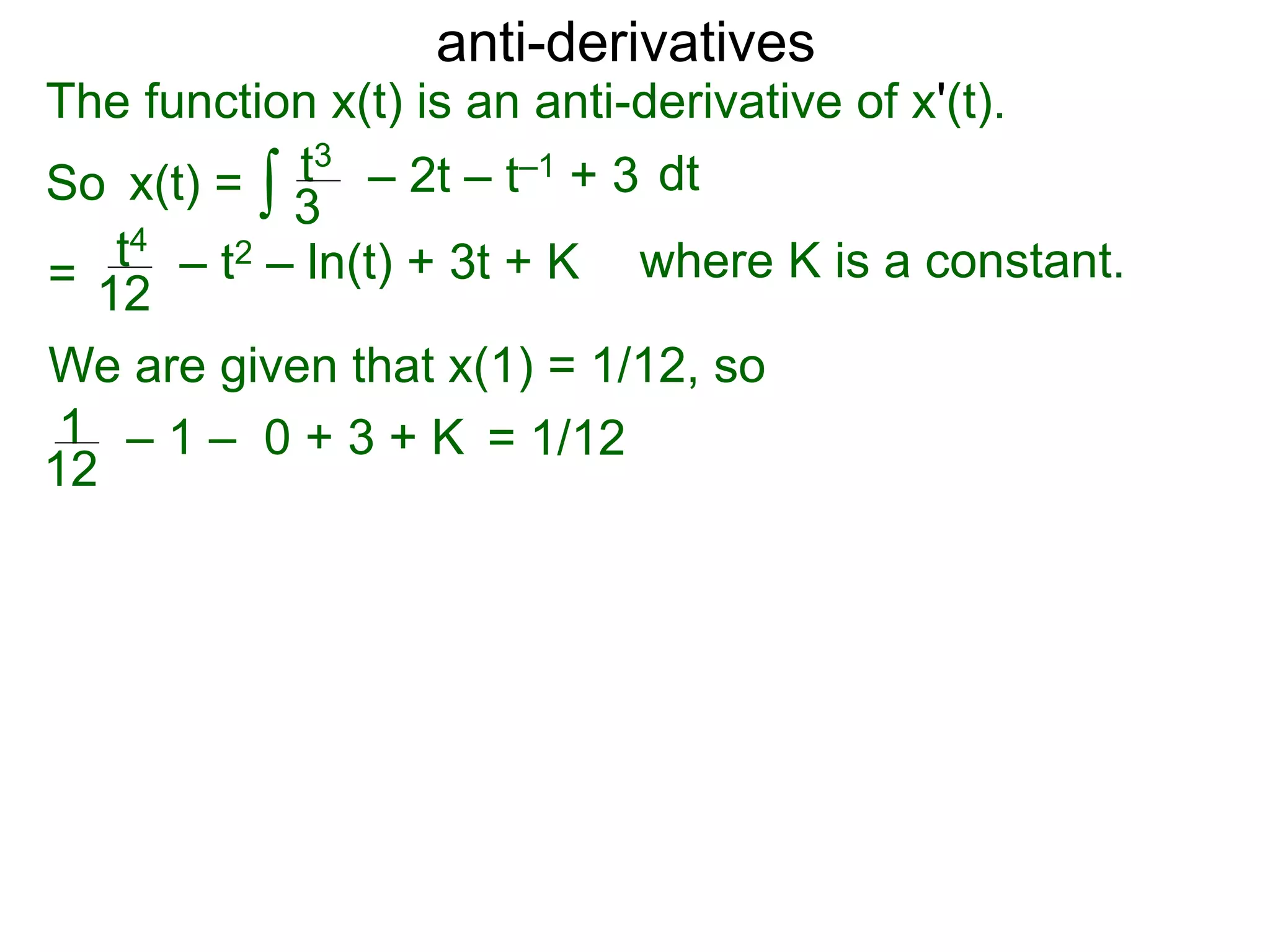
anti-derivatives
The function x(t) is an anti-derivative of x'(t).
So x(t) =
=
∫ dtt3
3
– 2t – t–1 + 3
t4
12
– t2 – ln(t) + 3t + K
We are given that x(1) = 1/12, so
= 1/121
12
– 1 – 0 + 3 + K
where K is a constant.
anti-derivatives
The function x(t) is an anti-derivative of x'(t).
So x(t) =
=
∫ dtt3
3
– 2t – t–1 + 3
t4
12
– t2 – ln(t) + 3t + K
We are given that x(1) = 1/12, so
= 1/121
12
– 1 – 0 + 3 + K
We have that K = –2.
where K is a constant.
anti-derivatives
The function x(t) is an anti-derivative of x'(t).
So x(t) =
=
∫ dtt3
3
– 2t – t–1 + 3
t4
12
– t2 – ln(t) + 3t + K
We are given that x(1) = 1/12, so
= 1/121
12
– 1 – 0 + 3 + K
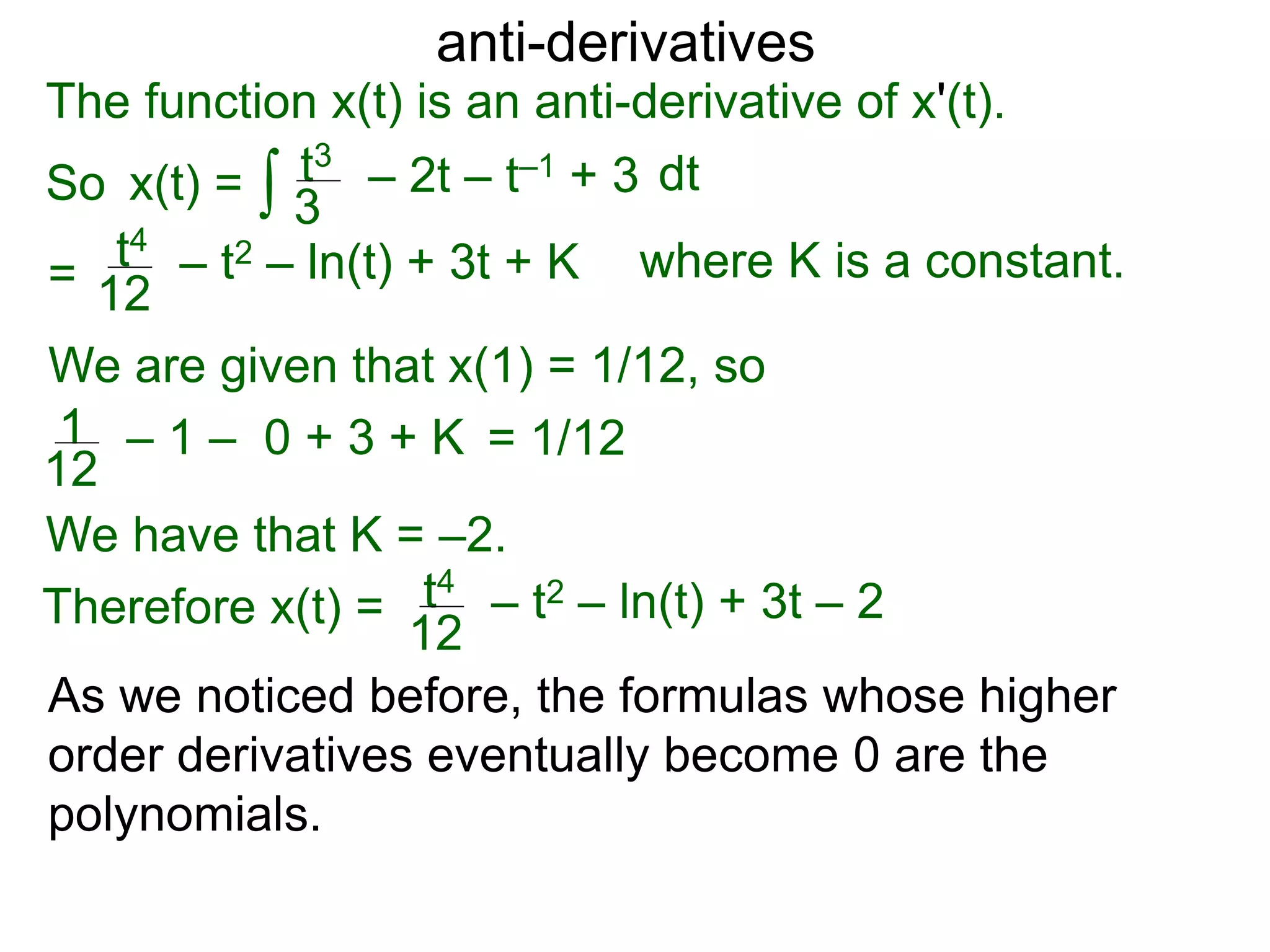
We have that K = –2.
Therefore x(t) = t4
12
– t2 – ln(t) + 3t – 2
where K is a constant.
anti-derivatives
The function x(t) is an anti-derivative of x'(t).
So x(t) =
=
∫ dtt3
3
– 2t – t–1 + 3
t4
12
– t2 – ln(t) + 3t + K
We are given that x(1) = 1/12, so
= 1/121
12
– 1 – 0 + 3 + K
We have that K = –2.
Therefore x(t) = t4
12
– t2 – ln(t) + 3t – 2
where K is a constant.
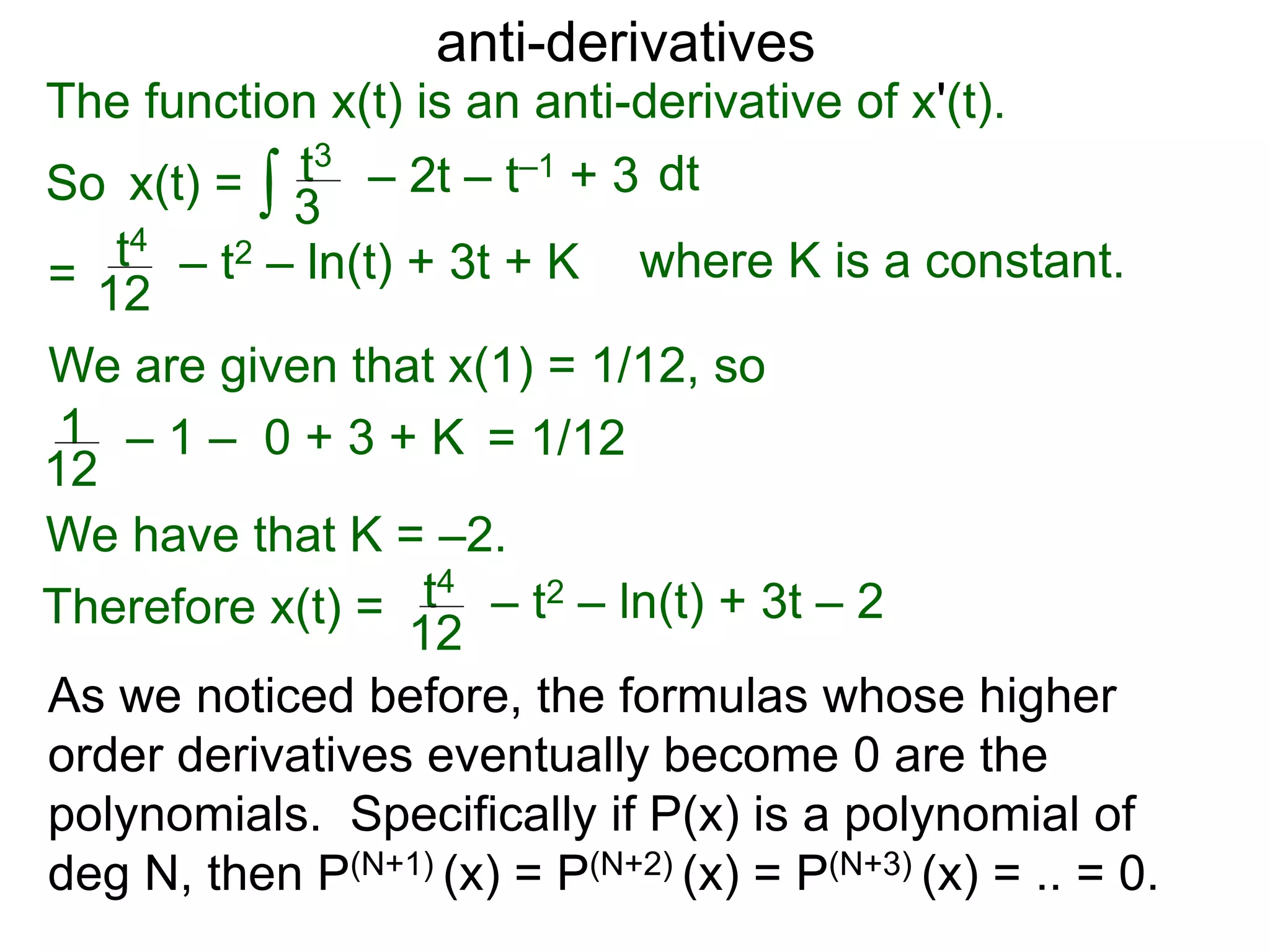
As we noticed before, the formulas whose higher
order derivatives eventually become 0 are the
polynomials.
anti-derivatives
The function x(t) is an anti-derivative of x'(t).
So x(t) =
=
∫ dtt3
3
– 2t – t–1 + 3
t4
12
– t2 – ln(t) + 3t + K
We are given that x(1) = 1/12, so
= 1/121
12
– 1 – 0 + 3 + K
We have that K = –2.
Therefore x(t) = t4
12
– t2 – ln(t) + 3t – 2
where K is a constant.
As we noticed before, the formulas whose higher
order derivatives eventually become 0 are the
polynomials. Specifically if P(x) is a polynomial of
deg N, then P(N+1) (x) = P(N+2) (x) = P(N+3) (x) = .. = 0.
anti-derivatives
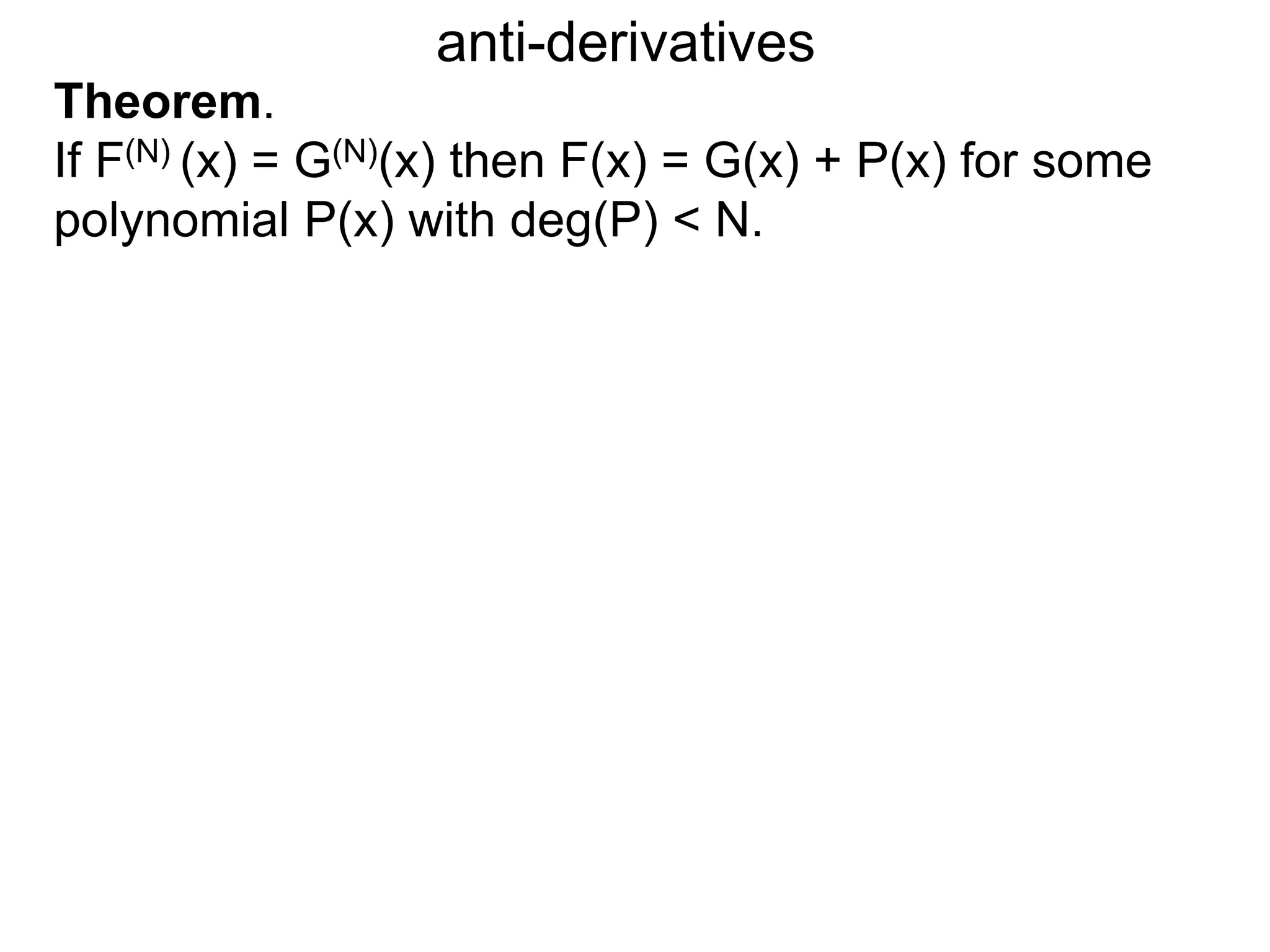
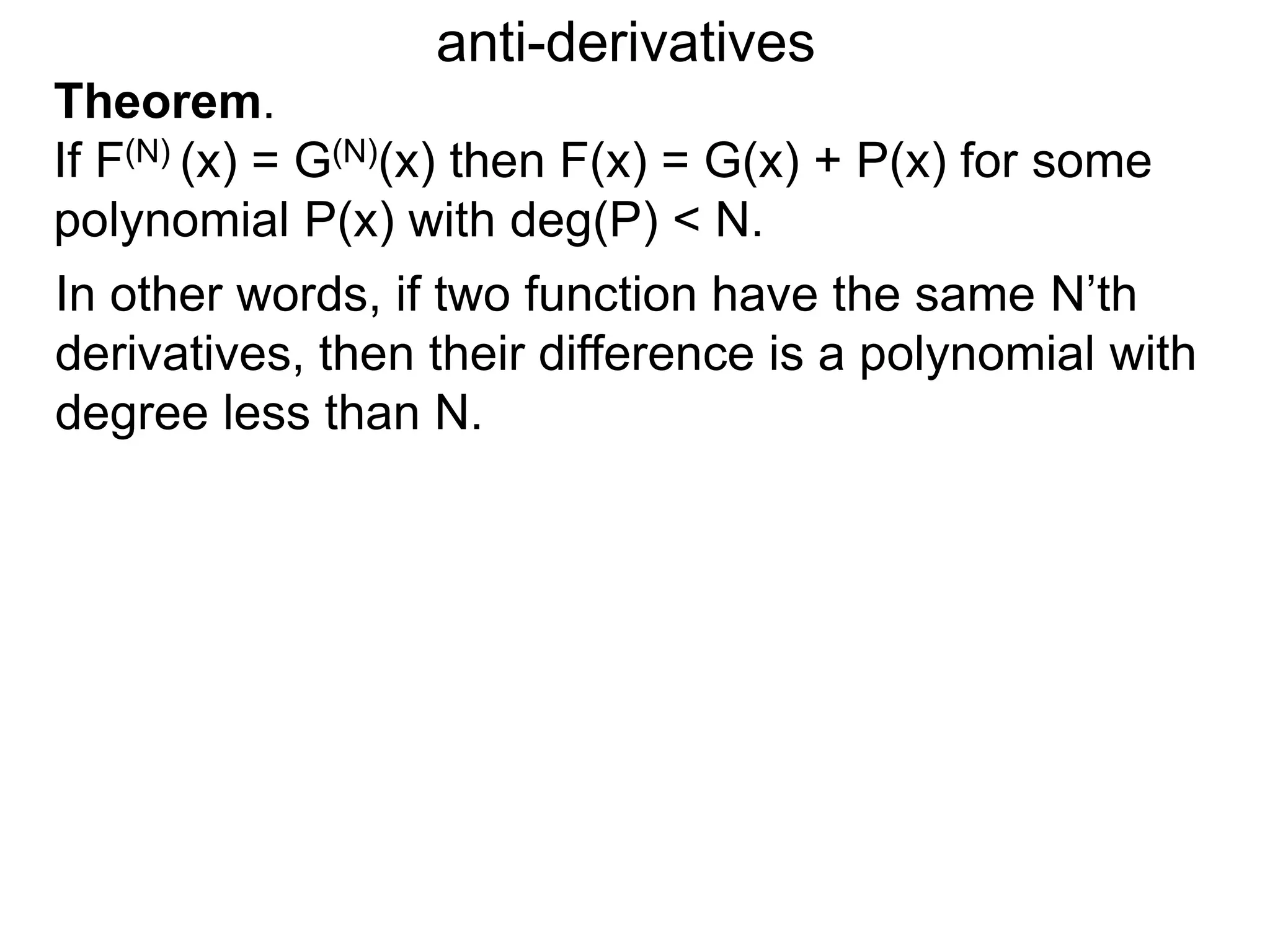
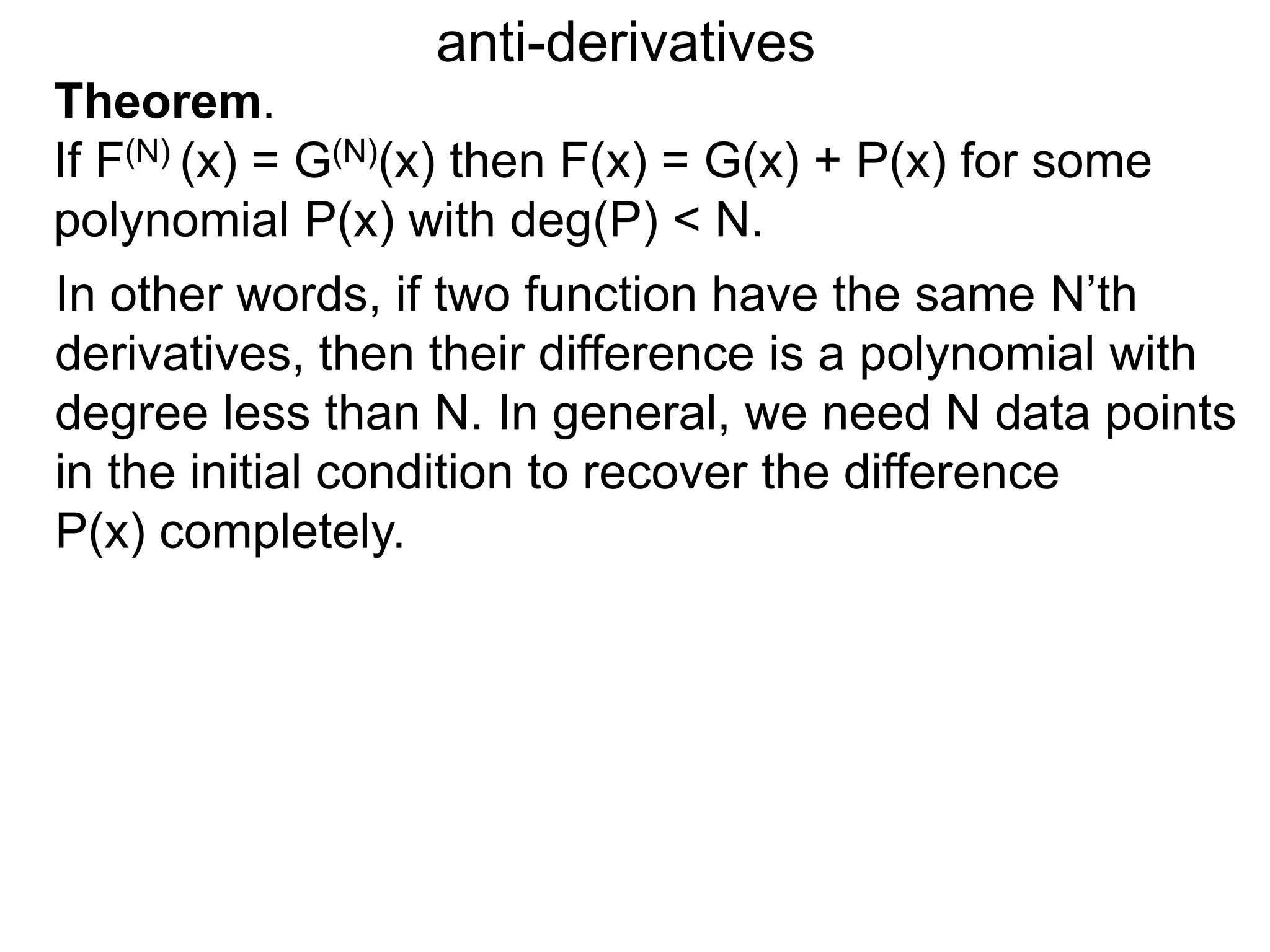
Theorem.
If F(N) (x) = G(N)(x) then F(x) = G(x) + P(x) for some
polynomial P(x) with deg(P) < N.
anti-derivatives
In other words, if two function have the same N’th
derivatives, then their difference is a polynomial with
degree less than N.
Theorem.
If F(N) (x) = G(N)(x) then F(x) = G(x) + P(x) for some
polynomial P(x) with deg(P) < N.
anti-derivatives
In other words, if two function have the same N’th
derivatives, then their difference is a polynomial with
degree less than N. In general, we need N data points
in the initial condition to recover the difference
P(x) completely.
Theorem.
If F(N) (x) = G(N)(x) then F(x) = G(x) + P(x) for some
polynomial P(x) with deg(P) < N.
The Substitution Method
The derivative of an elementary function is another
elementary function, but the anti-derivative of an
elementary function might not be elementary.
The Substitution Method
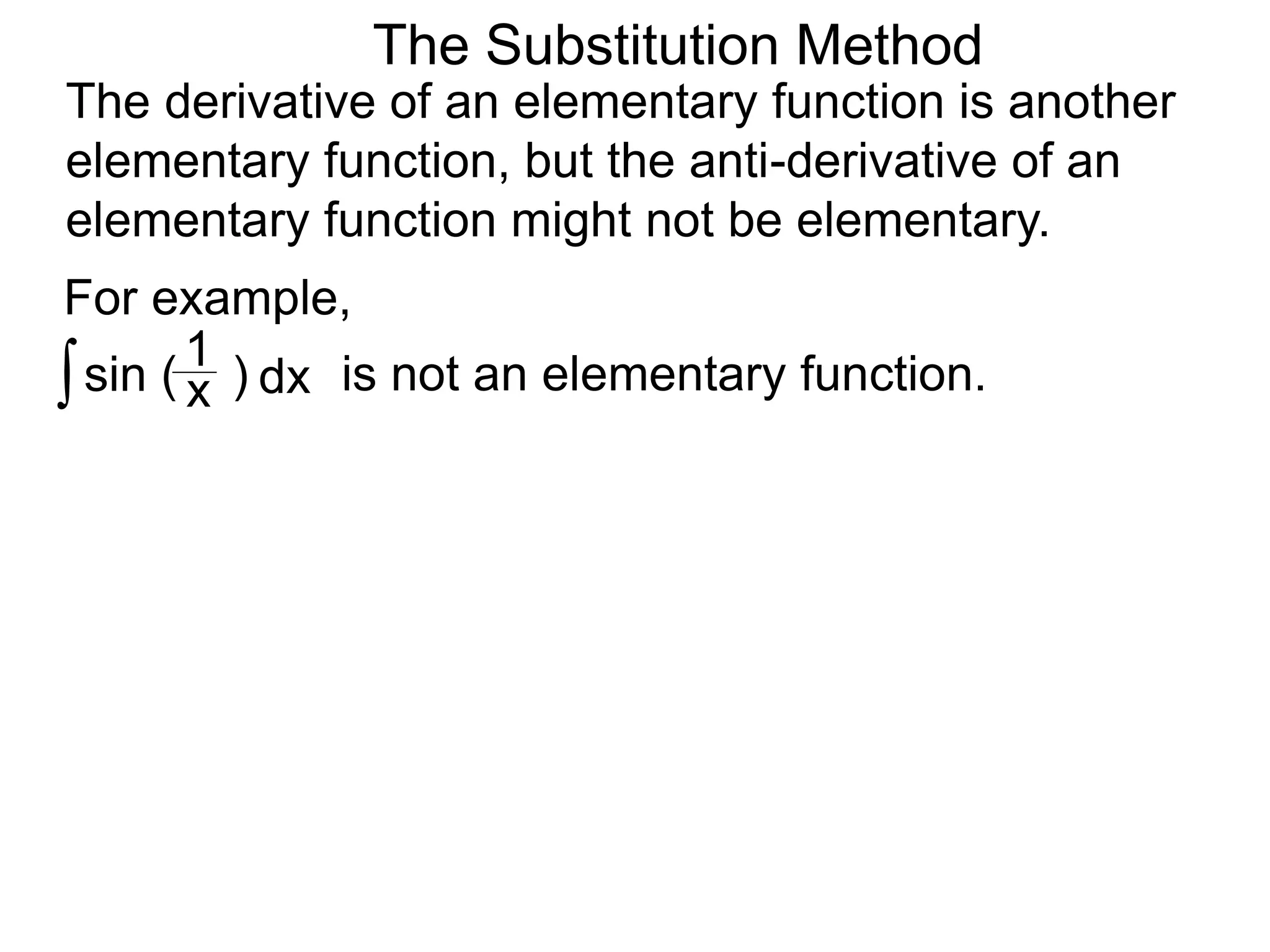
For example,
The derivative of an elementary function is another
elementary function, but the anti-derivative of an
elementary function might not be elementary.
∫sin ( )x
1
dx is not an elementary function.
The Substitution Method
For example,
The derivative of an elementary function is another
elementary function, but the anti-derivative of an
elementary function might not be elementary.
∫sin ( )x
1
dx is not an elementary function.
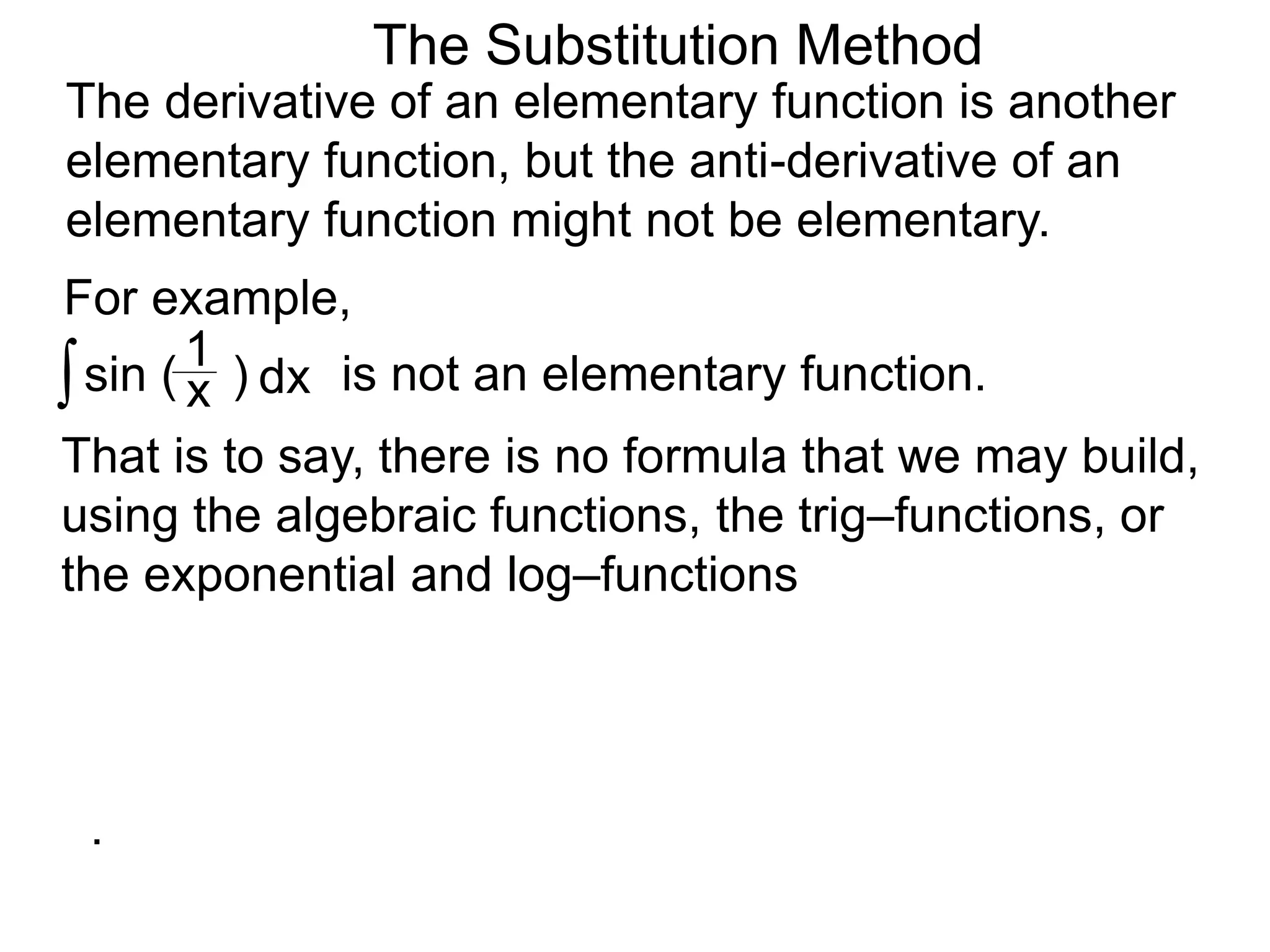
That is to say, there is no formula that we may build,
using the algebraic functions, the trig–functions, or
the exponential and log–functions
.
The Substitution Method
For example,
The derivative of an elementary function is another
elementary function, but the anti-derivative of an
elementary function might not be elementary.
∫sin ( )x
1
dx is not an elementary function.
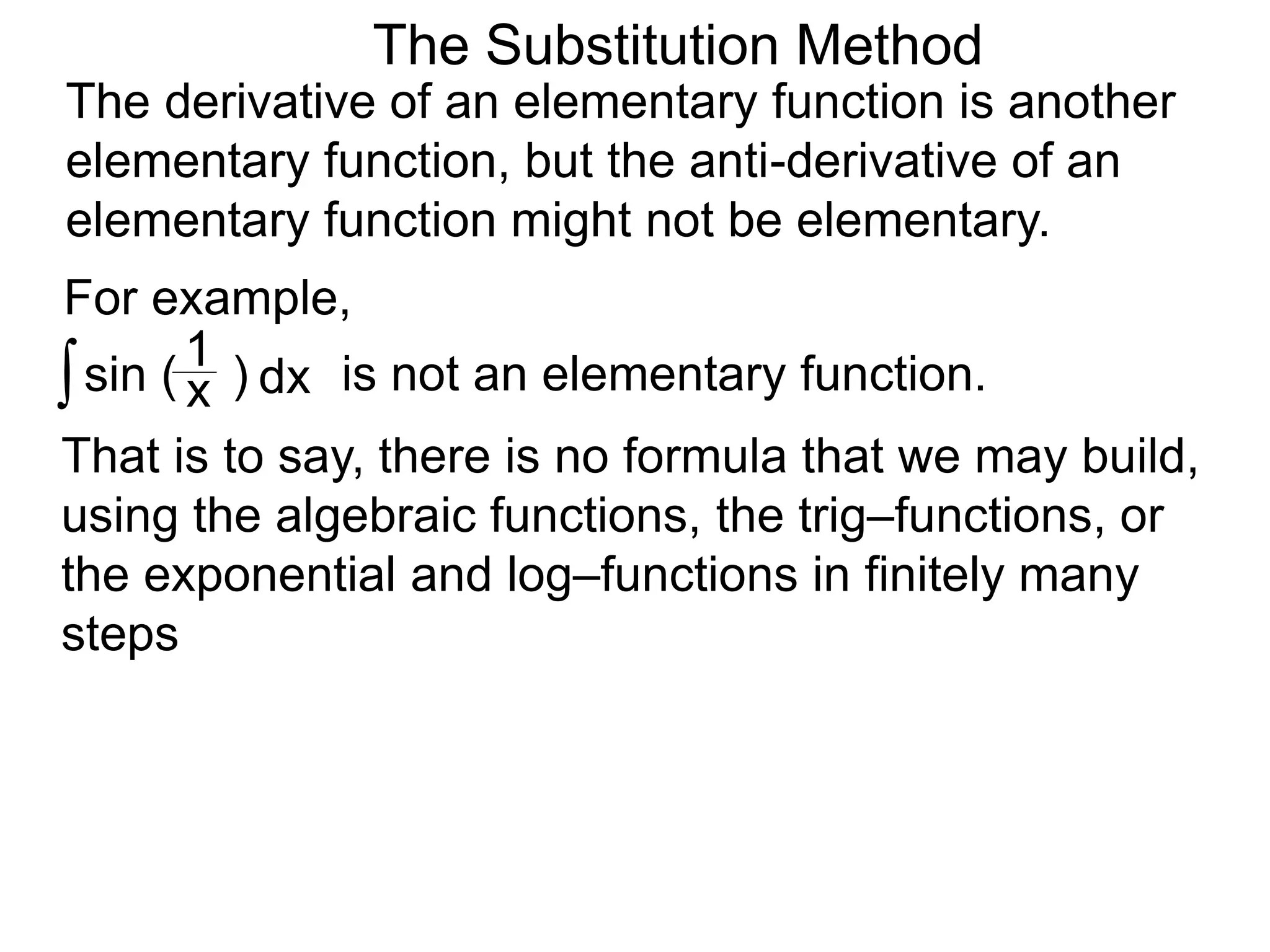
That is to say, there is no formula that we may build,
using the algebraic functions, the trig–functions, or
the exponential and log–functions in finitely many
steps
The Substitution Method
For example,
The derivative of an elementary function is another
elementary function, but the anti-derivative of an
elementary function might not be elementary.
∫sin ( )x
1
dx is not an elementary function.
That is to say, there is no formula that we may build,
using the algebraic functions, the trig–functions, or
the exponential and log–functions in finitely many
steps, whose derivative is sin(1/x).
The Substitution Method
For example,
The derivative of an elementary function is another
elementary function, but the anti-derivative of an
elementary function might not be elementary.
∫sin ( )x
1
dx is not an elementary function.
That is to say, there is no formula that we may build,
using the algebraic functions, the trig–functions, or
the exponential and log–functions in finitely many
steps, whose derivative is sin(1/x). Because there is
no Product Rule, no Quotient Rule, and no Chain
Rule for integrations, it means that the algebra of
calculating anti-derivatives is a lot more complex than
derivatives.
The Substitution Method
There are two main methods of integration,
the Substitution Method and Integration by Parts.
The Substitution Method
There are two main methods of integration,
the Substitution Method and Integration by Parts.
The Substitution Method reverses the Chain Rule
The Substitution Method
There are two main methods of integration,
the Substitution Method and Integration by Parts.
The Substitution Method reverses the Chain Rule
and Integration by Parts unwinds the Product Rule.
The Substitution Method
There are two main methods of integration,
the Substitution Method and Integration by Parts.
The Substitution Method reverses the Chain Rule
and Integration by Parts unwinds the Product Rule.
The Substitution Method–Chain Rule Reversed
The Substitution Method
There are two main methods of integration,
the Substitution Method and Integration by Parts.
The Substitution Method reverses the Chain Rule
and Integration by Parts unwinds the Product Rule.
The Substitution Method–Chain Rule Reversed
Let f = f(u) be a function of u, and u = u(x) be a
function x.
The Substitution Method
(f ○ u)'(x) = [f(u(x))]'
There are two main methods of integration,
the Substitution Method and Integration by Parts.
The Substitution Method reverses the Chain Rule
and Integration by Parts unwinds the Product Rule.
The Substitution Method–Chain Rule Reversed
Let f = f(u) be a function of u, and u = u(x) be a
function x. By the Chain Rule,
the derivative of f with respect to x is
The Substitution Method
There are two main methods of integration,
the Substitution Method and Integration by Parts.
(f ○ u)'(x) = [f(u(x))]' = f'(u(x))u'(x),
The Substitution Method reverses the Chain Rule
and Integration by Parts unwinds the Product Rule.
The Substitution Method–Chain Rule Reversed
Let f = f(u) be a function of u, and u = u(x) be a
function x. By the Chain Rule,
the derivative of f with respect to x is
The Substitution Method
There are two main methods of integration,
the Substitution Method and Integration by Parts.
(f ○ u)'(x) = [f(u(x))]' = f'(u(x))u'(x), or that
The Substitution Method reverses the Chain Rule
and Integration by Parts unwinds the Product Rule.
∫ f'(u(x))u'(x) dx f(u(x)) + k
The Substitution Method–Chain Rule Reversed
Let f = f(u) be a function of u, and u = u(x) be a
function x. By the Chain Rule,
the derivative of f with respect to x is
The Substitution Method
There are two main methods of integration,
the Substitution Method and Integration by Parts.
(f ○ u)'(x) = [f(u(x))]' = f'(u(x))u'(x), or that
The Substitution Method reverses the Chain Rule
and Integration by Parts unwinds the Product Rule.
∫ f'(u(x))u'(x) dx
This integration rule is more useful when stated with
f’s as specific basic functions.
f(u(x)) + k
The Substitution Method–Chain Rule Reversed
Let f = f(u) be a function of u, and u = u(x) be a
function x. By the Chain Rule,
the derivative of f with respect to x is
The Substitution Method
There are two main methods of integration,
the Substitution Method and Integration by Parts.
(f ○ u)'(x) = [f(u(x))]' = f'(u(x))u'(x), or that
The Substitution Method reverses the Chain Rule
and Integration by Parts unwinds the Product Rule.
∫ f'(u(x))u'(x) dx
This integration rule is more useful when stated with
f’s as specific basic functions. We list the integral
formulas from last section in their substitution–form .
f(u(x)) + k
The Substitution Method–Chain Rule Reversed
Let f = f(u) be a function of u, and u = u(x) be a
function x. By the Chain Rule,
the derivative of f with respect to x is
anti-derivatives
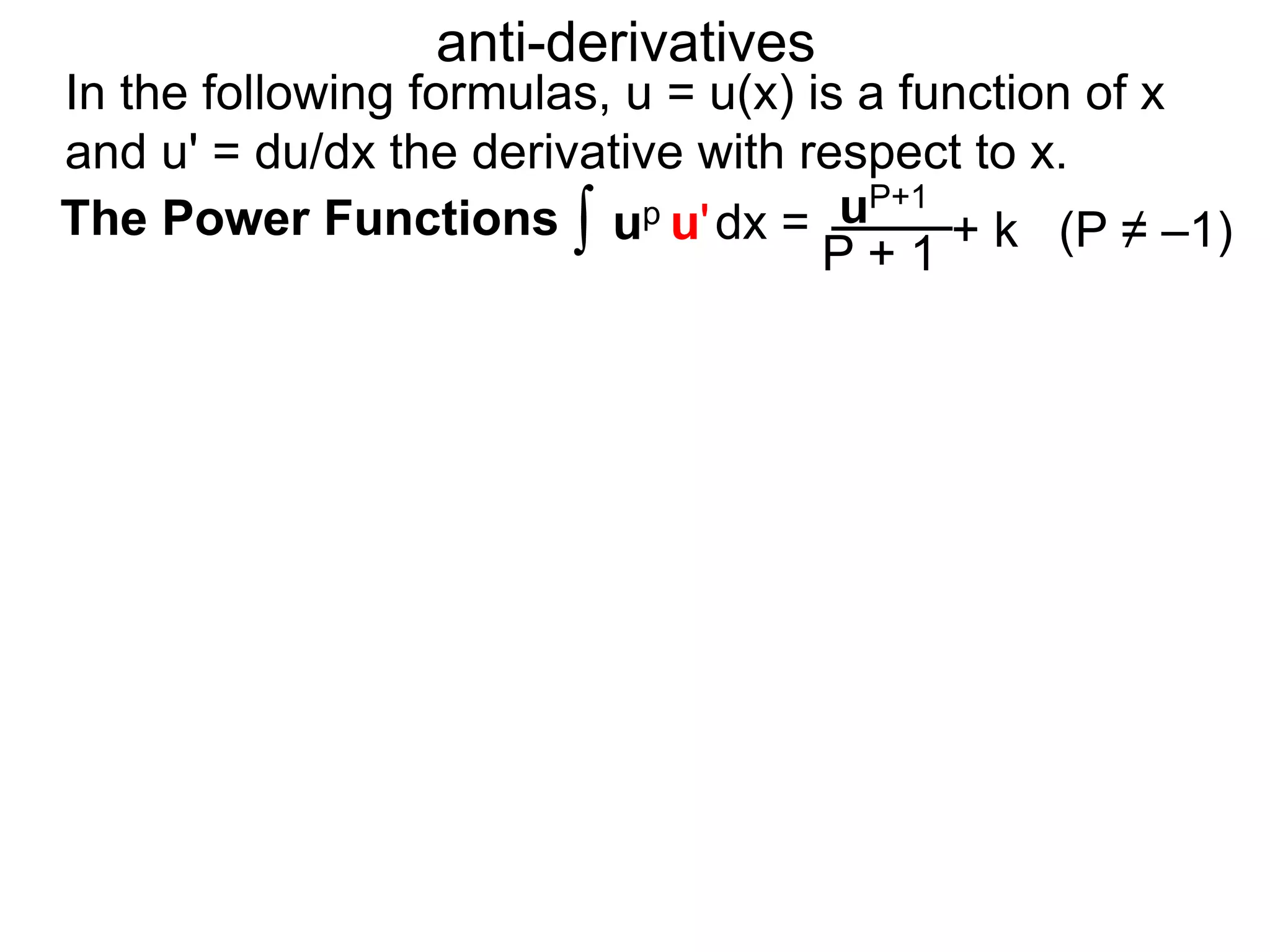
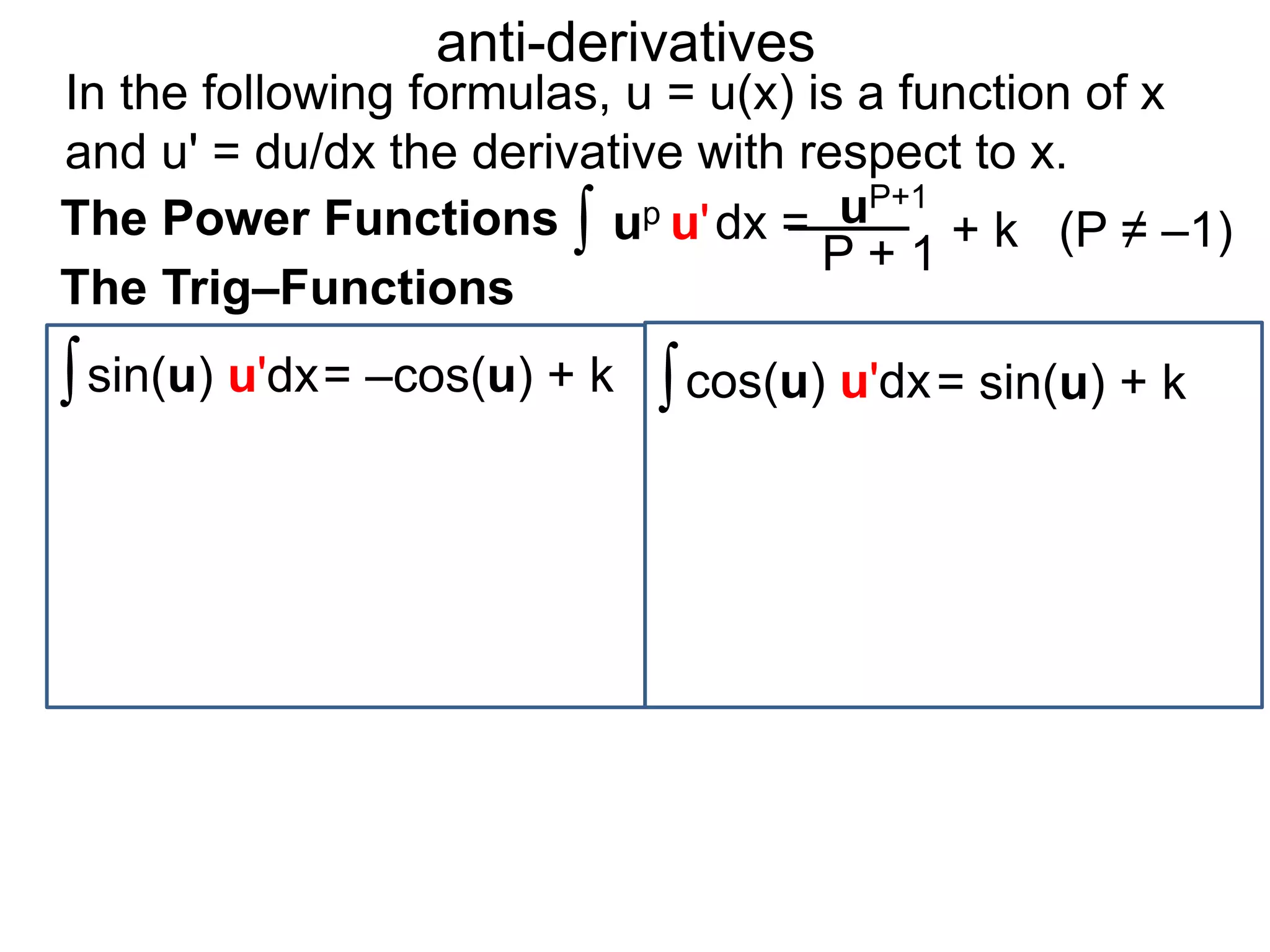
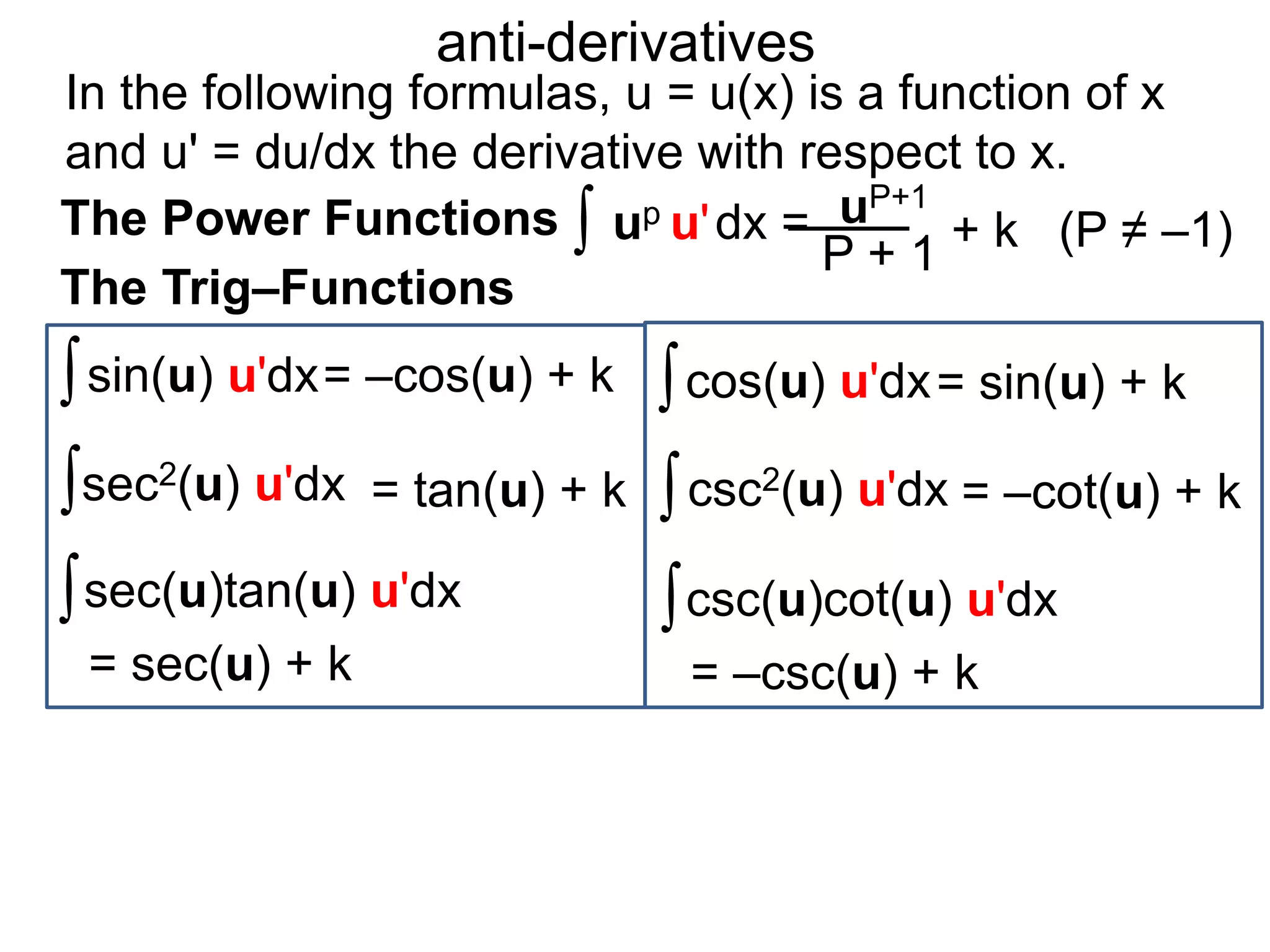
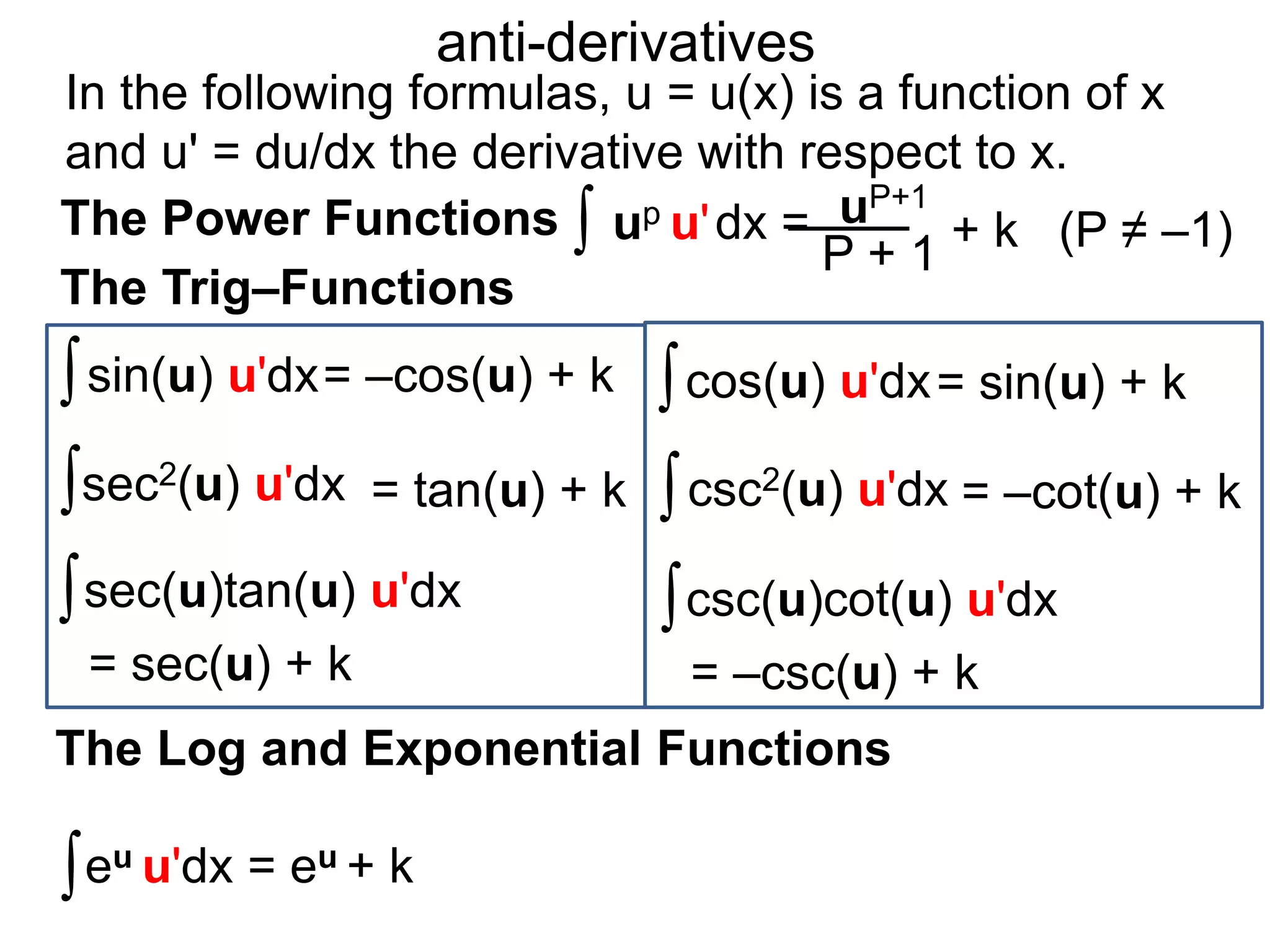
In the following formulas, u = u(x) is a function of x
and u' = du/dx the derivative with respect to x.
up u'dx =
anti-derivatives
∫ uP+1
P + 1 (P ≠ –1)The Power Functions
In the following formulas, u = u(x) is a function of x
and u' = du/dx the derivative with respect to x.
+ k
up u'dx =
sin(u) u'dx
anti-derivatives
∫
∫ uP+1
P + 1 (P ≠ –1)
cos(u) u'dx= sin(u) + k∫
The Power Functions
The Trig–Functions
= –cos(u) + k
In the following formulas, u = u(x) is a function of x
and u' = du/dx the derivative with respect to x.
+ k
up u'dx =
sin(u) u'dx
sec(u)tan(u) u'dx
anti-derivatives
∫
∫ uP+1
P + 1 (P ≠ –1)
cos(u) u'dx= sin(u) + k∫
sec2(u) u'dx = tan(u) + k∫ = –cot(u) + k∫
∫
= sec(u) + k
csc(u)cot(u) u'dx∫
= –csc(u) + k
csc2(u) u'dx
The Power Functions
The Trig–Functions
= –cos(u) + k
In the following formulas, u = u(x) is a function of x
and u' = du/dx the derivative with respect to x.
+ k
up u'dx =
sin(u) u'dx
sec(u)tan(u) u'dx
eu u'dx = eu + k
anti-derivatives
∫
∫
∫ uP+1
P + 1 (P ≠ –1)
cos(u) u'dx= sin(u) + k∫
sec2(u) u'dx = tan(u) + k∫ = –cot(u) + k∫
∫
= sec(u) + k
csc(u)cot(u) u'dx∫
= –csc(u) + k
csc2(u) u'dx
The Power Functions
The Trig–Functions
The Log and Exponential Functions
= –cos(u) + k
In the following formulas, u = u(x) is a function of x
and u' = du/dx the derivative with respect to x.
+ k
up u'dx =
sin(u) u'dx
sec(u)tan(u) u'dx
eu u'dx = eu + k
dx = ln(u) + ku
u'
anti-derivatives
∫
∫
∫
∫ uP+1
P + 1 (P ≠ –1)
cos(u) u'dx= sin(u) + k∫
sec2(u) u'dx = tan(u) + k∫ = –cot(u) + k∫
∫
= sec(u) + k
csc(u)cot(u) u'dx∫
= –csc(u) + k
csc2(u) u'dx
The Power Functions
The Trig–Functions
The Log and Exponential Functions
u–1u'dx = ln(u) + k∫
or
= –cos(u) + k
In the following formulas, u = u(x) is a function of x
and u' = du/dx the derivative with respect to x.
+ k
The Substitution Method
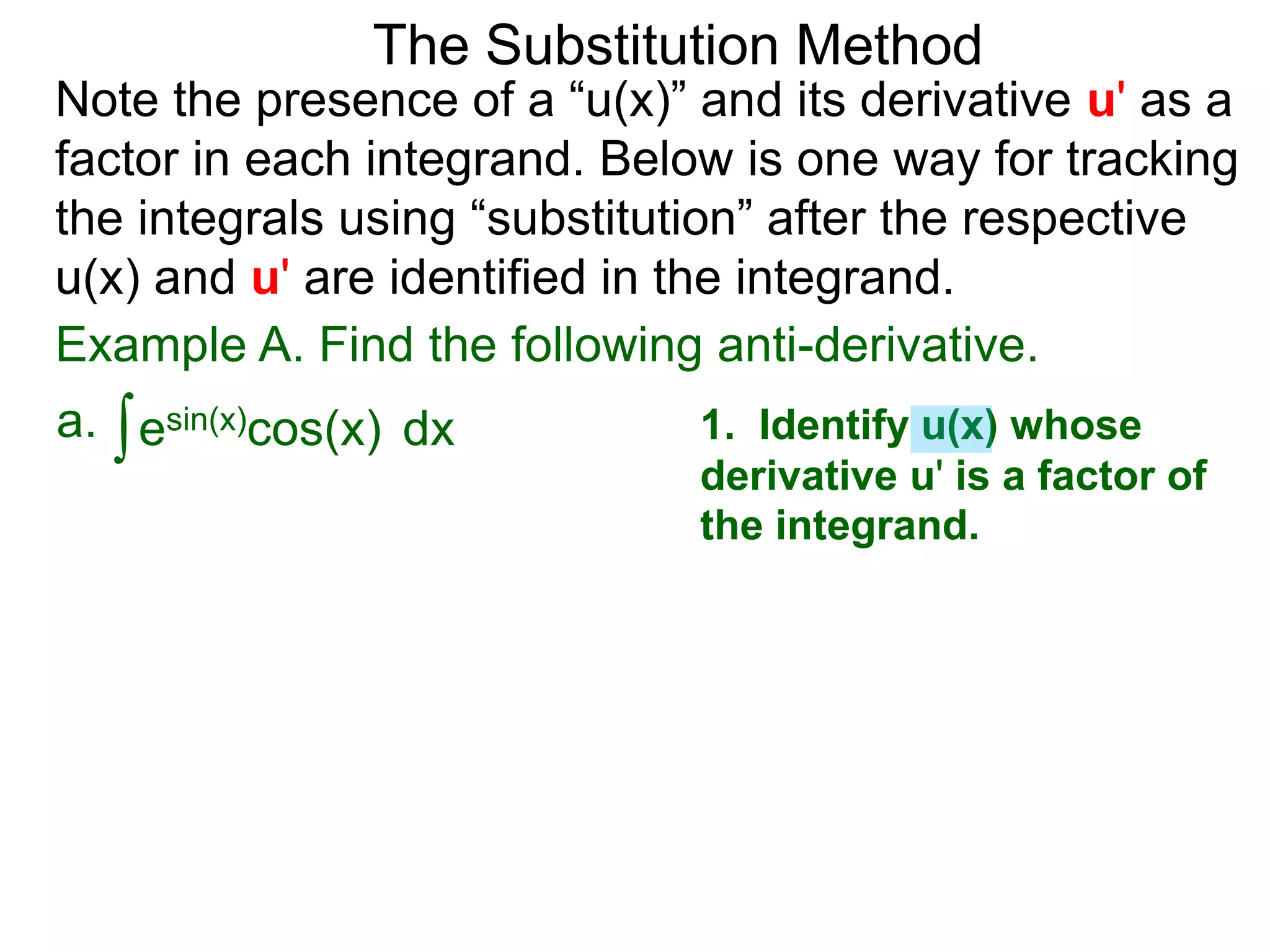
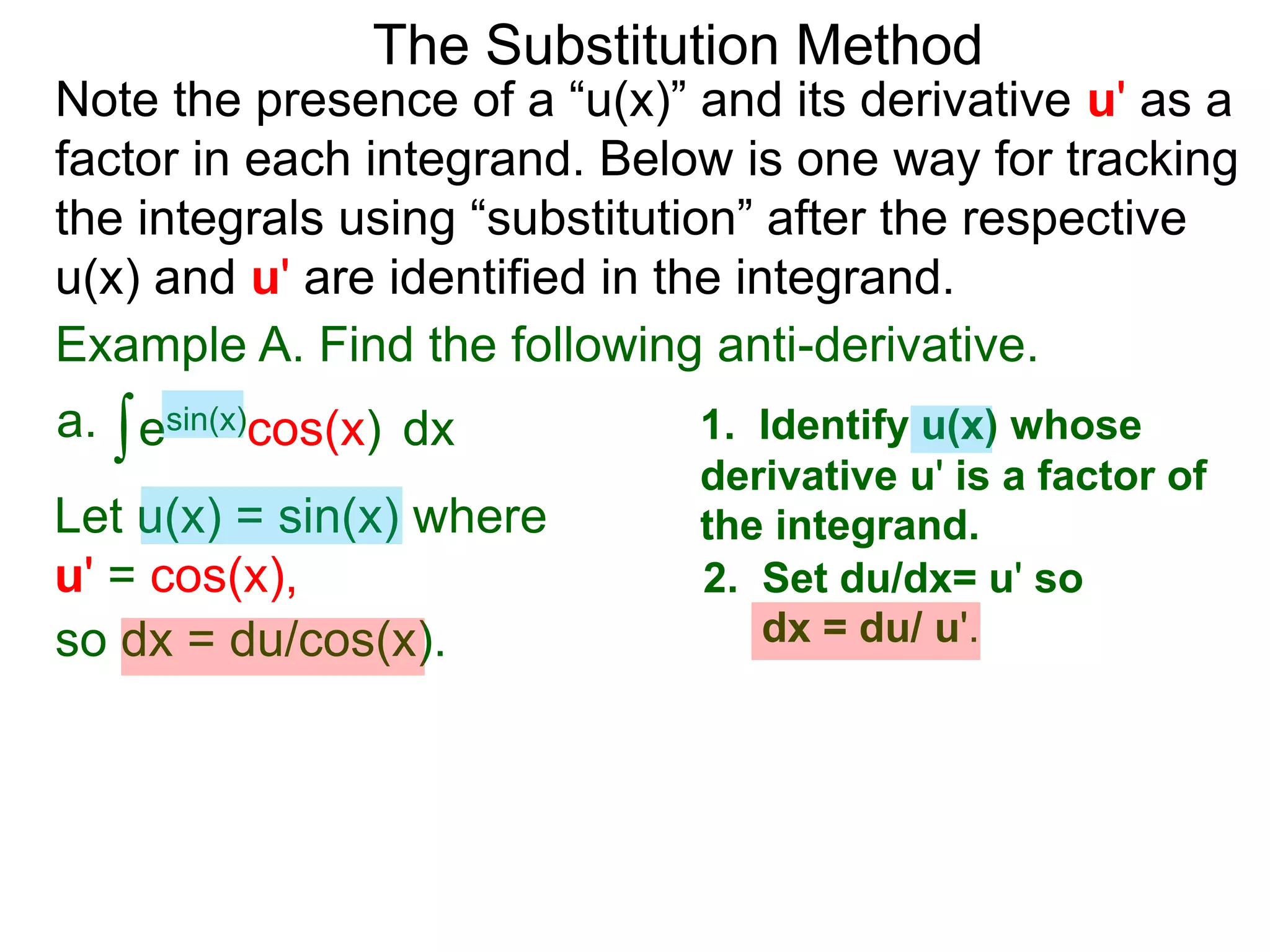
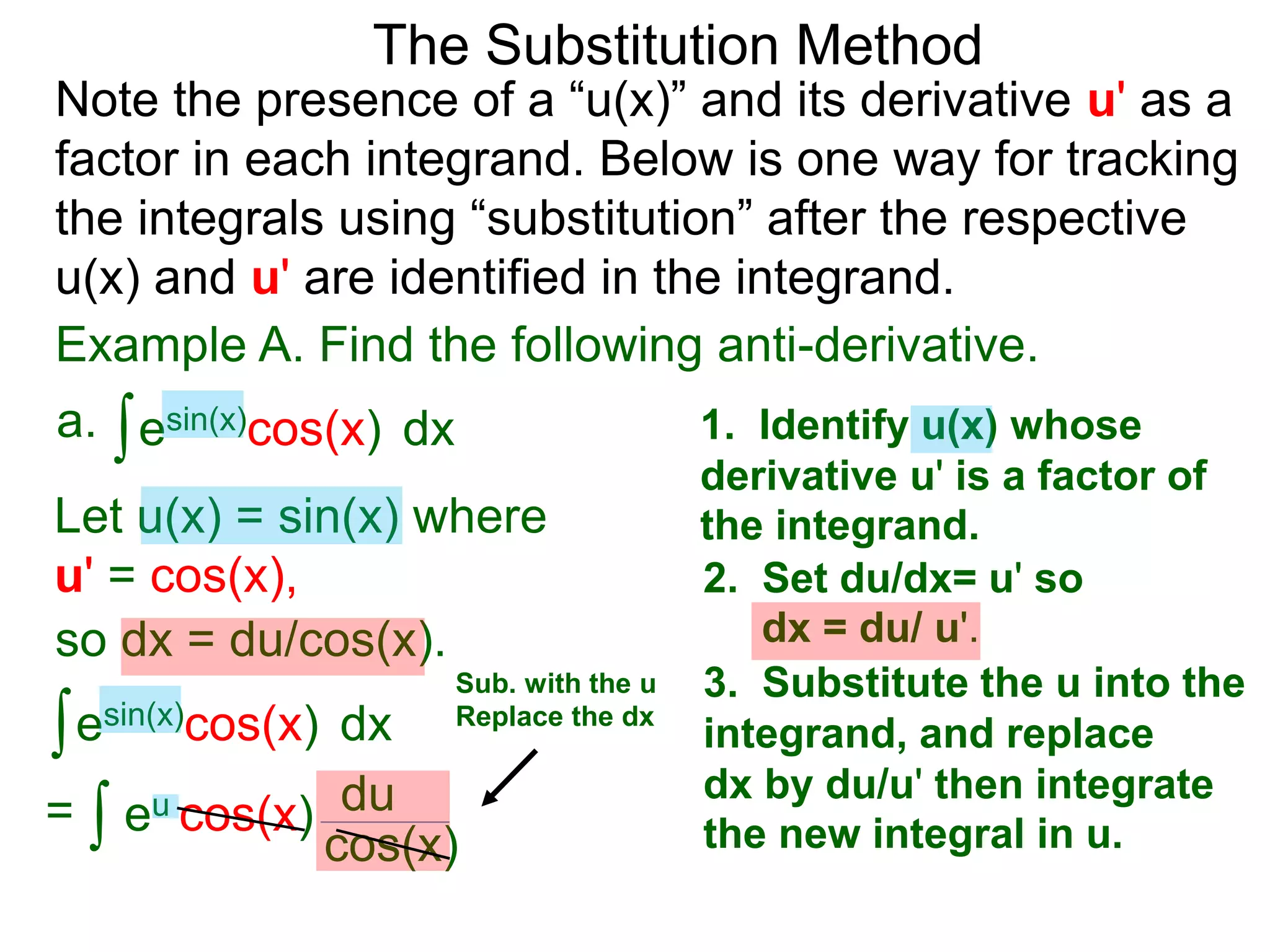
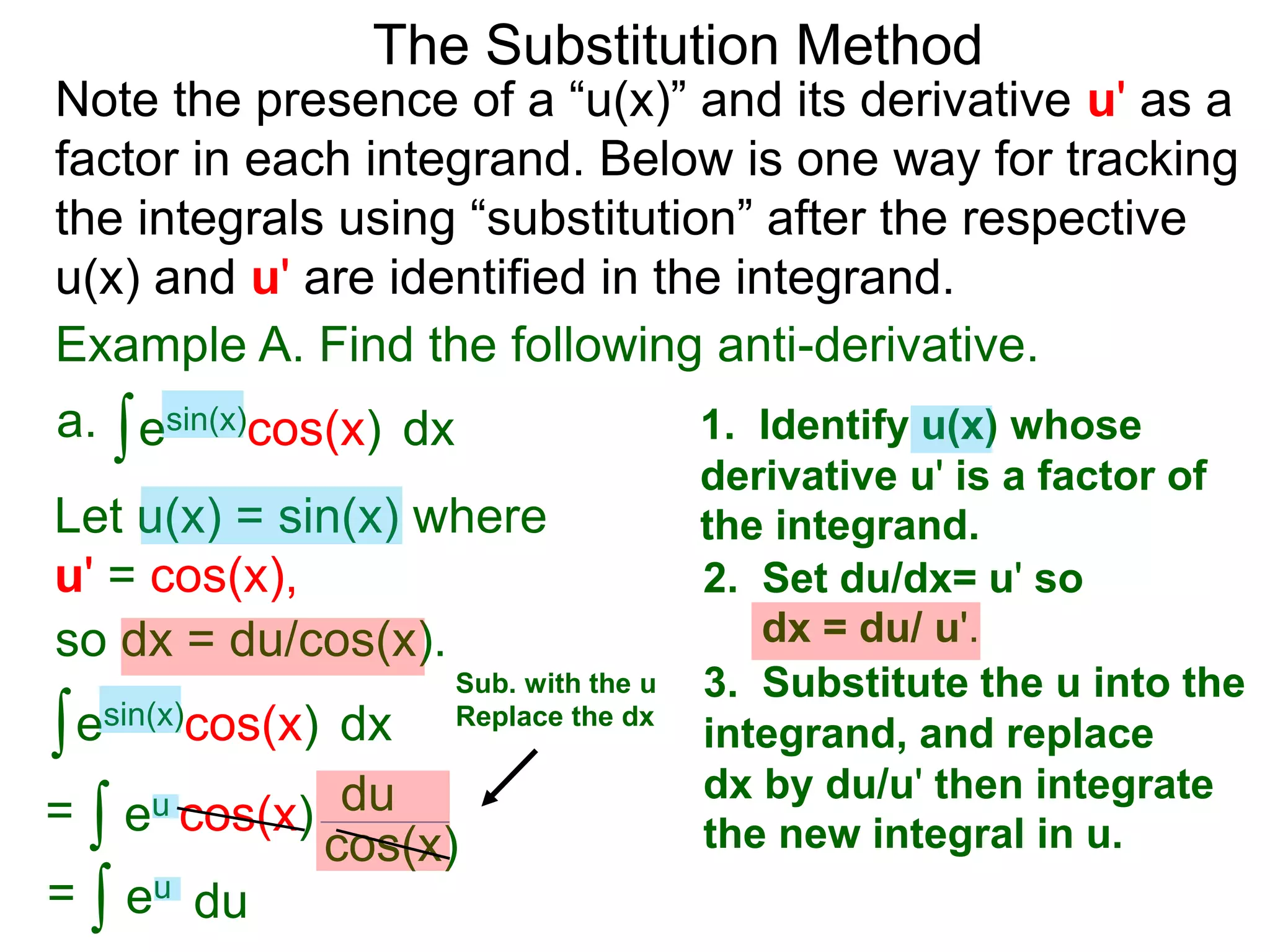
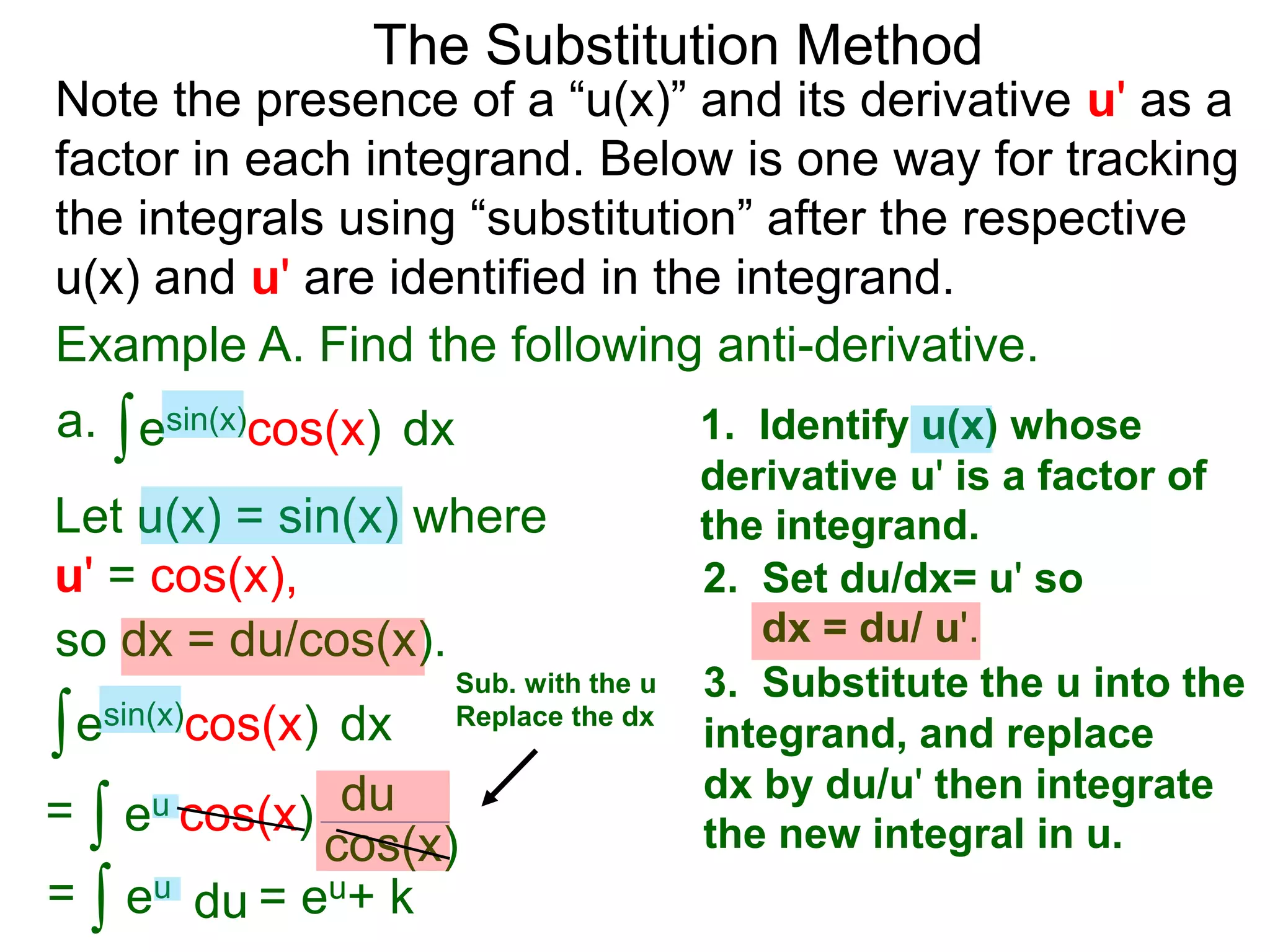
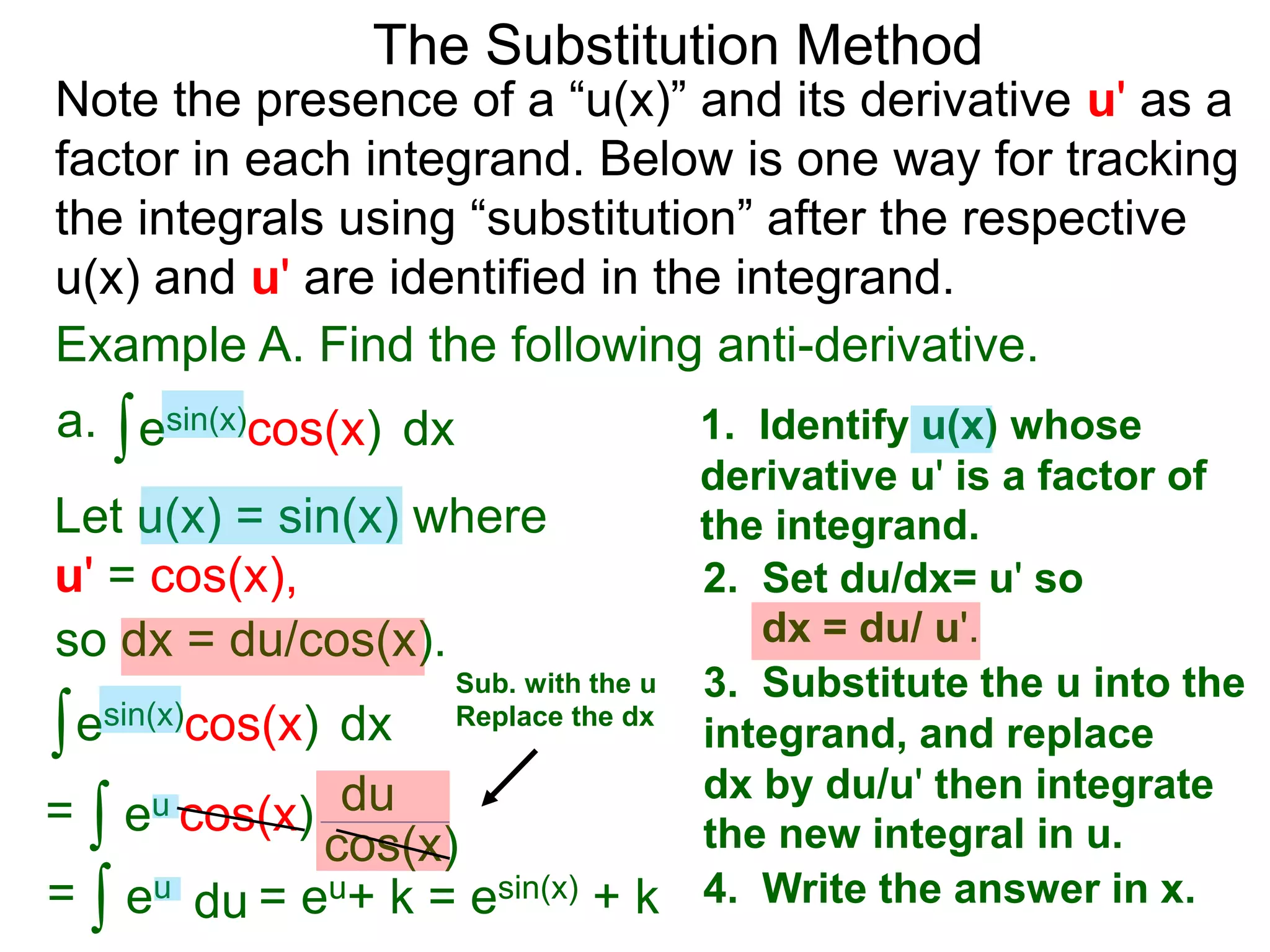
Note the presence of a “u(x)” and its derivative u' as a
factor in each integrand.
The Substitution Method
Note the presence of a “u(x)” and its derivative u' as a
factor in each integrand. Below is one way for tracking
the integrals using “substitution” after the respective
u(x) and u' are identified in the integrand.
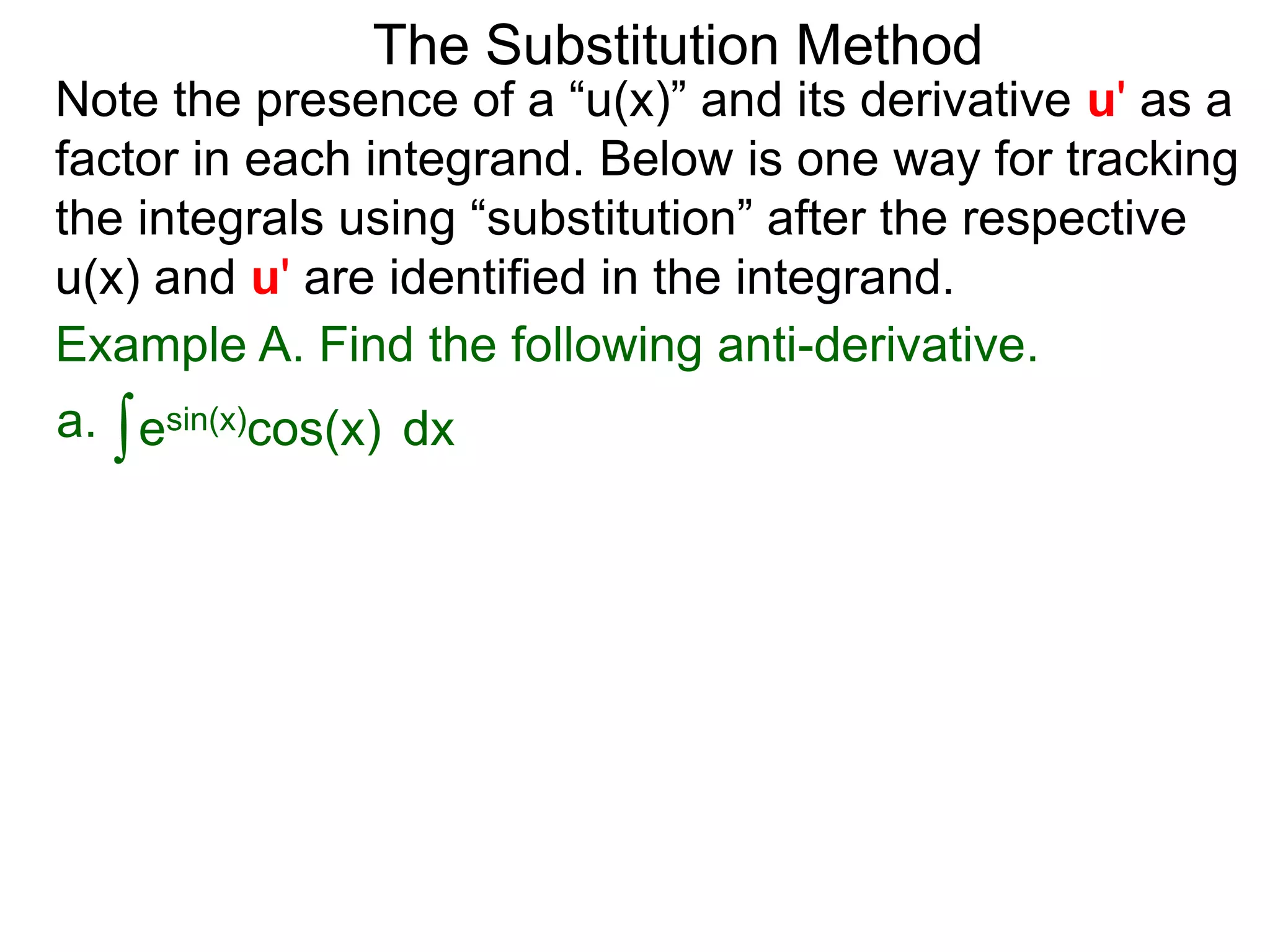
Example A. Find the following anti-derivative.
∫esin(x)cos(x)a. dx
The Substitution Method
Note the presence of a “u(x)” and its derivative u' as a
factor in each integrand. Below is one way for tracking
the integrals using “substitution” after the respective
u(x) and u' are identified in the integrand.
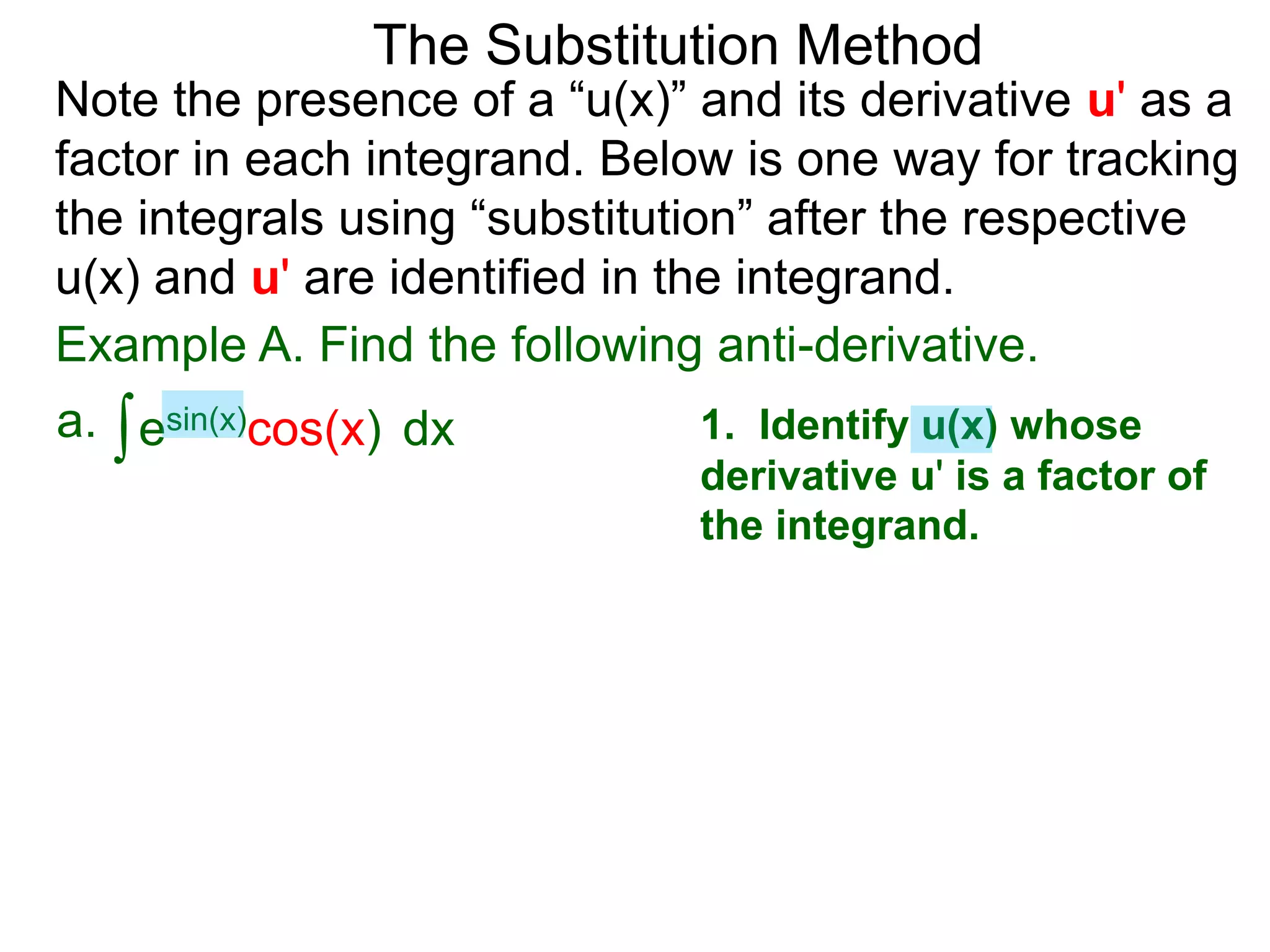
Example A. Find the following anti-derivative.
∫esin(x)cos(x)a. dx
The Substitution Method
Note the presence of a “u(x)” and its derivative u' as a
factor in each integrand. Below is one way for tracking
the integrals using “substitution” after the respective
u(x) and u' are identified in the integrand.
1. Identify u(x) whose
derivative u' is a factor of
the integrand.
Example A. Find the following anti-derivative.
∫esin(x)cos(x)a. dx
The Substitution Method
Note the presence of a “u(x)” and its derivative u' as a
factor in each integrand. Below is one way for tracking
the integrals using “substitution” after the respective
u(x) and u' are identified in the integrand.
1. Identify u(x) whose
derivative u' is a factor of
the integrand.
Example A. Find the following anti-derivative.
∫esin(x)cos(x)a. dx
The Substitution Method
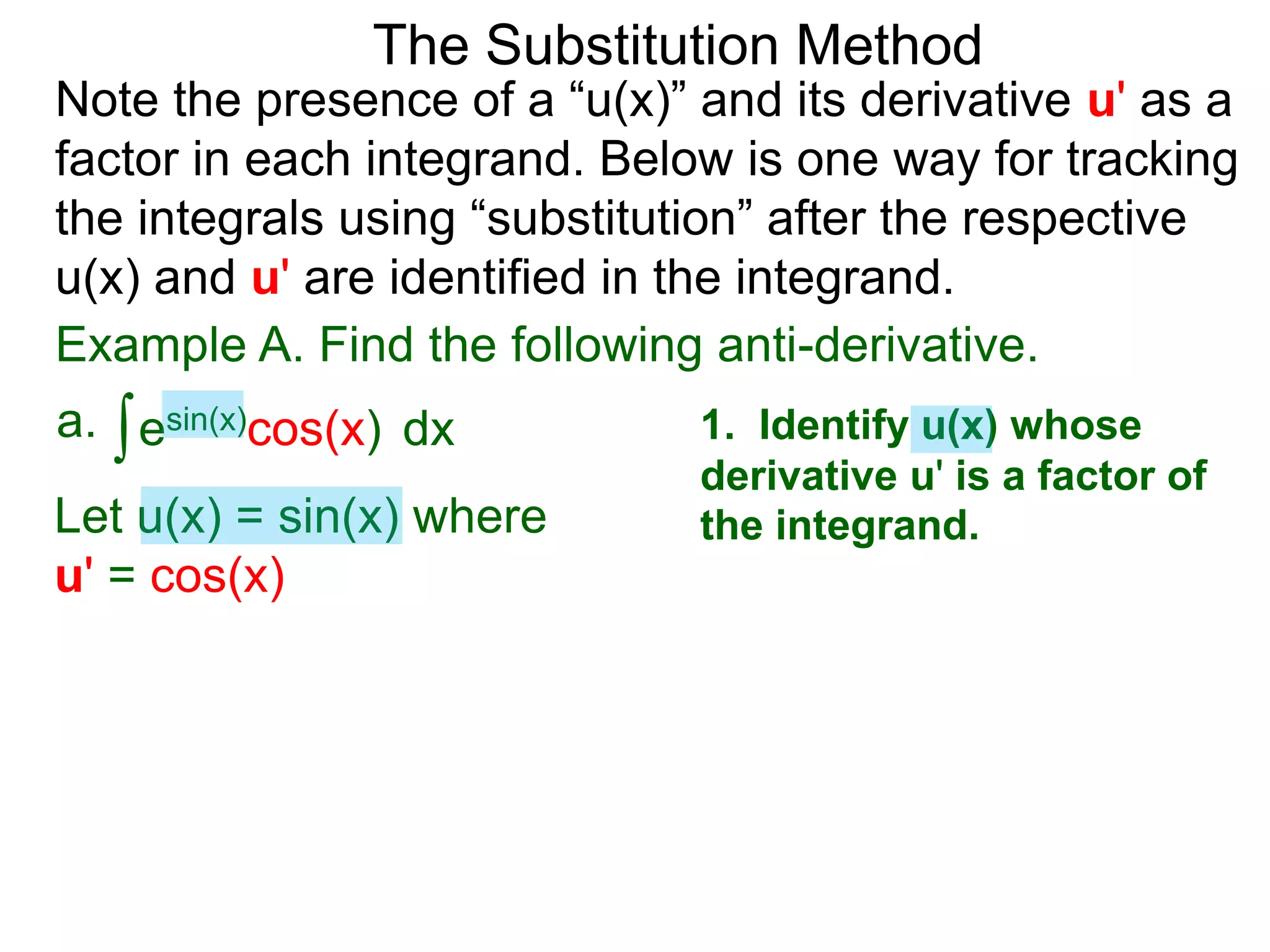
1. Identify u(x) whose
derivative u' is a factor of
the integrand.Let u(x) = sin(x) where
u' = cos(x)
Note the presence of a “u(x)” and its derivative u' as a
factor in each integrand. Below is one way for tracking
the integrals using “substitution” after the respective
u(x) and u' are identified in the integrand.
Example A. Find the following anti-derivative.
∫esin(x)cos(x)a. dx
The Substitution Method
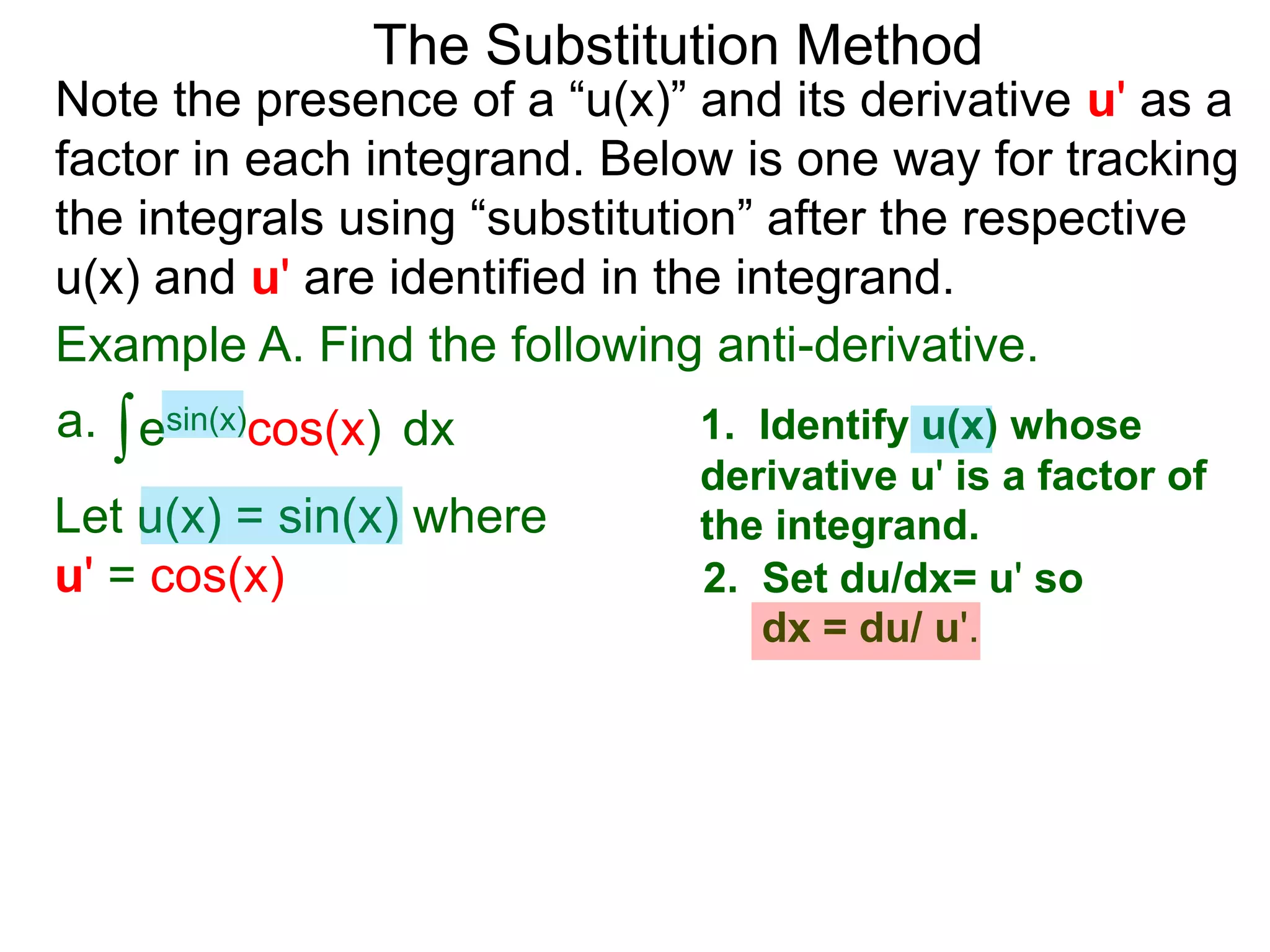
1. Identify u(x) whose
derivative u' is a factor of
the integrand.Let u(x) = sin(x) where
u' = cos(x) 2. Set du/dx= u' so
dx = du/ u'.
Note the presence of a “u(x)” and its derivative u' as a
factor in each integrand. Below is one way for tracking
the integrals using “substitution” after the respective
u(x) and u' are identified in the integrand.
Example A. Find the following anti-derivative.
∫esin(x)cos(x)a. dx
The Substitution Method
1. Identify u(x) whose
derivative u' is a factor of
the integrand.Let u(x) = sin(x) where
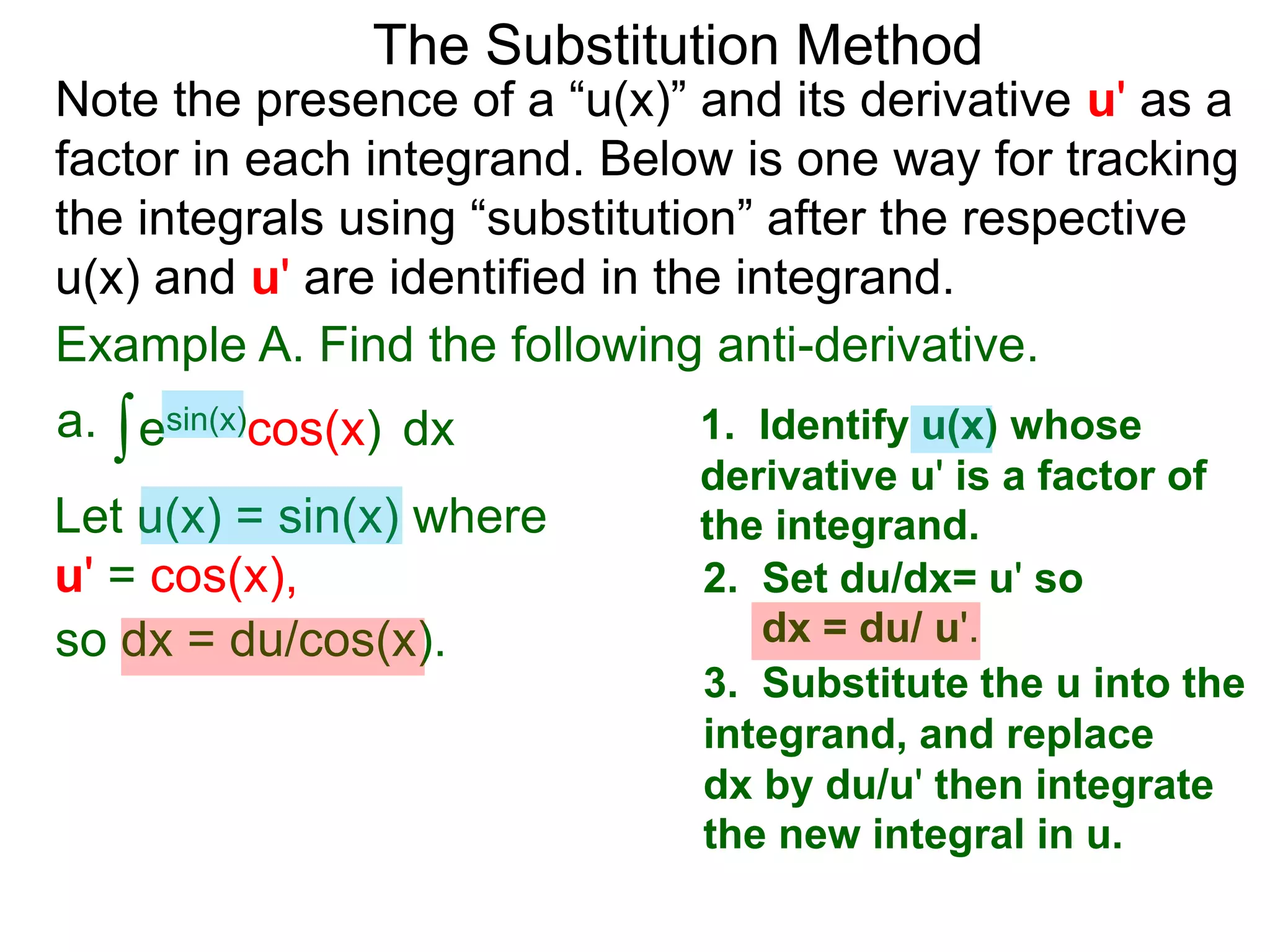
u' = cos(x), 2. Set du/dx= u' so
dx = du/ u'.so dx = du/cos(x).
Note the presence of a “u(x)” and its derivative u' as a
factor in each integrand. Below is one way for tracking
the integrals using “substitution” after the respective
u(x) and u' are identified in the integrand.
Example A. Find the following anti-derivative.
∫esin(x)cos(x)a. dx
The Substitution Method
1. Identify u(x) whose
derivative u' is a factor of
the integrand.Let u(x) = sin(x) where
u' = cos(x), 2. Set du/dx= u' so
dx = du/ u'.so dx = du/cos(x).
3. Substitute the u into the
integrand, and replace
dx by du/u' then integrate
the new integral in u.
Note the presence of a “u(x)” and its derivative u' as a
factor in each integrand. Below is one way for tracking
the integrals using “substitution” after the respective
u(x) and u' are identified in the integrand.
Example A. Find the following anti-derivative.
∫esin(x)cos(x)a. dx
The Substitution Method
1. Identify u(x) whose
derivative u' is a factor of
the integrand.Let u(x) = sin(x) where
u' = cos(x), 2. Set du/dx= u' so
dx = du/ u'.so dx = du/cos(x).
3. Substitute the u into the
integrand, and replace
dx by du/u' then integrate
the new integral in u.
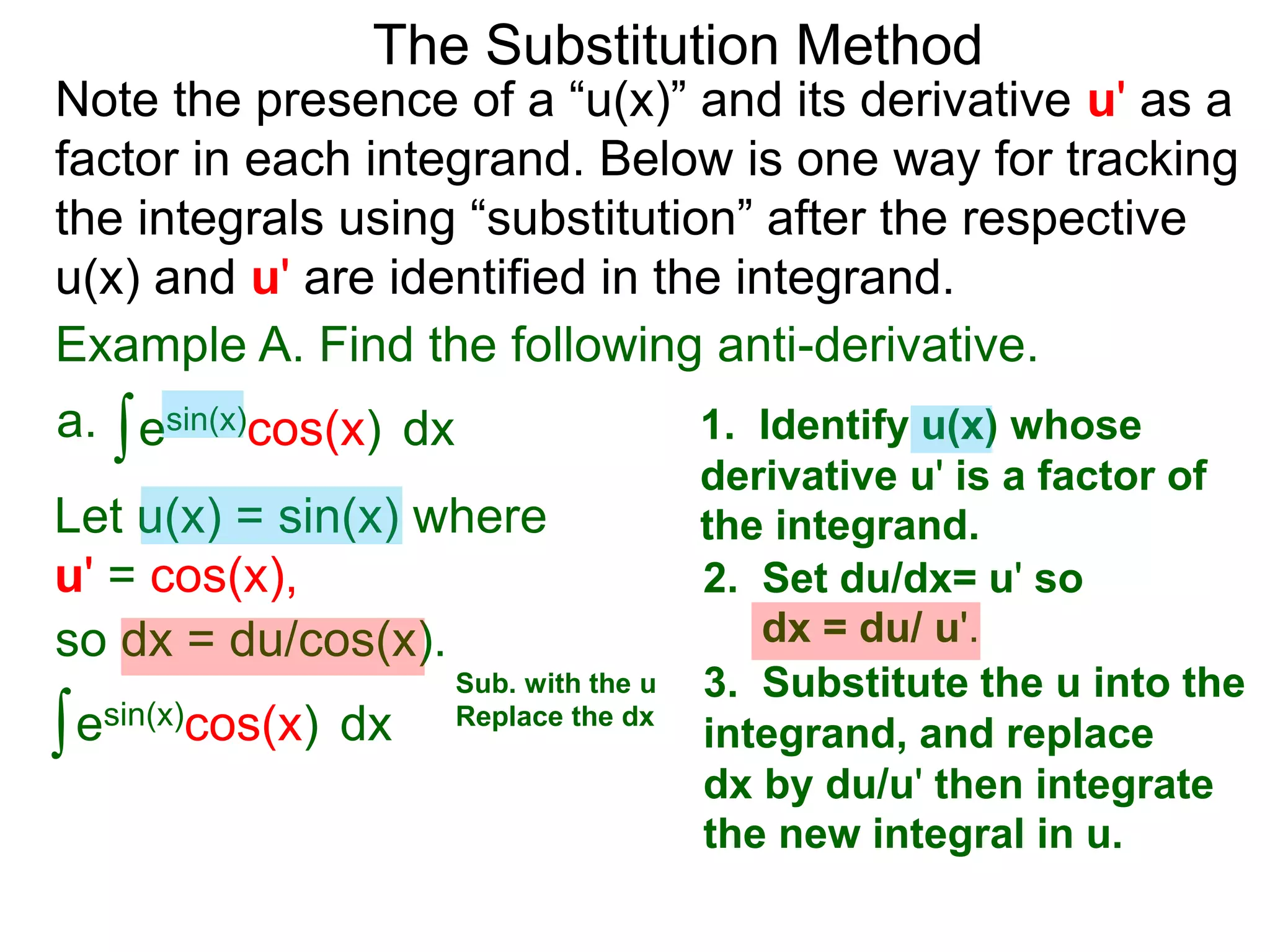
∫esin(x)cos(x) dx
Sub. with the u
Replace the dx
Note the presence of a “u(x)” and its derivative u' as a
factor in each integrand. Below is one way for tracking
the integrals using “substitution” after the respective
u(x) and u' are identified in the integrand.
Example A. Find the following anti-derivative.
∫esin(x)cos(x)a. dx
The Substitution Method
1. Identify u(x) whose
derivative u' is a factor of
the integrand.Let u(x) = sin(x) where
u' = cos(x), 2. Set du/dx= u' so
dx = du/ u'.so dx = du/cos(x).
3. Substitute the u into the
integrand, and replace
dx by du/u' then integrate
the new integral in u.
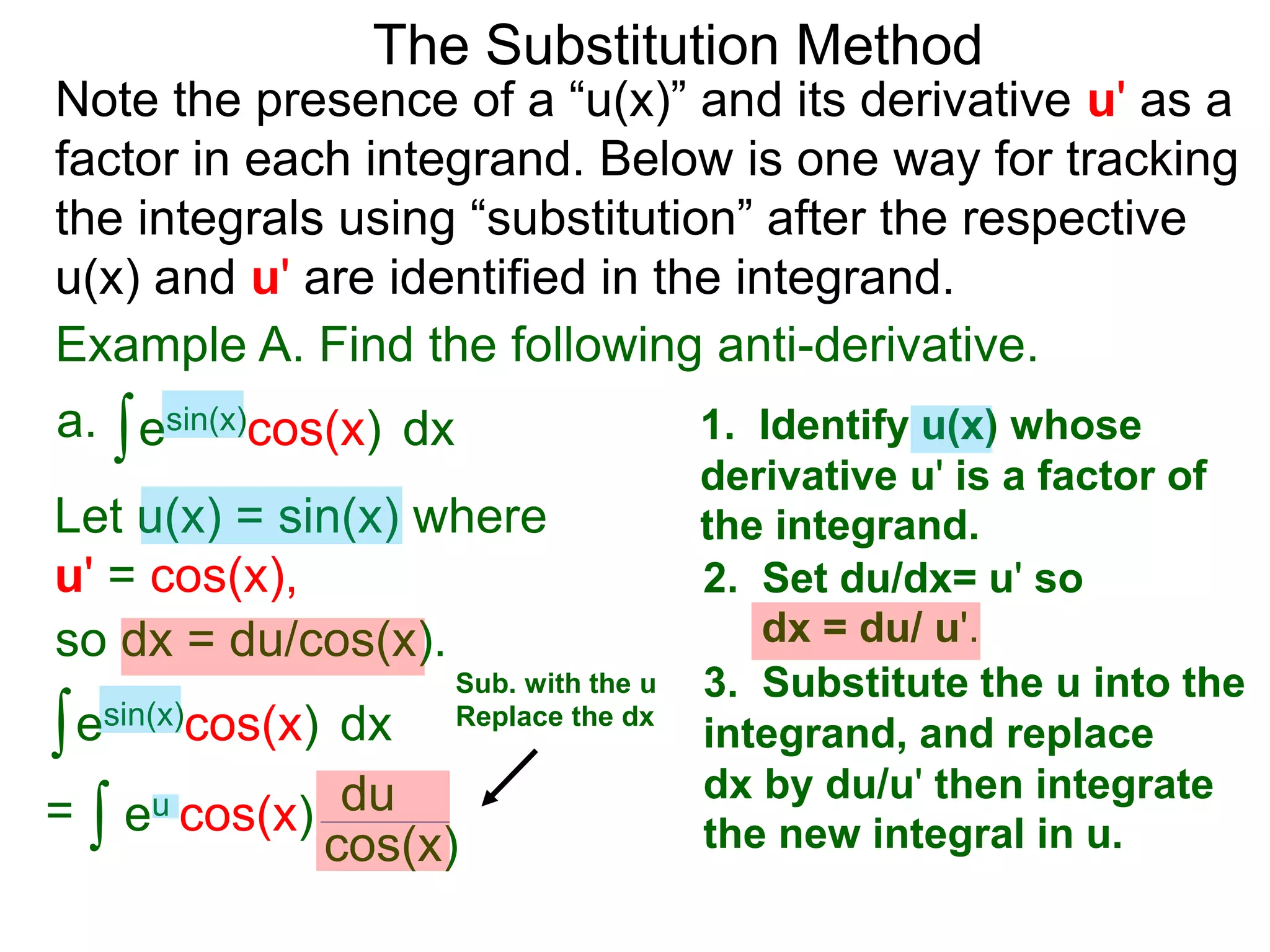
∫esin(x)cos(x) dx
∫ eu cos(x)= du
cos(x)
Sub. with the u
Replace the dx
Note the presence of a “u(x)” and its derivative u' as a
factor in each integrand. Below is one way for tracking
the integrals using “substitution” after the respective
u(x) and u' are identified in the integrand.
Example A. Find the following anti-derivative.
∫esin(x)cos(x)a. dx
The Substitution Method
1. Identify u(x) whose
derivative u' is a factor of
the integrand.Let u(x) = sin(x) where
u' = cos(x), 2. Set du/dx= u' so
dx = du/ u'.so dx = du/cos(x).
3. Substitute the u into the
integrand, and replace
dx by du/u' then integrate
the new integral in u.
∫esin(x)cos(x) dx
∫ eu cos(x)= du
cos(x)
Sub. with the u
Replace the dx
Note the presence of a “u(x)” and its derivative u' as a
factor in each integrand. Below is one way for tracking
the integrals using “substitution” after the respective
u(x) and u' are identified in the integrand.
Example A. Find the following anti-derivative.
∫esin(x)cos(x)a. dx
The Substitution Method
1. Identify u(x) whose
derivative u' is a factor of
the integrand.Let u(x) = sin(x) where
u' = cos(x), 2. Set du/dx= u' so
dx = du/ u'.so dx = du/cos(x).
3. Substitute the u into the
integrand, and replace
dx by du/u' then integrate
the new integral in u.
∫esin(x)cos(x) dx
∫ eu cos(x)= du
cos(x)
∫ eu= du
Sub. with the u
Replace the dx
Note the presence of a “u(x)” and its derivative u' as a
factor in each integrand. Below is one way for tracking
the integrals using “substitution” after the respective
u(x) and u' are identified in the integrand.
Example A. Find the following anti-derivative.
∫esin(x)cos(x)a. dx
The Substitution Method
1. Identify u(x) whose
derivative u' is a factor of
the integrand.Let u(x) = sin(x) where
u' = cos(x), 2. Set du/dx= u' so
dx = du/ u'.so dx = du/cos(x).
3. Substitute the u into the
integrand, and replace
dx by du/u' then integrate
the new integral in u.
∫esin(x)cos(x) dx
∫ eu cos(x)= du
cos(x)
∫ eu= du = eu+ k
Sub. with the u
Replace the dx
Note the presence of a “u(x)” and its derivative u' as a
factor in each integrand. Below is one way for tracking
the integrals using “substitution” after the respective
u(x) and u' are identified in the integrand.
Example A. Find the following anti-derivative.
∫esin(x)cos(x)a. dx
The Substitution Method
1. Identify u(x) whose
derivative u' is a factor of
the integrand.Let u(x) = sin(x) where
u' = cos(x), 2. Set du/dx= u' so
dx = du/ u'.so dx = du/cos(x).
3. Substitute the u into the
integrand, and replace
dx by du/u' then integrate
the new integral in u.
∫esin(x)cos(x) dx
∫ eu cos(x)= du
cos(x)
4. Write the answer in x.
∫ eu= du = eu+ k = esin(x) + k
Sub. with the u
Replace the dx
Note the presence of a “u(x)” and its derivative u' as a
factor in each integrand. Below is one way for tracking
the integrals using “substitution” after the respective
u(x) and u' are identified in the integrand.
The Substitution Method
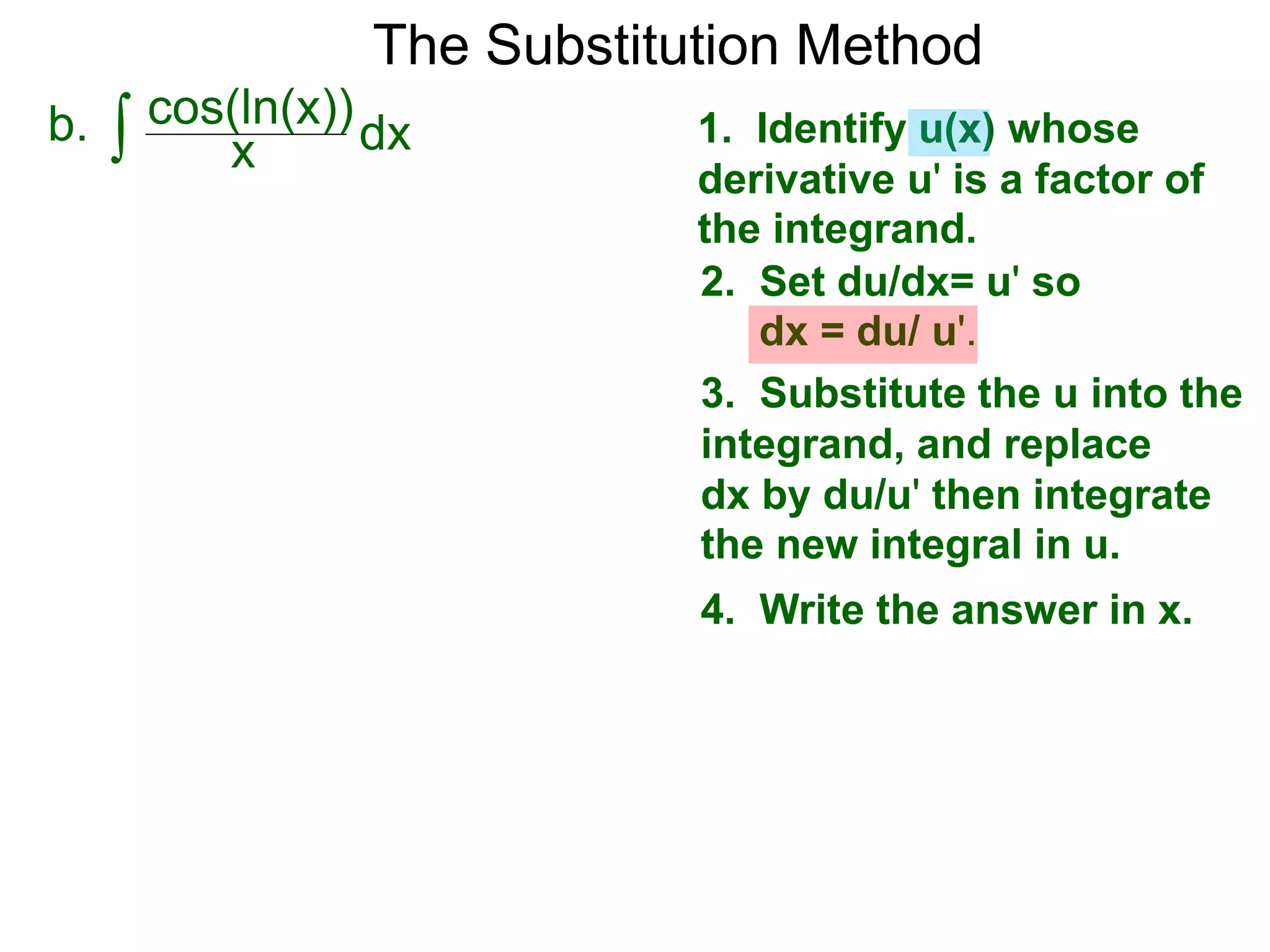
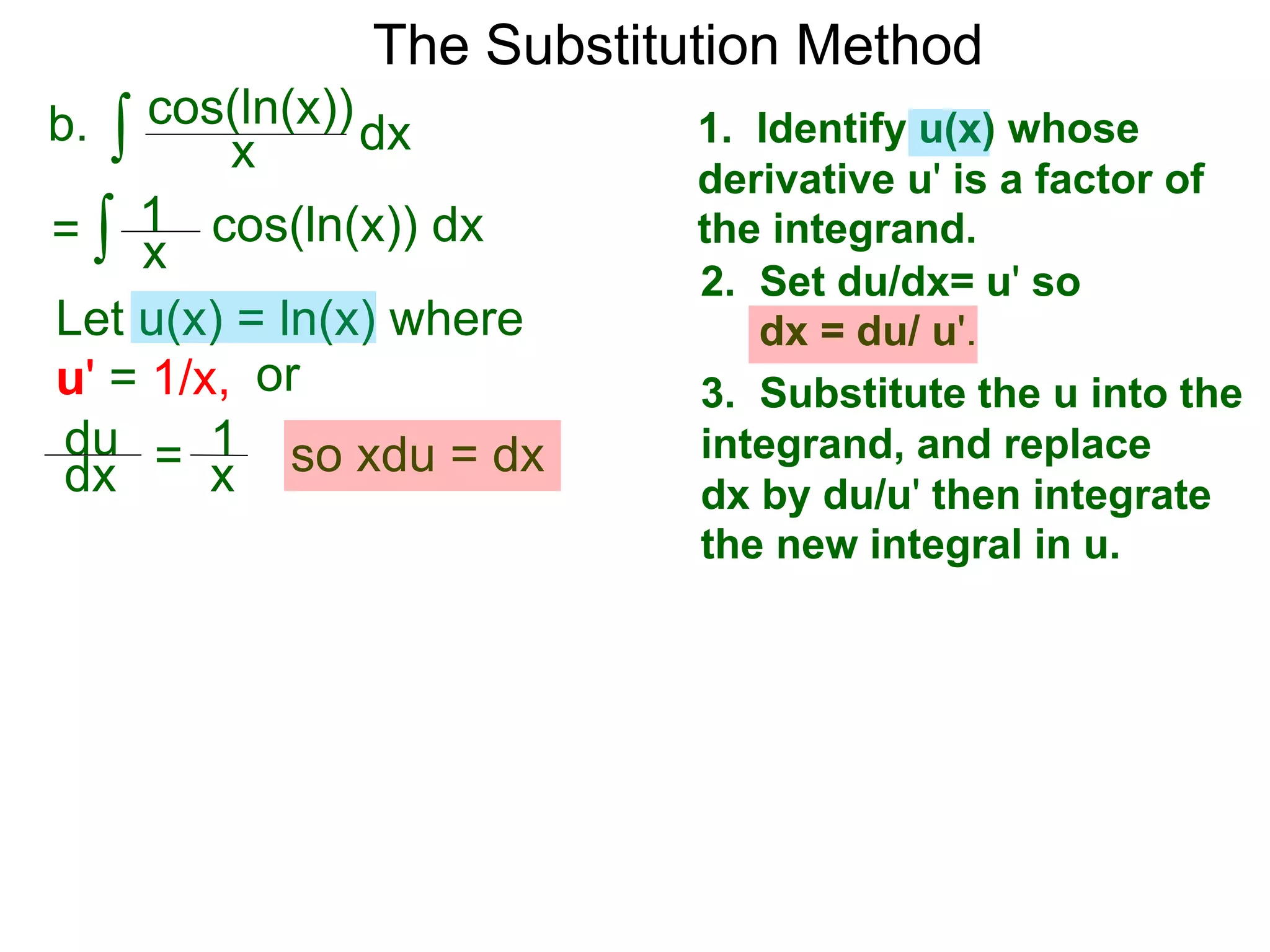
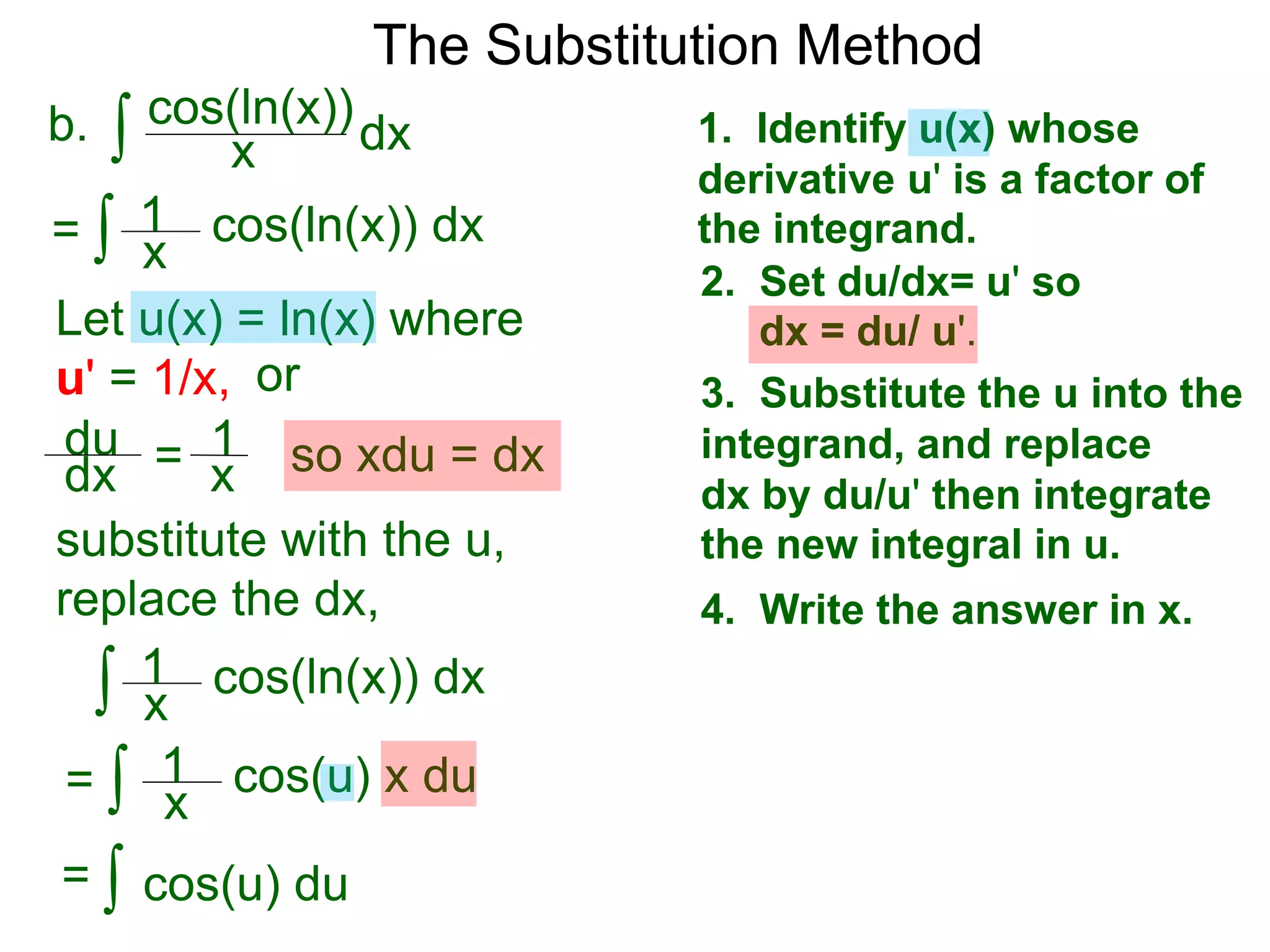
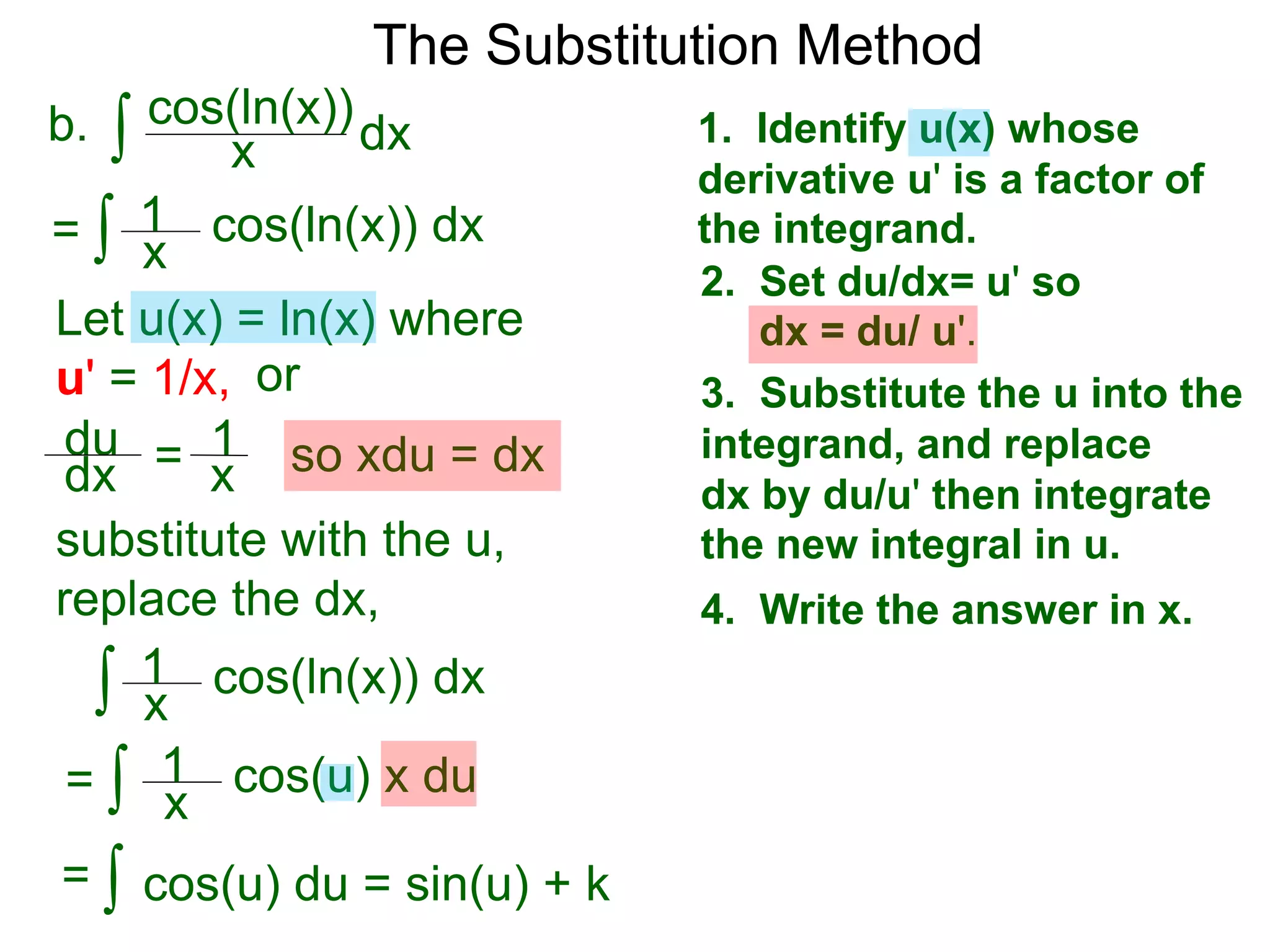
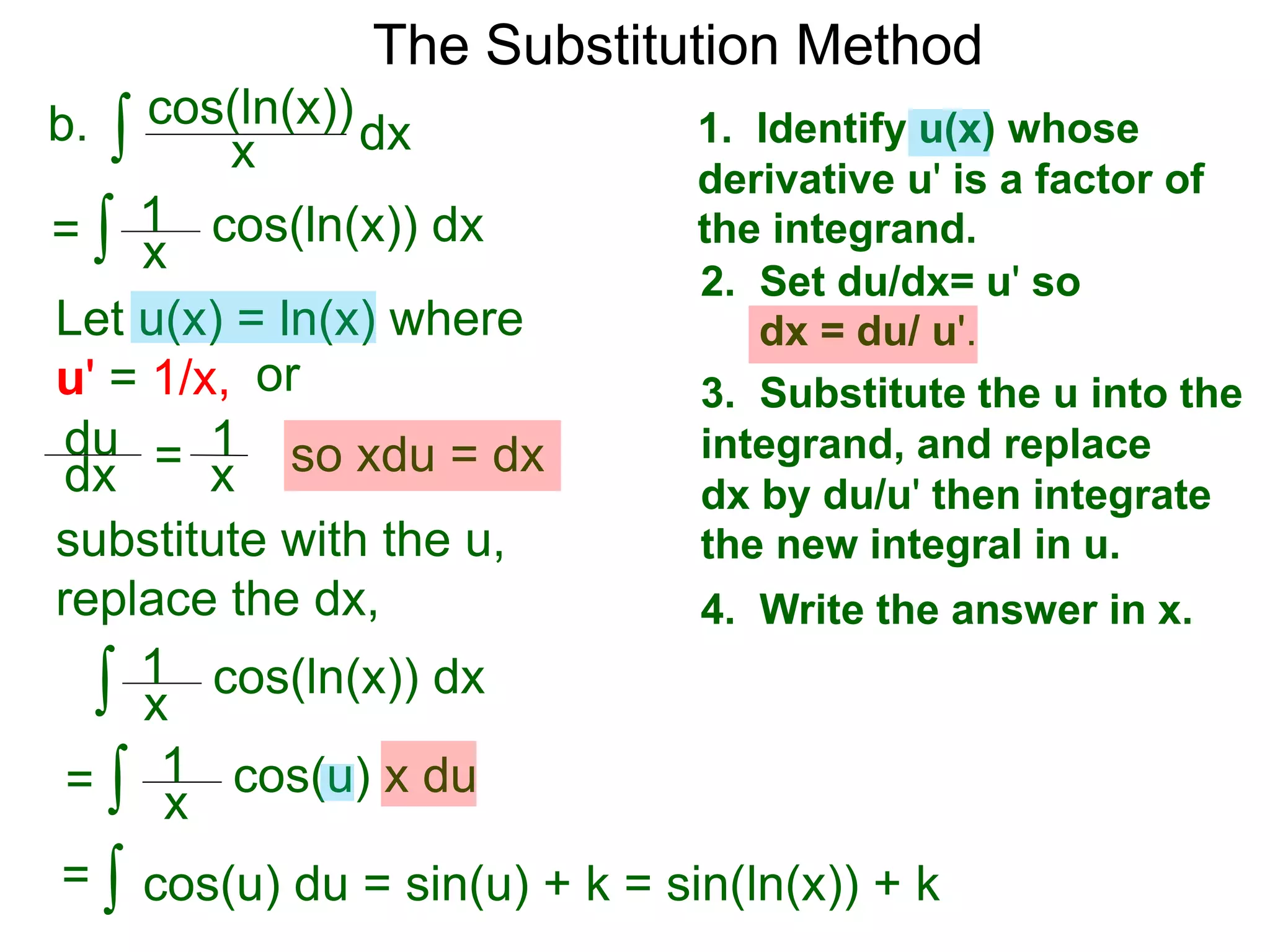
∫ cos(ln(x))b. dxx
1. Identify u(x) whose
derivative u' is a factor of
the integrand.
2. Set du/dx= u' so
dx = du/ u'.
3. Substitute the u into the
integrand, and replace
dx by du/u' then integrate
the new integral in u.
4. Write the answer in x.
The Substitution Method
∫ cos(ln(x))b. dxx
1. Identify u(x) whose
derivative u' is a factor of
the integrand.
2. Set du/dx= u' so
dx = du/ u'.
3. Substitute the u into the
integrand, and replace
dx by du/u' then integrate
the new integral in u.
4. Write the answer in x.
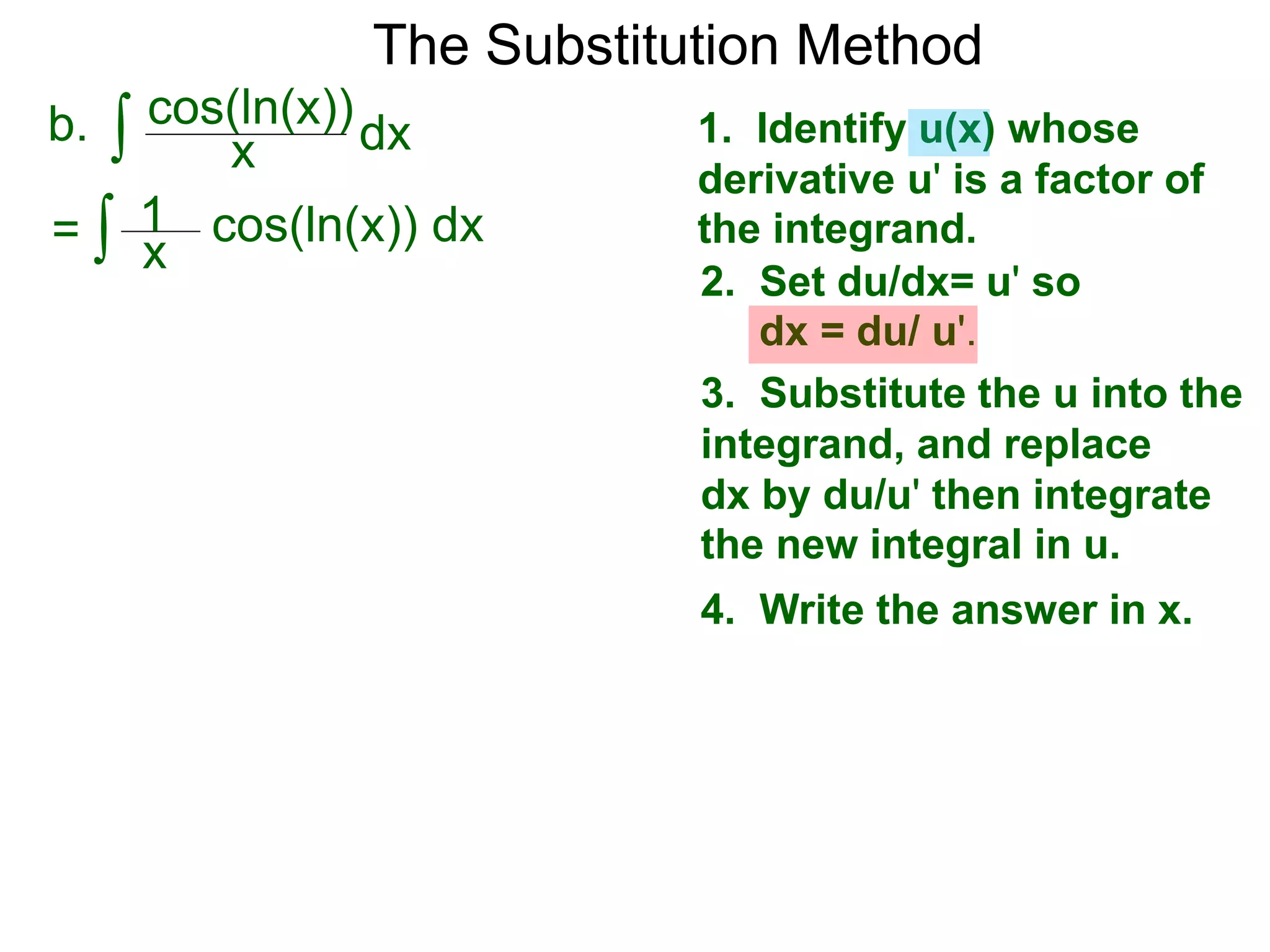
∫ cos(ln(x)) dx= x
1
The Substitution Method
∫ cos(ln(x))b. dxx
1. Identify u(x) whose
derivative u' is a factor of
the integrand.
2. Set du/dx= u' so
dx = du/ u'.
3. Substitute the u into the
integrand, and replace
dx by du/u' then integrate
the new integral in u.
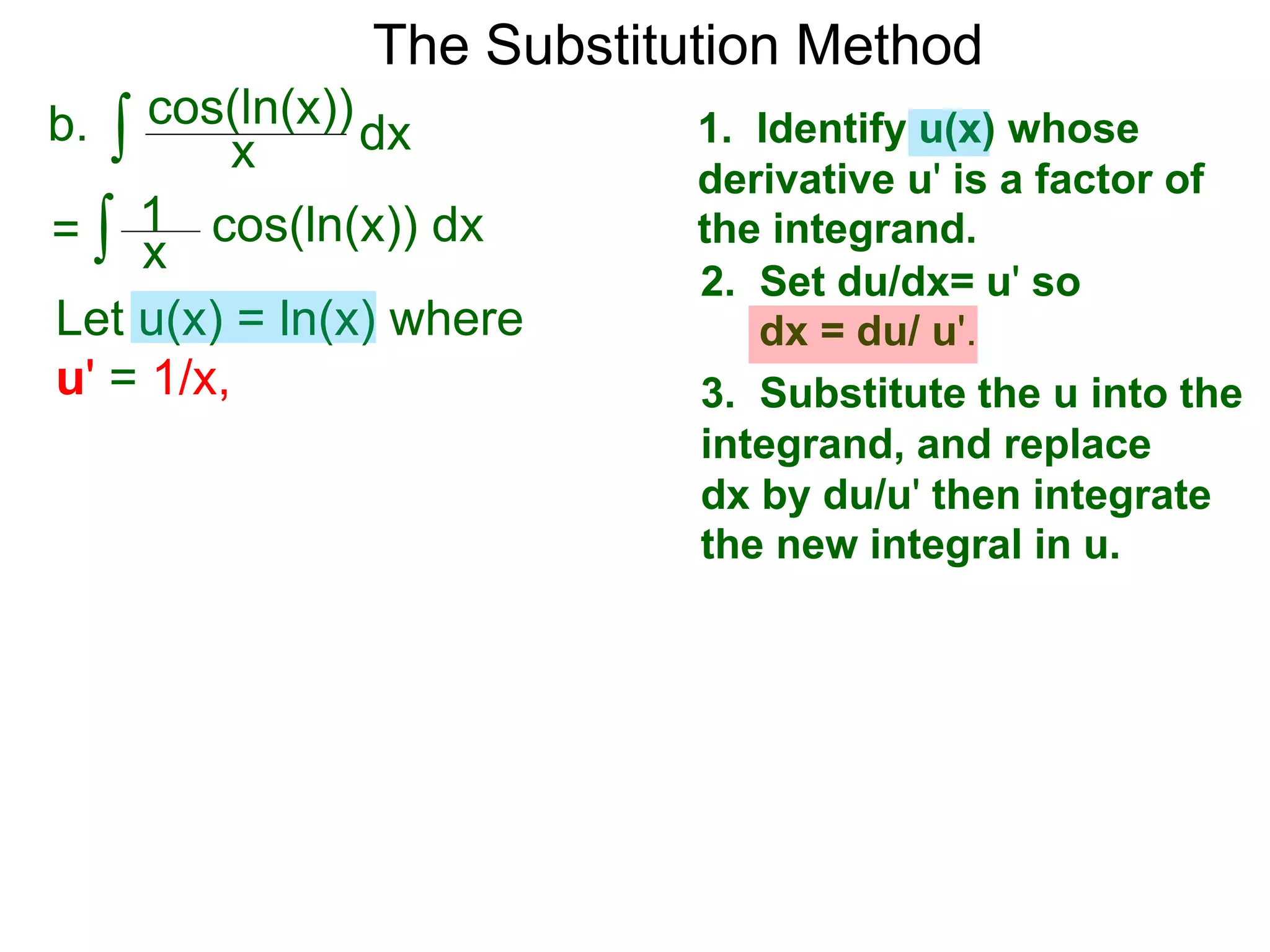
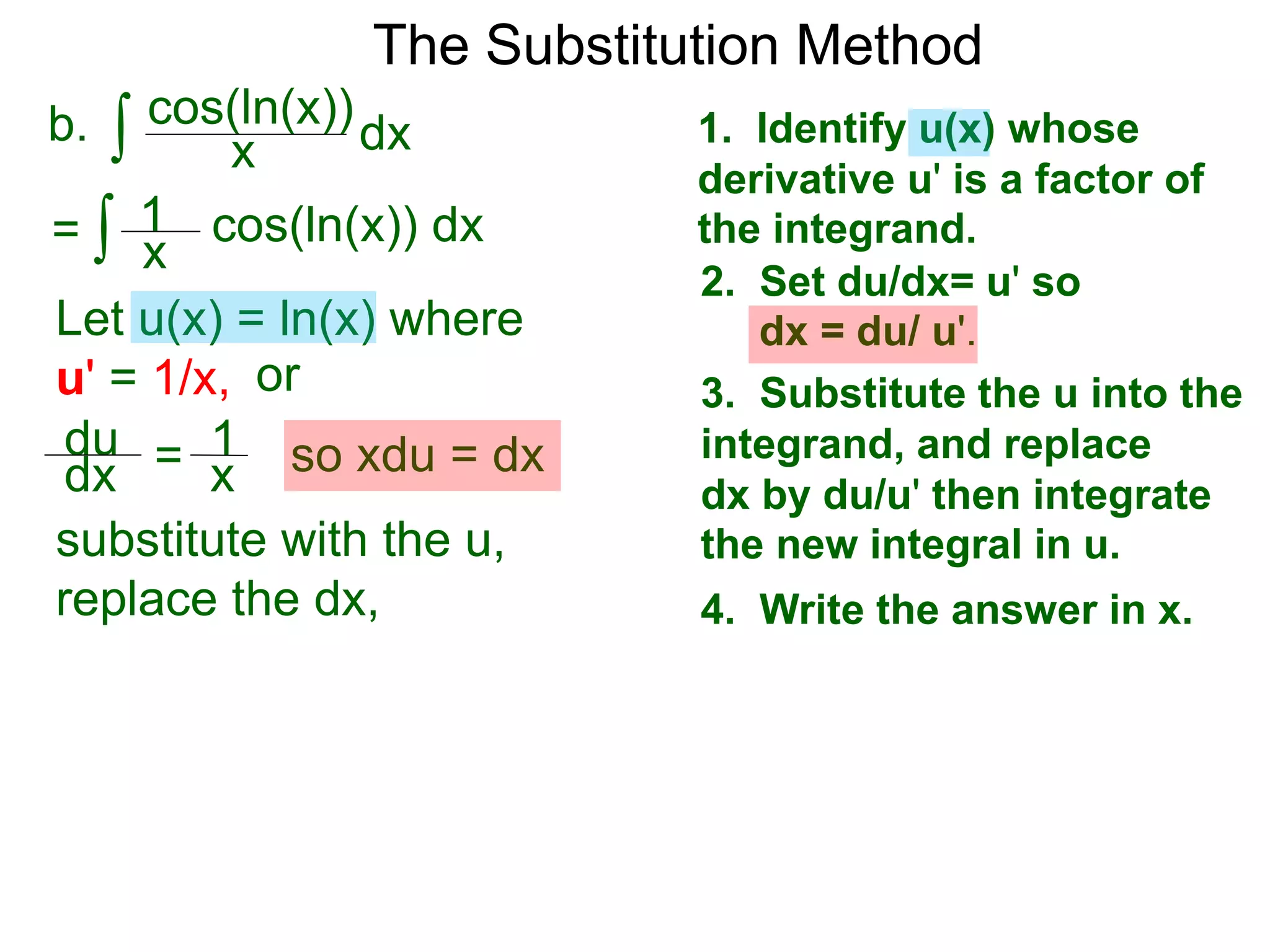
Let u(x) = ln(x) where
u' = 1/x,
∫ cos(ln(x)) dx= x
1
The Substitution Method
∫ cos(ln(x))b. dxx
1. Identify u(x) whose
derivative u' is a factor of
the integrand.
2. Set du/dx= u' so
dx = du/ u'.
3. Substitute the u into the
integrand, and replace
dx by du/u' then integrate
the new integral in u.
Let u(x) = ln(x) where
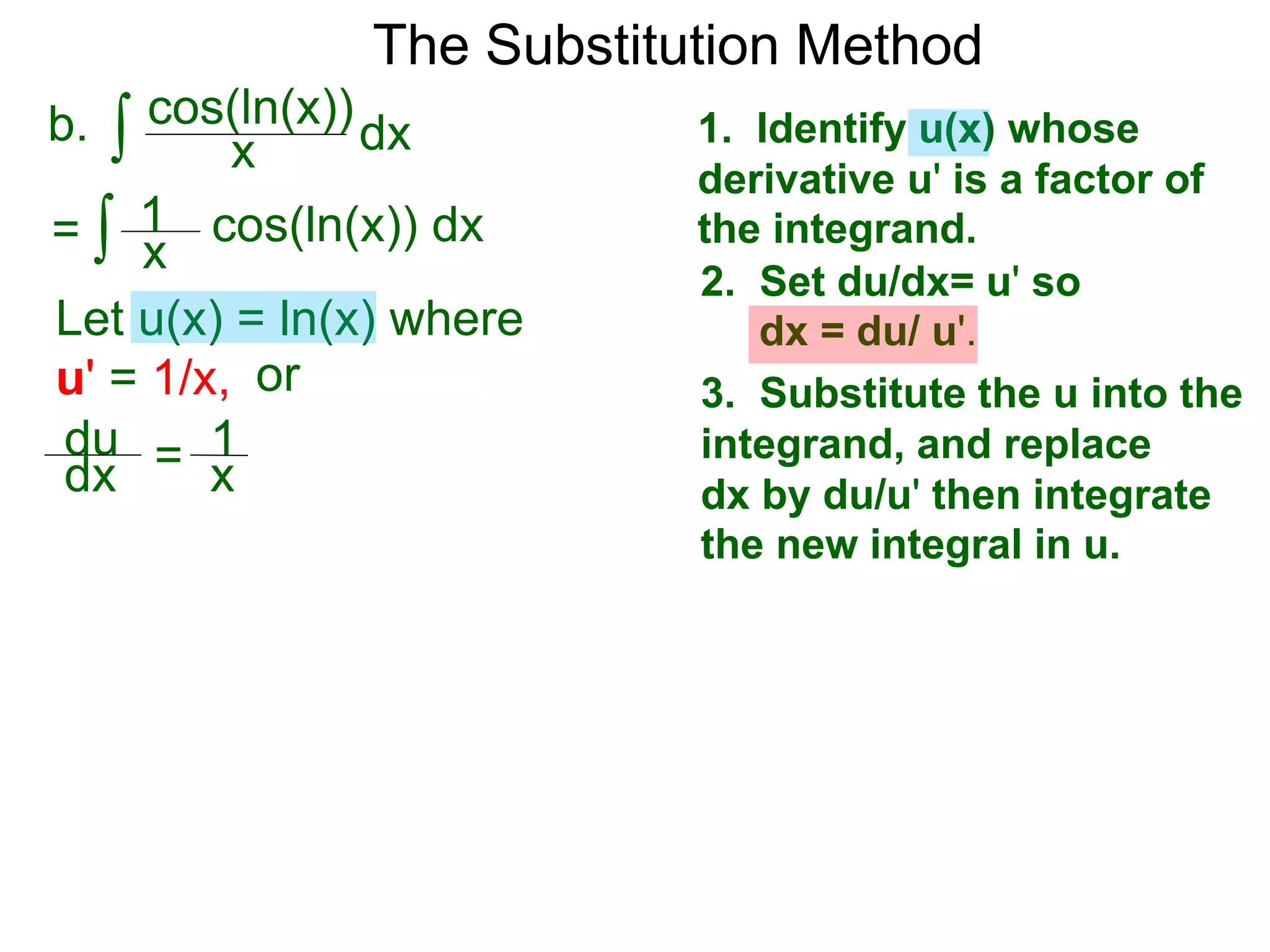
u' = 1/x, or
du
dx = 1
x
∫ cos(ln(x)) dx= x
1
The Substitution Method
∫ cos(ln(x))b. dxx
1. Identify u(x) whose
derivative u' is a factor of
the integrand.
2. Set du/dx= u' so
dx = du/ u'.
3. Substitute the u into the
integrand, and replace
dx by du/u' then integrate
the new integral in u.
Let u(x) = ln(x) where
u' = 1/x, or
du
dx = 1
x so xdu = dx
∫ cos(ln(x)) dx= x
1
The Substitution Method
∫ cos(ln(x))b. dxx
1. Identify u(x) whose
derivative u' is a factor of
the integrand.
2. Set du/dx= u' so
dx = du/ u'.
3. Substitute the u into the
integrand, and replace
dx by du/u' then integrate
the new integral in u.
4. Write the answer in x.
Let u(x) = ln(x) where
u' = 1/x, or
du
dx = 1
x so xdu = dx
∫ cos(ln(x)) dx= x
1
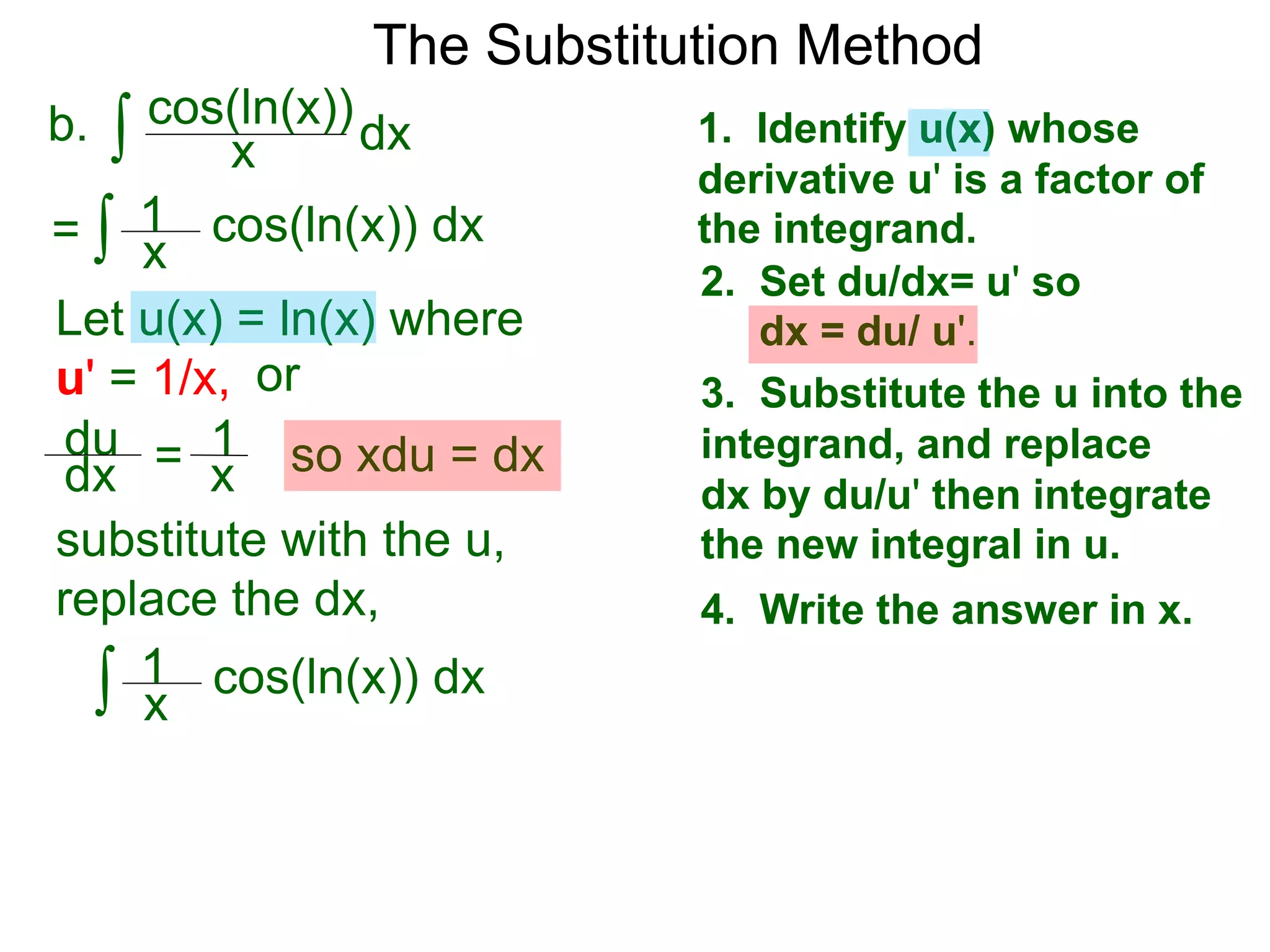
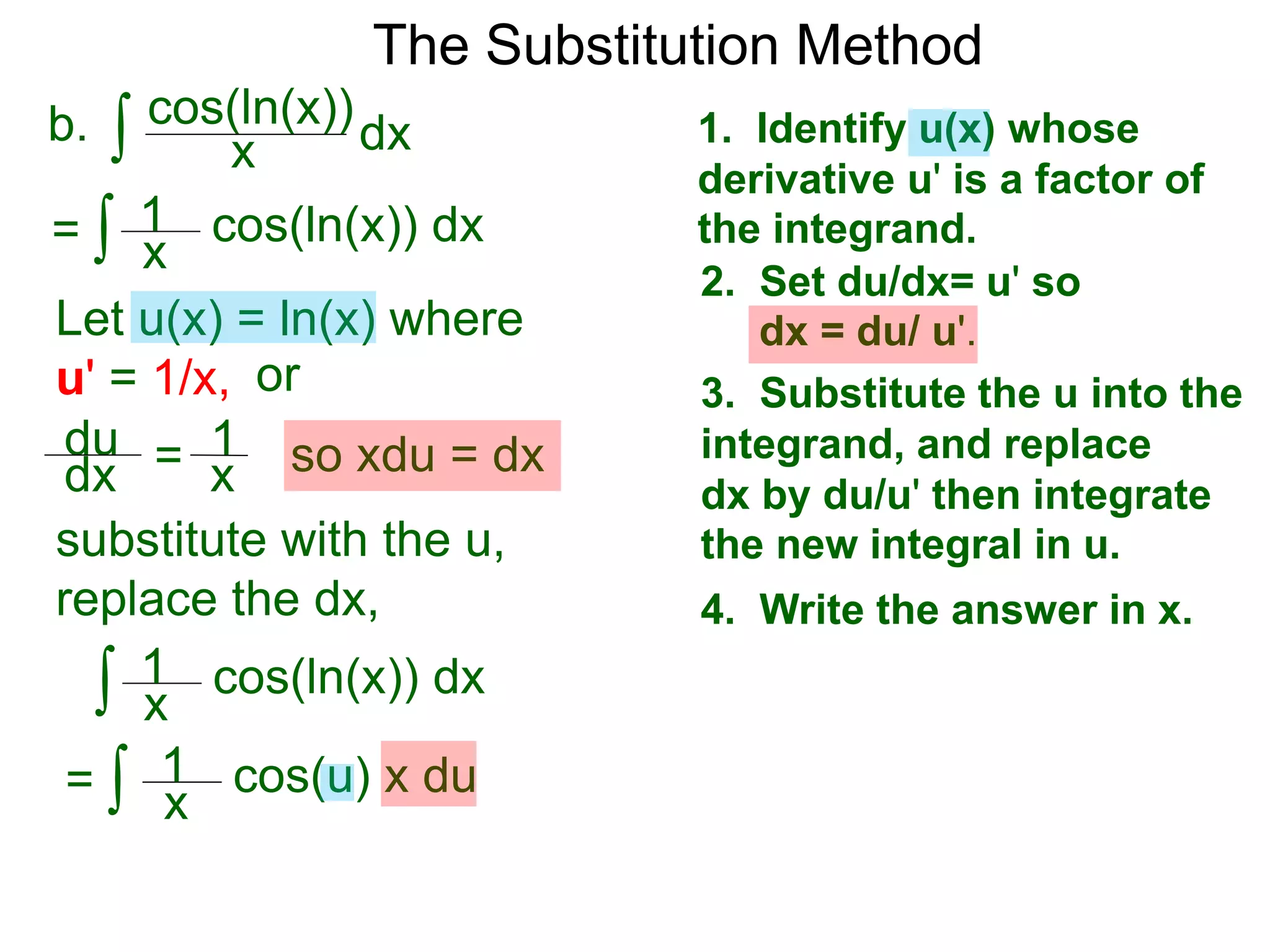
substitute with the u,
replace the dx,
The Substitution Method
∫ cos(ln(x))b. dxx
1. Identify u(x) whose
derivative u' is a factor of
the integrand.
2. Set du/dx= u' so
dx = du/ u'.
3. Substitute the u into the
integrand, and replace
dx by du/u' then integrate
the new integral in u.
4. Write the answer in x.
Let u(x) = ln(x) where
u' = 1/x, or
du
dx = 1
x so xdu = dx
∫ cos(ln(x)) dx= x
1
substitute with the u,
replace the dx,
∫ cos(ln(x)) dx
x
1
The Substitution Method
∫ cos(ln(x))b. dxx
1. Identify u(x) whose
derivative u' is a factor of
the integrand.
2. Set du/dx= u' so
dx = du/ u'.
3. Substitute the u into the
integrand, and replace
dx by du/u' then integrate
the new integral in u.
4. Write the answer in x.
Let u(x) = ln(x) where
u' = 1/x, or
du
dx = 1
x so xdu = dx
∫ cos(ln(x)) dx= x
1
∫ cos(u) x du
x
1
substitute with the u,
replace the dx,
∫ cos(ln(x)) dx
=
x
1
The Substitution Method
∫ cos(ln(x))b. dxx
1. Identify u(x) whose
derivative u' is a factor of
the integrand.
2. Set du/dx= u' so
dx = du/ u'.
3. Substitute the u into the
integrand, and replace
dx by du/u' then integrate
the new integral in u.
4. Write the answer in x.
Let u(x) = ln(x) where
u' = 1/x, or
du
dx = 1
x so xdu = dx
∫ cos(ln(x)) dx= x
1
∫ cos(u) x du
x
1
∫ cos(u) du=
substitute with the u,
replace the dx,
∫ cos(ln(x)) dx
=
x
1
The Substitution Method
∫ cos(ln(x))b. dxx
1. Identify u(x) whose
derivative u' is a factor of
the integrand.
2. Set du/dx= u' so
dx = du/ u'.
3. Substitute the u into the
integrand, and replace
dx by du/u' then integrate
the new integral in u.
4. Write the answer in x.
Let u(x) = ln(x) where
u' = 1/x, or
du
dx = 1
x so xdu = dx
∫ cos(ln(x)) dx= x
1
∫ cos(u) x du
x
1
∫ cos(u) du = sin(u) + k=
substitute with the u,
replace the dx,
∫ cos(ln(x)) dx
=
x
1
The Substitution Method
∫ cos(ln(x))b. dxx
1. Identify u(x) whose
derivative u' is a factor of
the integrand.
2. Set du/dx= u' so
dx = du/ u'.
3. Substitute the u into the
integrand, and replace
dx by du/u' then integrate
the new integral in u.
4. Write the answer in x.
Let u(x) = ln(x) where
u' = 1/x, or
du
dx = 1
x so xdu = dx
∫ cos(ln(x)) dx= x
1
∫ cos(u) x du
x
1
∫ cos(u) du = sin(u) + k = sin(ln(x)) + k=
substitute with the u,
replace the dx,
∫ cos(ln(x)) dx
=
x
1
The Substitution Method
By the Chain Rule
[e3x + 2]' = e3x + 2(3), so [ (e3x + 2)]' = e3x + 2
3
1
The Substitution Method
By the Chain Rule
[e3x + 2]' = e3x + 2(3), so [ (e3x + 2)]' = e3x + 2
∫ e3x + 2 dx =Hence
e3x + 2
3 + k
3
1
The Substitution Method
By the Chain Rule
[sin(3x + 2)]' = cos(3x + 2)(3),
[e3x + 2]' = e3x + 2(3), so [ (e3x + 2)]' = e3x + 2
∫ e3x + 2 dx =Hence
e3x + 2
3 + k
3
1
The Substitution Method
By the Chain Rule
[sin(3x + 2)]' = cos(3x + 2)(3),
[e3x + 2]' = e3x + 2(3), so [ (e3x + 2)]' = e3x + 2
∫ e3x + 2 dx =Hence
e3x + 2
3 + k
3
1
so [ sin(3x + 2)]' = cos(3x + 2)
3
1
The Substitution Method
By the Chain Rule
[sin(3x + 2)]' = cos(3x + 2)(3),
[e3x + 2]' = e3x + 2(3), so [ (e3x + 2)]' = e3x + 2
∫ e3x + 2 dx =Hence
e3x + 2
3 + k
3
1
so [ sin(3x + 2)]' = cos(3x + 2)
3
1
∫ cos(3x + 2) dx =Hence sin(3x + 2)
3
+ k
The Substitution Method
By the Chain Rule
[sin(3x + 2)]' = cos(3x + 2)(3),
[e3x + 2]' = e3x + 2(3), so [ (e3x + 2)]' = e3x + 2
∫ e3x + 2 dx =Hence
e3x + 2
3 + k
3
1
so [ sin(3x + 2)]' = cos(3x + 2)
3
1
∫ cos(3x + 2) dx =Hence sin(3x + 2)
3
+ k
In fact if F'(x) = f(x), then F'(ax + b) = a*f(ax + b) where
a and b are constants.
The Substitution Method
By the Chain Rule
[sin(3x + 2)]' = cos(3x + 2)(3),
[e3x + 2]' = e3x + 2(3), so [ (e3x + 2)]' = e3x + 2
∫ e3x + 2 dx =Hence
e3x + 2
3 + k
3
1
so [ sin(3x + 2)]' = cos(3x + 2)
3
1
∫ cos(3x + 2) dx =Hence sin(3x + 2)
3
+ k
In fact if F'(x) = f(x), then F'(ax + b) = a*f(ax + b) where
a and b are constants.
∫f(u(x)) dx = F(u(x))a + k where u(x) = ax + b.
(Linear Substitution Integrations) Let F'(x) = f(x),
1then
The Substitution Method
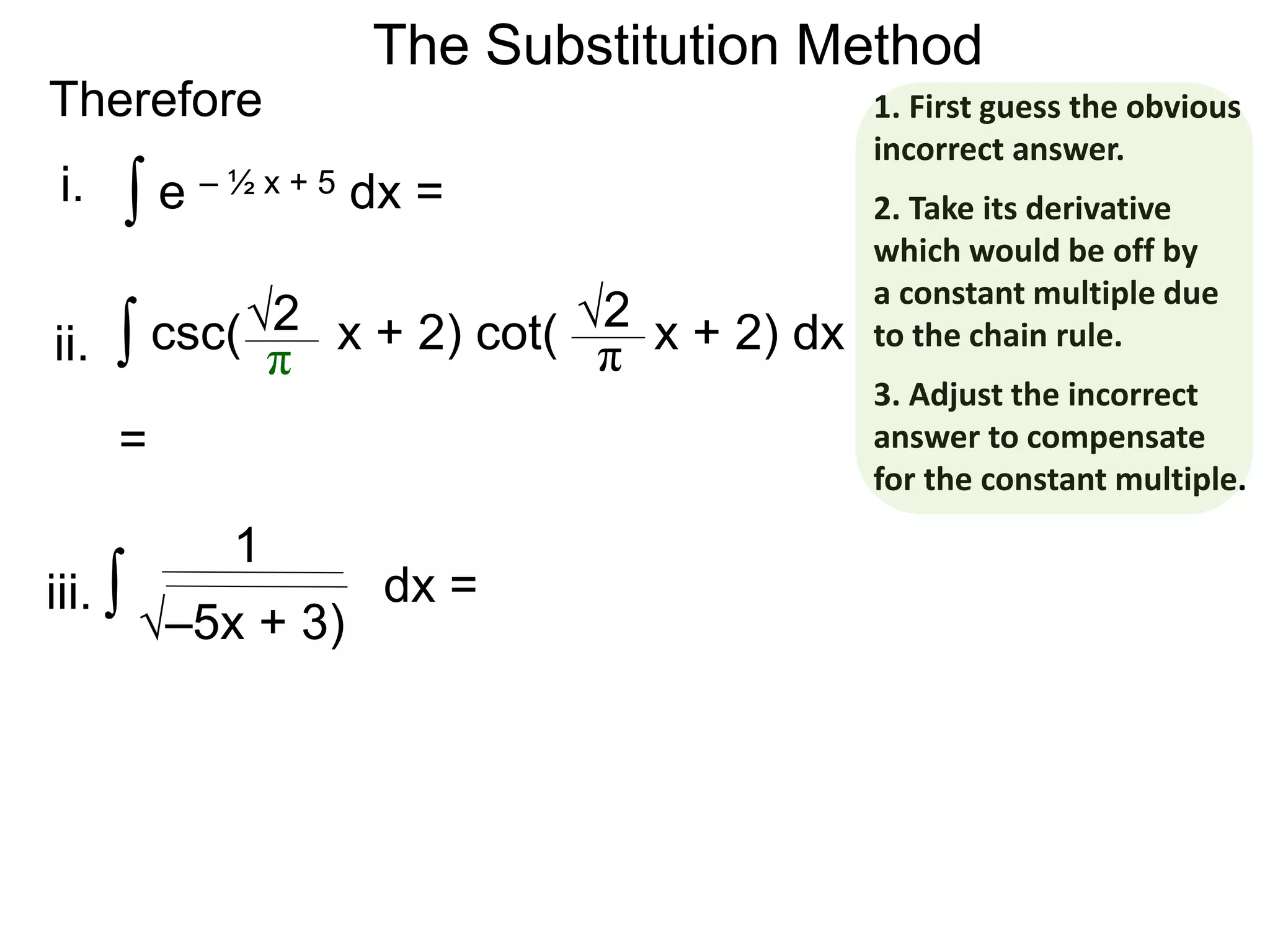
Therefore
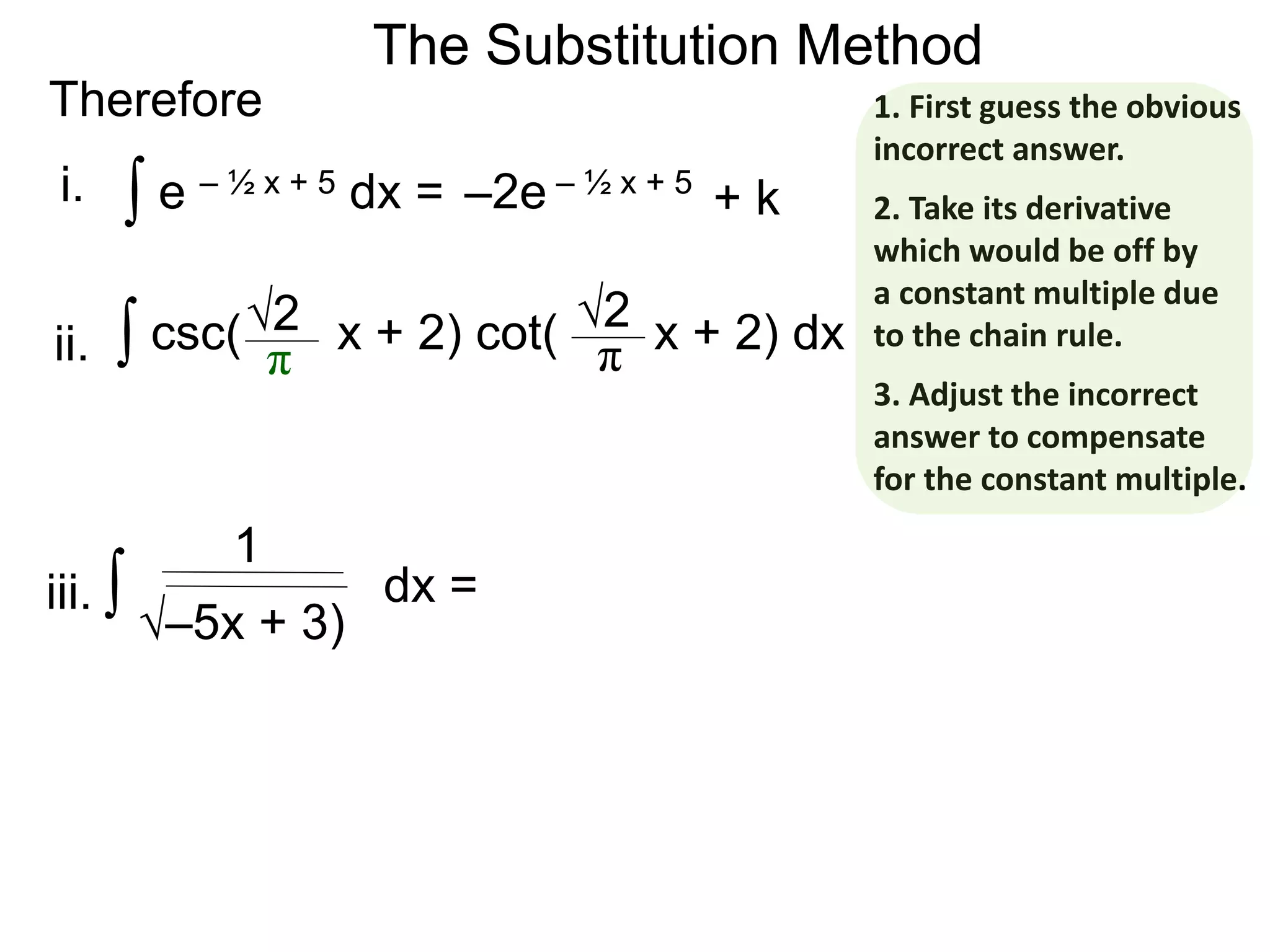
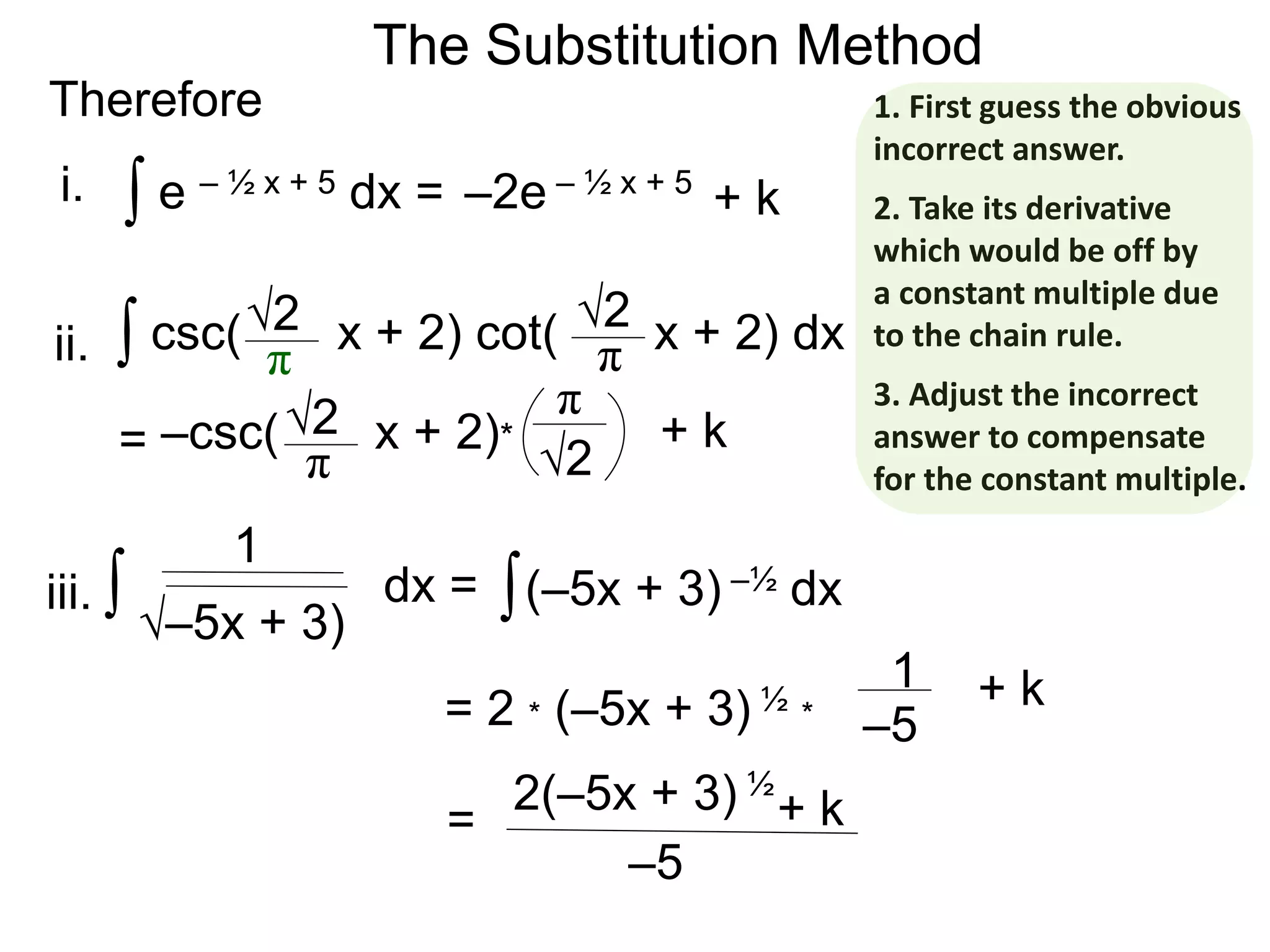
∫ e – ½ x + 5 dx =
∫ csc( x + 2) cot( x + 2) dx√2
π
√2
π
=
∫ dx =
1
i.
ii.
iii.
√–5x + 3)
1. First guess the obvious
incorrect answer.
2. Take its derivative
which would be off by
a constant multiple due
to the chain rule.
3. Adjust the incorrect
answer to compensate
for the constant multiple.
The Substitution Method
Therefore
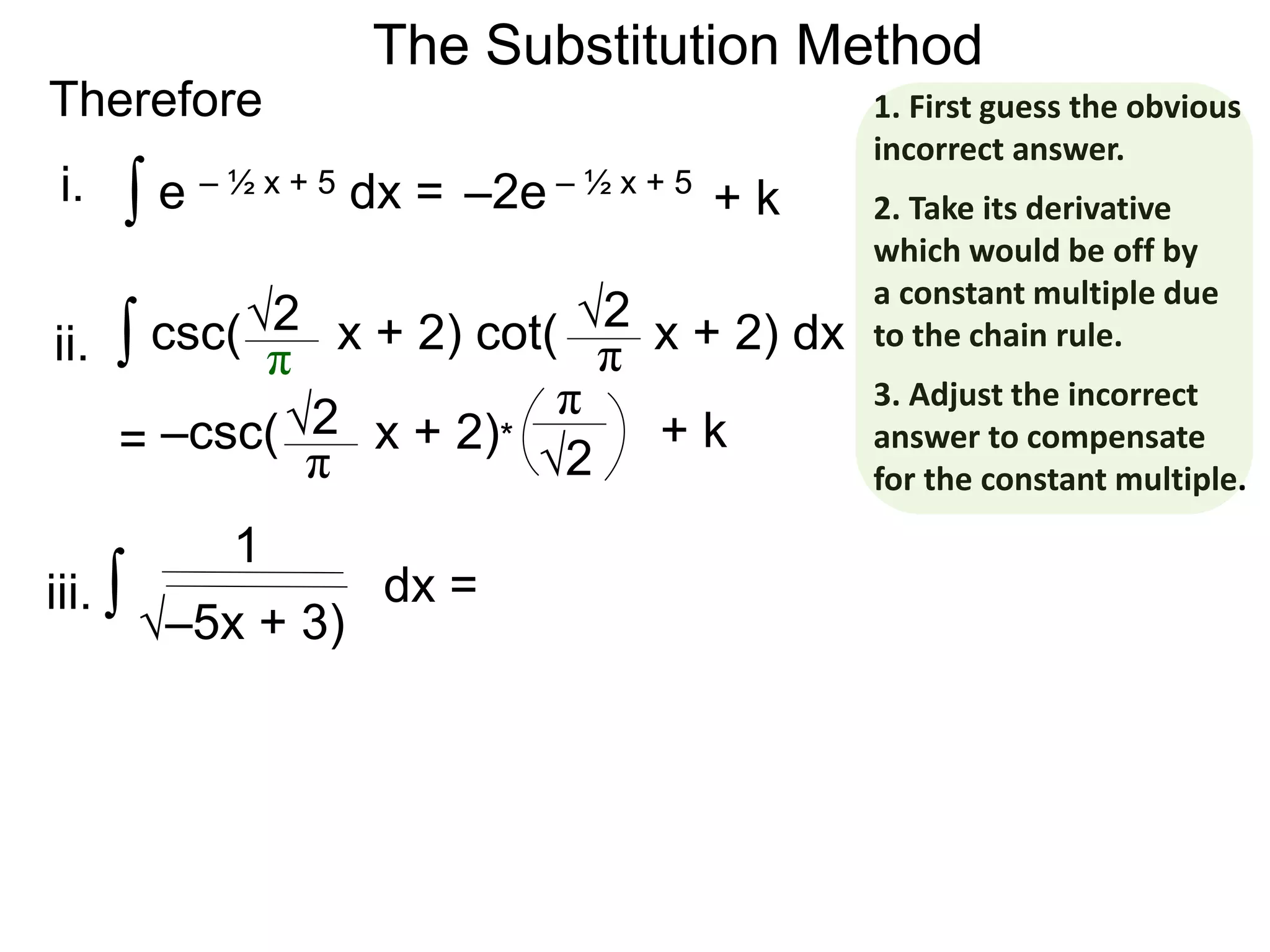
∫ e – ½ x + 5 dx = –2e – ½ x + 5
∫ csc( x + 2) cot( x + 2) dx√2
π
√2
π
+ k
∫ dx =
1
i.
ii.
iii.
√–5x + 3)
1. First guess the obvious
incorrect answer.
2. Take its derivative
which would be off by
a constant multiple due
to the chain rule.
3. Adjust the incorrect
answer to compensate
for the constant multiple.
The Substitution Method
Therefore
∫ e – ½ x + 5 dx = –2e – ½ x + 5
∫ csc( x + 2) cot( x + 2) dx√2
π
√2
π
= –csc( x + 2)*√2
π √2
π
+ k
+ k
∫ dx =
1
i.
ii.
iii.
√–5x + 3)
1. First guess the obvious
incorrect answer.
2. Take its derivative
which would be off by
a constant multiple due
to the chain rule.
3. Adjust the incorrect
answer to compensate
for the constant multiple.
The Substitution Method
Therefore
∫ e – ½ x + 5 dx = –2e – ½ x + 5
∫ csc( x + 2) cot( x + 2) dx√2
π
√2
π
= –csc( x + 2)*√2
π √2
π
+ k
+ k
∫ dx =
1
i.
ii.
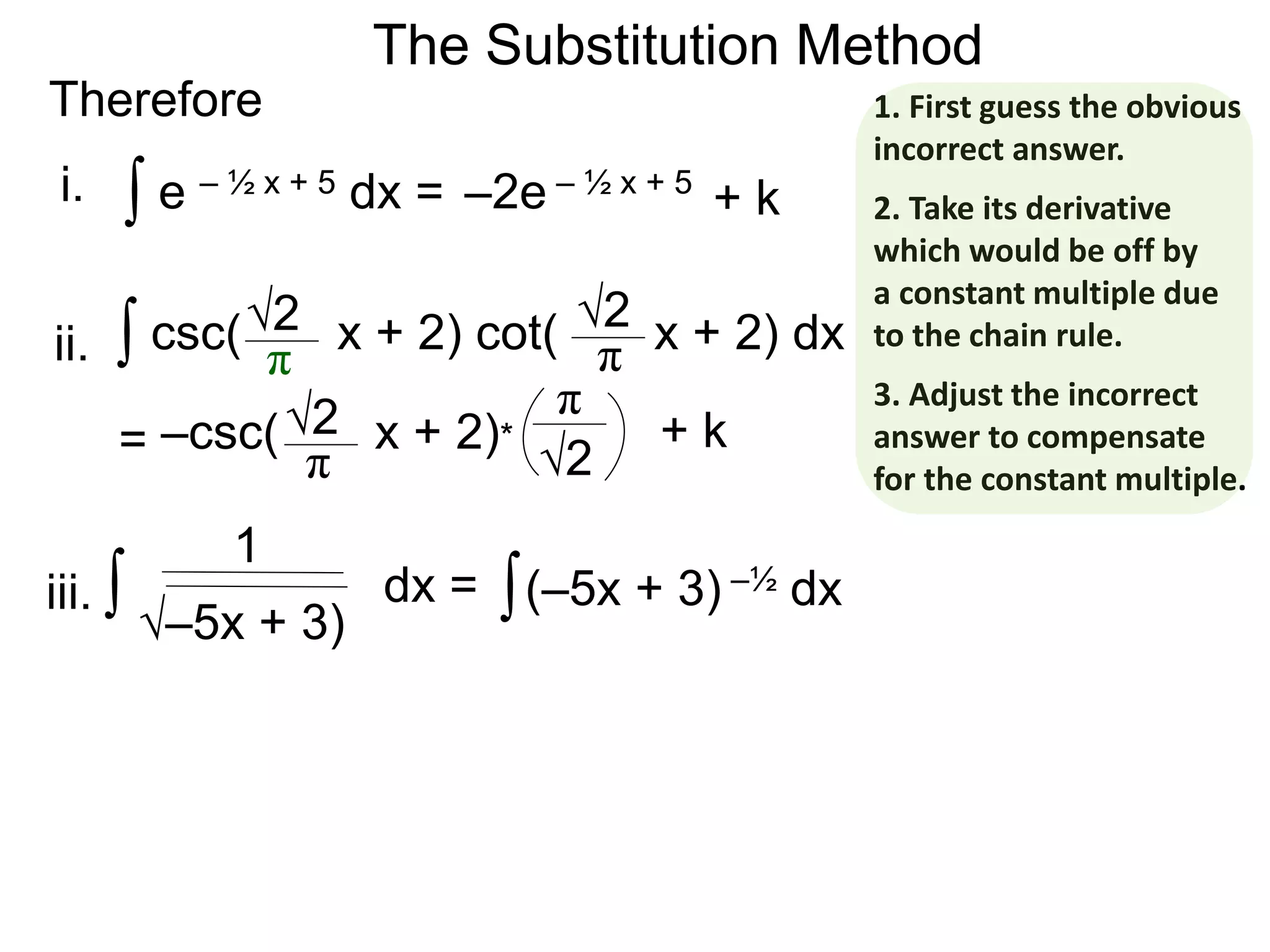
iii. ∫(–5x + 3) –½ dx
√–5x + 3)
1. First guess the obvious
incorrect answer.
2. Take its derivative
which would be off by
a constant multiple due
to the chain rule.
3. Adjust the incorrect
answer to compensate
for the constant multiple.
The Substitution Method
Therefore
∫ e – ½ x + 5 dx = –2e – ½ x + 5
∫ csc( x + 2) cot( x + 2) dx√2
π
√2
π
= –csc( x + 2)*√2
π √2
π
+ k
+ k
∫ dx =
–5
1
i.
ii.
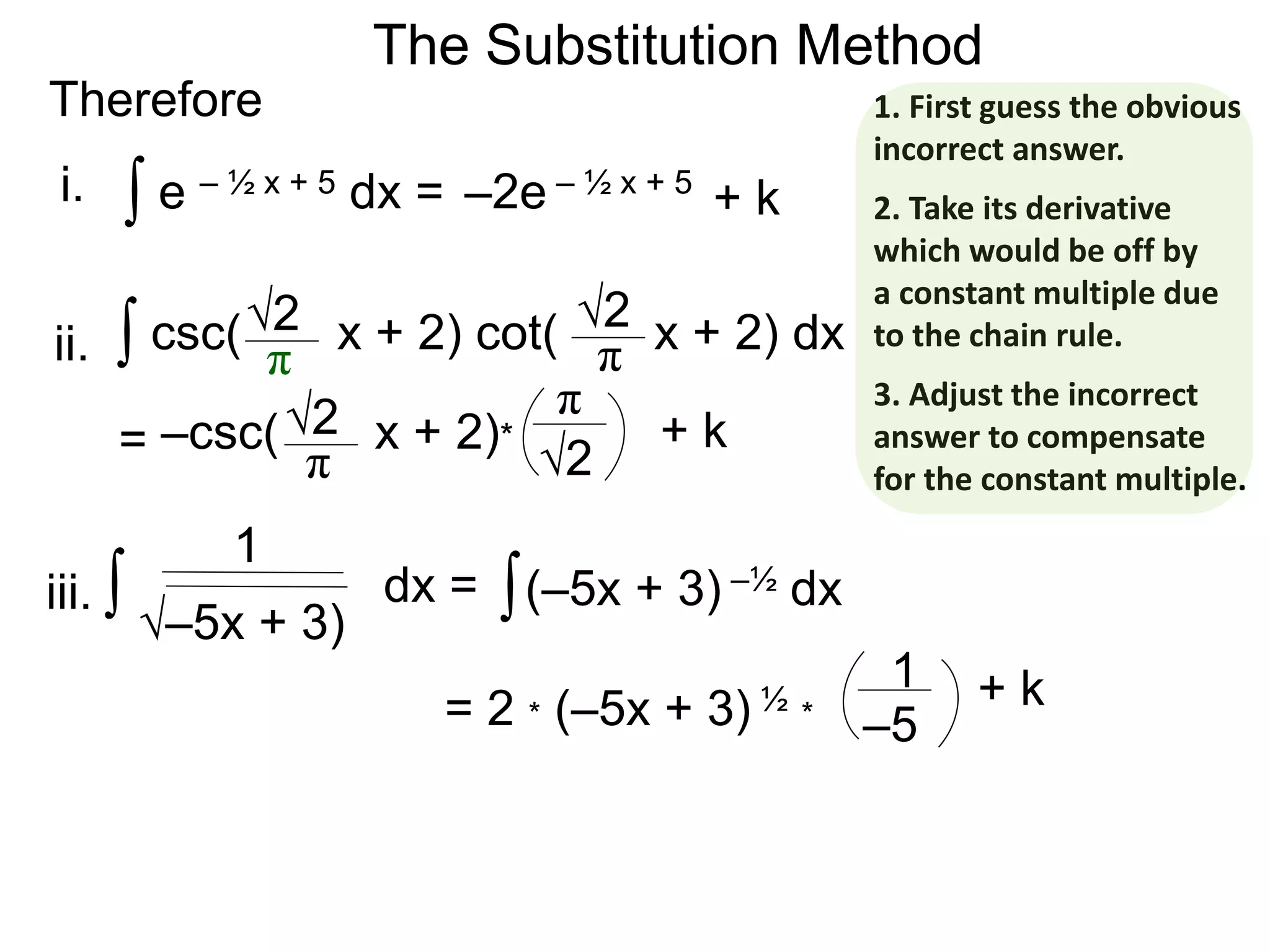
iii. ∫(–5x + 3) –½ dx
√–5x + 3)
= 2 * (–5x + 3) ½ *
1 + k
1. First guess the obvious
incorrect answer.
2. Take its derivative
which would be off by
a constant multiple due
to the chain rule.
3. Adjust the incorrect
answer to compensate
for the constant multiple.
The Substitution Method
Therefore
∫ e – ½ x + 5 dx = –2e – ½ x + 5
∫ csc( x + 2) cot( x + 2) dx√2
π
√2
π
= –csc( x + 2)*√2
π √2
π
+ k
+ k
∫ dx =
1
i.
ii.
iii. ∫(–5x + 3) –½ dx
√–5x + 3)
–5
= + k2(–5x + 3) ½
–5= 2 * (–5x + 3) ½ *
1 + k
1. First guess the obvious
incorrect answer.
2. Take its derivative
which would be off by
a constant multiple due
to the chain rule.
3. Adjust the incorrect
answer to compensate
for the constant multiple.
anti-derivatives
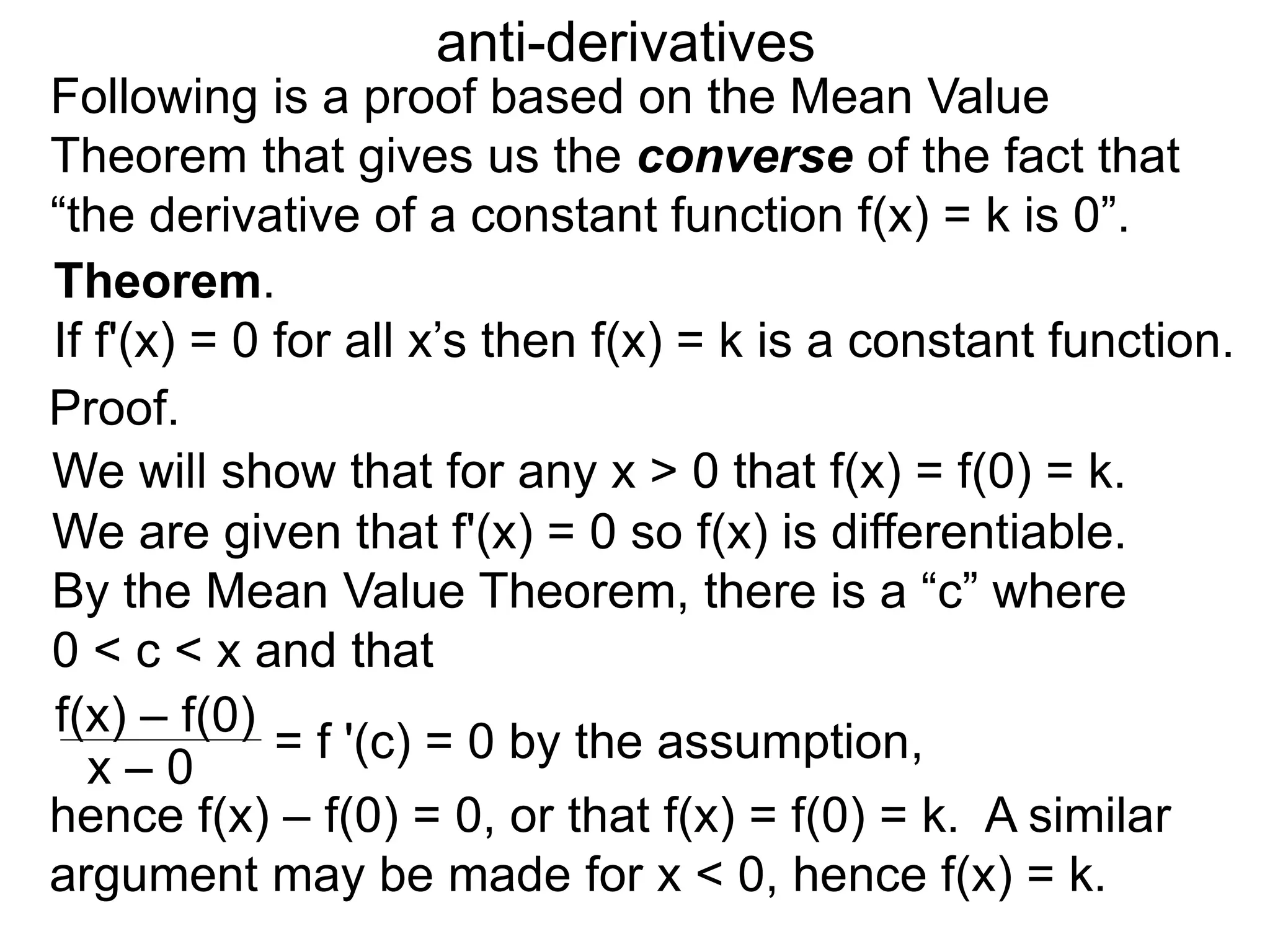
Following is a proof based on the Mean Value
Theorem that gives us the converse of the fact that
“the derivative of a constant function f(x) = k is 0”.
Proof.
Theorem.
If f'(x) = 0 for all x’s then f(x) = k is a constant function.
We will show that for any x > 0 that f(x) = f(0) = k.
We are given that f'(x) = 0 so f(x) is differentiable.
By the Mean Value Theorem, there is a “c” where
0 < c < x and that
f(x) – f(0)
x – 0
= f '(c) = 0 by the assumption,
hence f(x) – f(0) = 0, or that f(x) = f(0) = k. A similar
argument may be made for x < 0, hence f(x) = k.

2 integration and the substitution methods x

  • 1.
    We say F(x)is an anti-derivative of f(x) if F'(x) = f(x). anti-derivatives
  • 2.
    We say F(x)is an anti-derivative of f(x) if F'(x) = f(x). anti-derivatives We also call F(x) “the (indefinite) integral of f(x)”.
  • 3.
    We say F(x)is an anti-derivative of f(x) if F'(x) = f(x). anti-derivatives We write this as ∫f(x) dxF(x) = We also call F(x) “the (indefinite) integral of f(x)”.
  • 4.
    We say F(x)is an anti-derivative of f(x) if F'(x) = f(x). anti-derivatives We write this as ∫f(x) dxF(x) = We also call F(x) “the (indefinite) integral of f(x)”. ∫0 dx = k Fact: The anti-derivatives of the function f(x) = 0 are exactly all the constant functions F(x) = k or that
  • 5.
    We say F(x)is an anti-derivative of f(x) if F'(x) = f(x). anti-derivatives We write this as ∫f(x) dxF(x) = We also call F(x) “the (indefinite) integral of f(x)”. Remarks I. There is only one derivative for any f(x) but the “anti-derivatives” of f(x) is a set of functions. ∫0 dx = k Fact: The anti-derivatives of the function f(x) = 0 are exactly all the constant functions F(x) = k or that
  • 6.
    We say F(x)is an anti-derivative of f(x) if F'(x) = f(x). anti-derivatives We write this as ∫f(x) dx ∫0 dx = k F(x) = We also call F(x) “the (indefinite) integral of f(x)”. Remarks I. There is only one derivative for any f(x) but the “anti-derivatives” of f(x) is a set of functions. II. Any two anti-derivatives of f(x) must differ by a constant. Hence if F'(x) = G'(x) then F(x) = G(x) + k for some constant k. Fact: The anti-derivatives of the function f(x) = 0 are exactly all the constant functions F(x) = k or that
  • 7.
    The procedure offinding the anti-derivatives is called “integration”. anti-derivatives
  • 8.
    The procedure offinding the anti-derivatives is called “integration”. Rewording the basic differentiation rules, we have the following integration rules. anti-derivatives Basic Integration Rules
  • 9.
    The procedure offinding the anti-derivatives is called “integration”. Rewording the basic differentiation rules, we have the following integration rules. anti-derivatives then (F ± G)' = F' ± G' = f + g. Let f, g, F, G and that F' = f and G' = g, Basic Integration Rules
  • 10.
    The procedure offinding the anti-derivatives is called “integration”. Rewording the basic differentiation rules, we have the following integration rules. anti-derivatives then (F ± G)' = F' ± G' = f + g. In integral notation, Let f, g, F, G and that F' = f and G' = g, ∫f ± g dx = ∫f dx ± ∫g dx Basic Integration Rules
  • 11.
    The procedure offinding the anti-derivatives is called “integration”. Rewording the basic differentiation rules, we have the following integration rules. anti-derivatives then (F ± G)' = F' ± G' = f + g. In integral notation, Let f, g, F, G and that F' = f and G' = g, ∫f ± g dx = ∫f dx ± ∫g dx and we say that we can “integrate term by term”. Basic Integration Rules
  • 12.
    The procedure offinding the anti-derivatives is called “integration”. Rewording the basic differentiation rules, we have the following integration rules. anti-derivatives then (F ± G)' = F' ± G' = f + g. In integral notation, For any constant c, (c*F) ' = c*F'= c*f, Let f, g, F, G and that F' = f and G' = g, ∫f ± g dx = ∫f dx ± ∫g dx and we say that we can “integrate term by term”. Basic Integration Rules
  • 13.
    The procedure offinding the anti-derivatives is called “integration”. Rewording the basic differentiation rules, we have the following integration rules. anti-derivatives then (F ± G)' = F' ± G' = f + g. In integral notation, For any constant c, (c*F) ' = c*F'= c*f, so in integrals, Let f, g, F, G and that F' = f and G' = g, ∫f ± g dx = ∫f dx ± ∫g dx ∫cf dx = c∫f dx and we say that we can “integrate term by term”. Basic Integration Rules
  • 14.
    The procedure offinding the anti-derivatives is called “integration”. Rewording the basic differentiation rules, we have the following integration rules. anti-derivatives then (F ± G)' = F' ± G' = f + g. In integral notation, For any constant c, (c*F) ' = c*F'= c*f, so in integrals, Let f, g, F, G and that F' = f and G' = g, ∫f ± g dx = ∫f dx ± ∫g dx ∫cf dx = c∫f dx and we say that we can “integrate term by term”. We say that we can “pull out the constant multiple.” Basic Integration Rules
  • 15.
    The procedure offinding the anti-derivatives is called “integration”. Rewording the basic differentiation rules, we have the following integration rules. anti-derivatives then (F ± G)' = F' ± G' = f + g. In integral notation, For any constant c, (c*F) ' = c*F'= c*f, so in integrals, Let f, g, F, G and that F' = f and G' = g, ∫f ± g dx = ∫f dx ± ∫g dx ∫cf dx = c∫f dx The following is a list of integration formulas for basic functions. and we say that we can “integrate term by term”. We say that we can “pull out the constant multiple.” Basic Integration Rules
  • 16.
    The procedure offinding the anti-derivatives is called “integration”. Rewording the basic differentiation rules, we have the following integration rules. anti-derivatives then (F ± G)' = F' ± G' = f + g. In integral notation, For any constant c, (c*F) ' = c*F'= c*f, so in integrals, Let f, g, F, G and that F' = f and G' = g, ∫f ± g dx = ∫f dx ± ∫g dx ∫cf dx = c∫f dx The following is a list of integration formulas for basic functions. These formulas are just the derivatives of the basic functions written in the integral forms. and we say that we can “integrate term by term”. We say that we can “pull out the constant multiple.” Basic Integration Rules
  • 17.
    xpdx = sin(x) dx= –cos(x) + k sec(x)tan(x) dx ex dx = ex + k dx = ln(x) + kx 1 anti-derivatives ∫ ∫ ∫ ∫ xP+1 P + 1 + k where P ≠ –1 cos(x) dx = sin(x) + k∫ sec2(x) dx = tan(x) + k∫ = –cot(x) + k∫ ∫ = sec(x) + k csc(x)cot(x) dx∫ = –csc(x) + k csc2(x) dx The Power Functions The Trig–Functions The Log and Exponential Functions x–1 dx = ln(x) + k∫ or
  • 18.
    anti-derivatives Example A. Findthe following anti-derivative. ∫3ex – 5sin(x) + x √x – 2 dx
  • 19.
    anti-derivatives Example A. Findthe following anti-derivative. ∫3ex – 5sin(x) + x √x – 2 dx Integrate term by term and pull out the constant multiple of each term.
  • 20.
    anti-derivatives Example A. Findthe following anti-derivative. ∫3ex – 5sin(x) + x √x – 2 = ∫3 ex dx dx Integrate term by term and pull out the constant multiple of each term.
  • 21.
    anti-derivatives Example A. Findthe following anti-derivative. ∫3ex – 5sin(x) + x √x – 2 = ∫3 ex dx – 5 ∫ sin(x) dx dx Integrate term by term and pull out the constant multiple of each term.
  • 22.
    anti-derivatives Example A. Findthe following anti-derivative. ∫3ex – 5sin(x) + x √x – 2 = ∫3 ex dx – 5 x–½ dx∫ dx∫ ∫ x 2sin(x) dx + – dx Integrate term by term and pull out the constant multiple of each term.
  • 23.
    anti-derivatives Example A. Findthe following anti-derivative. ∫3ex – 5sin(x) + x √x – 2 = ∫3 ex dx – 5 x–½ dx∫ dx∫ ∫ x 2sin(x) dx + – dx Integrate term by term and pull out the constant multiple of each term. There is no Quotient Rule for integration. Hence we have to separate the fractions.
  • 24.
    anti-derivatives Example A. Findthe following anti-derivative. ∫3ex – 5sin(x) + x √x – 2 = ∫3 ex dx – 5 x–½ dx∫ dx∫ ∫ x 2sin(x) dx + – = 3ex + 5cos(x) + 2x½ – 2 ln(x) + k dx
  • 25.
    anti-derivatives Example A. Findthe following anti-derivative. ∫3ex – 5sin(x) + x √x – 2 = ∫3 ex dx – 5 x–½ dx∫ dx∫ ∫ x 2sin(x) dx + – = 3ex + 5cos(x) + 2x½ – 2 ln(x) + k dx Although each integral yields a constant term, these terms may be collected as a single “k”.
  • 26.
    anti-derivatives Example A. Findthe following anti-derivative. ∫3ex – 5sin(x) + x √x – 2 = ∫3 ex dx – 5 x–½ dx∫ dx∫ ∫ x 2sin(x) dx + – = 3ex + 5cos(x) + 2x½ – 2 ln(x) + k dx The graphs of all the anti-derivatives F(x) + k of f(x) are positioned by the integration constant k.
  • 27.
    anti-derivatives Example A. Findthe following anti-derivative. ∫3ex – 5sin(x) + x √x – 2 = ∫3 ex dx – 5 x–½ dx∫ dx∫ ∫ x 2sin(x) dx + – = 3ex + 5cos(x) + 2x½ – 2 ln(x) + k dx The graphs of all the anti-derivatives F(x) + k of f(x) are positioned by the integration constant k. For example, the anti-derivatives of 2x are F(x) = x2 + k.
  • 28.
    anti-derivatives Example A. Findthe following anti-derivative. ∫3ex – 5sin(x) + x √x – 2 = ∫3 ex dx – 5 x–½ dx∫ dx∫ ∫ x 2sin(x) dx + – = 3ex + 5cos(x) + 2x½ – 2 ln(x) + k dx The graphs of all the anti-derivatives F(x) + k of f(x) are positioned by the integration constant k. For example, the anti-derivatives of 2x are F(x) = x2 + k. Their graphs are just the vertical translations of the parabola y = x2 “filed” by k as shown here. Graphs of the anti-derivatives of 2x, F(x) = x2 + k, layered by k k=–2 k=–1 k=0 k=1 k=2
  • 29.
    anti-derivatives Example A. Findthe following anti-derivative. ∫3ex – 5sin(x) + x √x – 2 = ∫3 ex dx – 5 x–½ dx∫ dx∫ ∫ x 2sin(x) dx + – = 3ex + 5cos(x) + 2x½ – 2 ln(x) + k dx The graphs of all the anti-derivatives F(x) + k of f(x) are positioned by the integration constant k. For example, the anti-derivatives of 2x are F(x) = x2 + k. Their graphs are just the vertical translations of the parabola y = x2 “filed” by k as shown here. All of them have identical slope at any given x. Graphs of the anti-derivatives of 2x, F(x) = x2 + k, layered by k k=–2 k=–1 k=0 k=1 k=2
  • 30.
    anti-derivatives When solving forthe equation of a line with a given derivative, i.e. its slope m, a point on the line is needed in order to determine its equation. anti-derivatives of 2x, F(x) = x2 + k, “filed” by k k=–2 k=–1 k=0 k=1 k=2 (1, 3)
  • 31.
    anti-derivatives When solving forthe equation of a line with a given derivative, i.e. its slope m, a point on the line is needed in order to determine its equation. Likewise if we know the derivative, i.e. the slopes, of a function F(x) then all we need is a point to completely determine F(x). anti-derivatives of 2x, F(x) = x2 + k, “filed” by k k=–2 k=–1 k=0 k=1 k=2 (1, 3)
  • 32.
    anti-derivatives When solving forthe equation of a line with a given derivative, i.e. its slope m, a point on the line is needed in order to determine its equation. Likewise if we know the derivative, i.e. the slopes, of a function F(x) then all we need is a point to completely determine F(x). anti-derivatives of 2x, F(x) = x2 + k, “filed” by k k=–2 k=–1 k=0 k=1 k=2 Such a data–point is called the “initial condition”. (1, 3)
  • 33.
    anti-derivatives When solving forthe equation of a line with a given derivative, i.e. its slope m, a point on the line is needed in order to determine its equation. Likewise if we know the derivative, i.e. the slopes, of a function F(x) then all we need is a point to completely determine F(x). anti-derivatives of 2x, F(x) = x2 + k, “filed” by k k=–2 k=–1 k=0 k=1 k=2 Such a data–point is called the “initial condition”. In general the initial condition is a list of data– points that enables us to determine all the unspecified constants in the general solution. (1, 3)
  • 34.
    anti-derivatives When solving forthe equation of a line with a given derivative, i.e. its slope m, a point on the line is needed in order to determine its equation. Likewise if we know the derivative, i.e. the slopes, of a function F(x) then all we need is a point to completely determine F(x). anti-derivatives of 2x, F(x) = x2 + k, “filed” by k k=–2 k=–1 k=0 k=1 k=2 Such a data–point is called the “initial condition”. In general the initial condition is a list of data– points that enables us to determine all the unspecified constants in the general solution. So if F'(x) = 2x with the initial condition F(1) = 3, then it must be that F(x) = x2 + 2. (1, 3)
  • 35.
    anti-derivatives We may recovera function completely through its higher order derivative if we have sufficient information.
  • 36.
    anti-derivatives Example B. Findthe position function x(t) given that x''(t) = (t – )2 t 1 x'(1) = 1/3 and that x(1) = 1/12. We may recover a function completely through its higher order derivative if we have sufficient information. with the initial condition
  • 37.
    anti-derivatives Example B. Findthe position function x(t) given that x''(t) = (t – )2 t 1 x'(1) = 1/3 and that x(1) = 1/12. We may recover a function completely through its higher order derivative if we have sufficient information. The 1st derivative x'(t) is the integral of the x''(t). with the initial condition
  • 38.
    anti-derivatives Example B. Findthe position function x(t) given that x''(t) = ∫ (t – )2 t 1 x'(1) = 1/3 and that x(1) = 1/12. We may recover a function completely through its higher order derivative if we have sufficient information. The 1st derivative x'(t) is the integral of the x''(t). x'(t) = (t – )2 t 1 dtSo with the initial condition
  • 39.
    anti-derivatives Example B. Findthe position function x(t) given that x''(t) = ∫ (t – )2 t 1 x'(1) = 1/3 and that x(1) = 1/12. We may recover a function completely through its higher order derivative if we have sufficient information. The 1st derivative x'(t) is the integral of the x''(t). x'(t) = (t – )2 t 1 dt = ∫ t2 – 2 + t2 1 dt So with the initial condition
  • 40.
    anti-derivatives Example B. Findthe position function x(t) given that x''(t) = ∫ (t – )2 t 1 x'(1) = 1/3 and that x(1) = 1/12. We may recover a function completely through its higher order derivative if we have sufficient information. The 1st derivative x'(t) is the integral of the x''(t). x'(t) = (t – )2 t 1 dt = ∫ t2 – 2 + t2 1 dt = t3 3 – 2t – t–1 + k So where k is a constant. with the initial condition
  • 41.
    anti-derivatives Example B. Findthe position function x(t) given that x''(t) = ∫ (t – )2 t 1 x'(1) = 1/3 and that x(1) = 1/12. We may recover a function completely through its higher order derivative if we have sufficient information. The 1st derivative x'(t) is the integral of the x''(t). x'(t) = (t – )2 t 1 dt = ∫ t2 – 2 + t2 1 dt = t3 3 – 2t – t–1 + k So We are given that x'(1) = 1/3, so = 1/31 3 – 2 – 1 + k where k is a constant. with the initial condition
  • 42.
    anti-derivatives Example B. Findthe position function x(t) given that x''(t) = ∫ (t – )2 t 1 x'(1) = 1/3 and that x(1) = 1/12. We may recover a function completely through its higher order derivative if we have sufficient information. The 1st derivative x'(t) is the integral of the x''(t). x'(t) = (t – )2 t 1 dt = ∫ t2 – 2 + t2 1 dt = t3 3 – 2t – t–1 + k So We are given that x'(1) = 1/3, so = 1/31 3 – 2 – 1 + k Therefore k = 3 and that t3 3 – 2t – t–1 + 3x'(t) = where k is a constant. with the initial condition
  • 43.
    anti-derivatives The function x(t)is an anti-derivative of x'(t).
  • 44.
    anti-derivatives The function x(t)is an anti-derivative of x'(t). So x(t) = ∫ dtt3 3 – 2t – t–1 + 3
  • 45.
    anti-derivatives The function x(t)is an anti-derivative of x'(t). So x(t) = = ∫ dtt3 3 – 2t – t–1 + 3 t4 12 – t2 – ln(t) + 3t + K where K is a constant.
  • 46.
    anti-derivatives The function x(t)is an anti-derivative of x'(t). So x(t) = = ∫ dtt3 3 – 2t – t–1 + 3 t4 12 – t2 – ln(t) + 3t + K We are given that x(1) = 1/12, so where K is a constant.
  • 47.
    anti-derivatives The function x(t)is an anti-derivative of x'(t). So x(t) = = ∫ dtt3 3 – 2t – t–1 + 3 t4 12 – t2 – ln(t) + 3t + K We are given that x(1) = 1/12, so = 1/121 12 – 1 – 0 + 3 + K where K is a constant.
  • 48.
    anti-derivatives The function x(t)is an anti-derivative of x'(t). So x(t) = = ∫ dtt3 3 – 2t – t–1 + 3 t4 12 – t2 – ln(t) + 3t + K We are given that x(1) = 1/12, so = 1/121 12 – 1 – 0 + 3 + K We have that K = –2. where K is a constant.
  • 49.
    anti-derivatives The function x(t)is an anti-derivative of x'(t). So x(t) = = ∫ dtt3 3 – 2t – t–1 + 3 t4 12 – t2 – ln(t) + 3t + K We are given that x(1) = 1/12, so = 1/121 12 – 1 – 0 + 3 + K We have that K = –2. Therefore x(t) = t4 12 – t2 – ln(t) + 3t – 2 where K is a constant.
  • 50.
    anti-derivatives The function x(t)is an anti-derivative of x'(t). So x(t) = = ∫ dtt3 3 – 2t – t–1 + 3 t4 12 – t2 – ln(t) + 3t + K We are given that x(1) = 1/12, so = 1/121 12 – 1 – 0 + 3 + K We have that K = –2. Therefore x(t) = t4 12 – t2 – ln(t) + 3t – 2 where K is a constant. As we noticed before, the formulas whose higher order derivatives eventually become 0 are the polynomials.
  • 51.
    anti-derivatives The function x(t)is an anti-derivative of x'(t). So x(t) = = ∫ dtt3 3 – 2t – t–1 + 3 t4 12 – t2 – ln(t) + 3t + K We are given that x(1) = 1/12, so = 1/121 12 – 1 – 0 + 3 + K We have that K = –2. Therefore x(t) = t4 12 – t2 – ln(t) + 3t – 2 where K is a constant. As we noticed before, the formulas whose higher order derivatives eventually become 0 are the polynomials. Specifically if P(x) is a polynomial of deg N, then P(N+1) (x) = P(N+2) (x) = P(N+3) (x) = .. = 0.
  • 52.
    anti-derivatives Theorem. If F(N) (x)= G(N)(x) then F(x) = G(x) + P(x) for some polynomial P(x) with deg(P) < N.
  • 53.
    anti-derivatives In other words,if two function have the same N’th derivatives, then their difference is a polynomial with degree less than N. Theorem. If F(N) (x) = G(N)(x) then F(x) = G(x) + P(x) for some polynomial P(x) with deg(P) < N.
  • 54.
    anti-derivatives In other words,if two function have the same N’th derivatives, then their difference is a polynomial with degree less than N. In general, we need N data points in the initial condition to recover the difference P(x) completely. Theorem. If F(N) (x) = G(N)(x) then F(x) = G(x) + P(x) for some polynomial P(x) with deg(P) < N.
  • 55.
  • 56.
    The Substitution Method Thederivative of an elementary function is another elementary function, but the anti-derivative of an elementary function might not be elementary.
  • 57.
    The Substitution Method Forexample, The derivative of an elementary function is another elementary function, but the anti-derivative of an elementary function might not be elementary. ∫sin ( )x 1 dx is not an elementary function.
  • 58.
    The Substitution Method Forexample, The derivative of an elementary function is another elementary function, but the anti-derivative of an elementary function might not be elementary. ∫sin ( )x 1 dx is not an elementary function. That is to say, there is no formula that we may build, using the algebraic functions, the trig–functions, or the exponential and log–functions .
  • 59.
    The Substitution Method Forexample, The derivative of an elementary function is another elementary function, but the anti-derivative of an elementary function might not be elementary. ∫sin ( )x 1 dx is not an elementary function. That is to say, there is no formula that we may build, using the algebraic functions, the trig–functions, or the exponential and log–functions in finitely many steps
  • 60.
    The Substitution Method Forexample, The derivative of an elementary function is another elementary function, but the anti-derivative of an elementary function might not be elementary. ∫sin ( )x 1 dx is not an elementary function. That is to say, there is no formula that we may build, using the algebraic functions, the trig–functions, or the exponential and log–functions in finitely many steps, whose derivative is sin(1/x).
  • 61.
    The Substitution Method Forexample, The derivative of an elementary function is another elementary function, but the anti-derivative of an elementary function might not be elementary. ∫sin ( )x 1 dx is not an elementary function. That is to say, there is no formula that we may build, using the algebraic functions, the trig–functions, or the exponential and log–functions in finitely many steps, whose derivative is sin(1/x). Because there is no Product Rule, no Quotient Rule, and no Chain Rule for integrations, it means that the algebra of calculating anti-derivatives is a lot more complex than derivatives.
  • 62.
    The Substitution Method Thereare two main methods of integration, the Substitution Method and Integration by Parts.
  • 63.
    The Substitution Method Thereare two main methods of integration, the Substitution Method and Integration by Parts. The Substitution Method reverses the Chain Rule
  • 64.
    The Substitution Method Thereare two main methods of integration, the Substitution Method and Integration by Parts. The Substitution Method reverses the Chain Rule and Integration by Parts unwinds the Product Rule.
  • 65.
    The Substitution Method Thereare two main methods of integration, the Substitution Method and Integration by Parts. The Substitution Method reverses the Chain Rule and Integration by Parts unwinds the Product Rule. The Substitution Method–Chain Rule Reversed
  • 66.
    The Substitution Method Thereare two main methods of integration, the Substitution Method and Integration by Parts. The Substitution Method reverses the Chain Rule and Integration by Parts unwinds the Product Rule. The Substitution Method–Chain Rule Reversed Let f = f(u) be a function of u, and u = u(x) be a function x.
  • 67.
    The Substitution Method (f○ u)'(x) = [f(u(x))]' There are two main methods of integration, the Substitution Method and Integration by Parts. The Substitution Method reverses the Chain Rule and Integration by Parts unwinds the Product Rule. The Substitution Method–Chain Rule Reversed Let f = f(u) be a function of u, and u = u(x) be a function x. By the Chain Rule, the derivative of f with respect to x is
  • 68.
    The Substitution Method Thereare two main methods of integration, the Substitution Method and Integration by Parts. (f ○ u)'(x) = [f(u(x))]' = f'(u(x))u'(x), The Substitution Method reverses the Chain Rule and Integration by Parts unwinds the Product Rule. The Substitution Method–Chain Rule Reversed Let f = f(u) be a function of u, and u = u(x) be a function x. By the Chain Rule, the derivative of f with respect to x is
  • 69.
    The Substitution Method Thereare two main methods of integration, the Substitution Method and Integration by Parts. (f ○ u)'(x) = [f(u(x))]' = f'(u(x))u'(x), or that The Substitution Method reverses the Chain Rule and Integration by Parts unwinds the Product Rule. ∫ f'(u(x))u'(x) dx f(u(x)) + k The Substitution Method–Chain Rule Reversed Let f = f(u) be a function of u, and u = u(x) be a function x. By the Chain Rule, the derivative of f with respect to x is
  • 70.
    The Substitution Method Thereare two main methods of integration, the Substitution Method and Integration by Parts. (f ○ u)'(x) = [f(u(x))]' = f'(u(x))u'(x), or that The Substitution Method reverses the Chain Rule and Integration by Parts unwinds the Product Rule. ∫ f'(u(x))u'(x) dx This integration rule is more useful when stated with f’s as specific basic functions. f(u(x)) + k The Substitution Method–Chain Rule Reversed Let f = f(u) be a function of u, and u = u(x) be a function x. By the Chain Rule, the derivative of f with respect to x is
  • 71.
    The Substitution Method Thereare two main methods of integration, the Substitution Method and Integration by Parts. (f ○ u)'(x) = [f(u(x))]' = f'(u(x))u'(x), or that The Substitution Method reverses the Chain Rule and Integration by Parts unwinds the Product Rule. ∫ f'(u(x))u'(x) dx This integration rule is more useful when stated with f’s as specific basic functions. We list the integral formulas from last section in their substitution–form . f(u(x)) + k The Substitution Method–Chain Rule Reversed Let f = f(u) be a function of u, and u = u(x) be a function x. By the Chain Rule, the derivative of f with respect to x is
  • 72.
    anti-derivatives In the followingformulas, u = u(x) is a function of x and u' = du/dx the derivative with respect to x.
  • 73.
    up u'dx = anti-derivatives ∫uP+1 P + 1 (P ≠ –1)The Power Functions In the following formulas, u = u(x) is a function of x and u' = du/dx the derivative with respect to x. + k
  • 74.
    up u'dx = sin(u)u'dx anti-derivatives ∫ ∫ uP+1 P + 1 (P ≠ –1) cos(u) u'dx= sin(u) + k∫ The Power Functions The Trig–Functions = –cos(u) + k In the following formulas, u = u(x) is a function of x and u' = du/dx the derivative with respect to x. + k
  • 75.
    up u'dx = sin(u)u'dx sec(u)tan(u) u'dx anti-derivatives ∫ ∫ uP+1 P + 1 (P ≠ –1) cos(u) u'dx= sin(u) + k∫ sec2(u) u'dx = tan(u) + k∫ = –cot(u) + k∫ ∫ = sec(u) + k csc(u)cot(u) u'dx∫ = –csc(u) + k csc2(u) u'dx The Power Functions The Trig–Functions = –cos(u) + k In the following formulas, u = u(x) is a function of x and u' = du/dx the derivative with respect to x. + k
  • 76.
    up u'dx = sin(u)u'dx sec(u)tan(u) u'dx eu u'dx = eu + k anti-derivatives ∫ ∫ ∫ uP+1 P + 1 (P ≠ –1) cos(u) u'dx= sin(u) + k∫ sec2(u) u'dx = tan(u) + k∫ = –cot(u) + k∫ ∫ = sec(u) + k csc(u)cot(u) u'dx∫ = –csc(u) + k csc2(u) u'dx The Power Functions The Trig–Functions The Log and Exponential Functions = –cos(u) + k In the following formulas, u = u(x) is a function of x and u' = du/dx the derivative with respect to x. + k
  • 77.
    up u'dx = sin(u)u'dx sec(u)tan(u) u'dx eu u'dx = eu + k dx = ln(u) + ku u' anti-derivatives ∫ ∫ ∫ ∫ uP+1 P + 1 (P ≠ –1) cos(u) u'dx= sin(u) + k∫ sec2(u) u'dx = tan(u) + k∫ = –cot(u) + k∫ ∫ = sec(u) + k csc(u)cot(u) u'dx∫ = –csc(u) + k csc2(u) u'dx The Power Functions The Trig–Functions The Log and Exponential Functions u–1u'dx = ln(u) + k∫ or = –cos(u) + k In the following formulas, u = u(x) is a function of x and u' = du/dx the derivative with respect to x. + k
  • 78.
    The Substitution Method Notethe presence of a “u(x)” and its derivative u' as a factor in each integrand.
  • 79.
    The Substitution Method Notethe presence of a “u(x)” and its derivative u' as a factor in each integrand. Below is one way for tracking the integrals using “substitution” after the respective u(x) and u' are identified in the integrand.
  • 80.
    Example A. Findthe following anti-derivative. ∫esin(x)cos(x)a. dx The Substitution Method Note the presence of a “u(x)” and its derivative u' as a factor in each integrand. Below is one way for tracking the integrals using “substitution” after the respective u(x) and u' are identified in the integrand.
  • 81.
    Example A. Findthe following anti-derivative. ∫esin(x)cos(x)a. dx The Substitution Method Note the presence of a “u(x)” and its derivative u' as a factor in each integrand. Below is one way for tracking the integrals using “substitution” after the respective u(x) and u' are identified in the integrand. 1. Identify u(x) whose derivative u' is a factor of the integrand.
  • 82.
    Example A. Findthe following anti-derivative. ∫esin(x)cos(x)a. dx The Substitution Method Note the presence of a “u(x)” and its derivative u' as a factor in each integrand. Below is one way for tracking the integrals using “substitution” after the respective u(x) and u' are identified in the integrand. 1. Identify u(x) whose derivative u' is a factor of the integrand.
  • 83.
    Example A. Findthe following anti-derivative. ∫esin(x)cos(x)a. dx The Substitution Method 1. Identify u(x) whose derivative u' is a factor of the integrand.Let u(x) = sin(x) where u' = cos(x) Note the presence of a “u(x)” and its derivative u' as a factor in each integrand. Below is one way for tracking the integrals using “substitution” after the respective u(x) and u' are identified in the integrand.
  • 84.
    Example A. Findthe following anti-derivative. ∫esin(x)cos(x)a. dx The Substitution Method 1. Identify u(x) whose derivative u' is a factor of the integrand.Let u(x) = sin(x) where u' = cos(x) 2. Set du/dx= u' so dx = du/ u'. Note the presence of a “u(x)” and its derivative u' as a factor in each integrand. Below is one way for tracking the integrals using “substitution” after the respective u(x) and u' are identified in the integrand.
  • 85.
    Example A. Findthe following anti-derivative. ∫esin(x)cos(x)a. dx The Substitution Method 1. Identify u(x) whose derivative u' is a factor of the integrand.Let u(x) = sin(x) where u' = cos(x), 2. Set du/dx= u' so dx = du/ u'.so dx = du/cos(x). Note the presence of a “u(x)” and its derivative u' as a factor in each integrand. Below is one way for tracking the integrals using “substitution” after the respective u(x) and u' are identified in the integrand.
  • 86.
    Example A. Findthe following anti-derivative. ∫esin(x)cos(x)a. dx The Substitution Method 1. Identify u(x) whose derivative u' is a factor of the integrand.Let u(x) = sin(x) where u' = cos(x), 2. Set du/dx= u' so dx = du/ u'.so dx = du/cos(x). 3. Substitute the u into the integrand, and replace dx by du/u' then integrate the new integral in u. Note the presence of a “u(x)” and its derivative u' as a factor in each integrand. Below is one way for tracking the integrals using “substitution” after the respective u(x) and u' are identified in the integrand.
  • 87.
    Example A. Findthe following anti-derivative. ∫esin(x)cos(x)a. dx The Substitution Method 1. Identify u(x) whose derivative u' is a factor of the integrand.Let u(x) = sin(x) where u' = cos(x), 2. Set du/dx= u' so dx = du/ u'.so dx = du/cos(x). 3. Substitute the u into the integrand, and replace dx by du/u' then integrate the new integral in u. ∫esin(x)cos(x) dx Sub. with the u Replace the dx Note the presence of a “u(x)” and its derivative u' as a factor in each integrand. Below is one way for tracking the integrals using “substitution” after the respective u(x) and u' are identified in the integrand.
  • 88.
    Example A. Findthe following anti-derivative. ∫esin(x)cos(x)a. dx The Substitution Method 1. Identify u(x) whose derivative u' is a factor of the integrand.Let u(x) = sin(x) where u' = cos(x), 2. Set du/dx= u' so dx = du/ u'.so dx = du/cos(x). 3. Substitute the u into the integrand, and replace dx by du/u' then integrate the new integral in u. ∫esin(x)cos(x) dx ∫ eu cos(x)= du cos(x) Sub. with the u Replace the dx Note the presence of a “u(x)” and its derivative u' as a factor in each integrand. Below is one way for tracking the integrals using “substitution” after the respective u(x) and u' are identified in the integrand.
  • 89.
    Example A. Findthe following anti-derivative. ∫esin(x)cos(x)a. dx The Substitution Method 1. Identify u(x) whose derivative u' is a factor of the integrand.Let u(x) = sin(x) where u' = cos(x), 2. Set du/dx= u' so dx = du/ u'.so dx = du/cos(x). 3. Substitute the u into the integrand, and replace dx by du/u' then integrate the new integral in u. ∫esin(x)cos(x) dx ∫ eu cos(x)= du cos(x) Sub. with the u Replace the dx Note the presence of a “u(x)” and its derivative u' as a factor in each integrand. Below is one way for tracking the integrals using “substitution” after the respective u(x) and u' are identified in the integrand.
  • 90.
    Example A. Findthe following anti-derivative. ∫esin(x)cos(x)a. dx The Substitution Method 1. Identify u(x) whose derivative u' is a factor of the integrand.Let u(x) = sin(x) where u' = cos(x), 2. Set du/dx= u' so dx = du/ u'.so dx = du/cos(x). 3. Substitute the u into the integrand, and replace dx by du/u' then integrate the new integral in u. ∫esin(x)cos(x) dx ∫ eu cos(x)= du cos(x) ∫ eu= du Sub. with the u Replace the dx Note the presence of a “u(x)” and its derivative u' as a factor in each integrand. Below is one way for tracking the integrals using “substitution” after the respective u(x) and u' are identified in the integrand.
  • 91.
    Example A. Findthe following anti-derivative. ∫esin(x)cos(x)a. dx The Substitution Method 1. Identify u(x) whose derivative u' is a factor of the integrand.Let u(x) = sin(x) where u' = cos(x), 2. Set du/dx= u' so dx = du/ u'.so dx = du/cos(x). 3. Substitute the u into the integrand, and replace dx by du/u' then integrate the new integral in u. ∫esin(x)cos(x) dx ∫ eu cos(x)= du cos(x) ∫ eu= du = eu+ k Sub. with the u Replace the dx Note the presence of a “u(x)” and its derivative u' as a factor in each integrand. Below is one way for tracking the integrals using “substitution” after the respective u(x) and u' are identified in the integrand.
  • 92.
    Example A. Findthe following anti-derivative. ∫esin(x)cos(x)a. dx The Substitution Method 1. Identify u(x) whose derivative u' is a factor of the integrand.Let u(x) = sin(x) where u' = cos(x), 2. Set du/dx= u' so dx = du/ u'.so dx = du/cos(x). 3. Substitute the u into the integrand, and replace dx by du/u' then integrate the new integral in u. ∫esin(x)cos(x) dx ∫ eu cos(x)= du cos(x) 4. Write the answer in x. ∫ eu= du = eu+ k = esin(x) + k Sub. with the u Replace the dx Note the presence of a “u(x)” and its derivative u' as a factor in each integrand. Below is one way for tracking the integrals using “substitution” after the respective u(x) and u' are identified in the integrand.
  • 93.
    The Substitution Method ∫cos(ln(x))b. dxx 1. Identify u(x) whose derivative u' is a factor of the integrand. 2. Set du/dx= u' so dx = du/ u'. 3. Substitute the u into the integrand, and replace dx by du/u' then integrate the new integral in u. 4. Write the answer in x.
  • 94.
    The Substitution Method ∫cos(ln(x))b. dxx 1. Identify u(x) whose derivative u' is a factor of the integrand. 2. Set du/dx= u' so dx = du/ u'. 3. Substitute the u into the integrand, and replace dx by du/u' then integrate the new integral in u. 4. Write the answer in x. ∫ cos(ln(x)) dx= x 1
  • 95.
    The Substitution Method ∫cos(ln(x))b. dxx 1. Identify u(x) whose derivative u' is a factor of the integrand. 2. Set du/dx= u' so dx = du/ u'. 3. Substitute the u into the integrand, and replace dx by du/u' then integrate the new integral in u. Let u(x) = ln(x) where u' = 1/x, ∫ cos(ln(x)) dx= x 1
  • 96.
    The Substitution Method ∫cos(ln(x))b. dxx 1. Identify u(x) whose derivative u' is a factor of the integrand. 2. Set du/dx= u' so dx = du/ u'. 3. Substitute the u into the integrand, and replace dx by du/u' then integrate the new integral in u. Let u(x) = ln(x) where u' = 1/x, or du dx = 1 x ∫ cos(ln(x)) dx= x 1
  • 97.
    The Substitution Method ∫cos(ln(x))b. dxx 1. Identify u(x) whose derivative u' is a factor of the integrand. 2. Set du/dx= u' so dx = du/ u'. 3. Substitute the u into the integrand, and replace dx by du/u' then integrate the new integral in u. Let u(x) = ln(x) where u' = 1/x, or du dx = 1 x so xdu = dx ∫ cos(ln(x)) dx= x 1
  • 98.
    The Substitution Method ∫cos(ln(x))b. dxx 1. Identify u(x) whose derivative u' is a factor of the integrand. 2. Set du/dx= u' so dx = du/ u'. 3. Substitute the u into the integrand, and replace dx by du/u' then integrate the new integral in u. 4. Write the answer in x. Let u(x) = ln(x) where u' = 1/x, or du dx = 1 x so xdu = dx ∫ cos(ln(x)) dx= x 1 substitute with the u, replace the dx,
  • 99.
    The Substitution Method ∫cos(ln(x))b. dxx 1. Identify u(x) whose derivative u' is a factor of the integrand. 2. Set du/dx= u' so dx = du/ u'. 3. Substitute the u into the integrand, and replace dx by du/u' then integrate the new integral in u. 4. Write the answer in x. Let u(x) = ln(x) where u' = 1/x, or du dx = 1 x so xdu = dx ∫ cos(ln(x)) dx= x 1 substitute with the u, replace the dx, ∫ cos(ln(x)) dx x 1
  • 100.
    The Substitution Method ∫cos(ln(x))b. dxx 1. Identify u(x) whose derivative u' is a factor of the integrand. 2. Set du/dx= u' so dx = du/ u'. 3. Substitute the u into the integrand, and replace dx by du/u' then integrate the new integral in u. 4. Write the answer in x. Let u(x) = ln(x) where u' = 1/x, or du dx = 1 x so xdu = dx ∫ cos(ln(x)) dx= x 1 ∫ cos(u) x du x 1 substitute with the u, replace the dx, ∫ cos(ln(x)) dx = x 1
  • 101.
    The Substitution Method ∫cos(ln(x))b. dxx 1. Identify u(x) whose derivative u' is a factor of the integrand. 2. Set du/dx= u' so dx = du/ u'. 3. Substitute the u into the integrand, and replace dx by du/u' then integrate the new integral in u. 4. Write the answer in x. Let u(x) = ln(x) where u' = 1/x, or du dx = 1 x so xdu = dx ∫ cos(ln(x)) dx= x 1 ∫ cos(u) x du x 1 ∫ cos(u) du= substitute with the u, replace the dx, ∫ cos(ln(x)) dx = x 1
  • 102.
    The Substitution Method ∫cos(ln(x))b. dxx 1. Identify u(x) whose derivative u' is a factor of the integrand. 2. Set du/dx= u' so dx = du/ u'. 3. Substitute the u into the integrand, and replace dx by du/u' then integrate the new integral in u. 4. Write the answer in x. Let u(x) = ln(x) where u' = 1/x, or du dx = 1 x so xdu = dx ∫ cos(ln(x)) dx= x 1 ∫ cos(u) x du x 1 ∫ cos(u) du = sin(u) + k= substitute with the u, replace the dx, ∫ cos(ln(x)) dx = x 1
  • 103.
    The Substitution Method ∫cos(ln(x))b. dxx 1. Identify u(x) whose derivative u' is a factor of the integrand. 2. Set du/dx= u' so dx = du/ u'. 3. Substitute the u into the integrand, and replace dx by du/u' then integrate the new integral in u. 4. Write the answer in x. Let u(x) = ln(x) where u' = 1/x, or du dx = 1 x so xdu = dx ∫ cos(ln(x)) dx= x 1 ∫ cos(u) x du x 1 ∫ cos(u) du = sin(u) + k = sin(ln(x)) + k= substitute with the u, replace the dx, ∫ cos(ln(x)) dx = x 1
  • 104.
    The Substitution Method Bythe Chain Rule [e3x + 2]' = e3x + 2(3), so [ (e3x + 2)]' = e3x + 2 3 1
  • 105.
    The Substitution Method Bythe Chain Rule [e3x + 2]' = e3x + 2(3), so [ (e3x + 2)]' = e3x + 2 ∫ e3x + 2 dx =Hence e3x + 2 3 + k 3 1
  • 106.
    The Substitution Method Bythe Chain Rule [sin(3x + 2)]' = cos(3x + 2)(3), [e3x + 2]' = e3x + 2(3), so [ (e3x + 2)]' = e3x + 2 ∫ e3x + 2 dx =Hence e3x + 2 3 + k 3 1
  • 107.
    The Substitution Method Bythe Chain Rule [sin(3x + 2)]' = cos(3x + 2)(3), [e3x + 2]' = e3x + 2(3), so [ (e3x + 2)]' = e3x + 2 ∫ e3x + 2 dx =Hence e3x + 2 3 + k 3 1 so [ sin(3x + 2)]' = cos(3x + 2) 3 1
  • 108.
    The Substitution Method Bythe Chain Rule [sin(3x + 2)]' = cos(3x + 2)(3), [e3x + 2]' = e3x + 2(3), so [ (e3x + 2)]' = e3x + 2 ∫ e3x + 2 dx =Hence e3x + 2 3 + k 3 1 so [ sin(3x + 2)]' = cos(3x + 2) 3 1 ∫ cos(3x + 2) dx =Hence sin(3x + 2) 3 + k
  • 109.
    The Substitution Method Bythe Chain Rule [sin(3x + 2)]' = cos(3x + 2)(3), [e3x + 2]' = e3x + 2(3), so [ (e3x + 2)]' = e3x + 2 ∫ e3x + 2 dx =Hence e3x + 2 3 + k 3 1 so [ sin(3x + 2)]' = cos(3x + 2) 3 1 ∫ cos(3x + 2) dx =Hence sin(3x + 2) 3 + k In fact if F'(x) = f(x), then F'(ax + b) = a*f(ax + b) where a and b are constants.
  • 110.
    The Substitution Method Bythe Chain Rule [sin(3x + 2)]' = cos(3x + 2)(3), [e3x + 2]' = e3x + 2(3), so [ (e3x + 2)]' = e3x + 2 ∫ e3x + 2 dx =Hence e3x + 2 3 + k 3 1 so [ sin(3x + 2)]' = cos(3x + 2) 3 1 ∫ cos(3x + 2) dx =Hence sin(3x + 2) 3 + k In fact if F'(x) = f(x), then F'(ax + b) = a*f(ax + b) where a and b are constants. ∫f(u(x)) dx = F(u(x))a + k where u(x) = ax + b. (Linear Substitution Integrations) Let F'(x) = f(x), 1then
  • 111.
    The Substitution Method Therefore ∫e – ½ x + 5 dx = ∫ csc( x + 2) cot( x + 2) dx√2 π √2 π = ∫ dx = 1 i. ii. iii. √–5x + 3) 1. First guess the obvious incorrect answer. 2. Take its derivative which would be off by a constant multiple due to the chain rule. 3. Adjust the incorrect answer to compensate for the constant multiple.
  • 112.
    The Substitution Method Therefore ∫e – ½ x + 5 dx = –2e – ½ x + 5 ∫ csc( x + 2) cot( x + 2) dx√2 π √2 π + k ∫ dx = 1 i. ii. iii. √–5x + 3) 1. First guess the obvious incorrect answer. 2. Take its derivative which would be off by a constant multiple due to the chain rule. 3. Adjust the incorrect answer to compensate for the constant multiple.
  • 113.
    The Substitution Method Therefore ∫e – ½ x + 5 dx = –2e – ½ x + 5 ∫ csc( x + 2) cot( x + 2) dx√2 π √2 π = –csc( x + 2)*√2 π √2 π + k + k ∫ dx = 1 i. ii. iii. √–5x + 3) 1. First guess the obvious incorrect answer. 2. Take its derivative which would be off by a constant multiple due to the chain rule. 3. Adjust the incorrect answer to compensate for the constant multiple.
  • 114.
    The Substitution Method Therefore ∫e – ½ x + 5 dx = –2e – ½ x + 5 ∫ csc( x + 2) cot( x + 2) dx√2 π √2 π = –csc( x + 2)*√2 π √2 π + k + k ∫ dx = 1 i. ii. iii. ∫(–5x + 3) –½ dx √–5x + 3) 1. First guess the obvious incorrect answer. 2. Take its derivative which would be off by a constant multiple due to the chain rule. 3. Adjust the incorrect answer to compensate for the constant multiple.
  • 115.
    The Substitution Method Therefore ∫e – ½ x + 5 dx = –2e – ½ x + 5 ∫ csc( x + 2) cot( x + 2) dx√2 π √2 π = –csc( x + 2)*√2 π √2 π + k + k ∫ dx = –5 1 i. ii. iii. ∫(–5x + 3) –½ dx √–5x + 3) = 2 * (–5x + 3) ½ * 1 + k 1. First guess the obvious incorrect answer. 2. Take its derivative which would be off by a constant multiple due to the chain rule. 3. Adjust the incorrect answer to compensate for the constant multiple.
  • 116.
    The Substitution Method Therefore ∫e – ½ x + 5 dx = –2e – ½ x + 5 ∫ csc( x + 2) cot( x + 2) dx√2 π √2 π = –csc( x + 2)*√2 π √2 π + k + k ∫ dx = 1 i. ii. iii. ∫(–5x + 3) –½ dx √–5x + 3) –5 = + k2(–5x + 3) ½ –5= 2 * (–5x + 3) ½ * 1 + k 1. First guess the obvious incorrect answer. 2. Take its derivative which would be off by a constant multiple due to the chain rule. 3. Adjust the incorrect answer to compensate for the constant multiple.
  • 117.
    anti-derivatives Following is aproof based on the Mean Value Theorem that gives us the converse of the fact that “the derivative of a constant function f(x) = k is 0”. Proof. Theorem. If f'(x) = 0 for all x’s then f(x) = k is a constant function. We will show that for any x > 0 that f(x) = f(0) = k. We are given that f'(x) = 0 so f(x) is differentiable. By the Mean Value Theorem, there is a “c” where 0 < c < x and that f(x) – f(0) x – 0 = f '(c) = 0 by the assumption, hence f(x) – f(0) = 0, or that f(x) = f(0) = k. A similar argument may be made for x < 0, hence f(x) = k.