Section	4.7
                               Antiderivatives

                              V63.0121.027, Calculus	I


                                November	19, 2009


       Announcements
               Next	written	assignment	will	be	due	Wednesday, Nov	25
               next	and	last	quiz	will	be	the	week	after	Thanksgiving
               (4.1–4.4, 4.7)
               Final	Exam: Friday, December	18, 2:00–3:50pm

.      .
Image	credit: Ian	Hampton
                                                      .    .   .    .   .   .
Why	the	MVT is	the	MITC
Most	Important	Theorem	In	Calculus!


    Theorem
    Let f′ = 0 on	an	interval (a, b). Then f is	constant	on (a, b).

    Proof.
    Pick	any	points x and y in (a, b) with x < y. Then f is	continuous
    on [x, y] and	differentiable	on (x, y). By	MVT there	exists	a	point
    z in (x, y) such	that

                             f(y) − f(x)
                                         = f′ (z) = 0.
                                y−x

    So f(y) = f(x). Since	this	is	true	for	all x and y in (a, b), then f is
    constant.


                                                     .    .    .    .    .    .
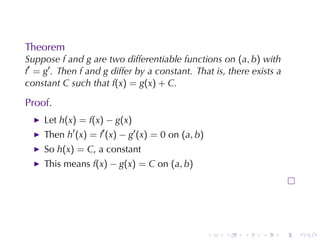
Theorem
Suppose f and g are	two	differentiable	functions	on (a, b) with
f′ = g′ . Then f and g differ	by	a	constant. That	is, there	exists	a
constant C such	that f(x) = g(x) + C.

Proof.
     Let h(x) = f(x) − g(x)
     Then h′ (x) = f′ (x) − g′ (x) = 0 on (a, b)
     So h(x) = C, a	constant
     This	means f(x) − g(x) = C on (a, b)


                                                   .   .   .   .       .   .
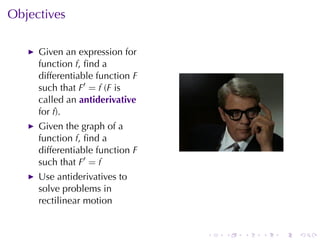
Objectives

     Given	an	expression	for
     function f, find	a
     differentiable	function F
     such	that F′ = f (F is
     called	an antiderivative
     for f).
     Given	the	graph	of	a
     function f, find	a
     differentiable	function F
     such	that F′ = f
     Use	antiderivatives	to
     solve	problems	in
     rectilinear	motion


                                 .   .   .   .   .   .
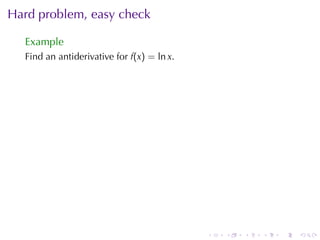
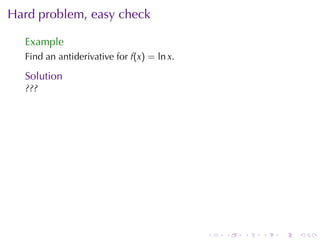
Hard	problem, easy	check

  Example
  Find	an	antiderivative	for f(x) = ln x.


                                            .   .   .   .   .   .
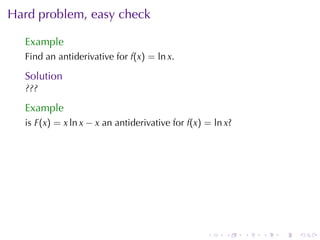
Hard	problem, easy	check

  Example
  Find	an	antiderivative	for f(x) = ln x.

  Solution
  ???


                                            .   .   .   .   .   .
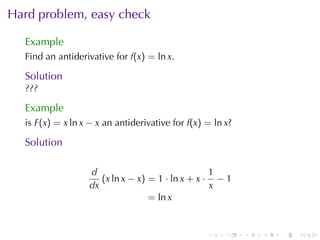
Hard	problem, easy	check

  Example
  Find	an	antiderivative	for f(x) = ln x.

  Solution
  ???

  Example
  is F(x) = x ln x − x an	antiderivative	for f(x) = ln x?


                                                  .    .    .   .   .   .
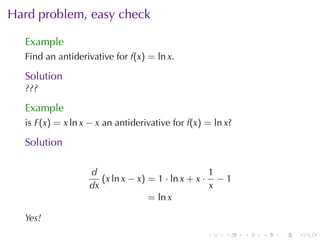
Hard	problem, easy	check

  Example
  Find	an	antiderivative	for f(x) = ln x.

  Solution
  ???

  Example
  is F(x) = x ln x − x an	antiderivative	for f(x) = ln x?

  Solution

                   d                               1
                      (x ln x − x) = 1 · ln x + x · − 1
                   dx                              x
                                   = ln x


                                                  .    .    .   .   .   .
Hard	problem, easy	check

  Example
  Find	an	antiderivative	for f(x) = ln x.

  Solution
  ???

  Example
  is F(x) = x ln x − x an	antiderivative	for f(x) = ln x?

  Solution

                   d                               1
                      (x ln x − x) = 1 · ln x + x · − 1
                   dx                              x
                                   = ln x

  Yes!
                                                  .    .    .   .   .   .
Outline


  Tabulating	Antiderivatives
     Power	functions
     Combinations
     Exponential	functions
     Trigonometric	functions


  Finding	Antiderivatives	Graphically


  Rectilinear	motion


                                        .   .   .   .   .   .
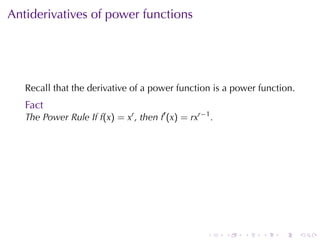
Antiderivatives	of	power	functions


   Recall	that	the	derivative	of	a	power	function	is	a	power	function.
   Fact
   The	Power	Rule	If f(x) = xr , then f′ (x) = rxr−1 .


                                                    .    .   .   .   .   .
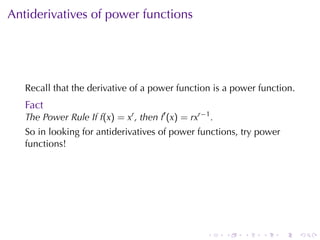
Antiderivatives	of	power	functions


   Recall	that	the	derivative	of	a	power	function	is	a	power	function.
   Fact
   The	Power	Rule	If f(x) = xr , then f′ (x) = rxr−1 .
   So	in	looking	for	antiderivatives	of	power	functions, try	power
   functions!


                                                    .    .   .   .   .   .
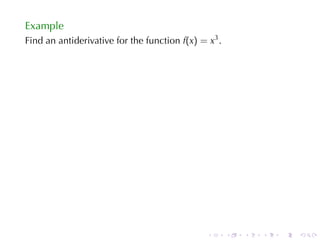
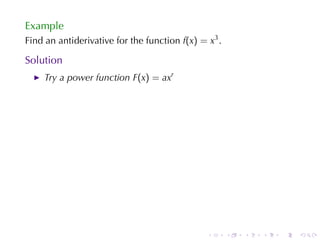
Example
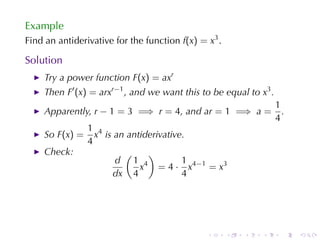
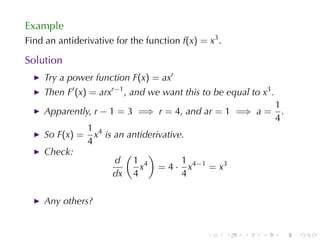
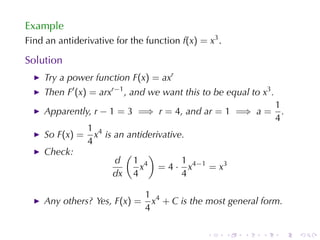
Find	an	antiderivative	for	the	function f(x) = x3 .


                                               .      .   .   .   .   .
Example
Find	an	antiderivative	for	the	function f(x) = x3 .

Solution
    Try	a	power	function F(x) = axr


                                               .      .   .   .   .   .
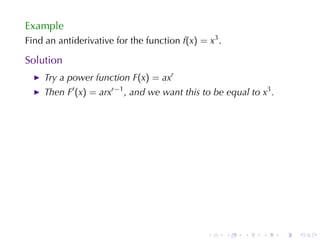
Example
Find	an	antiderivative	for	the	function f(x) = x3 .

Solution
    Try	a	power	function F(x) = axr
    Then F′ (x) = arxr−1 , and	we	want	this	to	be	equal	to x3 .


                                               .      .   .   .   .   .
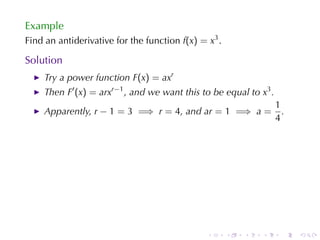
Example
Find	an	antiderivative	for	the	function f(x) = x3 .

Solution
    Try	a	power	function F(x) = axr
    Then F′ (x) = arxr−1 , and	we	want	this	to	be	equal	to x3 .
                                                                  1
    Apparently, r − 1 = 3 =⇒ r = 4, and ar = 1 =⇒ a =               .
                                                                  4


                                               .      .   .   .     .   .
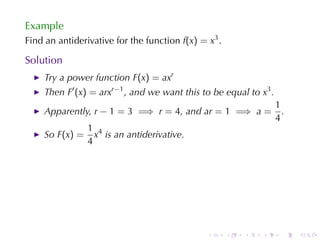
Example
Find	an	antiderivative	for	the	function f(x) = x3 .

Solution
    Try	a	power	function F(x) = axr
    Then F′ (x) = arxr−1 , and	we	want	this	to	be	equal	to x3 .
                                                                  1
    Apparently, r − 1 = 3 =⇒ r = 4, and ar = 1 =⇒ a =               .
                                                                  4
                1 4
    So F(x) =     x is	an	antiderivative.
                4


                                               .      .   .   .     .   .
Example
Find	an	antiderivative	for	the	function f(x) = x3 .

Solution
    Try	a	power	function F(x) = axr
    Then F′ (x) = arxr−1 , and	we	want	this	to	be	equal	to x3 .
                                                                  1
    Apparently, r − 1 = 3 =⇒ r = 4, and ar = 1 =⇒ a =               .
                                                                  4
                1 4
    So F(x) =     x is	an	antiderivative.
                4
    Check:               (     )
                       d 1 4            1
                             x = 4 · x 4 −1 = x 3
                      dx 4              4


                                               .      .   .   .     .   .
Example
Find	an	antiderivative	for	the	function f(x) = x3 .

Solution
    Try	a	power	function F(x) = axr
    Then F′ (x) = arxr−1 , and	we	want	this	to	be	equal	to x3 .
                                                                  1
    Apparently, r − 1 = 3 =⇒ r = 4, and ar = 1 =⇒ a =               .
                                                                  4
                1 4
    So F(x) =     x is	an	antiderivative.
                4
    Check:               (     )
                       d 1 4            1
                             x = 4 · x 4 −1 = x 3
                      dx 4              4

    Any	others?


                                               .      .   .   .     .   .
Example
Find	an	antiderivative	for	the	function f(x) = x3 .

Solution
    Try	a	power	function F(x) = axr
    Then F′ (x) = arxr−1 , and	we	want	this	to	be	equal	to x3 .
                                                                  1
    Apparently, r − 1 = 3 =⇒ r = 4, and ar = 1 =⇒ a =               .
                                                                  4
                1 4
    So F(x) =     x is	an	antiderivative.
                4
    Check:               (     )
                       d 1 4            1
                             x = 4 · x 4 −1 = x 3
                      dx 4              4

                               1 4
    Any	others? Yes, F(x) =      x + C is	the	most	general	form.
                               4

                                               .      .   .   .     .   .
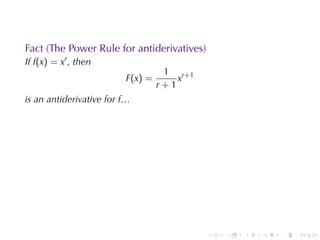
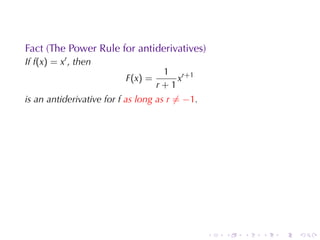
Fact	(The	Power	Rule	for	antiderivatives)
If f(x) = xr , then
                                   1 r+1
                         F(x) =       x
                                  r+1
is	an	antiderivative	for f…


                                            .   .   .   .   .   .
Fact	(The	Power	Rule	for	antiderivatives)
If f(x) = xr , then
                                    1 r+1
                          F(x) =       x
                                   r+1
is	an	antiderivative	for f as	long	as r ̸= −1.


                                                 .   .   .   .   .   .
Fact	(The	Power	Rule	for	antiderivatives)
If f(x) = xr , then
                                        1 r+1
                              F(x) =       x
                                       r+1
is	an	antiderivative	for f as	long	as r ̸= −1.

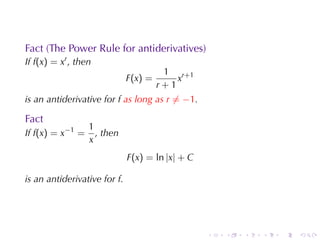
Fact
                  1
If f(x) = x−1 =     , then
                  x
                              F(x) = ln |x| + C

is	an	antiderivative	for f.


                                                  .   .   .   .   .   .
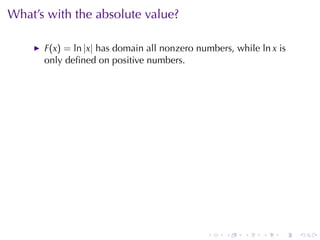
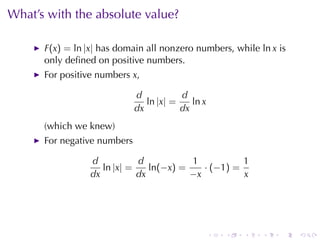
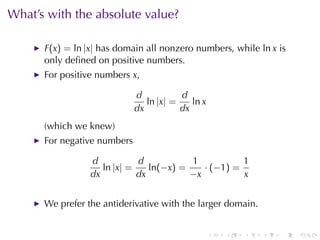
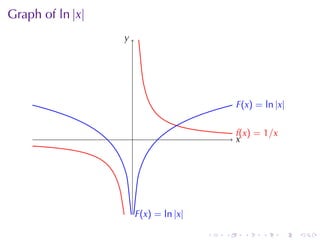
What’s	with	the	absolute	value?

      F(x) = ln |x| has	domain	all	nonzero	numbers, while ln x is
      only	defined	on	positive	numbers.


                                             .    .   .    .   .    .
What’s	with	the	absolute	value?

      F(x) = ln |x| has	domain	all	nonzero	numbers, while ln x is
      only	defined	on	positive	numbers.
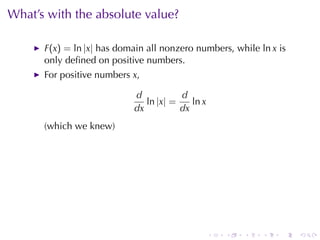
      For	positive	numbers x,

                           d           d
                              ln |x| =    ln x
                           dx          dx
      (which	we	knew)


                                                 .   .   .   .   .   .
What’s	with	the	absolute	value?

      F(x) = ln |x| has	domain	all	nonzero	numbers, while ln x is
      only	defined	on	positive	numbers.
      For	positive	numbers x,

                             d           d
                                ln |x| =    ln x
                             dx          dx
      (which	we	knew)
      For	negative	numbers

                 d           d           1           1
                    ln |x| =    ln(−x) =    · (−1) =
                 dx          dx          −x          x


                                                   .   .   .   .   .   .
What’s	with	the	absolute	value?

      F(x) = ln |x| has	domain	all	nonzero	numbers, while ln x is
      only	defined	on	positive	numbers.
      For	positive	numbers x,

                             d           d
                                ln |x| =    ln x
                             dx          dx
      (which	we	knew)
      For	negative	numbers

                 d           d           1           1
                    ln |x| =    ln(−x) =    · (−1) =
                 dx          dx          −x          x


      We	prefer	the	antiderivative	with	the	larger	domain.


                                                   .   .   .   .   .   .
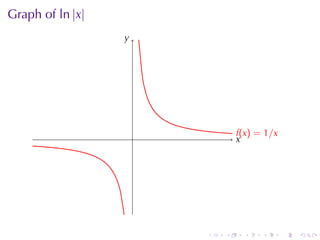
Graph	of ln |x|
                  y
                  .


                      .           f
                                  . (x ) = 1 /x
                                  x
                                  .


                          .   .     .     .       .   .
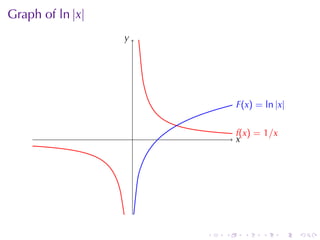
Graph	of ln |x|
                  y
                  .


                                  . (x) = ln |x|
                                  F


                      .           f
                                  . (x ) = 1 /x
                                  x
                                  .


                          .   .     .     .       .   .
Graph	of ln |x|
                  y
                  .


                                               . (x) = ln |x|
                                               F


                      .                        f
                                               . (x ) = 1 /x
                                               x
                                               .


                      . (x) = ln |x|
                      F

                                       .   .     .     .       .   .
Combinations	of	antiderivatives
   Fact	(Sum	and	Constant	Multiple	Rule	for	Antiderivatives)
       If F is	an	antiderivative	of f and G is	an	antiderivative	of g,
       then F + G is	an	antiderivative	of f + g.
       If F is	an	antiderivative	of f and c is	a	constant, then cF is	an
       antiderivative	of cf.


                                                  .    .    .    .       .   .
Combinations	of	antiderivatives
   Fact	(Sum	and	Constant	Multiple	Rule	for	Antiderivatives)
       If F is	an	antiderivative	of f and G is	an	antiderivative	of g,
       then F + G is	an	antiderivative	of f + g.
       If F is	an	antiderivative	of f and c is	a	constant, then cF is	an
       antiderivative	of cf.

   Proof.
   These	follow	from	the	sum	and	constant	multiple	rule	for
   derivatives:
       If F′ = f and G′ = g, then

                           (F + G)′ = F′ + G′ = f + g

       Again, if F′ = f,
                                (cF)′ = cF′ = cf

                                                   .    .   .    .       .   .
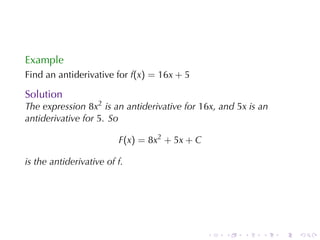
Example
Find	an	antiderivative	for f(x) = 16x + 5


                                            .   .   .   .   .   .
Example
Find	an	antiderivative	for f(x) = 16x + 5

Solution
The	expression 8x2 is	an	antiderivative	for 16x, and 5x is	an
antiderivative	for 5. So

                         F(x) = 8x2 + 5x + C

is	the	antiderivative	of f.


                                               .   .   .   .    .   .
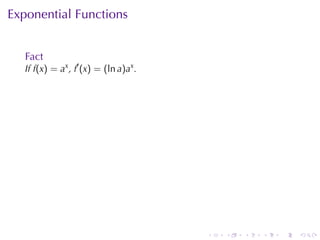
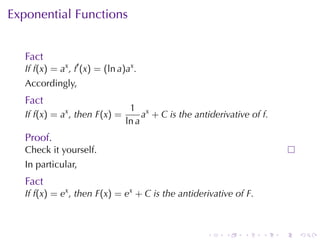
Exponential	Functions


   Fact
   If f(x) = ax , f′ (x) = (ln a)ax .


                                        .   .   .   .   .   .
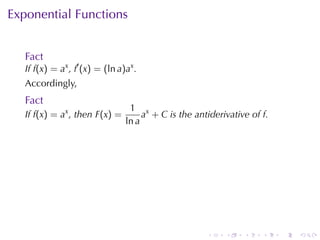
Exponential	Functions


   Fact
   If f(x) = ax , f′ (x) = (ln a)ax .
   Accordingly,
   Fact
                                  1 x
   If f(x) = ax , then F(x) =         a + C is	the	antiderivative	of f.
                                 ln a


                                                      .    .    .    .    .   .
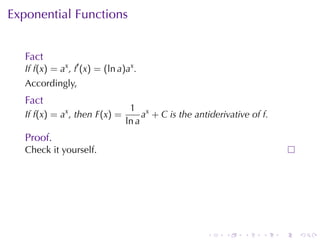
Exponential	Functions


   Fact
   If f(x) = ax , f′ (x) = (ln a)ax .
   Accordingly,
   Fact
                                  1 x
   If f(x) = ax , then F(x) =         a + C is	the	antiderivative	of f.
                                 ln a
   Proof.
   Check	it	yourself.


                                                      .    .    .    .    .   .
Exponential	Functions


   Fact
   If f(x) = ax , f′ (x) = (ln a)ax .
   Accordingly,
   Fact
                                  1 x
   If f(x) = ax , then F(x) =         a + C is	the	antiderivative	of f.
                                 ln a
   Proof.
   Check	it	yourself.
   In	particular,
   Fact
   If f(x) = ex , then F(x) = ex + C is	the	antiderivative	of F.


                                                      .    .    .    .    .   .
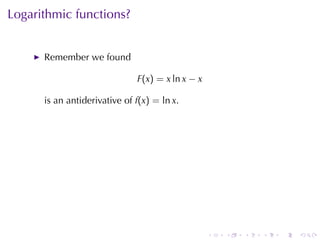
Logarithmic	functions?


      Remember	we	found

                              F(x) = x ln x − x

      is	an	antiderivative	of f(x) = ln x.


                                                  .   .   .   .   .   .
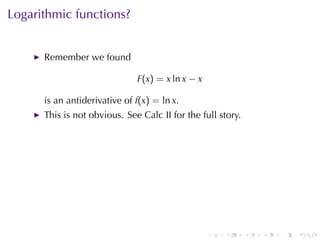
Logarithmic	functions?


      Remember	we	found

                              F(x) = x ln x − x

      is	an	antiderivative	of f(x) = ln x.
      This	is	not	obvious. See	Calc	II for	the	full	story.


                                                  .   .      .   .   .   .
Logarithmic	functions?


      Remember	we	found

                               F(x) = x ln x − x

      is	an	antiderivative	of f(x) = ln x.
      This	is	not	obvious. See	Calc	II for	the	full	story.
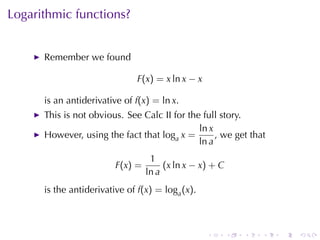
                                              ln x
      However, using	the	fact	that loga x =        , we	get	that
                                              ln a
                                   1
                         F(x) =        (x ln x − x) + C
                                  ln a
      is	the	antiderivative	of f(x) = loga (x).


                                                   .      .   .   .   .   .
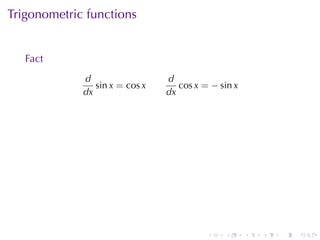
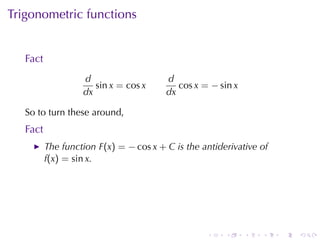
Trigonometric	functions


   Fact
             d                  d
                sin x = cos x      cos x = − sin x
             dx                 dx


                                          .   .      .   .   .   .
Trigonometric	functions


   Fact
                   d                    d
                      sin x = cos x        cos x = − sin x
                   dx                   dx

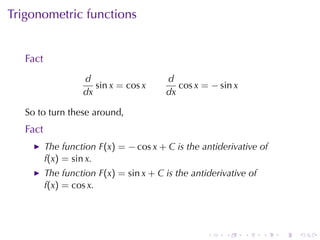
   So	to	turn	these	around,
   Fact
          The	function F(x) = − cos x + C is	the	antiderivative	of
          f(x) = sin x.


                                                  .    .     .   .   .   .
Trigonometric	functions


   Fact
                   d                    d
                      sin x = cos x        cos x = − sin x
                   dx                   dx

   So	to	turn	these	around,
   Fact
          The	function F(x) = − cos x + C is	the	antiderivative	of
          f(x) = sin x.
          The	function F(x) = sin x + C is	the	antiderivative	of
          f(x) = cos x.


                                                   .    .    .     .   .   .
Outline


  Tabulating	Antiderivatives
     Power	functions
     Combinations
     Exponential	functions
     Trigonometric	functions


  Finding	Antiderivatives	Graphically


  Rectilinear	motion


                                        .   .   .   .   .   .
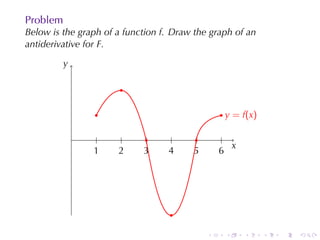
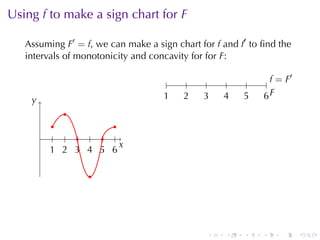
Problem
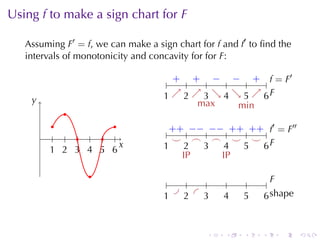
Below	is	the	graph	of	a	function f. Draw	the	graph	of	an
antiderivative	for F.

          y
          .

                         .

                   .                                . . = f(x)
                                                      y

              .     .     .     .     .     .         .
                                                        x
                                                        .
                  1
                  .     2
                        .     3
                              .     4
                                    .     5
                                          .         6
                                                    .


                                     .

                                                .     .     .    .   .   .
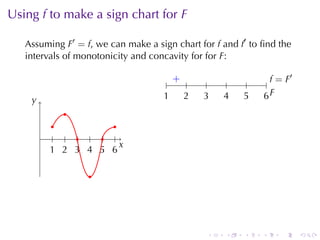
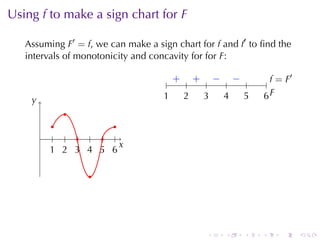
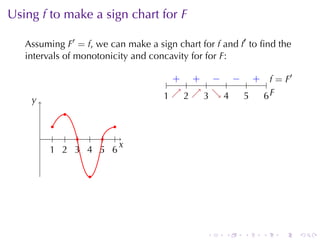
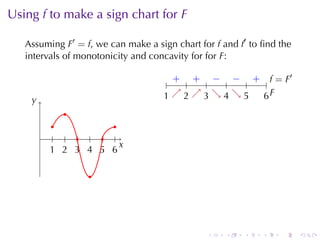
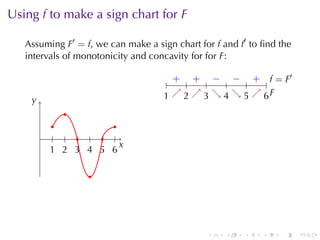
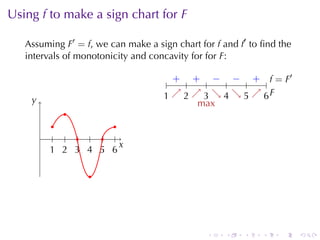
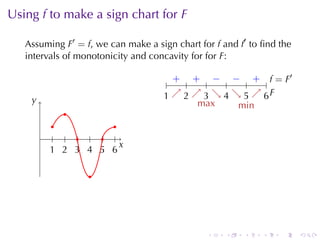
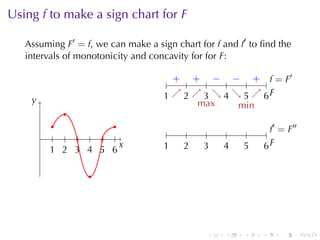
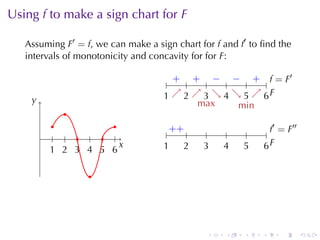
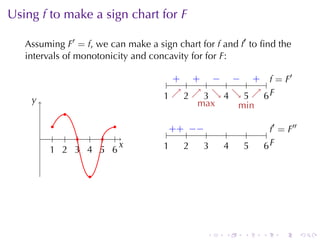
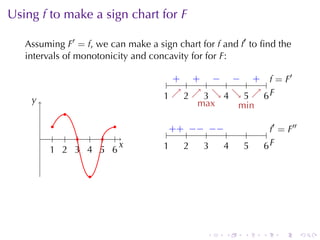
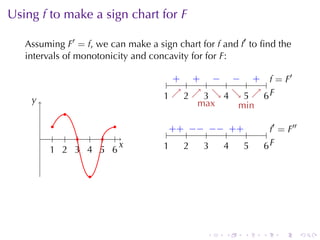
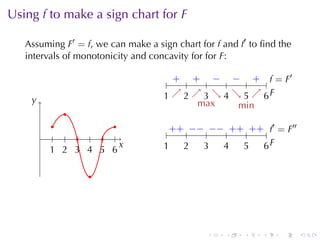
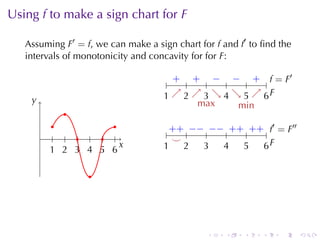
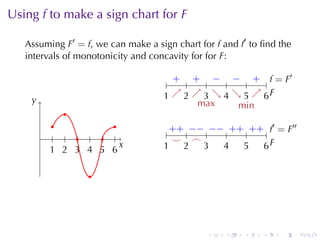
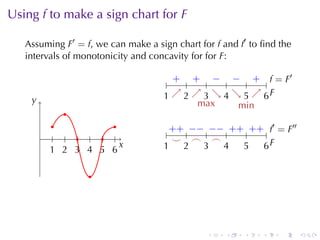
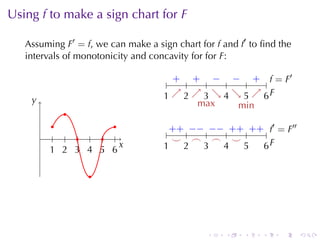
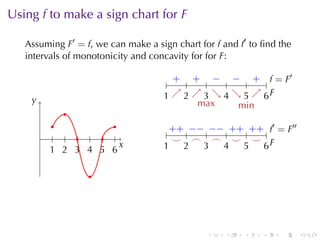
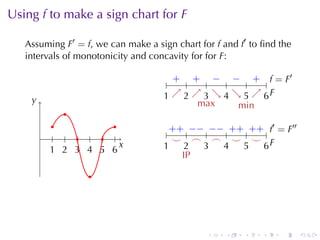
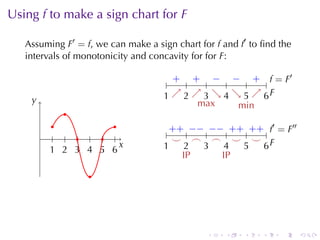
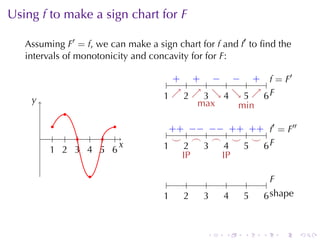
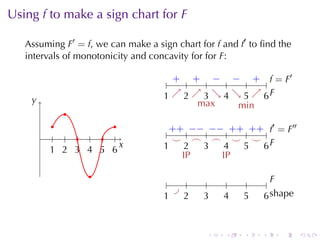
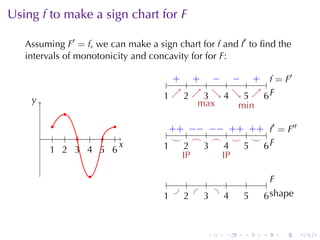
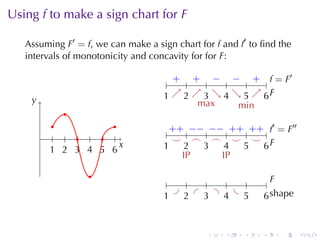
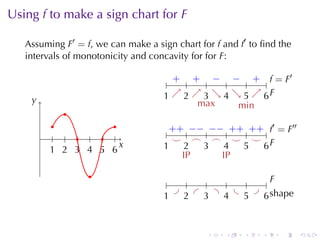
Using f to	make	a	sign	chart	for F

   Assuming F′ = f, we	can	make	a	sign	chart	for f and f′ to	find	the
   intervals	of	monotonicity	and	concavity	for	for F:

                                                                           ′
                                .     .     .     .     .     .   .. = F
                                                                   f

    y
    .                               1
                                    .     2
                                          .     3
                                                .     4
                                                      .     5
                                                            .     6F
                                                                  ..
             .
           .          .
        . . . . . . .
                        x
                        .
          1 2 3 4 5 6
          . . . . . .

                  .


                                                  .    .    .     .   .        .
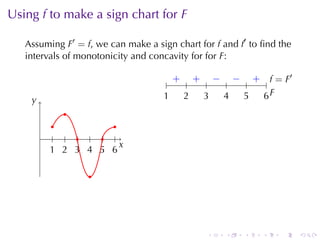
Using f to	make	a	sign	chart	for F

   Assuming F′ = f, we	can	make	a	sign	chart	for f and f′ to	find	the
   intervals	of	monotonicity	and	concavity	for	for F:

                                                                         ′
                                .     .. .
                                       +        .     .     .   .. = F
                                                                 f

    y
    .                               1
                                    .    2
                                         .    3
                                              .     4
                                                    .     5
                                                          .     6F
                                                                ..
             .
           .          .
        . . . . . . .
                        x
                        .
          1 2 3 4 5 6
          . . . . . .

                  .


                                                .    .    .     .   .        .
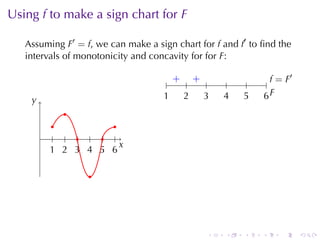
Using f to	make	a	sign	chart	for F

   Assuming F′ = f, we	can	make	a	sign	chart	for f and f′ to	find	the
   intervals	of	monotonicity	and	concavity	for	for F:

                                                                        ′
                                .     .. .. .
                                       + +           .     .   .. = F
                                                                f

    y
    .                               1
                                    .    2
                                         .  3
                                            .      4
                                                   .     5
                                                         .     6F
                                                               ..
             .
           .          .
        . . . . . . .
                        x
                        .
          1 2 3 4 5 6
          . . . . . .

                  .


                                               .    .    .     .   .        .
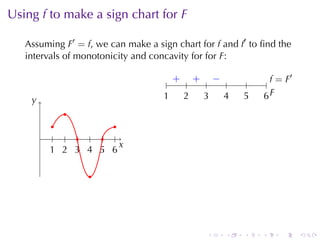
Using f to	make	a	sign	chart	for F

   Assuming F′ = f, we	can	make	a	sign	chart	for f and f′ to	find	the
   intervals	of	monotonicity	and	concavity	for	for F:

                                       + + −                           ′
                                .     .. .. .. .          .   .. = F
                                                               f

    y
    .                               1
                                    .    2
                                         .  3
                                            .  4
                                               .        5
                                                        .     6F
                                                              ..
             .
           .          .
        . . . . . . .
                        x
                        .
          1 2 3 4 5 6
          . . . . . .

                  .


                                               .    .   .     .   .        .
Using f to	make	a	sign	chart	for F

   Assuming F′ = f, we	can	make	a	sign	chart	for f and f′ to	find	the
   intervals	of	monotonicity	and	concavity	for	for F:

                                       + + − −                        ′
                                .     .. .. .. .. .          .. = F
                                                              f

    y
    .                               1
                                    .    2
                                         .  3
                                            .  4
                                               .  5
                                                  .          6F
                                                             ..
             .
           .          .
        . . . . . . .
                        x
                        .
          1 2 3 4 5 6
          . . . . . .

                  .


                                               .    .   .    .   .        .
Using f to	make	a	sign	chart	for F

   Assuming F′ = f, we	can	make	a	sign	chart	for f and f′ to	find	the
   intervals	of	monotonicity	and	concavity	for	for F:

                                        + + − − + f              ′
                                .     . . . . . . . . . . .. = F
    y
    .                               1
                                    .     2
                                          .   3
                                              .   4
                                                  .   5
                                                      .   6F
                                                          ..
             .
           .          .
        . . . . . . .
                        x
                        .
          1 2 3 4 5 6
          . . . . . .

                  .


                                               .    .   .    .   .     .
Using f to	make	a	sign	chart	for F

   Assuming F′ = f, we	can	make	a	sign	chart	for f and f′ to	find	the
   intervals	of	monotonicity	and	concavity	for	for F:

                                       + + − − + f              ′
                                .    . . . . . . . . . . .. = F
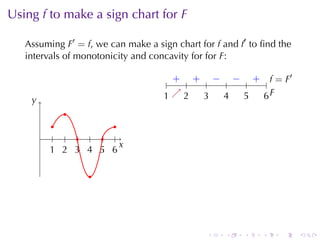
    y
    .                               1↗2
                                    . . .    3
                                             .   4
                                                 .   5
                                                     .   6F
                                                         ..
             .
           .          .
        . . . . . . .
                        x
                        .
          1 2 3 4 5 6
          . . . . . .

                  .


                                               .    .   .    .   .     .
Using f to	make	a	sign	chart	for F

   Assuming F′ = f, we	can	make	a	sign	chart	for f and f′ to	find	the
   intervals	of	monotonicity	and	concavity	for	for F:

                                       + + − − + f              ′
                                .    . . . . . . . . . . .. = F
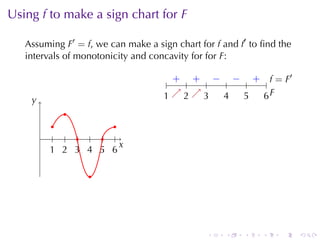
    y
    .                               1↗2↗3
                                    . . . . .    4
                                                 .   5
                                                     .   6F
                                                         ..
             .
           .          .
        . . . . . . .
                        x
                        .
          1 2 3 4 5 6
          . . . . . .

                  .


                                               .    .   .    .   .     .
Using f to	make	a	sign	chart	for F

   Assuming F′ = f, we	can	make	a	sign	chart	for f and f′ to	find	the
   intervals	of	monotonicity	and	concavity	for	for F:

                                       + + − − + f              ′
                                .    . . . . . . . . . . .. = F
    y
    .                               1↗2↗3↘4
                                    . . . . . . .    5
                                                     .   6F
                                                         ..
             .
           .          .
        . . . . . . .
                        x
                        .
          1 2 3 4 5 6
          . . . . . .

                  .


                                               .    .   .    .   .     .
Using f to	make	a	sign	chart	for F

   Assuming F′ = f, we	can	make	a	sign	chart	for f and f′ to	find	the
   intervals	of	monotonicity	and	concavity	for	for F:

                                       + + − − + f              ′
                                .    . . . . . . . . . . .. = F
    y
    .                               1↗2↗3↘4↘5
                                    . . . . . . . . .    6F
                                                         ..
             .
           .          .
        . . . . . . .
                        x
                        .
          1 2 3 4 5 6
          . . . . . .

                  .


                                               .    .   .    .   .     .
Using f to	make	a	sign	chart	for F

   Assuming F′ = f, we	can	make	a	sign	chart	for f and f′ to	find	the
   intervals	of	monotonicity	and	concavity	for	for F:

                                       + + − − + f              ′
                                .    . . . . . . . . . . .. = F
    y
    .                               1 ↗ 2 ↗ 3 ↘ 4 ↘ 5 ↗ 6F
                                    . . . . . . . . . . ..
             .
           .          .
        . . . . . . .
                        x
                        .
          1 2 3 4 5 6
          . . . . . .

                  .


                                               .    .   .    .   .     .
Using f to	make	a	sign	chart	for F

   Assuming F′ = f, we	can	make	a	sign	chart	for f and f′ to	find	the
   intervals	of	monotonicity	and	concavity	for	for F:

                                       + + − − + f              ′
                                .    . . . . . . . . . . .. = F
    y
    .                               1 ↗ 2 ↗ 3 ↘ 4 ↘ 5 ↗ 6F
                                    . . .. . . . . . . . . .
                                            max
             .
           .          .
        . . . . . . .
                        x
                        .
          1 2 3 4 5 6
          . . . . . .

                  .


                                               .    .   .    .   .     .
Using f to	make	a	sign	chart	for F

   Assuming F′ = f, we	can	make	a	sign	chart	for f and f′ to	find	the
   intervals	of	monotonicity	and	concavity	for	for F:

                                       + + − − + f              ′
                                .    . . . . . . . . . . .. = F
    y
    .                               1 ↗ 2 ↗ 3 ↘ 4 ↘ 5 ↗ 6F
                                    . . .. . . . .. . . . . .
                                            max      min
             .
           .          .
        . . . . . . .
                        x
                        .
          1 2 3 4 5 6
          . . . . . .

                  .


                                               .    .   .    .   .     .
Using f to	make	a	sign	chart	for F

   Assuming F′ = f, we	can	make	a	sign	chart	for f and f′ to	find	the
   intervals	of	monotonicity	and	concavity	for	for F:

                                       + + − − + f              ′
                                .    . . . . . . . . . . .. = F
    y
    .                               1 ↗ 2 ↗ 3 ↘ 4 ↘ 5 ↗ 6F
                                    . . .. . . . .. . . . . .
                                            max      min
             .
           .          .
                                      .     .     .     .     .    f′
                                                                  .. = F
                                                                         ′′
        . . . . . . .
          1 2 3 4 5 6
          . . . . . .
                        x
                        .           1
                                    .     2
                                          .     3
                                                .     4
                                                      .     5
                                                            .     6F
                                                                  ..

                  .


                                                  .    .    .     .   .       .
Using f to	make	a	sign	chart	for F

   Assuming F′ = f, we	can	make	a	sign	chart	for f and f′ to	find	the
   intervals	of	monotonicity	and	concavity	for	for F:

                                       + + − − + f              ′
                                .    . . . . . . . . . . .. = F
    y
    .                               1 ↗ 2 ↗ 3 ↘ 4 ↘ 5 ↗ 6F
                                    . . .. . . . .. . . . . .
                                            max      min
             .
           .          .
                                      .. + .
                                       +         .     .     .    f′
                                                                 .. = F
                                                                        ′′
        . . . . . . .
          1 2 3 4 5 6
          . . . . . .
                        x
                        .           1
                                    .     2
                                          .    3
                                               .     4
                                                     .     5
                                                           .     6F
                                                                 ..

                  .


                                                 .    .    .     .   .       .
Using f to	make	a	sign	chart	for F

   Assuming F′ = f, we	can	make	a	sign	chart	for f and f′ to	find	the
   intervals	of	monotonicity	and	concavity	for	for F:

                                       + + − − + f              ′
                                .    . . . . . . . . . . .. = F
    y
    .                               1 ↗ 2 ↗ 3 ↘ 4 ↘ 5 ↗ 6F
                                    . . .. . . . .. . . . . .
                                            max      min
             .
           .          .
                                      .. + .. − .
                                       + −            .     .    f′
                                                                .. = F
                                                                       ′′
        . . . . . . .
          1 2 3 4 5 6
          . . . . . .
                        x
                        .           1
                                    .     2
                                          .    3
                                               .    4
                                                    .     5
                                                          .     6F
                                                                ..

                  .


                                                .    .    .     .   .       .
Using f to	make	a	sign	chart	for F

   Assuming F′ = f, we	can	make	a	sign	chart	for f and f′ to	find	the
   intervals	of	monotonicity	and	concavity	for	for F:

                                       + + − − + f              ′
                                .    . . . . . . . . . . .. = F
    y
    .                               1 ↗ 2 ↗ 3 ↘ 4 ↘ 5 ↗ 6F
                                    . . .. . . . .. . . . . .
                                            max      min
             .
           .          .
                                      .. + .. − .. − .
                                       + − −               .    f′
                                                               .. = F
                                                                      ′′
        . . . . . . .
          1 2 3 4 5 6
          . . . . . .
                        x
                        .           1
                                    .     2
                                          .    3
                                               .    4
                                                    .    5
                                                         .     6F
                                                               ..

                  .


                                                .    .   .     .   .       .
Using f to	make	a	sign	chart	for F

   Assuming F′ = f, we	can	make	a	sign	chart	for f and f′ to	find	the
   intervals	of	monotonicity	and	concavity	for	for F:

                                       + + − − + f              ′
                                .    . . . . . . . . . . .. = F
    y
    .                               1 ↗ 2 ↗ 3 ↘ 4 ↘ 5 ↗ 6F
                                    . . .. . . . .. . . . . .
                                            max      min
             .
           .          .
                                      .. + .. − .. − .. + .
                                       + − − +                 f′
                                                              .. = F
                                                                     ′′
        . . . . . . .
          1 2 3 4 5 6
          . . . . . .
                        x
                        .           1
                                    .     2
                                          .    3
                                               .    4
                                                    .    5
                                                         .    6F
                                                              ..

                  .


                                               .    .    .    .   .       .
Using f to	make	a	sign	chart	for F

   Assuming F′ = f, we	can	make	a	sign	chart	for f and f′ to	find	the
   intervals	of	monotonicity	and	concavity	for	for F:

                                       + + − − + f              ′
                                .    . . . . . . . . . . .. = F
    y
    .                               1 ↗ 2 ↗ 3 ↘ 4 ↘ 5 ↗ 6F
                                    . . .. . . . .. . . . . .
                                            max      min
             .
           .          .                + − − + + f′                    ′′
        . . . . . . .                 .. + .. − .. − .. + .. + . . = F
          1 2 3 4 5 6
          . . . . . .
                        x
                        .           1
                                    .     2
                                          .    3
                                               .    4
                                                    .    5
                                                         .    6F
                                                              ..

                  .


                                                .    .    .    .    .       .
Using f to	make	a	sign	chart	for F

   Assuming F′ = f, we	can	make	a	sign	chart	for f and f′ to	find	the
   intervals	of	monotonicity	and	concavity	for	for F:

                                       + + − − + f              ′
                                .    . . . . . . . . . . .. = F
    y
    .                               1 ↗ 2 ↗ 3 ↘ 4 ↘ 5 ↗ 6F
                                    . . .. . . . .. . . . . .
                                            max      min
             .
           .          .                + − − + + f′                    ′′
        . . . . . . .                 .. + .. − .. − .. + .. + . . = F
                                        .
                                        ⌣
          1 2 3 4 5 6
          . . . . . .
                        x
                        .           1
                                    .     2
                                          .    3
                                               .    4
                                                    .    5
                                                         .    6F
                                                              ..

                  .


                                                .    .    .    .    .       .
Using f to	make	a	sign	chart	for F

   Assuming F′ = f, we	can	make	a	sign	chart	for f and f′ to	find	the
   intervals	of	monotonicity	and	concavity	for	for F:

                                       + + − − + f              ′
                                .    . . . . . . . . . . .. = F
    y
    .                               1 ↗ 2 ↗ 3 ↘ 4 ↘ 5 ↗ 6F
                                    . . .. . . . .. . . . . .
                                            max      min
             .
           .          .                + − − + + f′                    ′′
        . . . . . . .                 .. + .. − .. − .. + .. + . . = F
                                        ⌣ .
                                        .    ⌢
          1 2 3 4 5 6
          . . . . . .
                        x
                        .           1
                                    .     2
                                          .    3
                                               .    4
                                                    .    5
                                                         .    6F
                                                              ..

                  .


                                                .    .    .    .    .       .
Using f to	make	a	sign	chart	for F

   Assuming F′ = f, we	can	make	a	sign	chart	for f and f′ to	find	the
   intervals	of	monotonicity	and	concavity	for	for F:

                                       + + − − + f              ′
                                .    . . . . . . . . . . .. = F
    y
    .                               1 ↗ 2 ↗ 3 ↘ 4 ↘ 5 ↗ 6F
                                    . . .. . . . .. . . . . .
                                            max      min
             .
           .          .                + − − + + f′                    ′′
        . . . . . . .                 .. + .. − .. − .. + .. + . . = F
                                        ⌣ .
                                        .    ⌢ .  ⌢
          1 2 3 4 5 6
          . . . . . .
                        x
                        .           1
                                    .     2
                                          .    3
                                               .    4
                                                    .    5
                                                         .    6F
                                                              ..

                  .


                                                .    .    .    .    .       .
Using f to	make	a	sign	chart	for F

   Assuming F′ = f, we	can	make	a	sign	chart	for f and f′ to	find	the
   intervals	of	monotonicity	and	concavity	for	for F:

                                       + + − − + f              ′
                                .    . . . . . . . . . . .. = F
    y
    .                               1 ↗ 2 ↗ 3 ↘ 4 ↘ 5 ↗ 6F
                                    . . .. . . . .. . . . . .
                                            max      min
             .
           .          .                + − − + + f′                    ′′
        . . . . . . .                 .. + .. − .. − .. + .. + . . = F
                                        ⌣ .
                                        .    ⌢ .  ⌢ .  ⌣
          1 2 3 4 5 6
          . . . . . .
                        x
                        .           1
                                    .     2
                                          .    3
                                               .    4
                                                    .    5
                                                         .    6F
                                                              ..

                  .


                                                .    .    .    .    .       .
Using f to	make	a	sign	chart	for F

   Assuming F′ = f, we	can	make	a	sign	chart	for f and f′ to	find	the
   intervals	of	monotonicity	and	concavity	for	for F:

                                       + + − − + f              ′
                                .    . . . . . . . . . . .. = F
    y
    .                               1 ↗ 2 ↗ 3 ↘ 4 ↘ 5 ↗ 6F
                                    . . .. . . . .. . . . . .
                                            max      min
             .
           .          .                + − − + + f′                    ′′
        . . . . . . .                 .. + .. − .. − .. + .. + . . = F
                                        ⌣ .
                                        .    ⌢ .  ⌢ .  ⌣ .  ⌣ .
          1 2 3 4 5 6
          . . . . . .
                        x
                        .           1
                                    .     2
                                          .    3
                                               .    4
                                                    .    5
                                                         .    .F
                                                              6

                  .


                                                .    .    .    .    .       .
Using f to	make	a	sign	chart	for F

   Assuming F′ = f, we	can	make	a	sign	chart	for f and f′ to	find	the
   intervals	of	monotonicity	and	concavity	for	for F:

                                       + + − − + f              ′
                                .    . . . . . . . . . . .. = F
    y
    .                               1 ↗ 2 ↗ 3 ↘ 4 ↘ 5 ↗ 6F
                                    . . .. . . . .. . . . . .
                                            max      min
             .
           .          .                 + − − + + f′                    ′′
        . . . . . . .                  .. + .. − .. − .. + .. + . . = F
                                         ⌣ .
                                         .    ⌢ .  ⌢ .  ⌣ .  ⌣ .
          1 2 3 4 5 6
          . . . . . .
                        x
                        .           ..
                                     1      2
                                            .   3
                                                .    4
                                                     .    5
                                                          .    .F
                                                               6
                                           IP
                  .


                                                .     .    .    .    .       .
Using f to	make	a	sign	chart	for F

   Assuming F′ = f, we	can	make	a	sign	chart	for f and f′ to	find	the
   intervals	of	monotonicity	and	concavity	for	for F:

                                       + + − − + f              ′
                                .    . . . . . . . . . . .. = F
    y
    .                               1 ↗ 2 ↗ 3 ↘ 4 ↘ 5 ↗ 6F
                                    . . .. . . . .. . . . . .
                                            max      min
             .
           .          .                 + − − + + f′                    ′′
        . . . . . . .                  .. + .. − .. − .. + .. + . . = F
                                         ⌣ .
                                         .    ⌢ .  ⌢ .  ⌣ .  ⌣ .
          1 2 3 4 5 6
          . . . . . .
                        x
                        .           ..
                                     1      2 ..
                                            .   3     4
                                                      .   5
                                                          .    .F
                                                               6
                                           IP        IP
                  .


                                                .     .    .    .    .       .
Using f to	make	a	sign	chart	for F

   Assuming F′ = f, we	can	make	a	sign	chart	for f and f′ to	find	the
   intervals	of	monotonicity	and	concavity	for	for F:

                                       + + − − + f              ′
                                .    . . . . . . . . . . .. = F
    y
    .                               1 ↗ 2 ↗ 3 ↘ 4 ↘ 5 ↗ 6F
                                    . . .. . . . .. . . . . .
                                            max      min
             .
           .          .                 + − − + + f′                    ′′
        . . . . . . .                  .. + .. − .. − .. + .. + . . = F
                                         ⌣ .
                                         .    ⌢ .  ⌢ .  ⌣ .  ⌣ .
          1 2 3 4 5 6
          . . . . . .
                        x
                        .           ..
                                     1      2 ..
                                            .   3     4
                                                      .   5
                                                          .    .F
                                                               6
                                           IP        IP
                  .
                                      .     .     .     .     .     F
                                                                   ..
                                    1
                                    .     2
                                          .     3
                                                .     4
                                                      .     5
                                                            .     6s
                                                                  . . hape


                                                  .    .    .     .   .      .
Using f to	make	a	sign	chart	for F

   Assuming F′ = f, we	can	make	a	sign	chart	for f and f′ to	find	the
   intervals	of	monotonicity	and	concavity	for	for F:

                                       + + − − + f              ′
                                .    . . . . . . . . . . .. = F
    y
    .                               1 ↗ 2 ↗ 3 ↘ 4 ↘ 5 ↗ 6F
                                    . . .. . . . .. . . . . .
                                            max      min
             .
           .          .                 + − − + + f′                    ′′
        . . . . . . .                  .. + .. − .. − .. + .. + . . = F
                                         ⌣ .
                                         .    ⌢ .  ⌢ .  ⌣ .  ⌣ .
          1 2 3 4 5 6
          . . . . . .
                        x
                        .           ..
                                     1      2 ..
                                            .   3     4
                                                      .   5
                                                          .    .F
                                                               6
                                           IP        IP
                  .
                                      .     .     .     .     .     F
                                                                   ..
                                        .
                                    1
                                    .     2
                                          .     3
                                                .     4
                                                      .     5
                                                            .     6s
                                                                  . . hape


                                                  .    .    .     .   .      .
Using f to	make	a	sign	chart	for F

   Assuming F′ = f, we	can	make	a	sign	chart	for f and f′ to	find	the
   intervals	of	monotonicity	and	concavity	for	for F:

                                       + + − − + f              ′
                                .    . . . . . . . . . . .. = F
    y
    .                               1 ↗ 2 ↗ 3 ↘ 4 ↘ 5 ↗ 6F
                                    . . .. . . . .. . . . . .
                                            max      min
             .
           .          .                 + − − + + f′                    ′′
        . . . . . . .                  .. + .. − .. − .. + .. + . . = F
                                         ⌣ .
                                         .    ⌢ .  ⌢ .  ⌣ .  ⌣ .
          1 2 3 4 5 6
          . . . . . .
                        x
                        .           ..
                                     1      2 ..
                                            .   3     4
                                                      .   5
                                                          .    .F
                                                               6
                                           IP        IP
                  .
                                      .     .     .     .     .     F
                                                                   ..
                                        .     .
                                    1
                                    .     2
                                          .     3
                                                .     4
                                                      .     5
                                                            .     6s
                                                                  . . hape


                                                  .    .    .     .   .      .
Using f to	make	a	sign	chart	for F

   Assuming F′ = f, we	can	make	a	sign	chart	for f and f′ to	find	the
   intervals	of	monotonicity	and	concavity	for	for F:

                                       + + − − + f              ′
                                .    . . . . . . . . . . .. = F
    y
    .                               1 ↗ 2 ↗ 3 ↘ 4 ↘ 5 ↗ 6F
                                    . . .. . . . .. . . . . .
                                            max      min
             .
           .          .                 + − − + + f′                    ′′
        . . . . . . .                  .. + .. − .. − .. + .. + . . = F
                                         ⌣ .
                                         .    ⌢ .  ⌢ .  ⌣ .  ⌣ .
          1 2 3 4 5 6
          . . . . . .
                        x
                        .           ..
                                     1      2 ..
                                            .   3     4
                                                      .   5
                                                          .    .F
                                                               6
                                           IP        IP
                  .
                                      .     .     .     .     .     F
                                                                   ..
                                        .     .     .
                                    1
                                    .     2
                                          .     3
                                                .     4
                                                      .     5
                                                            .     6s
                                                                  . . hape


                                                  .    .    .     .   .      .
Using f to	make	a	sign	chart	for F

   Assuming F′ = f, we	can	make	a	sign	chart	for f and f′ to	find	the
   intervals	of	monotonicity	and	concavity	for	for F:

                                       + + − − + f              ′
                                .    . . . . . . . . . . .. = F
    y
    .                               1 ↗ 2 ↗ 3 ↘ 4 ↘ 5 ↗ 6F
                                    . . .. . . . .. . . . . .
                                            max      min
             .
           .          .                 + − − + + f′                    ′′
        . . . . . . .                  .. + .. − .. − .. + .. + . . = F
                                         ⌣ .
                                         .    ⌢ .  ⌢ .  ⌣ .  ⌣ .
          1 2 3 4 5 6
          . . . . . .
                        x
                        .           ..
                                     1      2 ..
                                            .   3     4
                                                      .   5
                                                          .    .F
                                                               6
                                           IP        IP
                  .
                                      .     .     .     .     .     F
                                                                   ..
                                        .     .     .     .
                                    1
                                    .     2
                                          .     3
                                                .     4
                                                      .     5
                                                            .     6s
                                                                  . . hape


                                                 .     .     .    .   .      .
Using f to	make	a	sign	chart	for F

   Assuming F′ = f, we	can	make	a	sign	chart	for f and f′ to	find	the
   intervals	of	monotonicity	and	concavity	for	for F:

                                       + + − − + f              ′
                                .    . . . . . . . . . . .. = F
    y
    .                               1 ↗ 2 ↗ 3 ↘ 4 ↘ 5 ↗ 6F
                                    . . .. . . . .. . . . . .
                                            max      min
             .
           .          .                 + − − + + f′                    ′′
        . . . . . . .                  .. + .. − .. − .. + .. + . . = F
                                         ⌣ .
                                         .    ⌢ .  ⌢ .  ⌣ .  ⌣ .
          1 2 3 4 5 6
          . . . . . .
                        x
                        .           ..
                                     1      2 ..
                                            .   3     4
                                                      .   5
                                                          .    .F
                                                               6
                                           IP        IP
                  .
                                      .     .     .     .     .     F
                                                                   ..
                                        .     .     .     .     . . hape
                                    1
                                    .     2
                                          .     3
                                                .     4
                                                      .     5
                                                            .     .s
                                                                  6


                                                .     .    .    .    .       .
Using f to	make	a	sign	chart	for F

   Assuming F′ = f, we	can	make	a	sign	chart	for f and f′ to	find	the
   intervals	of	monotonicity	and	concavity	for	for F:

                                       + + − − + f              ′
                                .    . . . . . . . . . . .. = F
    y
    .                               1 ↗ 2 ↗ 3 ↘ 4 ↘ 5 ↗ 6F
                                    . . .. . . . .. . . . . .
                                            max      min
             .
           .          .                 + − − + + f′                    ′′
        . . . . . . .                  .. + .. − .. − .. + .. + . . = F
                                         ⌣ .
                                         .    ⌢ .  ⌢ .  ⌣ .  ⌣ .
          1 2 3 4 5 6
          . . . . . .
                        x
                        .           ..
                                     1      2 ..
                                            .   3     4
                                                      .   5
                                                          .    .F
                                                               6
                                           IP        IP
                  .
                                     ?
                                     ..   ?
                                          ..   ?
                                               ..   ?
                                                    ..   ?
                                                         ..   ?F
                                                              .. .
                                        .    .    .    .    . . hape
                                     1
                                     .    2
                                          .    3
                                               .    4
                                                    .    5
                                                         .    .s
                                                              6
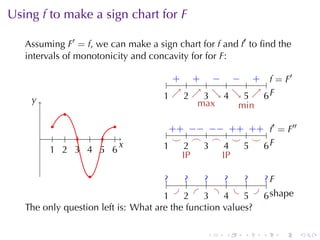
   The	only	question	left	is: What	are	the	function	values?

                                                .     .    .    .    .       .
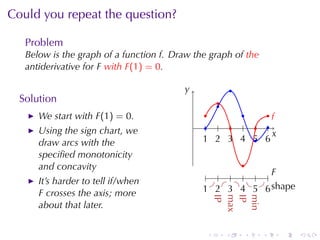
Could	you	repeat	the	question?

   Problem
   Below	is	the	graph	of	a	function f. Draw	the	graph	of the
   antiderivative	for F with F(1) = 0.

                                         y
                                         .             .
  Solution                                        .
                                                  .
      We	start	with F(1) = 0.                   .     .     ..
                                                             f
                                             . . . . . . .
      Using	the	sign	chart, we                               x
                                                             .
      draw	arcs	with	the                       . . . . .. .
                                               1 2 3 4 5 6
      specified	monotonicity
      and	concavity                                    .
                                                . . . . .            F
                                                                    ..
      It’s	harder	to	tell	if/when                . . . . .
      F crosses	the	axis; more                 1 2 3 4 5
                                               . . . . .           6s
                                                                   . . hape

                                                   IP
                                                   .
                                                   max
                                                   .
                                                   IP
                                                   .
                                                   min
                                                   .
      about	that	later.


                                               .   .       .   .       .      .
Outline


  Tabulating	Antiderivatives
     Power	functions
     Combinations
     Exponential	functions
     Trigonometric	functions


  Finding	Antiderivatives	Graphically


  Rectilinear	motion


                                        .   .   .   .   .   .
Say	what?


      “Rectlinear	motion”	just	means	motion	along	a	line.
      Often	we	are	given	information	about	the	velocity	or
      acceleration	of	a	moving	particle	and	we	want	to	know	the
      equations	of	motion.


                                            .    .   .      .   .   .
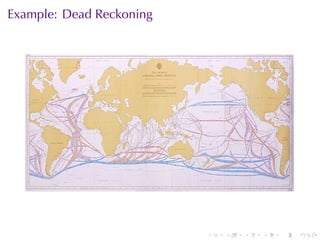
Example: Dead	Reckoning


                          .   .   .   .   .   .
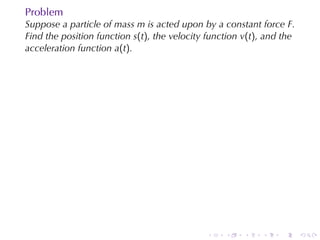
Problem
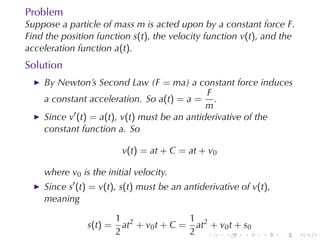
Suppose	a	particle	of	mass m is	acted	upon	by	a	constant	force F.
Find	the	position	function s(t), the	velocity	function v(t), and	the
acceleration	function a(t).


                                             .    .    .   .    .      .
Problem
Suppose	a	particle	of	mass m is	acted	upon	by	a	constant	force F.
Find	the	position	function s(t), the	velocity	function v(t), and	the
acceleration	function a(t).
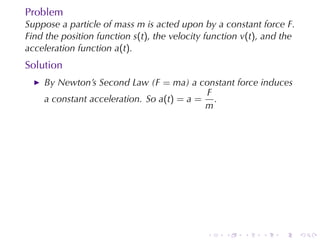
Solution
    By	Newton’s	Second	Law	(F = ma)	a	constant	force	induces
                                          F
    a	constant	acceleration. So a(t) = a = .
                                          m


                                             .    .    .   .    .      .
Problem
Suppose	a	particle	of	mass m is	acted	upon	by	a	constant	force F.
Find	the	position	function s(t), the	velocity	function v(t), and	the
acceleration	function a(t).
Solution
    By	Newton’s	Second	Law	(F = ma)	a	constant	force	induces
                                              F
    a	constant	acceleration. So a(t) = a = .
                                              m
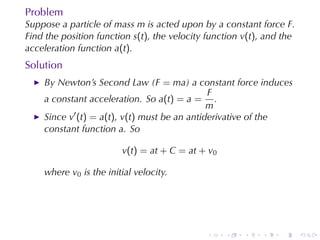
    Since v′ (t) = a(t), v(t) must	be	an	antiderivative	of	the
    constant	function a. So

                        v(t) = at + C = at + v0

    where v0 is	the	initial	velocity.


                                             .    .    .   .    .      .
Problem
Suppose	a	particle	of	mass m is	acted	upon	by	a	constant	force F.
Find	the	position	function s(t), the	velocity	function v(t), and	the
acceleration	function a(t).
Solution
    By	Newton’s	Second	Law	(F = ma)	a	constant	force	induces
                                              F
    a	constant	acceleration. So a(t) = a = .
                                              m
    Since v′ (t) = a(t), v(t) must	be	an	antiderivative	of	the
    constant	function a. So

                         v(t) = at + C = at + v0

    where v0 is	the	initial	velocity.
    Since s′ (t) = v(t), s(t) must	be	an	antiderivative	of v(t),
    meaning

                        1 2              1
               s(t) =     at + v0 t + C = at2 + v0 t + s0
                        2                2     .    .    .    .    .   .
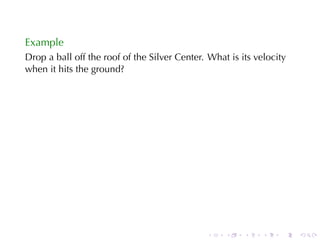
Example
Drop	a	ball	off	the	roof	of	the	Silver	Center. What	is	its	velocity
when	it	hits	the	ground?


                                              .    .    .    .   .    .
Example
Drop	a	ball	off	the	roof	of	the	Silver	Center. What	is	its	velocity
when	it	hits	the	ground?

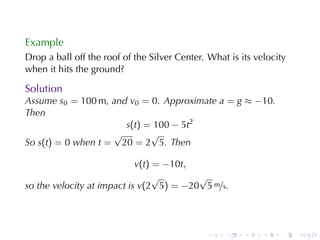
Solution
Assume s0 = 100 m, and v0 = 0. Approximate a = g ≈ −10.
Then
                      s(t) = 100 − 5t2
                    √       √
So s(t) = 0 when t = 20 = 2 5. Then

                            v(t) = −10t,
                                 √       √
so	the	velocity	at	impact	is v(2 5) = −20 5 m/s.


                                              .    .    .    .   .    .
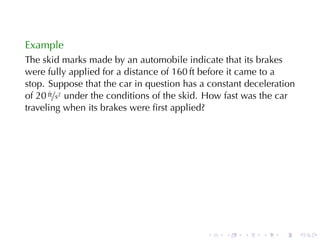
Example
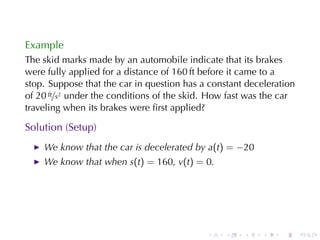
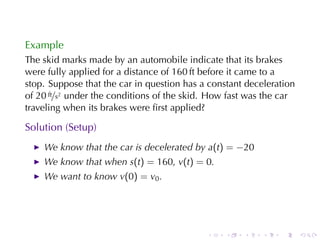
The	skid	marks	made	by	an	automobile	indicate	that	its	brakes
were	fully	applied	for	a	distance	of	160 ft	before	it	came	to	a
stop. Suppose	that	the	car	in	question	has	a	constant	deceleration
of 20 ft/s2 under	the	conditions	of	the	skid. How	fast	was	the	car
traveling	when	its	brakes	were	first	applied?


                                            .    .   .    .   .      .
Example
The	skid	marks	made	by	an	automobile	indicate	that	its	brakes
were	fully	applied	for	a	distance	of	160 ft	before	it	came	to	a
stop. Suppose	that	the	car	in	question	has	a	constant	deceleration
of 20 ft/s2 under	the	conditions	of	the	skid. How	fast	was	the	car
traveling	when	its	brakes	were	first	applied?

Solution	(Setup)
    We	know	that	the	car	is	decelerated	by a(t) = −20
    We	know	that	when s(t) = 160, v(t) = 0.


                                            .    .   .    .   .      .
Example
The	skid	marks	made	by	an	automobile	indicate	that	its	brakes
were	fully	applied	for	a	distance	of	160 ft	before	it	came	to	a
stop. Suppose	that	the	car	in	question	has	a	constant	deceleration
of 20 ft/s2 under	the	conditions	of	the	skid. How	fast	was	the	car
traveling	when	its	brakes	were	first	applied?

Solution	(Setup)
    We	know	that	the	car	is	decelerated	by a(t) = −20
    We	know	that	when s(t) = 160, v(t) = 0.
    We	want	to	know v(0) = v0 .


                                            .    .   .    .   .      .
Solution	(Implementation)
                                 1 2
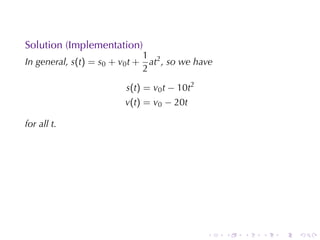
In	general, s(t) = s0 + v0 t +     at , so	we	have
                                 2

                          s(t) = v0 t − 10t2
                          v(t) = v0 − 20t

for	all t.


                                                .    .   .   .   .   .
Solution	(Implementation)
                                 1 2
In	general, s(t) = s0 + v0 t +     at , so	we	have
                                 2

                            s(t) = v0 t − 10t2
                            v(t) = v0 − 20t

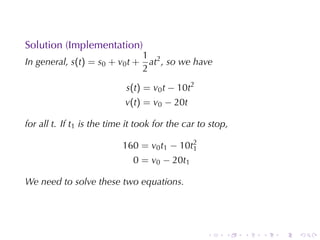
for	all t. If t1 is	the	time	it	took	for	the	car	to	stop,

                           160 = v0 t1 − 10t2
                                            1
                              0 = v0 − 20t1

We	need	to	solve	these	two	equations.


                                                   .    .   .   .   .   .
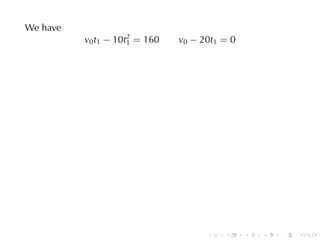
We	have
          v0 t1 − 10t2 = 160
                     1         v0 − 20t1 = 0


                                     .   .     .   .   .   .
We	have
             v0 t1 − 10t2 = 160
                        1            v0 − 20t1 = 0


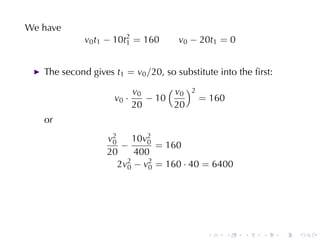
   The	second	gives t1 = v0 /20, so	substitute	into	the	first:

                           v0      ( v )2
                                      0
                    v0 ·      − 10        = 160
                           20        20
   or
                  v2
                   0     10v2
                            0
                      −       = 160
                  20     400
                     2v2 − v2 = 160 · 40 = 6400
                       0    0


                                            .     .   .   .     .   .
We	have
             v0 t1 − 10t2 = 160
                        1             v0 − 20t1 = 0


   The	second	gives t1 = v0 /20, so	substitute	into	the	first:

                            v0      ( v )2
                                       0
                     v0 ·      − 10        = 160
                            20        20
   or
                   v2
                    0     10v2
                             0
                       −       = 160
                   20     400
                      2v2 − v2 = 160 · 40 = 6400
                        0    0


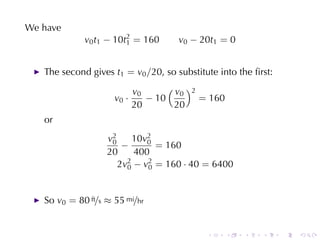
   So v0 = 80 ft/s ≈ 55 mi/hr


                                            .      .   .   .    .   .

Lesson 23: Antiderivatives

  • 1.
    Section 4.7 Antiderivatives V63.0121.027, Calculus I November 19, 2009 Announcements Next written assignment will be due Wednesday, Nov 25 next and last quiz will be the week after Thanksgiving (4.1–4.4, 4.7) Final Exam: Friday, December 18, 2:00–3:50pm . . Image credit: Ian Hampton . . . . . .
  • 2.
    Why the MVT is the MITC Most Important Theorem In Calculus! Theorem Let f′ = 0 on an interval (a, b). Then f is constant on (a, b). Proof. Pick any points x and y in (a, b) with x < y. Then f is continuous on [x, y] and differentiable on (x, y). By MVT there exists a point z in (x, y) such that f(y) − f(x) = f′ (z) = 0. y−x So f(y) = f(x). Since this is true for all x and y in (a, b), then f is constant. . . . . . .
  • 3.
    Theorem Suppose f andg are two differentiable functions on (a, b) with f′ = g′ . Then f and g differ by a constant. That is, there exists a constant C such that f(x) = g(x) + C. Proof. Let h(x) = f(x) − g(x) Then h′ (x) = f′ (x) − g′ (x) = 0 on (a, b) So h(x) = C, a constant This means f(x) − g(x) = C on (a, b) . . . . . .
  • 4.
    Objectives Given an expression for function f, find a differentiable function F such that F′ = f (F is called an antiderivative for f). Given the graph of a function f, find a differentiable function F such that F′ = f Use antiderivatives to solve problems in rectilinear motion . . . . . .
  • 5.
    Hard problem, easy check Example Find an antiderivative for f(x) = ln x. . . . . . .
  • 6.
    Hard problem, easy check Example Find an antiderivative for f(x) = ln x. Solution ??? . . . . . .
  • 7.
    Hard problem, easy check Example Find an antiderivative for f(x) = ln x. Solution ??? Example is F(x) = x ln x − x an antiderivative for f(x) = ln x? . . . . . .
  • 8.
    Hard problem, easy check Example Find an antiderivative for f(x) = ln x. Solution ??? Example is F(x) = x ln x − x an antiderivative for f(x) = ln x? Solution d 1 (x ln x − x) = 1 · ln x + x · − 1 dx x = ln x . . . . . .
  • 9.
    Hard problem, easy check Example Find an antiderivative for f(x) = ln x. Solution ??? Example is F(x) = x ln x − x an antiderivative for f(x) = ln x? Solution d 1 (x ln x − x) = 1 · ln x + x · − 1 dx x = ln x Yes! . . . . . .
  • 10.
    Outline Tabulating Antiderivatives Power functions Combinations Exponential functions Trigonometric functions Finding Antiderivatives Graphically Rectilinear motion . . . . . .
  • 11.
    Antiderivatives of power functions Recall that the derivative of a power function is a power function. Fact The Power Rule If f(x) = xr , then f′ (x) = rxr−1 . . . . . . .
  • 12.
    Antiderivatives of power functions Recall that the derivative of a power function is a power function. Fact The Power Rule If f(x) = xr , then f′ (x) = rxr−1 . So in looking for antiderivatives of power functions, try power functions! . . . . . .
  • 13.
  • 14.
    Example Find an antiderivative for the function f(x) =x3 . Solution Try a power function F(x) = axr . . . . . .
  • 15.
    Example Find an antiderivative for the function f(x) =x3 . Solution Try a power function F(x) = axr Then F′ (x) = arxr−1 , and we want this to be equal to x3 . . . . . . .
  • 16.
    Example Find an antiderivative for the function f(x) =x3 . Solution Try a power function F(x) = axr Then F′ (x) = arxr−1 , and we want this to be equal to x3 . 1 Apparently, r − 1 = 3 =⇒ r = 4, and ar = 1 =⇒ a = . 4 . . . . . .
  • 17.
    Example Find an antiderivative for the function f(x) =x3 . Solution Try a power function F(x) = axr Then F′ (x) = arxr−1 , and we want this to be equal to x3 . 1 Apparently, r − 1 = 3 =⇒ r = 4, and ar = 1 =⇒ a = . 4 1 4 So F(x) = x is an antiderivative. 4 . . . . . .
  • 18.
    Example Find an antiderivative for the function f(x) =x3 . Solution Try a power function F(x) = axr Then F′ (x) = arxr−1 , and we want this to be equal to x3 . 1 Apparently, r − 1 = 3 =⇒ r = 4, and ar = 1 =⇒ a = . 4 1 4 So F(x) = x is an antiderivative. 4 Check: ( ) d 1 4 1 x = 4 · x 4 −1 = x 3 dx 4 4 . . . . . .
  • 19.
    Example Find an antiderivative for the function f(x) =x3 . Solution Try a power function F(x) = axr Then F′ (x) = arxr−1 , and we want this to be equal to x3 . 1 Apparently, r − 1 = 3 =⇒ r = 4, and ar = 1 =⇒ a = . 4 1 4 So F(x) = x is an antiderivative. 4 Check: ( ) d 1 4 1 x = 4 · x 4 −1 = x 3 dx 4 4 Any others? . . . . . .
  • 20.
    Example Find an antiderivative for the function f(x) =x3 . Solution Try a power function F(x) = axr Then F′ (x) = arxr−1 , and we want this to be equal to x3 . 1 Apparently, r − 1 = 3 =⇒ r = 4, and ar = 1 =⇒ a = . 4 1 4 So F(x) = x is an antiderivative. 4 Check: ( ) d 1 4 1 x = 4 · x 4 −1 = x 3 dx 4 4 1 4 Any others? Yes, F(x) = x + C is the most general form. 4 . . . . . .
  • 21.
    Fact (The Power Rule for antiderivatives) If f(x) =xr , then 1 r+1 F(x) = x r+1 is an antiderivative for f… . . . . . .
  • 22.
    Fact (The Power Rule for antiderivatives) If f(x) =xr , then 1 r+1 F(x) = x r+1 is an antiderivative for f as long as r ̸= −1. . . . . . .
  • 23.
    Fact (The Power Rule for antiderivatives) If f(x) =xr , then 1 r+1 F(x) = x r+1 is an antiderivative for f as long as r ̸= −1. Fact 1 If f(x) = x−1 = , then x F(x) = ln |x| + C is an antiderivative for f. . . . . . .
  • 24.
    What’s with the absolute value? F(x) = ln |x| has domain all nonzero numbers, while ln x is only defined on positive numbers. . . . . . .
  • 25.
    What’s with the absolute value? F(x) = ln |x| has domain all nonzero numbers, while ln x is only defined on positive numbers. For positive numbers x, d d ln |x| = ln x dx dx (which we knew) . . . . . .
  • 26.
    What’s with the absolute value? F(x) = ln |x| has domain all nonzero numbers, while ln x is only defined on positive numbers. For positive numbers x, d d ln |x| = ln x dx dx (which we knew) For negative numbers d d 1 1 ln |x| = ln(−x) = · (−1) = dx dx −x x . . . . . .
  • 27.
    What’s with the absolute value? F(x) = ln |x| has domain all nonzero numbers, while ln x is only defined on positive numbers. For positive numbers x, d d ln |x| = ln x dx dx (which we knew) For negative numbers d d 1 1 ln |x| = ln(−x) = · (−1) = dx dx −x x We prefer the antiderivative with the larger domain. . . . . . .
  • 28.
    Graph of ln |x| y . . f . (x ) = 1 /x x . . . . . . .
  • 29.
    Graph of ln |x| y . . (x) = ln |x| F . f . (x ) = 1 /x x . . . . . . .
  • 30.
    Graph of ln |x| y . . (x) = ln |x| F . f . (x ) = 1 /x x . . (x) = ln |x| F . . . . . .
  • 31.
    Combinations of antiderivatives Fact (Sum and Constant Multiple Rule for Antiderivatives) If F is an antiderivative of f and G is an antiderivative of g, then F + G is an antiderivative of f + g. If F is an antiderivative of f and c is a constant, then cF is an antiderivative of cf. . . . . . .
  • 32.
    Combinations of antiderivatives Fact (Sum and Constant Multiple Rule for Antiderivatives) If F is an antiderivative of f and G is an antiderivative of g, then F + G is an antiderivative of f + g. If F is an antiderivative of f and c is a constant, then cF is an antiderivative of cf. Proof. These follow from the sum and constant multiple rule for derivatives: If F′ = f and G′ = g, then (F + G)′ = F′ + G′ = f + g Again, if F′ = f, (cF)′ = cF′ = cf . . . . . .
  • 33.
  • 34.
    Example Find an antiderivative for f(x) =16x + 5 Solution The expression 8x2 is an antiderivative for 16x, and 5x is an antiderivative for 5. So F(x) = 8x2 + 5x + C is the antiderivative of f. . . . . . .
  • 35.
    Exponential Functions Fact If f(x) = ax , f′ (x) = (ln a)ax . . . . . . .
  • 36.
    Exponential Functions Fact If f(x) = ax , f′ (x) = (ln a)ax . Accordingly, Fact 1 x If f(x) = ax , then F(x) = a + C is the antiderivative of f. ln a . . . . . .
  • 37.
    Exponential Functions Fact If f(x) = ax , f′ (x) = (ln a)ax . Accordingly, Fact 1 x If f(x) = ax , then F(x) = a + C is the antiderivative of f. ln a Proof. Check it yourself. . . . . . .
  • 38.
    Exponential Functions Fact If f(x) = ax , f′ (x) = (ln a)ax . Accordingly, Fact 1 x If f(x) = ax , then F(x) = a + C is the antiderivative of f. ln a Proof. Check it yourself. In particular, Fact If f(x) = ex , then F(x) = ex + C is the antiderivative of F. . . . . . .
  • 39.
    Logarithmic functions? Remember we found F(x) = x ln x − x is an antiderivative of f(x) = ln x. . . . . . .
  • 40.
    Logarithmic functions? Remember we found F(x) = x ln x − x is an antiderivative of f(x) = ln x. This is not obvious. See Calc II for the full story. . . . . . .
  • 41.
    Logarithmic functions? Remember we found F(x) = x ln x − x is an antiderivative of f(x) = ln x. This is not obvious. See Calc II for the full story. ln x However, using the fact that loga x = , we get that ln a 1 F(x) = (x ln x − x) + C ln a is the antiderivative of f(x) = loga (x). . . . . . .
  • 42.
    Trigonometric functions Fact d d sin x = cos x cos x = − sin x dx dx . . . . . .
  • 43.
    Trigonometric functions Fact d d sin x = cos x cos x = − sin x dx dx So to turn these around, Fact The function F(x) = − cos x + C is the antiderivative of f(x) = sin x. . . . . . .
  • 44.
    Trigonometric functions Fact d d sin x = cos x cos x = − sin x dx dx So to turn these around, Fact The function F(x) = − cos x + C is the antiderivative of f(x) = sin x. The function F(x) = sin x + C is the antiderivative of f(x) = cos x. . . . . . .
  • 45.
    Outline Tabulating Antiderivatives Power functions Combinations Exponential functions Trigonometric functions Finding Antiderivatives Graphically Rectilinear motion . . . . . .
  • 46.
    Problem Below is the graph of a function f. Draw the graph of an antiderivative forF. y . . . . . = f(x) y . . . . . . . x . 1 . 2 . 3 . 4 . 5 . 6 . . . . . . . .
  • 47.
    Using f to make a sign chart forF Assuming F′ = f, we can make a sign chart for f and f′ to find the intervals of monotonicity and concavity for for F: ′ . . . . . . .. = F f y . 1 . 2 . 3 . 4 . 5 . 6F .. . . . . . . . . . . x . 1 2 3 4 5 6 . . . . . . . . . . . . .
  • 48.
    Using f to make a sign chart forF Assuming F′ = f, we can make a sign chart for f and f′ to find the intervals of monotonicity and concavity for for F: ′ . .. . + . . . .. = F f y . 1 . 2 . 3 . 4 . 5 . 6F .. . . . . . . . . . . x . 1 2 3 4 5 6 . . . . . . . . . . . . .
  • 49.
    Using f to make a sign chart forF Assuming F′ = f, we can make a sign chart for f and f′ to find the intervals of monotonicity and concavity for for F: ′ . .. .. . + + . . .. = F f y . 1 . 2 . 3 . 4 . 5 . 6F .. . . . . . . . . . . x . 1 2 3 4 5 6 . . . . . . . . . . . . .
  • 50.
    Using f to make a sign chart forF Assuming F′ = f, we can make a sign chart for f and f′ to find the intervals of monotonicity and concavity for for F: + + − ′ . .. .. .. . . .. = F f y . 1 . 2 . 3 . 4 . 5 . 6F .. . . . . . . . . . . x . 1 2 3 4 5 6 . . . . . . . . . . . . .
  • 51.
    Using f to make a sign chart forF Assuming F′ = f, we can make a sign chart for f and f′ to find the intervals of monotonicity and concavity for for F: + + − − ′ . .. .. .. .. . .. = F f y . 1 . 2 . 3 . 4 . 5 . 6F .. . . . . . . . . . . x . 1 2 3 4 5 6 . . . . . . . . . . . . .
  • 52.
    Using f to make a sign chart forF Assuming F′ = f, we can make a sign chart for f and f′ to find the intervals of monotonicity and concavity for for F: + + − − + f ′ . . . . . . . . . . . .. = F y . 1 . 2 . 3 . 4 . 5 . 6F .. . . . . . . . . . . x . 1 2 3 4 5 6 . . . . . . . . . . . . .
  • 53.
    Using f to make a sign chart forF Assuming F′ = f, we can make a sign chart for f and f′ to find the intervals of monotonicity and concavity for for F: + + − − + f ′ . . . . . . . . . . . .. = F y . 1↗2 . . . 3 . 4 . 5 . 6F .. . . . . . . . . . . x . 1 2 3 4 5 6 . . . . . . . . . . . . .
  • 54.
    Using f to make a sign chart forF Assuming F′ = f, we can make a sign chart for f and f′ to find the intervals of monotonicity and concavity for for F: + + − − + f ′ . . . . . . . . . . . .. = F y . 1↗2↗3 . . . . . 4 . 5 . 6F .. . . . . . . . . . . x . 1 2 3 4 5 6 . . . . . . . . . . . . .
  • 55.
    Using f to make a sign chart forF Assuming F′ = f, we can make a sign chart for f and f′ to find the intervals of monotonicity and concavity for for F: + + − − + f ′ . . . . . . . . . . . .. = F y . 1↗2↗3↘4 . . . . . . . 5 . 6F .. . . . . . . . . . . x . 1 2 3 4 5 6 . . . . . . . . . . . . .
  • 56.
    Using f to make a sign chart forF Assuming F′ = f, we can make a sign chart for f and f′ to find the intervals of monotonicity and concavity for for F: + + − − + f ′ . . . . . . . . . . . .. = F y . 1↗2↗3↘4↘5 . . . . . . . . . 6F .. . . . . . . . . . . x . 1 2 3 4 5 6 . . . . . . . . . . . . .
  • 57.
    Using f to make a sign chart forF Assuming F′ = f, we can make a sign chart for f and f′ to find the intervals of monotonicity and concavity for for F: + + − − + f ′ . . . . . . . . . . . .. = F y . 1 ↗ 2 ↗ 3 ↘ 4 ↘ 5 ↗ 6F . . . . . . . . . . .. . . . . . . . . . . x . 1 2 3 4 5 6 . . . . . . . . . . . . .
  • 58.
    Using f to make a sign chart forF Assuming F′ = f, we can make a sign chart for f and f′ to find the intervals of monotonicity and concavity for for F: + + − − + f ′ . . . . . . . . . . . .. = F y . 1 ↗ 2 ↗ 3 ↘ 4 ↘ 5 ↗ 6F . . .. . . . . . . . . . max . . . . . . . . . . x . 1 2 3 4 5 6 . . . . . . . . . . . . .
  • 59.
    Using f to make a sign chart forF Assuming F′ = f, we can make a sign chart for f and f′ to find the intervals of monotonicity and concavity for for F: + + − − + f ′ . . . . . . . . . . . .. = F y . 1 ↗ 2 ↗ 3 ↘ 4 ↘ 5 ↗ 6F . . .. . . . .. . . . . . max min . . . . . . . . . . x . 1 2 3 4 5 6 . . . . . . . . . . . . .
  • 60.
    Using f to make a sign chart forF Assuming F′ = f, we can make a sign chart for f and f′ to find the intervals of monotonicity and concavity for for F: + + − − + f ′ . . . . . . . . . . . .. = F y . 1 ↗ 2 ↗ 3 ↘ 4 ↘ 5 ↗ 6F . . .. . . . .. . . . . . max min . . . . . . . . f′ .. = F ′′ . . . . . . . 1 2 3 4 5 6 . . . . . . x . 1 . 2 . 3 . 4 . 5 . 6F .. . . . . . . .
  • 61.
    Using f to make a sign chart forF Assuming F′ = f, we can make a sign chart for f and f′ to find the intervals of monotonicity and concavity for for F: + + − − + f ′ . . . . . . . . . . . .. = F y . 1 ↗ 2 ↗ 3 ↘ 4 ↘ 5 ↗ 6F . . .. . . . .. . . . . . max min . . . .. + . + . . . f′ .. = F ′′ . . . . . . . 1 2 3 4 5 6 . . . . . . x . 1 . 2 . 3 . 4 . 5 . 6F .. . . . . . . .
  • 62.
    Using f to make a sign chart forF Assuming F′ = f, we can make a sign chart for f and f′ to find the intervals of monotonicity and concavity for for F: + + − − + f ′ . . . . . . . . . . . .. = F y . 1 ↗ 2 ↗ 3 ↘ 4 ↘ 5 ↗ 6F . . .. . . . .. . . . . . max min . . . .. + .. − . + − . . f′ .. = F ′′ . . . . . . . 1 2 3 4 5 6 . . . . . . x . 1 . 2 . 3 . 4 . 5 . 6F .. . . . . . . .
  • 63.
    Using f to make a sign chart forF Assuming F′ = f, we can make a sign chart for f and f′ to find the intervals of monotonicity and concavity for for F: + + − − + f ′ . . . . . . . . . . . .. = F y . 1 ↗ 2 ↗ 3 ↘ 4 ↘ 5 ↗ 6F . . .. . . . .. . . . . . max min . . . .. + .. − .. − . + − − . f′ .. = F ′′ . . . . . . . 1 2 3 4 5 6 . . . . . . x . 1 . 2 . 3 . 4 . 5 . 6F .. . . . . . . .
  • 64.
    Using f to make a sign chart forF Assuming F′ = f, we can make a sign chart for f and f′ to find the intervals of monotonicity and concavity for for F: + + − − + f ′ . . . . . . . . . . . .. = F y . 1 ↗ 2 ↗ 3 ↘ 4 ↘ 5 ↗ 6F . . .. . . . .. . . . . . max min . . . .. + .. − .. − .. + . + − − + f′ .. = F ′′ . . . . . . . 1 2 3 4 5 6 . . . . . . x . 1 . 2 . 3 . 4 . 5 . 6F .. . . . . . . .
  • 65.
    Using f to make a sign chart forF Assuming F′ = f, we can make a sign chart for f and f′ to find the intervals of monotonicity and concavity for for F: + + − − + f ′ . . . . . . . . . . . .. = F y . 1 ↗ 2 ↗ 3 ↘ 4 ↘ 5 ↗ 6F . . .. . . . .. . . . . . max min . . . + − − + + f′ ′′ . . . . . . . .. + .. − .. − .. + .. + . . = F 1 2 3 4 5 6 . . . . . . x . 1 . 2 . 3 . 4 . 5 . 6F .. . . . . . . .
  • 66.
    Using f to make a sign chart forF Assuming F′ = f, we can make a sign chart for f and f′ to find the intervals of monotonicity and concavity for for F: + + − − + f ′ . . . . . . . . . . . .. = F y . 1 ↗ 2 ↗ 3 ↘ 4 ↘ 5 ↗ 6F . . .. . . . .. . . . . . max min . . . + − − + + f′ ′′ . . . . . . . .. + .. − .. − .. + .. + . . = F . ⌣ 1 2 3 4 5 6 . . . . . . x . 1 . 2 . 3 . 4 . 5 . 6F .. . . . . . . .
  • 67.
    Using f to make a sign chart forF Assuming F′ = f, we can make a sign chart for f and f′ to find the intervals of monotonicity and concavity for for F: + + − − + f ′ . . . . . . . . . . . .. = F y . 1 ↗ 2 ↗ 3 ↘ 4 ↘ 5 ↗ 6F . . .. . . . .. . . . . . max min . . . + − − + + f′ ′′ . . . . . . . .. + .. − .. − .. + .. + . . = F ⌣ . . ⌢ 1 2 3 4 5 6 . . . . . . x . 1 . 2 . 3 . 4 . 5 . 6F .. . . . . . . .
  • 68.
    Using f to make a sign chart forF Assuming F′ = f, we can make a sign chart for f and f′ to find the intervals of monotonicity and concavity for for F: + + − − + f ′ . . . . . . . . . . . .. = F y . 1 ↗ 2 ↗ 3 ↘ 4 ↘ 5 ↗ 6F . . .. . . . .. . . . . . max min . . . + − − + + f′ ′′ . . . . . . . .. + .. − .. − .. + .. + . . = F ⌣ . . ⌢ . ⌢ 1 2 3 4 5 6 . . . . . . x . 1 . 2 . 3 . 4 . 5 . 6F .. . . . . . . .
  • 69.
    Using f to make a sign chart forF Assuming F′ = f, we can make a sign chart for f and f′ to find the intervals of monotonicity and concavity for for F: + + − − + f ′ . . . . . . . . . . . .. = F y . 1 ↗ 2 ↗ 3 ↘ 4 ↘ 5 ↗ 6F . . .. . . . .. . . . . . max min . . . + − − + + f′ ′′ . . . . . . . .. + .. − .. − .. + .. + . . = F ⌣ . . ⌢ . ⌢ . ⌣ 1 2 3 4 5 6 . . . . . . x . 1 . 2 . 3 . 4 . 5 . 6F .. . . . . . . .
  • 70.
    Using f to make a sign chart forF Assuming F′ = f, we can make a sign chart for f and f′ to find the intervals of monotonicity and concavity for for F: + + − − + f ′ . . . . . . . . . . . .. = F y . 1 ↗ 2 ↗ 3 ↘ 4 ↘ 5 ↗ 6F . . .. . . . .. . . . . . max min . . . + − − + + f′ ′′ . . . . . . . .. + .. − .. − .. + .. + . . = F ⌣ . . ⌢ . ⌢ . ⌣ . ⌣ . 1 2 3 4 5 6 . . . . . . x . 1 . 2 . 3 . 4 . 5 . .F 6 . . . . . . .
  • 71.
    Using f to make a sign chart forF Assuming F′ = f, we can make a sign chart for f and f′ to find the intervals of monotonicity and concavity for for F: + + − − + f ′ . . . . . . . . . . . .. = F y . 1 ↗ 2 ↗ 3 ↘ 4 ↘ 5 ↗ 6F . . .. . . . .. . . . . . max min . . . + − − + + f′ ′′ . . . . . . . .. + .. − .. − .. + .. + . . = F ⌣ . . ⌢ . ⌢ . ⌣ . ⌣ . 1 2 3 4 5 6 . . . . . . x . .. 1 2 . 3 . 4 . 5 . .F 6 IP . . . . . . .
  • 72.
    Using f to make a sign chart forF Assuming F′ = f, we can make a sign chart for f and f′ to find the intervals of monotonicity and concavity for for F: + + − − + f ′ . . . . . . . . . . . .. = F y . 1 ↗ 2 ↗ 3 ↘ 4 ↘ 5 ↗ 6F . . .. . . . .. . . . . . max min . . . + − − + + f′ ′′ . . . . . . . .. + .. − .. − .. + .. + . . = F ⌣ . . ⌢ . ⌢ . ⌣ . ⌣ . 1 2 3 4 5 6 . . . . . . x . .. 1 2 .. . 3 4 . 5 . .F 6 IP IP . . . . . . .
  • 73.
    Using f to make a sign chart forF Assuming F′ = f, we can make a sign chart for f and f′ to find the intervals of monotonicity and concavity for for F: + + − − + f ′ . . . . . . . . . . . .. = F y . 1 ↗ 2 ↗ 3 ↘ 4 ↘ 5 ↗ 6F . . .. . . . .. . . . . . max min . . . + − − + + f′ ′′ . . . . . . . .. + .. − .. − .. + .. + . . = F ⌣ . . ⌢ . ⌢ . ⌣ . ⌣ . 1 2 3 4 5 6 . . . . . . x . .. 1 2 .. . 3 4 . 5 . .F 6 IP IP . . . . . . F .. 1 . 2 . 3 . 4 . 5 . 6s . . hape . . . . . .
  • 74.
    Using f to make a sign chart forF Assuming F′ = f, we can make a sign chart for f and f′ to find the intervals of monotonicity and concavity for for F: + + − − + f ′ . . . . . . . . . . . .. = F y . 1 ↗ 2 ↗ 3 ↘ 4 ↘ 5 ↗ 6F . . .. . . . .. . . . . . max min . . . + − − + + f′ ′′ . . . . . . . .. + .. − .. − .. + .. + . . = F ⌣ . . ⌢ . ⌢ . ⌣ . ⌣ . 1 2 3 4 5 6 . . . . . . x . .. 1 2 .. . 3 4 . 5 . .F 6 IP IP . . . . . . F .. . 1 . 2 . 3 . 4 . 5 . 6s . . hape . . . . . .
  • 75.
    Using f to make a sign chart forF Assuming F′ = f, we can make a sign chart for f and f′ to find the intervals of monotonicity and concavity for for F: + + − − + f ′ . . . . . . . . . . . .. = F y . 1 ↗ 2 ↗ 3 ↘ 4 ↘ 5 ↗ 6F . . .. . . . .. . . . . . max min . . . + − − + + f′ ′′ . . . . . . . .. + .. − .. − .. + .. + . . = F ⌣ . . ⌢ . ⌢ . ⌣ . ⌣ . 1 2 3 4 5 6 . . . . . . x . .. 1 2 .. . 3 4 . 5 . .F 6 IP IP . . . . . . F .. . . 1 . 2 . 3 . 4 . 5 . 6s . . hape . . . . . .
  • 76.
    Using f to make a sign chart forF Assuming F′ = f, we can make a sign chart for f and f′ to find the intervals of monotonicity and concavity for for F: + + − − + f ′ . . . . . . . . . . . .. = F y . 1 ↗ 2 ↗ 3 ↘ 4 ↘ 5 ↗ 6F . . .. . . . .. . . . . . max min . . . + − − + + f′ ′′ . . . . . . . .. + .. − .. − .. + .. + . . = F ⌣ . . ⌢ . ⌢ . ⌣ . ⌣ . 1 2 3 4 5 6 . . . . . . x . .. 1 2 .. . 3 4 . 5 . .F 6 IP IP . . . . . . F .. . . . 1 . 2 . 3 . 4 . 5 . 6s . . hape . . . . . .
  • 77.
    Using f to make a sign chart forF Assuming F′ = f, we can make a sign chart for f and f′ to find the intervals of monotonicity and concavity for for F: + + − − + f ′ . . . . . . . . . . . .. = F y . 1 ↗ 2 ↗ 3 ↘ 4 ↘ 5 ↗ 6F . . .. . . . .. . . . . . max min . . . + − − + + f′ ′′ . . . . . . . .. + .. − .. − .. + .. + . . = F ⌣ . . ⌢ . ⌢ . ⌣ . ⌣ . 1 2 3 4 5 6 . . . . . . x . .. 1 2 .. . 3 4 . 5 . .F 6 IP IP . . . . . . F .. . . . . 1 . 2 . 3 . 4 . 5 . 6s . . hape . . . . . .
  • 78.
    Using f to make a sign chart forF Assuming F′ = f, we can make a sign chart for f and f′ to find the intervals of monotonicity and concavity for for F: + + − − + f ′ . . . . . . . . . . . .. = F y . 1 ↗ 2 ↗ 3 ↘ 4 ↘ 5 ↗ 6F . . .. . . . .. . . . . . max min . . . + − − + + f′ ′′ . . . . . . . .. + .. − .. − .. + .. + . . = F ⌣ . . ⌢ . ⌢ . ⌣ . ⌣ . 1 2 3 4 5 6 . . . . . . x . .. 1 2 .. . 3 4 . 5 . .F 6 IP IP . . . . . . F .. . . . . . . hape 1 . 2 . 3 . 4 . 5 . .s 6 . . . . . .
  • 79.
    Using f to make a sign chart forF Assuming F′ = f, we can make a sign chart for f and f′ to find the intervals of monotonicity and concavity for for F: + + − − + f ′ . . . . . . . . . . . .. = F y . 1 ↗ 2 ↗ 3 ↘ 4 ↘ 5 ↗ 6F . . .. . . . .. . . . . . max min . . . + − − + + f′ ′′ . . . . . . . .. + .. − .. − .. + .. + . . = F ⌣ . . ⌢ . ⌢ . ⌣ . ⌣ . 1 2 3 4 5 6 . . . . . . x . .. 1 2 .. . 3 4 . 5 . .F 6 IP IP . ? .. ? .. ? .. ? .. ? .. ?F .. . . . . . . . hape 1 . 2 . 3 . 4 . 5 . .s 6 The only question left is: What are the function values? . . . . . .
  • 80.
    Could you repeat the question? Problem Below is the graph of a function f. Draw the graph of the antiderivative for F with F(1) = 0. y . . Solution . . We start with F(1) = 0. . . .. f . . . . . . . Using the sign chart, we x . draw arcs with the . . . . .. . 1 2 3 4 5 6 specified monotonicity and concavity . . . . . . F .. It’s harder to tell if/when . . . . . F crosses the axis; more 1 2 3 4 5 . . . . . 6s . . hape IP . max . IP . min . about that later. . . . . . .
  • 81.
    Outline Tabulating Antiderivatives Power functions Combinations Exponential functions Trigonometric functions Finding Antiderivatives Graphically Rectilinear motion . . . . . .
  • 82.
    Say what? “Rectlinear motion” just means motion along a line. Often we are given information about the velocity or acceleration of a moving particle and we want to know the equations of motion. . . . . . .
  • 83.
  • 84.
    Problem Suppose a particle of mass m is acted upon by a constant forceF. Find the position function s(t), the velocity function v(t), and the acceleration function a(t). . . . . . .
  • 85.
    Problem Suppose a particle of mass m is acted upon by a constant forceF. Find the position function s(t), the velocity function v(t), and the acceleration function a(t). Solution By Newton’s Second Law (F = ma) a constant force induces F a constant acceleration. So a(t) = a = . m . . . . . .
  • 86.
    Problem Suppose a particle of mass m is acted upon by a constant forceF. Find the position function s(t), the velocity function v(t), and the acceleration function a(t). Solution By Newton’s Second Law (F = ma) a constant force induces F a constant acceleration. So a(t) = a = . m Since v′ (t) = a(t), v(t) must be an antiderivative of the constant function a. So v(t) = at + C = at + v0 where v0 is the initial velocity. . . . . . .
  • 87.
    Problem Suppose a particle of mass m is acted upon by a constant forceF. Find the position function s(t), the velocity function v(t), and the acceleration function a(t). Solution By Newton’s Second Law (F = ma) a constant force induces F a constant acceleration. So a(t) = a = . m Since v′ (t) = a(t), v(t) must be an antiderivative of the constant function a. So v(t) = at + C = at + v0 where v0 is the initial velocity. Since s′ (t) = v(t), s(t) must be an antiderivative of v(t), meaning 1 2 1 s(t) = at + v0 t + C = at2 + v0 t + s0 2 2 . . . . . .
  • 88.
  • 89.
    Example Drop a ball off the roof of the Silver Center. What is its velocity when it hits the ground? Solution Assume s0= 100 m, and v0 = 0. Approximate a = g ≈ −10. Then s(t) = 100 − 5t2 √ √ So s(t) = 0 when t = 20 = 2 5. Then v(t) = −10t, √ √ so the velocity at impact is v(2 5) = −20 5 m/s. . . . . . .
  • 90.
  • 91.
    Example The skid marks made by an automobile indicate that its brakes were fully applied for a distance of 160 ft before it came to a stop. Suppose that the car in question has a constant deceleration of20 ft/s2 under the conditions of the skid. How fast was the car traveling when its brakes were first applied? Solution (Setup) We know that the car is decelerated by a(t) = −20 We know that when s(t) = 160, v(t) = 0. . . . . . .
  • 92.
    Example The skid marks made by an automobile indicate that its brakes were fully applied for a distance of 160 ft before it came to a stop. Suppose that the car in question has a constant deceleration of20 ft/s2 under the conditions of the skid. How fast was the car traveling when its brakes were first applied? Solution (Setup) We know that the car is decelerated by a(t) = −20 We know that when s(t) = 160, v(t) = 0. We want to know v(0) = v0 . . . . . . .
  • 93.
    Solution (Implementation) 1 2 In general, s(t) = s0 + v0 t + at , so we have 2 s(t) = v0 t − 10t2 v(t) = v0 − 20t for all t. . . . . . .
  • 94.
    Solution (Implementation) 1 2 In general, s(t) = s0 + v0 t + at , so we have 2 s(t) = v0 t − 10t2 v(t) = v0 − 20t for all t. If t1 is the time it took for the car to stop, 160 = v0 t1 − 10t2 1 0 = v0 − 20t1 We need to solve these two equations. . . . . . .
  • 95.
    We have v0 t1 − 10t2 = 160 1 v0 − 20t1 = 0 . . . . . .
  • 96.
    We have v0 t1 − 10t2 = 160 1 v0 − 20t1 = 0 The second gives t1 = v0 /20, so substitute into the first: v0 ( v )2 0 v0 · − 10 = 160 20 20 or v2 0 10v2 0 − = 160 20 400 2v2 − v2 = 160 · 40 = 6400 0 0 . . . . . .
  • 97.
    We have v0 t1 − 10t2 = 160 1 v0 − 20t1 = 0 The second gives t1 = v0 /20, so substitute into the first: v0 ( v )2 0 v0 · − 10 = 160 20 20 or v2 0 10v2 0 − = 160 20 400 2v2 − v2 = 160 · 40 = 6400 0 0 So v0 = 80 ft/s ≈ 55 mi/hr . . . . . .