Shigella
Muni Venkatesh.PMuni Venkatesh.P
Group 2Group 2
 Coliform bacilli (enteric rods)
 Nonmotile gram-negative facultative anaerobes
 Four species
•Shigella sonnei (most common in industrial world)
•Shigella flexneri (most common in developing
countries)
•Shigella boydii
•Shigella dysenteriae
 Non-lactose fermenting
 Resistant to bile salts
General Characteristics of ShigellaGeneral Characteristics of Shigella
Shigellosis = Generic term for disease
 Low infectious dose (102
-104
CFU)
 Humans are only reservoir
 Transmission by fecal-oral route
 Incubation period = 1-3 days
 Watery diarrhea with fever; changing to dysentery
 Major cause of bacillary dysentery (severe 2nd
stage)
in pediatric age group (1-10 yrs) via fecal-oral route
 Outbreaks in daycare centers, nurseries, institutions
 Estimated 15% of pediatric diarrhea in U.S.
 Leading cause of infant diarrhea and mortality
(death) in developing countries
Epidemiology and ClinicalEpidemiology and Clinical
Syndromes of ShigellaSyndromes of Shigella
DEFINITIONS
 Enterotoxin = an exotoxin with enteric activity, i.e.,
affects the intestinal tract
 Dysentery = inflammation of intestines (especially
the colon (colitis) of the large intestine) with
accompanying severe abdominal cramps,
tenesmus (straining to defecate), and frequent, low-
volume stools containing blood, mucus, and
fecal leukocytes (PMN’s)
 Bacillary dysentery = dysentery caused by
bacterial infection with invasion of host cells/tissues
and/or production of exotoxins
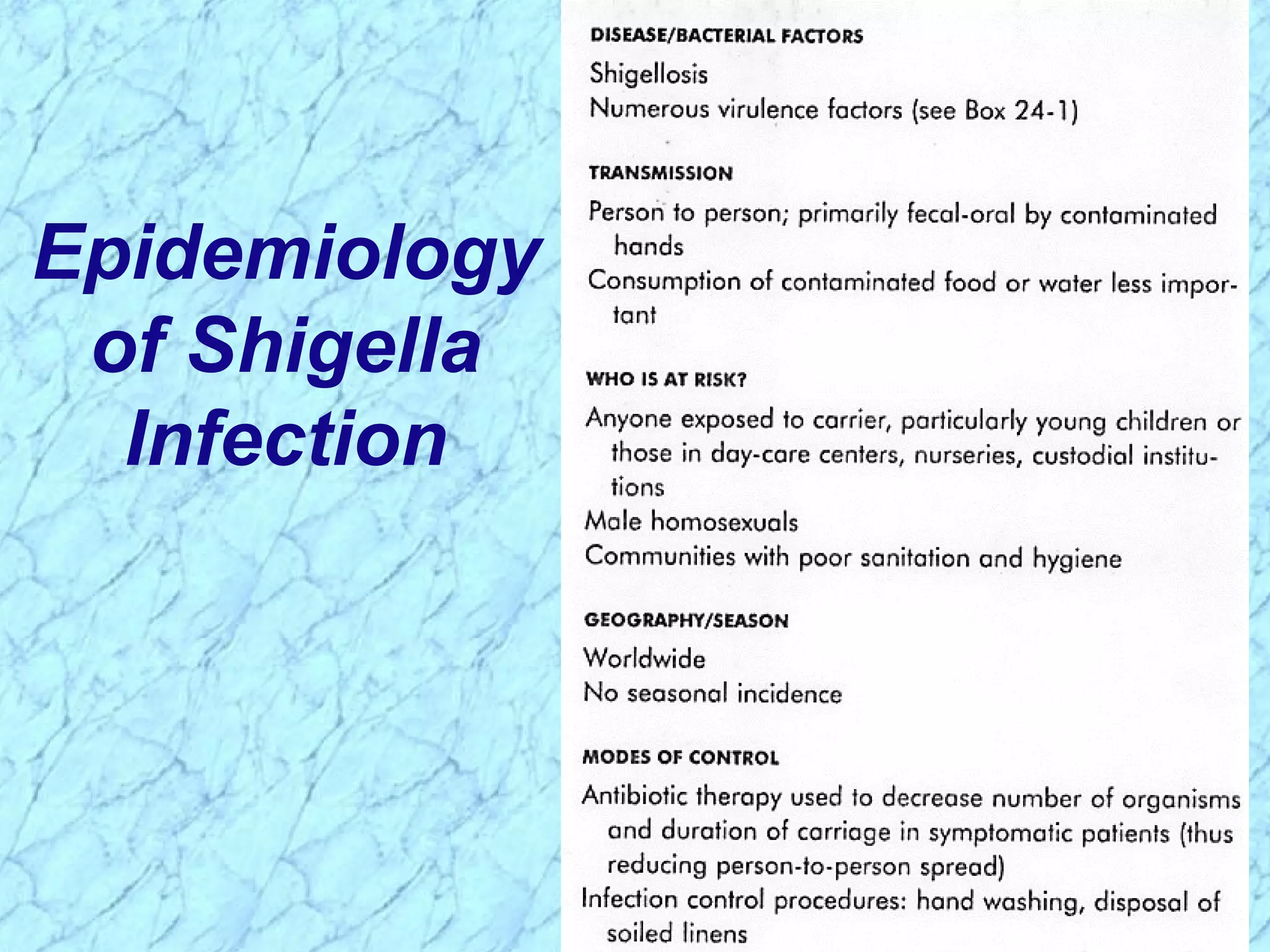
Epidemiology
of Shigella
Infection
Shigellosis
Two-stage disease:
 Early stage:
• Watery diarrhea attributed to the enterotoxic
activity of Shiga toxin following ingestion and
noninvasive colonization, multiplication, and
production of enterotoxin in the small intestine
• Fever attributed to neurotoxic activity of toxin
 Second stage:
• Adherence to and tissue invasion of large
intestine with typical symptoms of dysentery
• Cytotoxic activity of Shiga toxin increases
severity
Pathogenesis of ShigellaPathogenesis of Shigella
Pathogenesis and Virulence FactorsPathogenesis and Virulence Factors
Virulence attributable to:
 Invasiveness
• Attachment (adherence) and internalization
with complex genetic control
• Large multi-gene virulence plasmid regulated by
multiple chromosomal genes
 Exotoxin (Shiga toxin)
 Intracellular survival & multiplication
 Penetrate through mucosal surface of colon
(colonic mucosa) and invade and multiply in the
colonic epithelium but do not typically invade
beyond the epithelium into the lamina propria (thin
layer of fibrous connective tissue immediately beneath the
surface epithelium of mucous membranes)
 Preferentially attach to and invade into M cells in
Peyer’s patches (lymphoid tissue, i.e., lymphatic system)
of small intestine
Invasiveness in Shigella-Associated Dysentery
Pathogenesis and Virulence FactorsPathogenesis and Virulence Factors
 M cells typically transport foreign antigens from
the intestine to underlying macrophages, but
Shigella can lyse the phagocytic vacuole
(phagosome) and replicate in the cytoplasm
• Note: This contrasts with Salmonella which
multiplies in the phagocytic vacuole
 Actin filaments propel the bacteria through the
cytoplasm and into adjacent epithelial cells with
cell-to-cell passage, thereby effectively avoiding
antibody-mediated humoral immunity (similar
to Listeria monocytogenes)
Pathogenesis and Virulence FactorsPathogenesis and Virulence Factors
Invasiveness in Shigella-Associated Dysentery(cont.)
Methods That CircumventMethods That Circumvent
Phagocytic KillingPhagocytic Killing
See Chpt. 19
, Shigella spp.
Shigella spp.
,
 Enterotoxic, neurotoxic and cytotoxic
 Encoded by chromosomal genes
 Two domain (A-5B) structure
 Similar to the Shiga-like toxin of
enterohemorrhagic E. coli (EHEC)
• NOTE: except that Shiga-like toxin is encoded by
lysogenic bacteriophage
Pathogenesis and Virulence FactorsPathogenesis and Virulence Factors
Characteristics of Shiga Toxin
Shiga Toxin Effects in Shigellosis
Enterotoxic Effect:
 Adheres to small intestine receptors
 Blocks absorption (uptake) of electrolytes,
glucose, and amino acids from the intestinal
lumen
• Note: This contrasts with the effects of cholera toxin
(Vibrio cholerae) and labile toxin (LT) of
enterotoxigenic E. coli (ETEC) which act by blocking
absorption of Na+
, but also cause hypersecretion
of water and ions of Cl-
, K+
(low potassium =
hypokalemia), and HCO3
-
(loss of bicarbonate
buffering capacity leads to metabolic acidosis) out of
the intestine and into the lumen
Pathogenesis and Virulence FactorsPathogenesis and Virulence Factors
Cytotoxic Effect:
 B subunit of Shiga toxin binds host cell glycolipid
 A domain is internalized via receptor-mediated
endocytosis (coated pits)
 Causes irreversible inactivation of the 60S
ribosomal subunit, thereby causing:
• Inhibition of protein synthesis
• Cell death
• Microvasculature damage to the intestine
• Hemorrhage (blood & fecal leukocytes in
stool)
Neurotoxic Effect: Fever, abdominal cramping are
Shiga Toxin Effects in Shigellosis (cont.)
Pathogenesis and Virulence FactorsPathogenesis and Virulence Factors
Heparin-binding epidermal growth
factor on heart & nerve surfaces
Lab diagnosticLab diagnostic
• Specimens: fecal leucocytes and rbc seen
microscopically
• Culture: material streaked on differential
selective media
• Serology: not used to dianose shigella
infection
Culture medium
ImmunityImmunity
• Infection followed by antibody response
• Injection of kiled shigella stimulate the
production ofnantibodies in serum, but fails to
protect human body against infection
• Ig Aantibody in gut in important
• Serum antibody to somatic shigella antigens
are Ig M
ControlControl
• Sanitary control of water, food and milk;
sewage disposal; and fly control
• Isolation of patient and disinfection of excreta
• Detection of sub clinical cases and carrier,
particularly food handlers; and;
• Antibiotic treatment of infected individuals
Shigella

Shigella

  • 1.
  • 2.
     Coliform bacilli(enteric rods)  Nonmotile gram-negative facultative anaerobes  Four species •Shigella sonnei (most common in industrial world) •Shigella flexneri (most common in developing countries) •Shigella boydii •Shigella dysenteriae  Non-lactose fermenting  Resistant to bile salts General Characteristics of ShigellaGeneral Characteristics of Shigella
  • 3.
    Shigellosis = Genericterm for disease  Low infectious dose (102 -104 CFU)  Humans are only reservoir  Transmission by fecal-oral route  Incubation period = 1-3 days  Watery diarrhea with fever; changing to dysentery  Major cause of bacillary dysentery (severe 2nd stage) in pediatric age group (1-10 yrs) via fecal-oral route  Outbreaks in daycare centers, nurseries, institutions  Estimated 15% of pediatric diarrhea in U.S.  Leading cause of infant diarrhea and mortality (death) in developing countries Epidemiology and ClinicalEpidemiology and Clinical Syndromes of ShigellaSyndromes of Shigella
  • 4.
    DEFINITIONS  Enterotoxin =an exotoxin with enteric activity, i.e., affects the intestinal tract  Dysentery = inflammation of intestines (especially the colon (colitis) of the large intestine) with accompanying severe abdominal cramps, tenesmus (straining to defecate), and frequent, low- volume stools containing blood, mucus, and fecal leukocytes (PMN’s)  Bacillary dysentery = dysentery caused by bacterial infection with invasion of host cells/tissues and/or production of exotoxins
  • 5.
  • 6.
    Shigellosis Two-stage disease:  Earlystage: • Watery diarrhea attributed to the enterotoxic activity of Shiga toxin following ingestion and noninvasive colonization, multiplication, and production of enterotoxin in the small intestine • Fever attributed to neurotoxic activity of toxin  Second stage: • Adherence to and tissue invasion of large intestine with typical symptoms of dysentery • Cytotoxic activity of Shiga toxin increases severity Pathogenesis of ShigellaPathogenesis of Shigella
  • 7.
    Pathogenesis and VirulenceFactorsPathogenesis and Virulence Factors Virulence attributable to:  Invasiveness • Attachment (adherence) and internalization with complex genetic control • Large multi-gene virulence plasmid regulated by multiple chromosomal genes  Exotoxin (Shiga toxin)  Intracellular survival & multiplication
  • 8.
     Penetrate throughmucosal surface of colon (colonic mucosa) and invade and multiply in the colonic epithelium but do not typically invade beyond the epithelium into the lamina propria (thin layer of fibrous connective tissue immediately beneath the surface epithelium of mucous membranes)  Preferentially attach to and invade into M cells in Peyer’s patches (lymphoid tissue, i.e., lymphatic system) of small intestine Invasiveness in Shigella-Associated Dysentery Pathogenesis and Virulence FactorsPathogenesis and Virulence Factors
  • 9.
     M cellstypically transport foreign antigens from the intestine to underlying macrophages, but Shigella can lyse the phagocytic vacuole (phagosome) and replicate in the cytoplasm • Note: This contrasts with Salmonella which multiplies in the phagocytic vacuole  Actin filaments propel the bacteria through the cytoplasm and into adjacent epithelial cells with cell-to-cell passage, thereby effectively avoiding antibody-mediated humoral immunity (similar to Listeria monocytogenes) Pathogenesis and Virulence FactorsPathogenesis and Virulence Factors Invasiveness in Shigella-Associated Dysentery(cont.)
  • 11.
    Methods That CircumventMethodsThat Circumvent Phagocytic KillingPhagocytic Killing See Chpt. 19 , Shigella spp. Shigella spp. ,
  • 12.
     Enterotoxic, neurotoxicand cytotoxic  Encoded by chromosomal genes  Two domain (A-5B) structure  Similar to the Shiga-like toxin of enterohemorrhagic E. coli (EHEC) • NOTE: except that Shiga-like toxin is encoded by lysogenic bacteriophage Pathogenesis and Virulence FactorsPathogenesis and Virulence Factors Characteristics of Shiga Toxin
  • 13.
    Shiga Toxin Effectsin Shigellosis Enterotoxic Effect:  Adheres to small intestine receptors  Blocks absorption (uptake) of electrolytes, glucose, and amino acids from the intestinal lumen • Note: This contrasts with the effects of cholera toxin (Vibrio cholerae) and labile toxin (LT) of enterotoxigenic E. coli (ETEC) which act by blocking absorption of Na+ , but also cause hypersecretion of water and ions of Cl- , K+ (low potassium = hypokalemia), and HCO3 - (loss of bicarbonate buffering capacity leads to metabolic acidosis) out of the intestine and into the lumen Pathogenesis and Virulence FactorsPathogenesis and Virulence Factors
  • 14.
    Cytotoxic Effect:  Bsubunit of Shiga toxin binds host cell glycolipid  A domain is internalized via receptor-mediated endocytosis (coated pits)  Causes irreversible inactivation of the 60S ribosomal subunit, thereby causing: • Inhibition of protein synthesis • Cell death • Microvasculature damage to the intestine • Hemorrhage (blood & fecal leukocytes in stool) Neurotoxic Effect: Fever, abdominal cramping are Shiga Toxin Effects in Shigellosis (cont.) Pathogenesis and Virulence FactorsPathogenesis and Virulence Factors
  • 15.
    Heparin-binding epidermal growth factoron heart & nerve surfaces
  • 16.
    Lab diagnosticLab diagnostic •Specimens: fecal leucocytes and rbc seen microscopically • Culture: material streaked on differential selective media • Serology: not used to dianose shigella infection Culture medium
  • 17.
    ImmunityImmunity • Infection followedby antibody response • Injection of kiled shigella stimulate the production ofnantibodies in serum, but fails to protect human body against infection • Ig Aantibody in gut in important • Serum antibody to somatic shigella antigens are Ig M
  • 18.
    ControlControl • Sanitary controlof water, food and milk; sewage disposal; and fly control • Isolation of patient and disinfection of excreta • Detection of sub clinical cases and carrier, particularly food handlers; and; • Antibiotic treatment of infected individuals